
Imagine a living library where every plant tells a story—a story of survival, healing, and deep spiritual connection. This is the world of ethnobotanicals, a fascinating field that dives into the ancient, intricate relationship between people and plants. It’s where culture, history, and botany intersect.
What Are Ethnobotanicals? A Bridge Between People and Plants
At its core, an ethnobotanical is any plant that holds a specific purpose within a human culture. This covers an enormous range of plants used for everything you can think of: medicine, ritual, food, clothing, and even shelter. The study of these plants, known as ethnobotany, is a journey into how communities built incredibly sophisticated systems of knowledge simply by observing and living with the flora around them.
It’s best to think of ethnobotany less as a dry academic discipline and more as a living chronicle of human ingenuity. The field focuses on identifying which plant was used, and also uncovering the why and the how. This knowledge, often passed down through generations, is a form of deep wisdom encoded in traditions, stories, and ceremonies.
The Scope of Traditional Plant Knowledge
The world of ethnobotanicals is staggeringly diverse. This field includes exotic psychoactive plants hidden in remote jungles as well as countless everyday items that have shaped human life for millennia.
- Medicinal Plants: This is what most people think of first. It covers everything from the chamomile in your tea to the complex botanicals that form the very foundation of many modern pharmaceuticals.
- Ritual and Spiritual Plants: Certain plants, like Ayahuasca in the Amazon, are central to spiritual practices. They are used as tools to foster connection, healing, and profound insight.
- Food and Sustenance: For thousands of years, cultures have developed unique ways to cultivate, harvest, and prepare plants for nourishment, demonstrating a deep, practical understanding of local ecosystems.
- Functional Materials: Plants have always been our partners in creation. Think of natural dyes for textiles, strong fibers for rope and baskets, and sturdy wood for building homes.
This traditional knowledge is anything but a relic of the past. In fact, a staggering 75% of the world’s population still relies primarily on plants and plant extracts for their basic healthcare needs. This statistic alone highlights the enduring global relevance of ethnobotanicals, especially in regions where access to synthetic pharmaceuticals is limited or nonexistent. You can read more about the global use of medicinal plants in this comprehensive research.
“Ethnobotany is the study of how people of a particular culture and region make use of indigenous (native) plants. It is a field that seeks to understand the deep-seated wisdom that connects humanity to the botanical world.”
Ultimately, exploring ethnobotanicals is about learning to see plants not as passive organisms, but as active partners in the human story. Grasping this foundational idea is the key to appreciating the rich cultural context that gives plants like Ayahuasca their true power and significance.
The Ancient Roots of Our Partnership with Plants
The bond between people and plants is as old as humanity itself. Long before we had written history, our ancestors lived in lockstep with the natural world. They didn’t just see plants as food or building materials; through careful observation, trial and error, and a deep sense of intuition, they developed an incredible understanding of the flora around them. This was more than just survival—it was the very foundation of their healing practices and spiritual lives.
Whether in the Amazon rainforest or the high peaks of the Himalayas, cultures everywhere have leaned on the plant kingdom for support. This intimate knowledge, passed down from one generation to the next through stories and apprenticeships, became the bedrock of some of the world’s most sophisticated and enduring systems of medicine.
The Great Traditions of Plant Medicine
These ancient healing systems weren’t just a random collection of herbal recipes. They were intricate frameworks built on a holistic understanding of how plants interact with the human body, mind, and spirit. Mastering them often took a lifetime of dedicated study, and they represent the living history of ethnobotanicals.
- Ayurveda: Born in India more than 3,000 years ago, Ayurveda—which translates to “The Science of Life”—uses powerful plants like Ashwagandha and Turmeric. The goal is to bring the body’s fundamental life forces, or doshas, back into balance. Its principles are still a vital part of wellness for millions today.
- Traditional Chinese Medicine (TCM): With equally ancient roots, TCM relies on a massive catalog of botanicals, including famous plants like Ginseng and Goji berry. The core idea is to restore the smooth flow of qi, or vital energy, through the body’s pathways.
- Indigenous Shamanism: This is a global phenomenon, where plants are often seen as conscious, intelligent allies. In the Amazon, for instance, shamans enter into a relationship with plant spirits during ceremonies, using sacred brews like Ayahuasca to gain insight and heal all kinds of ailments.
What these traditions share is a different way of knowing—one grounded in direct experience and a sense of kinship with the natural world. They truly set the stage for how we approach plant medicine today.
From Folklore to Formal Study
For a long time, this deep plant wisdom was mainly recorded in the diaries of explorers, missionaries, and colonial botanists. These accounts were certainly valuable, but they were almost always filtered through an outsider’s perspective, often missing the rich cultural context behind the practices. The formal discipline of ethnobotany eventually came about to close that gap and treat this knowledge with the respect it deserves.
The term ethnobotany was officially coined back in the late 19th century, originally defined as the study of plants used by “primitive and aboriginal people.” Thankfully, the field has come a long way since then. Today’s ethnobotanists strive to work as true partners with Indigenous communities, acknowledging them as the rightful guardians of this priceless wisdom.
“This evolution points to a critical truth: ethnobotanical knowledge isn’t some dusty relic to be cataloged in a museum. It is a living, breathing tradition that holds powerful lessons for the problems we face right now—from finding new medicines to healing our own fractured relationship with the planet.”
This heritage is both tough and delicate. With both ecosystems and traditional cultures under immense pressure, protecting these ancient plant-human partnerships is more urgent than ever. It’s about honoring the lineage of healers who first learned to listen to what the plants have to teach us and making sure their voices can still be heard.
A Few Key Ethnobotanicals From Around the World
The world of ethnobotanicals is a vibrant, living tapestry. For every plant that makes headlines, there are thousands of others quietly woven into the daily lives of communities across the globe. These ancient partnerships between people and plants are about more than just medicine; they speak to a universal human need to connect with nature for healing, ceremony, and community.
Let’s take a quick trip around the world to meet a few of these remarkable plants. This is just a glimpse, but it shows how wildly different their roles can be—from sacred spiritual guides to gentle social lubricants.
Kava: A Pacific Tradition of Connection
Picture the sun-drenched islands of the Pacific, from Fiji to Hawaii. Here, Kava (Piper methysticum) is the anchor of social and ceremonial life. It’s prepared by grounding the plant’s root and mixing it with water, creating an earthy drink that brings on a state of calm, relaxed sociability without fogging the mind. For centuries, it has been the go-to for welcoming guests, settling disputes, and simply strengthening the bonds between people.
Kava ceremonies are deeply respected rituals. The whole point is connection and open-hearted communication, which is why it’s a cornerstone of diplomacy and social harmony. In a world that seems to be moving faster every day, the Kava tradition offers a powerful lesson in slowing down and being truly present with one another.
Ashwagandha: India’s Ancient Adaptogen
Travel to India, and you’ll encounter Ashwagandha (Withania somnifera), a plant that has been a giant in Ayurvedic medicine for more than 3,000 years. Its Sanskrit name means “smell of the horse,” a nod to its traditional use for building strength and vitality. Unlike plants known for intense, immediate effects, Ashwagandha is an adaptogen—a remarkable substance that helps the body gently adapt to stress and find its equilibrium.
It’s traditionally turned to for a wide range of needs:
- Easing stress and anxiety
- Boosting energy and fighting off fatigue
- Sharpening cognitive function and memory
- Supporting overall resilience
Today, Ashwagandha has found a global audience as a natural supplement for navigating the pressures of modern life. It’s a perfect example of how ancient plant wisdom can be profoundly relevant to our contemporary challenges.
“Ethnobotanicals are more than just plants with specific properties; they are cultural artifacts. Each one carries the history, values, and worldview of the people who first understood its purpose.”
San Pedro: The Heart-Opening Cactus of the Andes
High up in the Andes Mountains of Peru and Ecuador, the San Pedro cactus (Echinopsis pachanoi) has been revered as a sacred tool for at least 2,000 years. Indigenous cultures know it as Huachuma, and they honor it for its ability to open the heart and connect people to the natural world. Its active compound, mescaline, is known to foster profound feelings of empathy, emotional clarity, and spiritual insight.
Traditionally, a healer known as a curandero leads San Pedro ceremonies, which often take place at night. These are gentle yet powerful journeys of self-discovery, helping people dissolve emotional walls and see the world—and themselves—with far greater compassion. It’s often called a gentle teacher for good reason.
Ayahuasca: The Visionary Vine of the Amazon
Deep within the Amazon basin, Ayahuasca reigns as one of the most powerful and respected ethnobotanicals on the planet. This sacred brew isn’t from a single plant but is a brilliant combination of two: the Banisteriopsis caapi vine and the leaves of the Psychotria viridis shrub. This pairing is an incredible feat of indigenous pharmacology, unlocking a profound visionary state that’s used for deep healing and spiritual guidance.
For the indigenous peoples of the Amazon, Ayahuasca is nothing less than a master teacher and a diagnostic tool. Shamans drink it to see the spiritual roots of an illness, receive direct guidance from the plant world, and maintain the energetic balance of their communities. It is a central pillar of their entire cosmology.
To really see how these plants differ, it helps to put them side-by-side.
A Snapshot of Global Ethnobotanicals
This table gives a quick look at how these four plants compare, highlighting their unique origins and the roles they play within their native cultures.
| Plant Name | Region of Origin | Primary Traditional Use | Cultural Context |
|---|---|---|---|
| Ayahuasca | Amazon Rainforest | Spiritual Healing, Divination | Sacred ceremonies led by a shaman for profound insight and healing. |
| Kava | Pacific Islands | Social & Ceremonial Relaxation | A communal beverage to foster harmony, resolve conflicts, and welcome guests. |
| Ashwagandha | India | Stress Relief & Vitality | An adaptogenic tonic in Ayurveda used daily to build resilience and balance. |
| San Pedro | Andes Mountains | Emotional & Spiritual Healing | A heart-opening sacrament used in ceremonies for connection and self-discovery. |
This global tour barely scratches the surface, but it paints a clear picture of the incredible diversity of these plant-human relationships. From the social calm of a Kava circle to the deep inner work of an Ayahuasca ceremony, the plant kingdom offers a vast spectrum of support for almost every facet of the human experience.
Ayahuasca: A Deep Dive into the Sacred Amazonian Brew
In the vast world of ethnobotanicals, few plants command as much respect, awe, and curiosity as Ayahuasca. This sacred Amazonian brew is far more than just a psychoactive substance; it’s a profound tradition, a powerful tool for healing, and a gateway to realms of consciousness explored by indigenous cultures for millennia. It truly represents a pinnacle of indigenous botanical genius.
Ayahuasca is an ingenious combination of two distinct botanicals, a feat of traditional pharmacology that still amazes scientists today. The magic happens in the synergy between these two plants, which is what unlocks the brew’s uniquely powerful effects.
The Alchemical Combination
The secret to Ayahuasca lies in its specific recipe, which involves cooking two core ingredients together for many hours:
- The Banisteriopsis caapi vine: Often called the “vine of the soul,” this is the very spirit of Ayahuasca. It contains a class of compounds known as MAO-inhibitors, which are essential for the brew to work.
- The leaves of Psychotria viridis: Known as chacruna, these leaves hold the powerful visionary compound DMT (N,N-dimethyltryptamine).
Here’s the brilliant part. If you were to consume DMT on its own, enzymes in your digestive system would break it down before it could ever reach your brain. The genius of the Ayahuasca recipe is that the MAO-inhibitors from the B. caapi vine temporarily hit pause on those enzymes. This allows the DMT to become orally active, producing its signature, profound effects. Understanding this intricate dance is key to appreciating the depth of indigenous knowledge. You can explore the rich history and traditions further by reading about the origins of Ayahuasca.
The chart below helps place unique ethnobotanicals like Ayahuasca into the broader global context of plant wisdom.
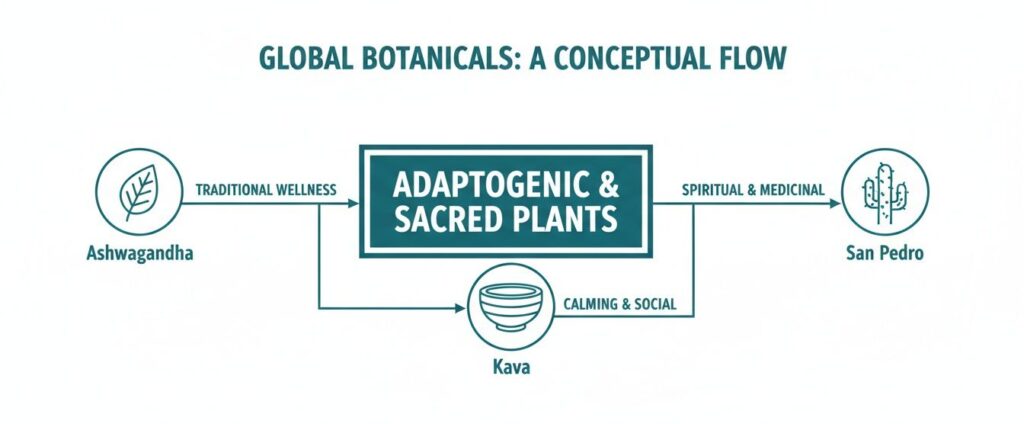
As you can see, different cultures have cultivated deep relationships with key plants, from adaptogens like Ashwagandha to ceremonial aids like Kava and San Pedro, with each serving a distinct purpose.
The Sacred Role in Amazonian Cultures
For the indigenous peoples of the Amazon basin, Ayahuasca is not a recreational drug. It is a sacred medicine, a master teacher, and a diagnostic tool that sits at the very heart of their communities and their understanding of the cosmos.
In these traditions, the brew is always used under the careful guidance of a shaman, or curandero, who has dedicated years to rigorous training and apprenticeship. An Ayahuasca ceremony can serve many purposes: it’s a tool for healing physical ailments, resolving conflicts within the community, and seeking direct spiritual guidance from the plant spirits. Shamans use it to perceive the energetic or spiritual root of an illness, allowing for a much deeper form of healing that addresses the entire person.
“In its traditional context, Ayahuasca is a pillar of the community. It is used to maintain social harmony, connect with the wisdom of the ancestors, and ensure the well-being of both the people and the forest they call home.”
The Modern Quest for Healing and Growth
Over the last few decades, Ayahuasca has traveled far beyond the Amazon, attracting seekers from every corner of the globe. Many people are drawn to it not out of idle curiosity, but from a deep need for healing that modern Western medicine and therapy have failed to address.
More and more, individuals are turning to Ayahuasca to work through deep-seated trauma, find relief from persistent depression and anxiety, and finally break free from the grips of addiction. The experience can catalyze a profound shift in perspective, allowing people to confront painful memories and emotions from a place of greater clarity and self-compassion.
This modern adoption really highlights a growing recognition that true wellness includes more than just physical health—it requires emotional and spiritual nourishment, too.
The Importance of Set, Setting, and Guidance
Working with a medicine as powerful as Ayahuasca demands immense respect and careful preparation. The outcome of the experience is profoundly shaped by three critical factors:
- Set (Your Mindset): This is all about your internal state and intentions heading into the ceremony. A clear, humble, and sincere intention for healing or self-discovery creates a powerful container for the journey ahead.
- Setting (The Environment): The physical and energetic space is crucial. A safe, supportive, and respectful environment, free from distractions, is what allows you to surrender to the process without fear.
- Guidance (The Facilitator): The presence of a skilled, ethical, and experienced guide is non-negotiable. A true facilitator knows how to hold space, help navigate challenging moments, and ensure the physical and psychological safety of every single participant.
Because of this, choosing a vetted, authentic, and reputable retreat is absolutely essential. A properly managed ceremony is a sacred container for profound healing. A poorly run one can be confusing at best and deeply harmful at worst. Your first and most important step on this path is always careful research and discernment.
Where Ancient Wisdom Meets Modern Science
Exploring ethnobotanicals today means walking a line between ancient tradition and modern scrutiny. As powerful plants like Ayahuasca and psilocybin mushrooms step into the global spotlight, science is finally starting to catch up to what indigenous cultures have known for centuries: these plants can be profound tools for healing.
This intersection is exciting, but it also demands a clear head and a responsible approach. The worlds of science, law, and personal safety are incredibly complex and always in motion. For anyone considering this path, understanding these dynamics is essential.
The Scientific View of Traditional Plants
In recent years, the tide has turned. Top-tier institutions are now conducting rigorous studies on psychoactive plants, looking for answers to mental health conditions that have stumped conventional medicine.
The early results are nothing short of remarkable. Research on psilocybin, the active compound in “magic” mushrooms, has shown it can bring incredible relief for treatment-resistant depression and the anxiety people face at the end of life. In the same vein, studies on Ayahuasca point to its power in helping people process deep-seated trauma and overcome conditions like PTSD.
These plants aren’t being looked at as miracle cures, but as catalysts. When used in a safe, structured setting, they can open the door to deep psychological and emotional work.
“A lot of this research points to one key mechanism: neuroplasticity. Many of these plants seem to help the brain become more flexible and form new connections, allowing people to break free from the rigid, negative thought patterns that hold them back.”
Unpacking the Legal Maze
The legal status of ethnobotanicals is a tangled web. It can change dramatically from one country to the next, and sometimes even from one state to another. A plant that’s considered sacred and legal in the Amazon might be a highly controlled substance just across the border.
It’s a confusing landscape, so it helps to know the key terms:
- Decriminalization vs. Legalization: These aren’t the same thing. Decriminalization usually means you won’t face criminal charges for possessing small amounts. Legalization, on the other hand, allows for regulated production and sale.
- Religious Freedom: In places like Brazil and even parts of the U.S., some religious groups have won the legal right to use Ayahuasca as a core part of their ceremonies.
- Global Hotspots: Countries like Peru and Costa Rica are well-known for their more open approach, which has allowed a thriving retreat culture to develop. Many other nations, however, have strict prohibitions in place.
Because the laws are always shifting, doing your own research is non-negotiable. You have to know the specific regulations for your location before you even consider moving forward.
Your Safety Comes First, Always
Beyond the science and the legalities, nothing is more important than your personal safety. The sheer power of these plants demands respect and careful preparation. A safe journey is something you build through proper screening, education, and experienced guidance.
First and foremost, a comprehensive medical screening is an absolute must. If you have certain pre-existing conditions, especially involving your heart or psychiatric history, the risks can be severe. It’s also crucial to understand that many ethnobotanicals can interact dangerously with prescription medications, particularly SSRIs and other antidepressants.
This is often because of compounds like MAOIs found in the Ayahuasca brew, which can trigger life-threatening reactions when mixed with certain foods and drugs. For a deeper dive, review this essential guide on foods and meds to avoid with MAOIs.
This need for caution is a global issue. For example, one survey in South Africa found that 29% of medicines people were using were not prescribed, showing just how common it is for people to self-medicate with traditional plants. You can read more about the ethnobotanical use in South Africa and its broader implications. At the end of the day, your journey begins with making a safe, informed, and responsible decision.
How to Engage with Ethnobotanicals Ethically
As more and more people become curious about ethnobotanicals, a shadow of complex ethical questions follows. Stepping into this world is an entry into a delicate ecosystem of culture, environment, and economics. The single most important first step is to approach it with a deep sense of humility and respect.
The explosion in demand for plants like Ayahuasca, for example, has created some very real challenges. One of the most glaring issues is cultural appropriation—the act of lifting sacred practices out of their original context without honoring their roots. This doesn’t just dilute their meaning; it disrespects the very cultures that have stewarded this knowledge for generations.
Just as troubling is the ecological strain. When plants are over-harvested to meet global demand, it threatens their very existence in the wild. This ripple effect disrupts both the local environment and the communities who rely on these plants for their livelihood and traditions.
Practicing Conscious Engagement
If we want to participate ethically, we have to shift our mindset from being a consumer to being a conscious participant. It means asking tough questions and choosing to support practices that honor the source of these traditions. The guiding principle here is reciprocity—the simple, powerful act of giving back to the cultures and ecosystems offering this wisdom.
When you’re looking into a practitioner or a retreat center, search for clear signs of their ethical commitments:
- Indigenous Leadership and Involvement: Does the center have genuine, respectful relationships with indigenous communities? Are local people employed in meaningful roles, and are they paid fairly?
- Ecological Sustainability: Don’t be shy about asking where their plants come from. Do they grow their own or partner with sustainable sources to prevent wiping out wild populations?
- Fair-Trade Principles: Make sure a real portion of the profits goes back into the local community to support things like schools, healthcare, or conservation efforts.
These aren’t just Amazon-specific issues. Take British Columbia, Canada, for example, where over 200 different botanical species are harvested from public forests. This practice supports both the local economy and long-held indigenous knowledge. You can learn more about how these non-timber forest products are managed.
“Reciprocity is the recognition that we are in a relationship with these plants and the cultures that steward them. It is the understanding that when we receive a gift of healing, we have a responsibility to give something back.”
Choosing Your Path with Intention
At the end of the day, being an ethical participant means being a discerning one. It requires you to look past the slick marketing and find operations that are truly authentic and transparent. Your choices matter. Supporting retreats that put profit over people can make you part of the problem.
So, before you commit, do your homework. Read reviews, talk to people who have been there, and never hesitate to ask direct questions about a center’s ethical framework. Getting a handle on the delicate balance between profit and reciprocity in the Amazon is a great place to start. When you walk this path with awareness, you can ensure your personal healing journey also supports the well-being of the cultures and ecosystems that make it all possible.
Ethnobotanicals: Your Questions Answered
Let’s wrap up with some of the most common questions that come up when people first start digging into the fascinating world of ethnobotanicals.
Are All Ethnobotanicals Psychoactive?
Absolutely not. This is probably the biggest myth out there. The term ethnobotanicals is incredibly broad—it covers any plant that people have found a meaningful use for. This includes everything from the food we eat and the clothes we wear to the medicines that heal us.
Psychoactive plants, which are sometimes called entheogens, are just one tiny, albeit famous, sliver of this massive category. It helps to remember that common kitchen herbs like turmeric and chamomile are ethnobotanicals, too. They just happen to be on a completely different shelf than plants used for spiritual ceremonies.
How Can I Find a Safe Ayahuasca Retreat?
When it comes to something like Ayahuasca, your safety is everything. Finding a retreat that is responsible, ethical, and well-run isn’t something to rush. It takes real due diligence.
If you’re considering this path, here’s what to look for in a center:
- They must have a detailed medical screening process you have to pass before they’ll even consider accepting you.
- The facilitators should be experienced, well-regarded, and transparent about their training and lineage.
- Ceremony groups should be kept small. This ensures you get the individual attention and support you might need.
- They should offer robust support for both preparing for the experience and, just as importantly, integrating it afterward.
There are reputable organizations that vet retreats for safety, integrity, and respect for the tradition. Take your time with this step.
“The most important decision you make on this journey is choosing your guides. A well-held space is essential for a safe and meaningful experience, while a poorly run one can be dangerous.”
What Is the Difference Between Ethnobotany and Herbalism?
It’s easy to see why these two get confused, as they’re deeply connected. The simplest way to think about it is that they are two sides of the same coin: one is focused on study, the other on practice.
Ethnobotany is the academic field that studies the relationship between people and plants. An ethnobotanist is like a cultural historian, documenting how different societies have used their local plants for medicine, food, shelter, or ritual.
Herbalism, on the other hand, is the hands-on practice of using plants for healing. An herbalist is the practitioner who takes that knowledge—whether from science or tradition—and applies it directly to help people. Think of it as the researcher versus the clinician.
Disclaimer: The information provided on Ayahuasca.com is for educational purposes only and is not intended as medical advice, diagnosis, or treatment. Ayahuasca is a powerful traditional Amazonian medicine and may not be suitable for everyone. Always consult with a qualified healthcare professional before making decisions related to health, mental well-being, medications, or the use of Ayahuasca.