
Peyote, or Lophophora williamsii, is a small, spineless cactus known for its psychoactive compound, mescaline. For many Indigenous cultures, especially within the Native American Church, this isn’t a recreational drug—it’s a revered plant medicine sitting at the very heart of their spiritual traditions.
Exploring the World of the Sacred Peyote Cactus
To truly understand peyote, you have to look beyond simple definitions. You’re stepping into a space where botany, chemistry, spirituality, and ancient culture are all woven together. This humble, button-like cactus, native to the deserts of northern Mexico and southwestern Texas, is held in profound reverence by the peoples who have stewarded it for millennia. It’s a sacrament, a teacher, and a powerful medicine that can open doors to deep healing and connection.
The psychoactive engine of the peyote cactus is mescaline, an alkaloid that engages with the brain’s serotonin receptors. This is what can trigger significant shifts in perception, thought, and emotion. But just focusing on the chemistry misses the point entirely. Within its traditional context, the experience is about the ceremony, the prayer, and the community that create the sacred space for its use.
A Tradition Thousands of Years Old
The relationship between people and this sacred cactus goes back an astonishingly long way. In fact, it’s one of the oldest spiritual practices involving a plant medicine that we have evidence for. Archaeological finds from Shumla Cave No. 5 in Texas show that Indigenous peoples were using peyote for spiritual and healing purposes more than 5,700 years ago.
This incredible history points to a continuous spiritual lineage, a line of knowledge passed down through generations despite immense change and hardship. It speaks volumes about the resilience of the cultures that have carried this tradition forward.
“Peyote is not merely consumed; it is communed with. Within the sacred circle of a ceremony, it acts as a spiritual conduit, a way to speak with the Creator, find guidance, and heal wounds that other medicines cannot touch.”
Today, the conversation around peyote is complex, touching on everything from religious freedom to conservation biology. While it’s often grouped with other powerful plant teachers like Ayahuasca, its cultural context, legal standing, and the ethical issues surrounding it are completely unique. For a deeper look at another sacred plant’s cultural history, you can explore our guide on what Indigenous groups traditionally use Ayahuasca.
Recognizing these differences is key to approaching the topic with the necessary respect and awareness. As we continue, we’ll dive into the botany, the ceremonies, and the urgent conservation challenges this sacred cactus faces today.
The Unique Biology and Chemistry of Peyote
At a glance, the peyote cactus, Lophophora williamsii, doesn’t look like much. It’s a small, spineless, button-like succulent that grows low to the ground in the Chihuahuan Desert, often no bigger than the palm of your hand. But this humble exterior hides a complex biology and a powerful chemistry that people have revered for thousands of years.
Unlike most plants, peyote has an incredibly slow life cycle. A single cactus might take up to 13 years just to mature and produce its first flower. This patient growth is a survival strategy, an adaptation to the harsh, dry climate of its home in northern Mexico and southwestern Texas, where it has perfected the art of conserving every drop of water and nutrient.
This concept map breaks down the core ideas surrounding this sacred cactus, from its deep historical roots to its unique scientific profile.
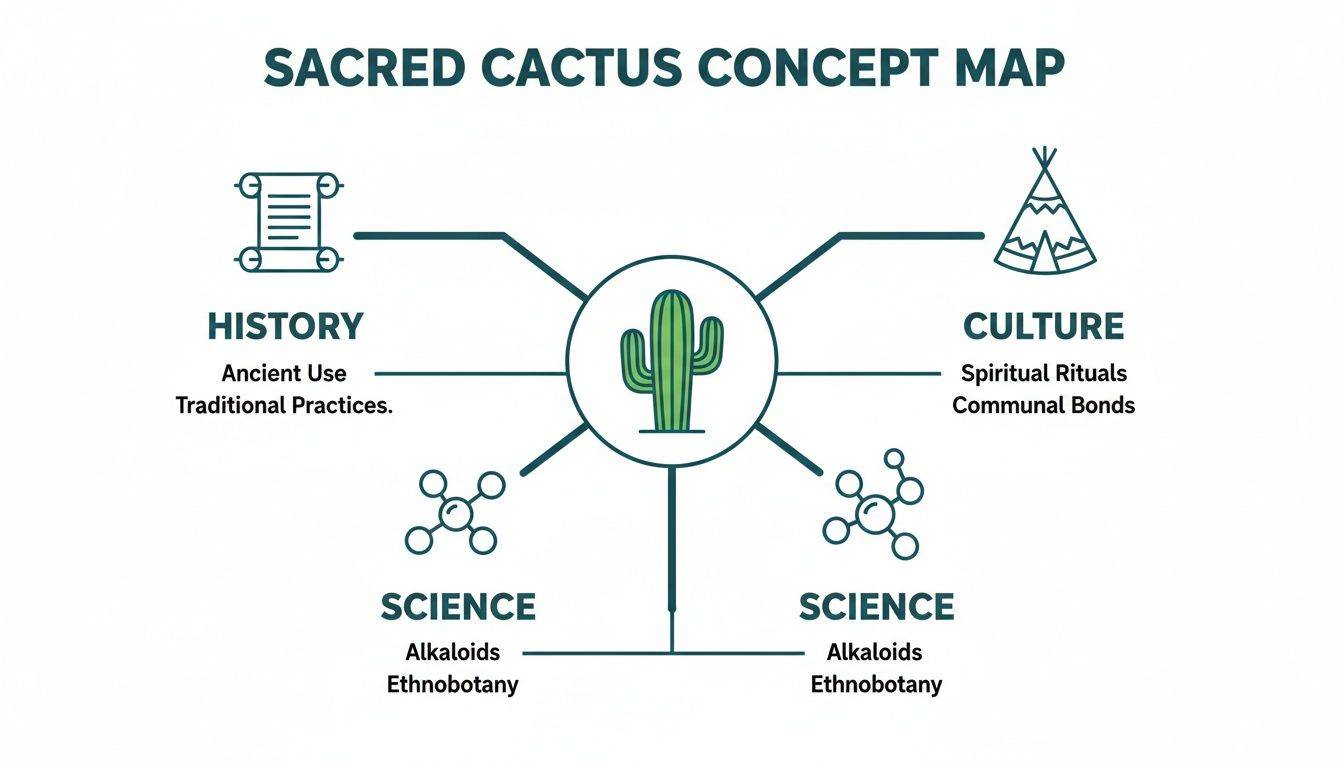
The map helps visualize how peyote’s cultural meaning, its long history with humans, and the science behind it are all deeply intertwined.
The Science Behind the Spirit
The powerful spiritual experiences peyote is known for are grounded in its unique chemistry. The cactus contains more than 50 different alkaloids, but the most famous one is mescaline—the main psychoactive compound that produces the profound shifts in consciousness, perception, and emotion central to the ceremony.
So, how does it work?
Mescaline’s molecular shape happens to be a very close match for some of our brain’s own chemical messengers, especially serotonin. You can think of your brain’s serotonin receptors as locks on the doors of perception. Mescaline acts like a special key that fits perfectly into one particular lock: the 5-HT2A receptor.
When mescaline clicks into these receptors, it opens up neurological pathways that aren’t normally active. This kicks off a cascade of effects:
- Altered Sensory Perception: Colors might appear intensely vivid, sounds can feel richer and more meaningful, and intricate patterns may emerge in your field of vision.
- Deep Introspection: The experience often feels like a journey inward, bringing old memories, deep-seated emotions, and personal insights to the surface for examination.
- A Sense of Connection: Many people describe a powerful feeling of unity—with nature, with others, and with a sense of the divine or the universe itself.
This is not a random event; it’s a specific chemical conversation that temporarily re-wires the brain’s normal operating system. The result is a deeply personal and often spiritually profound experience, turning a simple-looking cactus into a powerful catalyst for healing and self-discovery.
A Distinct Chemical Signature
It’s crucial to understand that while peyote is a powerful plant medicine, its effects are entirely its own. For instance, both peyote and the San Pedro cactus contain mescaline, but peyote’s other 50+ alkaloids create a completely unique experiential signature. These other compounds are thought to shape and color the mescaline journey, giving the peyote experience its distinct character.
This also sets it apart from other well-known plant medicines.
“While both are revered as sacred teachers, peyote’s mescaline-driven experience is chemically and phenomenologically different from the DMT-based journey facilitated by the Amazonian brew Ayahuasca.”
To truly grasp the place of peyote in the world, it helps to see how it stands alongside other sacred plants. This table offers a side-by-side look at peyote and Ayahuasca, two of the most significant plant medicines in the Americas.
Peyote and Ayahuasca A Comparative Overview
| Characteristic | Peyote | Ayahuasca |
|---|---|---|
| Origin | Chihuahuan Desert (Mexico, SW Texas) | Amazon Basin (South America) |
| Primary Alkaloid | Mescaline | N,N-DMT & Harmala alkaloids (MAOIs) |
| Plant Source | Lophophora williamsii cactus | A blend of two plants, typically Banisteriopsis caapi vine and Psychotria viridis leaves |
| Ceremonial Context | Often all-night ceremonies in a tipi, focused on prayer, song, and community healing (e.g., Native American Church) | Typically night ceremonies led by a shaman (ayahuasquero), involving icaros (sacred songs), purging, and intense visionary states |
| Typical Duration | 8-12 hours | 4-6 hours |
| Subjective Effects | Clarity, introspection, heart-opening, empathy, gentle visual patterns, feelings of connection | Intense, immersive visions; spiritual death/rebirth themes; emotional and physical purging (vomiting/diarrhea) is common and considered cleansing |
| Legal Status | Federally illegal in the US, with a specific religious exemption for members of the Native American Church | Legally complex; varies by country. In the US, some churches (like UDV and Santo Daime) have religious exemptions |
This comparison highlights that while both are used for deep healing and spiritual insight, their methods, effects, and cultural containers are profoundly different.
Understanding the biology of the peyote cactus—its slow growth, desert toughness, and complex alkaloid profile—is the foundation for everything else. It connects the physical plant to the powerful chemistry of mescaline, which in turn explains the deep spiritual experiences it can offer within a sacred ceremonial space.
Inside a Sacred Peyote Ceremony
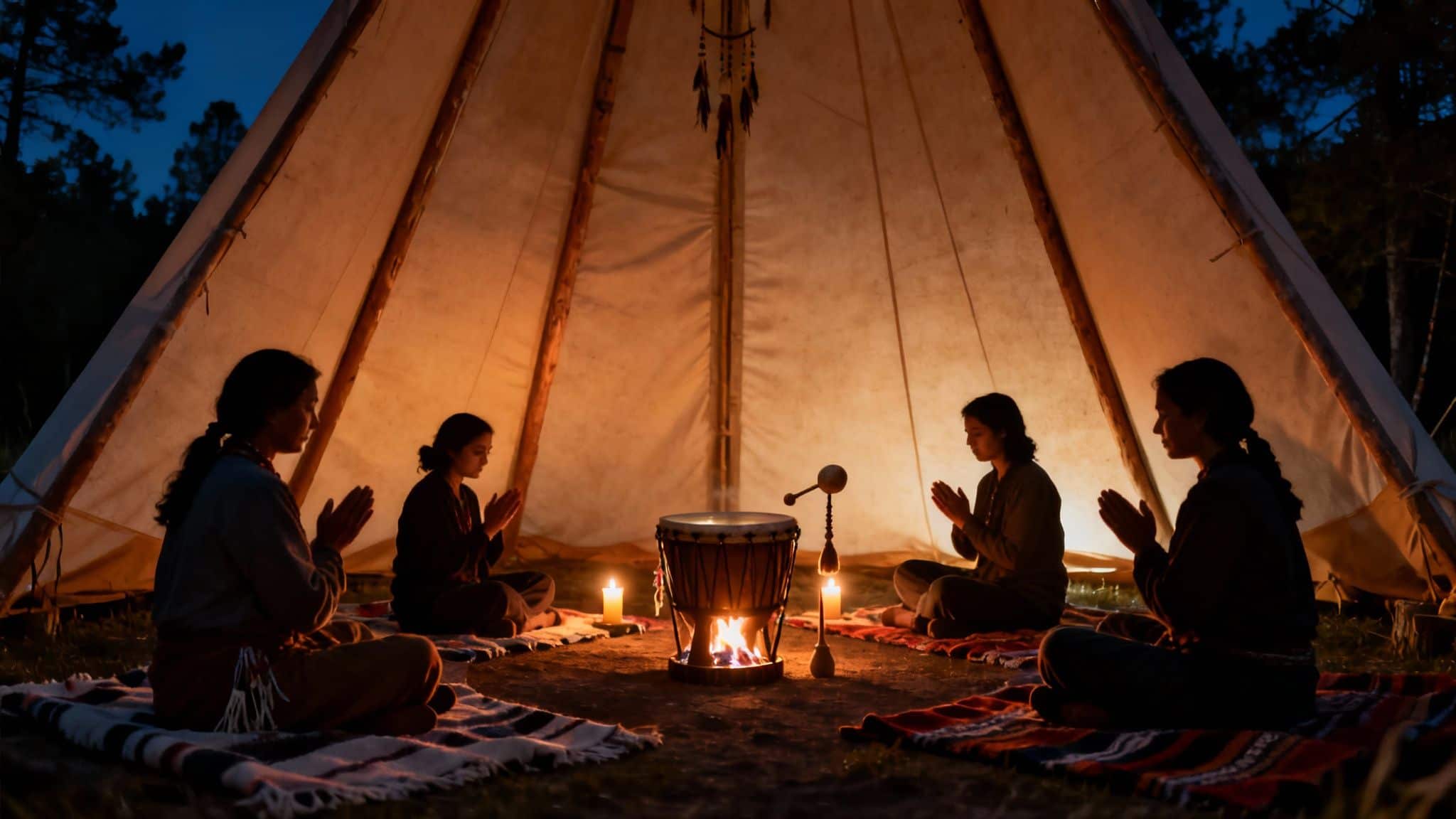
To truly grasp what peyote is, you have to understand its place at the heart of a living spiritual tradition. For members of the Native American Church (NAC), the cactus is a sacred sacrament, not a substance. It’s a divine messenger that opens a direct line of communication with the Creator.
A peyote ceremony is a deeply profound, all-night prayer meeting. It’s a sacred space where community, song, and spirit come together for healing and guidance.
The setting itself is steeped in symbolism. Typically, the ceremony is held inside a tipi, whose circular shape represents the universe and the unity of all life. At its center, a sacred fire burns through the night, meticulously tended as a symbol of the Great Spirit’s warmth and presence. The atmosphere is one of focused intention and deep reverence, as participants gather to pray for their families, their communities, and themselves.
The whole ceremony is a communal journey, led and protected by a “Roadman” who guides the prayers and songs, ensuring the space remains safe and sacred for everyone involved.
The Flow of a Peyote Meeting
A peyote meeting follows a rhythm that is both structured and wonderfully fluid, carrying participants from sunset all the way to sunrise. It’s a carefully orchestrated spiritual process, designed to quiet the mind and open the heart for prayer and deep introspection.
The night begins with prayers that set the intention for the work ahead. Then, the sacred peyote buttons are passed around the circle to be consumed with solemnity and respect. This sacrament is seen as a spiritual food, one that cleanses the body and spirit to prepare a person for divine guidance.
As the medicine begins to work, the ceremony unfolds through a cycle of songs. The Roadman leads these sung prayers, accompanied by the steady, heartbeat-like rhythm of a water drum and the soft shake of a rattle. Every person in the circle has the chance to sing, their voice joining a chorus that fills the tipi and carries their prayers skyward. For a look at another sacred plant medicine journey, you might find our article on the Ayahuasca experience insightful.
“The “Peyote Road” is more than a ceremony; it is a way of life. It teaches virtues of faith, hope, love, and charity, guiding followers on a path of sobriety, self-respect, and responsibility to one’s family and community.”
This journey through the night is woven with moments of profound silence, personal reflection, and shared prayer. Water is brought in with special rituals at midnight and again at dawn, marking key transitions and offering blessings to everyone present. As the sun rises, the ceremony concludes with a shared meal, grounding participants and celebrating the renewal of life.
The Native American Church and Its Enduring Legacy
The Native American Church is a powerful testament to peyote’s central role in modern Indigenous spirituality. The NAC has over 200,000 members across dozens of U.S. tribes and into Canada, all connected by these all-night prayer meetings where peyote is the divine sacrament.
The practice emerged between 1870 and 1885 as tribes were forcibly relocated to western reservations. There, through contact with southwestern groups, the use of peyote spread rapidly, eventually becoming the core ritual of the NAC, which was formally established in Oklahoma in 1918.
Creating this formal church was a critical move in a long, difficult legal fight for religious freedom. For decades, practitioners were persecuted, facing the constant threat of imprisonment for their spiritual beliefs.
That fight eventually led to major legal victories, most importantly the 1994 amendments to the American Indian Religious Freedom Act. This federal law now explicitly protects the right of NAC members to use, possess, and transport peyote for their religious ceremonies. It was a landmark achievement that finally acknowledged the profound spiritual significance of peyote, shielding a sacred tradition from being erased and ensuring it could be passed down to future generations.
The Spiritual and Psychological Effects of Peyote
A peyote journey is a profoundly personal experience, one that moves through the body to reach the mind and spirit. It’s a progression where physical feelings often act as a doorway to deeper psychological and spiritual territory. Knowing how this process typically unfolds can help you understand what a ceremony might actually feel like.
The journey usually starts with the body. Shortly after consuming the peyote buttons, many people go through a phase of physical adjustment. This can bring on waves of nausea or a need to purge, which is not seen as a bad side effect in a ceremonial context. Instead, it’s viewed as a vital physical and spiritual cleansing. The idea is that the body is purging what no longer serves it, making space for the deeper work that’s about to begin.
This initial stage has a crucial role to play. It’s a moment of surrender, a time to let go of physical control and prepare the spirit for what comes next. As these feelings start to settle, the focus naturally turns inward, and the journey transitions from a physical event to a psychological one.
Navigating the Inner Landscape
The real heart of the peyote experience is the journey into your own consciousness. This is where the cactus, held as a sacred teacher, starts to offer its lessons. The psychological effects are incredibly varied, but they often circle around themes of deep self-reflection, emotional healing, and finding a new sense of connection to the world.
One of the most common experiences is the appearance of vivid visions. These are not like random hallucinations of things that aren’t there. It’s more like intricate geometric patterns, brilliant colors, or deeply symbolic imagery that comes to life behind closed eyes. These visuals often feel like a language from the subconscious, delivering insights in a way that the logical mind can’t.
This visionary state frequently opens the door to powerful introspection. People might find themselves looking at key moments from their lives, re-examining relationships, or facing old beliefs and emotional habits head-on. It can feel like you’re having a direct conversation with your truest self, with the medicine acting as a gentle but firm guide.
“The peyote journey is about seeing reality with stunning clarity, not escaping from it. It strips away the noise of the everyday ego, offering a direct, felt experience of how interconnected everything is and your unique place within it all.”
This deep self-examination can trigger a major emotional release. Feelings you’ve pushed down or ignored for years can finally surface, ready to be acknowledged and integrated in a safe, held space. For countless people, this is a cornerstone of the healing that a peyote ceremony can offer.
Set and Setting: The Pillars of the Experience
The character and quality of any peyote journey are shaped almost entirely by two key factors: set and setting. This concept is a bedrock principle for responsible and safe work with any powerful plant medicine.
- Set (Mindset): This is all about your internal world—your thoughts, feelings, intentions, and how prepared you are mentally. Coming into a ceremony with a clear intention, a humble heart, and a genuine willingness to surrender to what comes is absolutely essential.
- Setting (Environment): This refers to the physical and social space where the journey happens. A traditional peyote ceremony is designed to create the ideal setting: a safe, contained space guided by a knowledgeable leader and supported by community, prayer, and sacred music.
Together, your set and setting form the container for the entire experience. A positive mindset in a supportive environment paves the way for a journey of profound healing and insight. On the flip side, a fearful mind or an unsafe environment can lead to a difficult and confusing time.
The Dissolution of Ego and Spiritual Connection
A theme that comes up again and again in peyote journeys is the experience of ego dissolution. This is the temporary quieting of that constant inner voice—the part of you that defines “I, me, and mine” and separates you from everything else. As this sense of being an isolated self begins to soften, an incredibly powerful feeling of unity often rushes in to take its place.
People describe this as a deep connection to nature, the universe, or a divine presence. The lines between yourself and the outside world blur, leaving you with a direct, undeniable feeling of being part of something much, much bigger. It is in this state that many report their most meaningful spiritual insights, feeling a profound sense of peace, love, and belonging that stays with them long after the ceremony is over.
Peyote Conservation and Ethical Responsibilities
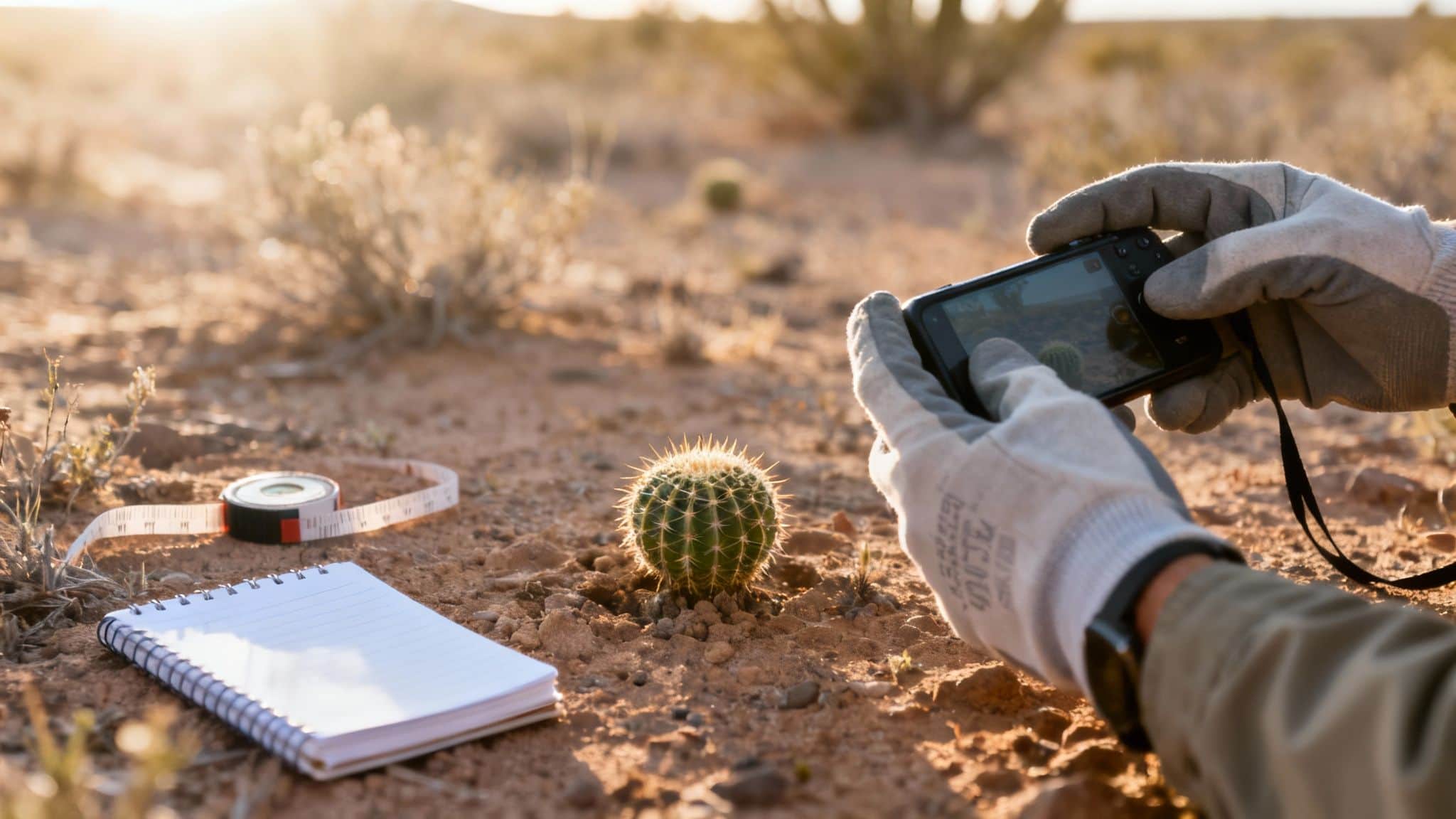
As we delve into the profound world of peyote, we inevitably arrive at a complex crossroads where law, ethics, and ecology meet. You can’t truly understand this sacred cactus without also grappling with the serious challenges it faces today. Recognizing these issues is a fundamental part of respecting the traditions that have stewarded this medicine for millennia.
The legal standing of peyote in the United States is quite unique and, frankly, often misunderstood. On a federal level, peyote is a Schedule I controlled substance, putting it in the same box as drugs considered to have a high potential for abuse and no accepted medical use. This classification makes its possession, use, or sale illegal for most people.
But there’s a crucial exception. The 1994 amendments to the American Indian Religious Freedom Act carved out a specific legal protection for the sacramental use of peyote. This protection is reserved for enrolled members of federally recognized tribes who belong to the Native American Church (NAC). This law was a hard-won victory for religious freedom, a recognition that for the NAC, peyote is a divine sacrament, not an illicit drug.
The Urgent Need for Peyote Conservation
This legal protection, while vital, doesn’t address a mounting ecological crisis. Wild peyote populations are shrinking, caught in a perfect storm of threats that endanger both the cactus and the spiritual traditions that rely on it. This problem is not far-off; it’s happening right now in its small native habitat.
The primary threats to peyote are threefold:
- Habitat Loss: The Chihuahuan Desert, peyote’s one and only native home, is being developed for agriculture, ranching, and oil and gas extraction. As this land gets cleared and transformed, the fragile ecosystem that supports the slow-growing cactus is simply wiped away.
- Improper Harvesting: There’s a right way and a wrong way to harvest peyote. To ensure it can regenerate, it must be carefully cut at its base, leaving the root intact. Uprooting the entire cactus kills it. Unskilled harvesting, often driven by poaching, permanently removes the plant from the landscape.
- Poaching and Black Market Demand: As interest in psychedelics grows, it has fueled a demand for peyote outside of its traditional ceremonial context. This illegal poaching places enormous pressure on already fragile populations and puts poachers in direct competition with the needs of the Native American Church.
“The slow growth of peyote—taking up to a decade or more to mature—means that every improperly harvested or poached cactus represents a loss that cannot be quickly replaced. The supply simply cannot keep up with the combined demand from both legal and illegal channels.”
This growing scarcity is a direct threat to the religious freedom of NAC members. As peyote becomes harder to find and more expensive, the ability of these Indigenous communities to continue their sacred ceremonies is put in jeopardy. This is where the conversation has to shift from conservation to our shared ethical responsibilities.
An Ethical Crossroads for Non-Indigenous Seekers
For those outside of Indigenous communities who are drawn to plant medicines for healing or spiritual exploration, the situation with peyote presents a clear ethical choice. At its heart, the issue is that any non-Indigenous use of peyote strains a very scarce resource—one that is legally and spiritually designated for a specific group of people whose cultural survival is tied to it.
Even with the best intentions, seeking a peyote experience as a non-native person contributes to the ecological damage and disregards the sovereignty of the Native American Church. The demand from the NAC alone is already difficult to meet with the available supply. Adding outside demand to that equation directly harms the availability of this sacrament for its traditional keepers.
In the spirit of reciprocity and respect, the most supportive action a non-Indigenous person can take is to step back. This means choosing not to seek out or consume peyote, allowing the remaining wild populations to be reserved for the religious and cultural continuation of the NAC. Exploring the principles of profit versus reciprocity in sacred plant economies can offer valuable perspective on these complex dynamics.
Despite its deep spiritual resonance, peyote use remains rare in the wider population. U.S. surveys show that only about 2% of people aged 12 or older have ever tried it, underscoring its ceremonial status over recreational appeal. You can discover more insights about these peyote usage statistics and their cultural implications. This context highlights the critical importance of protecting this limited resource for the communities at its heart.
Common Questions About Peyote, Answered
It’s natural to have questions when exploring a topic as complex as peyote. Let’s clear up some of the most common points about this sacred cactus, from its legal status to the ethics surrounding its use today.
Is Peyote the Same as San Pedro or Ayahuasca?
No, these are entirely distinct sacred medicines, each with its own unique history and chemistry.
While peyote and the San Pedro cactus both contain mescaline as their main psychoactive compound, they are different species of cacti from separate cultural traditions. Their experiences can also feel quite different due to their unique blend of other alkaloids.
Ayahuasca is in a completely different category. It’s a psychoactive brew from the Amazon, made by combining the Banisteriopsis caapi vine with leaves from the Psychotria viridis shrub. The active ingredient here is DMT, not mescaline. Think of them as revered teachers from different parts of the world—their origins, chemistry, and ceremonial use are not interchangeable.
Can I Legally Use Peyote for Personal Spiritual Growth?
In the United States, the answer is a clear no, unless you are a member of the Native American Church.
The legal use of peyote is exclusively reserved for members of the federally recognized Native American Church (NAC). A specific legal exemption allows them to use peyote as a central sacrament in their religious ceremonies. This protection does not extend to the general public for any reason, whether for personal, spiritual, or therapeutic exploration.
“The law recognizes that for the Native American Church, peyote is a sacrament essential to their religious freedom. This is not a loophole for general use; it’s a specific, hard-won right for a particular spiritual tradition.”
It’s a critical legal and ethical boundary to understand and respect.
Why Is It Unethical for Non-Indigenous People to Use Peyote?
This is a big one, and it boils down to two key issues: conservation and respect for Indigenous sovereignty.
Peyote is an incredibly slow-growing cactus that is now endangered. The wild populations in its small native habitat are already under immense pressure from habitat loss and poaching.
The existing demand from the Native American Church alone is straining the sustainable supply of this sacred medicine. When non-Indigenous people seek out peyote, they are directly competing for a dwindling resource, which threatens the religious freedom and cultural survival of the very communities who have stewarded this plant for thousands of years. The most ethical choice is to support them by not adding to that pressure.
Disclaimer: The information provided on Ayahuasca.com is for educational purposes only and is not intended as medical advice, diagnosis, or treatment. Ayahuasca is a powerful traditional Amazonian medicine and may not be suitable for everyone. Always consult with a qualified healthcare professional before making decisions related to health, mental well-being, medications, or the use of Ayahuasca.