
How does ayahuasca work? At its most basic level, it works through a partnership between two plants. One provides the psychoactive compound, and the other acts as its key, unlocking its potential so it can reach the brain.
This synergy is the secret behind the entire experience.
The Science Behind the Sacred Brew
The profound effects of Ayahuasca come down to a very specific chemical handshake.
The primary psychoactive ingredient is DMT (N,N-dimethyltryptamine), a compound that, on its own, is completely broken down by our digestive system before it can work its magic. Think of the enzymes in your gut as tiny bodyguards that immediately neutralize and escort DMT out of your system.
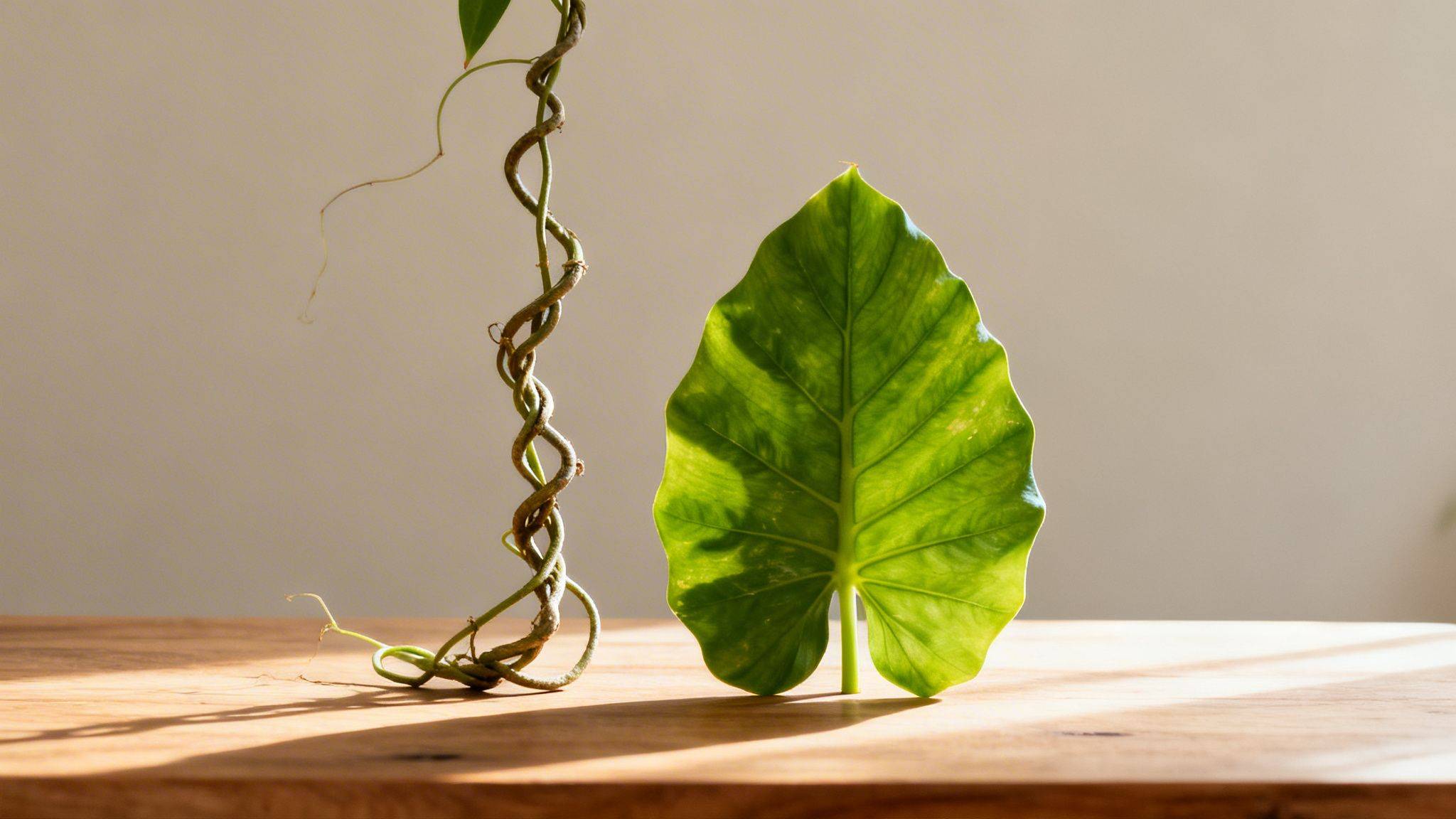
But this is where the second plant, the Banisteriopsis caapi vine, plays its crucial role.
A Powerful Plant Partnership
The B. caapi vine contains a special class of compounds called harmala alkaloids. These alkaloids act as MAO-inhibitors (MAOIs), temporarily telling those “bodyguard” enzymes to take a break.
This pause creates a critical window of opportunity. It allows the DMT from the other ingredient, the Psychotria viridis leaf, to slip past the gut’s defenses, get absorbed into the bloodstream, and travel to the brain.
This elegant teamwork makes drinking Ayahuasca effective. Without the vine’s MAO-inhibiting properties, the DMT would be rendered inert. This is a truly remarkable example of sophisticated indigenous botanical science.
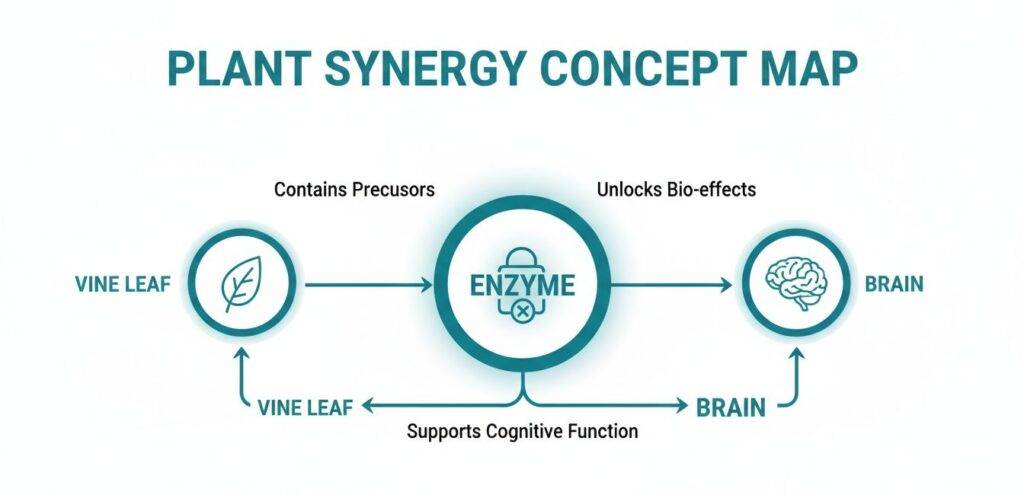
This synergy, the vine blocking the enzymes so the leaf’s compounds can work, is what underpins the entire process.
Once DMT reaches the brain, it primarily interacts with serotonin receptors, especially the 5-HT2A receptor. This specific receptor is a major player in our mood, what we perceive, and how we think. By activating these sites, DMT sets off a chain reaction in the brain that gives rise to the deeply visionary and introspective states Ayahuasca is known for.
Let’s break down this botanical duo into a simple table.
Ayahuasca’s Key Components and Their Roles
| Component | Plant Source | Primary Role |
|---|---|---|
| DMT (Psychoactive) | Psychotria viridis (Chacruna leaf) | Provides the visionary, consciousness-altering experience. |
| MAO-Inhibitors | Banisteriopsis caapi (Ayahuasca vine) | Pauses enzymes in the gut, making the DMT orally active. |
This two-part mechanism is what truly sets Ayahuasca apart from other psychedelics and is central to its long history of traditional and modern therapeutic use.
For those who want to dive even deeper into the chemistry, you can explore a more detailed review of Ayahuasca’s pharmacology.
Ayahuasca and Its Influence on Your Brain
So, we’ve seen the chemical handshake that makes Ayahuasca work. But what’s actually happening inside your head during the experience? This is where things get fascinating. The brew’s influence goes far beyond simple pharmacology, sparking profound shifts in brain activity that open the door to deep personal insights and lasting emotional change.
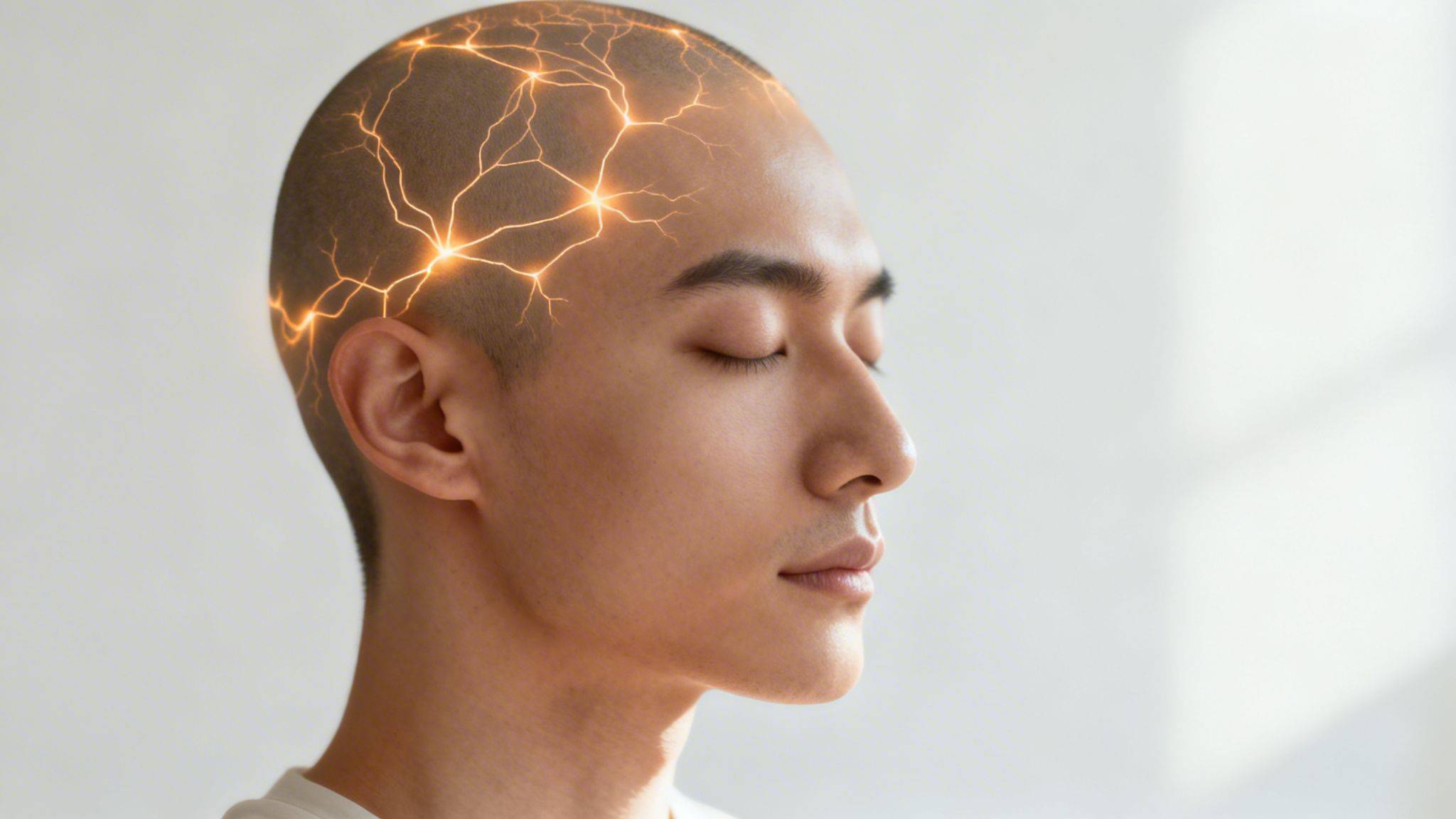
One of the most important things Ayahuasca does is turn down the volume on a specific network of brain regions: the Default Mode Network (DMN).
Quieting the Brain’s Storyteller
Think of the DMN as your brain’s autopilot. It’s the part that hums along when you’re daydreaming, ruminating about the past, or worrying about the future. This network is the home of your ego, the relentless narrator telling you the story of “you.”
Ayahuasca temporarily hushes this inner narrator. Imagine the DMN is a radio station that’s been stuck on the same channel your whole life, playing the greatest hits of your personal anxieties and old stories. Ayahuasca doesn’t break the radio; it just quiets it down, allowing you to hear all the other music and signals that were being drowned out.
By dampening the DMN’s activity, the rigid, habitual thought patterns that define us begin to soften. When the usual “story of me” fades into the background, a space opens up. It’s in this space that we can look at our lives with fresh eyes.
Rewiring Your Brain for New Growth
With the old guard temporarily off-duty, something incredible can happen: your brain starts building new connections. This is neuroplasticity in action, the brain’s fundamental ability to reorganize itself by forging new neural pathways.
Picture your thought patterns as well-worn trails in a dense forest. You walk them every day, so they’re deep and easy to follow, making it almost impossible to even consider another route. Ayahuasca is like a fresh, heavy snowfall that blankets the entire forest. The old trails are covered, giving you the freedom to create new ones.
This is a biological reality. Ayahuasca actively encourages this rewiring by boosting levels of a crucial protein called brain-derived neurotrophic factor (BDNF). It also engages the sigma-1 receptor (Sig-1R), which together helps your brain grow and strengthen new synaptic connections. This process is directly linked to the powerful antidepressant effects seen in clinical trials, where 60-80% of participants report significant relief. These changes can last for weeks, which helps explain how a single journey can have such a lasting impact. You can explore more on these remarkable therapeutic effects of Ayahuasca.
“By creating a biological environment ripe for new connections, Ayahuasca gives the brain a chance to fundamentally change how it operates. This process lays the scientific groundwork for the enduring shifts in mood and perspective that so many people describe.”
Connecting Emotional and Rational Centers
Another key change Ayahuasca brings about is a massive increase in communication between parts of the brain that don’t usually chat much. It acts like a bridge, strengthening the connection between the amygdala (your brain’s emotional hub and fear detector) and the prefrontal cortex (your center for logic, reason, and decision-making).
This enhanced dialogue allows for a powerful and unique form of emotional processing.
- Accessing Buried Memories: You might revisit past events or traumas, but with a sense of safety and objectivity that wasn’t possible before.
- Processing Emotions Safely: The experience allows you to process the feelings tied to those memories without being completely overwhelmed by them.
- Gaining New Insights: This fusion of emotion and reason lets you see your own history in a new light, often leading to profound healing and closure.
In essence, Ayahuasca allows you to be both the actor and the audience in the movie of your life, all at the same time. This dual perspective is an incredibly powerful tool for rewriting your own script. To dig deeper into the compounds that help make this possible, take a look at our guide on the unique properties of beta-carbolines.
Navigating Your Inner World During Ceremony
Knowing the science behind Ayahuasca is one thing. Actually navigating the deeply personal, psychological landscape it opens up is something else entirely. An Ayahuasca ceremony is a journey inward, an exploration of your own consciousness that often unfolds in distinct, yet deeply individual, phases.
Think of it as a dialogue with yourself, but on a level you may have never reached before.
The experience is a journey with a current and a flow. By getting familiar with the common terrain, you can relax into the process as it happens, which often leads to a more profound and meaningful journey.
The Visionary States
When people talk about Ayahuasca, they often start with the visions. These are far from simple hallucinations; they’re typically rich with personal meaning and symbolism, shifting in intensity and content as the experience progresses.
These visions can show up in a few common ways:
- Intricate Geometric Patterns: Often among the first visuals to appear, these can be kaleidoscopic, fractal-like patterns that pulse with light and color. Many describe it as feeling like they’re seeing the very architecture of reality.
- Meaningful Life Reviews: You might find yourself re-living pivotal moments from your past. What’s unique is the perspective. It’s often detached and compassionate, allowing you to see how these events shaped the person you are today.
- Encounters with Archetypes: The journey can also involve meeting figures or beings that feel deeply symbolic. These might represent parts of yourself, forces of nature, or universal concepts, often offering guidance or challenging your ingrained beliefs.
These visions are a core part of how Ayahuasca communicates. It uses a language of imagery and feeling that bypasses the rational mind and speaks directly to your subconscious.
Reframing The Purge
One of the most misunderstood aspects of the ceremony is the physical purge, known as la purga. While vomiting or nausea is common, seeing it as just a physical side effect completely misses the point. Within the ceremonial space, the purge is understood as a profound act of release.
It’s a physical manifestation of a deep psychological and emotional cleansing. Simply put, it’s your body’s way of getting rid of what no longer serves you.
“The purge is often felt as a release of old baggage, stored trauma, negative self-talk, and stuck emotional patterns. It’s a powerful clearing process that makes space for new growth, connecting mind and body in a direct, undeniable way.”
After a purge, many people report feeling lighter, cleaner, and unburdened. It’s a literal letting go of heavy energies you may have carried for years. Approaching it with this mindset can shift the experience from something to be feared into a welcome and essential part of the healing.
A Dialogue With Your Inner Self
At its heart, the Ayahuasca journey is a chance for a deep, honest conversation with yourself. The brew helps quiet the noise of the ego and the relentless mental chatter, opening a clear channel to your own inner wisdom and intuition.
This inner dialogue can take many forms. You may find yourself:
- Accessing Buried Memories: Events you long forgot might surface, not to re-traumatize, but to be finally understood and integrated.
- Feeling Suppressed Emotions: Emotions pushed down for years may finally rise to the surface to be felt and released within a safe container.
- Gaining New Perspectives: You might suddenly see a lifelong pattern of behavior or a difficult relationship from a completely new, compassionate angle.
This whole process is about reconnecting with parts of yourself that have been fragmented or ignored. Ayahuasca works by creating a state of heightened self-awareness where you can look at the contents of your own mind with real clarity and courage. This internal exploration is the very core of the journey and the foundation for lasting personal change.
The Importance of Ceremony and Intention
While we’ve dug into the fascinating science of what Ayahuasca does to the brain, it’s crucial to understand that the brew’s effects are never just a chemical reaction. The context surrounding the experience plays a massive role in shaping what unfolds. This is where the well-known concepts of “set” and “setting” come into play.
“Set” is all about your mindset, your intentions, your emotional state, and your psychological readiness heading into the journey. “Setting” refers to the physical and social environment where you take it. For Ayahuasca, the traditional setting is the ceremony.
Your Intention is Your Compass
Think of your intention as the personal reason you feel called to this experience. It’s the “why” that’s guiding you. This intention acts like a compass, helping you navigate the often intense and unpredictable inner landscape that Ayahuasca can open up.
Your intention might be a specific question you’re wrestling with, a difficult pattern you want to break, or a deep-seated wound you hope to heal. Setting a clear, heartfelt intention beforehand helps give the medicine’s work a direction.
“Having a clear intention is like giving your subconscious mind a destination. The process doesn’t guarantee you’ll get a specific answer, but it provides a focal point, helping to steer the journey toward meaningful insight.”
This is the “set” part of the equation. When you approach the ceremony with humility, respect, and a clear purpose, you prepare your mind to be receptive to whatever the medicine has to show you.
The Ceremony as a Safe Container
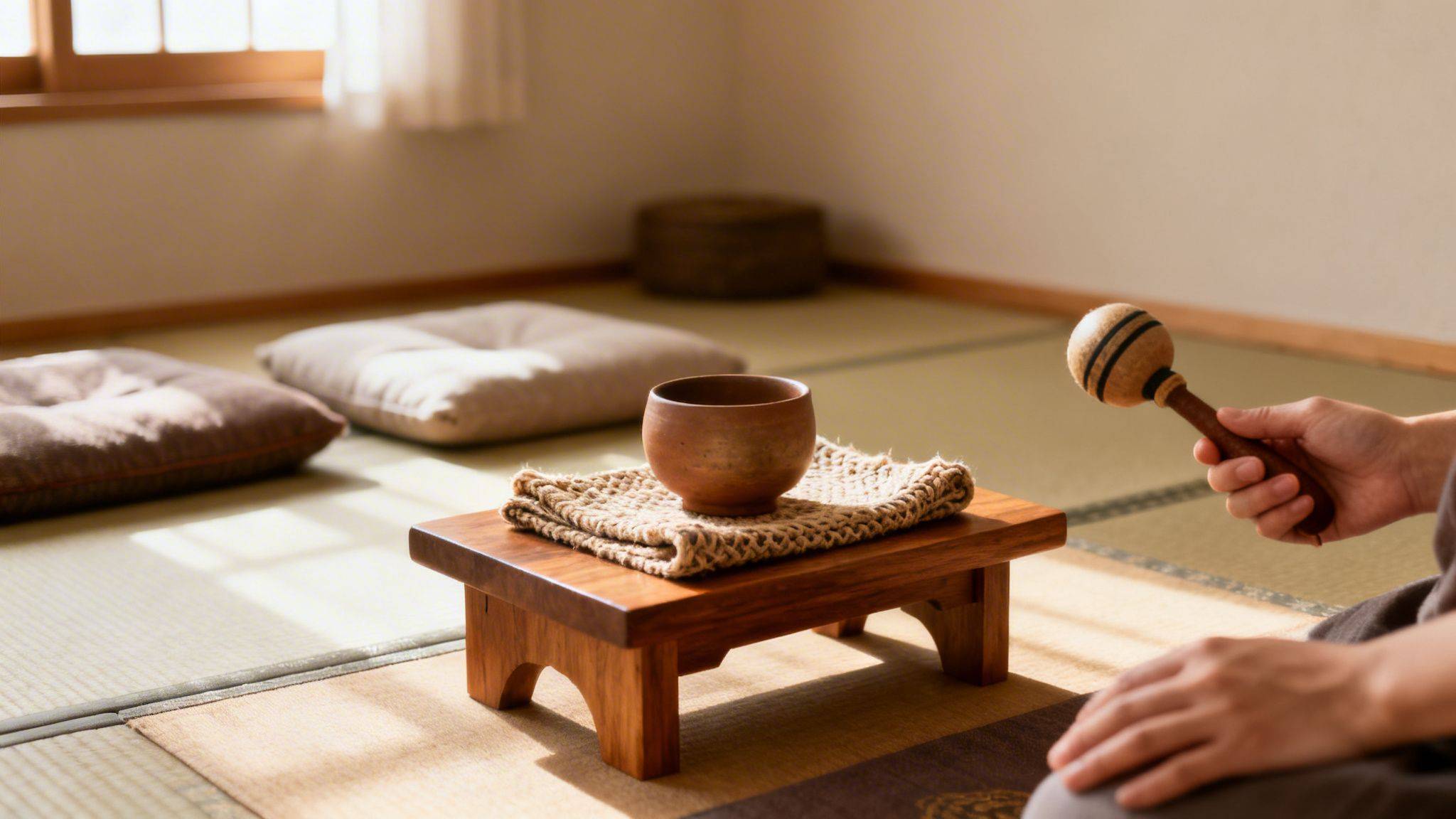
The “setting” is arguably just as critical. A traditional Ayahuasca ceremony is a carefully constructed container designed for safety, support, and profound introspection.
This container is held by an experienced facilitator or shaman. Their job is to guide the energy of the space and provide grounded support to everyone present. Their steady presence allows you to fully surrender to the experience, trusting that you are in a protected environment. This is why drinking in a well-held ceremony is a world away from taking the substance in a casual or recreational context.
The Power of Icaros and Sacred Songs
A central part of the ceremonial setting is the use of icaros, or sacred songs. These are not background music. In many Amazonian traditions, the icaros are considered the primary tool the shaman uses to direct the energy and guide the visionary states of the participants.
The vibrations and melodies of these songs are believed to serve several vital functions:
- Guiding the Journey: The songs can help you navigate the intensity of the experience, offering a lifeline of comfort during challenging moments and deepening periods of clarity.
- Providing Protection: Icaros are often sung to create a shield of positive energy around the ceremonial space, keeping disruptive influences at bay.
- Facilitating Healing: A shaman might sing a specific icaro for an individual to help them release emotional blockages or work through a difficult memory.
Many people report that the music seems to interact directly with their visions, almost as if the sound is weaving the patterns and guiding the flow of their inner world. The icaros are an essential part of the Ayahuasca experience, beautifully blending sound, spirit, and science together.
Ultimately, this powerful combination, a prepared mind and a sacred, supportive environment, truly unlocks Ayahuasca’s potential for healing and self-discovery.
Safety Guidelines and Responsible Preparation
While Ayahuasca holds incredible potential for healing and self-discovery, it demands a deep sense of respect and very careful preparation. Understanding how Ayahuasca works means getting serious about its safety parameters. This is not a substance to approach lightly; responsible and informed engagement is absolutely essential for a safe, beneficial journey.
The first and most critical step is a completely honest self-assessment of your physical and psychological health.
Medical and Psychological Screening
Because Ayahuasca’s MAO-inhibiting properties temporarily increase blood pressure, certain pre-existing conditions can present serious risks. It’s absolutely crucial to be transparent with your retreat facilitator about your entire health history.
Key areas of concern include:
- Cardiovascular Conditions: Anyone with a history of heart problems, severe hypertension, or aneurysms should avoid Ayahuasca.
- Liver or Kidney Issues: These organs are responsible for processing the brew’s compounds, so any significant impairment could be dangerous.
- Psychological History: A personal or family history of psychosis, such as schizophrenia or bipolar disorder, is a strong contraindication. Ayahuasca can potentially trigger or worsen these conditions.
Any reputable retreat center will have a thorough screening process for exactly these reasons. Their highest priority is your safety, which makes your full disclosure non-negotiable.
The Critical Role of Medication Washout
One of the most significant safety concerns involves interactions with pharmaceutical medications, especially those that affect serotonin levels. Mixing the MAOIs in Ayahuasca with certain drugs can be very dangerous.
This is particularly true for antidepressants like SSRIs (Selective Serotonin Reuptake Inhibitors) and SNRIs. You must go through a proper “washout” period to allow your system to completely clear these medications before you even think about sitting in a ceremony.
This washout period is a mandatory safety protocol. Failing to respect it can lead to serious, and avoidable, health complications.
The table below provides a general overview, but this is not medical advice. You must always consult with your prescribing doctor before making any changes to your medication schedule.
Medication and Ayahuasca Safety Guidelines
| Medication Class | Examples | Recommended Washout Period |
|---|---|---|
| SSRIs | Prozac, Zoloft, Lexapro | 4 to 6 weeks |
| SNRIs | Effexor, Cymbalta | 4 to 6 weeks |
| MAOIs (Pharmaceutical) | Nardil, Parnate | At least 6 weeks |
| Tricyclic Antidepressants | Tofranil, Elavil | 4 to 6 weeks |
| Stimulants (ADHD meds) | Ritalin, Adderall | 3 to 7 days |
| Certain Opiates | Demerol, Tramadol | At least 2 weeks |
This information should be taken seriously, but it’s also worth noting an interesting statistic: there have been zero globally documented cases of serotonin syndrome from Ayahuasca, despite millions of sessions worldwide. This speaks to the unique, reversible nature of the MAO-A inhibition from the harmala alkaloids. Studies show that harmine reversibly inhibits MAO-A by 80-90%, creating a strong safety profile when proper screening is followed. In well-screened participants, adverse events occur in less than 5% of cases.
Preparing Your Body With ‘La Dieta’
Beyond just avoiding medications, traditional preparation involves adhering to a specific diet, or ‘la dieta’. This is a practice of discipline and respect that readies your entire being, mind, body, and spirit, for the experience.
The dieta typically involves avoiding certain foods for a week or more before and after the ceremony. This practice helps purify the body, reduce physical discomfort during the experience, and heighten your sensitivity to the medicine’s more subtle work. For a complete breakdown, check out our guide on foods and medications to avoid with MAOIs.
By following these safety guidelines, you approach the ceremony with the seriousness and respect it deserves, creating the best possible conditions for a profound and healing journey.
Common Questions About the Ayahuasca Experience
It’s completely normal to have a lot of questions as you consider a journey with Ayahuasca. Getting a handle on the practical side of things can quiet the mind and help you walk into the ceremony feeling grounded and ready. Let’s tackle some of the most common questions people ask.
The idea here is to pull back the curtain a bit. By laying out clear, straightforward information, you can start building a realistic picture of what to expect, moving from a place of uncertainty to one of informed confidence.
What Are the Physical Sensations Like?
The Ayahuasca experience is a full-body event. The physical sensations can be just as powerful as the psychological ones, and while everyone’s journey is different, there are a few common threads.
One of the first things people often notice is a shift in their senses. Sounds might feel richer, colors can become incredibly vivid, and your sense of touch may be heightened. It’s also very common to feel waves of energy moving through your body, sometimes as warmth, a tingling sensation, or gentle vibrations.
Beyond that, you might feel a profound heaviness, as if you’re sinking into the earth, or a surprising lightness, like you’re floating. And yes, nausea is a very common part of the process. It often comes right before a major emotional or psychological release, which is a core part of the work.
How Long Do the Effects Typically Last?
You can expect the main, acute effects of an Ayahuasca ceremony to last somewhere between four to six hours. Of course, this can shift depending on your own metabolism, the specific batch of the brew, and how much you consume. The experience is not a flat line; it comes in waves of intensity.
Here’s a rough timeline of how it often unfolds:
- Onset (30-60 minutes): You’ll start to feel the first gentle shifts in your perception and body.
- Peak (1.5-3 hours): This is usually the most intense part of the journey. Visionary states and deep emotional work are most common here.
- Coming Down (3-6 hours): The intensity gradually fades, often leaving behind a period of quiet clarity and peaceful reflection.
Even after the main effects wear off, many people report a lingering sense of peace that can last for hours or even days. The real psychological and emotional shifts, however, are just beginning to unfold.
Can You Have a Bad Trip?
The term “bad trip” comes from the world of recreational drug use, and it doesn’t quite fit the Ayahuasca experience. While parts of your journey can be incredibly difficult, intense, or even scary, these moments are almost always seen as purposeful and deeply healing within a proper ceremonial container.
It’s more accurate to think of it not as a “bad trip,” but as a “difficult but meaningful” journey.
“A challenging Ayahuasca experience is often the medicine showing you exactly what needs to be healed. It might bring up suppressed trauma, deep-seated fears, or uncomfortable truths. The key is to surrender and trust the process, knowing that what is coming up is coming up for a reason.”
This is where having an experienced facilitator is non-negotiable. They know how to hold space for you during these challenging moments, offering the support you need to move through the fear instead of getting stuck in it. Learning to embrace the challenge is often what leads to the most profound breakthroughs.
What Is the Integration Process?
The ceremony is just the beginning. The real work, the work that changes your life, happens in the days, weeks, and months that follow. This is the integration process, and it’s arguably the most important part of the entire experience.
Integration is simply the practice of taking the insights and lessons from your journey and weaving them into the fabric of your everyday life. It’s how you turn a powerful night into lasting, positive change.
This looks different for everyone, but it usually involves a few key practices that help you stay connected to the wisdom you gained.
- Journaling: Writing about your experience helps you process it on a deeper level and see patterns over time.
- Time in Nature: Spending quiet time outside is a powerful way to stay grounded and connected to the feeling of peace you may have found in the ceremony.
- Mindfulness and Meditation: These practices help you hold onto the heightened self-awareness you cultivated, allowing you to observe your thoughts and feelings with more compassion.
- Community Support: Talking with an integration coach or others who have had similar experiences can be invaluable. It reminds you that you’re not alone.
The integration period is where you put your new awareness into action. It’s about making different choices, changing old habits, and living in a way that feels more authentic to you. When you approach this phase with intention, you honor the medicine and ensure its gifts continue to unfold in your life.
Disclaimer: The information provided on Ayahuasca.com is for educational purposes only and is not intended as medical advice, diagnosis, or treatment. Ayahuasca is a powerful traditional Amazonian medicine and may not be suitable for everyone. Always consult with a qualified healthcare professional before making decisions related to health, mental well-being, medications, or the use of Ayahuasca.