
You’ve booked an Ayahuasca retreat, paid the deposit, and suddenly the practical questions arrive. What can be eaten? Which medicines need review? How should a retreat center be assessed when it operates in a country with unfamiliar laws? And how can someone prepare without turning a sacred experience into an anxious checklist?
The most reliable answer is a phased preparation timeline. Medical screening comes first, followed by a gradual dieta and lifestyle adjustment, then mental preparation, travel planning, and careful retreat vetting. The ceremony is one part of the process. Post-retreat integration is another. Preparation connects them.
Why Preparation Defines Your Ayahuasca Experience
Ayahuasca is not a new wellness trend. A 2023 review describes documented Amazonian history reaching back about 150 years, while some scholars believe Indigenous groups have used Ayahuasca for millennia. A separate historical account describes the beverage as having been used for thousands of years by Indigenous peoples across the Amazonian highlands and lowlands, including areas now known as Bolivia, Brazil, Colombia, Ecuador, Peru, and Venezuela. The historical context is outlined in the ethnopharmacology review of Ayahuasca.
That geographic breadth matters. Modern retreats may draw from Indigenous and mestizo traditions that differ in ceremony, brew ingredients, songs, dietary expectations, and facilitator roles. There isn’t one universal formula called “the Ayahuasca retreat.” Preparation therefore requires both cultural respect and individual safety assessment.

A first-time participant might spend weeks researching ceremonies, then arrive exhausted, underfed, dehydrated, or uncertain whether a prescription medicine was disclosed correctly. That person hasn’t failed spiritually. The retreat began before the body and mind had a fair chance to participate.
The Three Phases Of The Journey
A practical model has three connected phases:
- Pre-retreat preparation, including medical review, substance washout, dieta, intention setting, logistics, and retreat vetting.
- Ceremony, where the participant works within the facilitator’s structure, follows safety instructions, and responds openly to changing physical or emotional states.
- Post-retreat integration, where insights are examined, translated into behavior, and supported through appropriate community or professional care.
This guide focuses on the first phase because preparation shapes the conditions brought into ceremony. A clear medication history supports safer screening. A gradual dietary taper reduces last-minute stress. A realistic intention creates orientation without demanding a particular vision or emotional outcome.
“Practical rule: A reputable retreat should be willing to slow the process down when a participant needs more screening, more information, or a different level of support.”
Preparation also has a ceremonial dimension. Contemporary good-practice guidance emphasizes knowing the brew’s strength and ingredients, because preparation methods vary across traditions. Asking respectful questions about the brew isn’t distrustful. It acknowledges that the substance, setting, and lineage all influence risk and experience.
The most useful mindset is neither rigid control nor passive surrender. Participants can prepare carefully while accepting that Ayahuasca may challenge their expectations. A disciplined timeline creates steadier ground. It doesn’t guarantee a comfortable ceremony, but it helps ensure that discomfort arises within a safer, better-understood container.
Medical Screening And Medication Washout Protocols
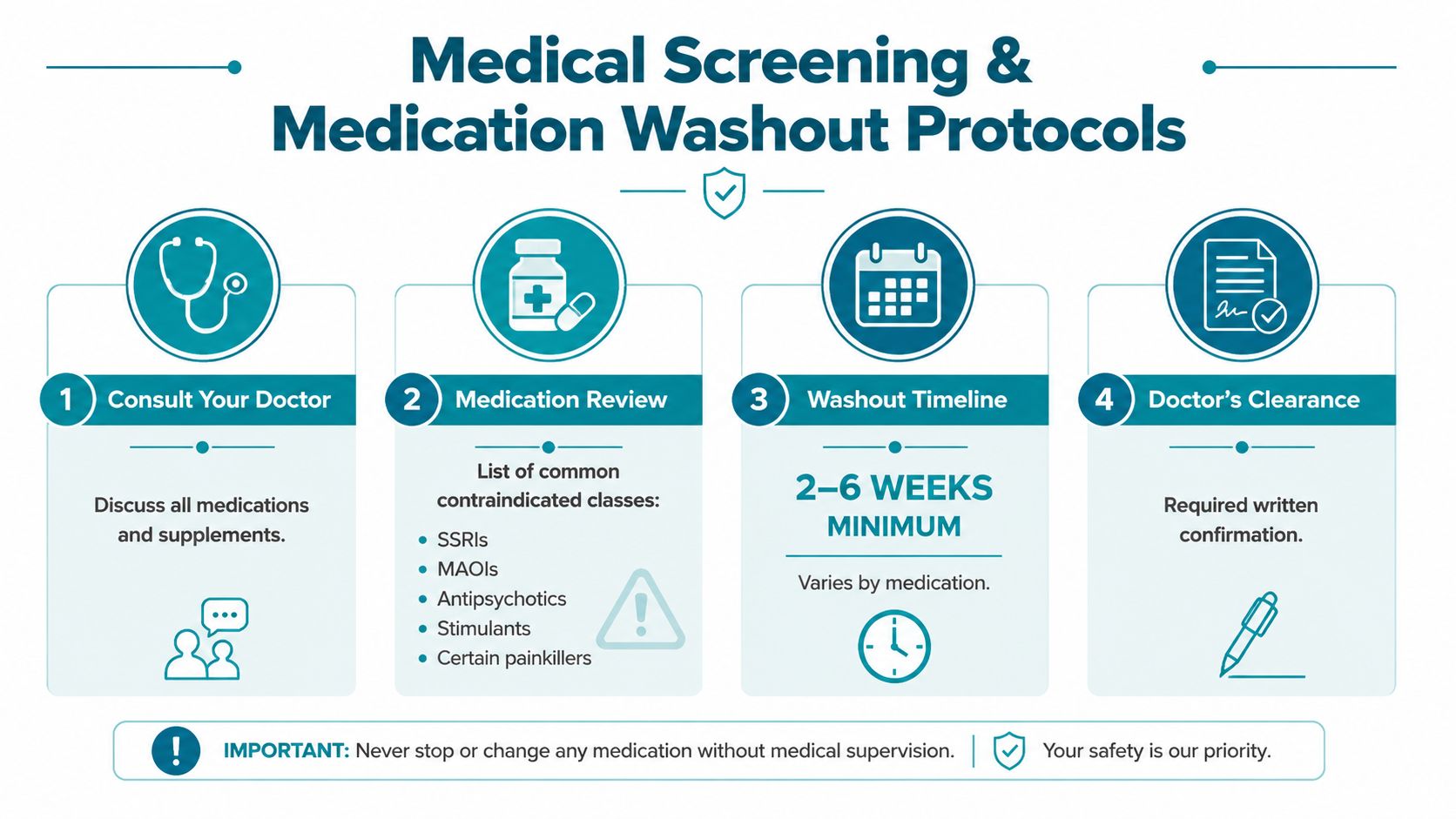
Medical screening comes before dieta rules, meditation routines, and travel bookings. Ayahuasca contains constituents associated with monoamine oxidase inhibition and serotonergic activity, so medication and substance interactions need an individualized review. A clinical review describes a practical 14-day washout period for substances with known or possible interactions, and one retreat cohort required participants to follow that period for 2 weeks before arrival. See the clinical review of Ayahuasca safety and contraindications.
That timeline does not apply to every medicine. Some require a different interval, a gradual taper, or continued treatment rather than discontinuation. Public retreat guidance commonly gives blanket timelines ranging from 2 to 4 weeks, while acknowledging that certain medicines may require longer. The prescribing clinician must make that decision, not a retreat website, facilitator, or participant acting alone.
Follow The Safety Sequence
Use this order:
- Stop non-prescribed interacting substances first. Disclose alcohol, recreational drugs, and often cannabis according to the retreat’s screening requirements. If stopping a substance may cause withdrawal, obtain medical support.
- Complete a full medication review. List prescriptions, over-the-counter medicines, supplements, stimulants, pain medicines, and products used occasionally. The foods and medicines to avoid with MAOIs guide can help you prepare questions for a clinician.
- Discuss every proposed change with the prescriber. SSRIs, MAOIs, antipsychotics, stimulants, and certain painkillers deserve particular attention. Never discontinue psychiatric medication abruptly.
- Confirm medical and psychiatric suitability. Give the retreat an honest health history and, where needed, written clearance from a qualified healthcare provider.
- Start dietary and behavioral preparation only after clearance. Dieta cannot compensate for an unsafe medication combination or an undisclosed health condition.
Severe psychiatric disorders involving psychosis risk, bipolar I, severe cardiovascular disease, uncontrolled hypertension, and pregnancy or breastfeeding are listed as contraindications in expert safety guidance. These situations require a serious discussion with a qualified clinician and the retreat team. A facilitator who dismisses the concern is giving you a warning sign.
Medication planning also needs a backup plan. Travel, supply disruption, or an unexpected delay can complicate prescription access. Participants who rely on ongoing treatment can review an advisory on medication shortages with a clinician while planning continuity of care.
Why Self-Discontinuation Fails
Treating washout as a personal experiment creates avoidable risk. Abruptly stopping an antidepressant, stimulant, sedative, or another prescription can cause withdrawal, symptom recurrence, or destabilization. A retreat’s preference for medication-free participation never overrides a prescriber’s duty to protect the patient.
A useful screening conversation covers the medicine’s name, dose, purpose, last use, previous withdrawal experience, mental health history, blood pressure, cardiovascular history, allergies, and emergency contacts. Ask what happens if the retreat team decides not to serve the brew after arrival.
Before traveling, obtain clear written guidance about medication changes and keep essential medical information accessible. If a retreat refuses to review medications, promises that every medicine is harmless, or treats disclosure as optional, reconsider participation.
Medical clearance cannot predict the emotional content of ceremony. It confirms that the most preventable physical and pharmacological risks have been addressed before entering the ceremonial space.
The Dieta And Lifestyle Tapering Timeline
The dieta has practical and traditional dimensions. Retreat guides commonly recommend at least 14 days of dietary and behavioral tapering, while some extend the preparation to 4 weeks for a more conservative buffer. The Ayahuasca Foundation preparation guidance reflects the recurring operational benchmark of a full 2-week protocol.
A participant doesn’t need to create a punishing cleanse. The aim is a steady reduction in substances, foods, and habits that may complicate ceremony, alongside respect for the retreat’s particular tradition. Dietary rules vary, so the center should provide its own written protocol and explain which restrictions are safety-related and which are lineage-specific.
Four Weeks Before Ceremony
For participants choosing a longer runway, begin by simplifying rather than imposing every restriction at once.
- Remove alcohol and recreational drugs: Cannabis and other non-prescribed substances should also be disclosed and handled according to medical and retreat guidance.
- Reduce heavy meals: Move toward fresh, simply prepared food with less fried food, heavy fat, refined sugar, and excess salt.
- Review the retreat’s traditional requirements: Some widely used guidance asks participants to avoid pork and red meat for at least 3 weeks, while also reducing caffeine, refined sugar, dairy, fermented foods, and adrenaline-inducing activities for at least 2 weeks. Those recommendations appear in the dietary and medical guidelines for Ayahuasca.
- Begin observing habits: Notice caffeine dependence, late nights, compulsive media use, and other patterns that may become uncomfortable when removed suddenly.
The longer taper helps participants distinguish genuine dietary needs from anxiety-driven perfectionism. It also leaves time to ask the retreat about allergies, vegetarian options, fasting expectations, and hydration.
Three To Two Weeks Before Ceremony
By this point, alcohol, recreational drugs, and often cannabis should be absent. Caffeine can be reduced gradually if stopping it suddenly produces headaches or other problems, but any significant symptoms deserve attention rather than bravado.
The recurring dietary targets are plain and manageable: fresh foods, light preparation, modest seasoning, and fewer processed ingredients. Participants should usually reduce or remove refined sugar, heavy fats, very salty or spicy foods, and fermented or aged foods. Tyramine-heavy foods deserve particular care because the brew’s MAOI-related constituents can create interaction concerns.
Hidden exposure is common. A participant may avoid obvious cured meat yet continue eating aged cheese, fermented sauces, or other products flagged by the retreat. Reading ingredient labels and asking the center for a specific food list works better than relying on a vague internet rule.
The introduction to the Ayahuasca dieta can help explain why different traditions use different restrictions. Participants should treat it as a framework for informed discussion, not a replacement for medical advice or the retreat’s own protocol.
The Final Week
The final week should feel quieter, not more extreme. Keep meals light and familiar, maintain hydration, protect sleep, and avoid arriving depleted after intense travel or overwork. Do not use fasting to compensate for earlier inconsistency, and don’t make abrupt medication changes at this stage.
Retreat materials commonly advise finishing the last meal at least 4 hours before ceremony and keeping it light. This can reduce gastrointestinal burden, but the retreat’s instructions take priority, particularly for participants with medical conditions affecting blood sugar, digestion, or hydration.
A practical final-week menu might involve simple grains, fresh vegetables, and other foods the retreat has approved. The exact menu varies by setting. The dependable principles are moderation, freshness, adequate fluids, and full disclosure of deviations.
“Food rule: Partial compliance followed by panic is less useful than a complete, calm protocol followed as consistently as possible.”
Behavioral restrictions also deserve clarity. Some traditions ask participants to reduce sexual activity, intense media, conflict, and stimulating activities before ceremony. These practices may carry ceremonial meaning beyond nutrition. Participants should ask what the retreat expects and why, then follow the protocol respectfully without turning it into a test of moral worth.
Mental Preparation And Choosing The Right Retreat
A participant arrives with a clear intention, then encounters emotions, memories, or insights that do not follow a planned script. “Help me understand why this pattern repeats” leaves room for discovery. “Remove every difficult feeling in one ceremony” creates a demand no responsible facilitator can promise.
Write a short intention several weeks before arrival. Revisit it while journaling about current challenges, recurring behavior, fear, grief, relationships, and the support needed afterward. The strongest intention is specific enough to focus attention, yet flexible enough to accept an unexpected answer.
Build Emotional Readiness
Preparation does not require an elaborate meditation practice. Quiet breathing, a body scan, gentle movement, or several minutes of observing thoughts can help you notice activation before reacting. Journaling can reveal both genuine hopes and apprehension, which gives facilitators more useful information than an idealized account of readiness.
Trauma history requires careful assessment. Ayahuasca may bring emotionally intense material into awareness, while a ceremonial setting may lack the structure, clinical training, or privacy required for trauma treatment. Anyone with unresolved trauma, dissociation, severe anxiety, or recent destabilization should discuss readiness with a qualified mental health professional. Participants who need structured support before or after travel can consider Interactive Counselling trauma services as one possible starting point for trauma-informed care.
A retreat intake should ask about emotional history, not only food preferences. Before booking, ask how staff respond to panic, what support is available during distress, and whether professional referral pathways exist. A vague answer is useful information: it may show that the center is not prepared for the range of reactions a ceremony can produce.
Vet The Retreat Before Booking Travel
A polished website proves little. Request clear answers in writing before paying or arranging transport.
| Area To Assess | Questions For The Retreat |
|---|---|
| Facilitator experience | Who leads the ceremonies, what training or lineage informs the work, and who assists during difficult moments? |
| Medical response | Is there an emergency plan, first-aid capacity, transport access, and communication with local medical services? |
| Screening | Does the center review psychiatric history, cardiovascular risk, pregnancy, medications, supplements, and substance use? |
| Ceremonial conditions | How many participants attend, how is personal space protected, and what happens if someone needs to leave the room? |
| Integration | Are follow-up conversations, referrals, or peer-support options available after departure? |
| Brew information | Will the center explain ingredients, approximate strength, serving practices, and contraindications? |
The retreat’s answers should align with the preparation timeline. Screening should happen before travel, medication questions should be reviewed with qualified healthcare professionals, and any washout period should be planned rather than improvised during the final days. Traditional dieta instructions can carry ceremonial meaning, but they do not replace medical screening or a clear emergency plan.
A respectful overview of the Ayahuasca shaman’s role and traditions can help participants ask informed questions about ceremonial authority, roles, and expectations without assuming every practitioner follows the same model.
Pack For Support, Not Performance
Pack for the environment, not for an image of the ideal participant. Comfortable layers, rain protection, suitable footwear, personal toiletries, a flashlight or headlamp, a towel where needed, sun protection, insect protection, a reusable water bottle, and a journal are sensible categories. Fragrances, expensive valuables, revealing clothing, and unnecessary distractions are usually poor choices.
Give a trusted contact the itinerary, retreat name, arrival details, emergency information, and expected communication schedule. Protect time after the retreat before finalizing the booking. Returning directly to demanding work or intense social obligations can leave little space to process the experience.
Ayahuasca.com provides preparation, safety, retreat, and integration resources that can supplement direct conversations with prospective centers and licensed healthcare professionals. Compare the information, identify unanswered questions, and choose a setting that responds clearly rather than defensively.
Safety And Legal Considerations Across Regions
Ayahuasca preparation changes when the destination changes. A retreat in a traditional Amazonian setting may draw from established ceremonial relationships, while a retreat in Europe or another emerging market may operate within a more uncertain legal and regulatory environment. Neither setting is automatically safe or unsafe. The participant must assess the actual jurisdiction, organization, and safeguards.
Recent coverage describes retreats expanding in Spain, characterized as one of the more permissive European environments. A search-trend report also describes 23% year-over-year growth to about 111K monthly searches, showing expanding public interest, not proof of retreat quality or legality. The trend figures appear in coverage of Ayahuasca retreat search demand.
Separate Legal Categories
Marketing language can blur important distinctions. Participants should identify whether the destination involves:
- A clear legal framework: The activity is addressed by applicable law, with responsibilities and limits that can be verified.
- Religious protection or exemption: A specific organization may have a recognized position, but that protection may not extend to every participant, facilitator, substance, or ceremony.
- Decriminalization: Enforcement priorities may differ from full legality. Decriminalized doesn’t necessarily mean regulated, approved, or risk-free.
- Unregulated operation: The retreat may function without meaningful oversight, leaving participants with fewer protections if something goes wrong.
A retreat should provide the legal basis for its operation in plain language and identify what the participant is responsible for. Vague claims such as “the medicine is legal everywhere” should end the conversation.
Audit The Safety Container
A credible center should explain who screens participants, who remains present during ceremony, how emergencies are handled, and how the team responds to medical or psychological distress. Screening rigor is a positive sign. A facilitator who rejects questions about medications, blood pressure, psychiatric history, or emergency planning is increasing risk.
Red flags include guaranteed healing claims, pressure to increase servings, sexualized conduct, blurred financial or personal boundaries, refusal to disclose ingredients, no sober support staff, and a demand that participants surrender medication information. A large or crowded group isn’t automatically unsafe, but the center should explain how each participant receives attention.
The participant should verify the facilitator’s identity, the physical address, transport arrangements, sleeping conditions, food and water access, and communication options. A trusted contact at home should hold copies of travel documents and the retreat itinerary.
Evaluate Integration In The Same Review
A retreat that focuses only on the ceremony may leave participants without help when difficult material surfaces later. Ask who handles follow-up concerns, whether the center provides integration calls, and whether it can refer participants to licensed clinicians when peer support isn’t enough.
Legal vetting also includes personal documentation. Participants should understand visa rules, local restrictions, travel insurance limitations, prescription requirements, and what happens if a ceremony is canceled. The center should never advise a participant to conceal a medication or misrepresent the purpose of travel.
The central trade-off is convenience versus verification. A cheaper or newer retreat may be appealing, but the absence of transparent screening, emergency planning, and legal information shifts more risk onto the participant. Careful questions before booking are far easier than crisis decisions after arrival.
Building Your Post-Retreat Integration Plan
Integration begins before the ceremony because the participant’s calendar, support network, and expectations shape what happens afterward. A powerful experience can produce insight without producing change. Daily life still demands decisions, boundaries, treatment, work, and relationships.
A practical plan should answer three questions: What will be recorded? Who can help interpret it? Which actions will be tested in ordinary life? The answers don’t need to be dramatic. A consistent sleep routine, a difficult conversation approached differently, or a decision to resume therapy may matter more than a sweeping promise made immediately after ceremony.
The First Days
The first days after returning should be deliberately simple. Protect rest, reduce unnecessary social demands, eat in line with the retreat’s guidance, and avoid making irreversible decisions while emotions remain heightened. A journal can separate direct observations from interpretations, which helps prevent every image or feeling from becoming an instruction.
A short daily entry might include:
- Experience: What was felt, remembered, or noticed?
- Meaning: What interpretation is emerging?
- Evidence: What in ordinary life supports that interpretation?
- Action: What small behavior can be practiced?
- Support: Who should be contacted if distress increases?
The participant should also document sleep, mood, anxiety, unusual perceptions, and physical symptoms. Persistent or escalating problems require professional assessment rather than spiritual explanation alone.
The Following Weeks
A structured integration rhythm can include therapy, trusted peer support, contemplative practice, gentle exercise, and regular journaling. The right therapist should understand trauma, altered states, cultural humility, and the difference between validating an experience and endorsing every interpretation attached to it.
Peer circles can reduce isolation, but they aren’t substitutes for medical or psychological care. A peer may listen well and share useful perspective. A qualified clinician can assess risk, diagnose conditions when appropriate, and create a treatment plan.
“Integration principle: The ceremony may reveal a pattern. Repeated behavior in daily life is what shows whether the pattern is changing.”
Participants should resist the urge to repeat ceremonies immediately in search of a cleaner answer. A period of observation allows insights to settle and exposes which conclusions remain useful outside the retreat environment. The retreat’s own post-ceremony dieta or behavioral guidance should be followed, with medical exceptions handled by a clinician.
A Longer Roadmap
Over the broader integration period, the participant can review the original intention and compare it with actual changes. Useful questions include:
- Which insight still feels relevant after ordinary responsibilities return?
- What behavior has changed, even slightly?
- Which promise became unrealistic?
- What relationship or habit needs a concrete boundary?
- What support should continue?
Professional help is especially important when the participant experiences persistent insomnia, severe anxiety, mania-like symptoms, paranoia, suicidal thoughts, inability to function, or worsening trauma symptoms. Emergency concerns require immediate local medical or crisis support. A retreat facilitator can offer context, but shouldn’t replace emergency services or qualified clinical care.
A sound integration plan treats Ayahuasca as one event within a larger life process. The participant can preserve meaningful practices, question dramatic conclusions, repair relationships carefully, and return to ordinary responsibilities with patience. Preparation creates the container. Integration determines whether the experience becomes a grounded change rather than a story that fades when travel ends.
Before booking, complete a supervised medication review, request the retreat’s written screening and emergency protocols, verify the destination’s legal position, and schedule protected time for integration. A reputable center should answer direct questions about ingredients, facilitators, contraindications, group care, and post-retreat support. If those answers aren’t clear, pause the booking and choose safety over momentum.
Disclaimer: The information provided on Ayahuasca.com is for educational purposes only and is not intended as medical advice, diagnosis, or treatment. Ayahuasca is a powerful traditional Amazonian medicine and may not be suitable for everyone. Always consult with a qualified healthcare professional before making decisions related to health, mental well-being, medications, or the use of Ayahuasca.