
Ayahuasca and schizophrenia is a topic that raises a difficult but important question: can Ayahuasca trigger schizophrenia, or can frightening experiences during a ceremony only resemble psychosis for a short time? That question exposes a gap in much of the public discussion. Ayahuasca is often presented either as a miracle cure or as an automatic psychosis trigger, while the evidence points to a more careful distinction between rare, context-dependent psychotic events and the much higher stakes faced by people already vulnerable to schizophrenia-spectrum disorders.
The central issue is individual susceptibility. A person without a psychotic history may experience intense visions, unusual beliefs, or temporary loss of ordinary boundaries without developing schizophrenia. A person with schizophrenia, schizoaffective disorder, bipolar disorder with psychotic features, a strong family history, or emerging symptoms may face a very different risk profile. This guide separates shared brain mechanisms from clinical treatment evidence, then translates the uncertainty into practical safety decisions.
Why the Schizophrenia Question Matters for Ayahuasca Seekers
Schizophrenia is a diagnosable psychiatric syndrome involving persistent psychotic symptoms, changes in thinking and perception, cognitive difficulties, and meaningful decline in everyday functioning. A brief visionary state during an altered-consciousness experience doesn’t automatically meet that definition. The clinical concern begins when hallucinations, delusions, disorganized thinking, or severe functional disruption continue beyond the expected period of intoxication, recur, or reveal an underlying illness.
That distinction matters because Ayahuasca can temporarily alter perception, emotion, self-experience, and the interpretation of meaning. A participant might see or hear things that others don’t, feel watched, or become convinced that a symbolic experience carries literal personal significance. Those experiences can be profound and distressing, but their presence alone doesn’t establish schizophrenia. Clinicians assess duration, baseline functioning, previous symptoms, family history, substance use, sleep, and the person’s ability to return to ordinary reality.
Ceremonial settings add variables that controlled research environments may limit. Participants may consume an unfamiliar preparation without reliable dose information, fast for long periods, sleep poorly, become emotionally overwhelmed, and absorb the expectations of a group. Some retreats lack psychiatric supervision, formal screening, or an emergency plan. These conditions can make it difficult to tell whether a reaction reflects the substance, exhaustion, another drug, a medical problem, a latent psychiatric disorder, or several factors at once.
“Practical rule: A history of psychosis should be treated as a reason for specialist assessment and likely avoidance, not as a detail to conceal from a facilitator.”
A person considering participation should review the preparation questions in this Ayahuasca suitability guide, then discuss the decision with a qualified mental-health professional. Personal history deserves the greatest weight, but family history also matters because it can indicate inherited vulnerability even when the individual has never experienced psychosis.
The population-level picture is reassuring in one limited sense. A majority of those who drink Ayahuasca don’t develop schizophrenia. The individual-level picture is more serious: psychosis-prone people may react unpredictably, and a rare event can still mean hospitalization, loss of safety, or a prolonged disruption to treatment and relationships.
How Ayahuasca Works in the Brain
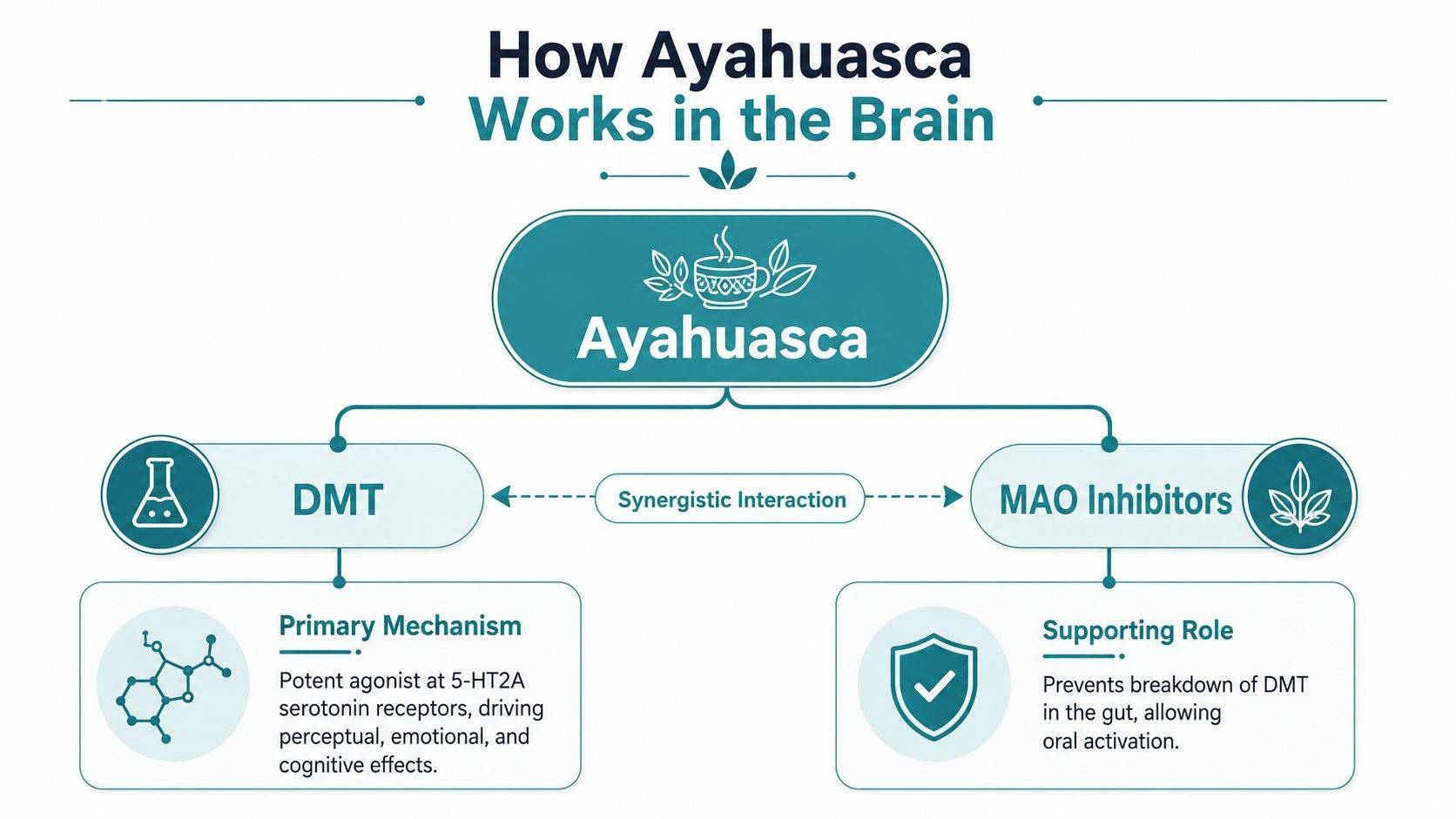
Ayahuasca combines two pharmacological roles. DMT, or dimethyltryptamine, is the main psychedelic component. It acts as a potent agonist at the 5-HT2A serotonin receptor, a signaling site involved in perception, cognition, emotion, and the sense of self. In plain language, DMT strongly changes how several brain networks interpret incoming information and generate internal experience.
The second group consists of harmala alkaloids, including harmine, harmaline, and tetrahydroharmine. These compounds inhibit monoamine oxidase, an enzyme that normally breaks down DMT in the digestive system. By slowing that breakdown, they allow DMT to remain orally active. The two components therefore have a synergistic interaction, DMT supplies the primary psychedelic signal, while the harmala alkaloids help that signal survive digestion.
From Receptors To Experience
Research discussions also refer to changes in default mode network connectivity, greater entropy or complexity in neural signaling, and shifts involving glutamatergic and dopaminergic systems. These terms describe altered coordination between brain regions, not a diagnosis. A temporary reduction in the usual dominance of self-referential processing can feel like ego dissolution, while unusual connectivity may produce novel associations, vivid imagery, or a sense of expanded meaning.
The psychosis connection becomes clearer when receptor activity is separated from clinical outcome. Strong 5-HT2A stimulation can produce psychotic-like phenomena temporarily in many people. Dopamine-related changes, sleep loss, stress, prior drug exposure, and inherited traits may influence whether the experience resolves cleanly or becomes destabilizing. The same broad pathway can therefore produce a short-lived altered state in one person and a dangerous reaction in another.
A scientific overview of these mechanisms is available in this research explanation of how Ayahuasca works. Mechanistic knowledge helps explain plausibility, but it can’t determine that Ayahuasca causes schizophrenia or that it treats schizophrenia. Receptors are entry points into a biological process, not proof of a beneficial or harmful clinical result.
What the Evidence On Psychosis Risk Shows
What does the evidence say about psychosis risk, and how should a prospective participant interpret it? The strongest conclusion is narrow: the vast majority of individuals who use Ayahuasca do not develop schizophrenia, and published research has not established that Ayahuasca causes schizophrenia in the general population. A 2017 systematic review of human studies found that reported psychotic episodes were rare and usually involved pre-existing vulnerability, prior or concurrent drug misuse, or unsupervised settings, rather than the substance alone (systematic review of Ayahuasca and DMT psychosis reports).
Reviewed case data described approximately 25,000 ritual drinking sessions over five years, alongside 13 to 24 psychosis-like incidents, a rate of less than 0.1% (reviewed case data on Ayahuasca-related psychosis). This figure should not be treated as a universal incidence rate. Ritual conditions differ, reporting is incomplete, preparations vary, and case reports tend to capture severe outcomes more readily than uneventful experiences.
Temporary Phenomena And Sustained Illness
A short-lived psychotic-like state can include unusual perceptions, paranoia, confusion, or reduced ability to test beliefs against ordinary reality during or soon after an experience. A sustained psychotic disorder involves symptoms that persist or recur, together with broader changes in thinking, behavior, relationships, self-care, work, or study. Published cases include first episodes, relapse, and extended hospitalization, especially among people with prior vulnerability or unrecognized early symptoms.
Duration changes the meaning of the event. A brief altered state that resolves as intoxication ends is clinically different from symptoms that continue afterward, worsen, or interfere with safety and daily functioning.
More recent safety literature discusses psychiatric events, including documented fatalities, and warns that people with psychotic disorders may experience symptom exacerbation. A global survey summarized in a major U.S. health source reported that about 56% of respondents experienced a negative mental-health impact in the days and weeks after use, including seeing or hearing things others did not, feeling disconnected, and anxiety-like symptoms (scoping review and broader safety evidence). That finding concerns negative mental-health impact, not a schizophrenia diagnosis.
| Outcome Type | Frequency In Reports | Typical Duration | Risk Profile Implied |
|---|---|---|---|
| Acute perceptual or psychotic-like effects | Reported during intense experiences and may resolve as the state ends | Usually temporary, though duration varies | Can occur without schizophrenia, but becomes more concerning when safety or reality testing is impaired |
| Persistent psychotic symptoms | Uncommon in the available literature | May continue beyond intoxication and require urgent assessment | More consistent with vulnerability, adverse context, or an emerging disorder |
| Relapse of an established psychotic illness | Repeatedly flagged as a high-risk possibility | Can disrupt ongoing recovery and treatment | People with psychotic histories are generally inappropriate candidates |
| Perception disturbances after use | Described in post-use mental-health reports | May continue after the acute experience | Requires clinical assessment, especially with anxiety, insomnia, or paranoia |
Persistent perception changes warrant separate attention. Readers can review this resource on HPPD and co-occurring mental health. A scientific investigation of Ayahuasca research provides broader context for interpreting the research record. Overall, the evidence supports caution focused on schizophrenia-spectrum vulnerability and clinical context, rather than treating population-level risk as identical for everyone.
Why Some Research Mentions Schizophrenia-Like Brain Patterns
Some readers encounter studies describing Ayahuasca or DMT effects that overlap with schizophrenia-related neurobiology. Those findings can include changes in default mode network activity, altered signaling complexity, 5-HT2A receptor involvement, positive-symptom-like experiences, mismatch negativity deficits, or differences in inhibition of return. The apparent contradiction is understandable: if the brain markers overlap, could Ayahuasca somehow treat schizophrenia?
The answer requires separating biomarker similarity from clinical equivalence. Two different states can involve the same receptor or network while producing different time courses and outcomes. A fever and strenuous exercise can both raise body temperature, but the shared measurement doesn’t make them the same condition. Likewise, a psychedelic state and schizophrenia may share selected biological signatures without sharing cause, duration, prognosis, or treatment response.
Similar Signals, Different Clinical States
Acute psychedelic effects are time-limited changes produced by a pharmacological event. Schizophrenia is a persistent disorder involving symptoms, cognition, self-care, relationships, work or study, and the person’s longer-term ability to function. A person may temporarily experience weakened ego boundaries during a ceremony and later regain ordinary reality testing. A person with schizophrenia may struggle with reality testing outside any intoxication, often requiring continuing clinical care.
The distinction also applies to research design. A laboratory marker can show that a compound activates a receptor or changes a network. It can’t show that the compound improves hallucinations, delusions, negative symptoms, cognition, or relapse prevention in people with schizophrenia. Clinical treatment claims require controlled studies in the relevant patient population, with safety monitoring and meaningful outcomes.
The available evidence doesn’t provide credible clinical support for using Ayahuasca to treat schizophrenia. A systematic review noted overlaps with schizophrenia-related neurobiology and cognition, but the same safety guidance advises people with a personal or family history of psychotic disorders to avoid Ayahuasca. Recent case literature continues to document Ayahuasca-induced psychosis and hospitalization. Shared markers may explain why researchers study the mechanism, but they don’t justify self-treatment.
Contraindications, Medications, And Screening Essentials
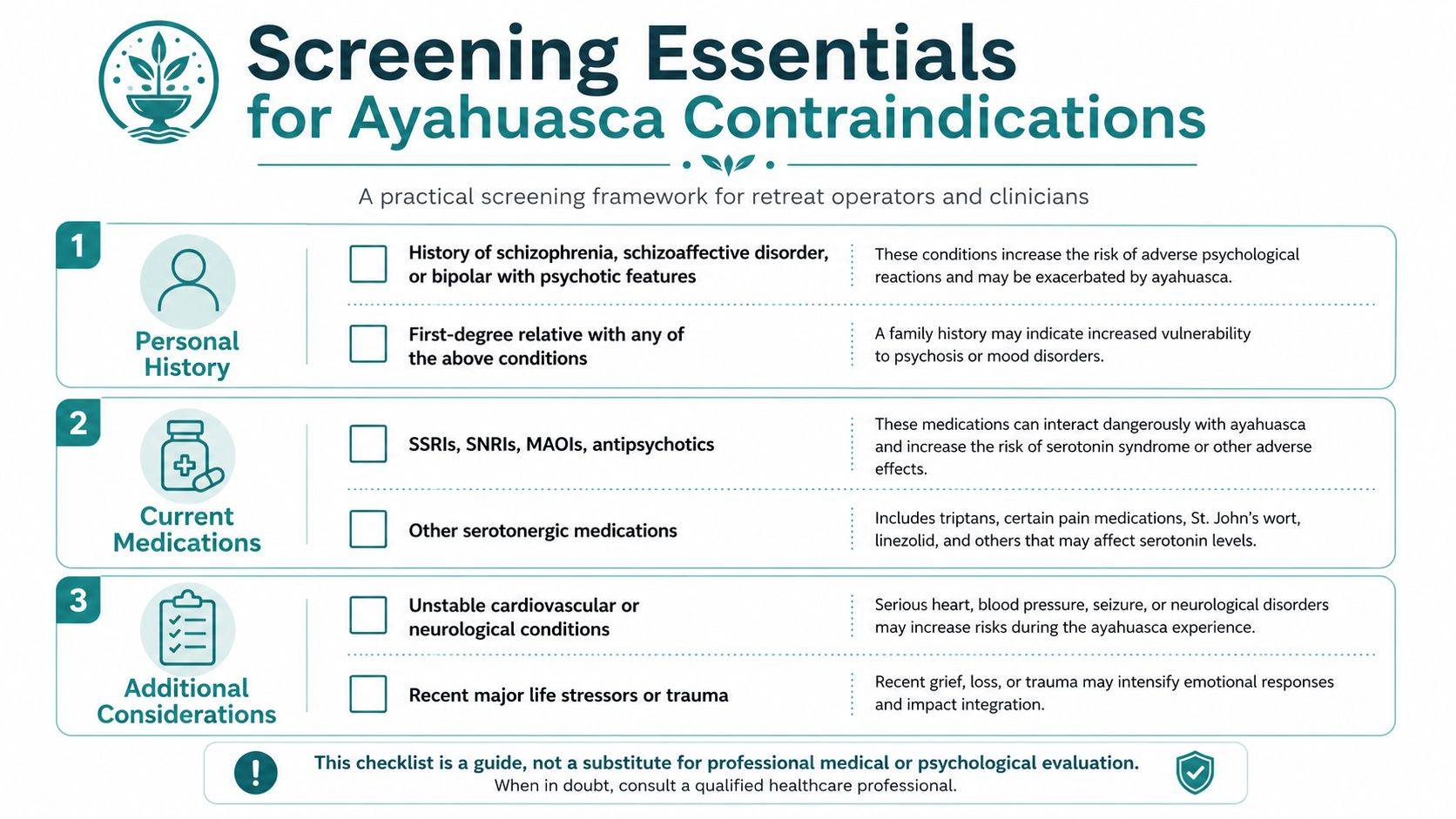
Screening should begin with psychiatric history, not with ceremonial intention. A personal history of schizophrenia, schizoaffective disorder, or bipolar disorder with psychotic features should generally be treated as an exclusion. A first-degree family history of psychotic illness also deserves specialist review, particularly if the person has experienced suspiciousness, unusual beliefs, perceptual changes, severe mood instability, or episodes of markedly reduced sleep.
A retreat operator shouldn’t promise that preparation, spiritual protection, or a supportive group can remove this risk. Any screening process should document who made the decision, what information was reviewed, and what emergency support exists if symptoms appear. Ayahuasca safety guidance describes severe psychiatric disorders, especially psychosis-prone conditions, as contraindications and warns that harmala alkaloids can interact dangerously with serotonergic medicines such as SSRIs (Ayahuasca safety profile and contraindications).
Medication Review Requires A Prescriber
Medication decisions can’t safely be handled through an informal retreat protocol. SSRIs, SNRIs, MAOIs, lithium, antipsychotics, benzodiazepines, and other serotonergic or psychoactive medicines may create interaction, withdrawal, sedation, destabilization, or reduced-treatment-effect concerns. The exact risk depends on the medicine, dose, timing, health history, and the Ayahuasca preparation.
A prescriber should determine whether any medication change is appropriate. No participant should abruptly stop psychiatric treatment to attend a ceremony, and no facilitator should give a personal washout schedule. A person seeking structured support for combined substance use and mental-health concerns may also review a dual diagnosis program in Orange County as an example of the kind of integrated care that addresses both areas.
A Minimum Safety Checklist
- Disclose psychiatric history: Include past psychosis, mania, hospitalization, severe dissociation, and family history.
- List every medicine and substance: Include prescriptions, over-the-counter products, supplements, alcohol, cannabis, stimulants, and other psychedelics.
- Request prescriber involvement: Medication continuation or tapering requires individualized medical advice.
- Ask for written consent procedures: Participants should understand foreseeable psychiatric and medical risks.
- Verify emergency arrangements: The setting should have trained staff, transport procedures, and a plan for urgent psychiatric evaluation.
- Review additional health concerns: Unstable cardiovascular or neurological conditions, recent trauma, and major life stressors may increase difficulty or reduce the ability to cope.
A short educational video can complement, but never replace, individualized screening.
Harm-Reduction And Integration Strategies That Reduce Risk
Harm reduction begins before a ceremony. A person considering Ayahuasca should disclose the complete psychiatric and medication history, obtain an independent clinical opinion, and avoid participation if a qualified professional identifies psychosis vulnerability. Preparation should also include realistic expectations, stable sleep, reliable transport, and a trusted sober person who knows what was taken and what warning signs require help.
Integration matters because an intense experience can leave unresolved fear, insomnia, suspiciousness, or confusion. A qualified therapist can help distinguish symbolic meaning from fixed beliefs, track whether symptoms are settling, and identify when urgent care is needed. A facilitator’s spiritual interpretation shouldn’t replace psychiatric assessment when a participant can’t sleep, remains disorganized, hears voices outside the expected experience, or feels unsafe.
Responsibilities By Role
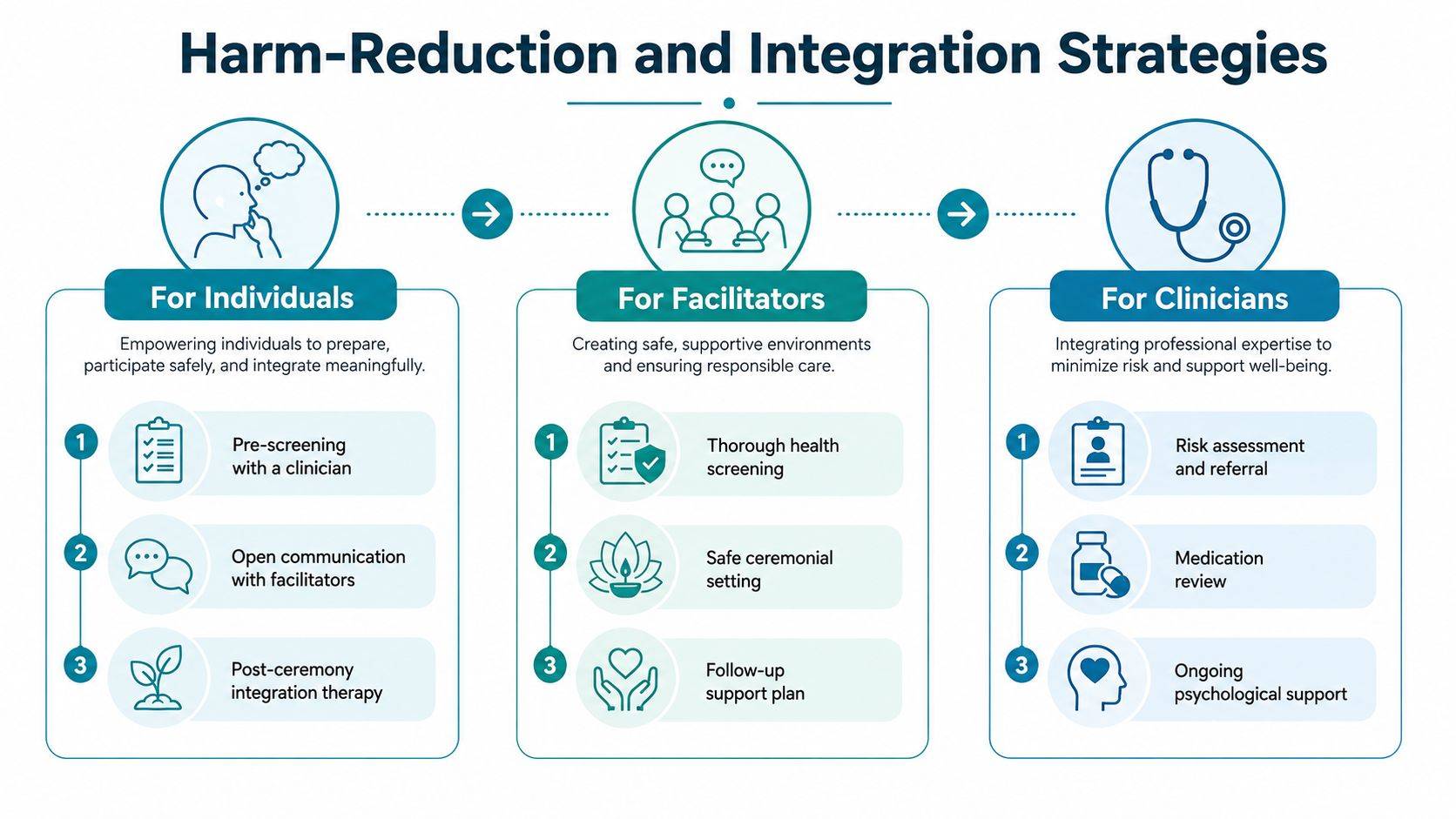
Individuals need honest disclosure, careful preparation, and post-ceremony support. A participant shouldn’t rely on secrecy, spiritual reassurance, or an internet checklist to override a known psychiatric risk.
Facilitators should use standardized intake questions, apply clear exclusion policies, maintain trained medical backup, control environmental hazards, and arrange follow-up contact. They should recognize early psychosis signs and know when to refer rather than attempting to manage severe symptoms inside the ceremony.
Clinicians should ask about psychedelic use without judgment, assess timing and symptom change, review medicines, evaluate sleep and substance use, and coordinate referrals. Patients may omit Ayahuasca use unless clinicians ask directly, so routine assessment improves the chance of timely intervention.
“For clinicians: Ask what was taken, when it was taken, whether sleep changed, and whether unusual perceptions continue outside the ceremony.”
Long-term safety depends on the whole process, not only the night of drinking. Screening, preparation, supervision, recovery time, and integration form a chain. A weak link can matter most for people already carrying psychiatric vulnerability.
Legal, Ethical, And Research Implications Plus Next Steps
Ayahuasca access is shaped by jurisdiction. DMT and harmala-containing preparations may be prohibited, restricted, or treated differently depending on local law, religious protections, and enforcement practice. Legal uncertainty can push use underground, where participants may receive less reliable information about contents, screening, emergency care, and follow-up. It can also make controlled clinical research harder to organize, especially when investigators need standardized preparations and consistent reporting.
Retreat operators have an ethical duty to explain uncertainty plainly. Consent isn’t meaningful if a provider promises healing while minimizing psychosis risk, accepts undisclosed psychiatric histories, or lacks a plan for a participant who becomes unsafe. Screening records should be handled confidentially, exclusion decisions should be documented, and facilitators should never frame referral to psychiatric care as spiritual failure.
Research still needs answers that current evidence can’t supply. Longitudinal studies could clarify outcomes among people with varying levels of vulnerability, although exposing people with psychotic histories to a known concern would raise serious ethical barriers. Mechanistic work could examine how 5-HT2A agonism interacts with vulnerable brain systems, while standardized adverse-event reporting could make case patterns easier to compare. The absence of approved or credible clinical trials supporting Ayahuasca treatment for schizophrenia remains decisive for current practice.
Next Steps For Each Audience
- Individuals: Consult prescribing clinicians, review personal and family psychiatric history, disclose all medicines and substances, and request the provider’s screening and emergency procedures in writing.
- Clinicians: Treat psychedelic exposure as a routine assessment question, document disclosures and symptom changes, review medication risks, and coordinate appropriate mental-health referrals.
- Retreat providers: Adopt validated screening tools, train staff to recognize early psychosis, maintain clear exclusion policies, and build referral pathways before accepting participants.
The practical conclusion is balanced but firm. Ayahuasca doesn’t have established evidence as a schizophrenia treatment, and most users don’t develop schizophrenia, yet people with psychotic vulnerability may face disproportionate harm. Anyone with a personal or family history of psychosis should pause the ceremony plan, speak with a qualified clinician, and choose documented safety and informed consent over promises of transformation.
Before considering Ayahuasca, arrange an honest medication and psychiatric-history review with a qualified clinician, then ask any retreat provider for written screening criteria, exclusion policies, emergency procedures, and integration support. If a provider discourages disclosure or minimizes psychosis risk, don’t participate.
Disclaimer: The information provided on Ayahuasca.com is for educational purposes only and is not intended as medical advice, diagnosis, or treatment. Ayahuasca is a powerful traditional Amazonian medicine and may not be suitable for everyone. Always consult with a qualified healthcare professional before making decisions related to health, mental well-being, medications, or the use of Ayahuasca.