
At its heart, Ayahuasca ceremonies are guided spiritual ritual, a sacred container built around the intentional use of a psychoactive plant medicine from the Amazon. This isn’t about a recreational trip; it’s a deliberate journey inward, designed for deep psychological healing, self-discovery, and spiritual connection. A trained facilitator, often called a shaman, is there to guide the entire process.
Be prepared: the experience is often intense. It frequently involves profound, movie-like visions and a physical and emotional “purge,” which is seen as a core part of the healing process.
What an Ayahuasca Ceremony Truly Is
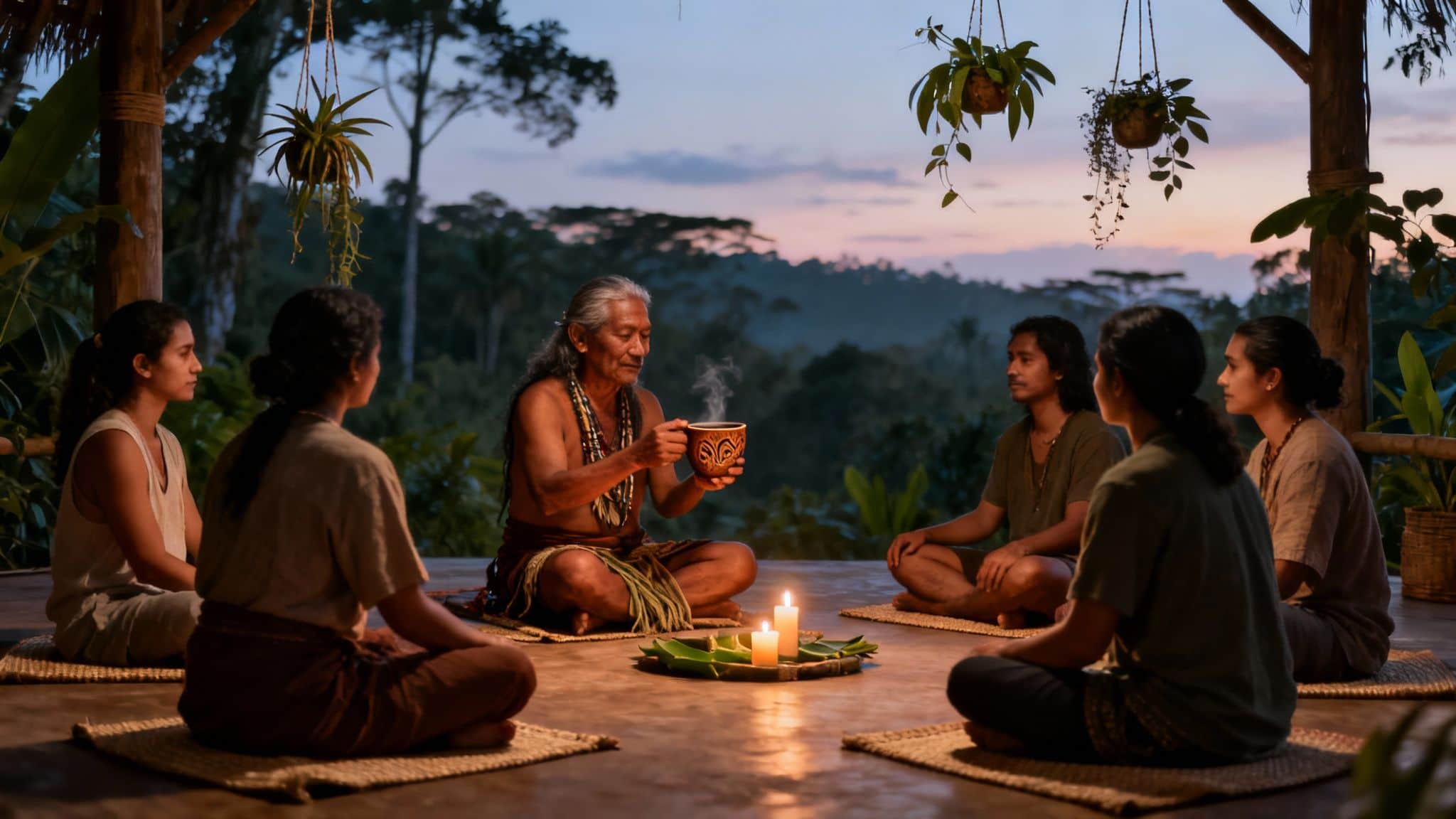
The best way to think about an Ayahuasca ceremony is to frame it as a form of intensive, guided therapy for the soul. It’s a highly structured event that takes place over several hours, almost always at night, inside a space that has been meticulously prepared and protected. Everything about the experience is built on a foundation of intention and deep respect for the medicine and the indigenous traditions it comes from.
A ceremony is really a three-way partnership: you, the facilitator, and the spirit of the medicine itself. The aim isn’t to escape reality but to dive headfirst into your own consciousness, uncovering and healing whatever is buried there. This is far from a passive experience. It demands courage, the ability to surrender control, and a genuine willingness to face difficult emotions and hard-won truths.
The Three Core Components
Every legitimate Ayahuasca ceremony is defined by three essential elements working together. They create the safe and effective container necessary for this kind of deep work, and each one plays a critical role in your journey.
- The Brew: This sacred Amazonian tea is made by boiling two plants together: the Banisteriopsis Caapi vine and the leaves of the Psychotria Viridis shrub. The vine acts as a monoamine oxidase inhibitor (MAOI), which is the key that unlocks the powerful psychoactive compound DMT in the leaves, allowing your body to absorb it and enabling the profound visionary experience.
- The Setting: A ceremony is always held in a secure, quiet, and comfortable space, often dimly lit to help you go inward. This “sacred space” is energetically cleansed and protected by the facilitator, creating a safe bubble where you can feel secure enough to completely let go.
- The Guide: The shaman or facilitator is the anchor of the entire ceremony. They are responsible for everything from opening and closing the ritual to serving the medicine and, most importantly, guiding participants through their experiences. They use traditional songs, known as icaros, along with music and focused energetic work to support everyone in the room.
To give you a clearer picture, this table breaks down the key components you can expect to find in a traditional ceremony.
Key Components of an Ayahuasca Ceremony
| Element | Role and Purpose |
|---|---|
| The Facilitator (Shaman) | Acts as the spiritual guide and protector of the ceremony, using songs and energy work to navigate the experience. |
| The Sacred Space | A physically and energetically clean, safe environment where participants can be vulnerable and surrender. |
| The Icaros (Sacred Songs) | Traditional chants sung by the shaman to call in spirits, guide visions, and provide healing energy. |
| The Opening and Closing | Formal rituals to begin and end the ceremony, creating a clear boundary between the sacred work and ordinary life. |
| The Purge (La Purga) | The physical process of vomiting or diarrhea, viewed as a release of negative energy, emotional trauma, and toxins. |
| The Sharing Circle | A post-ceremony opportunity to share and process experiences with the group, an essential part of integration. |
These elements work in harmony to create the specific conditions needed for deep, meaningful work to occur.
“A common metaphor for Ayahuasca is that it’s like undergoing open-heart surgery for the soul. The facilitator acts as the surgeon, skillfully navigating the inner worlds to help release emotional blockages, while the ceremony provides the sterile, safe operating room needed for such delicate work.“
Ultimately, participating in Ayahuasca ceremonies means stepping into a powerful tradition that has been used for centuries for healing and spiritual growth. It’s an intense, often challenging, and deeply rewarding process designed to bring clarity, insight, and profound change.
The Cultural and Historical Roots of Ayahuasca
To really get what Ayahuasca is all about, you have to look beyond the brew itself and go deep into its Amazonian roots. This isn’t some new wellness trend; it’s an ancient practice for healing and spiritual insight that’s been around for thousands of years. For generations, Indigenous cultures across the Amazon basin—especially in modern-day Peru, Colombia, Brazil, and Ecuador—have held Ayahuasca as a sacred master teacher.
In these traditions, Ayahuasca was never taken lightly. It was woven into the very fabric of community life, acting as a direct line to the spirit world. People turned to it to diagnose illnesses, settle disputes, or get guidance from ancestors. The shaman, known as a curandero, was the guide, the one who could bridge the physical and spiritual worlds, using the medicine to see the hidden causes of suffering and restore balance.
From Tribal Medicine to Global Phenomenon
For a long, long time, Ayahuasca was one of the Amazon’s best-kept secrets. But in the 20th century, ethnobotanists and explorers started documenting its use, and slowly, word began to spread.
A major turning point came with the rise of syncretic religions in Brazil, like Santo Daime and União do Vegetal (UDV). These groups blended Indigenous Amazonian rituals with Christian symbolism, creating a formal, community-based structure for using Ayahuasca as a sacrament. This really helped carry the practice beyond its original shamanic context and made it approachable for a wider, non-Indigenous audience.
In the last few decades, this interest has exploded. More and more people in the West are looking for alternative ways to heal and explore their spirituality, and many of them are finding their way to Ayahuasca.
“Ayahuasca is often called the ‘Vine Of The Soul’ for a reason. Its history is not just about a plant, but about humanity’s enduring search for meaning, healing, and a connection to something greater than ourselves. Understanding its sacred origins is the first step in approaching it with respect.”
Navigating Modern Neoshamanic Practices
Today’s Ayahuasca scene is incredibly diverse. You’ve still got the traditional Indigenous lineages and the syncretic churches, but now there’s also a whole field of “neoshamanic” practices. These ceremonies often mix Amazonian traditions with other modalities—think yoga, meditation, or even Western psychology—to create an experience tailored for a global audience.
This has made ayahuasca far more accessible, but it’s not without its problems. When a sacred tradition goes mainstream, it brings up tricky ethical questions around cultural appropriation, sustainability, and whether every facilitator is truly qualified. If you’re considering modern Ayahuasca ceremonies, it’s so important to do your homework and choose a path that honors the medicine’s Indigenous roots. A good place to start is learning about which Indigenous groups traditionally use Ayahuasca.
The numbers tell the story of its global reach. Recent estimates suggest that around four million people worldwide have sat in an Ayahuasca ceremony. What’s really striking is that only about 10% of them are from Indigenous groups. This ancient practice has truly gone global.
What to Expect During the Ceremony
The moments before your first Ayahuasca ceremony can be a potent mix of nerves and anticipation. That’s completely normal. Knowing what the night holds, at least in a general sense, can help you relax into the experience and let go.
While every shaman, facilitator, and tradition has its own unique flavor, most Ayahuasca ceremonies follow a time-tested structure that unfolds over four to eight hours. The whole process is designed to create a safe and sacred container for you to do incredibly deep inner work. Think of it as a journey into your own mind, with the facilitator as your trusted guide and the sacred songs, or icaros, as the current carrying you forward.
This infographic shows how ayahuasca has traveled from its Amazonian roots to become a global phenomenon, giving some context to the ceremony you’re about to experience.
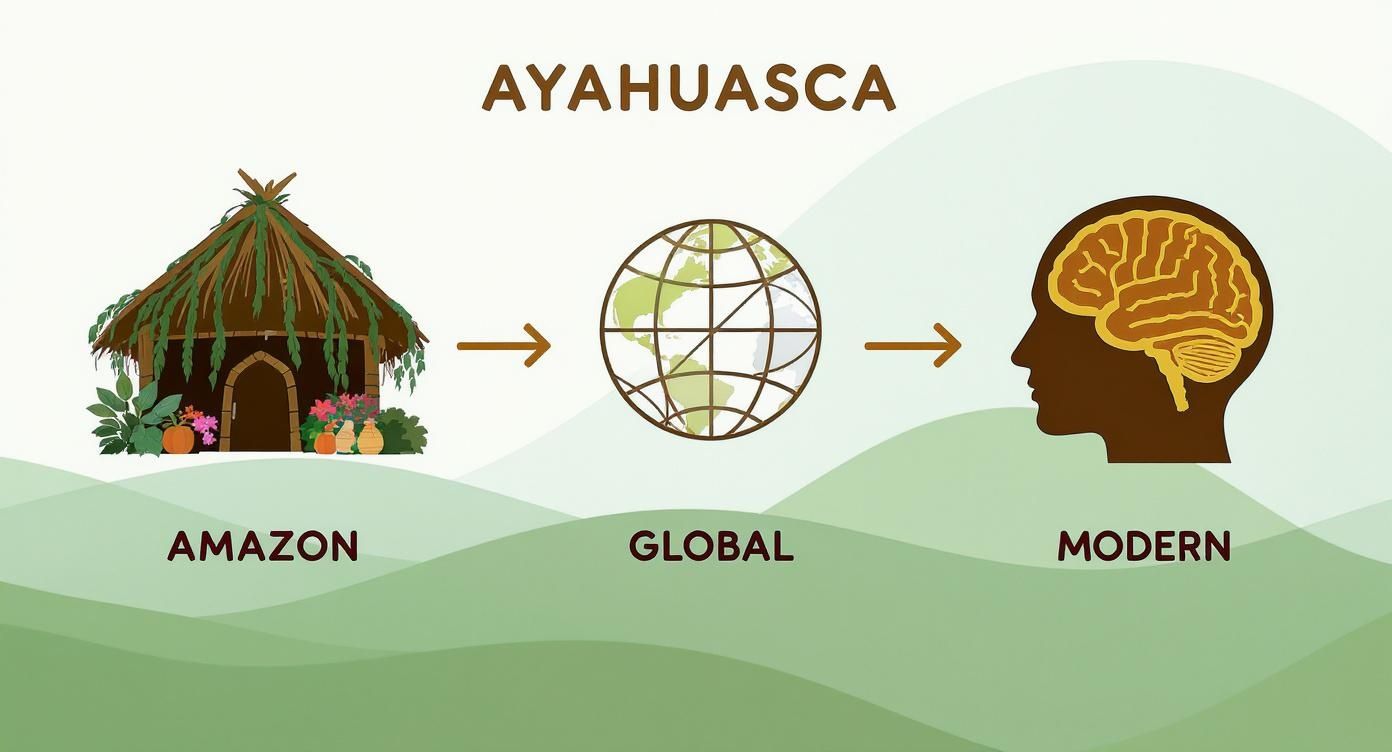
This journey from jungle huts to modern retreat centers shows how this ancient practice is adapting to meet the needs of people today, blending tradition with a contemporary understanding of healing.
Opening the Sacred Space
The ceremony actually begins well before anyone drinks the medicine. The facilitator will first prepare the ceremonial space—often a round hut called a maloca—by cleansing it with the smoke of mapacho (sacred jungle tobacco) or palo santo. This isn’t just for show; it’s a way of setting a strong energetic boundary, creating a protected bubble for the night’s journey.
You’ll find your spot, which is usually a mat or mattress with a blanket and a bucket. The facilitator then officially opens the ceremony, often sharing a few words about intention, showing respect for the medicine, and the importance of surrender. This is your moment to get centered, connect with why you’re there, and commit to the process.
Drinking the Medicine and the Onset
One by one, each participant is called up to receive their cup of Ayahuasca. The brew itself is notoriously earthy and bitter. It’s a medicine, not a cocktail. You drink it down and return to your mat, settling into the quiet darkness as you wait for it to take effect.
The onset can take anywhere from 20 minutes to over an hour. The first signs are often subtle shifts in your senses. Sounds might become clearer, or you might start seeing faint geometric patterns behind your closed eyes. It’s a slow launch, like a ship pulling away from the dock and heading out to sea.
The facilitator’s presence is key during this time. They are holding the energetic container for the group, often singing the first icaros to gently welcome the spirit of the plant and guide everyone’s energy as the effects start to build.
The Main Experience: The Journey Within
This is the heart of the ceremony, where the visions, emotions, and insights are most intense. There’s a reason they call Ayahuasca the “Vine of the Soul”—it can take you into the deepest corners of your psyche, bringing up old memories, powerful emotions, and profound truths.
The journey is navigated almost entirely by the icaros. These sacred songs are far more than just music. They are powerful energetic tools the shaman uses to direct the healing, clean the energy in the room, and keep everyone safe. In the middle of a powerful experience, the sound of the icaro can feel like a lifeline.
During this phase, it’s common to experience:
- Intense Visions: You might see anything from swirling geometric patterns to full-blown, movie-like scenes from your past or involving symbolic figures.
- Emotional Release: Deep-seated feelings like grief, anger, fear, or pure bliss can come to the surface. Crying is common and is seen as a healthy and welcome release.
- Physical Purging: Known as La Purga, vomiting or diarrhea is considered a fundamental part of the healing process. It’s viewed as a deep cleanse, not just of physical toxins, but of negative energy and emotional burdens. It might sound scary, but almost everyone reports feeling incredibly light and renewed afterward.
The Closing and Gentle Return
After several hours, as the peak effects of the medicine start to fade, the shaman will begin the process of closing the ceremony. The energy in the room will soften. The icaros often become gentler, guiding you back from the deep inner space you’ve been exploring.
The official closing might include a final blessing or a song of gratitude. The lights might be turned up slowly, and there’s usually a period of quiet reflection before people are encouraged to talk. Many ceremonies conclude with a light, grounding meal of fruit or soup. The intense part of the voyage is over, but the real work of integration is just beginning.
For more details on what you can do to get ready, we offer a complete overview on preparing for your Ayahuasca journey in our guide.
Exploring the Potential for Deep Healing
So, why would anyone sign up for such an intense, often difficult, experience? The answer, for many, is the profound healing that can happen. People don’t just talk about the visions or the purge; they talk about a fundamental shift in how they see themselves and the world, leading to healing that actually sticks.
It’s often described as a decade of therapy packed into a single night. Ayahuasca has a way of bringing up everything you’ve pushed down—old memories, deep-seated emotions, and behavioral patterns you didn’t even know were running the show. But it doesn’t just dredge them up; it lets you look at them from a new, more objective perspective, giving you a chance to heal the real source of the problem.
Confronting Trauma and Emotional Wounds
One of the most powerful things people report is Ayahuasca’s ability to help with deep-seated trauma. For a lot of us, traumatic experiences create emotional knots—pockets of pain that are just too hard to touch in our day-to-day lives. The medicine can guide you back to those moments, not to re-traumatize you, but to create a safe space to finally let go of all the fear, grief, or anger that’s been stuck there for years.
This isn’t easy work, but the release can be incredibly liberating. It’s common to hear people say they feel like a massive weight has been lifted off their shoulders. This kind of emotional clearing is often linked to major relief from symptoms of PTSD, anxiety, and depression.
“Ayahuasca is like a medical team of specialists and surgeons. She sends out her team to analyze and treat each and every one of our conditions. Always working with love and gentleness, she tends to our wounds like a compassionate grandmother.”
This quote really gets to the heart of it. The experience isn’t meant to be a brutal ordeal. It’s more like a highly targeted, compassionate form of “soul surgery” that addresses exactly what you need.
Breaking Destructive Patterns
People struggling with addiction or other compulsive behaviors also find their way to Ayahuasca ceremonies. The experience can offer startlingly clear insights into what’s driving these patterns in the first place—often, it’s an unmet need or an old wound that you’ve been trying to soothe.
By showing you your own behaviors with total clarity, Ayahuasca can help break the cycle of shame and self-blame. It replaces it with a genuine understanding and the motivation to change. It’s not unheard of for someone to walk out of a ceremony and find they’ve completely lost the desire for a substance that used to have a hold on them.
Cultivating a Healthier Life
The work done in a ceremony doesn’t just stay in the maloca. It ripples out into your everyday life. Many people leave with a renewed sense of purpose and feel more connected to themselves, to others, and to the world around them. This shift often sparks a desire to make healthier, more conscious choices.
In fact, long-term participation in Ayahuasca ceremonies is linked to some pretty impressive improvements in overall well-being. One study found that regular participants reported fewer chronic diseases and had healthier habits than the general population. In addition, a staggering 99% felt happier, more optimistic, attained greater self-awareness, experienced increased peace and calmness, grew in confidence and self-respect, became more sociable and empathetic, and displayed better emotional control. You can read the details in the lifestyle study report.
This shows that the healing that starts in the ceremony often translates into real, tangible choices that build a more vibrant life. At its core, the therapeutic power of Ayahuasca seems to lie in its ability to reconnect you with your own inner wisdom, empowering you to take charge of your own healing journey.
Understanding the Risks and Safety Measures

While the stories of healing are compelling, we need to talk seriously about the risks. Ayahuasca is powerful medicine, and it’s simply not for everyone. The single most important part of this journey is putting safety first, which means going in with your eyes wide open to the potential physical and psychological challenges.
This isn’t something to jump into lightly. It demands honest self-reflection and complete transparency with any facilitator or retreat you consider. A rigorous medical and psychological screening isn’t just a formality—it’s your first and most vital safeguard.
Critical Medical Contraindications
The biggest physical danger with ayahuasca comes down to chemistry. The brew contains a potent monoamine oxidase inhibitor (MAOI), and if that MAOI interacts with certain medications, the results can be catastrophic.
This is particularly true for antidepressants like SSRIs (Selective Serotonin Reuptake Inhibitors). Mixing these with ayahuasca can trigger a life-threatening condition called serotonin syndrome, which is essentially a toxic flood of serotonin in the brain. It’s a medical emergency.
Here are the absolute non-starters:
- Antidepressants: SSRIs, SNRIs, MAOIs, and tricyclics are all off-limits. You must work with your doctor to safely taper off and allow for a washout period of several weeks for the medication to completely leave your system.
- Heart Conditions: Anyone with a history of heart problems, high blood pressure, or cardiovascular disease is at risk. Ayahuasca can significantly affect heart rate and blood pressure.
- Psychiatric Conditions: A personal or family history of psychosis, schizophrenia, or bipolar disorder is a major red flag. An ayahuasca experience can potentially trigger a psychotic break or worsen these conditions.
“It is absolutely essential to be 100% honest about your entire medical history and every single medication or supplement you take. Hiding something could have devastating consequences. Any reputable facilitator will insist on a meticulous screening process for exactly this reason.“
The Importance of the Preparatory Dieta
Beyond medications, your physical prep involves a special diet, or “dieta,” for at least a week leading up to the ceremony. Think of this less as a spiritual suggestion and more as a non-negotiable safety protocol.
The dieta eliminates foods high in an amino acid called tyramine. When tyramine meets an MAOI, it can cause a hypertensive crisis—a sudden, severe spike in blood pressure. Sticking to the diet cleanses your body and dramatically reduces this physical risk. To get it right, you’ll want to study the comprehensive lists of foods and meds to avoid with MAOIs.
Understanding the Psychological Risks
The journey inward can be just as intense as the physical one. Ayahuasca has a way of bringing deeply buried emotions and traumas to the surface, and the experience can feel incredibly raw and overwhelming.
If you don’t have the right support, this can lead to what’s sometimes called a “spiritual emergency.” This is a state of psychological crisis where you might feel completely lost, terrified, and unable to make sense of your experience. This is precisely why the skill of the facilitator and the safety of the container they create are so critical.
An experienced guide knows how to hold space, navigate participants through turbulent waters, and provide grounding when things get too intense. It’s also why choosing a retreat that offers solid integration support after the ceremony is crucial for helping you safely process everything that comes up.
How to Find a Safe and Ethical Retreat
With the explosion of interest in Ayahuasca ceremonies around the world, the number of places offering it has skyrocketed. This boom makes choosing the right retreat—one that is safe, ethical, and led by qualified people—more critical than ever. The quality of your experience, and more importantly, your safety, rests entirely in the hands of the people guiding you.
Navigating this space takes real diligence. A slick website and a few five-star reviews are just the surface. You have to dig much deeper to find a center that truly operates with integrity, respects the tradition, and genuinely cares for the people who walk through their doors.
Vetting Facilitators and Their Lineage
The single most important element is the experience and training of the facilitator, or shaman. Don’t ever hesitate to ask pointed questions about their background. A guide worth their salt will be completely open and transparent about their path with the medicine.
Here’s what you need to find out:
- Where did they train? Look for people who have gone through long, intensive apprenticeships under a recognized lineage. This isn’t something you learn in a weekend workshop; it often takes many years.
- How long have they been serving medicine? There is no substitute for experience. You want someone who has held space for hundreds of people through countless ceremonies.
- What is their relationship with the medicine? A true facilitator sees themselves as a humble servant to the plant spirit. They aren’t gurus, rockstars, or enlightened masters.
Be very cautious of anyone who makes grand promises, seems fixated on money, or pressures you to book immediately. Real healers work from a place of humility and service, not ego.
Essential Safety and Support Protocols
A safe retreat is prepared for anything and everything. This isn’t just about the spiritual side of things; it’s about having practical, real-world emergency plans in place. An ethical center puts your well-being at the absolute top of its priority list.
“A reputable retreat center will have a comprehensive screening process to ensure Ayahuasca is safe for you. They should ask detailed questions about your physical and mental health history, as well as any medications you are taking. This is a non-negotiable sign of a responsible operator.“
Look for these non-negotiable safety measures:
- Thorough Medical Screening: They must have a detailed intake process to screen for any potential contraindications. No exceptions.
- Small Group Sizes: Smaller groups, usually under 15 people, allow facilitators to give each person the attention and support they need.
- Sober and Present Facilitators: The guides and all their helpers must be completely clear-headed and fully present for the entire ceremony.
- Integration Support: The real work often begins after the ceremony ends. A quality retreat will offer structured support to help you make sense of your experience and integrate it into your life.
Understanding the Legal and Ethical Landscape
Finally, you have to think about the legal and ethical side of your decision. While Ayahuasca is now a global phenomenon, its legal status varies wildly from one country to another. In places like Brazil, Peru, and Colombia, it’s a recognized and legal part of ceremonial and religious life. In the United States, however, it remains broadly illegal except for a few specific religious groups. This rapid commercialization also brings up serious ethical and environmental questions, making your choice of a responsible facilitator even more important.
The most responsible path is to choose a retreat in a country where the practice is legal and deeply rooted in the culture. It’s also important to ask about the center’s relationship with the local community and their sustainability practices. The best retreats honor the medicine’s origins and actively give back to the cultures that have stewarded it for generations.
Common Questions About Ayahuasca Ceremonies
Even with all the information out there, it’s natural to have a few lingering questions before considering an Ayahuasca ceremony. Let’s address some of the most common ones that come up for first-timers and the simply curious.
Getting clear, direct answers to these questions can help you move from a place of uncertainty to one of grounded understanding.
Is Ayahuasca Addictive?
The short answer is no. Ayahuasca isn’t physiologically addictive in the way substances like opioids or nicotine are. It doesn’t create a physical dependency or lead to compulsive, repeated use.
In fact, the experience is often so intense—both physically and emotionally—that most people feel no desire to do it frequently. It’s seen as deep, intentional work, not a recreational escape. If anything, the opposite is often true; many people turn to Ayahuasca ceremonies to help break free from addictions to other substances, using the insights gained to heal the root causes of their dependency.
What Is the Purpose of Purging?
Purging, or “La Purga” as it’s known in traditional circles, is a very common and expected part of the Ayahuasca experience. While the thought of vomiting or diarrhea in a ceremonial setting can sound intimidating, it’s viewed as a deeply positive and powerful form of release.
Think of it less as being sick and more as a profound cleansing that works on multiple levels. The medicine is helping your body expel things that no longer serve you, such as:
- Stuck Emotions: Releasing pent-up grief, anger, or fear that you’ve been carrying.
- Energetic Baggage: Clearing the residue from past traumas or negative life experiences.
- Limiting Beliefs: Shedding old mental patterns and self-critical thoughts.
It’s almost a universal report from participants that they feel incredibly light, clear, and relieved afterward. It’s a physical sign that the spiritual and emotional “house cleaning” is really working.
“A helpful way to think about it is an energetic and emotional reset. It’s like your system is clearing out old, corrupted files to make space for new, healthier software to run.“
Why Is Integration So Important?
If the ceremony is the spark, integration is the fire that keeps burning long after you’ve left the retreat. It’s the deliberate process of taking the insights, visions, and emotional breakthroughs from your journey and actually applying them to your daily life.
The ceremony can show you the door to a new way of being, but integration is the work of walking through it and living there.
Without this conscious effort, those profound revelations can quickly fade, becoming just a memory of a strange dream rather than a catalyst for real change. The most powerful shifts don’t just happen during those few hours in the ceremony space; they happen in the weeks and months that follow.
Good integration is an active practice and might include:
- Journaling: Writing down your experience to explore its meaning without judgment.
- Therapy or Coaching: Working with a professional who can help you make sense of it all.
- Lifestyle Adjustments: Making real-world changes to your habits, relationships, or career based on what you learned.
- Mindfulness and Nature: Using practices like meditation to stay connected to the clarity you found.
This is why any reputable retreat will place a huge emphasis on integration support. They know the ceremony only provides the blueprint; integration is how you actually build the new life you envision.
Disclaimer: The information provided on Ayahuasca.com is for educational purposes only and is not intended as medical advice, diagnosis, or treatment. Ayahuasca is a powerful traditional Amazonian medicine and may not be suitable for everyone. Always consult with a qualified healthcare professional before making decisions related to health, mental well-being, medications, or the use of Ayahuasca.