
Imagine you’re holding a key. Not a metal one, but one made of sound, capable of unlocking the deepest parts of your mind and spirit. In the world of Amazonian shamanism, that key is called an icaro.
These aren’t just songs. To call them that would be like calling a surgeon’s scalpel just a knife. They are living, breathing energetic tools used by healers during Ayahuasca ceremonies to navigate the spiritual landscape, offering guidance, healing, and protection.
So, What Exactly Is an Icaro?
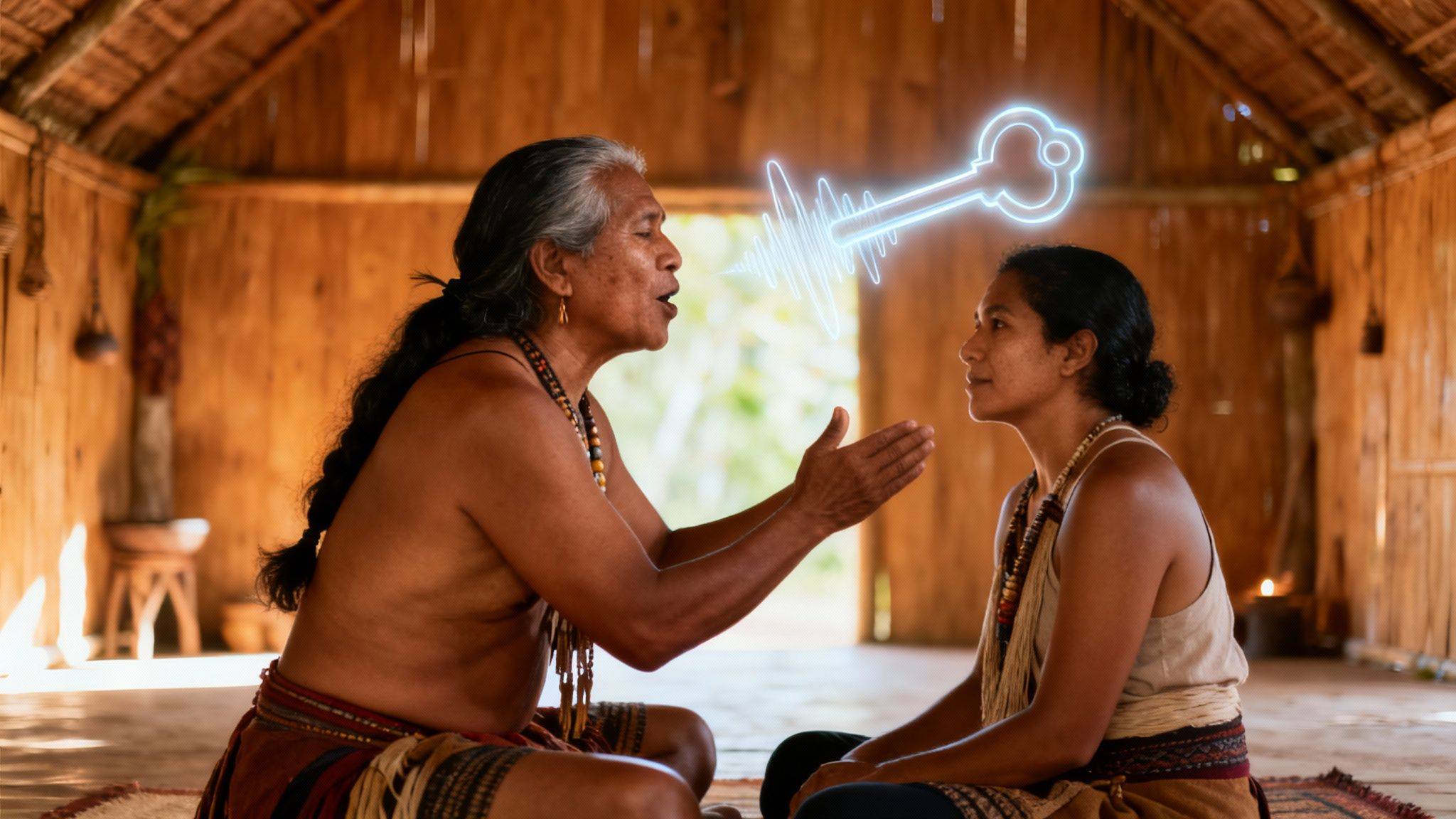
While the simplest translation is “sacred song,” it barely scratches the surface. A better way to think of an icaro is as a sonic prescription.
A doctor might give you a specific medicine to treat a physical illness. In the same way, a shaman or healer—a curandero—sings a specific icaro to address an emotional wound, a spiritual block, or a psychological pattern. Each melody is a unique tool, a vibrational formula received directly from the spirits of the plants and the natural world.
A Technology of Sound and Spirit
At their core, icaros are a bridge. They connect our ordinary, physical reality with the vast, spirit-filled dimensions that open up during an Ayahuasca ceremony. The healer’s voice becomes a conduit, a direct line to the spirits, calling them in to assist, teach, and protect.
The sound waves themselves are how a healer manages the energy of the room and helps people navigate their own profound, and sometimes challenging, inner worlds.
“Think of an icaro as the language of the plant spirits, translated into human sound. It’s more than music; it’s a direct conversation with the consciousness of nature itself, channeled through the healer.”
The true power of an icaro isn’t just in the words or the tune. It’s in the intention, the vibration, and the spiritual force the healer has cultivated through years of training and dieting with the plants. This is why the person singing, and the lineage they come from, matters so much.
Why Icaros Are the Heart of the Ceremony
Trying to have an Ayahuasca ceremony without icaros would be like trying to sail a ship in a storm without a rudder. It would be chaotic, ungrounded, and potentially unsafe. Icaros provide the very structure and energetic container needed for deep work to happen.
They serve several critical functions all at once:
- Setting the Space: Icaros are used to open the ceremony, maintain a protected energetic field, and formally close the circle at the end. They create a sacred bubble.
- Navigating the Visions: The rhythm and flow of the melody act like a sonic compass, giving participants an anchor as they journey through the often kaleidoscopic visions Ayahuasca can bring.
- Directing the Healing: A healer can focus the energy of an icaro on one person to perform a spiritual cleansing, known as a limpieza, pulling out dense or negative energy.
- Calling in Allies: Specific icaros act as a call to powerful spirit allies and protectors, ensuring the safety and integrity of the ceremonial space.
In the end, icaros are the lifeblood of the ceremony. They are the technology that turns sound into a vessel for real, tangible spiritual healing. Understanding their central role is the first, most important step toward respecting the depth and power of this ancient tradition.
The Cultural Roots and Ancient Lineages of Icaros
To really get what an icaro is, you have to look past the melody and into its soul—the deep, fertile ground of the Amazon rainforest where it was born. These sacred songs aren’t new creations. They are the living, breathing voices of ancient traditions, handed down through countless generations of Indigenous healers. They simply can’t be separated from the cultural world that birthed them, a world where spirit and nature are one and the same.
The origins of icaros are woven into vegetalismo, a traditional healing system practiced by many cultures across the Amazon basin. Think of it as much more than just herbalism; it’s a complete worldview. In this world, every plant, every animal, every river has a spirit, a consciousness that a healer can learn to communicate with. The songs are the language of that communion.
The Sacred Art of Transmission
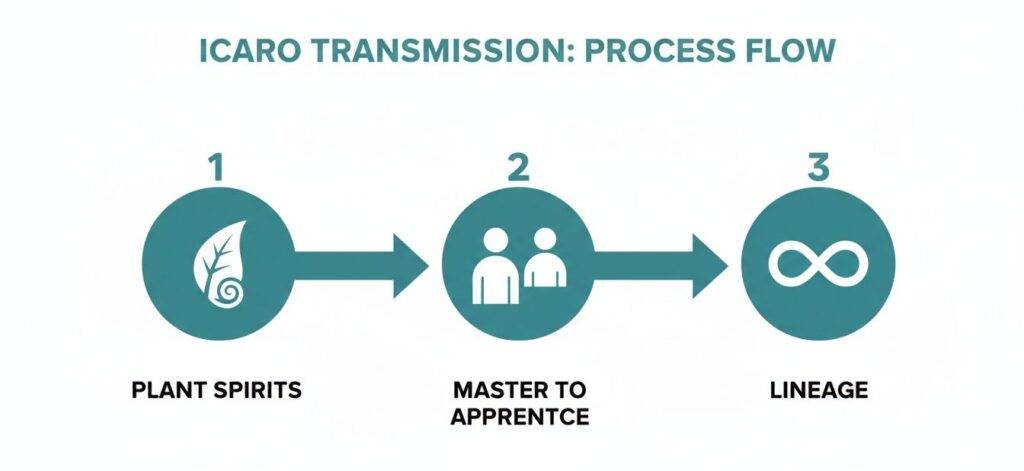
In our modern world, we write things down. We store knowledge in books and on hard drives. The wisdom of icaros isn’t like that. It’s an oral tradition, passed directly from a master healer—a maestro or maestra—to an apprentice in a demanding, sacred process. This isn’t just about memorizing words; it’s an energetic inheritance.
An apprentice might spend years, sometimes even decades, training under a master. The journey requires intense spiritual discipline and a direct connection to the source of the songs: the plant spirits themselves.
- Spiritual Diets (Dietas): Apprentices go into long periods of isolation in the jungle, following a very strict diet. This process is designed to sensitize their bodies and spirits, opening them up to receive the teachings of the plants.
- Direct Reception: It’s understood that the plants themselves “give” or “teach” the icaros to the person on the dieta. The song is a direct gift, a tool granted by the spirit of that plant.
- Energetic Imprint: When a healer receives an icaro, they are also receiving the spiritual power and the entire lineage connected to it. It becomes a part of their very soul.
This painstaking process ensures the integrity and power of the icaro remain intact. To learn an icaro is to accept a profound responsibility. You become a steward of a specific healing energy and the ancient line it comes from.
Diverse Lineages and Energetic Signatures
Just as the Amazon is home to a dizzying number of plant species, it’s also home to many different Indigenous groups, each with its own unique spiritual practices. Historically, icaros are a core part of the vegetalismo tradition, which continues to be a primary healthcare system for hundreds of thousands in the Amazon. For many, its culturally-grounded healing is far more relevant than Western medicine. Studies have even confirmed that the musical and symbolic qualities of icaros are vital for creating a therapeutic environment during Ayahuasca ceremonies.
“An icaro is not merely learned; it is earned. It is the culmination of immense personal sacrifice, deep listening, and a sacred pact made between the healer and the spirits of the Amazon.”
This diversity shines through in the icaros themselves. Different traditions, like the Shipibo-Conibo, Asháninka, or various Mestizo lineages, all have their own distinct styles and songbooks. The Shipibo, for instance, are famous for their intricate melodic patterns, which are said to be the sonic expression of the geometric designs you see in their textiles and pottery. You can learn more about the specific Indigenous groups that traditionally use Ayahuasca.
Each lineage carries its own unique energetic signature. A song from one tradition might be for calling the spirit of a specific tree, while an icaro from another might specialize in clearing deep emotional trauma. For an experienced listener, these subtle differences are palpable. Each song is like a key, tuned to a very specific spiritual frequency. Acknowledging these roots is the first step in approaching this sacred art with the respect it commands.
The Role of Icaros Inside an Ayahuasca Ceremony
Forget thinking of icaros as just background music for a ceremony. That’s not what they are at all. Icaros are the active, intelligent force that actually steers the entire healing journey.
Imagine the healer as a spiritual surgeon and the icaros as their specialized instruments. Each song is chosen with incredible precision, sung at a specific moment to produce a very particular energetic effect. They are the sonic compass that helps participants navigate the vast inner worlds that Ayahuasca opens up.
Opening the Space and Weaving Protection
A ceremony doesn’t just start—it’s deliberately and carefully opened. The healer begins by singing specific icaros to create a safe, energetically sealed container for the work to come. This is often called an arcana, which is essentially a protective shield woven from sound. This sonic barrier keeps disruptive energies out and calls in supportive spiritual allies.
This first step is absolutely crucial. It establishes the sacred space where people can feel secure enough to let go and fully surrender to their experience.
Navigating the Journey with Sound
Once the ceremony is underway, the healer tunes into the energy of the room and each individual. They become a vigilant guide, using icaros to manage the flow of the experience in real-time.
If someone is getting lost in a difficult vision or overwhelmed by fear, the healer might sing a specific icaro to soothe their energy, bring them back to their breath, or wrap them in a feeling of protection. The melody acts like a lifeline, a thread of coherence in what can feel like a chaotic state.
On the other hand, if a person is holding onto a deep energetic blockage, the healer can direct a song toward them to perform a limpieza, a spiritual cleansing. The vibrations of the icaro work to break up and clear dense, heavy energies, helping the person release old trauma or emotional baggage.
This diagram shows how this sacred knowledge is passed down, originating from the plant spirits themselves and carefully preserved through master-apprentice training within a lineage.
A Purposeful Orchestration of Energy
The strategic use of icaros isn’t random; it follows a clear structure throughout the ceremony. This careful orchestration is what makes the journey feel guided, safe, and deeply effective.
The table below breaks down the primary functions of icaros at the key stages of a ceremony.
Functions of Icaros During an Ayahuasca Ceremony
| Ceremonial Stage | Type of Icaro | Primary Function and Purpose |
|---|---|---|
| Opening | Arcana Icaro | Creates a protective energetic field, calls in spirit allies, and formally opens the sacred space. |
| Middle | Navigational & Healing Icaros | Guides participants through visionary states, provides comfort during challenges, and facilitates emotional release. |
| Cleansing | Limpieza Icaro | Performs targeted energetic cleansing on individuals, removing spiritual or emotional blockages. |
| Closing | Closing Icaro | Gently grounds the energy, thanks the spirits for their assistance, and formally closes the sacred container. |
This methodical approach is the heart of the tradition. Icaros are selected with immense presence and skill, responding directly to the unfolding needs of the group. The entire Ayahuasca experience itself is profoundly shaped by this sonic architecture.
An icaro is a tool of energetic surgery. A healer uses its vibration to precisely cut away what is no longer needed, mend what is broken, and realign the spirit with its true nature.
At the end of the day, icaros are both spiritual and therapeutic tools that make deep healing possible. This tradition is alive in countless Indigenous cultures across the Amazon. Healers might sing in Spanish, Quechua, Shipibo, or other languages, but the intent is the same: to work in harmony with the medicine.
From opening the space to navigating the deepest visions and finally closing the circle, icaros are the very technology of transformation within the ceremony. They are, in essence, the voice of the medicine singing people back home to themselves.
Understanding the Sounds and Structure of Icaros
To an outside ear, an icaro can sound like a simple, even repetitive, melody. But if you listen closely, you start to hear its true nature: a complex and deeply intentional sonic technology, crafted for serious spiritual work. These sounds aren’t just notes on a scale; they’re energetic codes, and each one has a job to do.
The very structure of an icaro is a reflection of the Amazonian world it comes from. You can hear the jungle in its melodies—the whisper of wind through the canopy, the steady rhythm of a flowing river, the specific calls of birds and other animals. These aren’t just artistic choices; they are the literal echoes of the plant and animal spirits the shaman is working with.
The Melodic Patterns and Rhythms
Many icaros are built on a cyclical or spiraling pattern. This structure is designed to gently pull participants into a trance-like state, helping them journey deeper into their own consciousness. The rhythm is rarely static, often shifting from a slow, comforting lullaby to a powerful, fast-paced chant.
A healer might speed up the tempo to help someone push through a tough emotional block, or they might slow everything down to bring a sense of safety and grounding. This dynamism is what makes the icaro so effective. It’s a living song that adapts to the energy in the room, making it an incredibly flexible tool for guiding the ceremony.
Languages of the Spirit
The lyrics of an icaro are just as vital as the melody. Many are sung in indigenous Amazonian languages like Shipibo or Quechua, which carry the ancient vibrational signature of the cultures that have held this knowledge for generations.
Interestingly, many icaros also feature vocables—sounds that don’t have a literal meaning or direct translation. Don’t mistake them for nonsense syllables. These are considered pure energetic frequencies, a direct line of communication from the spirit world that bypasses the thinking mind and speaks right to the soul.
“The power of an icaro often lies beyond words. Its vibration is a form of direct communication, a sonic key that unlocks cellular memory and spiritual understanding without needing intellectual translation.”
The Shipibo-Conibo tradition provides a stunning example of this. They believe their intricate songs are the audible expression of their famous geometric art, known as kené. You can learn more about this incredible synthesis in our article on the visual music of the Shipibo tribe.
Amplifying the Song with Sacred Tools
An icaro is almost never sung by voice alone. Healers use a whole toolkit of sacred instruments to focus and amplify the song’s healing power. These aren’t just props; they are essential parts of the energetic “prescription.”
Each tool adds a unique layer to the sound, boosting its potency and precision:
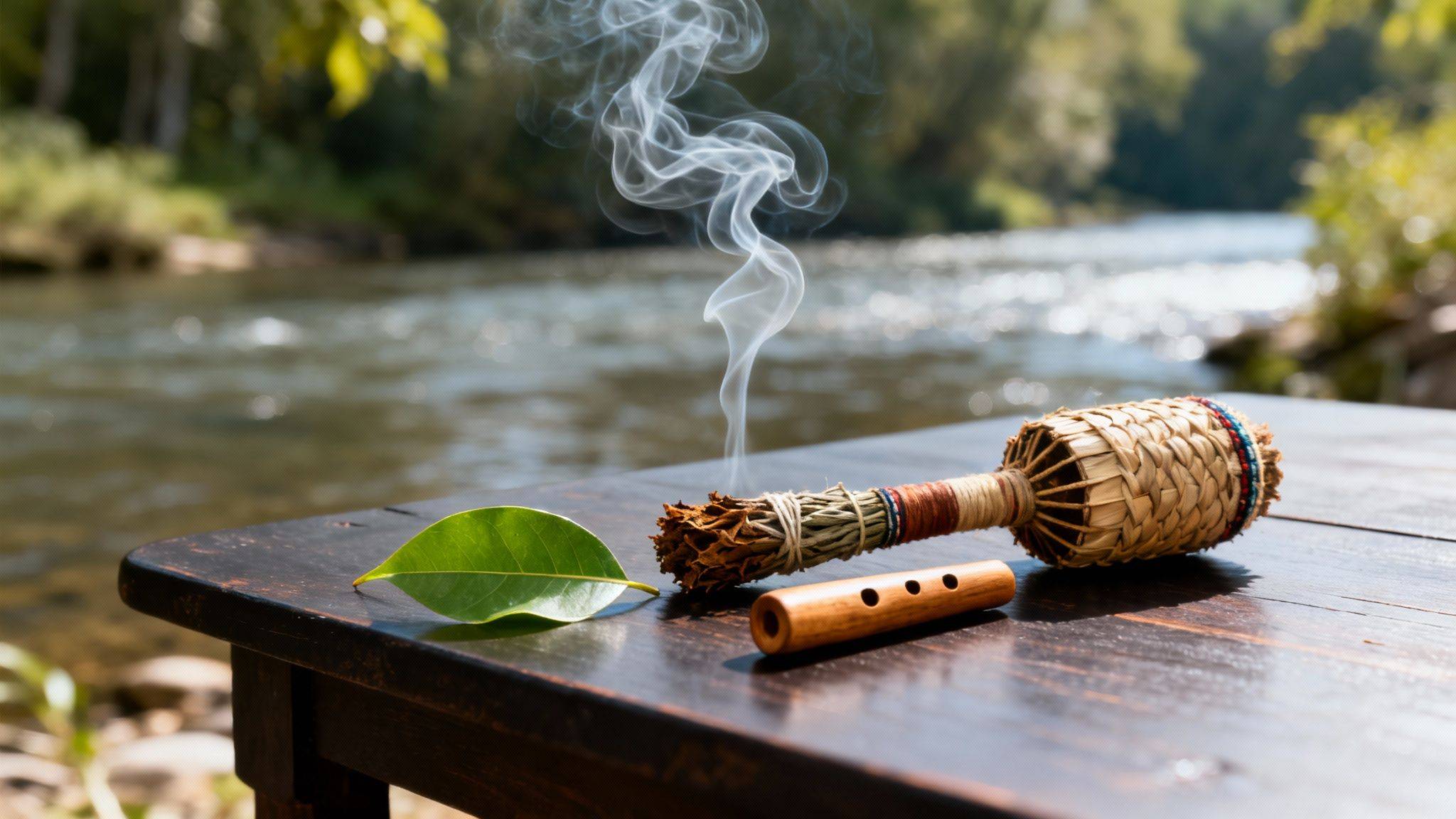
- Shacapa: This is a rattle made from bundled leaves. Its rustling sound is perfect for sweeping and clearing a person’s energetic field. The shaman will shake it in specific rhythms to brush away dense or stagnant energies.
- Whistles: Often carved from bone or wood, certain whistles produce high-frequency sounds that can slice through stubborn energetic knots. Think of them as a form of energetic scalpel used for very precise work.
- Sacred Tobacco (Mapacho): The smoke from mapacho is a powerful purifier used to cleanse the space and seal the healing. A healer might blow smoke over someone while singing, using it as a carrier to deliver the icaro’s intention deep into their energy body.
When you bring the voice, the rhythm, and these sacred tools together, you get a rich and powerful symphony of healing. This is the intricate sonic architecture that makes the icaro such an effective instrument for navigating the spiritual realms of an Ayahuasca ceremony.
How to Approach Icaros with Cultural Respect
As Ayahuasca finds its way from the Amazon into retreat centers around the globe, the sacred songs that guide its ceremonies—the icaros—are traveling with it. This journey opens up incredible avenues for healing, but it also demands that we engage with these ancient traditions with deep respect. Approaching icaros isn’t just about listening to a beautiful song; it’s about honoring an entire spiritual and cultural lineage.
The biggest pitfall to avoid is cultural appropriation. This is what happens when sacred elements are lifted from their original context, often for profit, without any real understanding, credit, or benefit flowing back to the source communities. True respect means treating icaros as the powerful, sacred tools they are—not as exotic products to be consumed.
The Problem with Turning the Sacred into a Product
When a sacred practice gets commercialized, its spiritual heart can be hollowed out. Think of someone selling recordings of icaros without permission or leading ceremonies without years of dedicated training under a legitimate teacher. This not only dishonors the tradition but can be genuinely unsafe for participants who aren’t being held in an authentic, protective energetic space.
This global spread is getting a lot of attention. The Global Ayahuasca Survey, a massive study involving over 10,800 people from more than 50 countries, underscores the urgent need for safety and ethical consideration as these practices move into new cultures. This means rigorous screening for participants and a profound respect for the traditions that keep everyone safe. You can explore the findings of this extensive global research on ayahuasca use for a deeper look.
“Reciprocity is the antidote to appropriation. It is the conscious act of giving back, ensuring that our personal healing contributes to the well-being of the communities who have stewarded this knowledge for generations.”
Your journey with this medicine shouldn’t be a one-way street. It should be a relationship built on mutual respect and a genuine desire to support the cultures that make this profound healing possible.
How to Vet Facilitators and Retreat Centers
Choosing where to drink Ayahuasca and experience icaros is one of the most critical decisions you’ll make. The best way to gauge the integrity of a facilitator or retreat center is to ask direct, thoughtful questions. Their answers (or lack thereof) will tell you everything you need to know about their relationship to the tradition.
Before you book anything, arm yourself with these questions. They’ll help you place your trust in capable, respectful hands.
Key Questions to Ask Your Facilitator
- What is your training and lineage? A facilitator with integrity will be happy to tell you who their teachers were, how long they trained, and what tradition they come from. If the answers are vague, that’s a major red flag.
- Do you have permission to share these icaros and practices? True practitioners receive explicit permission from their mentors to carry the work forward. It’s a fundamental sign of respect and right relationship.
- How do you practice reciprocity with the Indigenous communities you learned from? Look for concrete actions. Do they send money back to their teachers? Do they support community projects? Do they contribute to rainforest preservation?
- What is your approach to safety and screening? A responsible facilitator will have a thorough screening process to make sure you are mentally and physically prepared for such a powerful experience.
The Practice of Ayni: Sacred Reciprocity
In the Andes, there is a concept called ayni, which translates to “today for you, tomorrow for me.” It’s a foundational principle of reciprocity—a sacred exchange that keeps the community and the cosmos in balance. Bringing the spirit of ayni to your journey with Ayahuasca is a powerful way to walk in respect.
This doesn’t have to be complicated. It could mean donating to organizations that protect the Amazon or directly support the Indigenous communities who are the guardians of this medicine. It could also mean sharing what you’ve learned in a way that always gives credit to the source. By practicing reciprocity, you become part of a healthy cycle, helping ensure these sacred traditions can thrive for generations to come.
Your Icaro Questions, Answered
As more people seek out Ayahuasca, it’s natural for questions about its core traditions to come up. Let’s tackle some of the most common things people ask about icaros to clear up any confusion and help you appreciate these sacred songs even more.
Can Anyone Just Learn to Sing Icaros?
This is a great question, and the short answer is no, not in the traditional sense. Singing a true icaro isn’t like learning a song on the radio. It’s the culmination of a deep, years-long spiritual commitment, almost always through an apprenticeship with an experienced healer.
This journey involves intense personal work, including long periods of isolation and strict dietary protocols called dietas. The purpose of a dieta is to build a direct, personal relationship with the plant spirits. It’s believed that the spirits themselves are the ones who gift the songs to the healer. So, while anyone could mimic the melody, an icaro without that energetic connection and the permission of a lineage is seen as empty—a song without its spirit.
Are Icaros Ever Sung in English?
Traditionally, you’ll hear icaros in Amazonian languages like Shipibo or Quechua, or sometimes in the regional Spanish spoken there. This isn’t just for tradition’s sake; the specific words and sounds are believed to hold a certain vibration that’s essential for the healing work. The power is in the sonic frequency and spiritual intent, not whether you can understand the lyrics with your mind.
You might encounter Western facilitators who sing English songs inspired by their work with the medicine, and these can certainly be beautiful and heartfelt. However, within the traditional framework, they aren’t considered icaros because they don’t come from that direct cultural and spiritual transmission.
“The essence of an icaro transcends language. Its healing power is delivered through vibration and intention, speaking directly to the spirit rather than the intellect.”
What’s the Difference Between an Icaro and a Mantra?
It’s easy to see why people might group these together, as both use sound for spiritual purposes. But they come from entirely different worlds and are used in very different ways.
- Origin and Tradition: Mantras have their roots in Vedic and Buddhist traditions and are often chanted in Sanskrit. Icaros are born from the shamanic worldviews of the Amazon rainforest.
- Function and Application: A mantra is often a tool for personal practice—to focus the mind, honor a deity, or cultivate a specific inner state through repetition. An icaro is a shamanic tool used for a specific job during an Ayahuasca ceremony. Think of it as a spiritual instrument for calling in allies, cleansing heavy energy, or guiding someone through a difficult part of their vision.
Basically, you can think of a mantra as a way to tune your own internal state, while an icaro is what a healer uses to actively work on the spiritual and energetic landscape of the ceremony and the people in it.