
When you hear people talk about “bufo,” they’re almost certainly referring to the profound psychedelic experience that comes from the venom of the Incilius alvarius toad, better known as the Sonoran Desert Toad. The journey itself is powered by 5‑MeO‑DMT, one of the most potent naturally occurring psychoactive compounds on the planet.
Those who have experienced it often describe a complete, albeit brief, dissolution of the self—a total merging with everything.
What is the Bufo Alvarius Experience Really Like?
To get a real feel for the bufo experience, we need to look past the clinical definitions. Think of it less as a “trip” and more as a “cosmic reset button.” This analogy really hits home because of its sheer speed and intensity. Unlike a long, winding journey with psilocybin or Ayahuasca, the peak effects of bufo are lightning-fast, usually lasting just 15 to 30 minutes.
But don’t let the short duration fool you. The depth of the experience is staggering. It’s not about seeing colorful patterns or going on a narrative adventure. Instead, it’s a radical, fundamental shift in consciousness. Many describe it as a feeling of dissolving into a universal awareness or a state of pure, boundless being.
Where Does This Medicine Come From?
The psychoactive substance is found in the milky-white venom secreted from the parotoid glands of the Incilius alvarius toad as a defense mechanism. This venom is a complex mix of compounds, but the star player is 5-methoxy-N,N-dimethyltryptamine, or 5‑MeO‑DMT.
Here’s a look at the Sonoran Desert Toad, the only source of this powerful medicine.
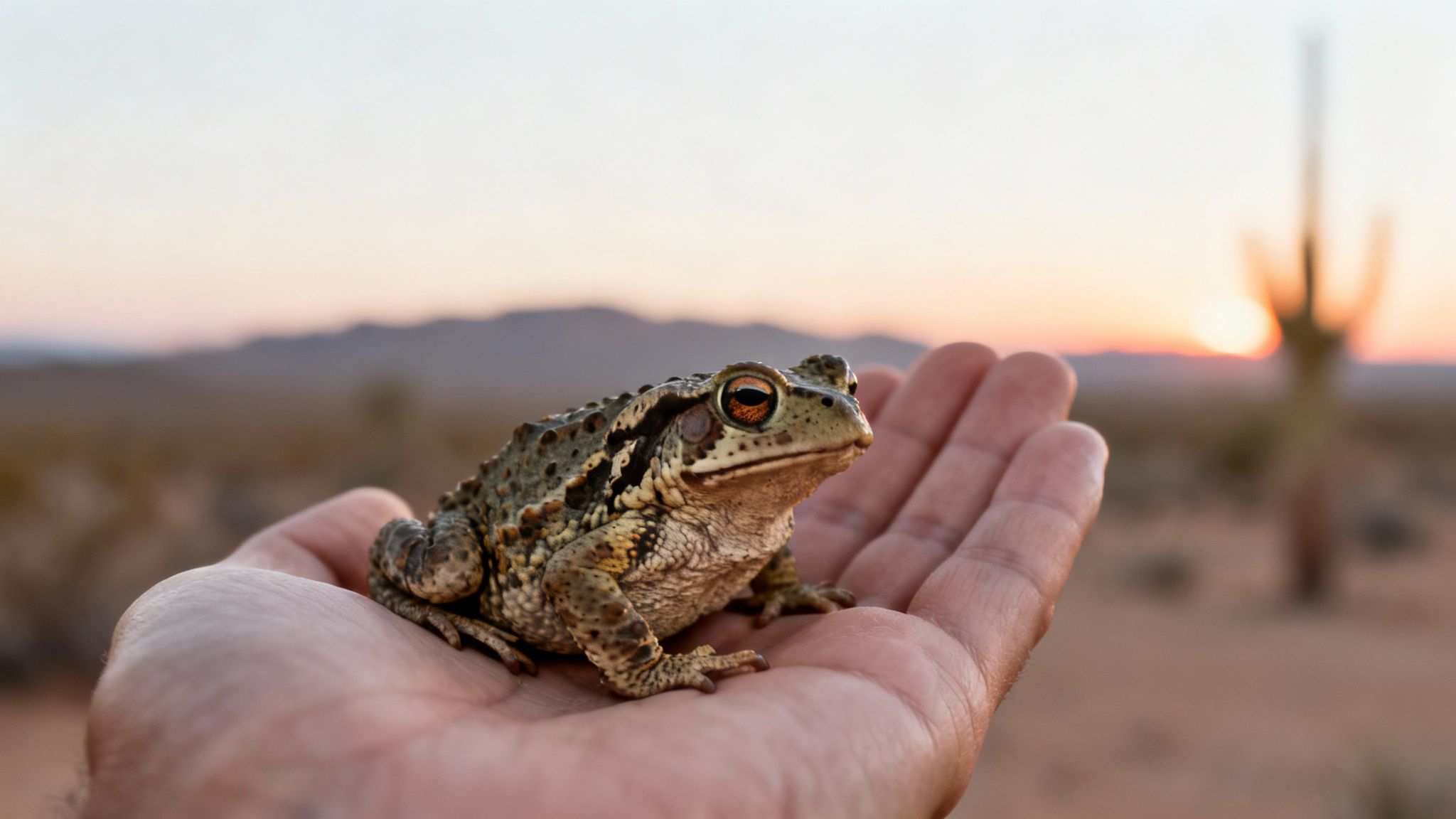
You can see the toad’s prominent parotoid glands located just behind its eyes. These are the glands responsible for producing the psychoactive secretion.
When done ethically, collecting the venom doesn’t harm the toad. The glands are gently “milked,” and the animal is immediately released back into its habitat. However, the explosion in bufo’s popularity has created serious conservation concerns, putting the toad population at risk. This makes ethical sourcing an absolutely critical conversation for anyone considering this path.
“My goal here is to give you a clear, no-nonsense foundation. I want to explain the core ideas in a way that makes sense, so you’re prepared for the deeper dive into its history, effects, and modern use.”
Getting Ready for What’s Next
To truly wrap your head around bufo, you have to look at it from a few different angles. Let’s build a solid base of understanding with these key points:
- It’s in a League of Its Own: Bufo is nothing like other psychedelics. It is not a party drug or a recreational substance. It’s an incredibly powerful tool for deep introspection and spiritual discovery.
- The Psychological Impact: The experience almost always involves a complete dissolution of the ego. For some, this is terrifying; for others, it’s the most liberating moment of their lives. For many, it’s both.
- Guidance is Non-Negotiable: Because of its sheer intensity, bufo should only be experienced in a safe, ceremonial setting with a trained, experienced, and responsible facilitator. Full stop.
This introduction should give you the essential knowledge to navigate the rest of this guide. You’ll feel grounded and informed as we explore the history, safety protocols, and crucial integration practices that come with the bufo experience.
The Ancient Roots and Modern Revival of Bufo Ceremonies
The story of Bufo is really a tale of two different worlds: a mysterious, ancient past we only see glimpses of in Mesoamerican art, and a very recent, explosive revival. While Bufo ceremonies are making headlines around the globe today, it’s crucial to understand that the modern practice isn’t part of a direct, unbroken line from any single indigenous tradition. Grasping this distinction is the first step to approaching this medicine with the respect and clarity it deserves.
When you dig into the history, you find some fascinating clues. Archaeologists have unearthed evidence suggesting that ancient cultures, like the Olmec and Maya, knew about the psychoactive power of toads. We see toad-like figures in their art and artifacts that hint at a sacred connection, though exactly how they used them is still being pieced together.
Traces in Mesoamerican History
Old accounts give us a clearer picture, showing that this knowledge wasn’t lost to time. For example, we know that as far back as the 16th century, the ancient Maya were adding potent substances from toad skins of the Bufo genus to their ritual drinks, mixing them with tobacco and alcohol to make them stronger. Records from that period mention the K’iche’ people, a Maya group, adding dried toad skins to their balché, a fermented ceremonial drink. You can learn more about these early Mesoamerican practices to get a better sense of their historical weight.
But here’s the key difference: this historical use is a world away from the modern practice of vaporizing the dried secretions of Incilius alvarius. Those ancient rituals probably involved different toad species and different ways of consuming them, which would have produced entirely different experiences.
“The modern Bufo ceremony as we know it is a contemporary phenomenon. It’s not an ancient tradition handed down for generations, but a practice that really only came into being in the late 20th century.”
Pointing this out isn’t to take away from the power of the experience. It’s about framing it correctly. This clarity helps us avoid mislabeling this medicine as an ancestral practice of a specific living culture, which is essential for engaging with it ethically.
The Modern Surge in Popularity
The global fascination with Bufo has absolutely skyrocketed in recent years, much like the rise of Ayahuasca retreats. People from every background imaginable are seeking out this intense experience for deep healing, personal insight, and spiritual connection. This boom has created a vibrant—but largely unregulated—scene of facilitators and retreats, mostly in Mexico and other parts of Latin America.
This rapid growth, however, comes with some serious ethical questions. Unlike Ayahuasca, which is deeply woven into the cultural and spiritual fabric of many Amazonian indigenous groups, the modern Bufo ceremony doesn’t have that kind of established cultural framework. This puts a much heavier burden on both the people serving the medicine and those receiving it to build a community centered on safety, respect, and integrity.
Understanding this unique modern history is non-negotiable for anyone feeling called to this medicine. It forces you to think critically: Where does this medicine come from? Who is serving it? What are the intentions behind the ceremony? This awareness helps you engage with the entire ecosystem—from the conservation of the toad itself to the ethics of the practice. It’s about taking a conscious approach that honors the medicine, its source, and your own journey.
Comparing the Bufo and Ayahuasca Journeys
When people begin exploring sacred medicines, Bufo and Ayahuasca are often the first two names that come up. While both are known for their profound, life-altering potential, the actual experiences couldn’t be more different. It’s crucial to understand these differences to know which path aligns with your own intentions.
Think of Ayahuasca as a long, winding conversation with a wise teacher. The journey is often deeply narrative, unfolding over many hours. People frequently report detailed visions, deep emotional processing, and symbolic encounters that feel like a decade of therapy in a single night. It’s a story you actively participate in, learning as it slowly reveals itself.
The Bufo experience, on the other hand, is like a lightning flash. It’s not a story; it’s a sudden, complete dissolution of the self into pure being. There are rarely complex visions or narratives. Instead, you’re plunged directly into a state of boundless awareness—a feeling often described as cosmic unity or a complete return to the source.
Speed and Duration
The most obvious difference is time. An Ayahuasca ceremony is a real commitment, typically lasting four to eight hours. The effects build gradually over the first hour and then roll in waves throughout the night. It’s a marathon for the spirit.
Bufo is a sprint. The effects are almost instantaneous, hitting within seconds of inhalation. The peak experience, while incredibly intense, lasts only 15 to 30 minutes. After this powerful peak, you gently float back to ordinary awareness over the next hour or so.
This infographic gives a great visual summary of Bufo’s history, showing its journey from ancient ritual to modern research.
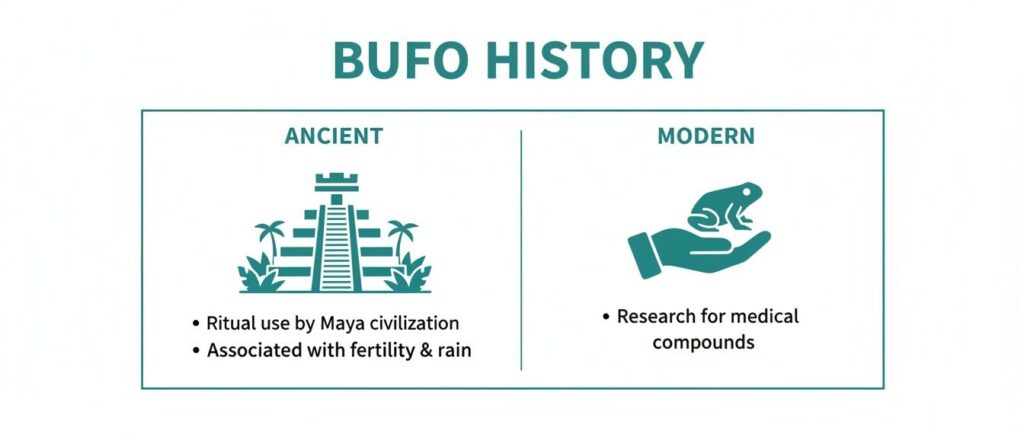
It really highlights the leap from its ancient ceremonial roots to the modern understanding of its potent medicinal compounds.
The Nature of the Experience
Ayahuasca can feel like a patient guide showing you your life through memories, metaphors, and feelings. The medicine has a knack for bringing deeply buried emotional material to the surface so it can finally be processed and healed. For a closer look at this process, you can learn more about the Ayahuasca experience and its story-like nature.
Bufo is more of a direct transmission that bypasses your personal story altogether. It is a profoundly non-dual experience, where the boundary between “you” and “the universe” simply evaporates.
“Many people describe the Bufo journey as experiencing the totality of existence in one breathtaking moment. It’s less about seeing things and more about being everything, without the filter of your personal identity.”
Here’s a quick breakdown of what that feels like:
- Ego Dissolution: While you can experience this with both, it is the absolute centerpiece of the Bufo experience. It’s a complete, if temporary, obliteration of the sense of self.
- Visuals: Ayahuasca is legendary for its rich, intricate, and deeply symbolic visions. Bufo, in contrast, is often an experience of pure white light or formless emptiness, with few, if any, geometric patterns.
- Emotional Content: Ayahuasca journeys often involve a “purge” of difficult emotions. The Bufo experience is frequently described as being beyond emotion—a state of pure, unwavering peace.
Bufo (5-MeO-DMT) vs. Ayahuasca (DMT) At a Glance
To make these distinctions even clearer, here’s a side-by-side comparison of the key characteristics of each medicine. This table can help you quickly grasp their fundamental differences.
| Characteristic | Bufo (5-MeO-DMT) | Ayahuasca (DMT) |
|---|---|---|
| Primary Source | Secretions from the Incilius alvarius toad. | A brewed tea of the Banisteriopsis caapi vine and other plants. |
| Active Compound | 5-methoxy-N,N-dimethyltryptamine (5-MeO-DMT). | N,N-dimethyltryptamine (DMT) combined with an MAOI. |
| Administration | Vaporized and inhaled. | Consumed as a tea. |
| Duration | 15-30 minute peak. | 4-8 hour journey. |
| Experience Type | Non-dual; dissolution into pure consciousness. | Narrative; emotional and psychological exploration. |
| Key Feature | Total ego dissolution; experience of unity. | Visionary journey; deep emotional processing. |
Ultimately, the choice between these two powerful medicines comes down to your personal intention. Are you looking to work through specific emotional patterns and life stories? Or are you seeking a direct experience of unity consciousness that transcends your personal identity? Answering that question is the first and most important step.
What a 5-MeO-DMT Journey Actually Feels Like
So, what can you really expect during a Bufo ceremony? Knowing the general arc of the experience isn’t about spoiling the mystery; it’s about building a solid container for yourself so you can surrender to the process with less fear. Let’s walk through the journey step-by-step, from the first inhalation to the gentle return.

The ceremony itself starts quietly. The facilitator prepares a carefully measured dose of the dried toad secretion, which is then vaporized for you to inhale. The effects are almost instantaneous—we’re talking seconds. This is a key difference from other psychedelics; there’s virtually no “come-up” or mental runway. Once you exhale, the journey is already beginning.
The Launch: Onset and Peak Experience
The initial moments are often described as an incredibly rapid acceleration, like a rocket ship leaving the atmosphere. Many people report hearing a powerful humming sound or feeling a full-body vibration as their awareness blasts past the normal boundaries of the self. This is the heart of the experience: ego dissolution.
Your sense of being a separate “I” with a name and a personal history simply dissolves. What rushes in to take its place is a profound, direct experience of unity with everything. You aren’t just looking at the universe; for a brief time, you are the universe. This peak state, which lasts roughly 15 to 30 minutes, is often described in a few common ways:
- Immersion in pure consciousness: A state of awareness without thought, emotion, or personal narrative.
- Infinite love and peace: An overwhelming feeling of being unconditionally held and connected to the fabric of existence.
- The “white light”: A common report of being absorbed into a brilliant, formless light that feels like the source of all creation.
“The experience is fundamentally non-dual. The line between you and the world outside vanishes. For those few minutes, there’s no “you” and “the universe”—there is only pure, unified existence.”
The Gentle Return and Lingering Afterglow
Just as quickly as it arrives, the peak intensity begins to recede. The return journey is typically soft and gentle, often feeling like you’re floating back down into your body and your sense of self. As your identity re-forms, you enter what’s known as the “afterglow.”
This phase, which can last for an hour or more, is usually marked by an incredible feeling of peace, mental clarity, and emotional vulnerability. Colors might seem brighter, and a deep sense of gratitude for life often surfaces. This is a crucial window for initial integration, where the profound, non-verbal insights from the peak experience start to settle into a new perspective.
The journey—marked by feelings of weightlessness, the distortion of time, and powerful visions—has parallels to the experience of other powerful medicines like Ayahuasca. Both can feel like a complete reset, a kind of death and rebirth. To understand the roots of these practices, you can explore the historical context of Mesoamerican entheogens and their sacred roles. It’s in this gentle afterglow that the real work begins, laying the foundation for integrating the experience into your daily life.
Your Safety Comes First: A Guide to Harm Reduction
When you’re considering a journey with Bufo, nothing is more important than your well-being. This isn’t something you do on a whim. Taking this medicine seriously means putting safety and harm reduction at the very top of your list. The first step is getting real about the risks involved, both for your body and your mind.
The single most critical thing to understand is how 5-MeO-DMT, the active compound in Bufo, can interact with other substances. Mixing it with certain prescription drugs can be incredibly dangerous—even fatal. Antidepressants, in particular, are a major red flag.
Medical and Psychological Screening
Before you even think about booking a ceremony, you need to do a completely honest inventory of your health. Some common medications can trigger a condition called serotonin syndrome, which is a life-threatening emergency caused by too much serotonin flooding your brain.
You absolutely must be aware of these medications:
- SSRIs (Selective Serotonin Reuptake Inhibitors) like Prozac, Zoloft, or Lexapro.
- SNRIs (Serotonin-Norepinephrine Reuptake Inhibitors) such as Cymbalta or Effexor.
- MAOIs (Monoamine Oxidase Inhibitors), which are sometimes prescribed for depression or Parkinson’s disease.
That’s not a complete list, by any means. It is absolutely crucial that you tell any potential facilitator about every single medication, supplement, or substance you take. For a more detailed look at these interactions, our guide on foods and medications to avoid with MAOIs is a great resource, as many of the same rules apply.
Your mental health history is just as important as your physical health. If you or your close family members have a history of psychosis, schizophrenia, or bipolar disorder, a Bufo ceremony is generally not a good idea. It can be profoundly destabilizing. Any safe, ethical facilitator will have a detailed screening process to catch these potential risks.
Finding a Safe and Ethical Facilitator
The recent explosion of interest in Bufo has created a completely unregulated space. You’ll find a lot of truly dedicated, experienced people out there, but you’ll also find some who are undertrained, unethical, or just in it for the money. Your safety literally depends on your ability to tell the difference.
Public interest has shot up, especially after people like Hunter Biden credited Bufo with helping them find sobriety. And with 1 in 5 U.S. adults currently dealing with mental health issues, it’s no surprise people are looking for answers. But it’s important to know that there’s no documented history of indigenous groups in Mexico or the U.S. using this medicine. Some marketers try to falsely link Bufo to ancient traditions like peyote or Ayahuasca, which is a serious ethical problem. You can discover more insights about this complex history and its modern context.
“Ultimately, the responsibility for choosing a safe space rests on you. A good facilitator will welcome your questions and answer them transparently. Your safety should always be more important to them than your money.”
When you’re looking into a facilitator or retreat center, approach it like you’re conducting an interview. Show up with a list of direct, specific questions that will help you understand their experience, ethics, and what they’ll do if something goes wrong.
Essential Questions for Any Bufo Facilitator
A facilitator who knows what they’re doing won’t have any problem answering these questions. If they get defensive, vague, or brush you off, that’s a huge red flag. Walk away.
- What’s your training and background? Ask them how long they’ve served this medicine, who their teachers were, and what their apprenticeship was like.
- What does your screening process involve? They should have a thorough intake form covering medical and psychological history and be able to clearly explain why certain conditions or medications are a no-go.
- What are your safety protocols? What’s the emergency plan? Are they trained in CPR and first aid? How do they handle a participant who is having a difficult physical or emotional crisis?
- Where does your medicine come from? An ethical provider will be open about their sourcing and show that they care about the conservation of the Incilius alvarius toad.
- What kind of integration support do you offer? The journey doesn’t just end when the effects wear off. A responsible facilitator will provide resources or guidance for the integration phase, which is where the real work often begins.
Deciding to work with Bufo is a massive decision. By making harm reduction your top priority, doing your homework, and asking the tough questions, you give yourself the power to make a smart choice that honors the medicine and, most importantly, yourself.
The Critical Role of Post-Ceremony Integration

The journey with Bufo doesn’t really end when the intense part of the experience subsides. In many ways, that’s when the real work begins. This next phase is called integration, and it’s all about weaving the profound insights and feelings from your ceremony into the fabric of your everyday life.
Think of it this way: without a conscious effort to integrate, the incredible sense of unity and clarity you touched can start to feel like a beautiful but fading dream. Integration is the bridge that connects that powerful, otherworldly experience back to your day-to-day reality, allowing it to create real, lasting change. It’s the process of making sense of it all and letting it inform how you live.
What Does Integration Look Like?
Integration isn’t a rigid, one-size-fits-all formula. It’s a deeply personal journey of grounding what you’ve learned. It’s completely normal to feel a bit disoriented or sensitive in the days and weeks after a Bufo ceremony as your sense of self reassembles, now with a whole new layer of information.
This is why gentle, mindful activities are so key. These aren’t just items on a to-do list; they are practices that help you continue the conversation with yourself that the medicine started. The idea is to create the time and space for those big lessons to land softly and really take root.
“The real measure of a powerful ceremony isn’t just the intensity of the experience itself, but how much of its wisdom you can successfully carry back and embody in your daily existence.”
This all takes time, patience, and a good dose of self-compassion. We’re aiming for sustainable growth, not a quick fix. Honoring this period with intention is what truly unlocks the long-term healing potential of the Bufo journey.
Practical Techniques for Grounding Your Experience
Having a few go-to practices can give you much-needed structure and support as you navigate the post-ceremony space. These techniques are designed to help you process emotions, unpack symbolic messages, and solidify your new perspective on life.
Here are some of the most effective methods people use:
- Journaling: Let it all out on the page. Write about the feelings, the visions, the wordless knowing. Don’t edit or judge it—just let it flow. This act of translating the experience into words can bring incredible clarity.
- Meditation and Mindfulness: A daily meditation practice can be a lifeline back to that quiet, centered awareness you tapped into. It helps you stay present and observe your thoughts without getting swept away by them.
- Nature Immersion: Spending quiet time in nature is one of the best ways to ground your energy. The natural world often mirrors that feeling of deep interconnectedness, gently reminding you of the ceremony’s core message.
- Working with a Specialist: An integration coach or a therapist who understands psychedelics can be a game-changer. They provide a safe container to explore what came up and offer tools to turn your insights into concrete action.
If you’re looking to go deeper, understanding the principles of psycho-integration can provide a helpful framework for making sense of it all. By dedicating real time and energy to these practices, you’re not just remembering an experience; you’re building your life on the foundation it provided.
Common Questions About Bufo
Let’s wrap things up by tackling some of the most frequent questions people have about bufo. Think of this as a quick-reference guide to clarify the key details you’ll need.
Are the Toads Harmed When the Venom Is Collected?
This is a huge and incredibly important ethical question. The good news is that when done correctly, the process is completely harmless to the toad.
A responsible facilitator will gently handle the Sonoran Desert Toad, carefully “milking” the venom from its parotoid glands before releasing it right back where they found it.
The problem is, the explosion in bufo’s popularity has created a dark side: unethical poaching and over-harvesting. This puts the toad population at serious risk. It’s absolutely crucial to only work with facilitators who are completely transparent about their sourcing and can show a real commitment to conserving the species.
What’s the Difference Between Bufo and Synthetic 5-MeO-DMT?
While both deliver the same core molecule, they aren’t exactly the same. The venom from the bufo toad is a natural cocktail. It contains 5-MeO-DMT as the main event, but it’s mixed with other alkaloids, most notably bufotenin. Many people feel this natural blend creates a more organic or holistic journey.
Synthetic 5-MeO-DMT, on the other hand, is just that—the pure, isolated molecule made in a lab. This means the dosage is incredibly precise and consistent, which is a major advantage in clinical research or therapeutic settings where predictability is key.
“Ultimately, people debate the subtle differences in the feel of the experience, but the bottom line is that both sources are profoundly powerful. The same exact safety rules, medical screening, and need for skilled facilitation apply whether you’re working with natural bufo or its synthetic counterpart.”
What’s the Legal Status of Bufo and 5-MeO-DMT?
This is where things get tricky, as the laws change dramatically depending on where you are in the world.
In the United States, 5-MeO-DMT is a Schedule I controlled substance. That puts it in the same category as heroin and LSD, making it illegal to possess, sell, or use under federal law.
Many bufo ceremonies happen in Mexico, where the law is much more of a gray area, especially when it’s used in a spiritual or cultural context. Before even considering a ceremony, you must research the specific laws for that country or region. Getting involved with this medicine where it’s illegal comes with serious legal consequences. Always put your safety and freedom first.
Disclaimer: The information provided on Ayahuasca.com is for educational purposes only and is not intended as medical advice, diagnosis, or treatment. Ayahuasca is a powerful traditional Amazonian medicine and may not be suitable for everyone. Always consult with a qualified healthcare professional before making decisions related to health, mental well-being, medications, or the use of Ayahuasca.