
When you start typing “ayahuasca retreat near me” into a search bar, you’re not just looking for a location on a map. You’re beginning a much deeper journey, and the first step is finding a safe and reputable center. This means prioritizing medical screening, facilitator experience, and legal standing over simple convenience.
Often, the best retreat isn’t the closest one; it’s the one most genuinely committed to your well-being.
Your Guide to Finding a Safe Local Retreat
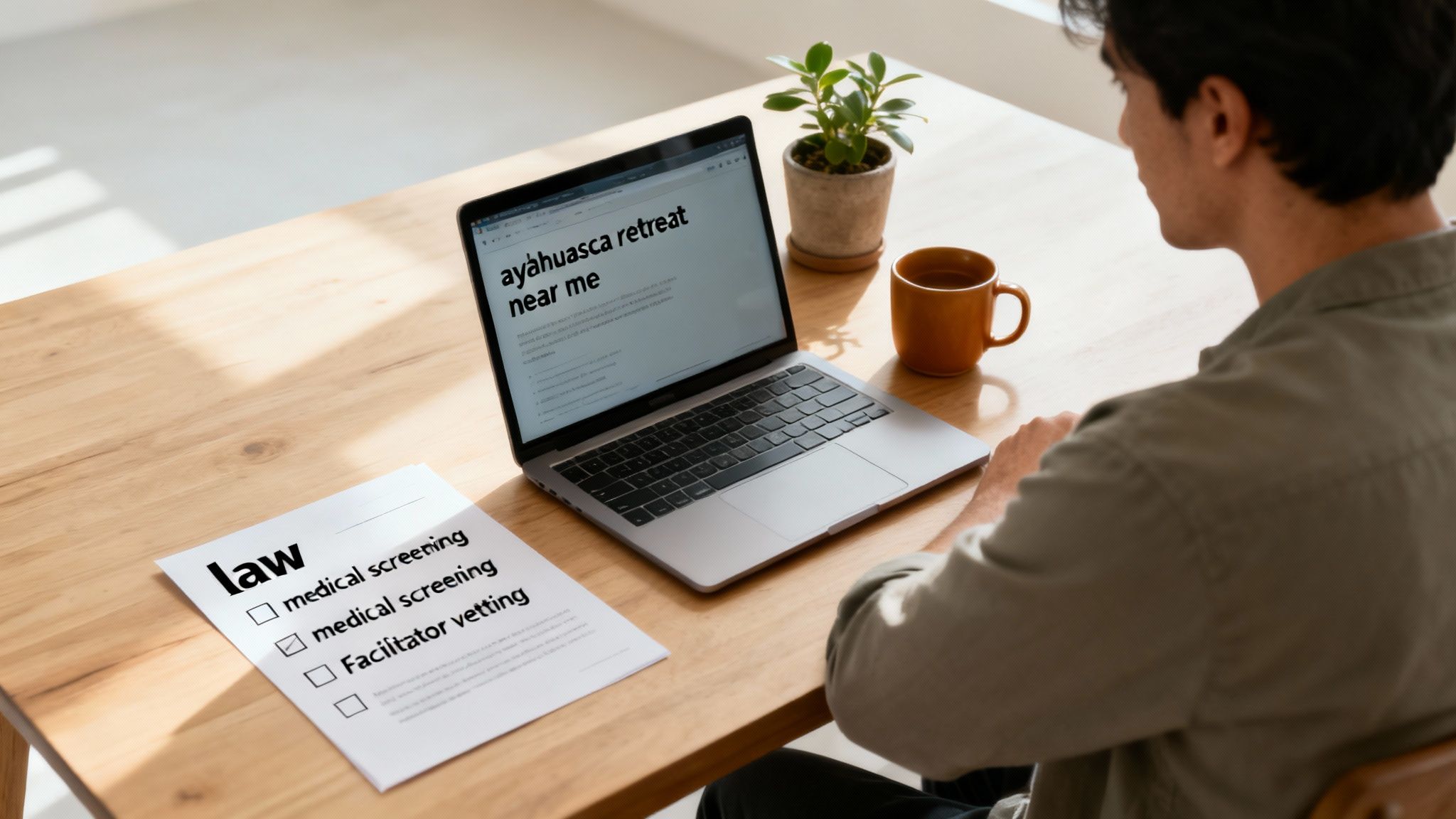
Deciding to work with ayahuasca is a significant moment, and it calls for careful, deliberate research. With the explosion of interest in this powerful plant medicine, a lot of new retreat options have appeared. This makes it absolutely crucial to learn how to tell the difference between a legitimate sanctuary and a risky, unprofessional operation. You’re not just looking for a place; you’re looking for a sacred container built on safety, expert support, and integrity.
Think of it like choosing a surgeon. You wouldn’t just go to the nearest clinic without looking into the doctor’s credentials, their safety record, and what other patients have said. It’s the same with an ayahuasca retreat. You need to do your homework to protect your physical, psychological, and spiritual health. This guide is here to give you the tools to make a confident, safety-first decision.
Foundational Pillars of a Safe Retreat
Before we get into how to search, let’s talk about the non-negotiables. These are the core elements that define a responsible, well-held ceremony and separate it from a potentially dangerous situation.
Every retreat you consider should be measured against these three pillars:
Legal and Medical Integrity: Does the center have a clear legal standing? More importantly, do they have a strict medical screening process to identify and exclude anyone with health contraindications?
Facilitator Competence: Who is leading the ceremony? The guides or shamans must have deep experience, a clear lineage, and years of dedicated training. They need to be equipped to handle intense psychological states with compassion and skill.
Support and Integration: What is the ratio of staff to participants? Is there enough help on hand during the ceremony? And just as critical, what support do they offer after the retreat to help you make sense of your experience?
The most crucial decision is not whether to drink ayahuasca, but with whom and where. A safe, ethical, and well-supported environment is the foundation upon which a healing experience can be built.
To get you started, here is a quick checklist you can use to organize your thoughts and begin evaluating potential centers.
Quick Safety Checklist for Vetting Local Retreats
This table breaks down the essential safety checks you should perform when looking into any ayahuasca retreat. Use it as a framework for your questions and to spot potential issues early on.
| Vetting Area | Key Questions to Ask | Red Flags to Watch For |
|---|---|---|
| Medical Screening | What is your medical intake process? What conditions or medications disqualify a participant? | No medical questions asked; vague answers about medication safety (especially SSRIs). |
| Facilitator Experience | How long have you served medicine? Who were your teachers, and for how many years did you train? | Unverifiable claims of lineage; lack of transparency about training or experience. |
| Ceremony Safety | What is the participant-to-facilitator ratio? Is there sober, trained support staff present? | Overcrowded ceremonies; facilitators participating in the ceremony (drinking the medicine). |
| Integration Support | What resources do you offer after the retreat to help me process my experience? | No post-retreat support offered; integration is treated as an afterthought. |
This checklist is your first line of defense. If a retreat can’t give you clear, confident answers to these questions, it’s a sign to keep looking.
Navigating the Legal and Medical Minefield
Before you jump too far down the rabbit hole of searching for an “ayahuasca retreat near me,” we need to talk about the tricky landscape you’re about to step into. Ayahuasca sits in a legal gray zone in many places, and more importantly, it comes with real medical risks if you aren’t careful. This isn’t to scare you off—it’s to arm you with the knowledge to make safe, smart choices.
The legal status of ayahuasca can be a real head-scratcher. Its active ingredient, DMT, is a Schedule I substance in the United States, which puts it in the same category as heroin. But it’s not that simple. Some religious groups, like the União do Vegetal (UDV) and Santo Daime, have actually won court cases that allow them to use ayahuasca as a sacrament.
On top of that, you have a wave of cities decriminalizing natural psychedelics. But don’t get confused: decriminalized is not the same as legal.
“Decriminalization usually just means law enforcement isn’t going to make arresting you for personal use a priority. Legalization, on the other hand, means there’s an actual system in place for its regulated use. A retreat in a decriminalized city isn’t automatically above board and could still be operating in a risky legal gray area.”
This confusing mess means that most retreats you’ll find in North America and Europe are flying under the radar. While many are led by genuine, well-intentioned people, the lack of oversight means literally anyone can call themselves a shaman. This is why you have to be so incredibly thorough in your own vetting process.
Medical Safety Is Non-Negotiable
Legal questions aside, your medical safety is the one thing you can’t compromise on. Ever. Ayahuasca contains powerful compounds called Monoamine Oxidase Inhibitors (MAOIs), which temporarily shut down a specific enzyme in your body. This is the key that allows the DMT in the brew to work when you drink it, but it’s also what opens the door to some serious dangers.
MAOIs can have dangerous, even fatal, interactions with certain foods and, most critically, a long list of common medications. The biggest risk is with antidepressants, especially Selective Serotonin Reuptake Inhibitors (SSRIs) like Prozac or Zoloft. Mix those with ayahuasca, and you’re risking a condition called serotonin syndrome—a life-threatening reaction that can cause seizures, a dangerously high fever, and muscle breakdown.
This is not a minor detail. Any retreat worth its salt will have a meticulous medical screening process. They should be asking for a full rundown of your physical and mental health history, plus a complete list of every single medication and supplement you take.
Red Flags: Conditions and Medications to Watch Out For
A good facilitator will know the contraindications by heart. There are certain health conditions and medications that are absolute no-gos for an ayahuasca ceremony.
Here are some of the big ones:
Heart Problems: This includes high blood pressure, a history of heart disease, or strokes.
Serious Psychiatric Conditions: If you have a history of schizophrenia, bipolar disorder, or psychosis, ayahuasca is known to make these conditions much worse.
Prescription Drugs: Especially SSRIs and other antidepressants, but also some stimulants and opioid painkillers. The list is long.
It’s up to you to be 100% honest during your screening. Hiding a medical condition or a medication isn’t just a bad idea—it could literally cost you your life. To get a better handle on the specifics, check out our guide on the foods and meds to avoid with MAOIs.
And here’s the bottom line: if a retreat organizer doesn’t ask you about this stuff, or if they brush off your concerns about your medication, it’s a massive red flag. Thank them for their time and walk away. Your health comes first, always.
How to Find Reputable Retreats Near You
Alright, you’ve done your homework on safety. Now, the search for an “ayahuasca retreat near me” isn’t just a blind Google search anymore. You can approach it like a detective, piecing together clues to find a place that’s legitimate, safe, and authentic. The first step is simply building a shortlist of potential centers to investigate further.
The internet is where most of us start, but you have to be smart about it. A generic search is going to serve you a lot of slick marketing from places that might be more focused on their bottom line than your well-being. A better strategy is to use more specific search terms to find communities where people are already having these critical conversations.
Beyond a Simple Search
Think about it like fishing. A huge, generic net will catch everything, but you’ll spend most of your time sorting through the junk. A smaller, more precise net brings in exactly what you’re looking for.
Here’s where you can start casting that finer net:
Vetted Directories: Us. We at Ayahuasca.com put a ton of work into screening every single retreat we list. That pre-vetting gives you a baseline of trust you just won’t find on a random website from a search engine.
Psychedelic Societies: Your local psychedelic society or integration circle is an absolute goldmine. These are real people in your community with firsthand experience. Their word-of-mouth recommendations are often the most trustworthy you can get.
Targeted Online Forums: Subreddits or private online groups focused on ayahuasca can be useful, but you have to tread carefully. Look for patterns—places that get recommended over and over again with detailed reviews, not just a single hyped-up post.
“The best recommendations usually come from people who have zero financial stake in where you go. Look for communities and individuals who are just sharing their stories to help others find their way.”
This kind of community-first approach gets you past the glossy brochures and into the real experiences of people who have walked this path before you.
Local Retreats Versus International Journeys
One of the first big decisions you’ll face is whether to find something close to home or travel to the Amazon, the birthplace of the medicine. There are real pros and cons to each, and what’s “right” comes down to your personal situation, budget, and what you hope to get out of the experience.
Traveling to countries like Peru, Colombia, or Brazil gives you a chance to connect with the medicine in its original context. You might work with indigenous shamans who hold wisdom passed down through generations. But that kind of journey comes with a hefty price tag, time off work, and the challenge of navigating a new culture. The boom in ayahuasca tourism has also created some very complex issues, which you can read about in our article on the transformations of traditional ayahuasca practice.
Staying local is convenient, more affordable, and makes life much easier when it comes to integration. You won’t have to deal with the stress of a long flight right after a deeply profound experience. The biggest hurdle with local options is doing the due diligence on the facilitators. You need to be sure they have legitimate training and a solid lineage, not just calling themselves a shaman after a few powerful experiences of their own.
Interest in ayahuasca has exploded. A 2023 report estimates that over four million people have tried it, with around 820,000 people participating in 2019 alone. This massive growth is exactly why it’s so important to choose your path—whether local or international—with real care and intention. You can dig into more of this data on the global consumption of ayahuasca on Psychedelic Health.
The Vetting Checklist Every Participant Needs
Once you’ve put together a shortlist of retreats, the real work begins. This is where you shift from a curious seeker to a careful investigator. A beautiful website and a few glowing testimonials just don’t cut it. You have to dig deeper to make sure the center is truly committed to your safety and well-being.
Think of this less like an interrogation and more like an essential conversation. You’re about to place an immense amount of trust—and your own vulnerability—in someone’s hands. It’s only right to ensure they are capable and deserving of that trust.
This checklist is designed to arm you with the specific, pointed questions you need to ask. We’ll break it down into three core pillars: Facilitator Experience, Safety Protocols, and Integration Support. Vague questions get vague answers, so let’s get specific to uncover the real substance behind a retreat’s promises.
The first step is always deciding where to look—close to home or further afield.
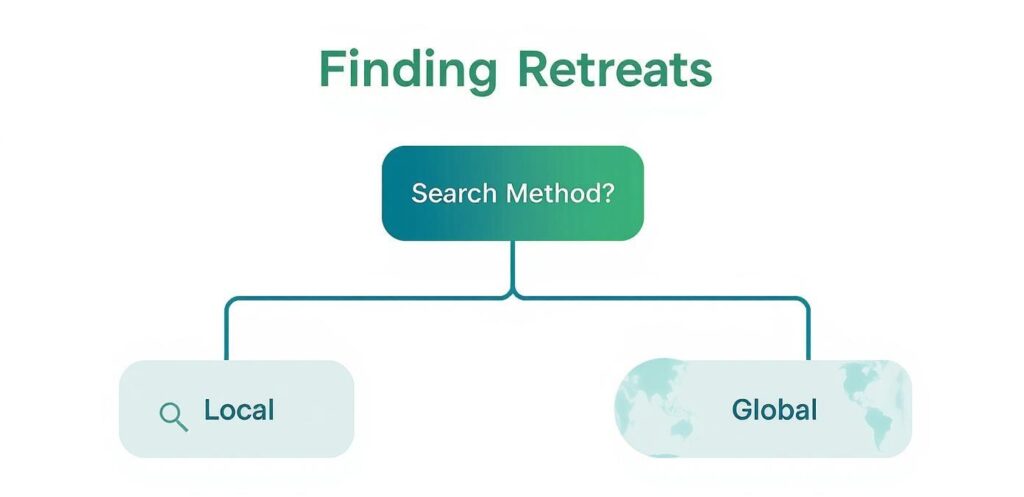
Ultimately, whether you find a place down the road or across the globe, the rigorous vetting process that follows is exactly the same.
Evaluating Facilitator Experience and Lineage
The person serving the medicine is, without a doubt, the single most important factor in your entire experience. Their training, their presence, and their integrity create the container for your journey. A true facilitator isn’t just pouring a cup; they’re holding a sacred space that can become intensely challenging.
Don’t just ask, “Are you experienced?” Go deeper with questions like these:
Training and Lineage: “Could you tell me about your teachers and the tradition you trained in (e.g., Shipibo, Santo Daime)?” And a crucial follow-up: “How many years did you apprentice directly with them before serving medicine on your own?” A legitimate facilitator will be open and proud to share their background.
Emergency Preparedness: “What’s your protocol for handling a severe psychological crisis, like a panic attack or someone having an overwhelming experience?” Also, ask: “Are you or your staff trained in basic first aid or CPR?” How they answer this tells you a lot about their professionalism.
Personal Relationship with the Medicine: “How do you continue your own work and learning with the medicine?” This reveals if they see themselves as a lifelong student—a sign of humility, which is a vital trait for any guide.
“A true facilitator serves the medicine, not their ego. They should be transparent about their training and focused entirely on the safety and well-being of the participants, not on creating a guru-like persona.”
If a facilitator gets defensive, is vague about their teachers, or seems more interested in their own mystique than your well-being, that’s a massive red flag. Trust your gut and walk away.
Scrutinizing Safety Protocols
Beyond the facilitator’s personal experience, the retreat’s operational safety protocols are absolutely non-negotiable. These are the practical systems in place that protect every single person in the room. A single oversight here can have devastating consequences.
You need to drill down into the nitty-gritty of their safety measures:
Medical Screening: This is paramount. Ask, “Can you walk me through your entire medical screening process, from the first form to final approval?” A truly thorough process involves a detailed health questionnaire and often a personal conversation to discuss any contraindications.
Staff-to-Participant Ratio: “What’s the maximum number of participants you allow in a ceremony, and what’s the ratio of sober support staff to participants?” A safe ratio is generally no more than 5 to 7 participants per facilitator or trained assistant. Overcrowded ceremonies are a recipe for disaster.
On-Site Support: “Besides the main facilitator, who else will be in the room to offer support?” There should always be sober, trained assistants available to help people get to the bathroom, fetch water, or just provide a comforting and grounding presence. A facilitator should never work alone.
A center that genuinely prioritizes safety will welcome these questions and have clear, confident answers. Any hesitation or ambiguity is a warning sign that their protocols might not be as solid as they need to be.
Assessing Integration and Post-Retreat Support
The ceremony itself is just one piece of the puzzle. The real work—and the real healing—often happens in the days, weeks, and months after you return home. A retreat’s commitment to integration is a huge indicator of its integrity and whether they’re in this for the right reasons.
Find out what happens after you leave:
Integration Resources: “What specific support do you provide after the retreat is over?” Look for concrete offerings like online integration circles, referrals to integration-focused therapists, or scheduled follow-up calls.
Community Access: “Is there a way for past participants to stay connected?” A private online group or alumni network can be an incredible resource for getting support from people who understand what you’ve been through.
The Integration Philosophy: “How do you see the role of integration in the ayahuasca journey?” Their answer will tell you if they see it as a fundamental part of the process or just a nice little add-on.
The ayahuasca experience doesn’t end when the icaros fade. A retreat that truly gets it will invest in helping you carry the insights and healing forward, long after you’ve left their care.
Comparing Key Aspects of Retreat Centers
To help you organize your research, use a simple comparison chart like the one below. Filling it out for your top 2-3 choices can make the best option crystal clear. It forces you to move past the “vibe” and focus on the concrete details that matter most for your safety and the quality of your experience.
| Criteria | Retreat Option A | Retreat Option B | Retreat Option C |
|---|---|---|---|
| Facilitator Lineage & Training | |||
| Years of Experience (Facilitator) | |||
| Medical Screening Process | |||
| Staff-to-Participant Ratio | |||
| On-Site Medical Support | |||
| Integration Support Offered | |||
| Retreat Cost | |||
| Reviews & Testimonials (Verified) | |||
| Your Gut Feeling (1-10) |
After you’ve gathered all the facts, take a moment to tune into your intuition. Sometimes, the most logical choice on paper just doesn’t feel right. This combination of diligent research and intuitive feeling will guide you to the right place.
Preparing for and Integrating Your Experience
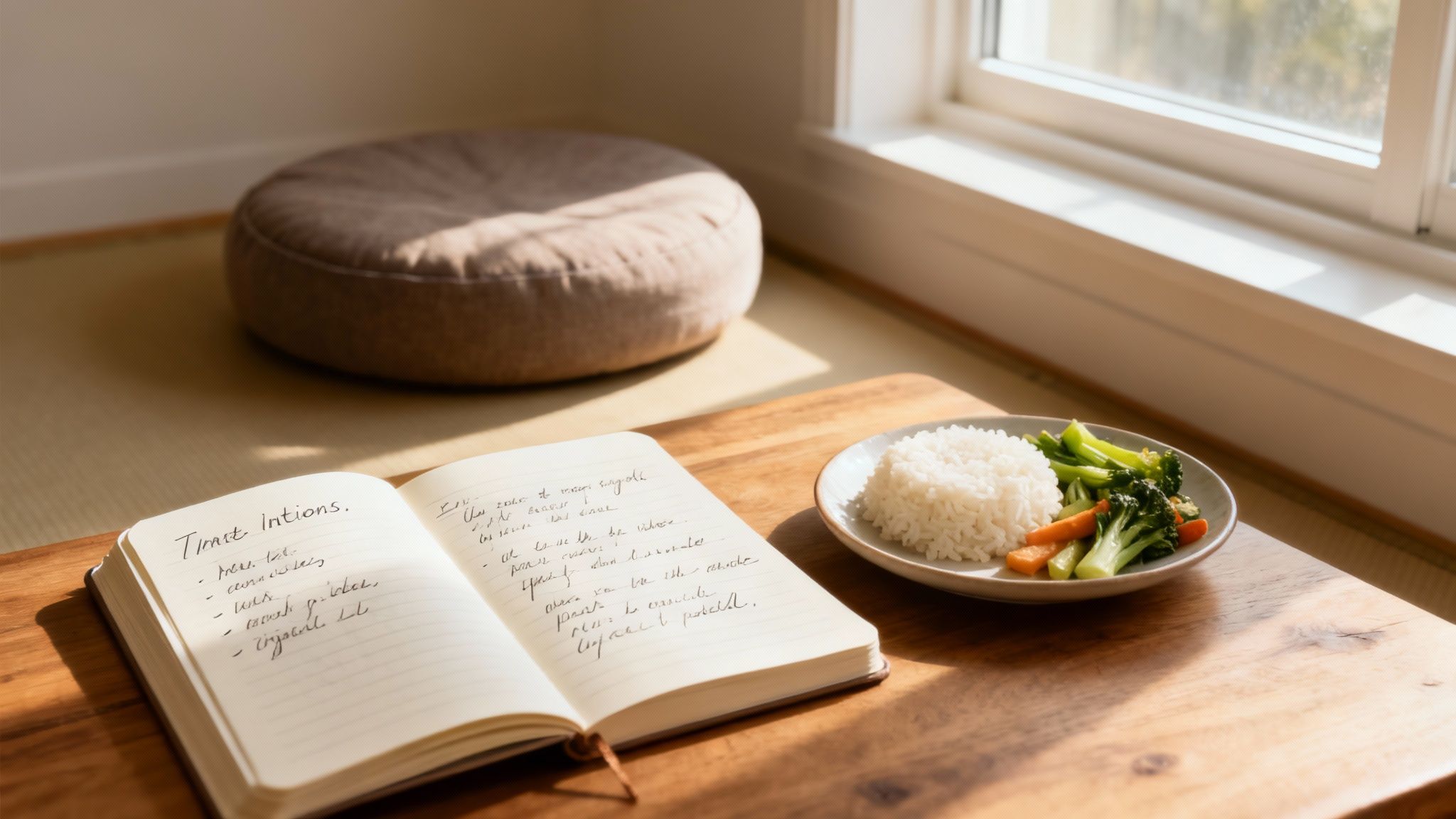
Finding a safe, well-held ayahuasca retreat is a huge step. But the journey itself doesn’t just happen during the ceremonies. The real work—and the real reward—lies in what you do before you arrive and after you leave.
These two phases, preparation and integration, aren’t just bonus features. They are the essential bookends that give the entire experience its structure and meaning. Without them, even the most profound ceremony can fade into a strange memory instead of becoming a source of lasting change.
Think of it like this: the retreat is the deep-sea dive. Preparation is checking your gear and mapping your course, while integration is how you bring the treasures you found back to the surface and make sense of them on dry land.
The Power of Preparation
Getting ready for ayahuasca is about so much more than packing a suitcase. It’s a deep, intentional process of preparing your mind, body, and spirit for what’s to come. This often involves a traditional practice called the dieta—a specific diet and lifestyle you adopt in the weeks leading up to your retreat.
The dieta isn’t just a cleanse. It’s a discipline. By simplifying your diet and avoiding things like salt, sugar, spicy foods, and heavy oils, you are essentially quieting the static in your system. This physical purification helps clear the way for the medicine to work more profoundly and with less interference.
“Preparation is an act of devotion to your own healing. By following the dieta and setting intentions, you are sending a clear signal to yourself and to the medicine that you are ready, respectful, and committed to the process.”
Beyond the body, your mind needs attention too. This is the time to get quiet and reflect on your intentions. What’s calling you to this work? What questions are you bringing? What are you hoping to heal or understand? An intention isn’t a demand for a specific outcome; it’s more like a compass that helps you navigate if the experience becomes overwhelming. For a deeper dive, check out our comprehensive guide to preparing for your ayahuasca journey.
Why Integration Is Not Optional
An ayahuasca ceremony can feel like a lifetime of therapy and insight packed into a single night. But those powerful revelations can be slippery, like trying to hold onto a dream the morning after. Integration is the conscious, deliberate practice of weaving those insights into the fabric of your everyday life.
Without it, the experience remains a powerful but isolated event. Integration is what turns a psychedelic journey into true personal development. It’s the bridge that connects the world of the ceremony to your daily reality, ensuring the healing continues long after you’ve gone home.
The evidence for this is compelling. Clinical studies show that ayahuasca can lead to rapid and lasting relief from depression. One study noted an incredible 82% reduction in depressive scores right after a retreat, with follow-ups showing the psychological benefits were still present up to a year later. These long-term positive outcomes are strongest when people actively work to integrate their experiences.
Actionable Steps for Effective Integration
Integration isn’t a one-and-done task; it’s an ongoing practice of tending to the seeds that were planted during the ceremony. Here are a few essential ways to support yourself:
Find a Coach or Therapist: Look for a professional who specializes in psychedelic integration. Having a trained, non-judgmental guide can make all the difference in processing what came up.
Journal Consistently: Write it all down. The visions, the feelings, the confusing parts. Keep journaling in the weeks and months that follow to track how the insights are unfolding in your daily life.
Connect with Community: You’re not alone in this. Joining an integration circle, whether in your city or online, can provide validation and support from others who get it.
Embrace Mindful Practices: Simple things like meditation, yoga, or just spending quiet time in nature can help you stay connected to that centered place you may have touched during your journey.
Ultimately, finding an “ayahuasca retreat near me” is just the start. Committing to the deep work of preparation and integration is what truly transforms the journey into a path of enduring growth.
Answering Your Final Questions About Ayahuasca Retreats
Once you’ve done the heavy lifting—vetting facilitators, checking safety protocols, and narrowing down your options—a few practical questions usually pop up. These are often the final puzzle pieces that help you confidently choose the right retreat.
Let’s clear up some of the most common queries people have when they’re this close to booking their journey.
How Much Should I Expect to Pay?
This is a big one, and the honest answer is: it varies wildly. The price tag really depends on where the retreat is, how long it lasts, and what kind of amenities are included.
For a shorter, weekend-style retreat in North America or Europe, you’re likely looking at a range of $500 to $1,500. These are great for dipping your toes in or if you can’t get away for a full week.
If you’re dreaming of a more traditional, immersive experience in the Amazon, a week-long stay in Peru or Colombia will probably run between $1,200 and $4,000, sometimes more. That price usually covers your lodging, all your meals (dieta-friendly, of course), several ceremonies, and often other healing practices like plant baths or consultations with the shaman. A word of caution: if you see a price that seems too good to be true, it probably is. Super-low costs can be a major red flag for safety, facilitator experience, or even the quality of the medicine itself.
What Is This Going to Feel Like in My Body?
The physical side of an ayahuasca journey is intense, and no two people have the exact same experience. The most famous physical effect is, of course, the purge. Known as ‘la purga’, it often involves nausea and vomiting, which is traditionally seen as a crucial part of the cleansing process. It’s not just about getting rid of physical toxins; it’s about releasing heavy emotional and energetic baggage, too.
You might also experience diarrhea, shaking, or feeling hot and cold flashes. Don’t worry, these sensations are temporary and are just signs that the medicine is doing its work. Any reputable retreat will always have sober, trained staff nearby to get you water, help you to the bathroom, and just provide a comforting presence if you feel overwhelmed.
What’s the Difference Between a “Traditional” and a “Modern” Retreat?
Figuring out the style of a retreat is a huge part of finding the right fit. The main differences really boil down to the setting, the cultural lens, and the kind of support you’ll receive.
Traditional Retreats: Think deep in the Amazon. These retreats are steeped in indigenous shamanic traditions, like the Shipibo lineage in Peru. The accommodations are often rustic—don’t expect a five-star hotel. The entire experience is built around the shaman’s icaros (sacred songs) and a strict adherence to the preparatory ‘dieta.’ The goal is deep spiritual healing guided by ancient wisdom.
Modern Retreats: You’ll typically find these in Western countries. They adapt the core ceremony for a non-indigenous crowd. The facilities are usually more comfortable, and they often blend the shamanic work with a psychological framework. For instance, you might find integration circles led by therapists or coaches to help you process your visions and insights in a more contemporary way.
“The choice between a traditional or modern retreat is completely personal. It all comes down to what you need. Ask yourself: How much physical comfort am I looking for? How important is cultural authenticity to me? What kind of support system will help me feel safest on this journey?”
In the end, it doesn’t matter if you’re in a simple jungle hut or a comfortable Western retreat center. The non-negotiables are always the same: safety, experienced facilitation, and a solid support system.
Disclaimer: The information provided on Ayahuasca.com is for educational purposes only and is not intended as medical advice, diagnosis, or treatment. Ayahuasca is a powerful traditional Amazonian medicine and may not be suitable for everyone. Always consult with a qualified healthcare professional before making decisions related to health, mental well-being, medications, or the use of Ayahuasca.