Ayahuasca legal status is not under direct international drug control, but depends entirely on how each country regulates DMT-containing preparations. That means the same brew can be treated as a protected sacrament in one place and a controlled substance in another.
That split is exactly why seasoned participants still get caught off guard. A ceremony may be lawful at the destination, yet the trip, the customs line, or the return flight can turn into a criminal exposure if the paperwork, transit route, or local drug code is stricter than expected.
The International Treaty Gap
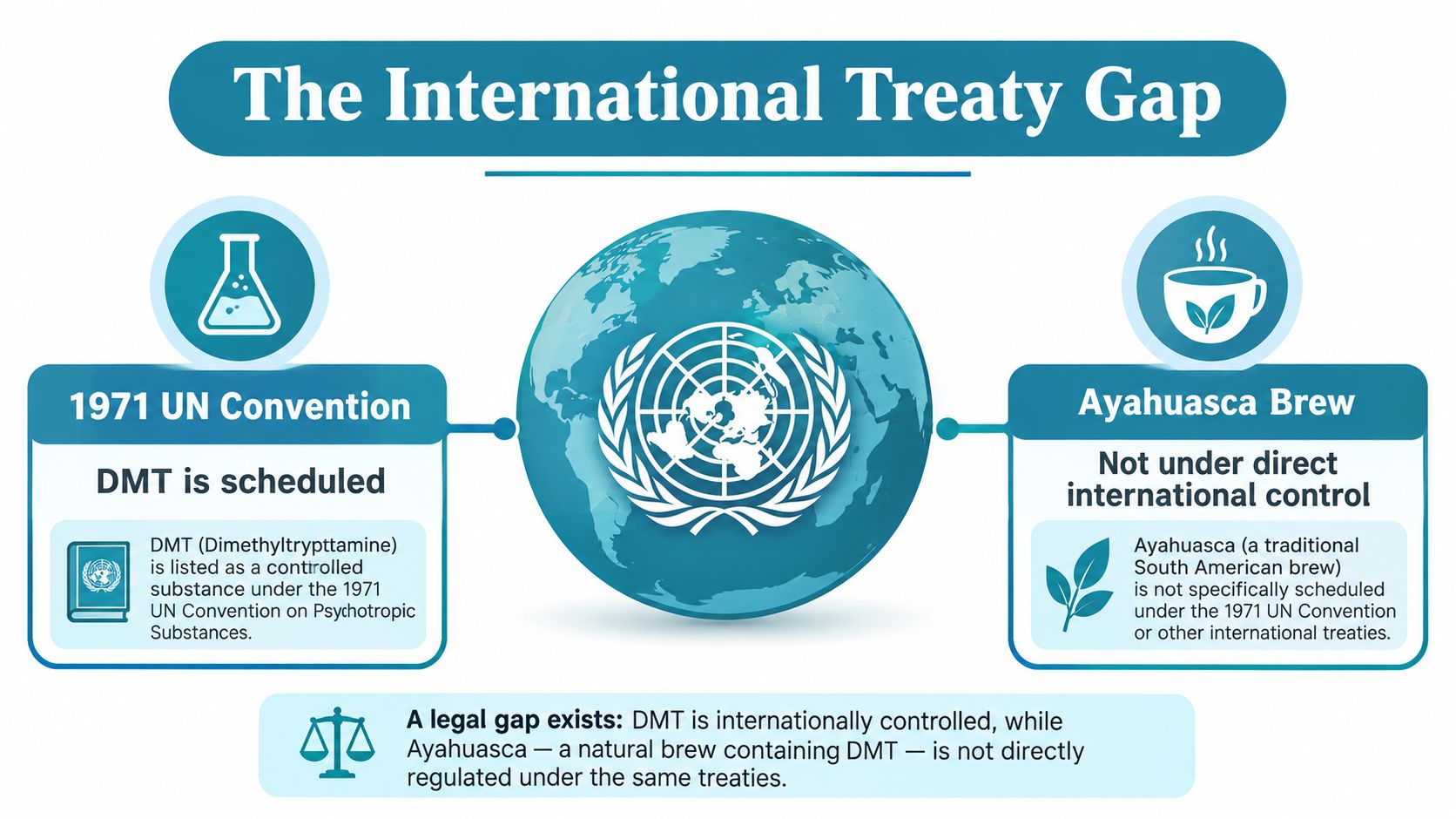
The legal foundation is simple, but the consequences are messy. DMT is scheduled under the 1971 UN Convention on Psychotropic Substances, while the ayahuasca brew itself is not under direct international control. ICEERS explains that the International Narcotics Control Board does not treat the plants or traditional concoctions containing them as currently falling under international control, and that gap is why national laws diverge so sharply (ICEERS).
That treaty gap matters because countries end up regulating the brew indirectly. If a jurisdiction focuses on the isolated alkaloid, ayahuasca can be swept into a drug offence. If it distinguishes the traditional preparation from purified DMT, the same brew may be carved out for ritual use. The result is a patchwork where legality turns less on the plant medicine itself and more on the domestic definition attached to it.
Why The Gap Creates Real Risk
That ambiguity isn’t academic. ICEERS says the mismatch has produced a legal limbo in many countries, exposing importers, ceremony organizers, and users to uncertainty (ICEERS). The practical lesson is blunt, if the country’s law is written around DMT, the brew may be treated as contraband even when the tradition is locally respected.
“Practical rule: Check the domestic drug code first, then check whether ayahuasca is treated separately from DMT. If the answer isn’t explicit, assume risk.”
The same international gap also explains why ayahuasca keeps becoming a test case for treaty-based drug scheduling versus domestic exemptions. For a broader policy frame on why this tension keeps expanding, see the globalization of ayahuasca and the harm-reduction debate.
Global Benchmarks in Regulation
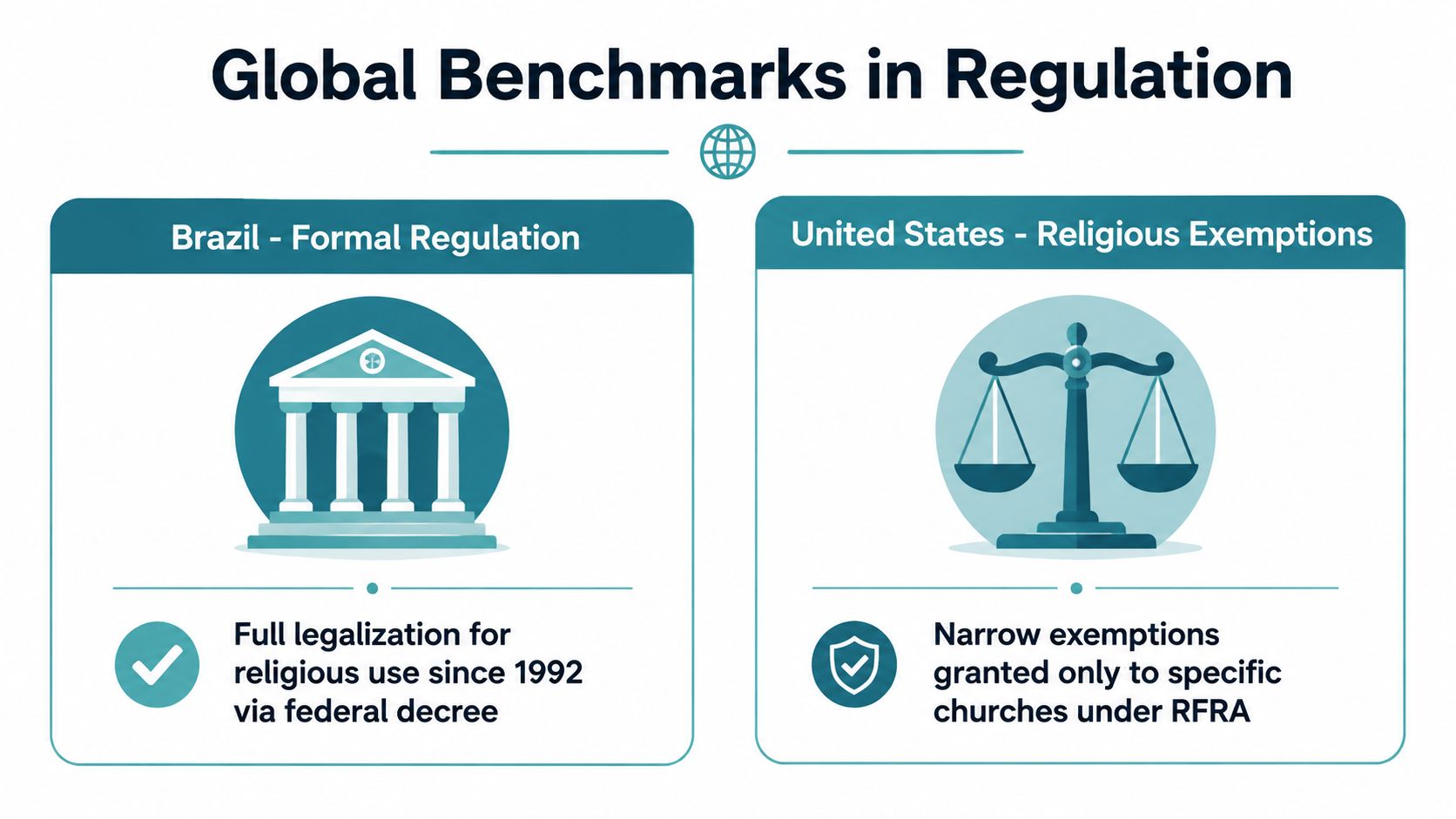
Brazil and the United States sit at opposite ends of the ayahuasca legal status spectrum. Brazil is the clearest example of a formal regulatory model. ICEERS states that ayahuasca has been explicitly authorized for ritual and religious use since 1987, and that it has been fully legal in Brazil since 1992 (ICEERS). The same source notes that Brazil’s drug law No. 11.343/2006 still prohibits DMT itself, which shows how carefully the law separates the compound from the traditional brew.
The United States works differently. Federal law treats DMT as a Schedule I substance, but religious use has been protected in limited circumstances. The U.S. Supreme Court’s 2006 decision in Gonzales v. O Centro Espírita Beneficente União do Vegetal affirmed a religious exemption for sacramental hoasca under the applicable federal framework (GMLaw). That is not broad legalization. It is a narrow legal shield for specific religious entities.
Formal Regulation Versus Litigation-Based Access
Brazil’s model is cleaner. It rests on a national policy carve-out for ritual use, so practitioners can read the framework as a standing rule rather than a case-by-case argument. That makes Brazil the benchmark for anyone seeking a jurisdiction where ayahuasca is addressed directly, not tolerated by accident.
The U.S. model is fragile by comparison. Exemptions are entity-specific, tied to religious-freedom standards, and dependent on ongoing compliance. A retreat group that assumes “spiritual use” is enough is taking a reckless shortcut. It isn’t enough.
For practical travel planning, a related jurisdictional overview can be useful, including ayahuasca legality in Costa Rica, but the main point remains that local rules matter far more than broad internet folklore.
The Hard Recommendation
Use Brazil as the model for settled clarity. Use the United States as the model for narrow permission. Anything in between should be treated as unstable until the local law says otherwise.
Navigating Religious Exemptions in the United States
U.S. law is where many experienced practitioners get complacent, and that’s a mistake. The federal regime is built around DMT, the Controlled Substances Act, and the Religious Freedom Restoration Act. In plain terms, ayahuasca is generally illegal unless a specific organization has secured a narrow exemption that survives federal scrutiny (Recovered).
That exemption does not attach to the brew in the abstract. It attaches to the applicant. In practice, that means sincerity, organizational structure, safety controls, and the ability to satisfy RFRA standards all matter. A group cannot merely call a gathering “spiritual” and assume the law will respect the label.
What The Federal Standard Really Demands
The federal question is usually whether the government has substantially burdened sincere religious exercise, and whether the group can justify its use within a controlled, structured framework. That is a hard bar, not a vibe check. It also means that unincorporated circles, pop-up ceremonies, and loosely affiliated facilitators are in a weak position if challenged.
“The exemption belongs to the organization that earned it. It doesn’t travel with guests, hosts, or copied ceremony language.”
A useful compliance mindset is to treat the exemption like a narrow operating license. If the entity changes, the service model changes, or the leadership changes materially, the legal analysis can change with it. The law does not care that the ceremony feels traditional if the sponsoring structure no longer fits the exemption.
Ayahuasca.com’s overview of the Religious Freedom Restoration Act and the DEA religious exemption process is relevant here because it reinforces a blunt reality, religious use in the United States is not a general public-access model. It is case-specific and organization-specific.
Why “Spiritual Use” Is Not A Shield
That distinction matters because many groups blur the line between religion, wellness, and retreat marketing. The law doesn’t. If a facilitator has no recognized exemption, “sincere intention” won’t save the event from federal scrutiny. The safest assumption is that the government will ask who the sponsor is, what rules govern the ceremony, and whether the claimed practice is covered.
A second caution is tax and governance. If an exemption is tied to a church-like structure, internal consistency matters. Loose branding, inconsistent doctrine, and informal governance can weaken the claim before the legal merits are even reached.
For operators, the recommendation is straightforward. Verify the exact exemption holder, confirm whether it covers the planned activity, and assume that unaffiliated guests don’t inherit protection by association. Anything less is amateur hour.
The Shifting Landscape of European Case Law
Europe is where many travelers make their second mistake. They hear that a ceremony once operated with relative freedom, then assume the same rule still applies. Dutch case law shows why that assumption is dangerous. ICEERS reports that Dutch courts initially allowed Santo Daime use by treating ceremonial ayahuasca as low-risk and protected by religious freedom, but later case law reversed course and classified import, possession, and ritual use as prohibited because the government argued that public-health risk outweighed Article 9 claims (ICEERS Dutch Legal Report).
That reversal is the key lesson. Historical tolerance is not current permission. A retreat that was workable under an earlier court view can become unlawful after the judiciary rebalances health risk, proportionality, or public-order concerns.
Why Proportionality Can Collapse Access
European courts often frame these cases through balancing tests rather than absolute entheogen policy. That means the result can turn on how judges assess risk, not just on a faith claim. Once the state persuades a court that public-health concerns outweigh religious freedom, import and possession can move from tolerated to prohibited very quickly.
“If the legal theory depends on a past ruling, treat it as fragile until the current case law says otherwise.”
That is why experienced organizers need a fresh legal read before every retreat season. A route that was acceptable last year may now expose facilitators, hosts, and guests to seizure or prosecution. The destination country’s reputation for tolerance is not a defense by itself.
For organizers who also handle other regulated plant activities, the logic is familiar. Cross-border compliance for controlled substances, whether in ceremonial or agricultural settings, always depends on the current legal posture. A useful comparison point on how local legality can still sit inside a restrictive enforcement environment is insights on European marijuana farming from Gonzalez & Waddington.
What Travelers Should Take From Europe
Do not build a travel plan around old stories. Do not assume a prior exemption survives a new appeal, a new court panel, or a changed public-health narrative. In Europe, ayahuasca legal status can be politically and judicially contingent, and that makes current case law the only reliable guide.
Cross-Border Risks and Transit Vulnerabilities
The biggest blind spot in ayahuasca legal status discussions is transit. People fixate on where the ceremony happens and ignore the airport, the border checkpoint, and the customs declaration. That is a serious error because local legality at the destination does not neutralize importation or transport offences in transit countries or on return home.
In the United States, the federal position is still hard. DMT in ayahuasca remains a Schedule I issue, and transport into the country can trigger importation exposure even if the brew was lawful abroad. That means a traveler can leave a permissive jurisdiction and still face a federal problem the moment a bag is screened, a residue is flagged, or a customs officer asks the right questions.
Why Transit Is The Real Legal Trap
A destination country can be lenient while a transit country is not. That mismatch is exactly where travelers get exposed. The risk is worse if there is residual brew in luggage, ceremonial documentation that describes a controlled substance, or tinctures and containers that look like an attempt to move medicine across borders.
The safest rule is simple, if the plan involves flying, changing planes, or crossing customs with anything connected to the brew, the legal analysis has to cover every jurisdiction on the route. Treating the itinerary as one legal environment is lazy and dangerous.
“A lawful ceremony does not create a lawful border crossing.”
Recent legal guides also note that Spain and Portugal are treated as legal-gray-zone exceptions rather than blanket approvals, which makes transit planning even more sensitive (Mind Medicine Law). A traveler cannot rely on a permissive reading in the destination and ignore the stricter posture of the departure or transit point.
The Compliance Mindset That Actually Works
Experienced participants should document three things before travel, the destination law, the transit-country law, and the return-entry law. If any of the three is unclear, the route is too risky. That includes ordinary items that seem harmless but may be interpreted as evidence of importation, possession, or intended distribution.
For operators, the same caution applies to logistics. Do not hand participants ambiguous paperwork, unlabeled materials, or anything that invites inspection problems. Airport screening is not a ceremonial setting, and customs officers do not care about tradition first. They care about controlled substances law.
Future Trends And Practical Compliance
The next phase is not broader certainty. It is more fragmentation. U.S. reporting and legal trackers point to a rapid narrowing-and-expansion of religious exemption pathways, which means the question is now who qualifies, under what process, and whether the approval survives DEA, IRS, and state scrutiny (Mind Medicine Law). That is a much tighter question than the lazy headline, “ayahuasca is legal for religion.”
The smart response is a compliance checklist, not optimism. Verify the current local case law before travel or hosting. Confirm whether the activity is covered by an actual exemption or only by informal tolerance. Separate religious use from general public access. Assume that spiritual intent alone is not a legal shield.
A Practical Pre-Flight Checklist
- Check The Exact Jurisdiction: Confirm the law where the ceremony takes place, where the traveler enters, and where the traveler exits.
- Identify The Legal Theory: Determine whether access depends on formal regulation, a court exemption, or simple enforcement discretion.
- Verify The Sponsor: Make sure the entity holds the exemption or lawful basis it claims.
- Review Transit Risk: Any route involving customs, baggage screening, or a stricter stopover deserves a fresh legal review.
- Document Nothing Ambiguous: Avoid paperwork, labels, or baggage contents that can be interpreted as importation evidence.
The long-term trend is also a reminder that rules can change without warning. Courts can reverse. Agencies can tighten. A group that looked safe under one posture can become exposed under another. That is why retreat organizers should build procedures around current law, not prior comfort.
Ayahuasca.com’s legal resources are useful as one reference point, but no resource replaces a live jurisdictional check before travel or ceremony planning. If the route is international, or if the group relies on a religious claim, the next move should be a current legal review, not a guess.
For anyone planning a ceremony, a retreat, or a cross-border trip, the next step is straightforward, verify the current law in every country on the route before anyone packs a bag. If the jurisdictional picture is unclear, pause the plan, get local counsel, and treat uncertainty as a stop sign rather than a green light.
Disclaimer: This article is for informational purposes only and does not constitute legal advice. Laws regarding Ayahuasca vary by jurisdiction and may change. Responsibility for compliance with all applicable local, national, and international laws rests with the individual.