
How long does Ayahuasca stay in your system? DMT from Ayahuasca typically clears from urine within 24 hours, but specialized tests can detect Ayahuasca markers longer, and harmala alkaloids may remain traceable for weeks in certain contexts. A pending workplace screening, medical appointment, or legal test can make that answer feel urgent, especially after a ceremony that carried deep spiritual meaning.
A person may leave a retreat feeling clear, reflective, and physically returned to baseline, yet still wonder whether a laboratory could identify the brew. Another participant may be planning a ceremony around an employment requirement, while a retreat facilitator needs to understand how medications, health conditions, and testing concerns affect safety. These situations call for more than a single number.
Ayahuasca contains a combination of compounds, principally DMT and harmala alkaloids. Each follows a different path through the body, and the result depends on whether a laboratory tests blood, saliva, urine, or hair, and whether the assay searches for Ayahuasca-specific markers. The practical answer therefore has two parts: how long the compounds remain biologically present, and how long a particular test can detect them.
Understanding the Ayahuasca Timeline
A participant named Elena has booked a retreat and then notices a drug-screening appointment on the calendar shortly afterward. She knows that the ceremony’s perceptual effects will pass, but “feeling normal” and “testing negative” are different questions. The first describes subjective experience. The second depends on chemistry, specimen type, laboratory equipment, and the exact compounds included in the test.
Ayahuasca can begin moving through the body quickly. The DMT component reaches measurable blood levels within a few hours and has a short half-life, while harmala alkaloids create a separate analytical trail. A person can therefore be beyond the acute experience while a targeted laboratory method is still looking for related markers.
“Practical rule: A routine drug panel and a specialized Ayahuasca assay are different tests. A negative result on one doesn’t predict the result of the other.”
This distinction matters for several groups. Retreat participants may want realistic information before scheduling travel. Facilitators need to recognize that a guest’s concern about testing can coexist with a sincere commitment to ceremonial preparation. Employers and clinicians, meanwhile, need to know whether a panel includes DMT or harmala alkaloids instead of assuming that every psychoactive substance receives automatic screening.
The question “how long does Ayahuasca stay in your system” also contains several separate questions:
- How long do the effects last?
- How long does DMT remain measurable in blood or urine?
- How long can harmala alkaloids be identified?
- Does a standard panel include those targets?
- Could a specialized assay find something that a routine screen misses?
The answers aren’t interchangeable. Modern toxicology can identify very small concentrations when a laboratory uses a targeted method, while a general workplace panel may not look for Ayahuasca compounds at all. Readers seeking a broader foundation can review how Ayahuasca works alongside an overview of forensic toxicology screening explained.
The Science Behind How Ayahuasca Moves Through Your Body
A person may feel the ceremony’s strongest effects fade while a laboratory could still find a related compound. Ayahuasca’s pharmacology makes sense as a two-part system. DMT produces the main psychedelic effects. Harmala alkaloids, including harmine, harmaline, and tetrahydroharmine, inhibit monoamine oxidase, allowing orally consumed DMT to remain active long enough for absorption.
The body and the laboratory follow different clocks. DMT is absorbed and transformed relatively quickly, while harmala alkaloids follow their own concentration curves. A test also functions like a filter: it can identify only the compounds and concentrations its method is designed to detect. This helps explain why harmala alkaloids may offer more useful evidence of Ayahuasca exposure in urine than DMT alone.
What Peak Levels And Half-Life Mean
In a 2002 human pharmacokinetic study, oral Ayahuasca produced measurable plasma DMT with a mean time to peak concentration of 1.8 hours. The average half-life for DMT, harmine, harmaline, and tetrahydroharmine was about 2.2 hours (reviewed data). Half-life describes the time needed for the measured amount to fall by roughly half under the study conditions. It does not mean the compound disappears completely after one interval.
A 2022 review reported peak plasma DMT around 107.5 ± 32.5 minutes after ingestion. Harmine reached its peak earlier, at about 30 minutes, and declined with a half-life of 116 minutes. Tetrahydroharmine and harmalol persisted up to 24 hours. These findings show why a person’s experience and a test result can diverge. Blood concentrations may fall soon after peak effects, while a sensitive, targeted assay may still identify a marker.
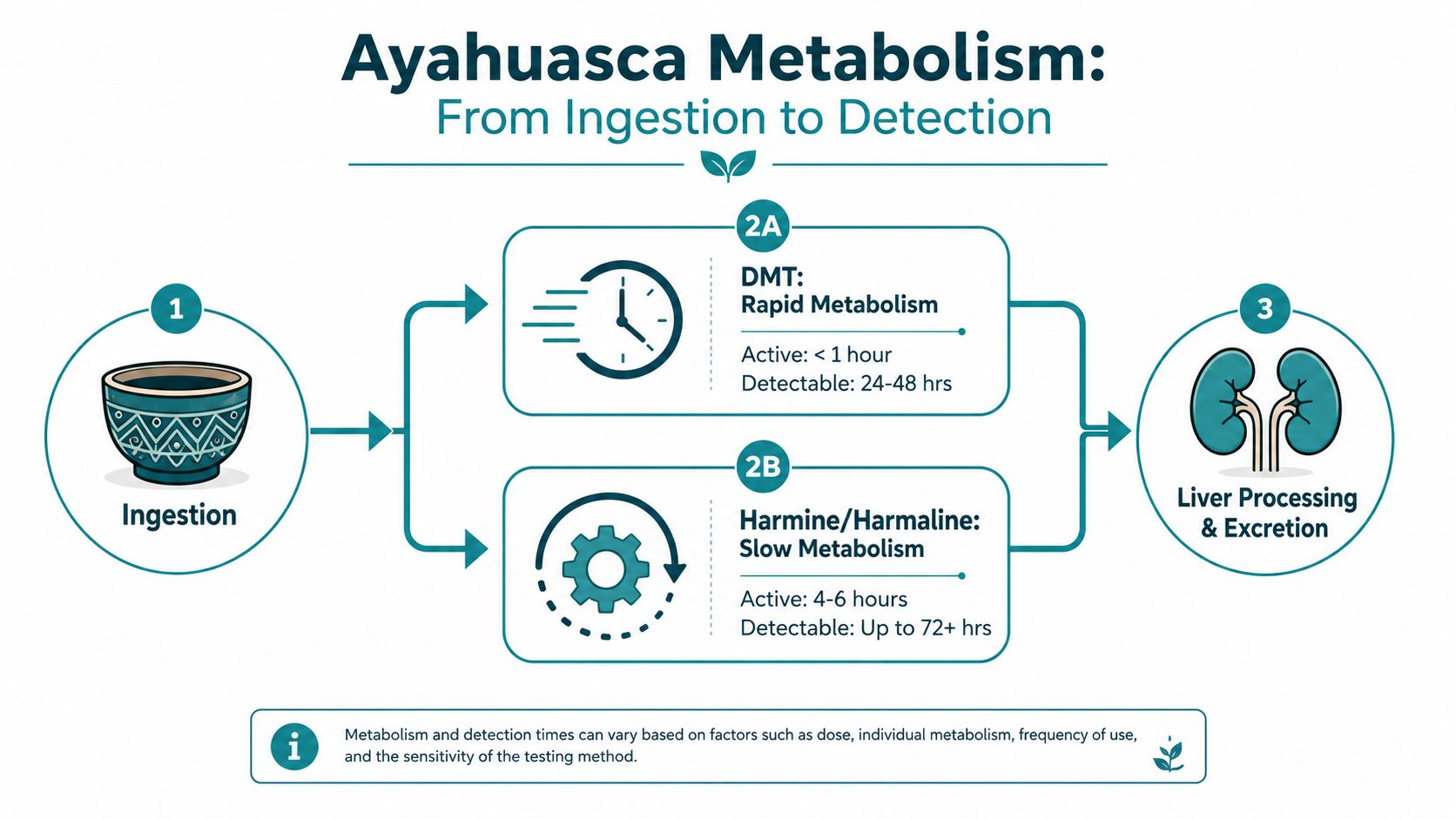
The practical lesson is clear: pharmacokinetic clearance and analytical detection aren’t the same event. The body can rapidly transform DMT, while a laboratory searches for parent compounds, harmala alkaloids, or metabolites. Readers can also review how Ayahuasca works and forensic toxicology screening explained for broader context.
Detection Windows By Test Type
The specimen determines which part of an Ayahuasca exposure a laboratory can read. Blood and saliva offer a relatively close view of recent exposure. Urine reflects compounds and metabolites excreted by the body, while hair may preserve a longer historical record when a specialized method is available.
For the DMT component, the most cited urine window is around 24 hours (toxicology review). Blood and saliva generally cover a few hours. Hair testing requires a specialized laboratory method, so it should not be treated as an automatic long-term Ayahuasca test.
| Sample Type | Typical Window | Specialized Assay Window | Key Notes |
|---|---|---|---|
| Urine | Around 24 hours for DMT | Longer detection may be possible with targeted methods or unusual circumstances | Harmala alkaloids may provide useful targets because urine excretion can differ from DMT |
| Blood | A few hours | Targeted testing can improve identification during the relevant period | Best suited to recent exposure |
| Saliva | A few hours | Depends on collection timing and assay design | Not equivalent to urine testing |
| Hair | No reliable general Ayahuasca window established here | Requires a specialized method targeting relevant compounds | A longer window should not be assumed without laboratory confirmation |
A 2020 urine-method validation reported detection limits of 1.0 ng/mL for DMT and 2.0 ng/mL for harmala alkaloids (validated urine method). These measurements show what that particular method could detect. They do not guarantee a positive result for every person or specimen.
The dual-compound nature of Ayahuasca explains why test results can vary. DMT may clear from urine quickly, while harmala alkaloids, including harmine, harmaline, and tetrahydroharmine, may offer different analytical targets. The laboratory must choose an assay that searches for those compounds or their metabolites.
Why Routine Panels Miss Ayahuasca
Standard workplace panels usually do not include DMT or harmala alkaloids. A negative routine result may therefore mean the laboratory did not search for Ayahuasca-related compounds, rather than proving that every trace has disappeared.
A targeted LC-MS/MS assay can examine DMT, harmine, harmaline, tetrahydroharmine, and related metabolites. The specimen type, collection time, requested analytes, and assay sensitivity all shape the result. Anyone facing a formal test should ask the testing authority or a clinician which compounds are included instead of relying on the general label “drug test.”
Factors That Shift Your Personal Detection Timeline
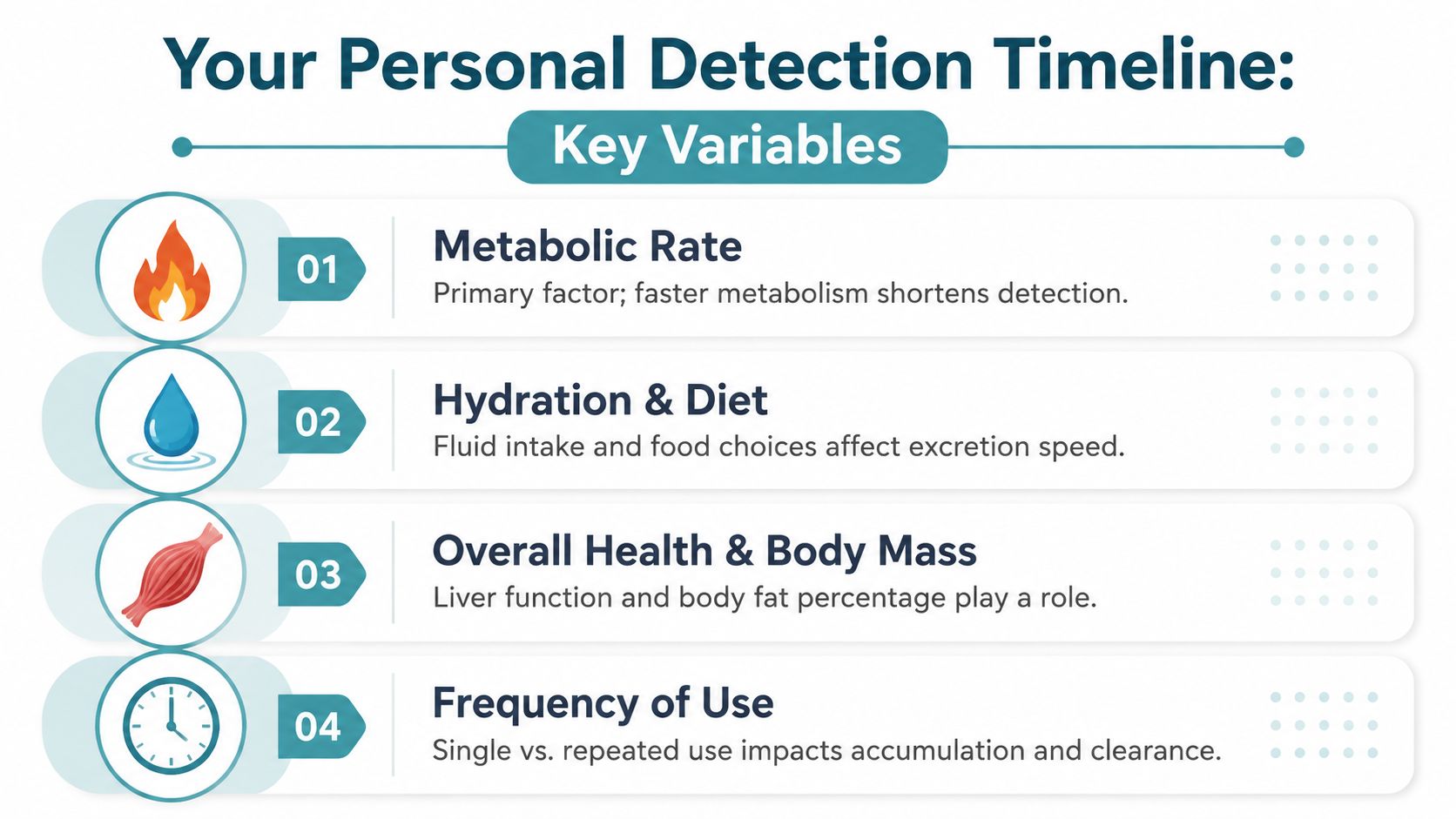
Published windows describe study conditions and typical patterns, not a personal guarantee. The individual timeline can shift with the brew’s composition, amount consumed, repeated exposure, metabolism, liver and kidney function, hydration, and the sensitivity of the assay.
The most important distinction concerns what the body excretes. A 2011 human urine study found that very little DMT appeared in urine after Ayahuasca administration, while tetrahydroharmine was the major harmala alkaloid excreted (human urine study). That finding helps explain why DMT can be a poor urine-screen target and why harmala markers deserve attention.
The Variables That Matter
- Brew composition: The relative presence of DMT and harmala alkaloids can change which markers a laboratory is most likely to find.
- Amount consumed: A larger exposure may produce more material for the body to process, but no universal personal detection period follows from dose alone.
- Repeated use: Multiple ceremonies can alter the analytical picture compared with a single exposure, especially when testing looks for several markers.
- Metabolic and organ function: Liver and kidney function influence transformation and excretion. A clinician can interpret those issues more safely than a generic online calculator.
- Hydration and urine concentration: Fluid intake can affect the concentration of a urine specimen, but it can’t guarantee that a targeted assay will fail to identify a compound.
- Assay sensitivity: A laboratory method with a lower detection threshold can identify smaller concentrations than a less sensitive screen.
A person shouldn’t interpret “very little DMT in urine” as proof that Ayahuasca cannot be identified. Harmaline and tetrahydroharmine may offer a more informative pattern, especially when a laboratory has deliberately added harmala compounds to its testing library. Readers comparing general detection science with broader detox discussions can also consult Tru Dallas Detox & Recovery Center’s explanation of detection factors, while beta-carbolines and Ayahuasca science provides useful context for the harmala group.
No cleanse, supplement, exercise routine, or unusual hydration strategy can reliably override the biology of absorption, metabolism, and testing. Attempts to dilute or manipulate a specimen can create separate medical or administrative problems and shouldn’t replace honest communication with a qualified professional.
What This Means For Retreats And Drug Testing
A retreat participant is preparing for two separate responsibilities. One is ceremonial safety, including medication interactions, mental and physical health, and the quality of facilitator support. The other is scheduling, especially if an employment, clinical, athletic, or legal test is pending. Clearance and detection are related, but they are not the same question.

Planning Around A Ceremony
A responsible facilitator should receive accurate information about prescription medicines, supplements, psychiatric history, cardiovascular concerns, and other relevant health details. Ayahuasca contains harmala alkaloids with monoamine oxidase inhibiting activity, so medication review deserves priority over trying to predict a testing window. A preparation resource covering foods and medicines to avoid with MAOIs can support that conversation, but it does not replace medical advice.
Scheduling also requires caution. A person may feel restored after the acute experience while the body continues processing different compounds. If a formal test matters, disclose Ayahuasca use to the responsible clinician or testing authority and ask which analytes and specimens will be used. A routine panel may look for an entirely different group of substances than a targeted assay.
What Specialized Testing Can Reveal
DMT and harmala alkaloids create two related but distinct testing questions. A toxicology case report detected harmala alkaloids, including harmaline and tetrahydroharmine, in urine. The report indicated that adding these compounds to a drug-screen library may help identify Ayahuasca use during non-targeted testing.
As noted in the Detection Windows analysis, targeted assays can reach limits as low as 1.0 ng/mL for DMT. That finding illustrates why generic drug-test guidance can be incomplete, without making the result universal across laboratories or participants.
Standard panels often omit DMT and harmala alkaloids. A targeted or expanded panel may include them, so the practical questions are specific:
- Which specimen is being collected?
- Which compounds are included?
- Is the test a routine screen or a confirmatory laboratory assay?
- What collection interval does the laboratory consider relevant?
“For retreat organizers: Clear pre-ceremony screening and medication disclosure protect participants more effectively than promising a fixed clearance time.”
Ayahuasca.com publishes educational material on ceremony preparation, science, and integration. Participants can use those resources to organize questions before speaking with a facilitator or healthcare professional. The information should complement individualized medical and legal guidance, particularly when testing consequences or medication safety are involved.
Key Takeaways And Practical Guidance
If someone asks how long does Ayahuasca stay in your system, the safest answer begins with a distinction: the experience, the drug’s activity, and laboratory detection follow different clocks. DMT clears quickly, while harmala alkaloids may offer a more useful marker after DMT becomes difficult to detect in urine. A routine panel may miss both.
The detection thresholds discussed above belong to specific analytical methods and should not be treated as universal guarantees. A laboratory result depends on the compound selected, the specimen collected, the assay used, and the time between ceremony and collection.
Use this checklist before interpreting a test result:
- Identify the specimen: urine, blood, saliva, or hair each answers a different detection question.
- Check the analytes: ask whether the method targets DMT, harmala alkaloids, or both.
- Confirm the test type: a routine screen and a targeted laboratory assay are not interchangeable.
- Ask about timing: collection schedules and laboratory procedures shape what can be found.
- Report relevant health information: medication use, medical conditions, and recent exposure may affect safety and interpretation.
These questions are more useful than relying on a fixed clearance promise. They also clarify why a negative routine panel does not prove that Ayahuasca markers were never present, and why a specialized test may examine a different part of the brew’s chemical profile.
Separate subjective recovery, pharmacological clearance, and laboratory detection when planning aftercare or responding to testing requirements. For decisions involving medication, employment, legal obligations, or retreat participation, seek direct guidance from the responsible clinician, laboratory, employer, or legal authority. Safety and accurate disclosure matter more than trying to predict a single calendar day.
Frequently Asked Questions About Ayahuasca Detection
Why Are Harmala Alkaloids Better Markers Than DMT
DMT has a short half-life and appears in very small amounts in urine after Ayahuasca administration. Human urine research identified tetrahydroharmine as the major harmala alkaloid excreted, making the harmala profile potentially more informative for targeted identification (human excretion research).
Can Detox Remedies Reliably Speed Clearance
No reliable evidence in the provided toxicology data supports a cleanse, supplement, sauna, exercise plan, or forced hydration method as a dependable way to accelerate Ayahuasca clearance or control a test result. Detection depends on metabolism, excretion, specimen type, and assay sensitivity. Extreme hydration can also make a specimen unsuitable for interpretation, so medical guidance is safer than improvised detox protocols.
Does Religious Or Medical Use Prevent Employment Testing
A religious or medical context may affect legal rights and organizational policy, but it doesn’t automatically determine whether a laboratory can test for Ayahuasca markers. Employment rules, jurisdiction, accommodation requirements, and the test authorization all matter. A participant should obtain current legal advice for the relevant location and communicate with the responsible testing authority rather than assuming ceremonial status guarantees exemption.
The most useful next step is specific rather than speculative: before attending a ceremony or facing a test, document the timing of Ayahuasca use, review all medications with a qualified clinician, ask the testing provider which specimens and analytes are included, and choose a properly screened facilitator. For preparation, safety, and integration resources grounded in both sacred tradition and modern research, visit Ayahuasca.com and make decisions with enough time for honest, informed consultation.
Disclaimer: The information provided on Ayahuasca.com is for educational purposes only and is not intended as medical advice, diagnosis, or treatment. Ayahuasca is a powerful traditional Amazonian medicine and may not be suitable for everyone. Always consult with a qualified healthcare professional before making decisions related to health, mental well-being, medications, or the use of Ayahuasca.