
Chacruna, known to botanists as Psychotria viridis, is a remarkable plant from the Amazon basin. It’s famous for being the leafy, visionary heart of the sacred Ayahuasca brew, working in a fascinating partnership with the Banisteriopsis caapi vine to unlock its profound effects.
The Visionary Heart of Ayahuasca
In the Amazonian traditions where it originates, chacruna is seen as far more than just a plant. It’s a teacher, a guide, and a source of deep spiritual insight.
Think of an Ayahuasca brew as needing two distinct partners to work. The chacruna leaf provides the “light”—the visions and the messages. The Banisteriopsis caapi vine brings the “strength,” acting as the key that unlocks the door. Without the vine, the chacruna remains silent; without the chacruna, the journey lacks its signature visionary clarity. This beautiful synergy makes the whole experience possible.
For anyone drawn to Ayahuasca for healing or self-discovery, grasping this relationship is fundamental. Your journey truly begins when you recognize the unique and equally important roles these two master plants play.
Indigenous Roots and Sacred Use
The reverence for this plant is deeply woven into the cultural fabric of the Amazon. For centuries, indigenous peoples like the Shipibo and Asháninka have regarded chacruna as a ‘plant teacher,’ turning to its leaves for the DMT that fuels profound spiritual visions.
Shamans have long brewed it with the B. caapi vine in ceremonies to address everything from physical illness to spiritual imbalances or soul loss. This history is a living tradition. You can get a good overview of its traditional use and botany on its Wikipedia page.
This long-standing relationship shows that chacruna’s importance goes far beyond its chemistry. For countless generations, it has served as a cultural keystone, a spiritual tool, and a bridge to the unseen world.
“In the traditional view, the vine is the spirit and strength, but the chacruna is the light and the vision. One without the other is incomplete.”
Why Chacruna is Essential
The plant’s importance comes down to its active compounds, which are responsible for the deeply visual, colorful, and introspective nature of the Ayahuasca journey. To really appreciate its role, it helps to know its fundamental properties.
Here’s a quick summary of Chacruna’s core characteristics to help you get oriented.
Chacruna at a Glance
| Aspect | Description |
|---|---|
| Botanical Name | Psychotria viridis |
| Primary Role | Provides the visionary component (DMT) in the Ayahuasca brew. |
| Cultural Status | Considered a sacred “plant teacher” in many Amazonian cultures. |
| Key Synergy | Requires partnership with an MAOI-containing plant, like the B. caapi vine, to become orally active. |
This table lays out the basics, showing how the plant fits into the bigger picture of the Ayahuasca experience.
As more people around the world become interested in Ayahuasca, it’s more important than ever to approach its ingredients with respect and a solid understanding. Recognizing chacruna’s foundational role is the first step for anyone looking to engage with this sacred medicine in a responsible and informed way.
The Sacred Chemistry of Ayahuasca: How Two Plants Become One
The powerful journey of an Ayahuasca ceremony is born from an incredible chemical partnership between two very different Amazonian plants. The first, the chacruna leaf, holds the famous visionary compound N,N-dimethyltryptamine, or DMT. But here’s the fascinating part: if you simply chewed on a chacruna leaf, nothing much would happen.
Your body has a built-in security system. An enzyme in our gut called monoamine oxidase (MAO) is incredibly efficient at breaking down compounds like DMT. Think of it like a bouncer at the door, immediately neutralizing DMT before it can ever get into your bloodstream and reach your brain. This is why smoking DMT creates such a rapid, fleeting experience—it bypasses the gut’s security altogether. To make it work as a drink, chacruna needs a partner.
The Vine That Unlocks the Door
This is where the Banisteriopsis caapi vine—the plant that gives Ayahuasca its name—steps in. The vine itself contains no DMT. Instead, it’s rich in a special class of compounds called harmala alkaloids, which act as monoamine oxidase inhibitors (MAOIs).
When brewed together, the MAOIs from the vine essentially distract the bouncer. They temporarily put those MAO enzymes on hold, clearing a path for the DMT from the chacruna. With the gatekeeper occupied, the DMT can pass safely through the digestive system, enter the bloodstream, and make its way to the brain.
This infographic paints a perfect picture of this synergy, showing how the vine and the leaf come together to create the sacred brew.
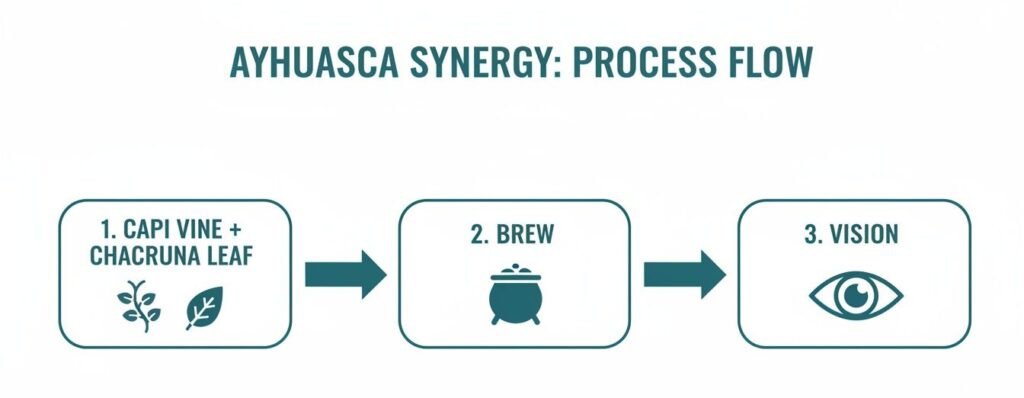
This brilliant combination, not one plant alone, gives rise to the visionary experience.
The Journey Inside the Brain
Once the DMT finally reaches the brain, it connects with serotonin receptors, most notably the 5-HT2A receptor. Scientists believe this is the key interaction that produces the profound visions, deep emotional release, and powerful self-reflection that define the Ayahuasca journey.
“This synergy is the heart of Amazonian pharmacology. It’s a sophisticated understanding of plant chemistry and the human body that has been refined over millennia, long before modern science could explain it.”
The vine does more than just unlock the DMT; it also shapes the experience. The MAOIs extend the journey, allowing it to unfold over several hours. This gives a person the time needed for the deep, introspective work that is the point of a traditional ceremony. For a closer look at the science, you can learn more about the beta-carbolines in the vine that make this possible.
The Two Halves of a Whole
A simple way to think about it is that the brew has two essential parts, each with its own job.
- Chacruna (Psychotria viridis): This is the “light.” It provides the DMT, the molecule responsible for the visions and insights.
- Ayahuasca Vine (Banisteriopsis caapi): This is the “key.” It provides the MAOIs that unlock the power of the DMT, making it active when consumed orally.
Without the vine, the light of the chacruna remains hidden. Without the chacruna, the vine offers a different kind of experience—heavier, more physical, but without the vivid visionary component. It is only when these two are brought together that they create the profound, holistic experience known as Ayahuasca.
From Amazonian Origins to Global Awareness
Chacruna’s story is woven into the very fabric of the Amazon basin, a history that stretches back centuries, long before any written records could capture it. For Indigenous peoples like the Shipibo, Asháninka, and Quechua, Psychotria viridis has never been just a plant. It’s a sacred teacher, a powerful ally, and a spiritual guide.
In these traditions, chacruna is held in the highest regard. It’s the cornerstone of healing ceremonies, used by shamans and healers to diagnose and treat what they often refer to as ‘spiritual illnesses’—those deep, lingering wounds like profound grief, trauma, or a paralyzing sense of disconnection. The plant is seen as the light, the source of the visions that illuminate the path through the spirit world, allowing the healer to bring back crucial insights for the community’s well-being.
The Journey From Forest to Favelas
For countless generations, knowledge of chacruna was a closely guarded secret of the Amazon. That all began to change in the 20th century, as the plant’s influence migrated from remote rainforest villages into new and unexpected cultural landscapes. A pivotal chapter in this journey started in Brazil, with the birth of syncretic religions like Santo Daime and União do Vegetal (UDV).
These new spiritual movements wove together Amazonian plant wisdom with threads of Christianity and African folk traditions. They adopted Ayahuasca—which they call Daime or Vegetal—as a holy sacrament. This was a hugely significant development. It created a structured, community-focused setting for Ayahuasca that could thrive far beyond its original Amazonian home.
“The plant’s journey tells a larger story of cultural exchange and adaptation. From a shaman’s tool in a forest clearing to a sacrament in a church, chacruna has shown an incredible capacity to find a home in new spiritual frameworks while holding onto its core identity as a visionary teacher.”
Chacruna on the Global Stage
These syncretic churches became the primary conduits through which chacruna and Ayahuasca stepped onto the world stage. As Santo Daime and UDV grew, they introduced their sacred brew to followers in North America, Europe, and elsewhere, igniting a global curiosity about the plant’s remarkable properties. For a much deeper dive into this fascinating history, you can read more about the origins of Ayahuasca and its cultural evolution.
Chacruna’s rise is a story of tradition meeting modernity. Ethnographic records suggest it is the key visionary ingredient in an estimated 95% of traditional Amazonian Ayahuasca recipes. Its reputation as a healer is profound, with healers consistently reporting high success rates in treating complex spiritual and emotional ailments. The incredible growth of churches like Santo Daime, which swelled from around 5,000 to over 25,000 members worldwide since the 1970s, was instrumental in bringing this Amazonian medicine to an international audience.
A New Chapter: The Psychedelic Renaissance
Today, chacruna’s journey has entered yet another phase, intersecting with the modern “psychedelic renaissance” and its focus on plant medicines for mental health and personal growth. Ayahuasca retreats have become a well-trodden destination for Westerners, many of whom are seeking a type of healing they feel is missing from conventional medicine.
This new chapter places chacruna at a fascinating crossroads. It is simultaneously a sacred plant medicine stewarded by Indigenous peoples for millennia, a holy sacrament in established global religions, and a substance of intense interest to modern science and the wellness industry. To approach this plant with integrity, we have to understand this rich, layered history. The reverence it has commanded for centuries is perhaps the best guide for how we might engage with it responsibly today.
Identifying and Cultivating Chacruna Sustainably
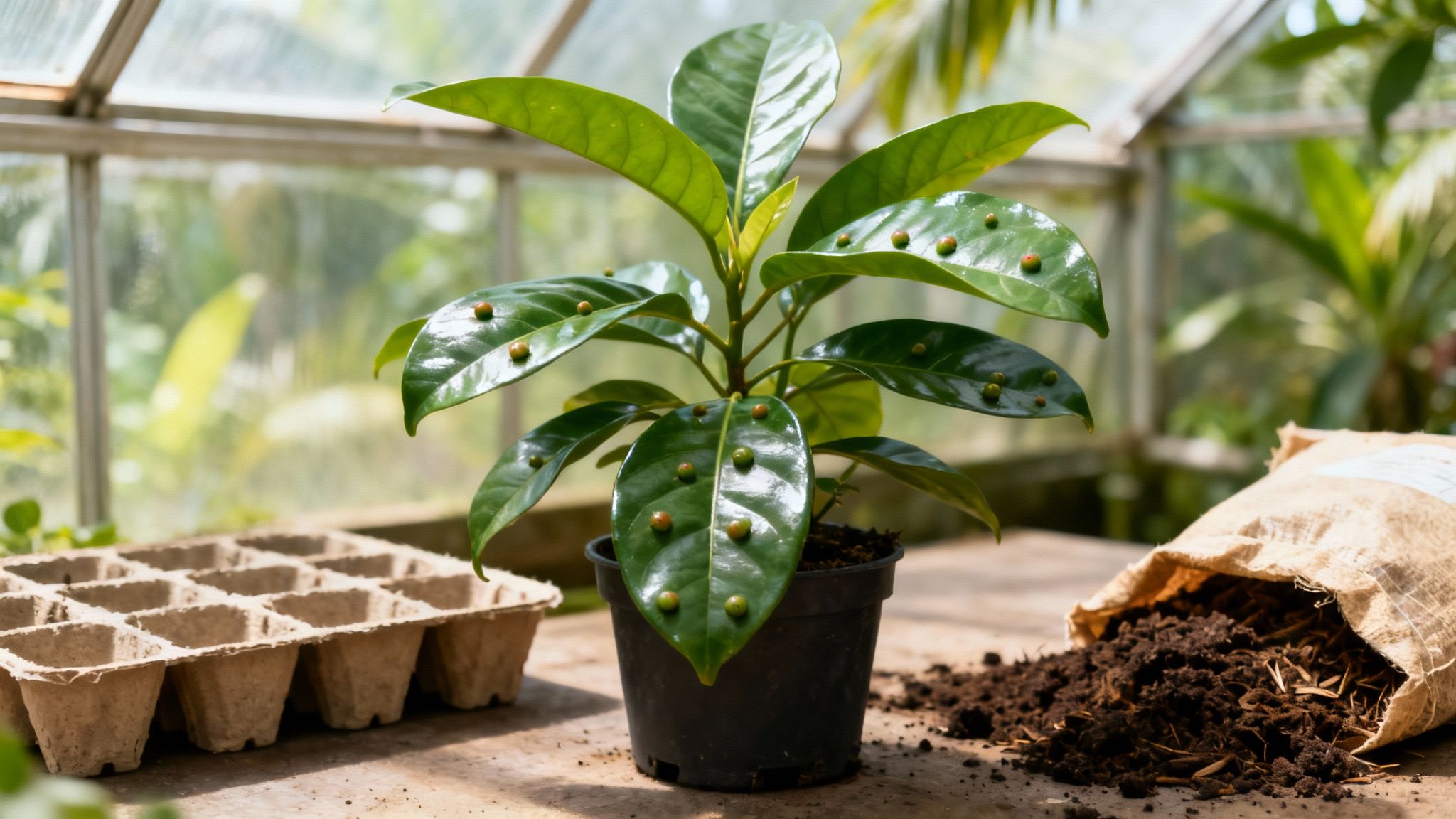
To truly understand chacruna, you have to look past its chemistry and see the living plant itself. For anyone working with this plant—whether you’re a botanist, a cultivator, or simply curious—learning to recognize Psychotria viridis in the wild is a foundational skill.
This evergreen shrub is native to the Amazonian lowlands, where it lives comfortably in the dappled light of the rainforest understory. Its most noticeable features are its large, glossy, deep green leaves. They grow in opposite pairs, giving the plant a distinctly symmetrical look.
But the real tell-tale sign is on the underside of the leaf. Look closely near the central vein, and you’ll often find tiny bumps called domatia. These are actually little chambers that provide a home for mites in a symbiotic partnership. For many, the presence of these domatia is the key to a positive identification.
How to Identify Chacruna
Spotting chacruna takes a keen eye. While it can look similar to other plants in the Psychotria family, a few specific details help it stand out.
- Leaf Shape and Feel: The leaves are elliptical and feel smooth, almost waxy. They have a rich, dark green color on top and are a bit paler on the bottom.
- The Domatia Test: This is the most reliable trick. Flip a leaf over and check along the midrib for those small, pimple-like bumps. They’re a classic chacruna feature.
- Growth Habit: Chacruna grows as a shrub or a small tree. In its natural habitat, it can reach heights of up to 5 meters. The stems are woody, and you’ll notice the new growth is often a much brighter green.
Knowing these details isn’t just for plant enthusiasts. For anyone preparing Ayahuasca, correct identification is a matter of safety and effectiveness. If you want to go deeper, you can explore more about the plants used in Ayahuasca shamanism and see how they fit into the broader ecosystem.
Cultivation and Ideal Growing Conditions
Trying to grow chacruna outside of the Amazon means you have to convince it that it’s still home. This is a plant that wants warmth, humidity, and filtered light—exactly what it would get on the forest floor.
“To thrive, chacruna needs a humid, tropical-like setting with well-draining soil that’s rich in nutrients. It’s very sensitive to frost, and direct, harsh sunlight will scorch its leaves and stop it from growing properly.”
Many growers use greenhouses or indoor setups to maintain high, consistent levels of temperature and humidity. The idea is to mimic the Amazonian environment as closely as possible, giving the plant the stable conditions it needs to produce healthy, potent leaves. This kind of careful cultivation is becoming more critical than ever.
The Critical Need for Sustainable Sourcing
As global interest in Ayahuasca has exploded, so has the demand for chacruna. This has put immense pressure on wild populations. The rise of Ayahuasca tourism, in particular, has led to over-harvesting in some areas, which threatens both the plant and the delicate rainforest ecosystem it belongs to.
This is where the conversation turns to ethics. Sourcing chacruna sustainably has to do with more than just being “green”—it’s about showing respect for the plant and for the cultures that have been its guardians for generations.
Ethical Sourcing Practices Include:
- Supporting Regenerative Farms: Look for chacruna from farms that are actively working to improve soil health, promote biodiversity, and create a balanced ecosystem.
- Backing Indigenous-Led Projects: Whenever possible, purchase from or support cultivation projects run by the Indigenous communities who hold the original knowledge of this plant.
- Avoiding Wild-Harvested Sources: By choosing cultivated chacruna, you help reduce the strain on wild plants, ensuring they’ll be around for generations to come.
By making conscious choices about where our chacruna comes from, we step into a cycle of reciprocity. We help ensure this sacred plant teacher can continue offering its healing and insight for many years to come.
Responsible Engagement and Ethical Considerations
As the world’s fascination with Ayahuasca grows, the conversation has to get bigger. We need to look beyond the personal journey and start talking seriously about our responsibilities to the cultures and ecosystems that steward this powerful plant medicine.
Engaging with chacruna is about more than what happens in a ceremony. It’s about stepping into a relationship with ancient traditions, and that requires a level of awareness and respect. When these practices are pulled out of their native soil and plopped down in a new context, there’s a real danger of them losing their soul. So, we have to ask ourselves: how can we show up with integrity?
The Thorny Issues of Cultural Exchange
One of the biggest concerns on everyone’s mind is cultural appropriation. This happens when sacred practices are co-opted, commercialized, and stripped of their original meaning, often without permission or understanding. There is a difference between respectful learning and turning a profound spiritual path into another wellness trend. This approach not only flattens the tradition but deeply disrespects its Indigenous roots.
Then there’s the problem of biopiracy. Think about it: for centuries, Amazonian peoples have cultivated not just chacruna, but the immense knowledge of how to work with it. Biopiracy is the theft of that knowledge or the plant’s genetic resources without fair compensation. As this medicine goes global, we have a duty to ensure the original stewards aren’t exploited, but are honored and supported.
“Engaging ethically means recognizing that this medicine is not a commodity. It is a living tradition, stewarded for generations by Indigenous communities who deserve our utmost respect and support. The principle of reciprocity is central to this relationship.”
Putting Reciprocity and Respect into Practice
Real reciprocity, or ayni as it’s known in some Andean traditions, is so much more than just a financial exchange. It’s about building genuine, lasting relationships with the communities that hold this knowledge. It means giving back in ways that are actually meaningful to them, ensuring the benefits of Ayahuasca’s global reach flow back to its source.
This idea is the bedrock of responsible engagement. It’s an invitation to be more than a spiritual tourist; it’s a call to be a conscious participant who understands their impact.
Here’s how to walk this path with intention:
- Choose Your Guides Wisely: Look for centers with deep, established ties to Indigenous communities. They should be transparent about how they give back, whether it’s through profit-sharing, direct employment, or funding community-led projects. Ask the hard questions.
- Honor the House Rules: Every tradition has its protocols, and they exist for a reason. Following the dieta (pre-ceremony diet), respecting the facilitator’s instructions, and maintaining a reverent silence are fundamental signs of respect.
- Do Your Homework: Before you even book a flight, learn about the specific lineage you’ll be working with. Understanding the cultural meaning behind the songs (icaros), the rituals, and the cosmology will not only enrich your experience but also demonstrate that you’re there to learn, not just to take.
By making conscious, ethical choices, you become part of the solution. You help protect the integrity of these ancient traditions and contribute to a future where the healing power of chacruna can be shared respectfully for generations to come.
Navigating Safety and Ceremony Preparation
Stepping into an Ayahuasca ceremony is a profound decision, one that asks for your full respect and diligent preparation. Your physical and psychological well-being is paramount, and the first step on this path is taking complete ownership of your health.
This commitment to safety starts long before you sit with the medicine. It’s a process of honest self-reflection, open dialogue with your facilitators, and following practices that have been developed over generations to keep participants safe. The point is to build a solid foundation of trust so you can fully surrender to the journey ahead.
The Power of the Dieta
At the heart of traditional preparation lies the dieta, a specific set of dietary and lifestyle guidelines followed for days or even weeks leading up to a ceremony. This is much more than a diet. Think of it as a deep spiritual and physical cleanse, designed to purify the body, calm the mind, and heighten your sensitivity to the plant’s wisdom.
Typically, a dieta means cutting out salt, sugar, oils, spicy foods, red meat, and abstaining from sexual activity. While these practices carry immense spiritual weight, there’s also a crucial physiological reason behind them, especially when it comes to certain foods.
“Adhering to the dieta is an act of intention. It demonstrates your commitment to the process and prepares your entire system—body, mind, and spirit—for the deep work ahead. This is your personal contribution to a safe and meaningful ceremony.”
Why Tyramine and MAOIs Don’t Mix
The magic of the Ayahuasca brew happens because the vine’s MAOIs let the DMT from the chacruna become orally active. But there’s a catch. Those same MAOIs also temporarily switch off the enzyme that breaks down tyramine, an amino acid present in many everyday foods.
When tyramine isn’t broken down, it can build up in your system and cause a dangerous spike in blood pressure, potentially leading to a hypertensive crisis. This is the core medical reason for the strict dietary rules.
Foods high in tyramine you absolutely must avoid include:
- Aged cheeses and meats: Parmesan, blue cheese, salami, pepperoni—these are all off-limits.
- Fermented products: This includes things like soy sauce, tofu, miso, and sauerkraut.
- Overripe fruits: Especially bananas and avocados.
- Certain alcoholic drinks: Red wine and some beers are particularly high in tyramine.
Following the dietary guidelines given to you by your facilitators isn’t a suggestion. It’s a non-negotiable safety requirement.
Medical and Pharmaceutical Contraindications
Just as important as the dieta is being fully transparent about your medical history and any medications you’re taking. This is where radical honesty with your ceremony facilitator or retreat center is absolutely essential for your safety.
Many medications can have dangerous, even life-threatening, interactions with the MAOIs in Ayahuasca. The table below outlines some of the most common categories, but it is not an exhaustive list. It is critical to discuss every single medication and supplement you take with both your doctor and the ceremony provider.
Common Contraindicated Medications and Substances
| Category | Examples (Not a complete list) | Reason for Contraindication |
|---|---|---|
| Antidepressants | SSRIs (Prozac, Zoloft), SNRIs (Cymbalta), MAOIs (Nardil), Tricyclics | High risk of serotonin syndrome, a potentially fatal condition. |
| Stimulants | Adderall, Ritalin, cocaine, amphetamines, diet pills | Can cause a dangerous increase in heart rate and blood pressure. |
| Opioids | Codeine, tramadol, Demerol, fentanyl | Risk of respiratory depression and other severe interactions. |
| Certain OTC Meds | Cold/flu remedies with dextromethorphan (DXM) or pseudoephedrine | Can lead to hypertensive crisis or serotonin syndrome. |
| Other Psychoactives | St. John’s Wort, 5-HTP, kava, cannabis (varies by tradition) | Unpredictable interactions; can potentiate or interfere with the experience. |
| Blood Pressure Meds | Diuretics, beta-blockers | MAOIs can cause unpredictable and dangerous fluctuations in blood pressure. |
Never stop taking any prescribed medication without the direct supervision and guidance of your doctor. A proper washout period, determined by your physician, is necessary to clear these substances from your system safely.
Finally, individuals with a personal or family history of certain mental health conditions, like psychosis, schizophrenia, or bipolar disorder, are often advised against working with Ayahuasca. The same goes for those with serious cardiovascular issues. Being honest during the screening process is about protecting yourself and the integrity and safety of the entire ceremonial space.
Frequently Asked Questions About Chacruna
To wrap up our deep dive into this sacred plant, let’s tackle some of the most common questions people have. Think of this as a quick-reference guide to solidify your understanding of chacruna and its central role in the Ayahuasca tradition.
We’ll cover the practical, the scientific, and the spiritual, giving you a complete picture.
Can You Use Chacruna on Its Own?
It’s a great question, and the short answer is no. While chacruna leaves are packed with the visionary compound DMT, simply eating or brewing them on their own won’t produce any psychedelic effects.
Our digestive system has a built-in defense mechanism, an enzyme called monoamine oxidase (MAO), that breaks down DMT almost instantly. This is where the magic of the Ayahuasca brew comes in. The vine, Banisteriopsis caapi, contains a natural MAO inhibitor (MAOI) that essentially tells those enzymes to take a break. This pause gives the DMT from the chacruna enough time to enter the bloodstream and travel to the brain, unlocking its profound visionary potential.
Are There Sustainable Alternatives to Wild-Harvested Chacruna?
Absolutely, and this is a crucial point for anyone approaching this medicine responsibly. The explosion in Ayahuasca’s popularity has put a real strain on wild chacruna populations, which makes mindful sourcing non-negotiable.
The best path forward is to support ceremonies and suppliers who use cultivated chacruna. Many of these regenerative farming projects are spearheaded by the Indigenous communities that have been the plant’s guardians for centuries. Sourcing from them ensures the tradition not only survives but thrives, directly benefiting its original keepers.
“Choosing cultivated over wild-harvested chacruna is a direct way to participate in a cycle of reciprocity. It helps preserve the rainforest’s biodiversity and supports the cultural integrity of the Amazonian people who share this medicine with the world.”
Another plant you might hear about is Chaliponga (Diplopterys cabrerana), which is also a source of DMT. However, it’s known to be significantly more potent and has a different energetic feel. For most people, the key is simply to ask. Inquire about where the plants come from and choose to support groups that are transparent and committed to cultivation.
What Does the Name Chacruna Mean?
The name ‘chacruna’ itself tells a beautiful story. It comes from the Quechua word ‘chaqruy,’ which means ‘to mix.’
This is a perfect description of the plant’s entire purpose in the Ayahuasca ceremony. It is the leaf that is ‘mixed’ with the vine to create the sacred sacrament.
This is more than just a chemical recipe; it’s a spiritual union. In many traditions, the vine is seen as the ‘strength’ or the ‘body’ of the medicine, while the chacruna is the ‘light’ or the source of the visions. The name is a direct reflection of the ancient, sophisticated understanding of how these two powerful plant spirits must work together.
Disclaimer: The information provided on Ayahuasca.com is for educational purposes only and is not intended as medical advice, diagnosis, or treatment. Ayahuasca is a powerful traditional Amazonian medicine and may not be suitable for everyone. Always consult with a qualified healthcare professional before making decisions related to health, mental well-being, medications, or the use of Ayahuasca.