
When people talk about Ayahuasca, you’ll often hear a specific name come up again and again: Mother Ayahuasca. This is not just a poetic nickname for the psychedelic brew. It gets to the very heart of the experience, framing it not as a chemical substance, but as a living, intelligent, and deeply maternal consciousness.
For those who have sat in ceremony, this distinction is everything. It is the difference between taking a drug and entering into a relationship with a wise, ancient teacher.
What It Means to Meet Mother Ayahuasca
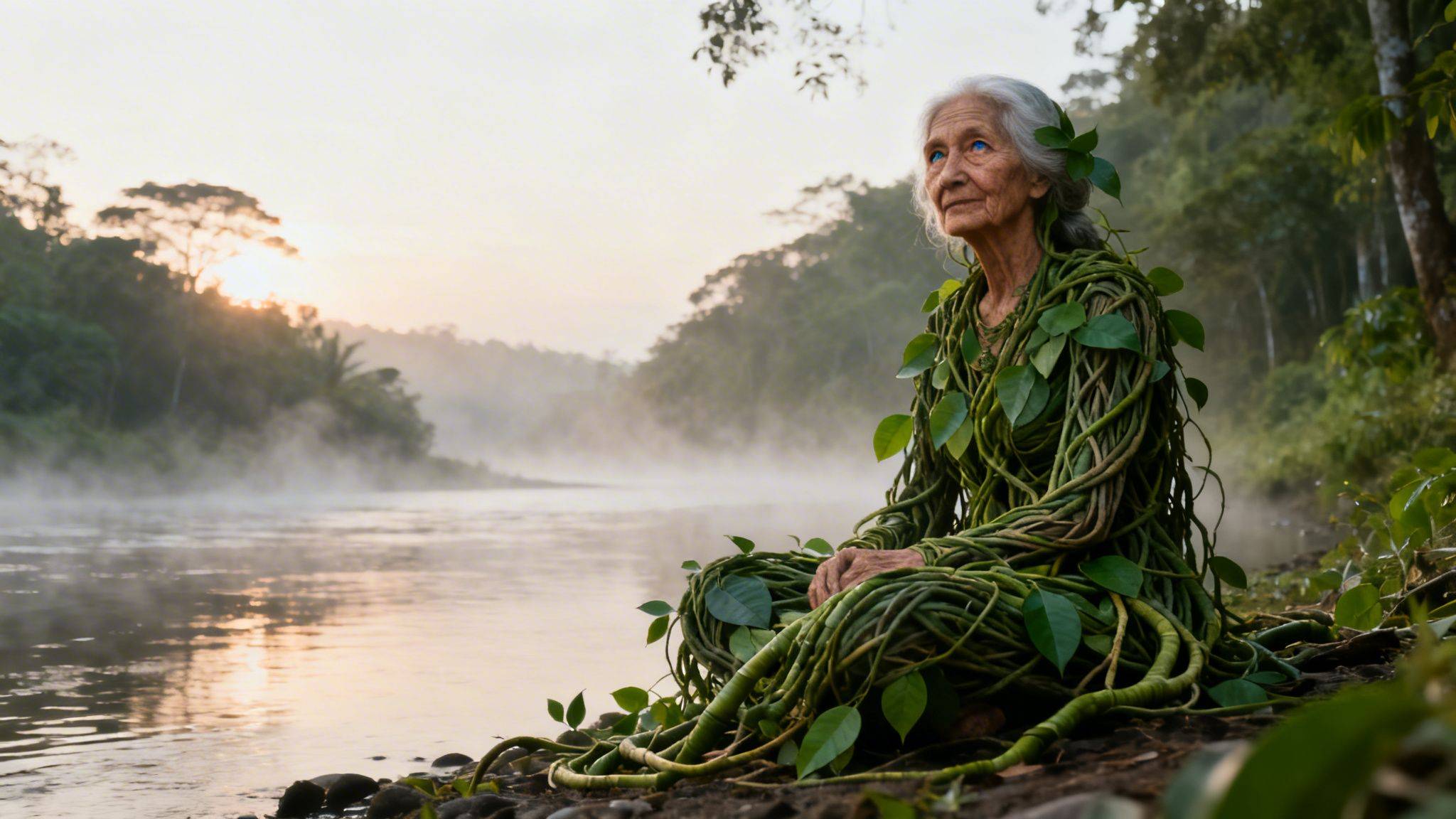
When you hear someone describe their journey, they often speak of being in the presence of a powerful, feminine spirit. This is the essence of meeting Mother Ayahuasca. The experience feels less like a hallucination and more like a direct dialogue with a being that holds profound knowledge about you, your past, and your path forward.
This perspective comes directly from the Amazonian indigenous traditions that have stewarded this medicine for thousands of years. In their worldview, plants are not just passive organisms; they are intelligent beings, powerful allies, and sacred teachers. Ayahuasca is revered as one of the most powerful and wisest of them all.
The Feeling of a Guiding Presence
Trying to put the experience into words is tough, but it often feels like a conversation with an entity that knows you better than you know yourself. This presence can bring long-buried memories to the surface, shine a light on destructive habits you were not aware of, or simply wrap you in a feeling of unconditional love.
Though every journey is unique, the feeling of her presence is often described in a few powerful ways:
- Nurturing Support: A profound sense of being held and kept safe, even during the most challenging moments of purging difficult emotions or physical discomfort.
- Firm Guidance: An honest, unflinching mirror that shows you your ego, your flaws, and the patterns that are holding you back, all without judgment.
- Profound Wisdom: Deep insights that seem to come from a source far beyond your own intellect, offering startling clarity on life’s biggest questions.
“The experience often feels like ten years of therapy packed into a single night. Mother Ayahuasca guides you through your own inner landscape, illuminating both the shadows and the light with an equal measure of compassion and truth. This is the essence of her role as a master healer.”
A Sacred Teacher, Not a Substance
Thinking of Ayahuasca as a “Mother” fundamentally changes how you approach the experience. It shifts the mindset from consumption to connection. You are not just taking something to see what happens; you are humbly entering a sacred space to ask for guidance from a respected elder. This respect is absolutely crucial for a safe and meaningful journey.
This reframing from a “what” to a “who” puts the focus on intention and humility. People are encouraged to come to the ceremony with a clear purpose, whether it is healing from trauma, finding direction in a confusing time, or simply connecting with a deeper part of themselves. Viewing Ayahuasca as a teacher is the foundation for truly understanding this powerful tradition.
The Sacred Roots in Amazonian Cultures
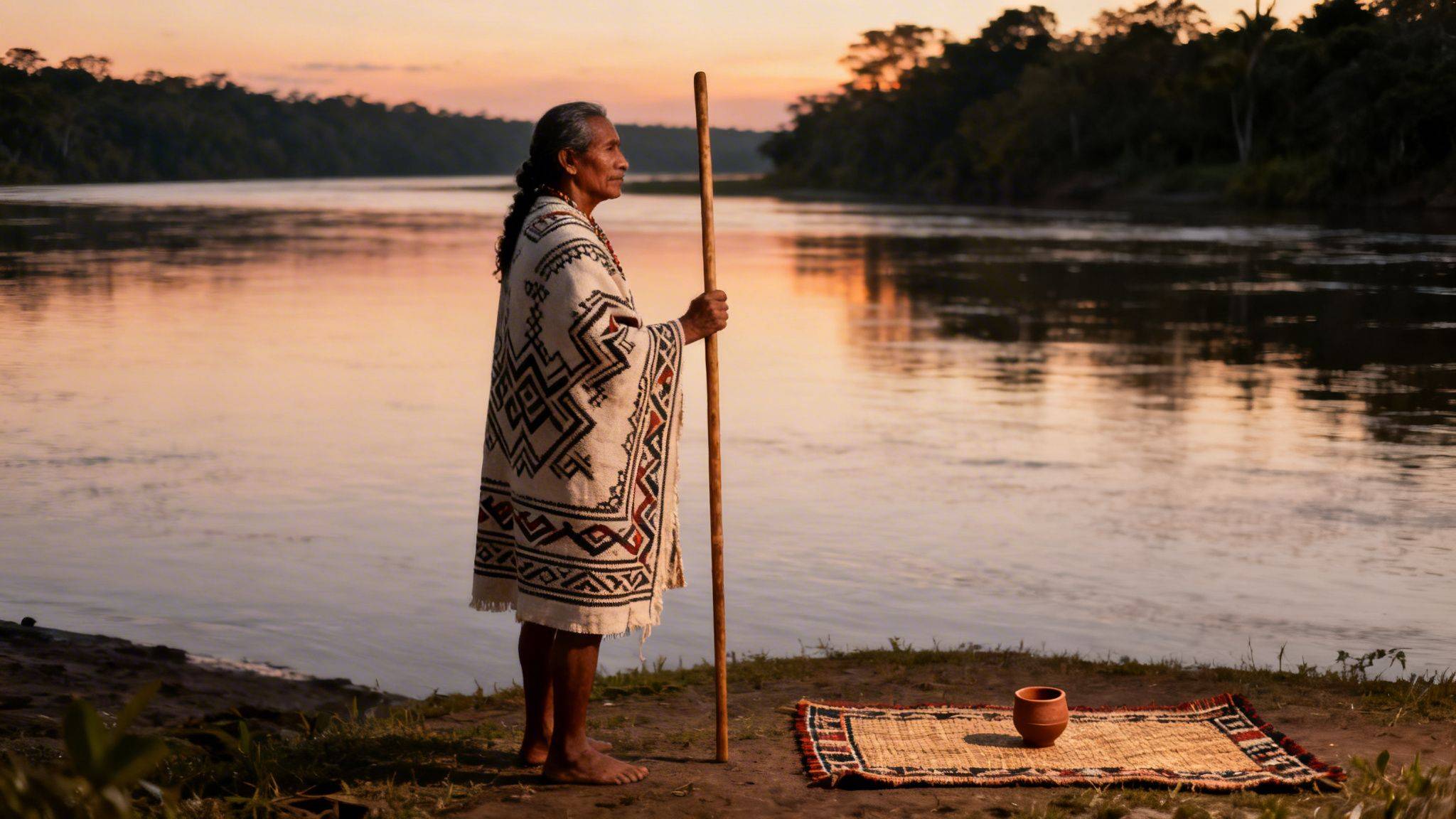
To even begin to grasp what “Mother Ayahuasca” means, we have to look to her home: the Amazon rainforest. This is not some new-age trend; it is an ancient practice, deeply embedded in the spiritual and social lives of dozens of indigenous groups for centuries, if not millennia.
For these cultures, the world is not a collection of inert objects. It’s a vibrant, conscious universe where plants, animals, and rivers possess intelligence and spirit. It is from this worldview that the concept of Mother Ayahuasca emerges, not as a mere substance, but as a wise, conscious entity, a teacher from the plant kingdom.
When you approach Ayahuasca from this perspective, it is no longer just a psychedelic experience. It becomes an act of participating in a living tradition, one founded on a deep, reciprocal relationship with the natural world.
The Shaman and the Ceremony
In a traditional Ayahuasca ceremony, the shaman, often known as a curandero, or healer, is the absolute center. They are not just a facilitator; they are the spiritual conductor and protector of the entire ceremony. Becoming a curandero is a lifelong commitment involving decades of rigorous training, strict dietary protocols, and profound communion with the plant spirits.
The shaman’s job is complex. They are the guardian of the space, the navigator of the spirit world, and the healer who tends to each person’s journey. They hold the energetic container, creating a safe space for people to confront their deepest fears and traumas.
“The shaman acts as a bridge between our world and the spirit world. Using their deep connection with the plants, they channel healing energies and guide you through the often-intense terrain of the Ayahuasca experience, making sure you have a supportive container for your work.”
This is precisely why choosing an experienced and ethical shaman is so incredibly important. Their mastery is what allows them to manage the powerful energies that surface and steer the ceremony toward genuine healing for everyone present.
Icaros: The Sacred Songs of Healing
One of the most essential tools in a shaman’s medicine bag is the icaro, or sacred song. These are not just pretty tunes. Icaros are a form of spirit technology, the literal language of the plants, received by the shaman during their long periods of training and isolation in the jungle.
Each icaro has a distinct purpose. Some are sung to create a protective energetic field around the ceremony. Others are used to call in specific plant spirits to help with healing, or to guide a person through a difficult part of their vision. The icaros are like a sonic roadmap for the journey. They can:
- Cleanse and Purify: Icaros are sung to clear away dense, negative energies from a person or the ceremonial space.
- Call in Allies: Shamans use them to summon the spirits of powerful plants and animals to aid in the healing.
- Navigate Visions: The songs can literally shape the visionary experience, helping to clarify insights or provide comfort during a challenging moment.
- Provide Protection: Certain icaros act as a fortress of sound, warding off any unwanted or disruptive spiritual influences.
The intricate vibrations of the icaros are just as medicinal as the brew itself. They work in tandem with the spirit of Mother Ayahuasca, weaving a tapestry of sound that makes deep transformation possible. You can learn more by exploring our guide on what indigenous groups traditionally use Ayahuasca. Without the shaman and their icaros, a ceremony lacks its spiritual anchor and its power to heal.
Ayahuasca’s Journey Into the Modern World
Not long ago, Ayahuasca was a secret known only to the indigenous communities deep within the Amazon. Today, it is a global phenomenon. What was once a closely guarded tradition has traveled far beyond the jungle, touching the lives of people from every imaginable background.
This incredible journey is fueled by a deep, collective search for something more. Many people in the modern world feel adrift, disconnected from themselves, from nature, or from a sense of true purpose. For them, the powerful stories of healing and spiritual awakening that surround Mother Ayahuasca are a beacon of hope.
The Western Thirst for Meaning
It is no surprise that Ayahuasca has found such fertile ground in the West. It speaks to a shared hunger for authentic experiences and profound healing that can feel just out of reach in our fast-paced, often secular societies. People are looking for real answers to life’s biggest questions, and for many, the usual paths are just not cutting it.
This has given rise to a boom in what many call “spiritual tourism.” Each year, thousands of Westerners fly to countries like Peru, Brazil, and Costa Rica, hoping to find guidance from Mother Ayahuasca. They come seeking relief from depression, PTSD, addiction, and the quiet desperation of modern life.
The numbers tell a stunning story. Over the last two decades, the global Ayahuasca community has exploded. It’s estimated that four million people worldwide have now taken part in an Ayahuasca ceremony. This is not just a niche trend; it is a massive cultural shift in how we think about healing and consciousness.
The Complexities of Globalization
Of course, this rapid global spread is a complicated affair, bringing both tremendous good and serious new problems. On one hand, more people than ever before have access to the healing this sacred medicine can offer. Countless individuals have found life-altering relief from conditions that modern medicine could not touch.
On the other hand, this popularity has a dark side. The commercialization of Ayahuasca has led to a flood of retreat centers, and not all of them operate with integrity or respect for the tradition. It has created a landscape where seekers absolutely must be careful and discerning.
“The globalization of Ayahuasca is a double-edged sword. It offers immense healing to many but also raises critical questions about sustainability, cultural respect, and the potential for exploitation when a sacred tradition becomes a commercial product.”
The biggest concerns that have emerged with this expansion include:
- Cultural Appropriation: When ceremonies are stripped of their rich spiritual context and sold as a simple “psychedelic trip,” the tradition is hollowed out and disrespected.
- Commercialization: The intense demand has attracted some unethical operators who put profit far ahead of the safety and well-being of their guests.
- Sustainability: The primary ingredient, the Banisteriopsis caapi vine, is being harvested at an unsustainable rate in some regions to keep up with global demand. This threatens not only the ecosystem but also the supply for the indigenous communities who have stewarded it for centuries.
As this powerful plant medicine continues its journey into the wider world, it demands that we approach it with awareness and a deep sense of responsibility. You can read more about how Ayahuasca was discovered by the world outside the Amazon to better understand its fascinating history.
How Ayahuasca Opens the Door to Psychological Healing
While the spiritual journey is a huge part of Ayahuasca’s pull, many people come to the medicine seeking something deeply personal: psychological healing. They are not just looking for a connection to the cosmos; they are searching for a way to heal old wounds and understand the patterns that keep them stuck.
The experience is often described as a kind of accelerated, intense therapy session. But instead of a therapist, the spirit of Ayahuasca itself seems to act as a guide, leading you on a tour through the deepest corners of your own mind and heart.
This journey is not always comfortable. It often involves confronting emotions you have pushed down for years, re-examining past traumas, and taking an honest look at your own behaviors. The plant seems to have a way of bringing these hidden things to the surface, not to cause more pain, but so they can finally be seen, understood, and let go.
What’s Happening Inside the Brain?
So, what’s actually going on in the brain to make this happen? This is where the science gets really interesting. The active compounds in the brew, especially DMT, interact with our serotonin receptors, which dramatically shifts our perception, thoughts, and feelings. One of the most significant effects researchers have found is on the Default Mode Network (DMN).
Think of the DMN as your brain’s “idle” setting. It is the network that lights up when you’re daydreaming, worrying about the future, or replaying past events. In people struggling with depression, anxiety, or PTSD, this network is often stuck in overdrive, forcing them into rigid, negative loops of thought.
“Ayahuasca does something remarkable: it dramatically quiets the DMN. It temporarily turns down the volume on the part of your brain that houses your ego and your inner critic. This creates a precious window where new connections can form, free from the usual mental chatter.”
By disrupting these stubborn thought patterns, Ayahuasca literally opens up new pathways in the brain. This “neurological reset” can be just what someone needs to break free from a cycle of negativity and see their life, and themselves, from a completely fresh perspective.
Ego Dissolution and Seeing Yourself Clearly
One of the most profound and common experiences people report from an Ayahuasca ceremony is ego dissolution. This is the temporary feeling that your sense of being a separate “I” has dissolved, and you’ve merged with everything around you.
While that might sound terrifying, it is usually described as a deeply liberating and peaceful experience. For a few hours, you get to step outside of your own personal narrative and all the self-limiting beliefs that come with it.
When the ego’s tight grip loosens, you can observe your own life with a newfound sense of clarity and compassion. This is often where people feel the presence of “Mother Ayahuasca” most profoundly, as if she is helping you see the unvarnished truth without a shred of judgment.
During this process, a few key things often happen:
- A Deep Emotional Release: Pent-up grief, anger, or fear can come pouring out in a powerful, cathartic way. People often describe feeling incredibly light and relieved afterward.
- Reframing Trauma: You might revisit a traumatic memory, but instead of being trapped in it, you see it from a detached, observer’s point of view. This distance allows for new understanding and emotional healing.
- A Surge in Self-Compassion: By seeing yourself from this wider, more objective vantage point, it becomes much easier to feel genuine love and acceptance for yourself, flaws and all.
This is not just anecdotal, either. A growing body of research is backing up these experiences. The Global Ayahuasca Survey, for instance, gathered data from over 10,000 people in more than 50 countries. It revealed a strong link between Ayahuasca use and improved psychological well-being, with many participants reporting significant mental health benefits. You can explore the findings on PsyPost to see just how impactful this can be.
By connecting the spiritual experience with these observable changes in the brain, we can start to understand how Ayahuasca can facilitate such deep and lasting healing. It is a powerful meeting of ancient wisdom and modern science, offering a rare opportunity to rewire the mind and mend the heart.
Your Guide to Preparation and Integration
Working with Mother Ayahuasca is not just about what happens during the ceremony. The real journey begins long before you take the first sip and continues long after the final song has faded. The work you put in beforehand and the care you take afterward are just as crucial as the experience itself.
Think of it this way: preparation and integration are the two pillars that support the entire structure of your healing. Without them, even the most profound experience can crumble. Trying to have a meaningful journey without this groundwork is like planting a precious seed in unprepared soil and just hoping for the best.
Preparing Your Body and Mind for the Journey
Proper preparation is, first and foremost, an act of respect for the medicine, for the ancient traditions, and for yourself. The main way we do this is through a traditional dietary protocol known as the dieta. This is not just a physical cleanse; it is a practice designed to quiet the static in your body and mind, making you more receptive to the plant’s subtle guidance.
Typically, the dieta starts at least one to two weeks before your ceremony. While the exact rules can vary between traditions, the core guidelines are fairly consistent.
- Foods to Avoid: You will want to cut out salt, refined sugar, red meat, pork, spicy foods, anything fermented, dairy, and heavy oils.
- Substances to Avoid: This is non-negotiable. Alcohol, caffeine, and all recreational drugs are strictly off-limits. Most importantly, many prescription drugs, especially SSRIs and other antidepressants, can have dangerous interactions with Ayahuasca. These must be discontinued well in advance, always under the supervision of your doctor.
- Activities to Limit: It is also wise to abstain from sexual activity and to curb your intake of intense or negative media.
“The goal of the dieta is to create a clean, quiet internal space. By clearing out these heavy and stimulating inputs, you’re essentially turning down the “noise” in your system. This allows the voice of Mother Ayahuasca to come through much more clearly.”
This process tunes you on both a physical and energetic level, opening you up to receive the healing the ceremony has to offer. For a deeper dive, our comprehensive guide on how to prepare for your Ayahuasca journey is an excellent resource.
Choosing a Safe and Ethical Facilitator
I can’t stress this enough: your safety is the absolute highest priority. With Ayahuasca’s growing popularity, there has been an explosion of retreat options, and not all of them are safe or ethical. Choosing your facilitator is the single most important decision you will make. A skilled, experienced, and ethical guide is what creates the secure container needed for this deeply vulnerable work.
When you’re researching centers, do not be shy. Ask direct questions and look for complete transparency. A trustworthy facilitator will always welcome your diligence.
Essential Questions for Any Retreat Center:
- What is the training, lineage, and experience of the shamans or facilitators?
- What does your medical screening process involve? Is there medically trained staff on-site?
- What is the ratio of facilitators to participants? (Smaller groups are generally better).
- Can you walk me through your safety and emergency protocols?
- How do you source your medicine? Is it done sustainably and ethically?
- What kind of integration support do you provide after the retreat?
Always trust your gut. If a center feels overly commercial, makes unbelievable promises, or is dodgy about its safety procedures, consider it a major red flag and walk away.
The Sacred Art of Integration
The ceremony might last a few hours, but the real work begins the moment you step back into your daily life. Integration is the conscious, and sometimes challenging, process of making sense of your experience and weaving its lessons into the fabric of who you are. Without it, even the most powerful insights can fade like a forgotten dream.
The psychological healing process you might encounter often follows these three stages:
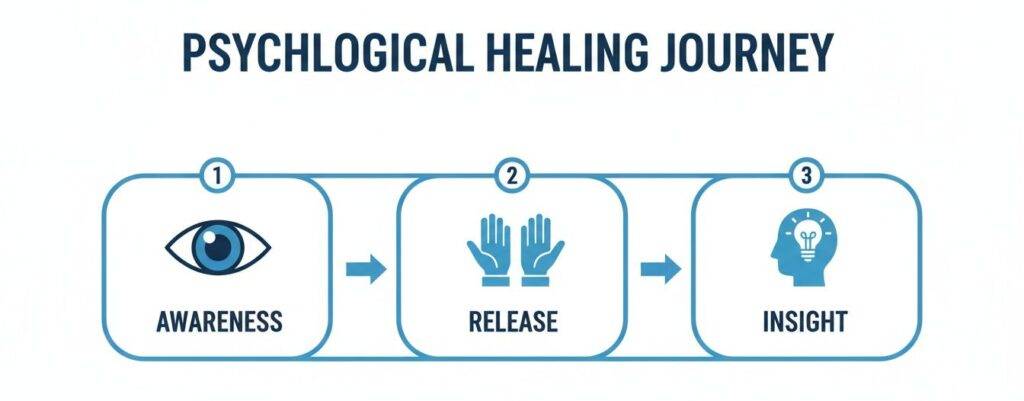
As the visual shows, the journey often moves from bringing unconscious patterns into Awareness, to a cathartic Release of pent-up emotional energy, and finally to a profound Insight that can completely reframe your life.
Be gentle with yourself. Ayahuasca can unlock doors in your mind that have been closed for years, and it takes time and patience to explore what is behind them. Some effective ways to support this process include:
- Journaling: Write down everything you remember, visions, feelings, bodily sensations, and stray thoughts. This helps anchor the experience and lets you start connecting the dots.
- Mindfulness and Meditation: These practices are perfect for staying connected to the clarity you felt in ceremony. They help you observe how old, familiar patterns might try to creep back in.
- Time in Nature: Spending quiet time outdoors can be incredibly grounding. For many, it feels like a way to continue the conversation with the plant spirit.
- Community Support: Talk to people who get it. Connect with fellow journeyers, or find an integration coach or therapist who has experience with psychedelics.
Integration is not a one-time task; it is an ongoing practice of living in alignment with the truths you have uncovered. It is how you truly honor the gift from Mother Ayahuasca, ensuring her lessons create real and lasting change in your life.
Common Questions About Mother Ayahuasca
Even after covering so much ground, you probably still have plenty of questions. That is completely normal, and frankly, it is a good thing. Being curious and cautious is a sign of respect for this powerful medicine.
Let’s dive into some of the most common questions people have as they learn more about Ayahuasca.
What Does It Mean When People Call Ayahuasca A ‘Mother’?
When you hear someone refer to “Mother Ayahuasca,” they are not just being poetic. They’re describing a profound and incredibly common experience, the feeling that the spirit of the plant itself is a living, intelligent, and distinctly feminine presence.
For many, the journey feels less like consuming a substance and more like entering into a relationship with a wise, maternal guide. This presence can feel nurturing and comforting, but it can also be a firm teacher, showing you truths you might have been avoiding. This perspective is directly tied to the indigenous worldview, where powerful plants are revered not as objects, but as conscious allies and spiritual teachers.
Is An Ayahuasca Ceremony Safe For Everyone?
This is perhaps the most critical question to ask, and the answer is a very clear no. An Ayahuasca ceremony is not safe for everyone, and proper screening is essential. People with certain health conditions, especially cardiovascular problems like high blood pressure, must avoid it.
Ayahuasca can also have dangerous, sometimes even fatal, interactions with common prescription drugs. Antidepressants, particularly SSRIs, pose a major risk. This is why a thorough and completely honest medical screening with an experienced facilitator is non-negotiable. It is also strongly advised against for anyone with a personal or family history of psychiatric conditions like psychosis or schizophrenia. Your safety depends on your honesty.
“Approaching Ayahuasca means putting safety above all else. A reputable center will have a strict screening process precisely because they understand the serious risks for certain individuals. Your well-being is always the number one priority.”
How Do I Find A Reputable Ayahuasca Retreat?
Finding the right retreat takes patience and careful research. A good center will prioritize your safety and well-being above anything else, and they will be transparent about it. Start by looking for centers that openly share information about their lineage, their facilitators’ experience, and their safety protocols.
A trustworthy retreat will always have a comprehensive medical screening process. Beyond their own website, spend time reading reviews and personal accounts from multiple independent sources to get a more complete picture.
Here are a few key things to look for:
- Facilitator Experience: Ask about the background and training of the people leading the ceremonies. How long have they been serving the medicine? Who did they learn from?
- Group Size: What is the ratio of facilitators to participants? Smaller groups are almost always better, as they allow for more personal attention and a safer container for the work.
- Integration Support: The journey does not end when the ceremony does. A responsible center understands this and will offer support to help you process and integrate your experience afterward.
- Cultural Reciprocity: Look for centers that show genuine respect for the indigenous traditions they work with and give back to the communities that have stewarded this medicine for generations.
Be wary of any place that makes grand promises of a “cure,” pressures you to book quickly, or is vague about its safety measures.
What Is The Difference Between Ayahuasca And Other Psychedelics?
While Ayahuasca is a psychedelic, it stands apart from substances like LSD or psilocybin mushrooms, both in its character and its context. Many people report that the spirit of Ayahuasca has a distinct personality, the “Mother”, who actively directs the journey, which is quite different from the experience with other psychedelics.
The setting is also a fundamental difference. Ayahuasca is almost always experienced in a group ceremony led by a shaman or facilitator. These ceremonies are built around sacred songs, called icaros, which are considered essential for guiding and shaping the healing process. The experience itself also has a typical duration of 4 to 6 hours.
Finally, it comes down to intention. While other psychedelics are sometimes used recreationally, Ayahuasca is consistently approached as a sacred medicine within a ceremonial framework. The focus is almost entirely on deep emotional healing, spiritual insight, and personal growth. This powerful, ritualized container is what truly defines the Mother Ayahuasca experience.
Disclaimer: The information provided on Ayahuasca.com is for educational purposes only and is not intended as medical advice, diagnosis, or treatment. Ayahuasca is a powerful traditional Amazonian medicine and may not be suitable for everyone. Always consult with a qualified healthcare professional before making decisions related to health, mental well-being, medications, or the use of Ayahuasca.