
So, what exactly is ayahuasca integration? Think of it as the vital process of weaving the profound, often otherworldly, insights from a ceremony into the fabric of your everyday life. It’s not an add-on or an afterthought; it’s arguably the most important part of the entire experience.
Without a conscious integration practice, even the most earth-shattering revelations can evaporate like dreams upon waking, leaving you with little more than a wild story to tell.
What Is Ayahuasca Integration and Why It Matters
Let’s use an analogy. Imagine your ayahuasca ceremony is like finding a detailed, mysterious map. The map reveals hidden treasures, forgotten paths, and dangerous territories within your own inner landscape. It’s an incredible discovery, but the map itself doesn’t move you.
Integration is the work of learning to read that map. It’s the journey you take, step-by-step, using its guidance to navigate your life differently when you get home. The ceremony opens a door; integration is choosing to walk through it and build something new on the other side.
From Vision to Lasting Change
The ayahuasca experience can feel like a lifetime of therapy packed into a single night. But the real transformation doesn’t happen in the maloca—it happens in the weeks and months that follow.
Integration is the dedicated work that turns those raw insights and emotional purges into tangible, real-world change. It’s what keeps the experience from becoming just an isolated, psychedelic memory. This is where the magic truly anchors into your reality.
This process involves a few key things:
- Making Sense of the Mystery: You have to translate symbolic visions and overwhelming feelings into practical wisdom about your habits, relationships, and life patterns.
- Embodying the Lessons: It’s about taking that new awareness and actively applying it. This could mean changing your behavior, setting healthy boundaries, or finally having that difficult conversation.
- Sustaining the Shift: Integration helps you build new routines and support systems that reflect your new perspective, making sure the changes aren’t just temporary.
The Science Behind the Practice
This isn’t just spiritual woo-woo; the importance of integration is backed by growing evidence. As more people work with ayahuasca, we’re learning what makes it an effective tool for mental health.
The largest-ever survey on ayahuasca, which included over 10,800 people from more than 50 countries, highlighted a powerful link between its use and better mental health. The most significant improvements were seen in people who had mystical experiences, gained deep personal insights, and built strong community bonds. These are the very pillars of successful ayahuasca integration. You can read a summary of this groundbreaking survey on PsyPost.org.
“Integration is the commitment to honor the medicine by embodying its message. It’s how your transformation becomes sustainable and woven into the fabric of your life, rather than remaining a beautiful but fleeting memory.”
To put it simply, the ceremony shows you the path. Integration is the act of walking it, day in and day out. By committing to this process, you give the powerful seeds planted during your journey the soil, water, and sunlight they need to grow.
To help you get a clearer picture, here’s a breakdown of what a well-rounded integration practice looks like. I call these the four pillars.
The Four Pillars of Successful Ayahuasca Integration
| Pillar | Focus Area | Example Activities |
|---|---|---|
| Psychological | Cognitive & Emotional Processing | Therapy (especially IFS or Somatic), journaling, meditation, sense-making with a coach. |
| Spiritual | Connecting to Purpose & Meaning | Nature immersion, mindfulness practices, creative expression (art, music), community circles. |
| Somatic | Reconnecting with the Body | Yoga, breathwork, dance, bodywork (massage, acupuncture), conscious movement. |
| Lifestyle | Grounding into Daily Routine | Nutrition changes, improving sleep hygiene, setting boundaries, physical exercise, spending time with supportive people. |
Each pillar supports the others, creating a strong foundation for your insights to land and take root. You don’t have to do everything at once, but touching on each of these areas over time will ensure your growth is balanced and sustainable.
The Timeline of Your Integration Journey
Ayahuasca integration isn’t a one-and-done event; it’s a gradual unfolding that happens over weeks, months, and even years. Think of it like a deep-sea diver who has to ascend slowly to avoid the bends. After the profound depths of a ceremony, you need to return to the surface of your everyday life with patience and intention.
Understanding the typical stages can help you normalize what you’re feeling and navigate the journey with a bit more grace.
It’s a bit like learning a new language. The ceremony gives you the vocabulary—the raw insights and feelings. In the beginning, you’re just trying to remember a few key “words.” Over time, you start stringing them together into simple sentences, connecting the dots in your own life. Eventually, those lessons become a fluent, natural part of how you think, act, and feel.
This infographic simplifies the entire ayahuasca arc into three core phases: the Dive (the ceremony itself), the Discovery (the integration), and the Ascent (embodying your new truth).
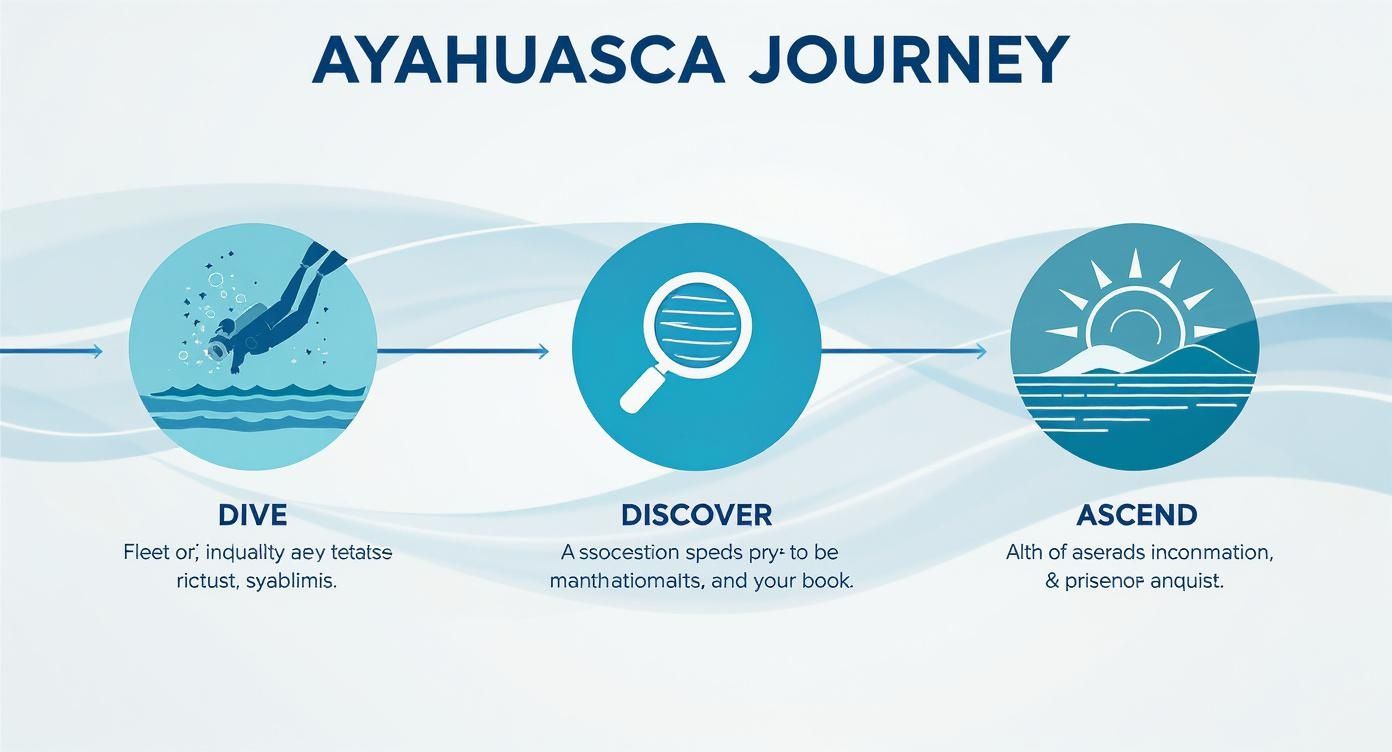
The real work happens during that discovery phase, which leads to the ascent into a new way of being. Let’s break down what that timeline often looks like.
The Immediate Echo: First 72 Hours
The first few days after a ceremony are an incredibly delicate time. Your whole system—emotional, energetic, psychological—is wide open. This makes you extremely sensitive to your surroundings. The last thing you want to do is jump straight back into a high-stress job, noisy social events, or doomscrolling online.
You might feel euphoric, weepy, exhausted, or blissfully calm—sometimes all at once. The key here is to prioritize rest and quiet contemplation. Your mind, body, and spirit are recalibrating on a massive scale. Give them the space to do so.
The Unpacking: First Month
In the first month, the initial intensity begins to settle, and the real processing starts. This is when you can begin to gently unpack the visions, emotions, and messages that came through during your journey.
Activities like journaling, walking in nature, or talking with a trusted friend or integration coach become your most valuable tools. You’re not trying to solve everything, just to observe it.
You may also notice old habits or difficult emotions popping up with surprising clarity. This isn’t a sign the medicine failed; it’s proof that it worked. It shined a light on what needs your attention, and now the work of healing truly begins.
“Ayahuasca integration isn’t about desperately clinging to the peak experience of the ceremony. It’s about learning to live from the new perspective it gave you, especially when you’re back in the quiet, ordinary moments of your life.”
Resist the urge to make huge life decisions during this phase. Don’t quit your job or end a major relationship on a whim. Just sit with the insights and let them marinate.
The Embodiment: Months 2 to 6
After the initial download and unpacking, the focus shifts from understanding to doing. This is where the rubber meets the road. You start embodying the lessons by consciously building new habits and making small, sustainable changes in your daily life.
If the medicine showed you the importance of self-compassion, this is when you commit to a daily meditation or self-care practice. If it revealed a need for connection, you start reaching out to your community.
This phase of ayahuasca integration is all about tangible action:
- Setting New Boundaries: Finally learning to say “no” to things that drain you.
- Changing Your Routine: Weaving in new practices like yoga, healthier eating, or a creative hobby.
- Shifting Relational Dynamics: Communicating your needs more honestly and vulnerably in your relationships.
Progress might feel slow, and that’s okay. These small, consistent steps are what build real, lasting change.
The Long-Term Weaving: Beyond 6 Months
Once you move past the six-month mark, integration often becomes less of a conscious “project” and more of an ingrained part of who you are. The new habits you worked so hard to build start to feel second nature. The insights are no longer just intellectual concepts; they are woven into the fabric of your being.
Of course, this doesn’t mean the work is “done.” Life will always bring new challenges and opportunities for growth. The difference is that you now have a deeper well of wisdom and a more reliable inner compass to guide you, thanks to the profound lessons the medicine helped you uncover.
Practical Methods for Effective Integration

The ceremony is over, but the real work has just begun. Now comes the delicate process of weaving the profound, often chaotic, insights from your journey into the fabric of your daily life. This is where the magic of ayahuasca integration truly happens, not in theory, but in practice.
Think of it like building a personal toolkit. You wouldn’t use a hammer to turn a screw, right? In the same way, some practices are perfect for sorting through emotions, while others are better for grounding your energy when you feel untethered. The goal is to find what works for you and create a sustainable routine that supports your new awareness.
Journaling to Decode Your Experience
One of the best things you can do right away is to start writing. Ayahuasca often speaks in a language of symbols, fragmented visions, and deep feelings that don’t always make logical sense. Journaling is your first step in translating this cosmic dialect into something your conscious mind can begin to grasp.
Forget about writing a perfect, polished story. Just get it all out.
- Capture Everything: Write down the visions, the feelings, the physical sensations, and any words or messages that came through. Don’t censor anything, no matter how strange or trivial it seems.
- Hunt for Patterns: After a few days, go back and read what you wrote. Do you see recurring symbols? A persistent feeling? An idea that keeps popping up? These are your breadcrumbs—the core messages the medicine wanted you to hear.
- Ask Deeper Questions: Move beyond just recording the events. Use prompts to dig deeper. Ask yourself things like, “Where else in my life does this feeling of unworthiness show up?” or “What’s one small, concrete step I can take today to honor this insight about connection?”
Your journal becomes a living map of your inner world, helping you track your progress and connect the dots in a way you’d otherwise miss. It’s a foundational practice for making sense of the mystery.
Reconnecting Through Somatic Practices
Ayahuasca doesn’t just mess with your head; it works on a profoundly physical level. Some of the most potent lessons are stored in the body as felt senses, emotional purges, and energetic realignments. To truly integrate them, you have to get out of your mind and into your body.
Somatic practices are the bridge. They help you process emotions that you simply can’t find words for, anchoring the healing deep within your physical being.
“The body remembers what the mind might forget. Somatic integration is the process of listening to the body’s wisdom and allowing it to guide the healing process, ensuring that transformation happens on a cellular level.”
Here are a few powerful ways to drop into your body:
- Breathwork: Simple, conscious breathing is a direct line to your nervous system. It can help you release stored tension and return to that calm, centered state you may have touched in ceremony.
- Yoga or Mindful Movement: This isn’t about hitting the perfect pose. It’s about moving intuitively and just feeling what it’s like to be in your body with heightened awareness.
- Bodywork: Things like massage or acupuncture can be incredibly helpful. They work to release physical knots where emotional energy gets stuck, helping everything flow more freely.
Grounding with Nature and Community
After such an expansive experience, grounding is non-negotiable. One of the simplest and most powerful ways to do this is to get outside. The natural world moves at a slower, more deliberate rhythm, which can be incredibly soothing for a raw and sensitive nervous system. Walk barefoot on the grass. Listen to the birds. Just sit under a tree. It’s a direct way to feel stable and connected to the earth again.
Just as important is finding your people. You are not meant to do this alone. Connecting with others who understand this path is incredibly validating. Simply sharing your story in a safe, non-judgmental space can make you feel seen and supported in a way that nothing else can. To dive deeper into this concept, you can read more about the principles of psychointegration.
Consistently engaging with these practices isn’t just about feeling good in the short term; it may even support your long-term cognitive health. A cross-sectional study of long-term ayahuasca drinkers found they maintained global cognitive function and, interestingly, showed even better memory performance than beginners. This suggests that intentional, consistent use within a supportive framework might not just be safe but could even help preserve certain mental faculties. You can explore the research on long-term ayahuasca use and cognitive function on PubMed.
By weaving together introspection like journaling with embodied methods like somatic work and grounding activities, you build a holistic integration practice. This is how you give the lessons from the medicine fertile ground to truly take root and flourish in your life.
How to Navigate Integration Challenges Safely
The ayahuasca journey doesn’t end when the ceremony does. In fact, that’s often when the real work begins. And let’s be honest—that work isn’t always filled with blissful, earth-shattering insights. Sometimes, it’s messy and uncomfortable.
After a ceremony cracks you open, it’s completely normal to feel emotionally raw, almost like you’ve lost a layer of skin. You might feel hypersensitive or find yourself feeling strangely disconnected from the life you knew just days before. This isn’t a sign that something went wrong.
Think of it as major psychological surgery. You wouldn’t expect to leave the hospital and immediately run a marathon. Your mind, spirit, and nervous system need time to recover. The challenges that come up aren’t roadblocks; they’re the curriculum.
You might struggle to articulate your experience to a partner who just doesn’t get it. You might feel overwhelmed by the stark truths the medicine showed you. Or maybe you’ll notice old, destructive habits roaring back to life, almost as if to test your resolve. This is the heart of integration.
Recognizing Common Pitfalls
Walking the path after a ceremony means learning to spot the common traps that can trip people up. One of the sneakiest is spiritual bypassing. This is when we use spiritual-sounding ideas to sidestep our real, messy human emotions. It’s the tendency to slap a “love and light” sticker on deep-seated anger, grief, or fear that desperately needs to be felt and processed.
Another huge piece of the work is facing your shadow side. Ayahuasca has a knack for shining a spotlight on the parts of ourselves we’ve disowned or hidden away. Seeing these aspects can be jarring, to say the least. The goal isn’t to judge or banish them, but to get curious. These suppressed parts often hold the very energy and wisdom we need to become whole.
Finally, there’s often a powerful urge to make huge, sweeping life changes right away. The medicine might have made it crystal clear that your job is soul-crushing or a relationship has run its course. But hitting the eject button impulsively is rarely the answer. Give the insights time to settle. Stability is your best friend in the early days of integration.
Red Flags That Signal a Need for Help
While feeling wobbly is part of the process, some signs suggest you’ve moved beyond typical integration discomfort and need professional support. Please don’t try to tough it out alone if you experience these.
Keep an eye out for these red flags:
- Persistent Disconnection: Feeling spaced out, ungrounded, or alienated for an extended period.
- Overwhelming Anxiety or Paranoia: Fear and anxiety that become so intense they interfere with your daily life.
- Prolonged Depression: A heavy sadness or sense of hopelessness that just won’t lift after a few weeks.
- Inability to Function: Finding it difficult to handle basic responsibilities at work, home, or with your family.
These aren’t signs of personal failure. They are signals from your nervous system that it’s overwhelmed and needs help from a skilled therapist or integration specialist to find its way back to balance.
“Ayahuasca opens the door, but it doesn’t organize the room for you. The messy, uncomfortable, and challenging parts of integration are where you learn to apply the medicine’s lessons to the real world.”
Creating a Safe Container for Healing
Your number one priority during integration is safety—both internally and externally. A crucial piece of this is physical. The MAOIs in ayahuasca can linger in your system, and they can have dangerous interactions with certain foods and medications. For a detailed breakdown, please review our guide on foods and medications to avoid with MAOIs.
As ayahuasca use becomes more widespread—with some estimates suggesting over four million people have participated in a ceremony—the conversation around safety is more important than ever. While scary headlines pop up occasionally, a thorough analysis of 58 reported deaths found no confirmed cases directly caused by a traditionally prepared ayahuasca brew. This really underscores how vital safe practices are, both in ceremony and during the delicate integration phase that follows. You can learn more about ayahuasca’s global consumption and safety on ICEERS.org.
To create your own safe “container” for healing, get serious about setting boundaries. Limit time with people who drain your energy. Prioritize rest like it’s your job. And nourish your body with clean, simple food. Your well-being is the very soil your healing needs to take root and grow.
Finding the Right Integration Support

Trying to integrate an ayahuasca experience all on your own is like trying to navigate a wild, new territory without a map. While so much of the work is internal, the right guide or community provides the anchor you need to ground your insights and make sense of it all.
Finding a good support system is probably one of the most important steps you can take. It’s the bridge between a powerful, mystical experience and real, lasting change in your day-to-day life.
But “support” can mean a lot of different things. The key is figuring out what you need, whether that’s a professional to help with deep-seated psychological patterns or simply a group of peers who just get it.
Types of Integration Support
The world of ayahuasca integration support has grown, and it can be tricky to figure out who does what. Each option provides a different kind of container for your process, so think about what would serve you best at this moment.
Here’s a quick look at the main players:
- Integration Coaches are often people who have walked this path themselves. They specialize in helping you translate the visions and lessons from your ceremony into practical action steps and new habits that actually stick.
- Licensed Therapists who are knowledgeable about psychedelics offer a clinical lens. This is crucial if your ceremony brought up heavy-duty stuff like trauma, deep-rooted anxiety, or other mental health challenges that need a professional touch.
- Peer Support Circles are all about community. Being in a room (even a virtual one) with others who’ve had similar experiences can be incredibly validating. It reminds you that you’re not alone on this sometimes-strange journey.
“Choosing the right support is less about finding a guru and more about finding a mirror—someone who can reflect your own wisdom back to you and hold a safe, non-judgmental space for your unfolding process.”
Vetting Your Potential Guide
Once you have a sense of what you need, it’s time to find the right person. This is where you have to be discerning. Not all guides are created equal, and a bad fit can unfortunately set you back.
Think of it like an interview. You’re hiring someone for a deeply personal and important role in your healing. Don’t be shy about asking tough questions. How they respond will tell you everything you need to know about their experience, their ethics, and whether they’re the right person to hold space for you. For anyone curious about this professional path, it’s worth understanding what it takes to become an ayahuasca facilitator and the immense responsibility it carries.
Here are a few essential questions you should ask anyone you’re considering working with:
- What is your direct experience with ayahuasca? You need someone who knows the territory from the inside out, not just from a book.
- What specific training do you have in psychedelic integration? Look for actual certifications or formal training from reputable organizations. “Experience” alone isn’t always enough.
- How do you approach challenging experiences or shadow work? A good guide isn’t afraid of the dark stuff. They should have a clear, grounded way of helping you navigate it.
- What are your ethical guidelines and professional boundaries? This is a red-flag detector. A true professional will have a clear code of conduct and be happy to discuss it.
- Can you describe your integration philosophy? Get a feel for their approach. Does it resonate with your own values and what you hope to achieve?
Above all, trust your gut. A qualified, ethical guide will welcome your questions, be transparent in their answers, and make you feel safe and respected from the very first conversation.
Your 12-Month Ayahuasca Integration Roadmap
The most powerful ayahuasca journeys aren’t measured by what you see in ceremony, but by what you do with the insights afterward. This roadmap isn’t a rigid checklist; it’s a living guide to help you nurture the seeds of change the medicine planted. Think of it as a compass for the year ahead, helping you navigate the profound process of ayahuasca integration.
We’ll break down the first year into three distinct phases. Each one builds on the last, guiding you from the initial, fragile aftermath of ceremony toward a deeply embodied new way of living. Remember, this is your path. Take what resonates, leave what doesn’t, and trust your own inner wisdom above all.
Months 1-3: Grounding and Stabilization
Right after a ceremony, you’re incredibly open and sensitive. The first three months are all about creating a safe, stable space for your system to recalibrate. The goal here isn’t to make huge life changes or analyze every vision. It’s simply about coming back into your body and your life, gently.
This is a time for deep rest, quiet observation, and radical self-compassion.
Key Activities for this Phase:
- Prioritize Rest: Sleep is one of the most powerful integration tools there is. Your brain and nervous system are doing a massive amount of rewiring, so allow yourself far more rest than you think you need.
- Capture the Experience: Keep a journal handy. Write down everything you can remember—visions, feelings, messages, even confusing parts—without trying to make sense of it yet. This is just for capturing the raw material.
- Get into Your Body: Simple, grounding practices are essential. Think gentle yoga, mindful walks in nature, or even just standing barefoot on the earth for a few minutes each day. These activities help anchor your energy.
- Create a Cocoon: Be very intentional about what you let in. Limit chaotic news, draining social media, and overwhelming social situations. Your nervous system is raw, so protect it.
Months 4-6: Deeper Processing and Building New Skills
Once you feel more grounded and stable, you can start to gently sift through the material that came up in your ceremony. This phase is about looking at the deeper patterns, old beliefs, and emotional wounds that ayahuasca brought to the surface. It’s less about just seeing them and more about learning new ways to work with them.
You’re shifting from being a passive observer of your inner world to an active participant in reshaping it. For many, this is the ideal time to start working with an ayahuasca integration therapist or coach who can help you navigate complex themes like shadow work or healing relational trauma.
“Your integration journey is a marathon, not a sprint. This middle phase is where you build the emotional strength and resilience needed to go the distance, turning powerful insights into lasting change.”
Months 7-12: Embodiment and Living the Lessons
The second half of the year is where the magic really happens. It’s all about embodiment—letting your newfound wisdom move from your head into your bones until it becomes a natural part of who you are. The new habits you’ve been consciously building start to feel less like effort and more like your default setting.
Here, the focus shifts from processing the past to intentionally creating your future. This is when you might feel ready to make bigger life changes, guided by a much clearer inner compass. Your integration work stops feeling like a separate “project” and simply becomes the way you live: with more presence, authenticity, and purpose.
To give you a clearer picture, here is a high-level overview of what this year-long journey might look like.
Sample 12-Month Integration Roadmap
| Timeframe | Primary Focus | Key Activities |
|---|---|---|
| Months 1-3 | Stabilization & Grounding | Prioritize sleep, journaling, somatic practices (yoga, breathwork), creating a calm environment. |
| Months 4-6 | Active Processing | Begin therapy or coaching, explore shadow work, learn new emotional regulation skills. |
| Months 7-9 | Embodiment & Practice | Start applying new behaviors in relationships, work, and daily routines. Test your new “muscles.” |
| Months 10-12 | Long-Term Vision | Make bigger life decisions aligned with your values. Set intentions for the future from a place of clarity. |
This roadmap is just a sketch. Your timeline will unfold in its own perfect time. The key is to stay patient, stay curious, and continue showing up for yourself long after the echoes of the icaros have faded.
Your Integration Questions, Answered
Stepping back into daily life after an ayahuasca ceremony can feel a bit like learning to walk again. It’s only natural to have questions. Here are some straightforward answers to the most common ones that come up on the integration path.
How Long Does Ayahuasca Integration Last?
This is probably the most common question, and the honest answer is that there’s no finish line. Integration is really a lifelong commitment to growth. That said, the most intense, hands-on phase usually spans the first six to twelve months post-ceremony.
Think of it less like a project you complete and more like a new lens through which you see yourself and the world. The first few weeks are often about finding your footing again. The months that follow are for actively unpacking your insights and weaving them into your life. Eventually, what started as conscious effort becomes second nature.
“The real measure of a powerful ceremony isn’t how profound the visions were, but how deeply you apply the lessons in the quiet, ordinary moments of your life long after you’ve returned home.”
Can I Do Integration On My Own?
You can absolutely start the process on your own. In fact, solo practices like journaling, meditation, and quiet time in nature are foundational. But the journey isn’t meant to be a solitary one.
Sharing your experience—whether with a close friend, a support group, or an integration coach—is incredibly important. Community acts like a mirror, helping you see blind spots and reminding you that you aren’t alone. Self-reflection is the engine, but connection is the fuel that keeps you from getting stuck or feeling isolated.
When Should I Consider Another Ceremony?
It’s tempting to want to jump back in, especially when integration feels challenging. This is often called “chasing the ceremony”—the belief that the answer to a tough integration is another big, transcendent experience.
Resist that urge. Give yourself plenty of time to digest what you’ve already been given. A good rule of thumb is to wait until you’ve made real, tangible changes in your life based on what you learned last time.
Ask yourself: Have I truly embodied what I’ve already learned? If the answer isn’t a clear “yes,” then your most important work isn’t in another ceremony; it’s right here, in your day-to-day life. The deepest growth happens between the journeys, not just during them.
Disclaimer: The information provided on Ayahuasca.com is for educational purposes only and is not intended as medical advice, diagnosis, or treatment. Ayahuasca is a powerful traditional Amazonian medicine and may not be suitable for everyone. Always consult with a qualified healthcare professional before making decisions related to health, mental well-being, medications, or the use of Ayahuasca.