
To integrate Ayahuasca is to carry what you learned in ceremony into everyday life. The last icaro has faded, the candles are out, and the ceremony is officially over. But in reality, the real work is just getting started.
An Ayahuasca journey doesn’t end when the sun comes up; it simply moves into a new, incredibly important phase. This is what we call integration: the conscious, deliberate process of taking the profound, often otherworldly insights from your ceremony and translating them into real, lasting change in your daily life.
From Ceremony to Reality: The Importance of Integration

It’s easy to think of the ceremony as the peak of the mountain. In my experience, it’s more like the door at the trailhead. The real work begins the moment you step back into your day-to-day world, carrying the raw, beautiful, and sometimes confusing messages the medicine shared with you.
Integration is the bridge connecting the person you were before the ceremony to the person you are becoming. It’s the conscious, patient process of honoring the medicine by embodying its wisdom through your choices, your relationships, and how you care for yourself.
Why Integration Is So Essential
Without a dedicated practice, even the most powerful breakthroughs can fade away like a half-remembered dream. The Ayahuasca experience opens you up, creating fertile ground for change. Integration is the act of planting seeds in that soil and gently nurturing them so they can grow.
This is about approaching the post-ceremony weeks with intention, patience, and a whole lot of self-compassion, rather than forcing change overnight. It provides a container to make sense of everything you saw and felt. You can learn more about what to expect during The Ayahuasca Experience in our detailed guide.
“Integration is where your transformation becomes sustainable. The insights from the medicine need a framework to take root in your body, mind, and spirit.”
The growing interest in this sacred plant medicine makes proper aftercare more important than ever. Over four million people worldwide have experienced Ayahuasca, with an estimated 820,000 participating in ceremonies in 2019 alone. Research shows that proper integration can significantly boost sustained mental health benefits, with participants reporting up to 30% better wellbeing retention when they combine ceremony with follow-up practices.
A Practical Framework, Not Rigid Rules
This guide offers a practical, real-world approach to help you honor your experience and cultivate lasting change. The goal is to help you build a supportive structure for yourself, allowing the medicine’s teachings to unfold naturally over time.
Think of it as creating a personal roadmap. Your integration journey will be unique, shaped entirely by what came up for you. We’ll explore how to:
- Create space for gentle reflection immediately after your ceremony.
- Use journaling and creative expression to explore your insights without judgment.
- Ground your energy through mindful movement and simple time in nature.
- Build a support system with community and professional guidance.
This framework is designed to empower you. It is about taking the reins in your own healing process and consciously guiding the positive changes you want to see in your life.
Your First 72 Hours: A Time for Gentle Reflection
The moments immediately following an Ayahuasca ceremony are a delicate and sacred window of time. Think of this period as a ‘Sacred Pause.’ Your energetic and emotional systems have been through a profound cleansing, leaving you far more open and sensitive than you are used to. The goal for these first three days is to simply hold space for the experience to settle, not to figure anything out.
Jumping right back into your daily grind is like trying to run a marathon moments after major surgery. It is unwise and it actively works against the healing you’ve just undertaken. Your mind, body, and spirit need deep, uninterrupted rest. This initial period is the first crucial step in your integration: it builds the foundation for all the work to come.
Prioritize Deep Rest and Quiet
The most important thing you can give yourself right now is permission to rest. And then, rest some more. The fatigue you feel is a clear signal from your body that immense energetic work has taken place. Your system is busy recalibrating and healing on levels you aren’t even consciously aware of yet.
Give yourself full permission to do less. This might look like:
- Sleeping more than usual: Don’t feel guilty about taking long naps or sleeping in. Your body knows what it needs.
- Embracing silence: Keep unnecessary chatter, loud music, and background TV to a minimum. Let silence be your friend.
- Practicing gentle presence: Instead of pushing yourself to be productive, just be. Sit in the sun, watch the clouds, or listen to the sounds outside. This is a quiet but powerful form of integration.
Nourish Your Body Gently
Your physical body is your partner in this process. Just as you carefully prepared your diet before the ceremony, intentional nourishment afterward is equally essential. This is about mindful self-care, not rigid rules. The food you choose can either support the clarity you’ve gained or cloud your system.
“In these first few days, let your meals be a continuation of the ceremony. A simple, clean diet helps you maintain the energetic clarity you fought for and allows your body to keep healing without any added burdens.”
Focus on foods that are simple, whole, and easy for your body to process.
- Hydrate abundantly: Water is absolutely essential for flushing your system and supporting brain function. Feel free to add a slice of lemon or gentle herbal teas.
- Eat whole foods: Think simple broths, steamed vegetables, fresh fruits, and light grains like quinoa or rice.
- Avoid heavy substances: Steer clear of alcohol, processed sugars, heavy meats, and too much caffeine. These can dull your newfound sensitivity and disrupt the delicate inner balance you’ve achieved. You can find more details on this topic by exploring our guide on preparation for the Ayahuasca experience.
Capture Impressions Without Judgment
While the time for deep analysis will come later, it’s a good idea to capture the initial echoes of your journey. The key here is to act as a gentle witness, not an analyst or a critic. The goal is just to record what’s surfacing, without getting tangled up in what it all means just yet.
This simple act of recording your experience is a foundational practice to integrate Ayahuasca. It honors the medicine and the messages you received, creating a priceless resource you can return to in the weeks ahead.
Here are a few gentle ways to do this:
- Voice Notes: In this sensitive state, speaking can often feel more natural than writing. Use your phone to record thoughts, feelings, or descriptions of visions as they float by.
- Scribbling in a Journal: Don’t worry about grammar, spelling, or perfect sentences. Just jot down keywords, draw symbols that came to you, or write down fragmented memories. This is for your eyes only.
These first 72 hours are all about creating a soft landing for yourself. By minimizing the external noise and tending to your basic needs with loving care, you create the fertile ground for the medicine’s profound teachings to take root. This gentle pause is the bedrock upon which your new awareness will be built.
After the stillness of your first few quiet days, the real work of weaving the wisdom of your Ayahuasca journey into your life begins. This is where you start building a bridge from the visionary world back to your day-to-day reality. The first few weeks after a ceremony are a uniquely fertile time, and creating a few simple practices can keep the connection to your experience vibrant and alive.
This period is all about creating a gentle structure for your unfolding. Pressure or perfection are not the focus. It is about developing a small set of daily and weekly habits that help you translate what can feel like abstract visions into concrete self-awareness and real change.
Structured Journaling For Deeper Clarity
While you may have scribbled down some first impressions, now is the time to go deeper with your journaling. Think of this less as a record of events and more as a private, non-judgmental space to have a conversation with yourself. It’s where you can explore the themes, symbols, and feelings that came up during your journey with gentle curiosity.
Consider trying a few of these approaches in your journal:
- Mapping the Themes: Look back at your initial notes. Do you see any recurring themes? Maybe a persistent feeling of grief, a surge of forgiveness, or a newfound sense of empowerment. Dedicate entire journal entries to just one of these themes. Ask questions like, “Where did I feel this in my body?” or “What in my daily life brings this feeling to the surface?”
- Exploring Symbols and Visions: Did a particular animal, ancestor, or geometric pattern keep appearing? Spend some time sketching it or describing it in vivid detail. You can research its archetypal meaning, but more importantly, just sit with it. What does it mean to you? Let your intuition be your guide here.
- Writing a Dialogue: Write letters between different parts of yourself. For example, a letter from your current self to the self you met in ceremony. Or, try a written conversation between your “inner critic” and your “inner guide.” This can be a surprisingly powerful way to see your internal dynamics more clearly.
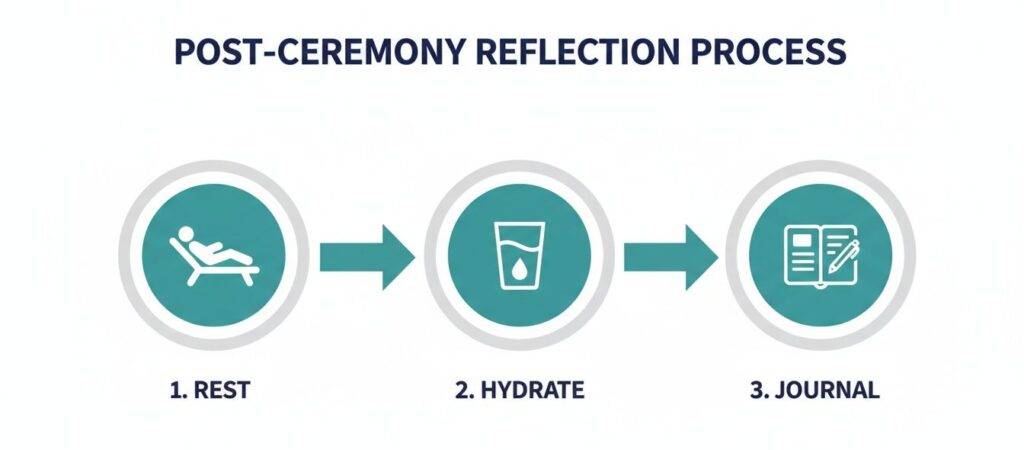
This simple flow—rest, hydrate, then reflect—is the foundation for all deeper integration work. Active practices like journaling are built on a bedrock of physical and mental calm.
Tapping Into Creative Expression
Let’s be honest, words often fail to capture the depth of an Ayahuasca journey. So many of the most profound lessons are felt in the body on a visceral, non-verbal level. This is where creative expression becomes an incredibly powerful tool for processing the deeper, more somatic layers of your experience.
You don’t have to be an artist. The point is simply to let your inner world take an outer form, without any judgment.
- Paint or Draw Your Feelings: Grab some colors and let them represent the emotions or visions from your ceremony. A chaotic scribble of red might be the perfect expression of a moment of anger, while flowing blue lines could capture a deep sense of peace.
- Create a Soundtrack: Make a playlist that mirrors the emotional journey you went on. Or, experiment with your own sounds—sing, hum, drum on a tabletop, or play an instrument. Give a voice to what you feel, literally.
- Move Your Body: Put on some music that resonates with you and just let your body move. Don’t choreograph it. Let your body express the emotions that are still moving through you. This is an amazing way to release stored energy.
“Creative expression allows you to bypass the analytical mind and speak the language of the soul. It’s a direct line to the subconscious and a beautiful way to honor the non-linear wisdom of Ayahuasca.”
Short-Term Integration Practice Framework
To help you get started, here is a simple weekly template you can adapt. The goal is to use it as a guide to build consistency in the first month after your ceremony, not to follow it perfectly.
| Day of the Week | Morning Practice (15-30 mins) | Afternoon/Evening Practice (30-60 mins) | Focus |
|---|---|---|---|
| Monday | Meditation & Intention Setting | Structured Journaling | Clarity & Introspection |
| Tuesday | Gentle Stretching or Yoga | Creative Expression (Drawing, Music) | Embodiment & Emotion |
| Wednesday | Mindful Walk in Nature | Reading or Listening to Spiritual Teachings | Grounding & Inspiration |
| Thursday | Meditation & Gratitude Practice | Structured Journaling | Reflection & Gratitude |
| Friday | Gentle Stretching or Yoga | Creative Expression (Movement, Dance) | Release & Embodiment |
| Saturday | Mindful Walk in Nature | Connect with Supportive Friend/Community | Connection & Grounding |
| Sunday | Meditation & Weekly Review | Rest & Quiet Contemplation | Rest & Integration |
This framework provides a balanced mix of introspection, creativity, and grounding. Treat it as a menu of options rather than a rigid schedule, and choose what feels most nourishing to you each day.
Grounding Through Nature And Gentle Movement
After such an expansive, and at times cosmic, experience, grounding your energy is non-negotiable. It simply means reconnecting with your physical body and with the earth. Gentle movement and time in nature are two of the most effective ways to do this. They help you feel stable, present, and comfortable in your own skin again.
These practices are incredibly calming for the nervous system, allowing the energetic shifts from the ceremony to settle in a healthy, balanced way.
- Mindful Walks: Go for a slow walk in a park, a forest, or by the water. Leave your phone behind. Pay attention to the simple sensations: the feeling of the earth under your feet, the sound of the wind, the smell of the trees. This simple act powerfully reaffirms your connection to the physical world.
- Gentle Yoga or Stretching: Practices like Yin Yoga or just a few simple stretches before bed can help you inhabit your body and gently release any physical or emotional tension you’re still holding. Focus on your breath and the sensations you feel.
Integration can look different for everyone. A published analysis of responses from 1,630 Ayahuasca drinkers found that the process often brought challenges and could take months or years. Because the findings are based on participants’ accounts, they offer insight into lived experiences rather than proof that any particular practice causes lasting benefits. You can explore more of these findings on Psypost.org.
Building a Life Aligned with Your Truth

The glow of an Ayahuasca ceremony is powerful, but the real, lasting change happens in the months and years that follow. Long-term integration is about moving past reflection and starting the brave work of redesigning your life to match the truths you encountered.
This is where you make real, tangible shifts: in your career, your relationships, and your daily habits. The process involves a series of small, intentional choices that build on each other over time, rather than a dramatic, overnight overhaul. You’re taking the blueprint the medicine gave you and starting the slow, rewarding work of construction.
Making Aligned Life Changes
An Ayahuasca journey can throw a harsh light on the gap between your inner truth and your outer world. Maybe you realized your job is crushing your soul, a close relationship is draining you, or your daily routines just don’t serve you anymore. The long-term challenge is to address these areas with mindful action, not rash decisions.
Start by getting specific. What, exactly, feels wrong? If it’s your job, is it the whole industry? Is it your role? The company culture? Maybe it’s just your boss. Breaking it down makes the idea of change feel less terrifying and a lot more manageable.
A real-world example might be someone who sees that their high-stress corporate job is the root of their anxiety. Instead of impulsively quitting, their integration path might look like this:
- Updating their resume to highlight values they now hold dear, like creativity or community.
- Enrolling in a part-time course in a field that actually sparks their passion.
- Building a financial cushion to make a future transition smoother and less stressful.
This gradual, steady approach is how you practically integrate Ayahuasca insights. It honors the vision for a new life while respecting the real-world steps it takes to build it.
Finding Your Community
One of the toughest parts of returning from a ceremony is the feeling of isolation. You’ve just had this profound, life-changing experience, and it can be hard to talk about it with friends and family who just don’t get it. Finding a community of people who understand is essential for long-term integration, not just nice to have.
“You are not meant to do this work alone. Authentic connection with others on a similar path provides the validation, support, and shared wisdom necessary to keep moving forward when challenges arise.”
This support network can show up in different ways, and it’s all about finding the right fit for you.
- Local Integration Circles: Many cities now have groups that meet up to talk about their experiences with plant medicine. They provide a safe, in-person space to share and just listen.
- Online Communities: Well-vetted forums or private social media groups can be a real lifeline, especially if you live somewhere without a local scene. They offer a huge range of perspectives and support at all hours.
- Retreat Connections: Make an effort to stay in touch with the people you sat in ceremony with. You went through something incredibly powerful together, and that shared experience creates a special bond that can be a source of support for years.
These connections help normalize the whole integration process. Just hearing that someone else is facing similar struggles and joys reminds you that you’re part of something much bigger.
The Role of Professional Support
While community is vital, some layers of this work really benefit from the skilled guidance of a professional. Ayahuasca has a way of bringing deep-seated trauma, complex relationship patterns, and core wounds right to the surface. Trying to navigate all of that on your own can be incredibly difficult, and sometimes, you can just end up going in circles.
Working with a therapist or coach who specializes in psychedelic integration offers a structured, confidential space to do this deeper work. They can help you make sense of confusing visions, understand the emotional patterns that keep showing up, and develop real strategies for healing them.
An integration-aware professional gets the unique landscape of the post-Ayahuasca mind. They won’t write off your experience as “just a weird dream” or try to fit it into a purely conventional box. Instead, they’ll help you use it as a powerful catalyst for genuine growth.
Finding the Right Guide
When you’re looking for a therapist or coach, finding the right fit is everything. Here’s what to look for:
- Specialized Training: Ask them directly if they have specific training or certification in psychedelic integration.
- A Non-Judgmental Stance: You should feel completely safe sharing the wild, weird, and wonderful details of your experience without fear of being judged.
- Personal Experience: A professional who has their own experience with non-ordinary states of consciousness often brings a deeper level of empathy and understanding to the table, though this is not a mandatory requirement.
This combination of personal practice, community, and professional support creates a strong, sustainable framework for your integration. It’s a support system that helps you not only get through the challenges but continue to blossom long after the ceremony ends, truly building a life that feels like your own.
Navigating Common Integration Challenges
The journey to bring Ayahuasca’s lessons into your life is rarely a straight line. After the initial glow fades, it’s completely normal to hit bumps in the road that can leave you feeling a bit lost or even discouraged. Knowing what to expect and how to respond is a huge part of building a solid, long-term integration practice.
These challenges aren’t a sign you’re doing something wrong. Think of them as part of the curriculum. They are opportunities to apply what you’ve learned in a real-world setting. From emotional waves to physical sensitivities, these hurdles test your commitment and, in the end, deepen your healing.
Feeling Disconnected or Confused
One of the most common struggles is feeling a disconnect from the powerful insights you gained in the ceremony. In the days and weeks that follow, that crystal clarity can seem to vanish, leaving you to wonder if it was all just a wild dream. This is a very real, and very normal, part of the process.
The visionary state of Ayahuasca is a world away from our day-to-day consciousness. To bridge that gap, go back to your journal. Reading your own words, written in the immediate afterglow, can be a powerful way to reconnect with the feelings and truths that came through.
Another classic challenge is trying to explain your experience to others. You might feel this incredible urge to share your profound journey, only to be met with blank stares or even judgment. Remember, you don’t owe anyone an explanation. It’s often more effective to share the results of your journey, like saying, “I’m feeling more patient lately,” rather than trying to describe the indescribable visions themselves.
Navigating Emotional Turbulence
Ayahuasca often performs an emotional deep clean, bringing feelings you’ve pushed down for years to the surface. It is very common to experience waves of sadness, anger, anxiety, or grief in the weeks after a ceremony. These aren’t new feelings; they’re old ones finally coming up for air.
- Make Space for It: Instead of trying to push the feelings away, create a safe container to feel them fully. This might mean journaling, talking to a trusted friend, or just giving yourself permission to have a good cry.
- Let Your Body Speak: Emotions get stored in the body. Gentle movement, yoga, or even just shaking out your limbs can help release this pent-up energy.
- Ask for Help: If the emotions feel like too much to handle on your own, that’s a clear signal to reach out to an integration circle or a therapist.
This emotional release is a sign that the medicine is still working with you. Approaching it with compassion, rather than fear, is a core part of integrating Ayahuasca successfully.
“Bumps in the road are not obstacles to your integration; they are the path itself. Each challenge is a curriculum designed by the medicine to help you embody its teachings.”
Critical Safety and Harm Reduction
Post-ceremony safety is every bit as important as the preparation you did beforehand. Your entire system is still highly sensitive, and respecting this vulnerability is key to avoiding needless complications. This is a crucial aspect of harm reduction.
A primary concern is the interaction between the MAOI component in Ayahuasca and certain substances. It’s vital to continue avoiding specific foods and medications for at least a week or two after your last ceremony.
Furthermore, it is strongly advised to avoid alcohol and other recreational drugs during this period. Your energetic and psychological boundaries are more porous, which can make you more susceptible to negative influences and energetic static.
When you look at the data, the picture becomes clearer. Despite an estimated 5.5 million servings of Ayahuasca consumed in 2019, autopsies have confirmed zero deaths from acute intoxication of the traditional brew. The real risks often come from poor facilitation or a lack of aftercare, which can amplify psychological vulnerabilities. In fact, surveys show that 90% of users who feel supported through an adverse reaction report no lingering issues, highlighting that robust integration is a key safety measure.
Knowing When to Seek Professional Help
While most integration challenges can be navigated with self-care and community support, some situations call for professional help. Persistent feelings of dissociation, paranoia, or overwhelming anxiety that don’t ease up after a few weeks are red flags.
If you have a history of serious mental health conditions, it is especially important to have a professional support system already in place. An integration-savvy therapist can help you tell the difference between a temporary spiritual emergence and a genuine mental health crisis. Reaching out for help is a sign of strength and a wise step in your commitment to integrate Ayahuasca in a healthy, sustainable way.
Common Questions About Ayahuasca Integration
Coming back from an Ayahuasca journey can feel like landing on a different planet. As you settle back into your daily rhythm, questions are bound to surface. It’s completely normal.
This final section addresses some of the most common uncertainties that arise during the integration process, offering some grounded guidance to help you walk this path with a bit more clarity.
How Long Should Integration Last
This is probably the most frequent question, and the honest answer is that in a way, integration never really ends. It becomes part of your life. However, the most active, hands-on phase usually spans the first few weeks to several months.
It’s helpful to think about it in layers:
- The First Month: This is your most sensitive window. It’s a time for active processing, requiring dedicated space for journaling, rest, and very gentle movement.
- Three to Six Months: By now, you’re often shifting from pure reflection into action. This is where you might start making those small but profound changes in your relationships, habits, and daily routines.
- One Year and Beyond: Integration slowly becomes your new way of being. It’s less about consciously working through the ceremony and more about simply living from the expanded awareness you’ve cultivated.
The timeline is completely unique to you. For some, big shifts click into place almost immediately. For others, the lessons are like a slow-blooming flower, unfolding over years. The most important thing is to be patient with your own rhythm and resist the urge to compare your path to anyone else’s.
What if My Ayahuasca Insights Start to Fade
It’s a very common experience for the vivid, crystal-clear insights from your ceremony to feel like a distant echo once you’re back in the swing of daily life. This doesn’t mean the medicine has worn off or that you’ve somehow “lost” the teachings. The energy has just shifted from a loud, peak experience to a more subtle, background hum.
When this happens, see it as a signal to reconnect, not as a reason to panic. Here are a few simple things you can do to tune back in:
- Revisit Your Journal: Go back and read the words you wrote in the days immediately following your ceremony. It’s a direct line back to the truth and feeling of that moment.
- Spend Time in Nature: Nature was an ally in the ceremonial space, and it continues to be one now. Even a short, quiet walk can help you feel grounded and connected again.
- Engage a Practice: Put on a piece of music from your retreat, do a five-minute meditation, or draw what you’re feeling. These small actions help reignite those neural pathways you started building.
“The fading of insights is not a loss; it’s an invitation. It invites you to find the medicine within yourself and in your daily life, rather than relying solely on the memory of the ceremony.”
How Do I Talk About My Experience
Sharing your journey can be one of the most delicate parts of integration. You’ve been through something extraordinary, and it’s only natural to want to put it into words. But the reality is, not everyone will be able to meet you there, and that’s perfectly okay.
A good rule of thumb is to share your transformation, not the transaction. Instead of trying to explain the intricate, otherworldly details of what you saw, focus on how the experience has tangibly changed you.
- Instead of saying: “I saw a giant cosmic serpent that unraveled my ancestral trauma…”
- Try saying: “I’ve been feeling a lot more compassion for my family lately and understanding them in a new way.”
This approach helps people connect with the relatable, human outcome of your journey. They can connect with your newfound peace or compassion, even if they can’t grasp the visions that got you there. For the few people in your life who are genuinely curious and open-minded, you can always choose to share more. Trust your gut to know who feels safe.
When Is It a Good Idea to Consider Another Ceremony
The pull to return to the medicine is a common one, but it’s a question that asks for deep self-honesty. Are you feeling called to build upon the foundation you’ve already laid? Or are you looking for an escape from a difficult part of your integration?
It might be the right time to consider another ceremony when:
- You feel you have genuinely worked with and embodied the core lessons from your last experience.
- A good amount of time has passed, typically at least six months to a year, allowing the initial lessons to fully land.
- You feel a clear, calm “call” from the medicine itself, rather than a frantic need for a quick fix or another peak experience.
The goal is to use Ayahuasca as a powerful catalyst for growth, not as a crutch to lean on. The real, lasting work happens in the days, weeks, and months between ceremonies. Giving yourself ample time to integrate Ayahuasca is what ensures each journey builds upon a solid foundation, leading to much deeper and more sustainable change in your life.
Disclaimer: The information provided on Ayahuasca.com is for educational purposes only and is not intended as medical advice, diagnosis, or treatment. Ayahuasca is a powerful traditional Amazonian medicine and may not be suitable for everyone. Always consult with a qualified healthcare professional before making decisions related to health, mental well-being, medications, or the use of Ayahuasca.