
A plant medicine retreat isn’t a vacation; it’s a deeply intentional, guided journey into your own consciousness, using sacred plants as the catalyst. Think of it as a dedicated space, held by experienced guides, designed for profound personal exploration, healing, and growth. The entire focus is on fostering psychological, emotional, and spiritual well-being in a safe, supportive environment.
What Really Happens at a Plant Medicine Retreat?
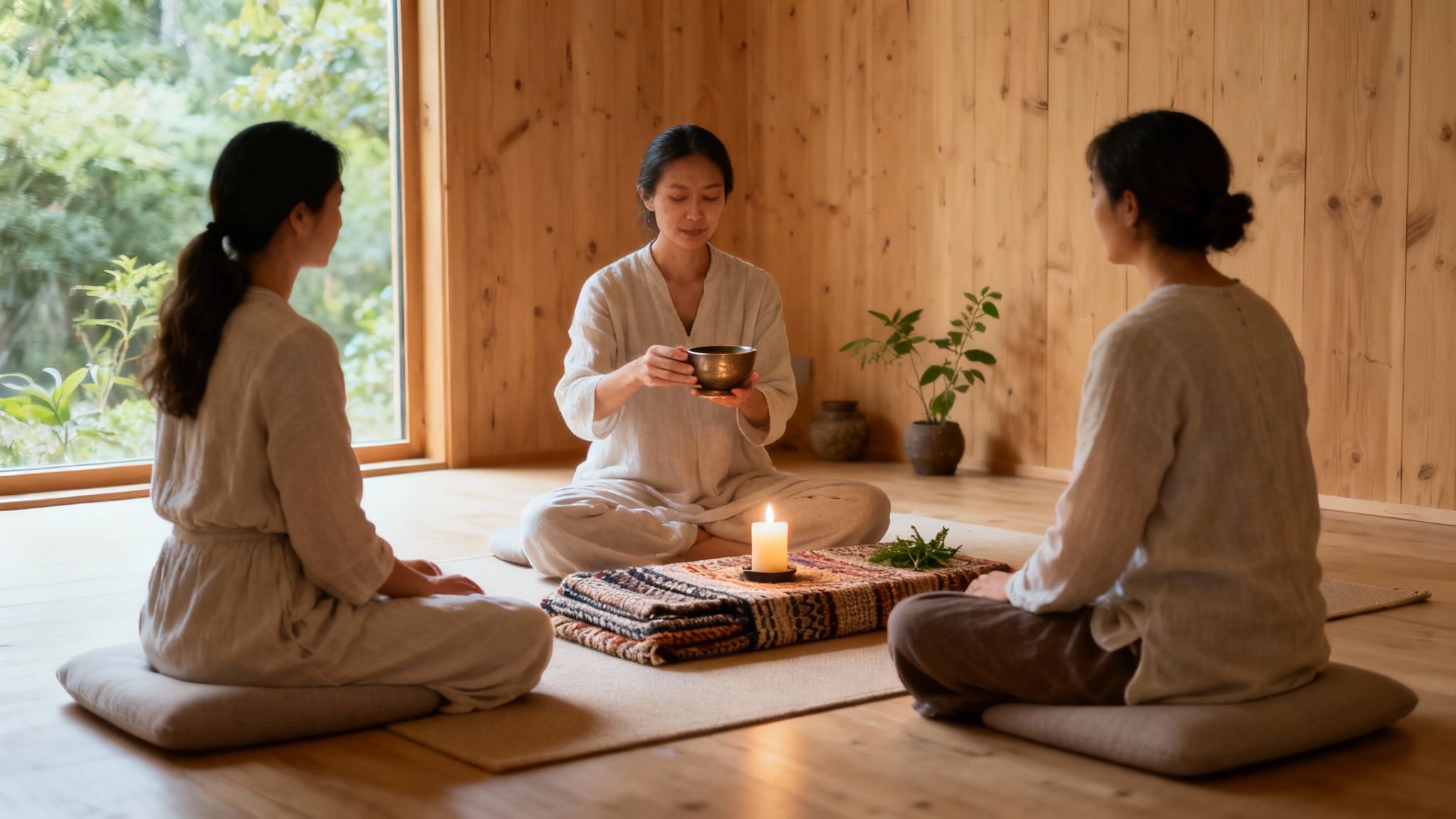
Picture a journey inward, one where ancient plant wisdom—not a map—is your guide. A plant medicine retreat creates the container for this kind of powerful self-discovery. It’s a far cry from a casual or recreational experience. Instead, it’s a carefully structured environment built to help you face deep-seated emotional patterns, see your life from a new perspective, and reconnect with your authentic self.
These retreats are anchored by ceremonies where participants work with sacred plants under the direct supervision of trained facilitators, guides, or shamans. The role of these facilitators is absolutely crucial. They are responsible for creating a physically and emotionally secure setting, helping you navigate the experience, and offering support if difficult moments arise. This intentional structure is what separates a true healing retreat from unstructured use.
The Sacred Plants at the Heart of the Work
The medicine itself is the core of any plant medicine retreat. In the indigenous cultures where their use began, these plants are revered not as substances, but as powerful teachers and healers. Each one has its own unique spirit and purpose, offering a different doorway to insight and self-understanding.
Some of the most common plant medicines you’ll encounter are:
- Ayahuasca: A powerful brew from the Amazon, known for its deep visionary journeys and potential for profound emotional cleansing.
- Psilocybin Mushrooms: Often sought out for their ability to spark creativity, facilitate emotional release, and foster a deep sense of connection to nature.
- San Pedro (Huachuma): A cactus from the Andes Mountains, respected for its gentle, heart-opening properties that encourage deep introspection.
People come to these retreats for all sorts of reasons. Many are seeking to heal from past trauma, anxiety, or depression. Others are searching for clarity about their life’s purpose, a deeper spiritual connection, or a way to move past creative blocks. The retreat is designed to honor these intentions, providing a sanctuary from daily life where this important personal work can finally unfold.
“A plant medicine ceremony is a conscious collaboration between you, the plant spirit, and a skilled facilitator. The retreat provides the safe harbor necessary for this delicate and often life-altering work to take place.”
Getting to know the unique properties of different plant medicines is the first step toward finding a path that feels right for you.
A Snapshot of Common Plant Medicines
The table below offers a quick look at some of the most common plant medicines used in retreats, giving you a sense of their origins and typical focus.
| Plant Medicine | Primary Active Compound | Traditional Origin | Common Retreat Focus |
|---|---|---|---|
| Ayahuasca | DMT & MAOIs | Amazon Basin | Deep emotional and psychological healing, spiritual insight, trauma release |
| Psilocybin Mushrooms | Psilocybin | Global (various species) | Creativity, emotional release, interconnectedness, mystical experiences |
| San Pedro (Huachuma) | Mescaline | Andes Mountains, Peru | Heart-opening, introspection, healing relationships, connecting with nature |
| Peyote | Mescaline | Mexico & Southwestern US | Spiritual guidance, community connection, ceremonial prayer |
Each of these traditions carries its own rich history and approach. Understanding the distinctions can help you align your personal intentions with the right retreat and medicine.
Why More People Are Seeking Plant Medicine Healing
The surge in interest around plant medicine retreats isn’t just a fleeting trend—it’s a clear signal of a much deeper cultural shift. More and more, people are looking for a sense of wellness and meaning that they just aren’t finding in conventional health and wellness models. It’s part of a collective yearning to reconnect with ancient traditions as a way to navigate the complexities of modern life.
This pull toward ancestral wisdom isn’t happening in a vacuum. It’s a direct response to a world saturated with digital noise, high-stress lifestyles, and a pervasive feeling of being disconnected—from ourselves, from each other, and from the natural world. When the usual therapies and solutions don’t bring relief, it’s only natural to start looking for paths that treat the whole person: mind, body, and spirit. A plant medicine retreat is a space intentionally designed for exactly that kind of profound, internal work.
A Turn Toward Holistic Solutions
So much of the modern wellness world is geared toward managing symptoms, not getting to the root of the problem. People are understandably tired of quick fixes that don’t stick. They’re looking for experiences that give them a real chance to understand what’s truly driving their anxiety, depression, or that persistent feeling of being stuck.
This search for real answers is fueling a massive global movement. The wellness retreat market, which absolutely includes experiences with medicines like Ayahuasca, is seeing explosive growth. It’s projected to hit a staggering USD 268,570 million in 2025. This isn’t just random growth; it’s being driven by the rise of chronic health issues and a widespread hunger for more holistic approaches to healing. You can explore the full market analysis on Cognitive Market Research to see just how significant this shift is.
What this data really shows is that a plant medicine retreat is no longer a niche or fringe idea. It’s a mainstream phenomenon, reflecting a collective understanding that ancient practices might just hold the keys to solving some of our most modern problems.
Seeking Deeper Connection and Meaning
Beyond the physical or mental health benefits, many people who attend these retreats are driven by a deep spiritual hunger. They’re grappling with some of life’s biggest questions: Who am I? What is my purpose? How can I feel more connected to the world?
“A plant medicine retreat is often seen as a chance to step outside the constant chatter of the rational mind and tap into a deeper layer of consciousness. It’s a journey to find the kind of clarity and connection that our day-to-day lives rarely offer.”
This desire for meaning is a powerful force. In a culture that often puts a premium on material success and external achievements, these retreats provide a much-needed sanctuary for real introspection and self-discovery.
Why This Is Resonating Right Now
It feels like the perfect storm of factors has come together to bring these ancestral healing practices back into the light:
- Dissatisfaction with Modern Healthcare: While essential, conventional medicine can sometimes feel impersonal and often falls short when it comes to addressing emotional or spiritual suffering.
- The Search for Authenticity: People are moving past superficial wellness fads. They want genuine, time-tested practices that can deliver real, lasting personal growth.
- Increased Accessibility and Information: As knowledge about these traditions becomes more widespread and is shared respectfully, more people feel confident and empowered to explore them safely.
Ultimately, the choice to attend a plant medicine retreat is deeply personal, but it’s a decision echoed by a powerful global current. It’s a conscious step toward seeking healing on a level that honors the wisdom of the past to build a more whole and meaningful future.
Staying Safe: The Critical Medical and Legal Checks
Your well-being is everything on this journey. A plant medicine retreat can open doors to incredible healing, but it’s not a path to wander down casually. Getting a firm grip on the safety protocols, medical checks, and the legal side of things is a non-negotiable first step. This ensures your experience is both responsible and deeply rewarding.
This isn’t about stirring up fear; it’s about fostering respect. The sheer power of these medicines demands careful preparation and an informed mind. Any retreat worth its salt will put your safety above all else, and knowing what to look for will empower you to make the right choice.
Medical Screenings: Your First Line of Defense
Before you even think about booking a flight, a comprehensive medical screening is an absolute must. Think of it as the foundation of a safe experience. Reputable centers will have a detailed intake process that flags any potential risks based on your physical and mental health history.
Some pre-existing conditions and common medications can have dangerous, even life-threatening, interactions with plant medicines. A prime example is Ayahuasca, which contains Monoamine Oxidase Inhibitors (MAOIs). These compounds can trigger severe reactions when mixed with certain foods or other drugs.
“The interaction between MAOIs and other substances is one of the most serious medical risks involved. This is why being completely honest about your health and any medications you’re taking during the screening process is absolutely critical for your safety.”
For instance, mixing MAOIs with antidepressants like SSRIs (Selective Serotonin Reuptake Inhibitors) can cause a life-threatening condition called serotonin syndrome. It is vital to know exactly what to steer clear of. You can dive deeper into the specifics with this guide on foods and medications to avoid with MAOIs, which is essential reading for anyone preparing for a ceremony.
Making Sense of the Global Legal Maze
The legal status of plant medicines is a patchwork quilt that changes dramatically from one country to another. What’s considered a sacred tradition and perfectly legal in one place could be a heavily controlled substance with harsh penalties just across the border. Sticking to a location where the practice is legal, decriminalized, or culturally protected is a basic but crucial part of staying safe.
Countries like Peru, Ecuador, and Brazil have deep, centuries-old traditions with Ayahuasca, where its use is often unregulated or simply an accepted part of the cultural fabric in ceremonial settings. Other spots, like Costa Rica and Mexico, have become retreat hubs thanks to a more relaxed legal climate.
Here’s a quick breakdown of what you might encounter:
- Legal: In some places, plant medicine is fully legal and even regulated.
- Decriminalized: Personal use might not land you in jail, but selling or distributing it is still illegal.
- Culturally Protected: Use is allowed, but only within specific indigenous or religious groups.
- Illegal: Possession, use, and distribution are forbidden and can lead to serious legal trouble.
Taking a chance on an underground ceremony in a country with strict drug laws just isn’t worth it. It adds a layer of legal risk on top of the potential for poor safety standards.
A Clear-Eyed Look at the Safety Data
The overwhelming majority of people who attend these retreats have safe, positive experiences. That said, it’s important to be honest about the fact that risks do exist. A recent study that reviewed media-reported incidents gives us some valuable perspective without being alarmist.
Between 1994 and 2022, there were 58 media-reported deaths connected to Ayahuasca. Of those, 40% (24 cases) happened at tourist-focused retreat centers in Amazonian countries. Now, that statistic deserves to be taken seriously. But it’s also important to know that these centers represent just 5% of the total Ayahuasca servings worldwide.
What does that tell us? It suggests that while the risks are real and concentrated in certain types of settings, they are incredibly low when you consider the millions of ceremonies that happen safely every single year. You can read the full research on Ayahuasca-related fatalities to get a more detailed picture.
This data isn’t a red flag telling you to turn back. Instead, see it as a powerful nudge to be extremely diligent in your search. It highlights just how vital it is to choose a plant medicine retreat with rock-solid safety standards, genuinely experienced facilitators, and crystal-clear medical protocols.
How to Choose a Reputable and Ethical Retreat
Picking the right plant medicine retreat is probably the single most important decision you’ll make in this entire process. It’s not just about finding a place with nice photos online. You’re looking for a sanctuary—a place run with deep integrity by experienced people who genuinely respect the traditions they work with.
This means you have to do a little digging. Look past the slick marketing and search for real, tangible proof that they know what they’re doing and that your well-being is their absolute top priority, from the first email you send to the support you get after you go home.
Assessing Facilitator Experience and Group Size
The heart and soul of any good retreat are the facilitators or shamans. These are the people holding the space, guiding the ceremonies, and sitting with you during what can be some of the most vulnerable moments of your life. Their experience isn’t just a “nice to have”; it’s everything.
You want to find leaders who have a long, established relationship with the specific medicine they serve. Ideally, they come from a direct lineage or have spent years in deep, mentored training within an indigenous tradition. A truly skilled facilitator knows how to read the energy of a room and support people through intense experiences without getting in the way.
Just as critical is the size of the group. For this kind of deep work, an intimate setting is non-negotiable.
- Small Groups (under 15 participants): This is the sweet spot. It allows the facilitators to give everyone individual attention, making sure no one feels overlooked or unsupported.
- Large Groups (over 20 participants): In a big group, it’s almost impossible to keep a close eye on everyone. This can introduce safety risks and seriously water down the quality of care you receive.
“A low facilitator-to-participant ratio is one of the best green flags you can find. It tells you the center prioritizes deep, personal work over packing the room to maximize profit.”
The Importance of Thorough Screening
A rigorous screening process before you’re even accepted is another sign you’re in the right place. This isn’t just a bureaucratic step; it’s a fundamental safety protocol designed to protect you, the other guests, and the facilitators. The intake forms should be detailed, asking about your physical health, mental health history, and any medications you’re on.
Be very cautious of any place that’s ready to take your money after just a few quick questions. That’s a massive red flag. Proper screening ensures that anyone with a medical contraindication (like a heart condition or a conflict with an antidepressant) isn’t put in a dangerous situation.
This flowchart maps out the essential steps for making sure a retreat is safe and responsibly run.
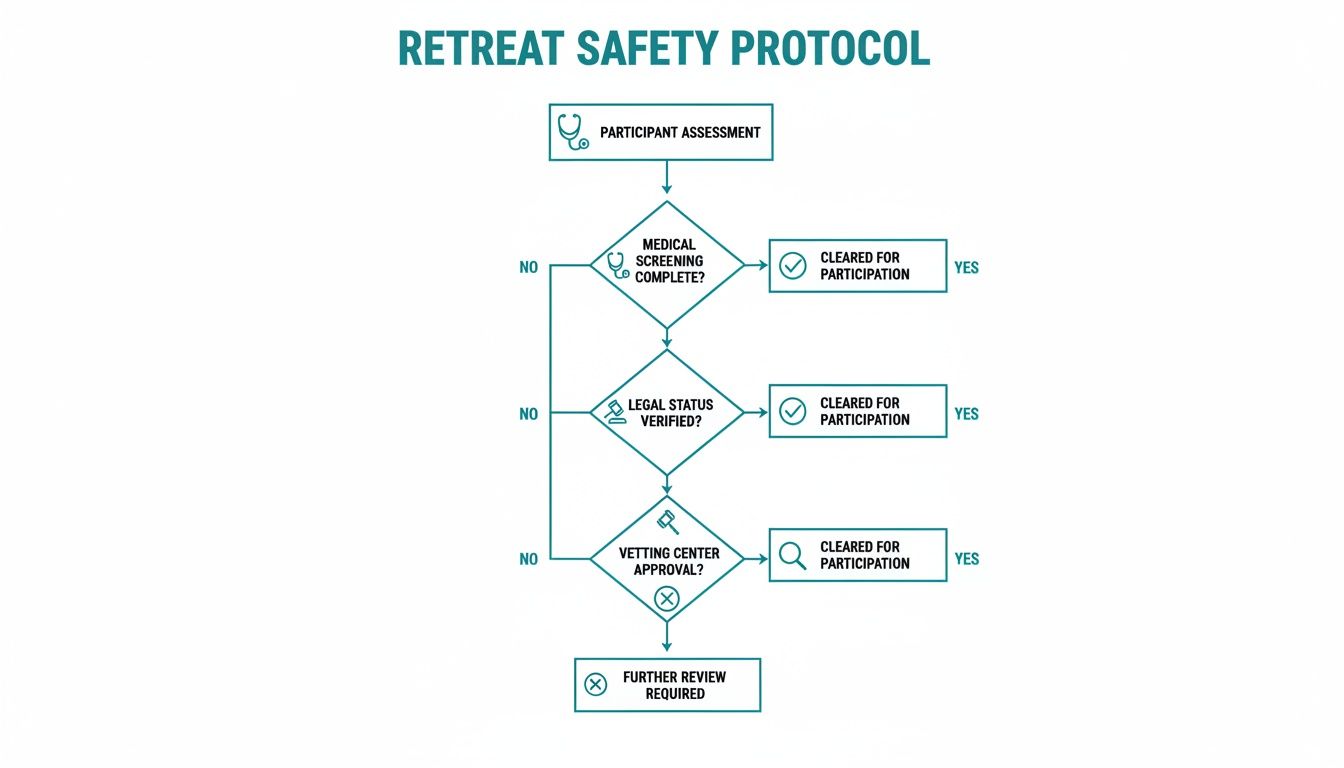
As you can see, vetting a center’s safety protocols—including their medical screening and legal standing—is the foundational work you need to do before committing.
To help you stay organized, I’ve put together a checklist of what to look for and what questions to ask. Think of this as your personal vetting guide.
Your Vetting Checklist for a Plant Medicine Retreat
| Evaluation Area | Key Questions to Ask | Green Flags to Look For |
|---|---|---|
| Facilitator Experience | How many years have you been serving this medicine? Where and with whom did you train? What is your lineage? | 10+ years of experience, direct mentorship with recognized elders, clear and humble answers. |
| Safety & Medical | What is your medical screening process? Do you have medically trained staff on-site? What is your emergency protocol? | Comprehensive health questionnaire, a nurse or doctor on staff, a clear plan for emergencies. |
| Group Size & Support | What is the maximum number of participants per ceremony? What is the facilitator-to-participant ratio? | Groups under 15, at least 1 facilitator for every 5-7 participants. |
| Ethics & Reciprocity | How do you honor the indigenous roots of this medicine? How do you give back to the local community or land? | Fair compensation for indigenous staff, active community projects, sustainable plant harvesting. |
| Integration Support | What kind of post-retreat support do you offer? Are there integration circles, calls, or resources available? | A structured integration program is included, not just an afterthought. |
| Reviews & Reputation | Can I speak to past participants? Where can I find unbiased reviews? | Willingness to connect you with alumni, transparent reviews on third-party sites. |
This checklist isn’t exhaustive, but it covers the most critical areas. A trustworthy retreat will welcome these questions and answer them openly and honestly.
Ethical Considerations and Reciprocity
Choosing an ethical retreat means looking beyond just your personal safety. It’s about considering the center’s relationship with the land, the local community, and the very traditions it works with. The boom in “shamanic tourism” has created some serious problems, so it’s on us to support centers that operate with respect. Reading up on the history of shamanic tourism in Iquitos, Peru can give you a lot of context for why this is so important.
Here are a few things to look for that signal a truly ethical operation:
- Honoring Indigenous Traditions: Does the center openly acknowledge where the medicine comes from? If they work with native facilitators, are those individuals treated as true partners and compensated fairly?
- Practicing Reciprocity: How does the retreat give back? Look for real, tangible initiatives—things that support the local economy, help preserve cultural traditions, or contribute to environmental conservation.
- Sustainable Harvesting: A good center is deeply concerned about the sustainability of the plants they use. They should be able to tell you how they ensure they aren’t contributing to the over-harvesting that threatens these fragile ecosystems.
By asking these questions, you become part of the solution. Your choice sends a message, ensuring your journey of personal healing doesn’t inadvertently harm the cultures and environments that have stewarded these traditions for millennia.
The Three Pillars of a Meaningful Journey
A plant medicine retreat isn’t a one-and-done event; it’s a whole process. A better way to think about it is like building a bridge—one that connects your everyday life to a much deeper, more insightful state of being. And that bridge needs three essential pillars to be stable: Preparation, the groundwork you lay beforehand; Ceremony, the experience itself; and Integration, the crucial work of bringing it all back home.
Each of these pillars is just as important as the others. If you skip one, the whole structure gets wobbly, and the profound lessons from your journey might never truly take root in your life. By understanding and honoring all three phases, you set the stage for real, lasting change.
Pillar One: Preparation
This is where your journey really begins, weeks or even months before you set foot in the retreat center. Preparation is all about cleaning house—physically and mentally—to create a clear and receptive space inside yourself. Think of it as an act of respect for yourself, for the medicine, and for the ancient tradition you’re about to participate in.
The most common physical prep is the ‘dieta’, a special diet you’ll follow in the time leading up to your ceremony. While specifics vary, it generally means cutting out:
- Red meat and pork
- Spicy, oily, or heavily processed foods
- Fermented foods and aged cheeses
- Alcohol, caffeine, and other stimulants
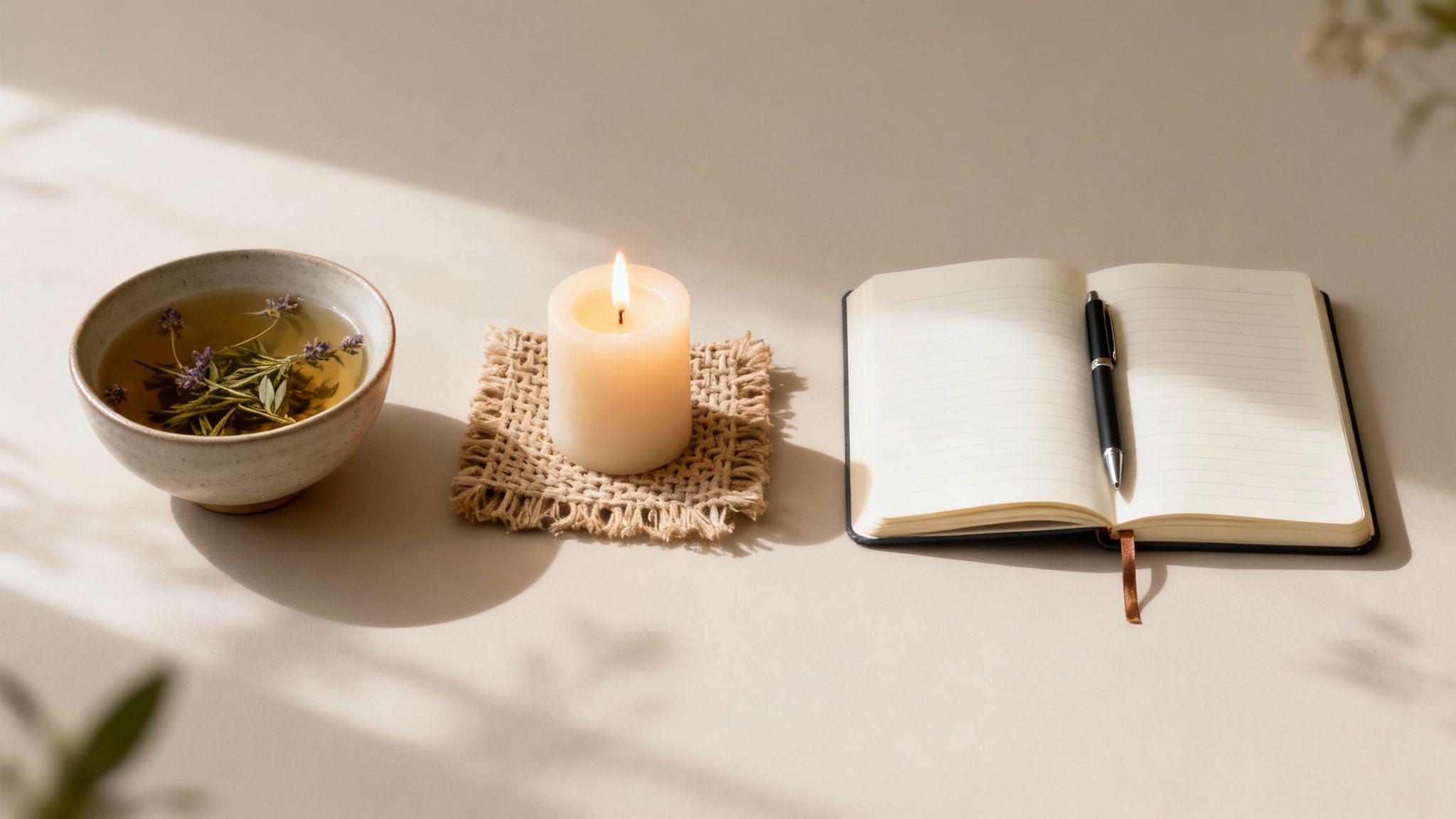
This clean diet helps purify your system, making you more sensitive to the medicine’s subtle energies. But the mental and emotional prep is just as vital. This is the time to get clear on your intentions. Ask yourself the big questions: What am I truly seeking? What am I ready to let go of? Journaling and meditation are fantastic tools for distilling your purpose.
Pillar Two: Ceremony
The ceremony is the heart of the experience. It’s a sacred, carefully held space where you connect with the plant spirit under the watchful eye of a seasoned facilitator. While every tradition has its own flavor, most ceremonies share a common flow designed to keep you safe while you do your deep inner work.
The ceremonial space is often dark and quiet, creating a safe, womb-like container for the journey ahead. After the medicine is served, the facilitator steers the experience, often using icaros—the sacred healing songs of Amazonian shamanism. These aren’t just songs; they’re seen as energetic tools used to move energy, provide protection, and guide the healing journey.
Your experience will be entirely your own. It could be filled with visions, cathartic emotional releases, or stunningly clear insights about your life. The facilitator’s job is to hold that space, offering a steady hand if things get tough and ensuring the ceremony remains a protected and focused environment for everyone.
“The ceremony is a surrender to the unknown. Your preparation is the anchor, the facilitator is the guide, but the journey itself is an intimate conversation between you and the plant medicine.”
Pillar Three: Integration
This is it. The most important—and most frequently neglected—part of the whole process. The ceremony can blast open doors to new perspectives and deep feelings, but integration is how you actually walk through those doors and bring the wisdom back into your daily life. The real work starts when you get home.
Without a dedicated integration practice, the powerful insights from a retreat can evaporate like a dream. The goal here is to translate those abstract visions and feelings into real, tangible changes in your life. This doesn’t happen overnight; it’s a gradual process that calls for patience and a lot of self-compassion.
A few solid integration strategies include:
- Journaling: Get it all down on paper. Write about everything you can remember from your experience, no matter how strange or fragmented it seems. This helps anchor the memories and allows you to spot emerging patterns.
- Community Support: Talk to others from your retreat group or find a local integration circle. Sharing what you went through with people who get it is incredibly validating and supportive.
- Mindful Practices: Ground yourself with activities like yoga, meditation, or simply spending quiet time in nature. These practices help you stay connected to the new awareness you’ve cultivated.
Integration is the bridge that ensures your plant medicine retreat becomes more than just a wild memory. It’s what turns the experience into a genuine catalyst for living a more conscious and fulfilling life.
Weaving Your Retreat into Everyday Life
Walking away from a plant medicine retreat isn’t the finish line; it’s the starting block for a more aware and connected way of life. The profound insights you uncover during a ceremony are like seeds. Your daily life back home is the soil where they can either wither or flourish. The real work is in carefully tending to those seeds, weaving the experience into the fabric of your routine. That’s how a powerful week becomes a foundation for lasting change.
If you’re drawn to this path, you’re not alone. There’s a huge global shift happening as people seek out more authentic, hands-on ways to take charge of their health. This has ignited a massive expansion in the global wellness economy, now valued at an incredible US$6.8 trillion, with a 7.9% year-over-year jump. Wellness tourism, a core part of this movement, is on track to hit US$1.38 trillion by 2029—a staggering increase from $637 billion in 2022. You can explore more insights into this wellness tourism boom to see just how journeys like these are reshaping our approach to well-being.
From Insight to Action
The real magic happens after you’ve unpacked your bags. It’s about taking the clarity you gained from Ayahuasca or another plant medicine and applying it to your day-to-day existence. The retreat acts as a catalyst, giving you the momentum to build a more mindful and resilient lifestyle from the ground up. This is where integration comes in—it’s the bridge between the abstract feelings of the ceremony and the concrete actions of your daily life.
This isn’t something that happens automatically. It takes commitment to keep the momentum going. If you want to go deeper into this crucial phase, we’ve put together a guide on the science of psychointegration that offers practical steps for making the benefits of your retreat stick.
Here are a few simple but powerful ways to start integrating the experience right away:
- Mindfulness and Meditation: Even a few minutes a day helps you stay grounded in the present and observe your thoughts without getting swept away by them.
- Journaling: Keep writing. Putting your thoughts, dreams, and reflections on paper builds a conscious connection to the deeper lessons from your journey.
- Nourishing Your Body: The pre-retreat “dieta” often kickstarts a lasting desire for cleaner, whole foods that support both a clear mind and a healthy body.
- Get Outside: Spending time in nature is one of the best ways to ground your energy and reconnect with that feeling of interconnectedness many people experience in ceremony.
The Bigger Picture: Ethical Wellness
As more of us seek out these profound experiences, our collective responsibility also grows. Choosing a plant medicine retreat isn’t just a purchase; it’s an economic and ethical statement. It’s so important to support centers that operate with true integrity—those that show deep respect for the plants, the planet, and the indigenous cultures who have been the stewards of this wisdom for generations.
“Think of your retreat not as a one-time fix, but as a cornerstone for building a more conscious, connected, and resilient life. It’s an invitation to live with greater intention, every single day.”
When you choose retreats that practice sustainability and give back to their communities, you become part of a wellness movement that heals more than just individuals. You support the healing of communities and ecosystems, too. This kind of conscious choice ensures that as this field grows, it does so in a way that is honorable and sustainable, protecting these sacred traditions for the future.
A Few Common Questions About Plant Medicine Retreats
If you’re thinking about a plant medicine retreat, you’ve probably got a few practical questions swirling around. Let’s walk through some of the most common ones that come up for first-timers.
What’s the Best Length for a Retreat?
You’ll see everything from quick weekend trips to month-long immersions. But for most people, the sweet spot is around 7 to 10 days.
This gives you enough time for several ceremonies, which is crucial for going deep into the work. It also builds in that much-needed space between sessions to rest, process what’s happening, and start learning how to integrate the experience before you even head home.
What Should I Pack for an Ayahuasca Retreat?
Think comfort, not fashion. You’ll want loose, breathable clothing, and many traditions prefer light colors for ceremonies.
Here are a few must-haves:
- A good reusable water bottle. Hydration is key.
- A journal and a reliable pen. You’ll want to capture thoughts and insights as they come.
- A headlamp, preferably one with a red-light setting so you can find your way in the dark without disrupting the whole room.
- Natural insect repellent and whatever personal toiletries you need, but stick to scent-free products.
The most important thing to pack? An open mind and a humble heart.
Is It Safe for a Woman to Go Alone?
Absolutely. It’s incredibly common for women to travel solo to retreats, and many find that it makes the journey even more powerful and personal.
A well-run, reputable center is built from the ground up to be a safe, supportive space for everyone. The trick is doing your homework—find a place with a proven safety record, glowing reviews from other solo female travelers, and staff who communicate clearly and openly from your very first email.
How Can I Get My Mind Ready for This?
Preparing your mind is just as vital as preparing your body. In the weeks leading up to your trip, try starting a simple meditation or journaling practice. It’s a great way to quiet the mental chatter and get clear on what you hope to work on.
It also really helps to dial down the noise. Cut back on stressful news, intense movies, and endless social media scrolling. You want to arrive feeling centered, open, and ready to receive whatever the medicine has to teach you.
Disclaimer: The information provided on Ayahuasca.com is for educational purposes only and is not intended as medical advice, diagnosis, or treatment. Ayahuasca is a powerful traditional Amazonian medicine and may not be suitable for everyone. Always consult with a qualified healthcare professional before making decisions related to health, mental well-being, medications, or the use of Ayahuasca.