
A reader searching for 4-MeO-DMT may be trying to identify an unfamiliar compound, compare it with better-known psychedelics, evaluate a research question, or understand a report from someone who has taken it. The difficulty is that the name appears in discussions that often blur chemical identity, animal pharmacology, anecdotal experience, and legal interpretation. Those categories need to stay separate.
4-MeO-DMT, also called 4-methoxy-N,N-dimethyltryptamine or O-methylpsilocin, is a relatively obscure tryptamine documented in scientific literature for decades. It has measurable serotonergic activity, yet it has far less human research than DMT or 5-MeO-DMT. The most responsible way to approach it is therefore neither romanticized nor alarmist. It is a molecule with a recognizable scientific history and a limited evidence base.
Why 4 Meo DMT Deserves A Careful Look
Curiosity alone doesn’t make a reader reckless, and scientific interest doesn’t make a compound clinically established. Someone examining 4-MeO-DMT may be a chemist reviewing substituted tryptamines, a practitioner responding to a patient’s disclosure, or a reader trying to understand why two compounds with similar names can produce different effects. Each perspective requires a different level of caution.
The historical record provides a useful starting point. A 1982 pharmacology study comparing related hallucinogens found that the 5-methoxy-DMT cue generalized across 4-methoxy analogs. In rats, the reported potency order was 5-OMe > 5-SMe > 4-OMe > 4-SMe DMT, placing the 4-methoxy compound below the 5-methoxy analog in that behavioral assay. The result matters because it established that 4-MeO-DMT had measurable psychoactive activity by that time, rather than existing only as a theoretical chemical possibility. (Historical pharmacology review)
Six Questions Organize The Evidence
A careful reading of 4-MeO-DMT benefits from six lenses:
- Chemistry: What structural feature defines the compound?
- Receptor pharmacology: Which serotonin receptors does it activate?
- Experience and dosing context: What remains unknown about onset, duration, and dose response?
- Tryptamine comparisons: How does it differ from DMT, 5-MeO-DMT, and psilocin?
- Legal status: Which rules may apply to possession, research, importation, or travel?
- Practitioner judgment: What information should clinicians and harm-reduction workers collect?
These questions shouldn’t be collapsed into one conclusion. A receptor result doesn’t predict a human experience with certainty. An animal potency ranking isn’t a safe dosing guide. A compound’s chemical recognition doesn’t guarantee that a particular jurisdiction permits it.
Scientific Recognition Is Not Human Validation
The broader tryptamine field has expanded through toxicology, receptor research, and patent activity, but 4-MeO-DMT remains underrepresented compared with 5-MeO-DMT and DMT. A recent in-silico toxicity paper covering six other clinically and forensically relevant tryptamines didn’t include 4-MeO-DMT, which itself illustrates the gap in direct evidence. (Recent tryptamine toxicity research)
“Practical rule: Treat every human-specific claim about safety, duration, therapeutic value, and predictable dosing as unconfirmed unless controlled research directly supports it.”
That standard makes harm reduction part of basic interpretation rather than an afterthought. The available evidence can describe molecular structure and receptor activity. It can’t currently answer every practical question a person may have about what the compound does in the human body.
The Chemistry Behind 4 Meo DMT
4-MeO-DMT becomes easier to understand when the molecule is built from familiar parts. It belongs to the tryptamine family, a group of compounds organized around an indole ring connected to an ethylamine side chain. DMT has the core tryptamine arrangement without a methoxy group on the indole ring. 5-MeO-DMT carries a methoxy group at the 5-position, while 4-MeO-DMT carries that group at the 4-position.
That positional change defines the compound. The molecular formula listed for 4-MeO-DMT is C13H18N2O, and the structure is distinct from both DMT and 5-MeO-DMT rather than being an interchangeable label. The added oxygen-containing methoxy group changes how the molecule presents chemical features to biological targets, contributing to a different receptor profile. (Chemical reference for 4-MeO-DMT)

Position Matters More Than The Similar Name
The numbers in 4-MeO-DMT and 5-MeO-DMT refer to locations on the indole ring. A reader can think of those locations as different attachment points on the same basic scaffold. Moving the methoxy group by one position may alter receptor fit, signaling bias, and the way the molecule is processed, so the names shouldn’t be treated as shorthand for the same substance.
Available chemical listings identify 4-methoxy DMT as CAS 3965-97-7, describe it as a crystalline solid, and report ultraviolet absorption maxima at 222, 268, and 292 nm in methanol. These properties help analytical chemists identify and characterize a material, but they don’t establish human safety or indicate an appropriate dose. (Analytical product data for 4-methoxy DMT)
Chemists may also encounter freebase and salt terminology in tryptamine literature. Those forms can differ in handling and laboratory behavior, but a form name alone doesn’t verify identity, purity, concentration, or suitability for human use. Any laboratory protocol involving reconstitution or dilution should rely on validated analytical procedures and appropriate institutional controls. For general background on sterile laboratory liquids used in peptide research, readers can review this resource on sterile diluent for peptide research, while recognizing that such material isn’t a dosing recommendation for 4-MeO-DMT.
How 4 Meo DMT Interacts With The Brain
The clearest pharmacological picture places 4-MeO-DMT among serotonin receptor agonists, meaning it can activate particular serotonin receptors rather than merely altering serotonin levels in a general way. Published receptor data report activity at 5-HT1A, 5-HT2A, 5-HT2B, and 5-HT2C receptors. Reported values include a 5-HT1A Ki of 235 nM, a 5-HT2A Ki range of 68 to 1,300 nM, a 5-HT2B EC50 of 9 nM, and a 5-HT2C EC50 of 4 nM. (Receptor and legal-status summary)
Ki and EC50 values describe different laboratory measurements, so they shouldn’t be read as a simple potency league table. Ki commonly describes binding affinity, while EC50 describes the concentration associated with a defined level of functional activity in a test system. Neither measurement directly predicts the intensity, safety, or duration of a human experience.
The Receptor Profile Is Distributed
5-HT2A is commonly treated as central to classic psychedelic signaling, but 4-MeO-DMT’s profile isn’t confined to one receptor. The reported 5-HT2C activity is especially notable because the source describes pronounced biased agonism at that receptor. Biased agonism means a compound may favor some downstream signaling pathways over others, even when it activates the same broad receptor class as another compound.
The same summary reports that 4-MeO-DMT has much lower 5-HT1A affinity than 5-MeO-DMT. That difference offers one reason chemically related compounds may produce different physiological and subjective patterns. However, direct human binding and pharmacokinetic data remain limited, so the profile should be treated as a working pharmacological model rather than a complete account of experience.
| Receptor Target | DMT | 5-MeO-DMT | 4-MeO-DMT |
|---|---|---|---|
| 5-HT1A | Serotonergic activity reported in related pharmacology | Stronger relative emphasis reported | Ki 235 nM reported |
| 5-HT2A | Commonly associated with psychedelic signaling | Serotonergic agonism reported | Ki 68 to 1,300 nM reported |
| 5-HT2B | Direct comparison requires separate assay data | Direct comparison requires separate assay data | EC50 9 nM reported |
| 5-HT2C | Direct comparison requires separate assay data | Different profile from 4-MeO-DMT | EC50 4 nM, with pronounced biased agonism reported |
A separate open question concerns metabolism. Direct experimental information on how the human body processes 4-MeO-DMT, how long metabolites remain active, and how route changes exposure is still lacking. Readers seeking broader context on serotonergic plant brews can consult this explanation of how Ayahuasca works, but related pharmacology shouldn’t be substituted for direct evidence about 4-MeO-DMT.
Effects, Onset, and Duration in Context
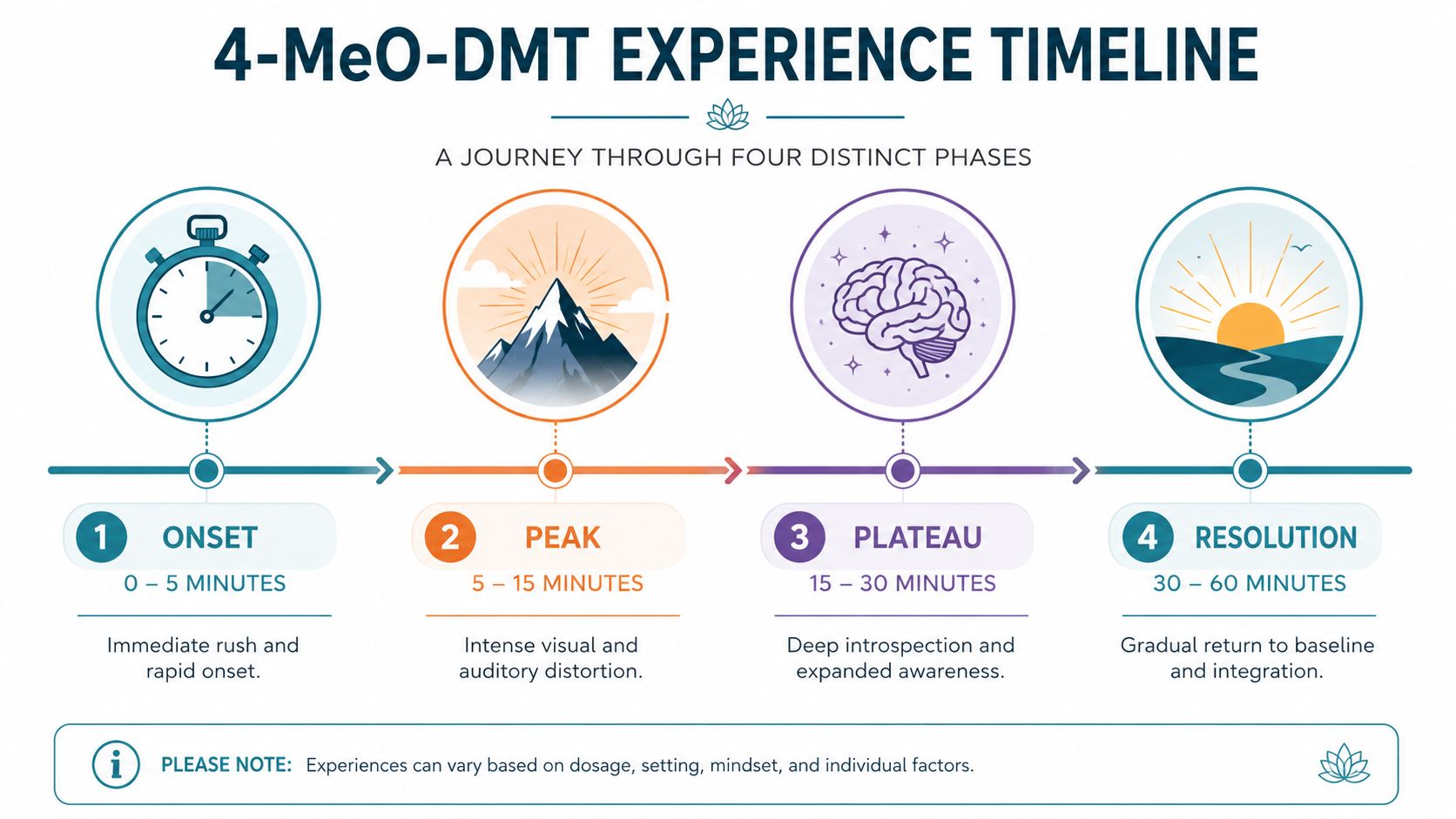
The most important practical fact is also the least satisfying: reliable human onset, duration, and dose-response data for 4-MeO-DMT are not established. Available comparisons suggest lower potency than 5-MeO-DMT in behavioral assays, but an animal discrimination result can’t tell a person how a specific preparation, route, or amount will behave.
The route of administration can change absorption and timing for many psychoactive compounds. Inhalation, insufflation, and oral administration shouldn’t be treated as interchangeable categories, yet direct pharmacokinetic data for 4-MeO-DMT are too sparse to support confident human timelines for any of them. User reports may describe rapid onset or short-lived effects, but anecdotal timing is vulnerable to misidentified substances, variable purity, inaccurate measurement, and differences in individual physiology. (Comparative pharmacology and research-gap discussion)
Why Dosage Advice Is Especially Unstable
Dose figures circulating online may be preclinical, user-reported, or copied from another tryptamine. None of those categories supplies a validated human dosing standard for 4-MeO-DMT. Body weight and neurochemistry may influence response, but those variables don’t make an unverified dose predictable.
A responsible safety discussion therefore focuses on conditions that increase uncertainty:
- Route: Different routes can alter absorption and timing, while direct human data remain absent.
- Substance identity: A label may not establish purity or even correct identity.
- Polydrug exposure: Other serotonin-acting substances can complicate physiological and psychological effects.
- Medical history: Cardiovascular and psychiatric conditions deserve professional screening before any exposure.
- Supervision: A sober, trusted sitter can help manage confusion, panic, falls, or delayed medical concerns.
Re-dosing during an acute or poorly understood window creates a particular risk because delayed absorption or misjudged potency can make the total exposure larger than intended. Anyone who develops severe agitation, chest pain, loss of consciousness, dangerous overheating, seizures, or difficulty breathing needs urgent medical attention.
“Safety boundary: No online timeline can turn an untested human dose into a predictable medical intervention.”
The subjective character is also difficult to define with confidence. Some comparisons describe 4-MeO-DMT as less potent than 5-MeO-DMT and different from DMT, but those descriptions come from preclinical proxies and limited reports rather than controlled human trials. A person shouldn’t use another compound’s familiar onset, visual profile, or duration as a substitute for direct evidence.
Comparing 4 Meo DMT With Other Tryptamines
Chemical relatives provide useful context, but comparison can mislead when it turns into a ranking. DMT, 5-MeO-DMT, and psilocin-like compounds share parts of a tryptamine framework, yet small structural differences can change receptor preferences and signaling. The evidence for 4-MeO-DMT remains much thinner than the evidence base for better-known substances.
DMT is often discussed as strongly visual, while 5-MeO-DMT is associated in published and observational discussions with a different balance of serotonergic and somatic effects. 4-MeO-DMT sits apart from both because its methoxy group occupies the 4-position and because available receptor summaries describe a distinct pattern, including pronounced 5-HT2C biased agonism. These are useful hypotheses, not controlled-trial conclusions. (Receptor differences and safety context)
| Substance | Primary Receptor Targets | Subjective Character | Typical Duration | Human Evidence Depth |
|---|---|---|---|---|
| DMT | Serotonergic receptors, including 5-HT2A-related signaling | Often described as visually intense | Route-dependent and not interchangeable with 4-MeO-DMT | Greater than 4-MeO-DMT, but route and context still matter |
| 5-MeO-DMT | Strong serotonergic activity, with greater 5-HT1A emphasis than 4-MeO-DMT | Often described as highly immersive and somatically intense | Route-dependent | More developed than 4-MeO-DMT, though important gaps remain |
| 4-MeO-DMT | 5-HT1A, 5-HT2A, 5-HT2B, and 5-HT2C activity reported | Distinct profile inferred from pharmacology and limited reports | Not reliably established in humans | Sparse |
| Psilocin | Serotonergic psychedelic activity | Often associated with perceptual and emotional changes | Preparation and route-dependent | More developed than 4-MeO-DMT |
Duration Is A Planning Variable
Duration matters for supervision, transport, medical observation, and psychological integration. Yet a reliable 4-MeO-DMT duration cannot be supplied from the current evidence base, and a duration associated with DMT or 5-MeO-DMT shouldn’t be transferred automatically.
A useful comparison therefore asks three questions rather than seeking a winner:
- Which receptor data come from direct experiments?
- Which effects come from controlled human observation, and which come from reports?
- Does the reported duration apply to the same route and verified compound?
This approach protects against a common error, treating a shared chemical family as proof of shared experience. Similar names can support a research question, but they don’t establish interchangeable effects or safety.
Legal Status Across Major Jurisdictions
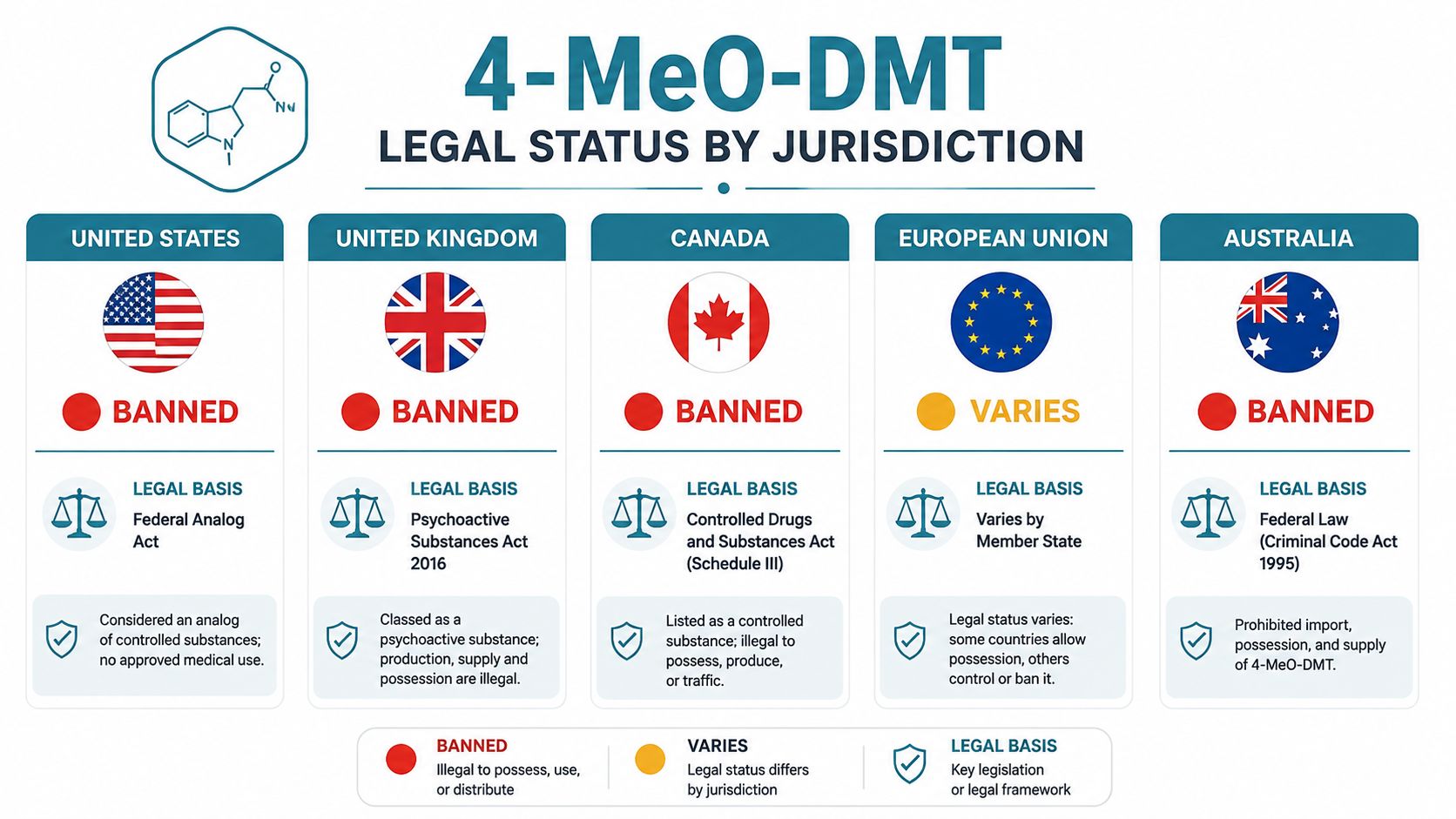
Legal interpretation is unusually important for 4-MeO-DMT because a compound may be chemically recognized without receiving a clear, dedicated entry in every national schedule. The available legal-status discussion identifies 4-MeO-DMT as a methoxytryptamine isomer of 5-MeO-DMT, placing it among related compounds considered in United States controlled-substance discussions. (United States psychedelic drug legal-status overview)
The legal position can depend on named scheduling, analogue provisions, generic psychoactive-substance rules, import controls, and local enforcement practice. A researcher shouldn’t assume that an apparent gap in a list means lawful possession or transfer.
Jurisdictional Questions Need Local Answers
Across the major jurisdictions commonly discussed, the practical picture is a patchwork:
- United States: Analogue and controlled-substance interpretations may create legal exposure even when a specific isomer isn’t the central subject of an article.
- United Kingdom: Broad psychoactive-substance controls may be relevant, with the exact application depending on the activity and statutory interpretation.
- Canada: Controlled-drug rules and related provisions may apply to possession, production, importation, or distribution.
- European Union: National laws vary. Some countries may classify related compounds differently, while others impose controls through broader categories.
- Australia: Federal and state or territory rules can interact, making local advice essential.
The cited legal summary doesn’t establish a single universal outcome for every country or activity. It also doesn’t justify treating a lack of named coverage as permission. Analytical standards, precursor materials, storage, and cross-border shipment can trigger separate obligations.
Researchers evaluating local exposure should also review ordinary controlled-substance consequences, not just psychedelic-specific commentary. For readers examining one state-level example, an overview of what are Minnesota’s drug penalties can provide context, although it can’t replace advice from counsel familiar with the exact compound and conduct.
The safest operational rule is straightforward: obtain current advice before handling, importing, storing, or transporting 4-MeO-DMT. Travelers face the law of the destination and transit jurisdictions, and classifications can change without matching the language used in older online discussions. Broader cultural and legal context for plant-medicine practices is available in this discussion of Ayahuasca harm reduction and benefit maximization, but it shouldn’t be read as a legal opinion about 4-MeO-DMT.
What Researchers and Practitioners Should Carry Forward
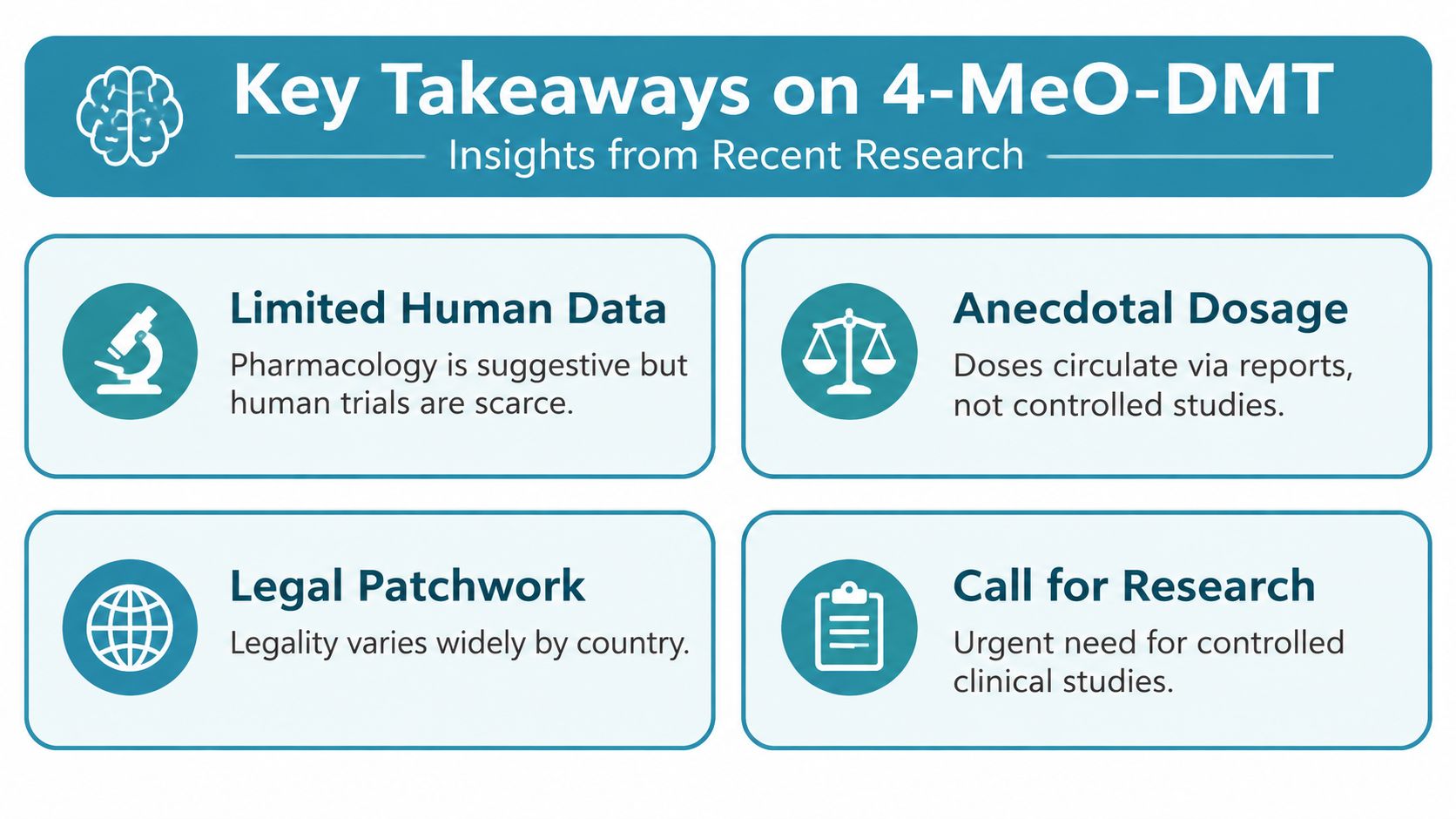
Four conclusions survive careful review.
First, the pharmacology is suggestive but incomplete. 4-MeO-DMT has a defined structure and reported activity at several serotonin receptors. That supports further study, but it doesn’t establish a therapeutic indication, a safe human dose, or a predictable clinical effect.
Second, dosage figures should be labeled by evidence type. Preclinical findings can help organize hypotheses. User reports can identify questions worth investigating. Neither category substitutes for controlled human pharmacology.
Third, legal classification belongs in the research design. A laboratory may need to evaluate not only whether the molecule is named in a schedule, but also whether analogue, generic psychoactive, import, precursor, storage, or institutional rules apply. Procurement for analytical work can create legal obligations even when the intended purpose is nonclinical.
Fourth, integration models may not transfer cleanly. Frameworks developed around psilocybin or 5-MeO-DMT may offer general principles for preparation, supervision, and post-experience support. They shouldn’t be assumed to describe 4-MeO-DMT’s receptor profile, psychological risks, or duration.
Clinical Intake Should Stay Concrete
When a patient reports 4-MeO-DMT exposure, a clinician can ask about:
- Route and timing: How was it taken, and when did symptoms begin?
- Substance certainty: Was the material analytically verified?
- Polydrug context: Were serotonin-acting medicines, stimulants, alcohol, or other psychoactive substances involved?
- Medical history: Are there cardiovascular, seizure-related, or psychiatric vulnerabilities?
- Current symptoms: Are there persistent perceptual changes, agitation, confusion, suicidality, or physical warning signs?
Researchers still need answers about receptor subtype selectivity, tolerance kinetics, metabolism, active metabolites, and whether any distinctive subjective profile supports a specific therapeutic hypothesis. Those questions call for validated analytical work, transparent reporting, and human studies with appropriate medical oversight.
For readers considering further study, the most useful next step isn’t finding a confident dose chart. It is building an evidence file that separates direct data, animal results, observational reports, and legal interpretation. That distinction is the clearest protection against both overclaiming and avoidable harm.
Readers seeking a responsible next step can explore the educational and safety resources at Ayahuasca.com, then consult a qualified clinician and local legal counsel before making any decision involving 4-MeO-DMT. No online article can replace medical screening, verified substance analysis, or jurisdiction-specific advice.
Disclaimer: The information provided on Ayahuasca.com is for educational purposes only and is not intended as medical advice, diagnosis, or treatment. Ayahuasca is a powerful traditional Amazonian medicine and may not be suitable for everyone. Always consult with a qualified healthcare professional before making decisions related to health, mental well-being, medications, or the use of Ayahuasca.