
What does a person think they are asking when they ask, what is Ayahuasca, a drink, a ritual, or a doorway into a much older Amazonian way of healing? The safest answer starts with all three, because Ayahuasca only makes sense when the plant, the ceremony, and the cultural frame stay together.
At its simplest, Ayahuasca is a traditional Amazonian brew made from two plants that work as a pair. The vine supplies the chemistry that makes the leaf’s psychoactive compound orally active, and the ceremony gives that chemistry meaning, structure, and containment. That combination is why Ayahuasca is discussed as sacred medicine, not just a psychedelic tea, and why beginners do better when they treat it as a process with preparation, ceremony, and integration rather than a single intense night.
What Ayahuasca Actually Is and Why It Matters
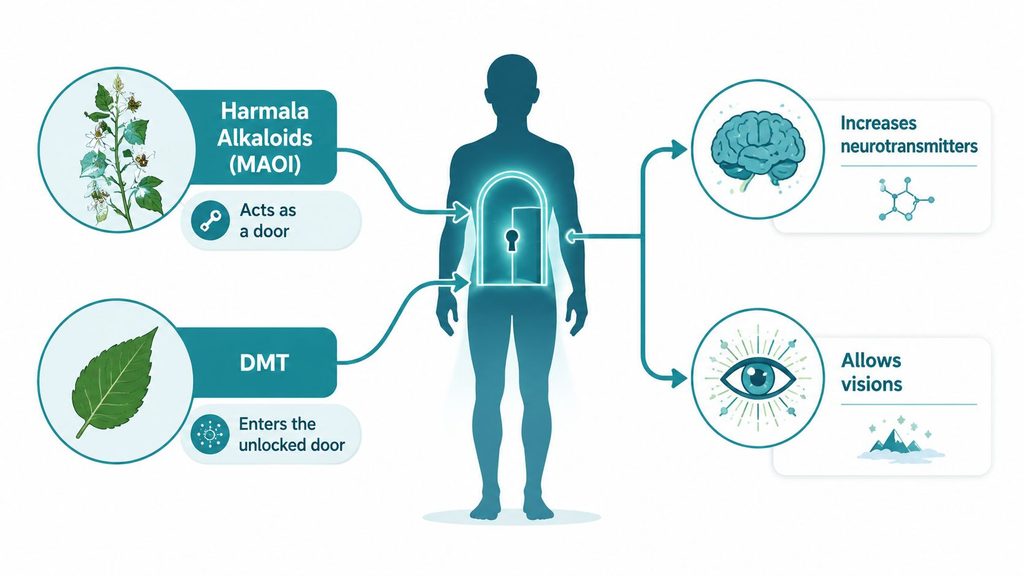
Ayahuasca is easiest to understand when it’s described as a two-plant system, not a mystery substance. The brew is typically prepared from Banisteriopsis Caapi, the vine, and Psychotria Viridis, often called chacruna, the leaf that contains DMT. The vine’s Harmala alkaloids act as MAO-A inhibitors, which allows DMT to become orally active instead of being broken down before it can reach the brain.
Why The Two-Plant Pairing Matters
That pairing changes everything about the experience. A person is not just consuming a psychoactive leaf, they’re taking in a brew where one plant activates the other, rather like a key and lock working together. The result is usually slower onset, deeper bodily effects, and a ceremony that unfolds over hours rather than minutes.
For beginners, that matters because expectations shape safety and interpretation. A recreational psychedelic mindset often looks for novelty or a quick peak, while Ayahuasca is usually approached with intention, set, setting, and guidance from a facilitator or shaman. The ceremony container is part of the experience, not a decorative extra.
“Practical rule: If a guide treats Ayahuasca like a casual drink rather than a structured rite with screening and support, that’s a warning sign.”
That difference also helps explain why people report the experience as emotionally and physically demanding, not visual. It’s a medicine that asks for preparation before the first cup and reflection after the final one. A beginner who understands that from the start is less likely to mistake intensity for meaning, or meaning for safety.
The Amazonian Roots of the Sacred Brew
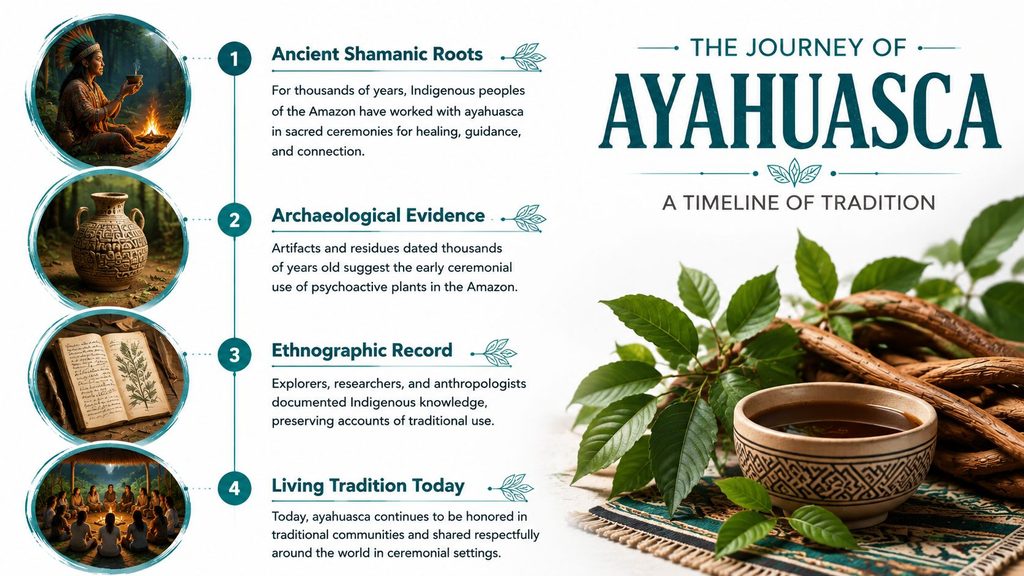
Ayahuasca belongs to a living Indigenous world, not a recent wellness trend. A review and survey summary reports that its recorded Amazonian history reaches back about 150 years, while archaeological evidence points to alkaloid samples at sites associated with use that may go back about 1,000 years. Read together, those lines of evidence show why Ayahuasca sits at the meeting point of documented tradition and material history.
The brew’s lineage is tied to Amazonian peoples including the Shipibo, Asháninka, and Kichwa, whose healers shaped preparation, song, and ritual form. Their ceremonies use Icaros, healing songs that help organize the experience and guide how the medicine is framed and held. For a fuller look at that relationship, see sacred reciprocity in Indigenous tradition. Modern practitioners who ignore that context often turn something relational into something consumable.
Why Origin Changes The Ethical Conversation
Ayahuasca later spread into urban Brazil through syncretic religious forms such as Santo Daime and União do Vegetal, and from there into global retreat culture. That movement matters because it shows how a local tradition became international without losing its roots in Amazonian medicine, ritual, and identity. Beginners who know that history tend to ask better questions, including who taught the facilitators, where the plants come from, and whether source communities receive reciprocity.
“Good practice: Favor facilitators who can speak clearly about lineage, plant sourcing, and why their ceremony exists at all.”
A thoughtful first-timer can also use a simple test. If a retreat discusses only spectacle, visuals, and transformation, but never mentions Indigenous context, the balance is off. The medicine may travel widely, but its meaning still begins in the forest and the communities that have carried it.
How Ayahuasca Works in the Body and Mind
The science behind Ayahuasca is surprisingly elegant. The vine’s Harmine, Harmaline, and Tetrahydroharmine slow the enzyme MAO-A, while the leaf contributes DMT, the main psychoactive compound. In plain terms, the vine opens a biological door, and the leaf walks through it.
The Body’s Doorway And The Mind’s Response
Without the vine, orally taken DMT would be rapidly broken down in the gut and liver. With the vine present, more of it reaches systemic circulation and the central nervous system, which is the key reason the brew works the way it does (mechanistic review, plant chemistry review). Reviews also describe the main measured compounds in traditional and analog brews as Harmine, Harmaline, Tetrahydroharmine, and DMT, with reported concentrations varying widely across samples (analytical review).
The experience then becomes a mix of sensory, emotional, and bodily shifts. Common descriptions include vivid imagery, memory surfacing, emotional release, and a loosening of the usual sense of self. Many users also notice nausea, vomiting, and temporary confusion or drowsiness, which are part of the predictable acute profile described in the literature (safety review).
What Beginners Often Feel
The subjective side is usually where people get confused. One person may describe a softening of mental defenses, another may spend the night working through old memories, and another may mostly feel physical purge and relief. The brew doesn’t hand out identical experiences, because body chemistry, dose, and setting all matter.
“Useful frame: A difficult moment in ceremony is often a sign of intensity, not automatically a sign of harm.”
A video can help make the chemistry feel less abstract.
For a deeper dive into the biochemistry, a beginner can also review the science overview at how Ayahuasca works. The main takeaway is simple, though. Ayahuasca is not one ingredient doing one thing, it’s a paired mechanism that changes how the body processes DMT and how the mind experiences it.
The Three Phases Of An Ayahuasca Journey
A first ceremony is easier to approach when it’s treated as a timeline. The work begins before the cup, peaks during the ceremony, and continues long after the room goes quiet. That’s why serious facilitators speak in phases instead of promising one-night transformation.
Preparation Before Ceremony
Preparation usually starts with the dieta, which is a period of abstaining from certain foods, alcohol, recreational drugs, and other substances that can complicate the experience. Many programs also ask for intention setting, honest reflection, and a clear calendar so the participant isn’t rushing back into daily noise the next morning.
The point of preparation is to reduce avoidable variables. A person who enters ceremony while metabolically strained, emotionally scattered, or still using conflicting substances is more likely to have a confusing experience. The cleanse is practical, not ceremonial theater.
“Practical rule: The quieter life gets before ceremony, the easier it is to notice what the medicine brings up.”
The preparation guide at preparing for an Ayahuasca journey is a useful reference point for first-timers who want a more structured checklist.
Ceremony And Integration
During ceremony, participants usually arrive, settle into a space prepared with prayer or opening song, and then drink under supervision. Effects often unfold in waves over several hours, and the facilitator’s job is to keep the container steady, especially if purging, anxiety, or disorientation appear. The ceremony is not about what the participant sees, it’s about how the room is held.
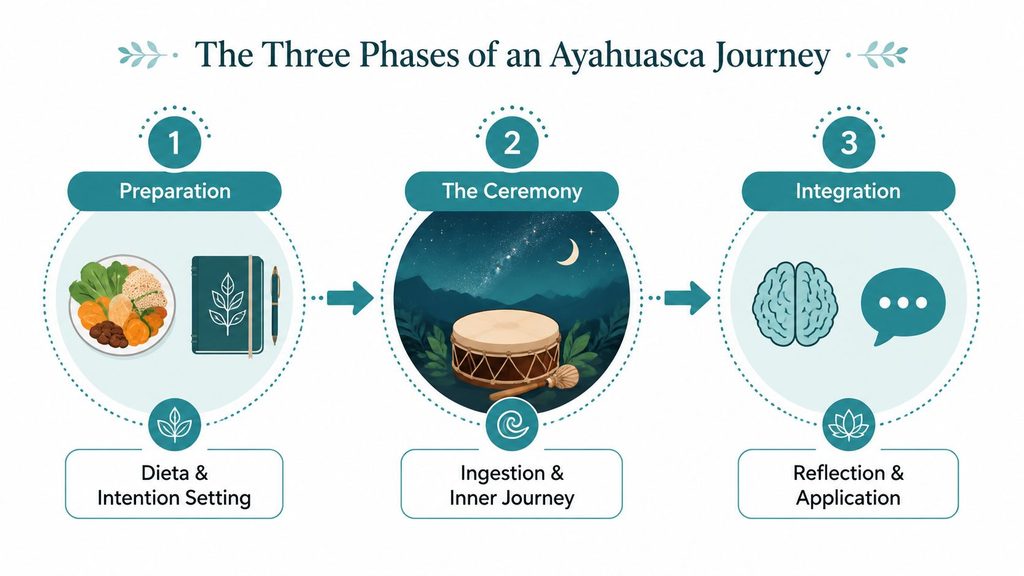
Integration starts after the ceremony ends. Journaling, quiet conversation, community circles, and therapy can help turn a powerful night into usable insight. Without integration, the experience may stay memorable but unresolved.
A sensible first-timer treats all three phases as one arc. Preparation protects the body, ceremony creates the experience, and integration gives the experience somewhere to land.
Safety, Medications, And Who Should Sit Out
Medication screening is the beginner blind spot most guides still handle badly. Ayahuasca contains MAOI compounds, which means it can interact dangerously with SSRIs, SNRIs, tricyclics, MAOIs, certain painkillers such as tramadol and meperidine, decongestants, stimulants, and tyramine-rich foods. Those combinations can raise the risk of serotonin toxicity or a blood pressure crisis, so a casual “natural means safe” assumption can be dangerous.
Who Should Not Move Forward Lightly
Recent clinical and review literature emphasizes avoiding Ayahuasca in people taking SSRIs, antipsychotics, MAOIs, and other psychoactive drugs, and in people with psychotic disorders, severe personality disorder, heart disease, or pregnancy (clinical review). Another recent review notes that acute use in healthy volunteers generally has an acceptable safety profile, but the margin is narrow and rare serious adverse events do occur, so screening matters as much as the brew itself (safety review).
A screening window often runs 2 to 6 weeks off contraindicated medications under medical supervision, depending on the drug, the person, and the clinician’s guidance. That timing isn’t a formality. It’s the difference between a managed transition and a dangerous overlap.
The main exclusions also include schizophrenia, bipolar disorder with psychosis, uncontrolled anxiety, cardiac disease, and significant liver or kidney impairment. Pregnancy and breastfeeding are also reasons to sit out. For a beginner, that means the first step is a complete medication and health review, not a discussion about visuals or retreats.
“Practical checklist: current medications, psychiatric history, blood pressure issues, heart history, pregnancy or breastfeeding status, and any recent substance use.”
The screening and prep guide at preparing for an Ayahuasca journey can help structure those questions before anyone commits to a ceremony. The core rule is blunt and useful. If screening feels rushed, the setting probably isn’t ready for a first-time participant.
Legal Status Around The World
Ayahuasca legality is a patchwork, not a simple yes or no. DMT is scheduled under the 1971 UN Convention on Psychotropic Substances, but the plants and brews themselves are not automatically under direct international control. Countries then draw their own lines around religious use, traditional use, prohibition, and legal gray areas (ICEERS legal overview). For travelers, that patchwork matters more than any abstract debate.
| Ayahuasca Legal Status by Country: A Beginner Decision Table | |||
|---|---|---|---|
| Country | Legal Status | Retreat Access For Visitors | Beginner Risk Level |
| Brazil | Recognized and widely used in religious and traditional contexts | Often accessible through established ceremonial settings | Moderate |
| Peru | Traditional and cultural use is recognized | Accessible, but visitors still need to verify facilitator quality and local rules | Moderate |
| Canada | DMT and harmala alkaloids are controlled substances | Limited, with significant legal caution | High |
| United States | DMT is Schedule I under the Controlled Substances Act (U.S. legal review) | Restricted, with narrow exemption contexts | High |
| France | Frequently treated as prohibited in practice | Very limited | High |
| The Netherlands | Legal status is shaped by exemption and enforcement context | Variable | High |
| Portugal | Decriminalization can apply to small amounts for self-use, while sale, transport, and cultivation remain restricted | Limited and jurisdiction-sensitive | Moderate to High |
The table helps, but borders still decide the outcome. A retreat can be tolerated in one place and treated very differently in another, just like the same prescription bottle can be legal in one country and restricted in the next. For beginners, that means checking the ceremony country, the departure country, and the return country before making plans.
One more layer sits underneath the law itself: health and access. Recent policy discussion notes that Australia treats Ayahuasca-related compounds as prohibited except for research, while Canada classifies DMT and harmala alkaloids as controlled substances, and U.S. travel messaging warns visitors about health and legality risks in Peru (policy review).
A place can be legal and still unsafe, or restricted and still spiritually important for local communities. Beginners do better with careful jurisdiction checks than with the assumption that every retreat follows the same rules.
Choosing A Retreat You Can Trust
A trustworthy retreat starts with paperwork, not poetry. The first things to ask for are documented lineage, trained facilitators, transparent medical screening, and 24-hour on-site medical support. If a center can’t explain who prepares the medicine, who watches participants, and what happens if someone has a medical issue, the participant shouldn’t be there.
Questions That Separate Serious Centers From Sales Pitches
The screening process should explicitly ask about SSRIs, MAOIs, blood pressure medication, pregnancy, and psychiatric history. A center that skips those questions is asking the participant to carry the risk alone. Dosage protocol and brew sourcing matter too, because a first-timer needs to know how much is being served, how second doses are handled, and who decides.
Red flags are usually easy to spot once they’re named. Guarantees, pressure to drink more, isolation tactics, and heroic language about “breaking through” often signal a sales mentality instead of a safety culture. So do vague answers about emergency planning or staff credentials.
- Documented Lineage: Ask who taught the facilitators and how the ceremonial form is connected to Indigenous practice.
- Medical Screening: Confirm that the intake form asks about medications, cardiovascular health, pregnancy, and mental-health history.
- Emergency Planning: Request the protocol for a panic reaction, fainting, allergic response, or transport to care.
- Participant Ratios: Confirm how many guests each facilitator is responsible for during the ceremony.
- Brew Transparency: Ask where the plants are sourced and who prepares the brew.
A center-based format usually offers more structure, while a small-circle format can feel more intimate if it still has strong screening and support. Pricing also tells a story. Clear costs for preparation, facilitation, accommodation, and aftercare usually indicate a real operation, while vague “all-inclusive” language sometimes hides corners cut elsewhere.
Ayahuasca.com also publishes beginner educational materials and retreat guidance for readers who want a more structured starting point. A good directory or guide should never replace personal vetting, but it can help a newcomer ask sharper questions before booking.
Beginner Questions Answered
A first-timer usually wants practical answers, not philosophy. The diet in the weeks before ceremony should be simple, clean, and free of obvious conflicts with MAOI use. Whether the exact list comes from a center or from personal preparation notes, the purpose stays the same, reduce avoidable strain before the medicine is taken.
The Questions People Ask After The Basics Land
Ayahuasca is not addictive in the way people usually mean when they talk about compulsive recreational use. It is also not a guaranteed cure, and it should never be combined with recreational substances, especially when medication interactions are in play. A difficult ceremony often includes vomiting, crying, trembling, fear, memory fragments, or long stretches of internal work, and that can still be part of a valid and meaningful session.
What to bring is usually simple, a water bottle if the retreat allows it, comfortable clothing, a journal, and any required documents or medication disclosures. What not to bring matters just as much, especially anything that can compromise screening or focus. Supporting a friend who is sitting means respecting silence, not trying to interpret their experience for them, and helping them protect their integration time afterward.
“Clear sign of integration: the person starts making small, steady changes in daily life without needing to force a dramatic story onto the experience.”
Microdosing claims should be treated separately from ceremonial Ayahuasca use. The brew’s actual context is ritual, screening, and guided work, not casual experimentation. If integration stalls, a person can return to journaling, talk with a therapist or integration circle, and review what the experience brought up before looking for the next ceremony.
The central lesson is straightforward. Ayahuasca is a process that spans preparation, ceremony, and integration, and the most meaningful transformation usually shows up in the months that follow, not only on the night of the brew.
If the next step is real preparation, start by checking medications, reviewing legal status in the intended country, and comparing retreats with a medical screening form in hand. A careful first conversation with a facilitator tells more than any glossy brochure, and that single habit can save time, money, and a great deal of risk.
Disclaimer:
The information provided on _Ayahuasca.com is for educational purposes only and is not intended as medical advice, diagnosis, or treatment. Ayahuasca is a powerful traditional Amazonian medicine and may not be suitable for everyone. Always consult with a qualified healthcare professional before making decisions related to health, mental well-being, medications, or the use of Ayahuasca.