
A person often lands on the phrase ayahuasca drugs in a very ordinary way. They’re scrolling late at night, trying to sort through fear, curiosity, and a long list of conflicting opinions. One search result calls it a dangerous drug. Another calls it sacred medicine. A third makes it sound mystical and simple at the same time.
That split can feel confusing because both language and context matter here. Ayahuasca does contain psychoactive compounds, so the word “drug” appears in legal, medical, and public health conversations. At the same time, many Indigenous communities and ceremonial lineages relate to Ayahuasca as a plant medicine, a spiritual teacher, and a healing sacrament.
A grounded understanding starts by holding both realities without flattening either one. Ayahuasca is a psychoactive brew. It is also part of living traditions, layered ritual practices, and a serious body of emerging scientific study. Responsible decision-making begins when a person stops asking only, “Is this a drug?” and starts asking, “What kind of thing is this, in what setting, with what risks, and for what purpose?”
Understanding the Term Ayahuasca Drugs
The phrase ayahuasca drugs usually signals a mismatch between modern categories and traditional use. “Drug” is a broad word. It can refer to a prescription medicine, an illegal substance, a ceremonial sacrament, or a compound studied in a lab. That broadness creates confusion before a person has even learned what Ayahuasca is.
Ayahuasca has a documented history in the Amazon with the first clear written accounts appearing in the 17th century, broader ritual use among Indigenous groups solidifying by the 19th century, and the earliest detailed Western documentation recorded by Richard Spruce in 1851. By the 1930s, it had entered urban Brazil through syncretic churches, and by the 1980s it had reached international cities, as summarized in this historical overview of Ayahuasca.
That history matters because it reframes the question. A person isn’t looking at a trendy invention or a random intoxicant detached from culture. They’re looking at a brew that grew inside ceremonial, medicinal, and spiritual frameworks before it entered modern global conversation.
Why the label matters
When someone hears “drug,” they may imagine a party setting, casual use, or a product designed for quick escape. That frame doesn’t match how Ayahuasca has traditionally been approached. In many ceremonial contexts, people prepare mentally, physically, and spiritually. They enter a guided container. They often seek healing, insight, grief processing, or a change in relationship to suffering.
“Ayahuasca asks for context. Without context, the word “drug” can hide more than it reveals.”
The more useful question is whether the term helps a person make safer and more respectful decisions. Sometimes it does. In medical screening, for example, it’s important to treat Ayahuasca seriously as a pharmacologically active substance. In cultural conversation, though, calling it only a drug can erase the ceremonial knowledge that has shaped its use.
A better frame for first-time seekers
A balanced frame includes three layers:
- Biological reality: Ayahuasca affects the brain and body in measurable ways.
- Cultural reality: Ayahuasca comes from traditions that hold meaning, boundaries, and ritual protocols.
- Personal reality: The experience can be intense, vulnerable, and life-changing for better or worse depending on preparation and support.
Readers who want a broader grounding in origins, uses, and ceremonial context can explore this introduction to Ayahuasca.
The Unique Chemistry of the Ayahuasca Brew
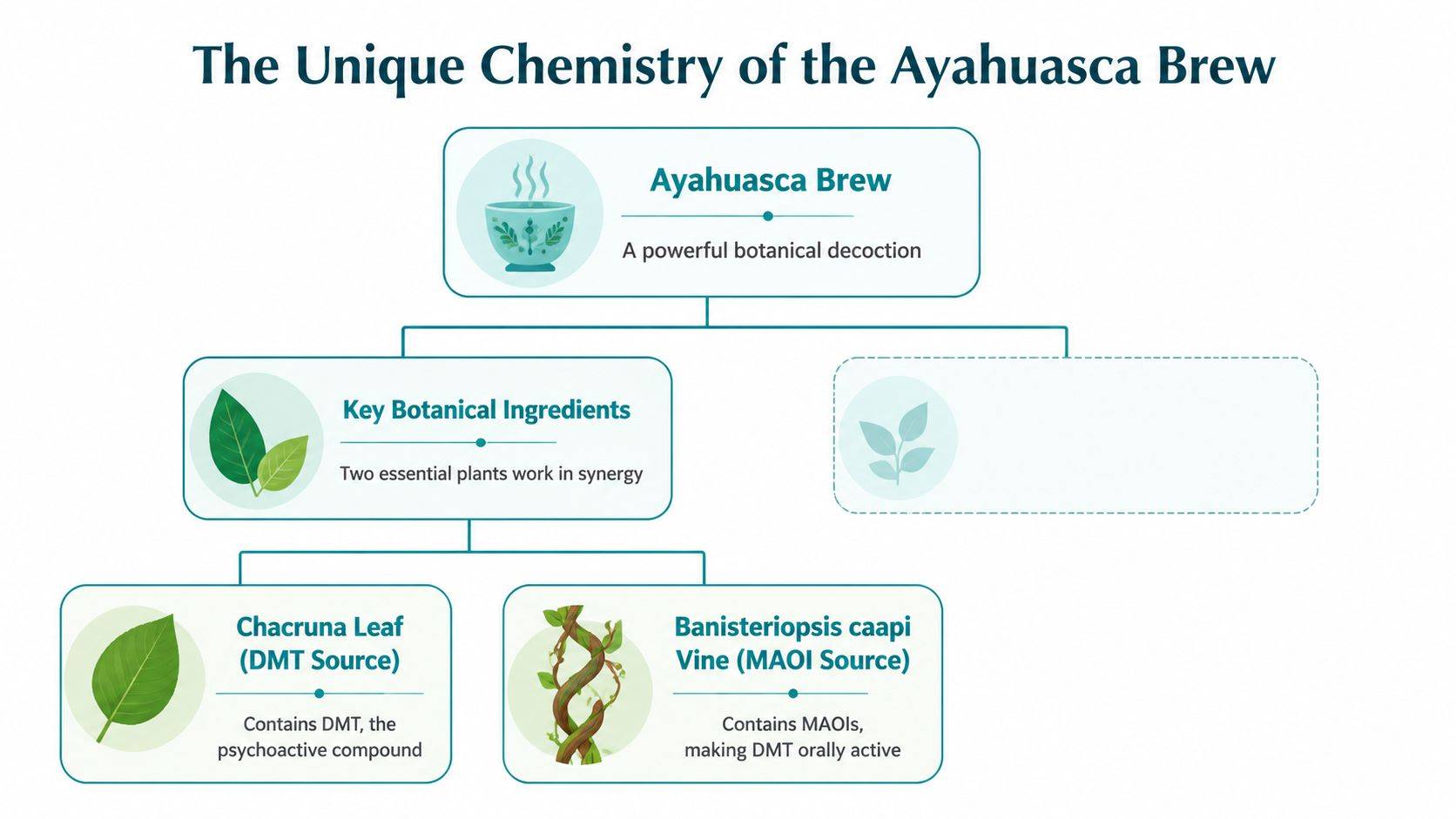
Ayahuasca can seem mysterious until its basic chemistry is explained in plain language. The brew works through a partnership between plants. One plant brings the main psychoactive compound. The other makes that compound orally active in the body.
The messenger and the key
A simple analogy helps. DMT can be understood as the messenger. It carries the psychoactive signal. But if a person swallows DMT by itself, the body usually breaks it down in the gut before it can do much. The message never reaches its destination.
The vine contributes β-carboline alkaloids, which act as reversible MAO-A inhibitors. In simple terms, they work like a key that enables the body’s ability to absorb DMT orally. According to this review of Ayahuasca pharmacology and safety, this interaction allows DMT from the leaves to become active after drinking the brew, with peak plasma DMT levels around 1.5 to 2 hours after ingestion and characteristic effects lasting around 4 to 6 hours.
That’s why the brew is more than the sum of its parts. The plants don’t just sit side by side. They cooperate.
What happens in the body
For many readers, the chemistry gets confusing at the serotonin part. DMT acts on serotonin-related systems, including the 5-HT2A receptor. Readers who want a simple primer on how serotonin receptors fit into mental health and perception may find IPA’s insights on 5-HT helpful background.
A practical way to think about the process looks like this:
- The brew is ingested.
- The vine’s alkaloids temporarily inhibit MAO-A, an enzyme that would otherwise break down DMT in the gut and liver.
- DMT remains available long enough to enter circulation.
- The psychoactive experience unfolds over several hours, often with changes in perception, emotion, imagery, and bodily awareness.
“Practical rule: Ayahuasca is pharmacology wrapped in tradition. Respect for ceremony doesn’t replace biology, and biology doesn’t cancel the importance of ceremony.”
Readers who want a deeper look at the compounds in the vine can review this guide to beta-carbolines.
Ceremony, Setting, and a Spectrum of Use
A cup of Ayahuasca consumed in a well-held ceremony is not the same thing as the same brew consumed casually. The chemistry may be similar, but the experience can unfold very differently depending on setting, intention, support, and structure.
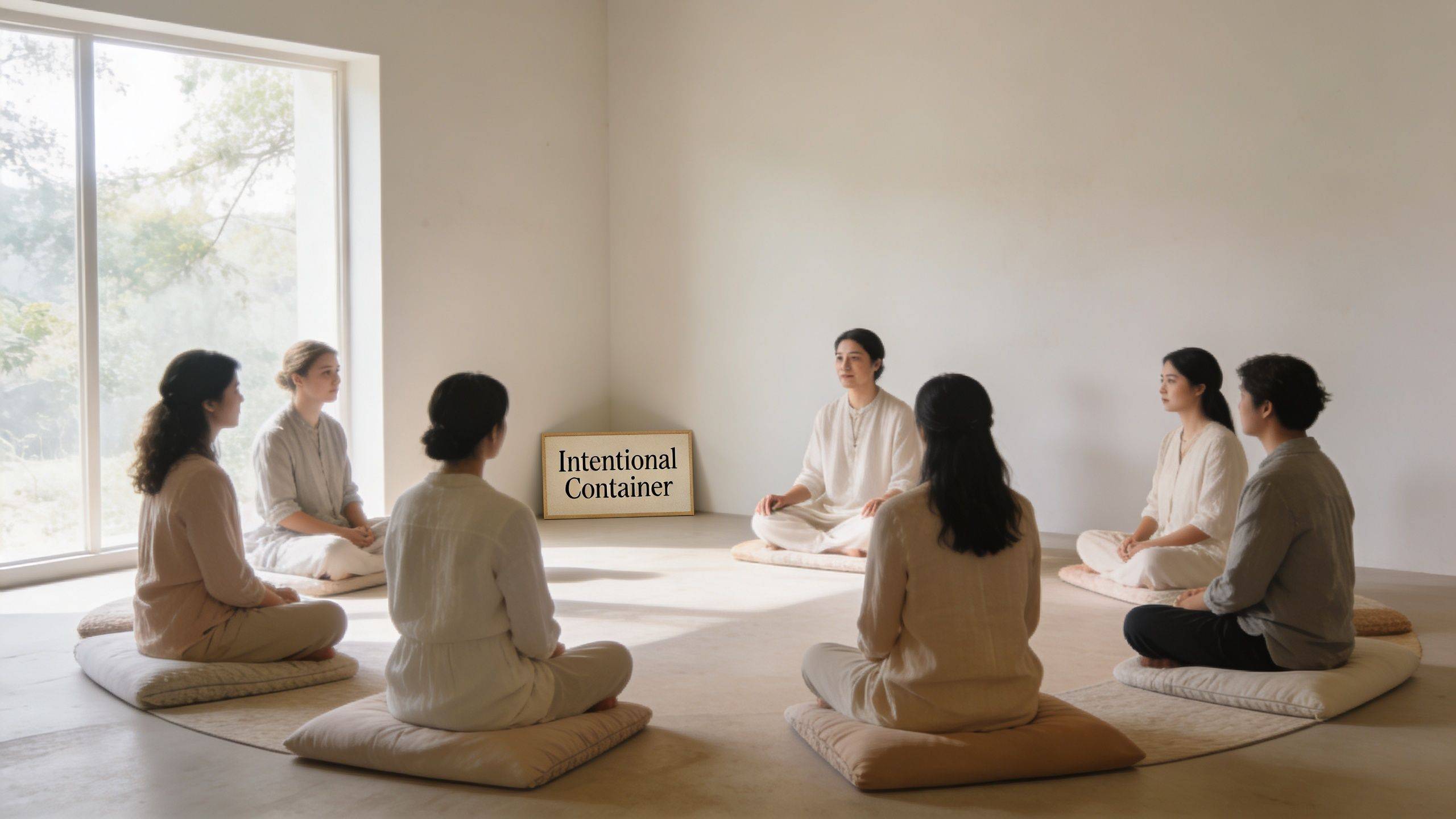
One context treats the brew as sacred medicine. Another treats it as an experiment. That difference affects how people prepare, how they respond when the experience becomes difficult, and whether the journey has any stable support around it.
What a ceremonial container changes
In a respectful ceremony, the environment is designed to reduce chaos. Participants usually arrive with preparation instructions, clear expectations, and some form of facilitator presence. The room often has a rhythm. There may be silence, prayer, music, or guided support. The point is containment.
By contrast, unstructured use can leave a person alone with intense fear, confusion, nausea, emotional release, or traumatic material with no one skilled enough to help. A powerful altered state without support can feel less like healing and more like being psychologically unmoored.
A useful comparison looks like this:
| Approach | What usually defines it | Likely impact on the experience |
|---|---|---|
| Ceremonial use | Intention, screening, guidance, ritual structure, aftercare | Supports emotional safety and meaning-making |
| Casual or unstructured use | Minimal preparation, unclear sourcing, weak supervision, no integration | Raises the chance of confusion, overwhelm, and poor decisions |
Set and setting are not spiritual buzzwords
“Set” refers to mindset. “Setting” refers to environment. Those two factors shape how a person moves through vulnerability.
Someone carrying grief, anxiety, or unresolved trauma may enter the experience with a very different internal state than someone approaching it from curiosity alone. Likewise, a calm room with trusted support is different from a chaotic space where the person doesn’t know who is in charge.
“A strong container doesn’t guarantee an easy journey. It gives the journey somewhere safe to happen.”
This short video gives readers a visual sense of ceremonial atmosphere and group process:
Why the role of the facilitator matters
A skilled facilitator or traditional ceremonial leader does more than serve the brew. They help regulate the field around it. That can include reading when someone needs reassurance, when someone needs space, and when a medical or psychological concern requires direct intervention.
First-time seekers often underestimate this point. They may focus on location, aesthetics, or price while overlooking the quality of leadership. But when the experience turns intense, the person holding the room matters far more than the room itself.
A helpful mental model is simple. Ayahuasca can open doors quickly. Ceremony determines whether there is a path, a guide, and a way back.
Navigating Potential Risks and Drug Interactions
The most important part of any conversation about ayahuasca drugs is safety. Ayahuasca can be meaningful, healing, and life-changing. It can also be dangerous for some people, especially when medications, mental health vulnerabilities, or incomplete screening are involved.
One major concern is drug interaction. The MAOIs in Ayahuasca can interact with other substances in ways that are medically serious. According to this Ayahuasca drug fact page, combining Ayahuasca with SSRI antidepressants can contribute to serotonin syndrome, tramadol can lower the seizure threshold, and cannabis can increase the risk of psychosis. The same source also notes that a 2025 survey of 500 retreat-goers found 22% did not disclose medication use, leading to adverse events.
That statistic points to a simple truth. A retreat can only screen for what a participant reveals.
Why serotonin syndrome matters
Serotonin syndrome happens when serotonin activity becomes dangerously excessive. In plain language, the body’s signaling system becomes overstimulated. A person may think, “This is just a plant brew, so it won’t interact like a medication.” That assumption can put them at real risk.
SSRIs already affect serotonin. Ayahuasca also interacts with serotonin systems and contains MAOI activity. That combination can become unsafe.
Common contraindications and interactions
| Category | Specific Examples | Reason for Caution |
|---|---|---|
| Antidepressants | SSRIs | Risk of serotonin syndrome |
| Pain medications | Tramadol | Can lower seizure threshold |
| Other psychoactive substances | Cannabis | Can increase risk of psychosis |
| Undisclosed medications | Any unreported prescription or supplement use | Prevents proper screening and raises risk of adverse events |
Readers who want a practical preparation reference can review foods and meds to avoid with MAOIs.
What readers often miss
The biggest risk isn’t only the brew itself. It’s the mismatch between the brew and the person’s current medical reality.
A retreat application may ask about:
- Current prescriptions: especially antidepressants, stimulants, pain medications, and sleep medications.
- Psychiatric history: including psychosis, mania, or severe instability.
- Cardiovascular concerns: because altered states and physiological stress can affect the body in demanding ways.
- Substance use patterns: including cannabis and alcohol.
Some people are tempted to hide information because they fear being excluded. That’s a dangerous way to approach Ayahuasca. Honest disclosure protects the participant, the facilitators, and everyone else in the room.
“If a person feels pressure to conceal medications to attend a ceremony, that ceremony isn’t the right place to attend.”
Preparation is part of harm reduction
Traditional preparation practices often include changes to food, substances, and behavior before ceremony. In a modern safety framework, preparation serves another purpose too. It creates space for the body and mind to arrive with fewer variables.
A safer decision-making checklist includes:
- Get medical clarity: A prescribing clinician should be part of any medication conversation. No one should stop or taper medication casually for the sake of a retreat.
- Ask direct questions: A retreat should clearly explain screening, emergency protocols, and who handles medical concerns.
- Take psychiatric history seriously: A difficult past reaction to psychedelics, mania, or psychosis deserves careful review, not optimism.
- Treat honesty as essential: Full disclosure is a safety requirement, not an administrative formality.
Ayahuasca can open profound territory. That’s exactly why caution belongs at the center of the process.
The Growing Evidence for Therapeutic Benefits
Modern research is beginning to describe in scientific language what many traditional practitioners have long approached through ceremony and healing practice. The language differs, but the core question is similar. How might Ayahuasca support emotional and psychological change?
According to this review in Frontiers in Pharmacology, β-carbolines in Ayahuasca show therapeutic potential by promoting hippocampal neural progenitor proliferation with a 2-4 fold increase in lab studies and by restoring glutamate uptake, which is linked to antidepressant effects. The same review notes that clinical studies show Ayahuasca can reduce depression scores within days of a single dose, correlated with increased BDNF levels and sigma-1 receptor activation by DMT, alongside effects related to oxidative stress and chronic inflammation.
What those findings mean in plain language
For a general reader, terms like neurogenesis and glutamate regulation can sound distant. A simpler translation is this: researchers are studying whether Ayahuasca may help the brain shift out of rigid, unhealthy patterns and support forms of repair or renewed flexibility.
That doesn’t mean it is a cure. It does suggest why some participants describe the experience as more than emotional catharsis. The process may involve biological changes alongside psychological insight.
A useful way to understand the research is to separate promise from proof:
- Promise: Early findings suggest antidepressant and neuroplastic effects worth serious attention.
- Proof: More rigorous and longer-term research is still needed before broad clinical conclusions can be made.
- Practice: Any therapeutic use should be paired with screening, support, and integration.
Why integration still matters here
A person can have a powerful breakthrough and still struggle afterward if daily life remains unchanged. That’s especially relevant for people carrying depression, trauma, or addiction patterns. Insight has to be translated into habits, relationships, and ongoing care.
For readers exploring mental health support in more conventional settings, especially where substance use and psychiatric concerns overlap, Still Water Wellness Group’s California guide offers general context on dual-diagnosis care.
“The therapeutic question isn’t only whether Ayahuasca can open a healing window. It’s whether the person has support to walk through that window in a stable way.”
That balanced lens matters. The research is promising. The need for humility is just as real.
The Legal Landscape and Choosing a Vetted Retreat
Legal questions around Ayahuasca can feel murky because the brew sits at the intersection of plant tradition, controlled substances law, religious practice, and cross-border travel. A person may hear that Ayahuasca is accepted in some ceremonial settings and restricted in others. Both can be true depending on country, context, and organizational structure.
For a first-time seeker, legality should be treated as one part of due diligence, not the whole of it. A legal setting can still be poorly run. A place with spiritual language can still have weak screening, unclear leadership, and no integration support.
The deeper issue is whether the retreat operates with enough structure to protect people before, during, and after ceremony.
Integration separates a meaningful retreat from a risky one
Long-term integration is often neglected, especially for Western participants. A review discussing integration challenges notes that Ayahuasca can increase introspection, but lack of post-ceremony support can contribute to disorientation or “spiritual emergencies,” while many facilitators serve thousands without standardized integration protocols, underscoring the need for vetted resources that combine Indigenous wisdom and modern therapeutic support, as described in this review on integration and ceremonial context.
A retreat shouldn’t be judged only by the ceremony night. It should also be judged by what happens after the visions fade, when a person returns to family stress, work pressure, grief, cravings, or confusion.
A retreat checklist that actually matters
A careful screening process usually says more about quality than polished branding does. Useful questions include:
- Who leads the ceremonies? Ask about training, lineage, experience, and who is responsible if a participant becomes medically or psychologically distressed.
- How is medical screening handled? A serious retreat asks about medications, psychiatric history, and contraindications in detail.
- What support exists during ceremony? There should be enough trained staff to respond when someone needs help.
- What integration is included? Look for structured follow-up, not vague encouragement to “process it later.”
- How is tradition treated? Respectful centers don’t use Indigenous language as decoration. They show real care for the origins and ethics of the work.
Red flags that deserve immediate caution
Some warning signs are easy to miss when a person is excited to book.
- Pressure to commit quickly: Urgency can cloud judgment.
- Dismissive answers about medications: Any casual attitude toward interactions is a serious concern.
- No integration plan: A retreat that ends at departure leaves too much unresolved.
- Grand promises: Claims of guaranteed healing or universal suitability usually signal poor boundaries.
“A good retreat doesn’t just know how to open an experience. It knows how to close it well and support what follows.”
The safest choice is often the place that feels less glamorous and more transparent.
Conclusion: A Tool for Transformation
The phrase ayahuasca drugs points to a real tension, but it doesn’t have to trap the conversation. Ayahuasca is pharmacologically active, which means safety, screening, and honest medical disclosure matter. It is also held within sacred and ceremonial traditions that give shape, meaning, and ethical context to the experience.
That combination changes how a responsible person evaluates it. The right question isn’t whether Ayahuasca fits neatly into one label. The right question is whether the person approaching it understands the brew, the setting, the risks, and the support required before deciding to participate.
The science helps explain the chemistry. The traditions help explain the container. The risks call for humility. The therapeutic research offers cautious hope. Integration turns a powerful night into something that can support lasting change.
Ayahuasca can be a tool for transformation. Tools can build, reveal, heal, and disrupt. Their effect depends on how they are used, who is guiding the process, and whether the person is prepared for what follows.
For readers seeking grounded education, preparation support, and carefully vetted retreat options, Ayahuasca.com offers a trusted place to continue that exploration.
Disclaimer: The information provided on Ayahuasca.com is for educational purposes only and is not intended as medical advice, diagnosis, or treatment. Ayahuasca is a powerful traditional Amazonian medicine and may not be suitable for everyone. Always consult with a qualified healthcare professional before making decisions related to health, mental well-being, medications, or the use of Ayahuasca.