
Ayahuasca trauma is a topic that is becoming more openly discussed, and for good reason. More and more people are looking beyond conventional therapy, searching for a path to heal deep emotional wounds that just will not seem to budge.
For many, this sacred Amazonian medicine feels like a potential key, a way to finally access and reprocess painful memories, leading to a profound sense of emotional release. But this journey is not a simple one. It holds incredible promise, but it also comes with very real risks.
Understanding Ayahuasca for Deep-Seated Trauma
The idea of using Ayahuasca to work with deep-seated trauma is gaining ground, especially for those who feel like they’ve hit a wall after years of traditional talk therapy. The appeal is completely understandable. Ayahuasca is often described as a journey that can move past the conscious, thinking mind to reach the repressed memories and emotions stored deep in the body and psyche.
This guide is here to look at that potential head-on. We’ll explore how the experience might help you unlock a powerful emotional release and reframe painful events from your past. Our aim is to give you a balanced, grounded perspective that honors both the indigenous wisdom behind the medicine and what modern science is beginning to understand. We’ll show you how to walk this path with awareness and safety.
Promise, Risks, and Knowledge
Before we dive deeper, it helps to see the whole picture. Think of it like a map for the journey you’re considering. It’s a path defined by three core elements.
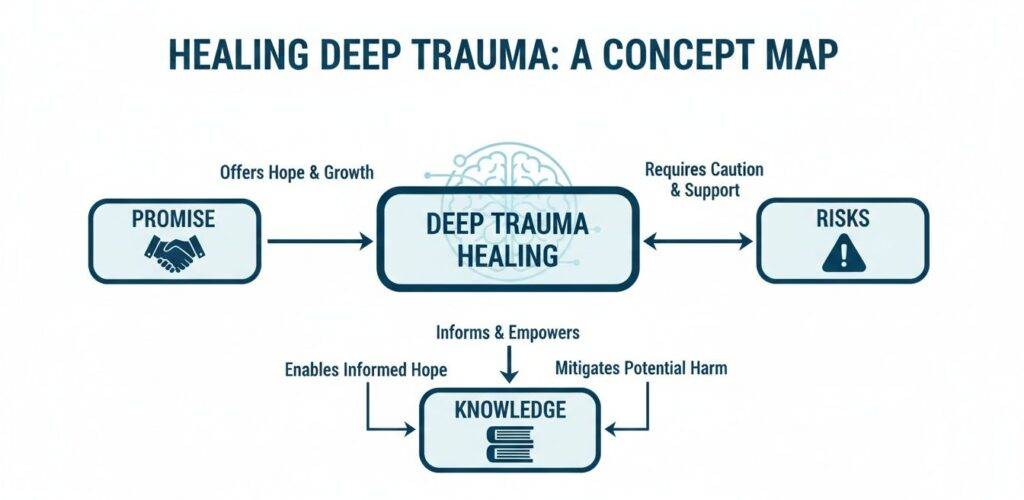
As you can see, the promise of real, lasting healing is significant. But it’s balanced by genuine risks that demand your caution and full attention. Ultimately, the key to navigating this path responsibly is empowering yourself with knowledge.
“By exploring the potential for profound personal change, you can make a more informed choice. You can learn more about the link between Ayahuasca and transformation in our detailed article.”
What to Expect From This Guide
This guide is designed to move past the sensational headlines. Our goal is to give you the information you need to make a clear-eyed decision about whether this path is truly right for you. We’ll cover several key areas to build a solid foundation of understanding.
- The Science: A look at how Ayahuasca seems to interact with the parts of the brain that manage memory and emotion.
- The Risks: An honest discussion about the potential for challenging experiences and even retraumatization if the process isn’t handled with care.
- The Safeguards: Practical, real-world advice on how to find a genuinely trauma-informed retreat and facilitator.
- The Process: Why the work you do before the ceremony (preparation) and after (integration) is just as important as the journey itself.
Our intention here is to honor your curiosity while also grounding it in the seriousness of this work. An Ayahuasca journey for trauma is a deeply personal undertaking, and being well-prepared is the most important first step you can possibly take.
How Ayahuasca Can Help Rewire the Traumatized Brain
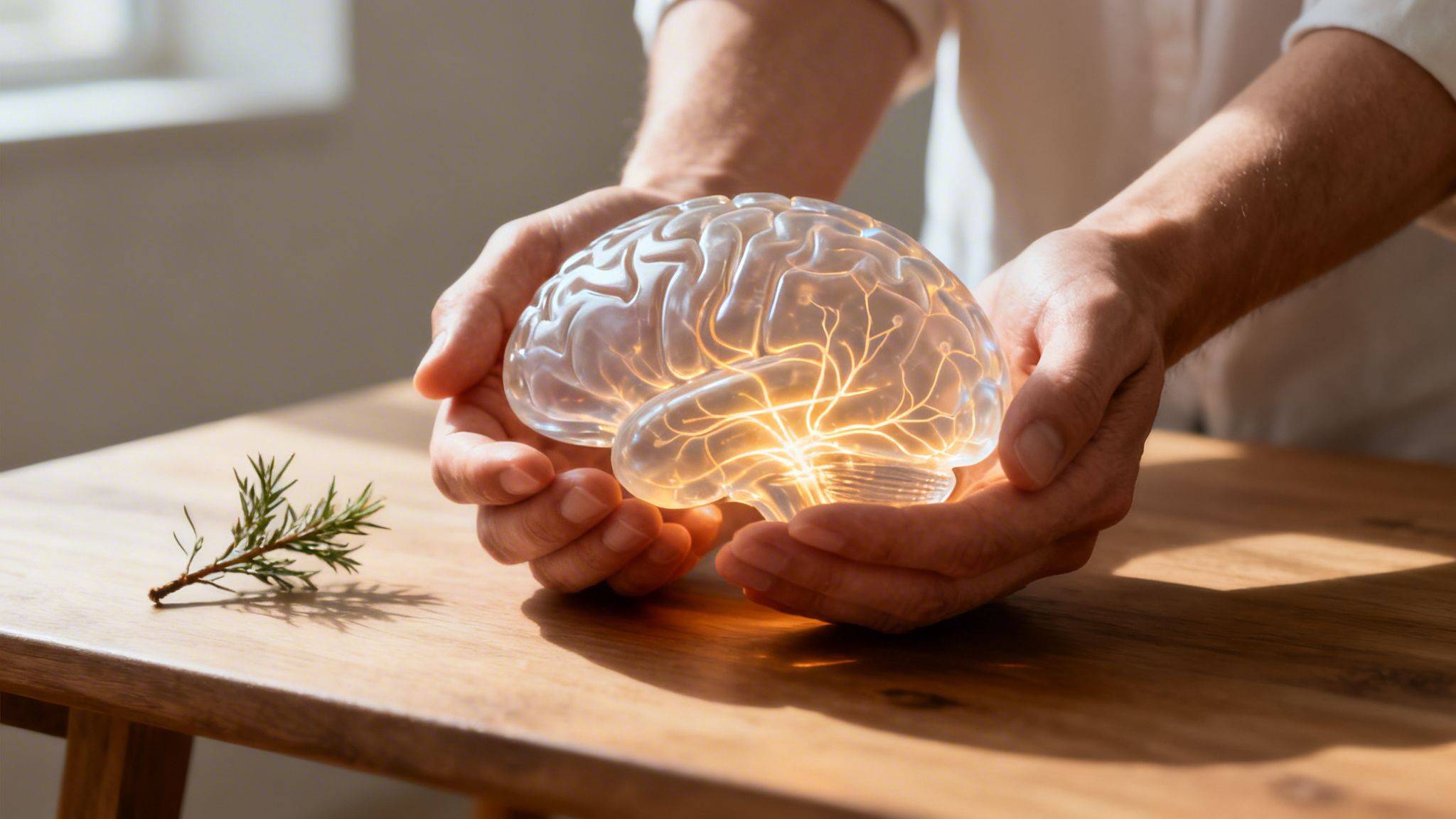
To understand how Ayahuasca can help with trauma, it’s useful to imagine the brain as a landscape with deep, well-worn grooves. After a traumatic event, these grooves become rigid pathways that our thoughts are forced down, leading to flashbacks, hypervigilance, and persistent anxiety.
Ayahuasca can act like a fresh coat of snow over this landscape. It doesn’t erase the old paths, but it creates a temporary, open space where new, healthier routes can be forged. The medicine’s compounds, especially DMT, interact with the very brain regions that manage our memories and emotions, opening a window for deep healing to occur.
Quieting the Brain’s Storyteller
A key player in this process is the Default Mode Network (DMN). Think of the DMN as your brain’s internal narrator. It is most active when you’re mind-wandering, ruminating, or thinking about yourself. It’s the part of you that tells stories about your past and worries about your future.
In a traumatized brain, this narrator is often stuck on a loop, replaying painful memories and negative self-talk over and over. It’s like a record skipping on the same devastating part of a song, trapping you in a cycle of distress.
Ayahuasca temporarily quiets this hyperactive DMN. By turning down the volume on that relentless inner storyteller, the medicine opens up a rare window of mental freedom. This allows for a different kind of self-reflection, one that isn’t chained to the usual loops of guilt, shame, and fear.
Reframing Painful Memories
With the DMN less dominant, the brain’s communication patterns become more fluid. This is especially true for the relationship between the amygdala and the prefrontal cortex, two regions central to the trauma response.
- The Amygdala: This is the brain’s smoke detector. In someone with PTSD, it’s often over-sensitive, screaming “fire!” every time a memory of the trauma is triggered.
- The Prefrontal Cortex: This is the brain’s calm, rational adult, responsible for emotional regulation. After trauma, its ability to soothe the panicking amygdala is often impaired.
During an Ayahuasca experience, this dynamic can shift. The prefrontal cortex can regain its authority over the amygdala, allowing you to revisit traumatic memories without being completely overwhelmed by the terror and panic that usually come with them.
“This process is what neuroscientists call memory reconsolidation. It’s the brain’s natural mechanism for updating old files. By accessing a traumatic memory from a place of relative safety and emotional distance, you can essentially “resave” it without the intense fear attached.”
This gives you a chance to find meaning or wisdom in the experience, rather than just reliving the pain. The memory can start to feel like a part of your past, not a constant threat in your present. This shift is fundamental to how Ayahuasca facilitates trauma healing. You can learn more about how Ayahuasca supports new neural pathways and its effects on depression in our other article.
Emerging Evidence from Trauma Survivors
This understanding of the brain is being validated by powerful real-world results. A 2023 case series from researchers at Johns Hopkins, for example, followed U.S. military veterans with PTSD who attended an Ayahuasca retreat.
The findings were remarkable. An incredible 71.4% of the veterans showed a significant drop in PTSD symptoms right after the retreat, a benefit that held strong at a three-month follow-up. On top of that, 63% of participants reported major daily improvements in their mood and a decrease in negative feelings. You can explore the details of Ayahuasca’s impact on PTSD in this Johns Hopkins study.
This ability to help “rewire” the brain’s response to trauma is what makes Ayahuasca such a compelling option for those who feel stuck. It offers a way to work directly with the brain’s own healing mechanisms, creating the potential for lasting change where other approaches may have fallen short.
Of all the questions we hear, this one is perhaps the most personal: “Is my history of trauma a barrier to sitting with Ayahuasca?” It’s a question that comes from a place of deep sincerity and, often, a little bit of fear.
The idea of revisiting painful memories can be intimidating. It’s completely understandable to wonder if a background of trauma automatically puts you in a high-risk category for a harmful or overwhelming journey.
For a long time, the conventional wisdom was that it did. But the conversation is changing. The focus is shifting away from trauma itself being the problem and toward the critical importance of the environment where the healing happens.
Context Is Everything
Safety, it turns out, has less to do with the baggage you bring to the ceremony and far more to do with the container that holds you while you unpack it.
Think of it this way: Imagine two people needing to cross a raging river. One tries to swim it alone, with no gear and no one watching. The other has a sturdy raft, an experienced guide who knows the currents, and a team waiting on the far bank. The river is the same for both, but the outcomes are going to be worlds apart.
For someone working with Ayahuasca and trauma, that supportive container is built from a few essential elements:
- Set: Your own mindset, your intentions, and your psychological readiness for the work ahead.
- Setting: The physical and emotional safety of the ceremonial space itself.
- Support: The skill, presence, and compassion of the facilitators, plus the integration resources available after the ceremony ends.
When these factors are intentionally aligned to be trauma-aware, the risk of a harmful experience drops dramatically, no matter what a person’s history looks like. The journey might still be intense, but the potential for it to be deeply healing is magnified.
Challenging Old Assumptions with New Data
The belief that trauma survivors are just inherently more vulnerable in a psychedelic space is a long-held assumption. But recent science is starting to paint a very different picture, suggesting that a history of trauma doesn’t necessarily predict a more difficult or adverse Ayahuasca session.
This represents a major shift in our understanding. It moves the responsibility for safety from the individual’s past to the quality of the ceremonial setting.
“A groundbreaking 2024 study looked at this exact issue. Researchers analyzed the experiences of 152 Ayahuasca participants and found no significant link between a history of childhood trauma and the likelihood of having an adverse or overly challenging experience during their sessions.”
This evidence directly challenges the idea that past trauma makes a person unfit for this work. In fact, the study found the correlation between childhood trauma scores and challenging experiences to be statistically insignificant. You can dive into the full research yourself in the Journal of Psychedelic Studies.
This does not mean that working with Ayahuasca and trauma is easy. The journey can be incredibly demanding and requires courage. But what this research strongly suggests is that the right support system is the single most critical factor in navigating it safely and productively.
The real takeaway here is one of empowered confidence. A history of trauma is not an automatic disqualifier. If anything, it’s a powerful reason to be even more diligent and discerning when choosing where and with whom you sit for a ceremony. With the right preparation, guidance, and integration, the experience can be a profoundly healing one.
Navigating Challenging Journeys and Retraumatization

While Ayahuasca holds immense potential for healing, it’s only natural to wonder if a difficult journey could do more harm than good. This is a common and completely valid concern, especially for anyone carrying deep-seated trauma. Not all challenging experiences are therapeutic.
The line between a productive, healing challenge and a genuinely harmful one is absolutely critical to understand. It’s the difference between confronting a difficult truth within a safe container and being thrown back into the chaos of the original trauma.
Ultimately, the environment you’re in and the skill of your facilitator are the two biggest factors that determine which way that experience will go.
Therapeutic Challenge vs Retraumatization Risk
So how can you tell the difference between a difficult but healing experience and one that is simply retraumatizing? A healing challenge can be intensely painful, but there’s an underlying sense of safety and purpose. Retraumatization, on the other hand, just feels chaotic, overwhelming, and unsafe.
The table below breaks down the key differences to help you recognize the signs of a well-held, therapeutic space versus a high-risk one.
| Element | Therapeutic Challenge | Retraumatization Risk |
|---|---|---|
| Facilitator Skill | Facilitators are present, non-intrusive, and offer calm support when needed. They understand trauma dynamics and create a feeling of safety. | Facilitators are absent, overwhelmed, or confrontational. They may lack the training to handle intense emotional releases safely. |
| Personal Agency | You feel you have control and can ask for help. Your boundaries are respected, and you never feel forced or coerced. | You feel a loss of control, and your requests for help are ignored. The environment feels chaotic, and personal boundaries are not maintained. |
| Pacing and Intensity | The experience, while intense, has moments of clarity and rest. The emotional flow feels productive, even if it is painful. | The intensity is relentless and overwhelming. You feel completely flooded with fear or panic without any sense of resolution or relief. |
| Integration Outcome | Afterward, you feel a sense of relief, clarity, or resolution. The difficult moments are seen as valuable parts of your healing process. | You feel more fragmented, anxious, or fearful than before the ceremony. The experience reinforces negative beliefs about yourself and the world. |
A therapeutic challenge empowers you by proving that you can face your deepest fears and emerge stronger. In sharp contrast, retraumatization can leave you feeling more broken and less safe than you were before.
Understanding Adverse Effects
It’s important to be honest about the fact that adverse effects are a real possibility. The key, however, lies in how these challenges are held, framed, and integrated after the fact.
The Global Ayahuasca Survey, a large-scale study of 5,400 participants, offered some incredible insights here. It found that while 55.9% reported experiencing some adverse mental health effects in the weeks following their ceremony, an overwhelming 88% of them later came to see these difficulties as manageable or even beneficial for their long-term growth. You can discover more insights from The Global Ayahuasca Survey for yourself.
This shows that a “bad trip” can often be reframed as a “hard but good” one, especially when you have the right support system in place.
“This data suggests that challenging moments are not just a risk to be avoided but are often an integral part of the healing process. The goal is not to have an easy journey, but to have a safe and supported one.”
This perspective is crucial. It shifts the focus from fearing difficulty to preparing for it. With the right tools and a solid support system, moments of intense fear, grief, or confusion can be turned into profound breakthroughs.
Thorough preparation and choosing a well-vetted, trauma-aware retreat are your most powerful tools for minimizing the risk of genuine harm and maximizing the potential for deep, lasting healing.
Finding a Truly Trauma-Informed Ayahuasca Retreat
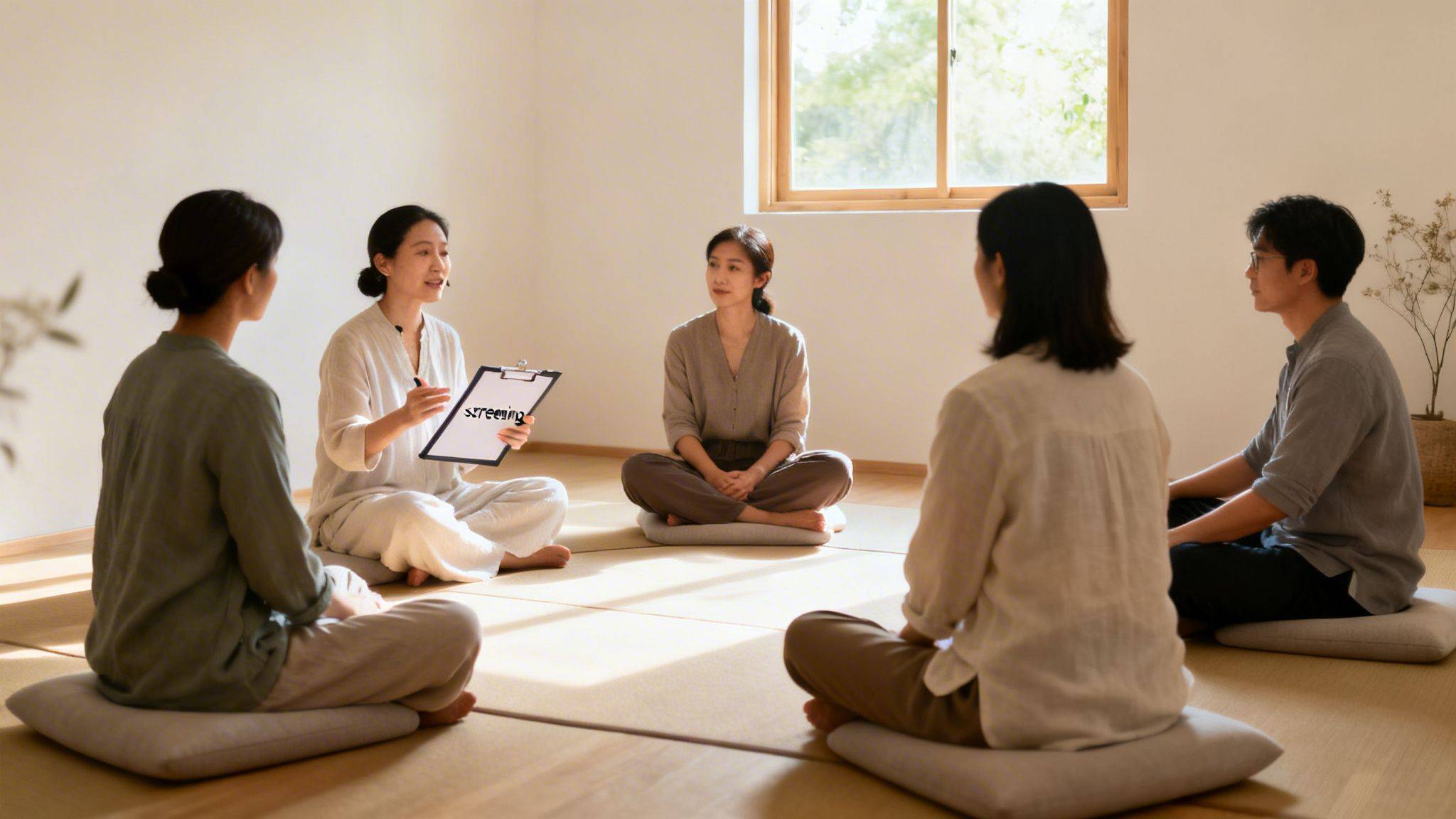
Choosing where to drink Ayahuasca is arguably the most important decision you’ll make on this journey. The difference between a truly supportive, healing space and an unsafe one is night and day. For anyone looking to work with Ayahuasca and trauma, finding a genuinely trauma-informed retreat is an absolute necessity.
But let’s be clear: “trauma-informed” is more than just a marketing buzzword. It means the entire process, from your very first email to your final integration call, is intentionally designed to prioritize your physical, psychological, and emotional safety. It’s a deep commitment to creating an environment where healing can unfold without the risk of retraumatization.
The Non-Negotiables of a Safe Retreat
Moving past slick websites and glowing testimonials requires a discerning eye. A truly safe container for working with Ayahuasca and trauma is built on a foundation of clear protocols and deeply experienced staff. Here are the core components you should be looking for.
First, a trustworthy retreat will have an exhaustive screening process. This is the first and most critical sign of a responsible organization. Expect to fill out detailed forms about your physical health, mental health history, and any medications you’re on. Combining Ayahuasca with certain drugs like SSRIs is extremely dangerous, and any legitimate center knows this.
“A facilitator who skips or rushes through a thorough medical and psychological screening is not prioritizing your safety. This process should feel like a serious, in-depth consultation, not a quick formality.”
Next, the facilitators themselves must have extensive experience, not just with serving Ayahuasca, but specifically with guiding individuals through trauma. Ask them about their training, their background, and their approach to handling difficult or overwhelming moments in ceremony. Their presence should feel grounding, calm, and deeply supportive.
Key Questions to Ask Any Retreat Center
Before you commit your time, money, and trust, remember that you are in the driver’s seat. It is your right and your responsibility to ask direct questions to gauge their level of professionalism and care. Your safety is everything, and any reputable center will welcome this kind of detailed inquiry.
Here is a checklist of questions to guide your vetting process:
- What is the group size? Smaller groups, typically under 15 people, allow for far more individual attention from facilitators. Large, crowded ceremonies can make it incredibly difficult to get support if you need it.
- What is the facilitator-to-participant ratio? This is crucial. Look for at least one facilitator or experienced helper for every five to seven participants.
- What are your policies on consent and touch? There should be clear, explicit communication about physical touch. Facilitators should only offer hands-on support with your direct and explicit consent.
- Is there on-site support staff? Beyond the main shaman or facilitator, are there other sober helpers available during the ceremony just to assist participants?
- What does your pre-ceremony preparation and post-ceremony integration support look like? A responsible center won’t just focus on the ceremony night. They’ll offer resources and guidance for the work you need to do before you arrive and, just as importantly, after you leave.
Choosing a retreat is a deeply personal decision. By arming yourself with this knowledge, you can vet potential centers with confidence, ensuring you select an environment that is truly equipped to support your healing journey with Ayahuasca.
Preparation and Integration for Lasting Healing
The Ayahuasca ceremony itself is a profound experience, but it’s really just the centerpiece of a much longer healing process. The truth is, lasting change depends almost entirely on the work you do before you ever sit with the medicine and after the final icaros have faded.
Think of it this way: your preparation is like tilling and enriching the soil of your consciousness. The integration that follows is how you tend to the seeds that were planted, making sure they grow into something real and tangible in your everyday life.
Before the Ceremony: Building a Strong Foundation
Proper preparation does more than just get you ready; it builds the emotional and spiritual container you’ll need to navigate the deep inner territory you’re about to explore. It’s how you build resilience for the difficult memories and feelings that might surface. Most importantly, it’s when you clarify your intention, which will act as your anchor throughout the entire journey.
A few key practices can make all the difference:
- Intentional Journaling: Spend some quiet time writing about what you hope to heal or understand. Ask yourself, “What patterns am I finally ready to let go of?” or “What parts of my past are calling for compassion?” This clarity gives your journey a true sense of purpose.
- Mindfulness and Grounding: Simple practices like meditation or breathwork train your nervous system to stay present, even when things get intense. This skill is priceless in a ceremony, allowing you to observe challenging emotions without being completely swept away by them.
- Adhering to the Dieta: The traditional preparatory diet, or ‘dieta,’ isn’t just a physical cleanse. It’s a spiritual practice that quiets the body and mind, sharpening your sensitivity to the medicine. Following it is an act of commitment that demonstrates your respect for the process. You can discover more about how to prepare for an Ayahuasca journey in our comprehensive guide.
After the Ceremony: Weaving Insights into Daily Life
Integration is where the real work of healing trauma with Ayahuasca truly begins. This is the delicate, ongoing process of taking the profound, often abstract, insights from your ceremony and translating them into concrete changes in your thoughts, behaviors, and relationships.
Without dedicated integration, even the most earth-shattering visions can fade like a distant dream, leaving you feeling inspired but ultimately unchanged. The days and weeks after a ceremony are a precious and sensitive time. Your mind is more open, and your emotional patterns are more pliable. This is the prime opportunity to solidify the healing that started in the ceremonial space.
“Working with a qualified therapist or integration coach who understands both trauma and psychedelics is vital. They can provide a safe space to process your experience, make sense of confusing visions, and develop practical strategies for applying your new awareness.”
This kind of support helps you turn the “what” of your journey into the “how” of your daily life. Effective integration practices bridge the gap between the mystical and the mundane, helping you release trauma stored not just in your mind but in your body.
Some powerful integration practices include:
- Somatic Therapies: Modalities like Somatic Experiencing or trauma-informed yoga are incredibly helpful for allowing the body to finally release the physical tension and stored energy connected to old traumatic memories.
- Continued Journaling: Keep writing about your experience, your feelings, and any new memories or emotions that surface. This helps you track your progress and continue making sense of the journey as it unfolds.
- Finding a Supportive Community: Connecting with others who have been through similar experiences can be deeply validating. It reduces feelings of isolation and provides invaluable encouragement as you walk your new path.
Frequently Asked Questions About Ayahuasca and Trauma
As you consider this powerful path for healing, it’s completely normal for a mix of curiosity and big questions to come up. This final section offers direct, clear answers to some of the most common inquiries, helping you feel more grounded and prepared as you explore what this journey might hold for you.
How Many Ayahuasca Ceremonies Are Needed for Trauma Healing?
This is one of the first questions people ask, and the honest answer is: there’s no magic number. For some, a single, deeply profound ceremony within a well-held retreat can be the catalyst that shifts everything and paves the way for lasting change.
For others, especially those working with deep-seated or developmental trauma, a series of ceremonies might be a safer and more effective approach. This allows the healing to unfold in layers, at a pace the nervous system can handle. The focus should always be on the quality of your engagement and the depth of your integration work afterward, not on collecting experiences. The goal is to do the deep work, not just hit a certain number of sessions.
Can Ayahuasca Cure PTSD Completely?
While many people report a dramatic and lasting reduction in their PTSD symptoms, calling it a complete “cure” can be a bit misleading. Think of Ayahuasca as an incredibly powerful catalyst for healing, one that can unlock new ways of seeing past events and allow for a deep emotional release that might have felt impossible before.
But the medicine works best when seen as one potent tool within a larger healing journey. The real, lasting change happens when you combine the breakthroughs from the ceremony with dedicated work afterward. This means continuing with therapy, exploring somatic practices to help the body release stored trauma, and building a community that supports your new way of being.
“A successful journey with Ayahuasca for trauma often marks the beginning of a new chapter in your healing, not the final page. It provides the breakthrough, but integration is what turns that breakthrough into a new way of being.”
What if I Have a Terrifying Experience?
Challenging moments are a very real, and often necessary, part of the Ayahuasca experience. In a properly held, trauma-informed space, facilitators are trained to be your anchor during periods of intense fear or distress. Their presence provides a container of safety that allows you to move through the difficulty, rather than getting stuck in it.
The critical difference is between a challenging but ultimately productive journey and an experience that is genuinely harmful or retraumatizing. Your best protection against the latter comes from careful preparation, building your own emotional resilience beforehand, and, most importantly, choosing a retreat with experienced, trustworthy facilitators who put your well-being first.
Do I Need to Stop My Antidepressant Medication?
Yes. This is an absolute and critical safety requirement. There are no exceptions. Combining Ayahuasca with most antidepressants, especially SSRIs and MAOIs, can trigger a dangerous and potentially life-threatening condition called serotonin syndrome.
You must work directly with your prescribing doctor to create a plan for safely tapering off these medications well in advance of a ceremony. Never stop taking your medication abruptly or without medical supervision. Any responsible retreat center will require this and will ask for detailed information about your medication history during their screening process. This is non-negotiable.
Disclaimer: The information provided on Ayahuasca.com is for educational purposes only and is not intended as medical advice, diagnosis, or treatment. Ayahuasca is a powerful traditional Amazonian medicine and may not be suitable for everyone. Always consult with a qualified healthcare professional before making decisions related to health, mental well-being, medications, or the use of Ayahuasca.