
A reader searching what is an Ayahuasca retreat may already be comparing jungle lodges, reading ceremony accounts, and wondering whether the experience resembles therapy, travel, religion, or a psychedelic session. The confusion is understandable. A retreat can include all of those elements, but none of them alone defines it.
An Ayahuasca retreat is better understood as a three-phase container: preparation before the ceremony, carefully supervised ceremonial work, and integration afterward. The brew matters, but so do medical screening, facilitator conduct, legal conditions, cultural respect, and the support available when participants return home.
The most responsible approach holds two truths together. Ayahuasca is a sacred ceremonial tradition with deep Amazonian roots, and modern retreats require practical risk management that no spiritual language can replace.
The Anatomy Of An Ayahuasca Retreat
A retreat often begins before a participant ever reaches the ceremonial room. After arrival, the schedule may include orientation, quiet time, meals, conversations with facilitators, and preparation for an evening ceremony. The setting might be an Amazonian center, a rural property, or a specialized facility outside South America. What matters most is the intentional structure, not the appearance of the buildings.
The modern retreat category developed from a primarily indigenous Amazonian practice into an international wellness and tourism market during the 2000s and 2010s. A frequently cited marker is the opening of retreat centers for foreign visitors in Iquitos, Peru, around 2004. Research later identified at least 232 centers specializing in Ayahuasca retreats by 2019, with most located in Peru. The same research estimated that those centers in the Amazon and Costa Rica received about 62,000 people in a year and delivered roughly 210,000 Ayahuasca experiences. These figures indicate that many retreats involve repeated ceremonies rather than a single evening. Historical and sector context on Ayahuasca retreats
A Deliberately Held Environment
A traditional practitioner, often described as a curandero or vegetalista, may lead the ceremony through songs, prayer, blowing tobacco smoke, or other culturally specific practices. Facilitators typically manage practical responsibilities, including participant observation, access to water and toilets, emotional reassurance, and emergency communication. Roles differ substantially between centers, so a reputable provider explains who holds ceremonial authority and who handles safety.
A well-designed room usually supports privacy, calm movement, low stimulation, and clear access for staff. Participants may lie on individual mats or beds, with buckets nearby because nausea and vomiting can occur. Lighting, sound, group size, and the distance between sleeping areas all affect how safely people can ask for help.
The retreat also carries a psychological frame. Orientation should explain consent, boundaries, expected effects, emergency procedures, and what participants can do if fear or confusion becomes intense. This broader view resembles the logic of holistic treatment and whole-person care, where physical, emotional, social, and spiritual needs receive attention together, although an Ayahuasca retreat isn’t automatically clinical treatment.
“Practical rule: A ceremonial atmosphere can support reflection, but it must never conceal weak supervision, unclear consent, or missing medical procedures.”
The distinction between a spiritual gathering and a structured retreat becomes clearest in the transitions. Preparation determines who should participate and how they arrive. Ceremony provides the controlled setting for the experience. Integration helps participants interpret what happened without treating every vision as a command or every emotional release as a permanent cure.
Understanding The Ceremony Timeline And Effects
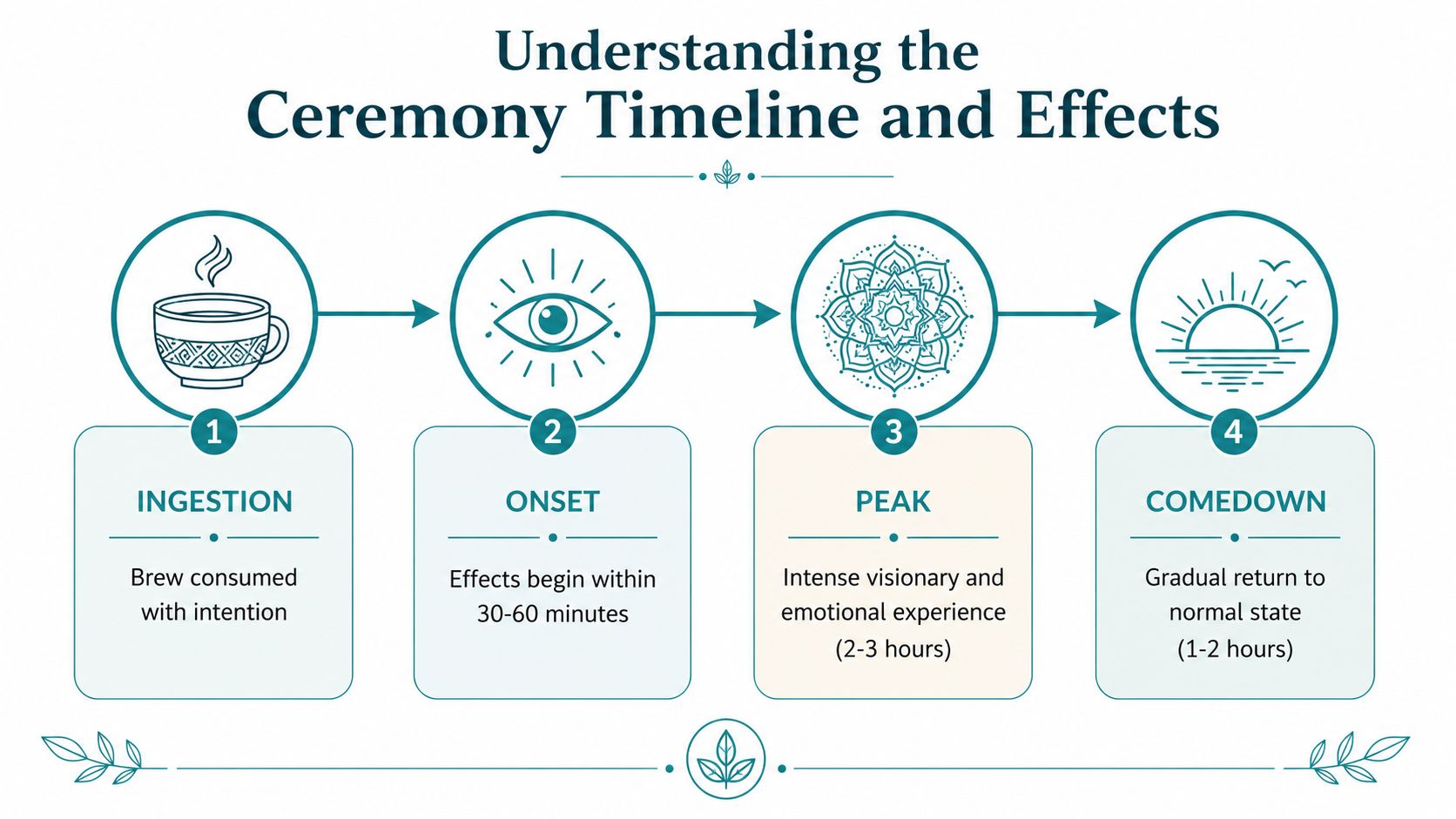
A retreat night may begin with a measured serving, a prayer or shared intention, then a period when little seems to happen. The ceremony is a three-phase container rather than a single psychedelic event. Preparation shapes who arrives and how they arrive, the ceremony holds the acute experience, and integration gives participants time to understand what remains. Each phase supports the next.
Ayahuasca’s timeline reflects its chemistry. The brew commonly combines a DMT-containing plant with plants containing β-carbolines, including harmala alkaloids such as harmine and harmaline. These compounds inhibit monoamine oxidase-A, an enzyme that would otherwise break down DMT in the digestive system before it could produce central psychoactive effects. Pharmacology and clinical considerations of Ayahuasca
From Ingestion To Onset
Participants usually receive a measured serving after the facilitator establishes the ceremony’s intention. Effects do not generally begin at once. Onset commonly occurs within 30 to 60 minutes, although digestion, preparation, individual physiology, and the brew’s composition can change the timing.
Early effects may include altered bodily sensation, emotional openness, visual imagery, changes in time perception, and nausea. Someone may remain still on a mat, listen to ceremonial singing, or ask for grounding support. Quietness does not necessarily indicate distress, and visible emotion does not prove therapeutic progress. Staff should observe attentively, respect privacy, and respond when a participant communicates a need.
The Peak And The Physical Arc
The strongest period generally develops over the next one to two hours, followed by a several-hour overall duration. Responsible centers therefore plan for extended observation. The experience needs room to unfold, much like a long journey requires support beyond the first departure.
Purging, including vomiting, is common in ceremony settings and may be understood traditionally as cleansing. Physiologically, it remains a gastrointestinal response that can involve discomfort, dehydration, or aspiration risk if someone is poorly positioned or left alone. Safe staff provide practical assistance without insisting that every difficult bodily reaction carries spiritual meaning.
The emotional peak can include grief, fear, awe, joy, memories, or connectedness. Intensity may make ordinary reassurance difficult to absorb. Facilitators should speak calmly, protect boundaries, avoid coercive touch, and never claim unquestionable authority over a participant’s experience.
For a plain-language account of the subjective arc, see what to expect from the Ayahuasca experience. No general timeline predicts an individual’s response perfectly.
The Comedown And Overnight Care
As effects recede, participants may feel tired, reflective, emotionally raw, or physically uncomfortable. The return to ordinary awareness can be gradual, so overnight staffing, access to hydration, safe sleeping arrangements, and a morning check-in matter.
The ceremony’s meaning cannot be judged reliably during the peak. A powerful vision may seem less important after reflection, while a quiet realization may prove more useful in daily life. The retreat’s value depends partly on what happens after the acute effects end, when experience can be considered with care rather than treated as an instruction or instant cure.
The Essential Preparation Phase And Dieta
Preparation begins with honest disclosure, not menu planning. Participants need to share medical conditions, psychiatric history, current medications, previous reactions to psychoactive substances, and any concern that could affect consent or emergency care. A center that treats preparation as a spiritual ritual while ignoring medication interactions has missed the most important part.
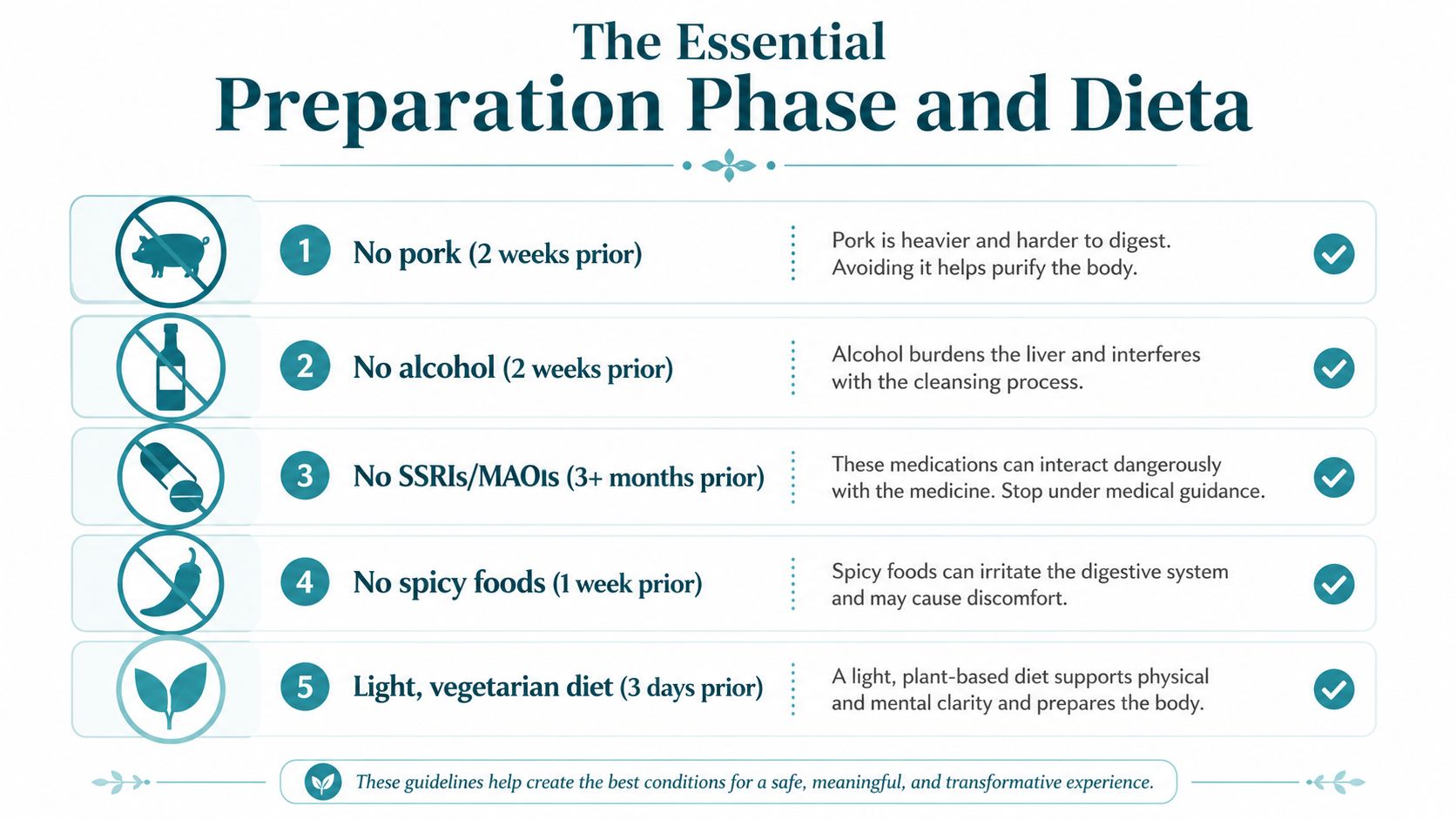
The traditional dieta can include food restrictions, sexual abstinence, reduced stimulation, and an intentional mental posture. Practices vary by lineage and center, so no universal menu should be presented as sacred law. Some providers use a phased timetable, and one published preparation guide advises avoiding pork and pork products for at least four weeks before a retreat, reducing red meat and processed foods for two weeks, and avoiding caffeine, dairy, fermented foods, and sexual activity during the final week or days before ceremony. Example of a structured Ayahuasca preparation timetable
Four Weeks Before Arrival
Use this period to assess whether the retreat is appropriate at all. A licensed clinician should review relevant medications and health conditions. Participants shouldn’t stop prescribed treatment independently, especially antidepressants, blood pressure medication, or other drugs that may affect cardiovascular or serotonin systems.
This is also the time to investigate the center. Ask for its screening form, cancellation policy, emergency plan, facilitator roles, and instructions for disclosing medication. A participant who can’t obtain clear answers before paying should treat that uncertainty as meaningful.
Two Weeks Before The Ceremony
Dietary simplification may help participants notice how food, sleep, and stress affect the body. Where a center recommends avoiding pork, alcohol, processed food, or other items, the provider should explain whether the reason is cultural, traditional, medical, or logistical. A diet restriction can’t compensate for inadequate screening.
Alcohol and recreational substances can complicate judgment, sleep, hydration, and emotional stability. Avoiding them before arrival supports clearer consent and makes it easier to recognize baseline symptoms.
The Final Days
Keep meals familiar and light if that aligns with the center’s guidance. Reduce unnecessary commitments, protect sleep, and write down an intention that describes a direction rather than demanding a particular vision or cure.
A useful intention might focus on understanding a recurring pattern, grieving a loss, or clarifying a decision. It shouldn’t pressure the ceremony to produce a guaranteed result. The Ayahuasca journey preparation guide can help participants organize questions and practical arrangements before departure.
Navigating Safety Screening And Legal Realities
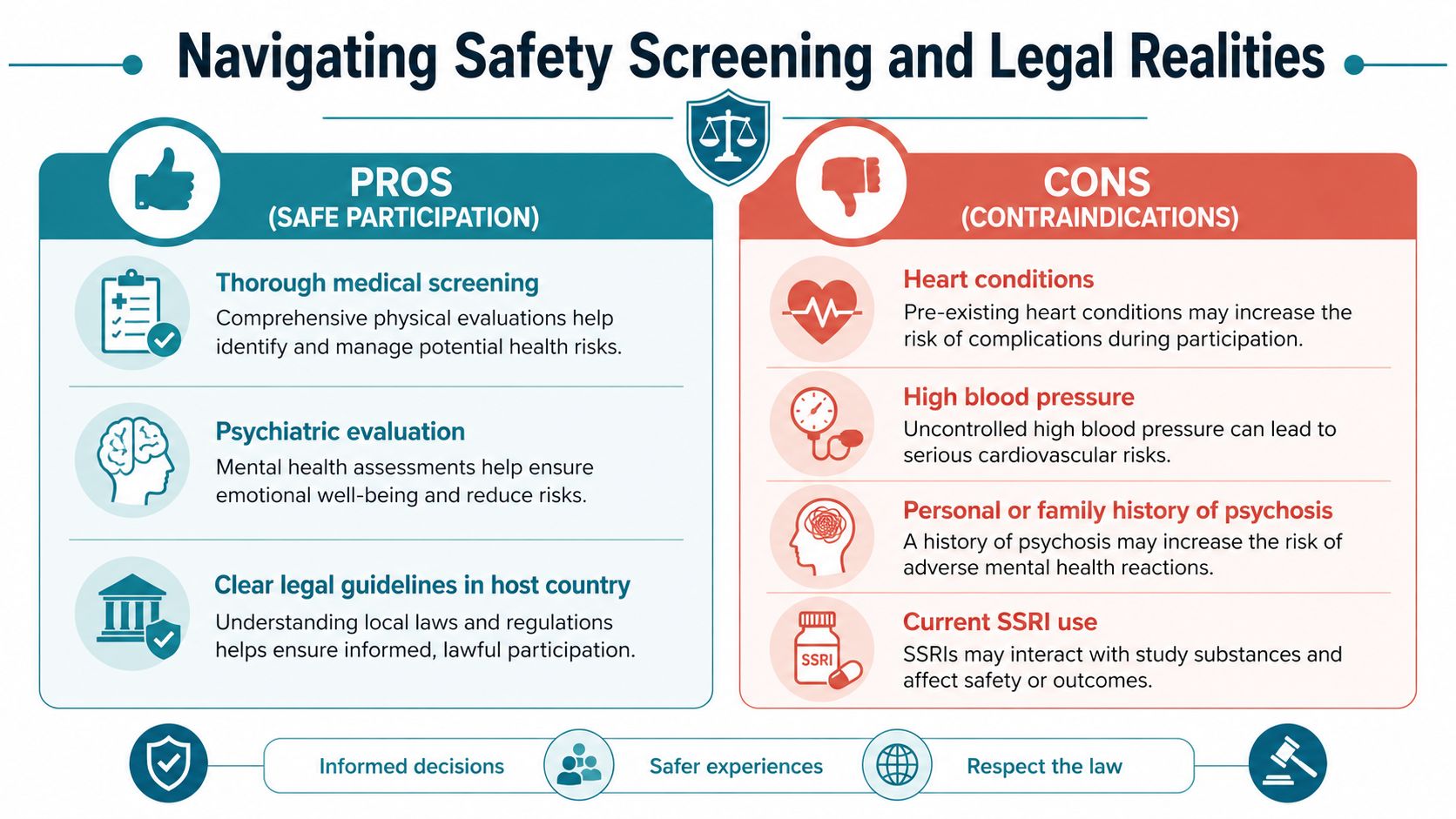
The most dangerous assumption about a retreat is that spiritual sincerity makes participation safe. Ayahuasca affects the body and mind, and a responsible center must screen for vulnerabilities before accepting payment.
In a risk assessment involving 614 participants, transient gastrointestinal symptoms, especially nausea and vomiting, were the most frequent acute effects. A minority required medical aid, and participants with psychiatric vulnerability reported adverse effects more often. Observational literature also describes rare but serious events, including seizure-like episodes and cardiopulmonary complaints. Risk assessment of Ayahuasca-related adverse effects
Medical And Psychiatric Screening
A center’s intake should ask direct questions about heart disease, high blood pressure, fainting, seizures, pregnancy, psychiatric diagnoses, psychosis risk, family psychiatric history, and current medication. Particular care is needed with serotonergic medications, including SSRIs and SNRIs, and with drugs that affect monoamine oxidase. Participants should receive medical advice from a qualified clinician rather than relying on a retreat facilitator to manage medication changes.
People with cardiac abnormalities or other vulnerabilities may face serious risks from psychedelic substances, making screening a core operational requirement. Safety and risk management in publicly advertised psychedelic retreats
“A clear refusal can be evidence of responsible practice. Centers that turn away unsuitable applicants may be protecting participants rather than losing business.”
The center should also explain what happens during an emergency. Ask who monitors participants, how staff summon medical help, where the nearest appropriate facility is, and what information staff collect before the ceremony. Vague answers deserve caution.
A Legal Patchwork
The legal position requires separate research for every destination and participant category. The Ayahuasca decoction itself isn’t under international drug control, but DMT is scheduled under the 1971 UN Convention on Psychotropic Substances. In the United States, DMT remains a Schedule I controlled substance, and possession or import can carry a statutory maximum of 20 years imprisonment. International legal status of Ayahuasca
Narrow religious exemptions exist in the United States, including the União do Vegetal Supreme Court victory in 2006 and Santo Daime exemptions beginning in 2009. Those exemptions don’t create general permission for commercial retreats or individual possession. Peru, Brazil, Mexico, Spain, Portugal, and the Netherlands illustrate why country-level and group-level distinctions matter. Separate legal treatment can apply to organizations, ceremonies, preparation, dispensing, and personal use. Dutch legal analysis of Ayahuasca
The Integration Process After The Ceremony
The retreat ends physically when participants leave the center, but psychological processing often continues. Integration gives a person time to translate an intense experience into ordinary decisions, relationships, habits, and boundaries. Without that work, a compelling ceremony can become a story repeatedly retold without producing durable change.
A useful integration conversation separates experience, interpretation, and action. The experience might involve a vision, memory, bodily sensation, or emotional release. The interpretation is the meaning assigned to it. The action is the small, observable change that can be tested in daily life. Keeping those categories separate reduces the risk of treating symbolic material as literal instruction.
Turning Insight Into Practice
A participant who feels called to repair a relationship might begin with a careful conversation, not an immediate promise or dramatic life change. Someone who recognizes a pattern of avoidance might schedule therapy, establish a daily writing practice, or ask a trusted person to help track behavior. Integration works best when insight becomes specific enough to observe.
Post-retreat support can include a follow-up call, peer circle, culturally grounded guidance, or therapy with a clinician familiar with altered-state experiences. A therapist shouldn’t automatically validate every supernatural interpretation, but neither should the therapist dismiss the participant’s experience. The task is to explore meaning while preserving functioning, consent, and reality testing.
Measuring Outcomes Honestly
Recent retreat research found reduced negative affect and increased positive affect after the retreat. It also found that 5.5% of participants showed potentially clinically significant deterioration in affect, and that acute mystical intensity didn’t directly predict the main short-term improvements. Retreat research on affect and post-ceremony outcomes
Those findings support a balanced view. Some people may report emotional benefits, but a powerful mystical experience isn’t a guarantee of improvement, and deterioration deserves prompt attention. Persistent insomnia, paranoia, mania-like symptoms, severe anxiety, suicidal thoughts, or inability to function require professional assessment.
“Integration asks a quieter question than ceremony does: What can be practiced safely and consistently after the extraordinary experience has passed?”
How To Choose A Reputable Retreat Center
A polished website and beautiful setting can’t establish safety. The stronger test is whether a center answers difficult questions before a participant commits, including questions about lineage, screening, touch, money, emergency care, staff supervision, and legal exposure.
Lineage deserves respectful investigation rather than romantic speculation. A center should explain which tradition informs its work, who trained the ceremonial leader, and how the organization relates to local communities. Lineage alone doesn’t guarantee ethical conduct, but evasiveness makes informed consent impossible.
Compare Centers By Evidence Of Care
| Evaluation Area | Questions For The Center | Concerning Response |
|---|---|---|
| Ceremonial leadership | Who leads the ceremony, and what training or lineage informs the work? | Grand claims with no meaningful explanation |
| Medical screening | What conditions and medications lead to exclusion or clinician review? | “The medicine knows who should participate” |
| Emergency planning | Who monitors participants, and how does staff obtain medical help? | No named procedure or responsible person |
| Consent and boundaries | Is touch optional, and how can a participant withdraw? | Pressure to accept physical or spiritual authority |
| Integration | What support exists after departure? | No follow-up or dismissive answers |
| Ethics | How are local staff and communities treated? | Secrecy about relationships, labor, or cultural claims |
A center that offers luxury amenities but can’t describe screening is a weaker choice than a modest facility with transparent procedures. Reviews can reveal patterns, but testimonials shouldn’t replace direct questions. Marketing language promising guaranteed healing, permanent transformation, or access to secret knowledge should prompt careful scrutiny.
Ask Before Paying
Participants should request the written intake form, cancellation terms, ceremony schedule, staff structure, dietary guidance, medication policy, and emergency plan. They should also confirm whether the center expects participants to travel with prescribed medication and what local medical resources are available.
The center’s response style matters. Clear answers, appropriate limits, and willingness to say “this may not be suitable” indicate a more mature operation. Pressure, urgency, secrecy, or claims that screening reflects a lack of spiritual commitment indicate the opposite.
Retreat structure and participant support considerations offer another framework for assessing how preparation, ceremony, and follow-up fit together. Ayahuasca.com may also be used as an educational resource and retreat directory for seekers evaluating options in regions such as Colombia, Ecuador, and Jamaica, while each applicant still needs to verify current local conditions independently.
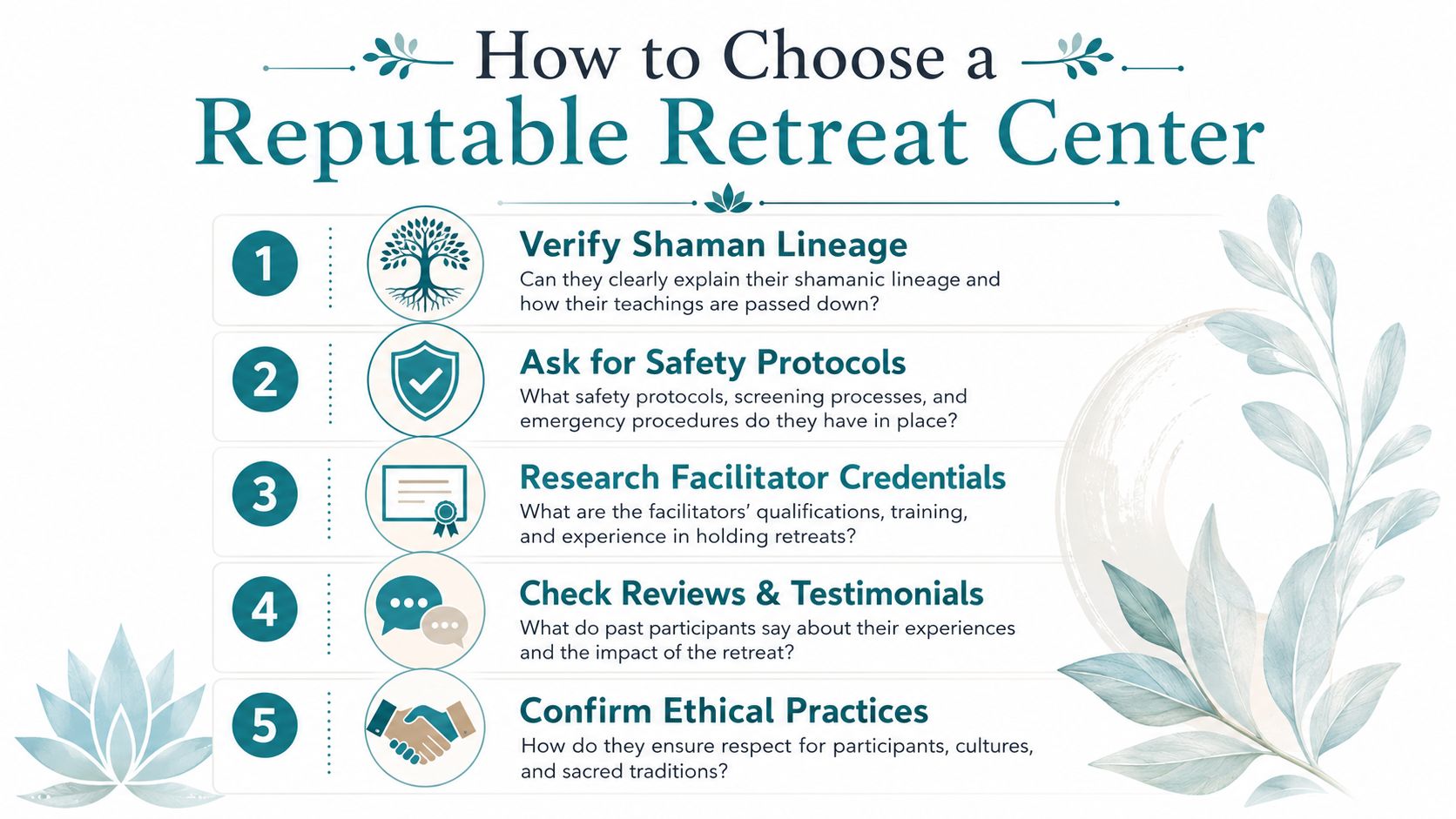
A reputable center doesn’t need to remove all uncertainty. It needs to identify foreseeable risks, explain its limits, protect participant autonomy, respect the traditions it presents, and provide a realistic path for care before and after ceremony.
Before booking an Ayahuasca retreat, request the center’s screening form, medication policy, emergency plan, consent rules, facilitator background, legal information, and integration support in writing. Review those materials with a qualified medical or mental health professional when relevant, then choose only a provider that answers difficult questions clearly and respects the right to decline participation.
Disclaimer: The information provided on Ayahuasca.com is for educational purposes only and is not intended as medical advice, diagnosis, or treatment. Ayahuasca is a powerful traditional Amazonian medicine and may not be suitable for everyone. Always consult with a qualified healthcare professional before making decisions related to health, mental well-being, medications, or the use of Ayahuasca.