
She has read the ceremony accounts, watched the candlelit videos, and saved several retreat pages. The attraction feels genuine, yet the practical questions keep returning. Will female staff be present all night? What happens if medication, menstruation, grief, or fear complicates the experience? Who can she contact if a boundary is crossed?
A women’s Ayahuasca retreat deserves a more serious evaluation than beautiful photographs and promises of transformation. The strongest programs make their staffing, screening, ceremonial structure, emergency procedures, and integration support visible before a guest travels. The medicine matters, but so do the people, policies, and physical setting around it.
Why Women Are Choosing Women-Only Ayahuasca Retreats
A woman researching her first retreat often reaches a point where spiritual curiosity meets logistical caution. She may feel ready for deep personal work, while still wondering whether a mixed-gender ceremony will leave enough room for vulnerability, body-related concerns, or difficult relational history. Those questions aren’t signs of weakness. They’re part of responsible preparation.
Women-only containers have become more visible because women are already a substantial part of retreat participation. In a 2024 pilot study of an indigenous Amazonian-led Ayahuasca retreat, 26 of 43 participants were women, or 60.5% of the sample, and the mean participant age was 45.5 years, with a standard deviation of 11.06 years (peer-reviewed retreat study). The finding describes one cohort, not every retreat, but it offers useful grounding. Women aren’t an unusual audience arriving at the edges of ceremonial work. They formed the majority in that setting.
A separate 2021 study surveyed 63 Amazonian retreat participants and included 25 women, or 44.4% of the sample (retreat participation study). That research also found that 37 participants, or 58.7%, were first-time Ayahuasca users, which matters for women considering a first ceremony. A women-only retreat may offer a familiar social environment, but it still needs to support beginners with clear explanations and careful supervision.
“A women-only container is a structural choice, not a guarantee of safety. Its value depends on how the retreat turns that choice into staffing rules, boundaries, screening, and support.”
Some women seek a setting where they can speak openly about sexuality, motherhood, aging, grief, trauma, or social conditioning without managing male attention at the same time. Others want a quieter group dynamic. Neither reason needs to be defended. The meaningful question is whether the program has built its format around those needs in concrete ways.
What a Women’s Ayahuasca Retreat Looks Like
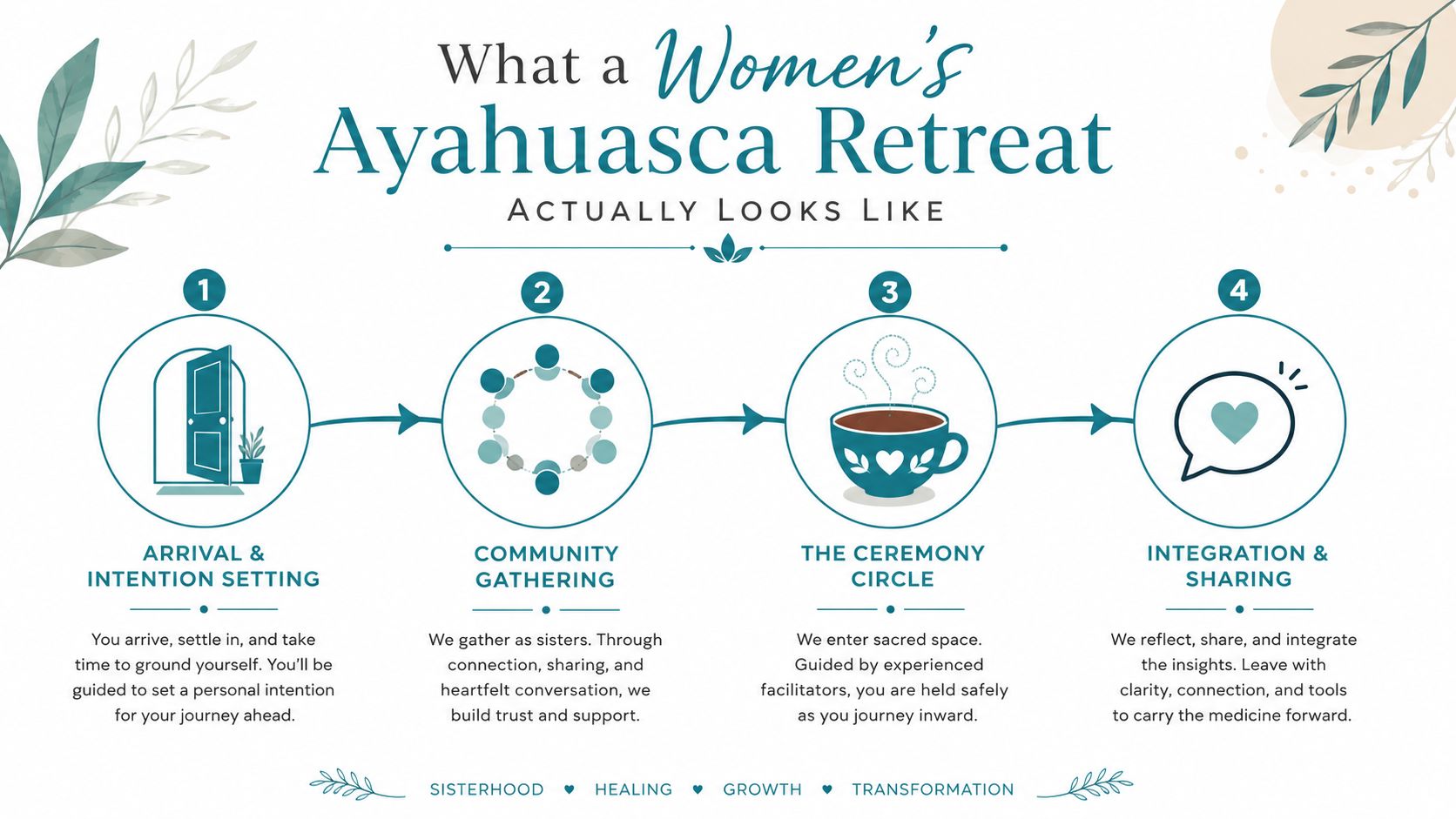
A women’s Ayahuasca retreat unfolds as a residential learning process, not a single ceremony. The structure works like a guided arc: arrival sets expectations, community builds familiarity, ceremony offers the central experience, and integration gives participants time to understand what surfaced.
The Four-Part Rhythm
Arrival and intention setting generally cover orientation, accommodation, introductions, and a conversation about personal aims. An intention offers direction without attempting to script a vision or emotional release. “Support with grief” gives room for uncertainty, while demanding a particular answer does not.
Community gathering establishes the group’s social fabric. Women may share meals, join circles, practise gentle movement, or attend educational sessions. The purpose is to make expectations, communication norms, and support channels clear before the first ceremony. Familiarity should develop gradually rather than through pressured disclosure.
The ceremony circle is the central ritual space. A responsible program explains who leads, who stays present, how participants request help, where private bathrooms are located, and what happens during physical or psychological distress. Women-focused programs often have female facilitators, and some lineages include a female Shipibo healer. The retreat should name each person’s role, including who handles health concerns and who provides emotional support.
Integration and sharing start during the retreat. Quiet reflection, facilitated conversations, journaling, and a closing circle can help participants distinguish a powerful experience from conclusions they may later reconsider. A clear retreat structure and support framework also shows whether support continues beyond the ceremony room.
Schedules differ by program. Research on Amazonian retreats describes formats lasting 8 days, 14 days, 21 days, and 28 days (retreat-format study). One women-focused model describes a small group of 5 to 10 women within a 7-night, 8-day schedule (women’s retreat format). Those figures describe particular formats, not a universal standard.
Before booking, ask how the retreat handles screening, medication and reproductive-health questions, emergency plans, facilitator boundaries, and post-ceremony support. These operational details reveal whether “women-only” describes a meaningful safety structure or only the guest list.
The Benefits Women Report and What Research Shows
A woman may arrive hoping to understand grief, a difficult relationship, or a persistent sense of disconnection. After ceremony, she might describe emotional release, greater self-understanding, spiritual connection, renewed direction, or a changed relationship with grief. These accounts matter, yet they remain personal reports, not guarantees. A responsible retreat provider should not promise trauma resolution, permanent happiness, or one spiritual outcome.
Research supports a measured view. A placebo-controlled Ayahuasca study found that mental-health improvements may involve both non-pharmacological factors and pharmacological action (placebo-controlled Ayahuasca study). The brew is therefore one part of a larger process. Expectations, trust, ceremony design, emotional support, physical surroundings, and the participant’s later choices can all shape what the experience means and whether it becomes useful.
What May Be Helpful
One woman may leave with a clearer view of a relationship. Another may become more willing to feel difficult emotions or commit to a long-delayed change. Someone else may notice quieter shifts in attention, self-compassion, or embodied awareness. Spiritual meaning can be important for one participant and absent for another. None of these outcomes should be treated as automatic, and a women-only container does not make them more certain.
Research also calls for careful screening rather than broad reassurance. A prospective retreat study reported no clinically significant adverse responses after the retreat, while 5.5% of participants showed potentially clinically significant deterioration in affect (prospective retreat findings). The finding supports cautious optimism. It also reinforces the need to consider mental-health history, current treatment, reproductive health, and the quality of follow-up before booking.
What Converts Insight Into Change
An insight becomes more useful when it can guide a decision, habit, conversation, or therapeutic goal. Quiet time, skilled support, and a clear route for continued care can help a participant test what she experienced instead of treating every ceremony impression as a final truth.
“A powerful ceremony can open a question. Integration helps a participant decide how to live with the answer.“
Anyone considering Ayahuasca alongside depression treatment should read this guidance on Ayahuasca and depression and discuss relevant health decisions with a qualified clinician. Benefit research is best read modestly. The women-only structure, medical safeguards, and support after ceremony deserve as much scrutiny as the ceremony itself.
How Women-Only Retreats Differ From Mixed-Gender Programs
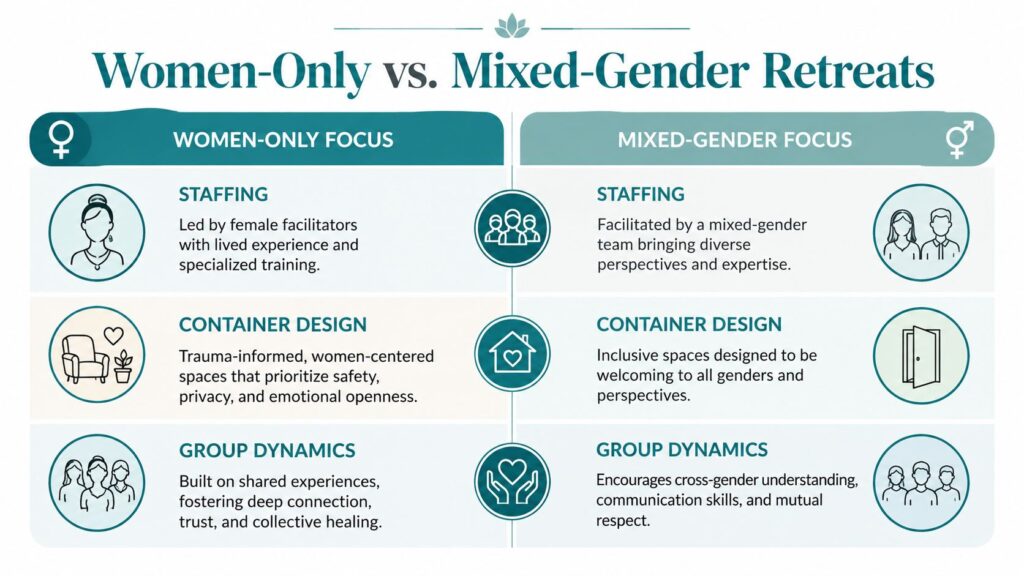
A woman comparing retreat formats is really comparing operating systems, not labels. A mixed-gender retreat may be appropriate, while a women-only retreat may still be poorly managed. The meaningful difference lies in staffing, boundaries, screening, and the way support works during difficult moments.
Women-only programs often place female facilitators during ceremonies, giving participants a clear route to request help with intimate physical or emotional concerns. Some offer women’s circles that examine relational patterns, body experience, social conditioning, or identity. These spaces can help when facilitators treat each participant as an individual, rather than imposing one explanation of what women should heal.
Mixed-gender programs bring a wider range of group perspectives and interpersonal dynamics. Some participants value that variety. Others speak less freely or receive care differently when men are present. Neither format guarantees safety or depth. The participant’s intention matters, but the provider’s concrete safeguards matter more.
Operational Differences That Matter
Photos and transformation claims do not answer the practical questions a woman should ask before booking. A credible women-only retreat should explain:
- Female presence: Which female staff members remain available throughout each ceremony, and what training do they have?
- Contact rules: Are facilitators prohibited from being alone with guests in private spaces?
- Staffing visibility: Does the provider state the facilitator-to-guest ratio instead of relying on broad promises of “high support”?
- Reporting process: Can a participant report sexual misconduct or coercion to someone independent of the accused staff member?
- Group boundaries: Does the program explain consent, touch, confidentiality, and romantic or sexual conduct?
Reviews of publicly advertised psychedelic retreats identify physical, psychological, and interpersonal harm as possible risks. Research on Ayahuasca adverse effects has also found that female participants showed a higher risk of adverse states in some analyses. These findings do not condemn women-only work. They show why a welcoming atmosphere cannot substitute for clear procedures, trained staff, and accountable oversight.
The accompanying video offers another way to consider how gender, facilitation, and ceremony design may shape a participant’s experience.
A women-only format may feel easier to enter emotionally, yet it can also mean a smaller participant pool and less variety in group dynamics. Compare conduct standards, staff availability, consent rules, and reporting arrangements. The retreat label is only the starting point.
Medical Considerations Every Woman Should Weigh
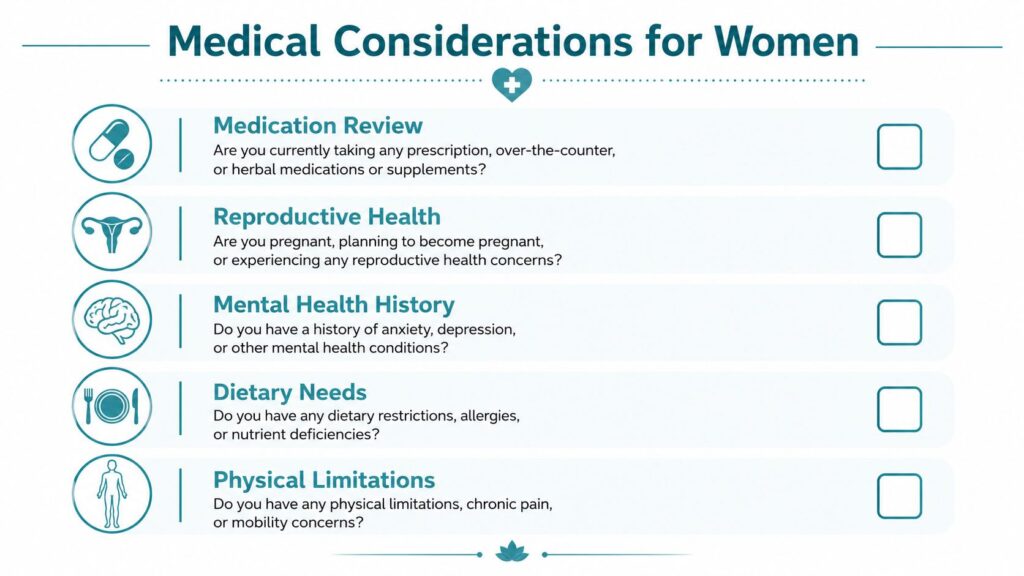
Medical screening should happen before payment and travel. A serious retreat asks about current diagnoses, previous psychiatric episodes, cardiovascular concerns, medications, substance use, pregnancy status, breastfeeding, and relevant physical limitations. Participants should receive a clear explanation of how the provider evaluates that information.
Reproductive Health
Menstruation alone hasn’t been shown to create a pharmacological risk, according to neutral research and review material (women’s Ayahuasca safety review). Retreat traditions may still set their own participation rules. One lineage states that menstruating women can’t participate in ceremony and may be moved to a separate lodge until the cycle ends (lineage-specific guidance). A participant should ask for the retreat’s policy before arrival, rather than assuming every center follows the same practice.
Pregnancy and breastfeeding are widely treated as exclusions in women-centered Ayahuasca guidance. The medical-oriented source above also warns about serious interactions involving SSRIs and other serotonergic medications. Medication changes should never be made independently to attend a ceremony. A clinician who understands the participant’s treatment history should be involved.
Questions about pregnancy often overlap with broader wellness decisions, including exposure to smoke or incense in retreat spaces. For general background on that separate issue, pregnancy and incense safety tips can help a participant prepare questions for the venue and her healthcare professional.
Why Screening Can’t Be a Checkbox
A large global survey found that 69.9% of users reported acute physical adverse effects and 2.3% needed medical attention (large-scale Ayahuasca safety survey coverage). The figures don’t predict what will happen to a particular woman, but they show why retreat staff need a plan for vomiting, panic, fainting, medication interactions, and other urgent situations.
Before booking, a participant should expect:
- Medication disclosure: A complete list of prescriptions, supplements, and recent changes.
- Reproductive questions: Clear answers about pregnancy, breastfeeding, menstruation, and fertility-related concerns.
- Mental-health history: Honest discussion of diagnoses, hospitalization, mania, psychosis, trauma, and current stability.
- Emergency planning: A named person responsible for escalation and access to appropriate medical care.
- Informed consent: Plain-language information about physical, psychological, and interpersonal risks.
A provider that treats these questions as intrusive or inconvenient has already supplied useful information about its standards.
Vetting a Retreat for Safety and Authenticity
A woman may feel drawn to a retreat’s warmth, spiritual language, or polished photographs. Before she books, she needs verifiable details: documents, names, roles, and procedures. Careful questions are a prerequisite, not a sign of distrust. In a ceremony setting, clear information works like a map. It shows who is responsible when the experience becomes physically or emotionally difficult.
Start With Screening
Ask whether the application includes medical and psychological questionnaires, who reviews them, and what happens when someone may not be suitable. The provider should explain how it handles medication disclosure, confidentiality, and clinician consultation when needed. Guidance for women also emphasizes personal boundaries and honest health screening.
Screening should also clarify who can decline an application and how that decision is communicated. A serious provider does not treat every applicant as a guaranteed booking.
Evaluate People and Lineage
Authenticity involves more than a healer’s photograph or a reference to indigenous tradition. Ask who leads each ceremony, what training facilitators have, how responsibilities are divided, and how the center relates to the tradition it presents. If the retreat is women-only, confirm whether facilitators are women, whether male staff enter ceremony spaces, and who provides support during vulnerable moments.
Specificity is a useful green flag. The provider names ceremonial leaders, describes staff duties, explains relationships with local communities, and acknowledges limits. Evasiveness is a warning, particularly if the retreat will not identify who is present or treats boundary questions as disloyalty.
Request the Safety Architecture
Before paying, ask for the retreat’s operating rules:
- Code of conduct: Written limits covering sexual contact, coercion, touch, confidentiality, and facilitator behavior.
- Ceremony staffing: The people present throughout the night and the method for requesting help.
- No-privacy policy: Rules preventing a facilitator from creating inappropriate one-on-one situations with a guest.
- Incident response: A reporting route that does not depend solely on the person accused.
- Medical escalation: The steps staff take when urgent professional care is needed.
- Integration pathway: Support after departure, including referrals when the team cannot provide appropriate help.
Independent guidance on solo women’s safety highlights named female staff, no-privacy rules, a stated facilitator-to-guest ratio, and incident reporting as questions to ask. These details should be available before commitment, not explained only after arrival.
Preparation Before and Integration After the Ceremony
Preparation starts with honest disclosure, not with a perfect dieta. A participant should complete the provider’s health forms accurately, review medication questions with a qualified clinician, set a flexible intention, and understand the ceremony’s physical and emotional demands. Dietary guidance may be part of the retreat tradition, but it shouldn’t replace medical screening.
The intention can be simple: understand a recurring pattern, make space for grief, or explore a spiritual question. It should remain open enough to accommodate an experience that doesn’t follow a planned narrative.
Preparation resources for an Ayahuasca journey can help organize practical questions before departure. Participants should also ask whether preparation includes a real conversation with staff or only a downloadable document.
Integration Needs a Plan
After returning home, useful practices may include journaling, gentle movement, sleep, time in nature, and conversations with trusted support. A participant may also work with a therapist or integration professional, especially if memories, anxiety, grief, relationship conflict, or unusual perceptions remain difficult to manage.
A retreat that offers no post-ceremony contact leaves the participant to interpret a demanding experience alone. Before booking, she should ask who remains reachable, for how long, and what happens when the retreat team needs to refer her to a qualified mental-health or medical professional.
Questions to Ask and Where to Go From Here
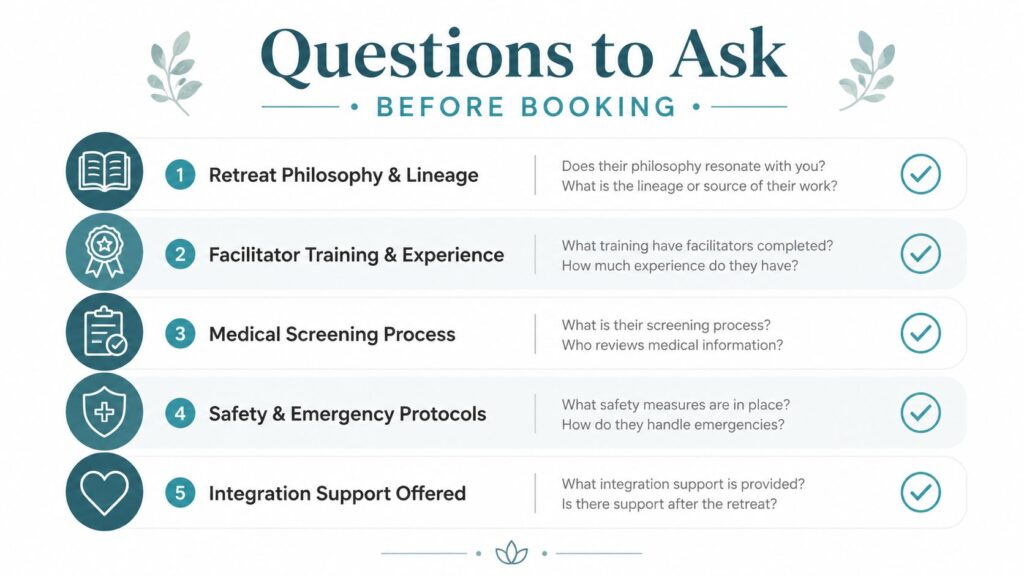
Before paying a deposit, ask questions that test the retreat’s structure, not only its spiritual language:
- Who leads each ceremony, and which female staff remain present?
- What medical and psychological screening is required?
- How are SSRIs, other serotonergic medications, pregnancy, breastfeeding, and menstruation addressed?
- What written rules cover touch, privacy, sexual conduct, confidentiality, and complaints?
- What is the facilitator-to-guest ratio?
- What emergency procedures and post-retreat support are available?
- How does the center document its lineage and relationships with indigenous communities?
The educational library at Ayahuasca.com covers preparation, health, safety, and retreat selection. Ask the program for its screening process, code of conduct, staffing plan, reproductive-health policy, medication guidance, emergency protocol, and integration offer. Speak with former participants and request concrete answers in writing. Compare policies across at least two retreats before deciding, then choose only when the safeguards fit your medical needs and are as clear as the ceremony’s invitation.
Disclaimer: The information provided on Ayahuasca.com is for educational purposes only and is not intended as medical advice, diagnosis, or treatment. Ayahuasca is a powerful traditional Amazonian medicine and may not be suitable for everyone. Always consult with a qualified healthcare professional before making decisions related to health, mental well-being, medications, or the use of Ayahuasca.