
The first evening at a jungle lodge can feel deceptively ordinary. Before dark, a newcomer may complete an intake form, meet a Shipibo maestro or maestra, receive instructions about food and silence, and notice the maloka waiting beyond the path. Then the light fades, phones are put away, and the practical world gives way to a ceremony whose rules, sounds, and responsibilities are unfamiliar.
A Shipibo shaman is better understood as a trained specialist than as a generic spiritual guide. The tradition includes graded levels of expertise, disciplined plant diets, apprenticeship, diagnosis, medicinal songs, and an ethical relationship with patients and community. It also exists within a changing economy shaped by tourism and international demand.
Three questions help orient a first encounter. Who trained the healer? How does the ceremony work? How are money, safety, and responsibility handled? Those questions matter together. A powerful ceremony without competent screening can be dangerous, while a beautifully marketed retreat may offer little evidence of genuine training.
Sitting With a Shipibo Shaman for the First Time
A first-time seeker usually arrives with a mixture of hope and uncertainty. The lodge may be quiet before sunset, but the preparation is active. A facilitator records medical information, explains the maloka’s rules, identifies where water and bathrooms are located, and clarifies who remains available during the night. The healer may speak through a translator, especially when the visitor doesn’t speak Spanish or a Shipibo-Konibo language.
The intake process has a purpose beyond administration. It gives the team a chance to identify health conditions, medications, psychiatric vulnerabilities, and practical needs before Ayahuasca is served. A responsible center also explains what happens if someone becomes frightened, physically unwell, or unable to remain inside the ceremonial space.
Three Pillars For Reading The Encounter
The first pillar is the biography of the healer. A serious inquiry asks about lineage, apprenticeship, plant dieta, teachers, and the point at which the person began leading ceremonies independently. In Shipibo practice, advanced healers are recognized through disciplined learning, dreams, plant work, and visionary development, not through family identity or a confident title. The ethnographic account of graded Shipibo shamanism describes this flexible specialist system and the importance of dieta in forming competence.
The second pillar is ceremony mechanics. Icaros, silence, timing, tobacco work, participant observation, and the healer’s own Ayahuasca use create the structure of the night. The songs are treated as active interventions that can protect, guide visions, and shape the intensity of an altered state, as described in field documentation of Shipibo ceremonial song.
The third pillar is the ethical frame. Pricing, medical screening, staff compensation, translation, emergency planning, and post-ceremony support reveal how a center treats both visitors and Shipibo workers. Preparation should leave room for nerves. No reputable healer can promise a particular vision, cure, or emotional result.
The Shipibo People and a Tradition Shaped by the Ucayali
Along the Ucayali, a visitor may encounter Shipibo-Konibo communities where river travel, family history, artistic knowledge, and ceremonial practice remain closely connected. These communities belong to the Indigenous peoples of the Peruvian upper Amazon, with major population centers along the Ucayali, Pisqui, and Madre de Dios river systems. The group is often described as one of the region’s most populous Pano-speaking Indigenous societies. The 2017 census estimated 34,152 people, excluding children under 12, and more than 45,000 when children were included academic overview of Shipibo-Konibo demography and history. Another academic source places the population at just under 33,000.
That scale changes how Shipibo shamanism should be understood. It belongs to a living society spread across around 120 communities, rather than to a vanished or isolated culture. Contemporary Shipibo-Konibo identity also developed through the early twentieth-century fusion of related Pano-language peoples. Missionary contact, rubber-boom violence, displacement, and economic pressure reshaped community life. Families nevertheless continued to maintain language, ceremonial knowledge, medicine, and artistic systems.
Revitalization And Cultural Memory
Academic literature identifies the 1970s as a period of revitalization in the Ucayali region. Vernacular Shipibo shamanism became more visible and institutionally active even as modernization placed pressure on older forms of knowledge. Ayahuasca, icaros, and dieta regained public importance as anchors of identity and healing, while specialists adjusted their work to changing social conditions. A historical study of this transformation connects modern Shipibo healing with growing engagement with Western visitors and international demand.
That history helps explain the present tension between continuity and commercialization. A ceremony offered to outsiders may draw on genuine Shipibo knowledge while also being shaped by tourism, branding, and occult capitalism. Authenticity therefore requires more than a visual style or a healer’s title. It calls for attention to training, community relationships, the role being claimed, and the responsibilities attached to paid work.
The outsider word shaman can also blur distinctions within Shipibo practice. Terms such as onanya and meraya refer to specialist roles and levels of knowledge, while onishi and vegetalista currents point toward different streams of healing practice and plant expertise. These categories should not be flattened into one Western label.
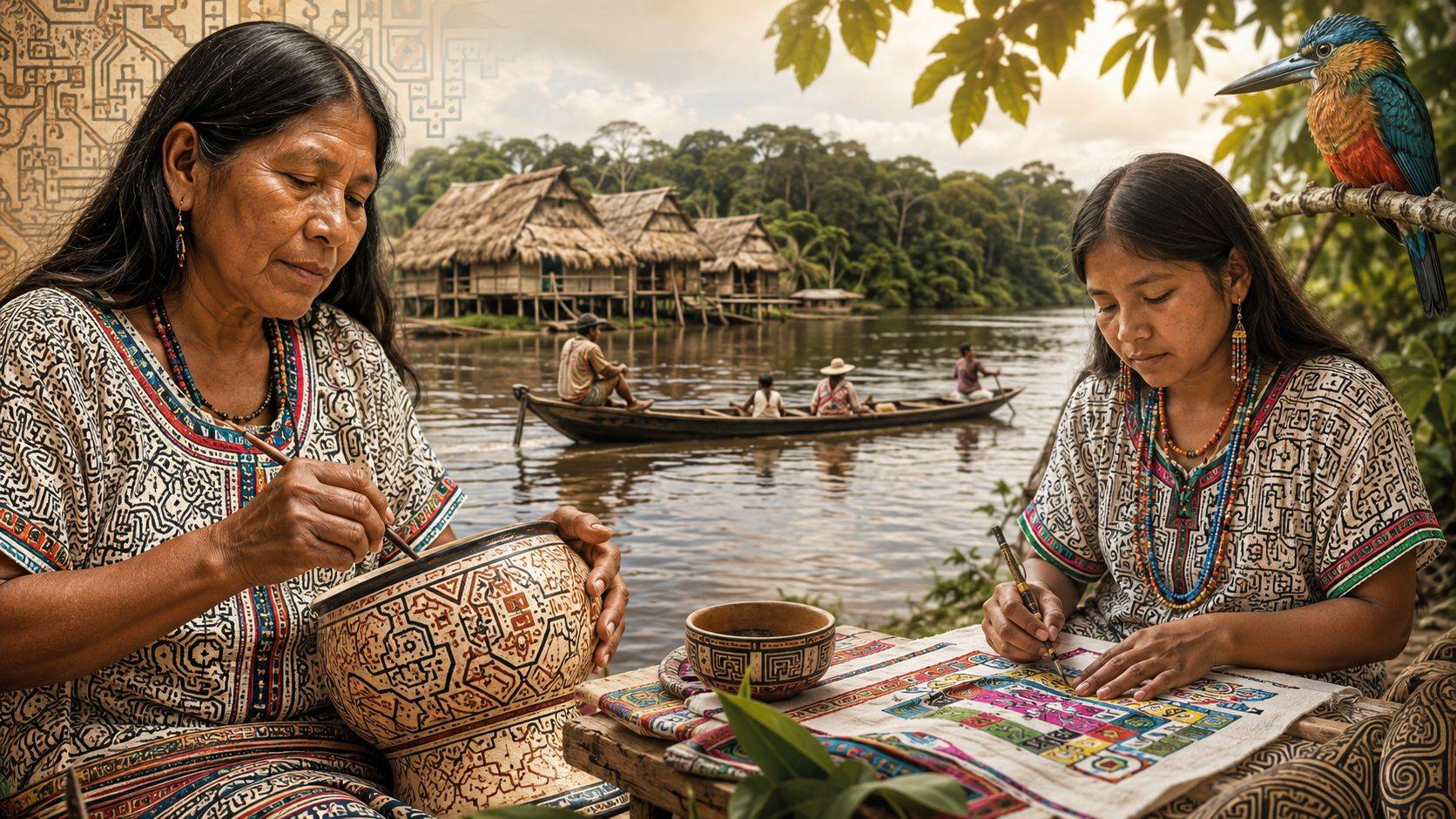
The geometric designs on ceramics, textiles, and embroidery are not merely decorative motifs. They preserve cosmological knowledge visually, much as icaros carry knowledge through sound. A healer, artist, and community elder may express related ideas through different forms, so ceremony aesthetics alone cannot establish authenticity, safety, or ethical practice.
How A Shipibo Shaman Is Trained Through Dieta And Plant Spirits
A trained Shipibo healer develops competence gradually. Apprentices commonly serve under an established maestro or maestra, observe treatment, learn ceremonial discipline, and undertake plant diets under supervision. The point isn’t to collect unusual experiences. Dieta is a controlled protocol intended to purify, transform, and establish reciprocity with plant spirits, known as ibo, while linking diagnosis, apprenticeship, and healing.
The Discipline Of Dieta
A dieta can include isolation, abstention from salt, sexual abstinence, and a restricted food regimen. The exact rules vary by teacher, plant, health, and purpose, so a visitor shouldn’t assume that every center uses one universal protocol. A useful plain-language explanation of the practice appears in this guide to Ayahuasca dieta.
Teacher plants may be introduced progressively. Accounts of Shipibo training describe work with plants such as ajo sacha, bobinsana, and chiric sanango, followed by deeper engagement with Ayahuasca itself. Dietado visions are understood as pedagogical encounters, not entertainment. The apprentice learns to recognize qualities, messages, bodily effects, and methods of response.
After a dieta, the apprentice may develop or receive icaros associated with the plant. These songs become part of a living memory system. The healer must remember how to call, clear, protect, and direct, while also learning when a song is appropriate and when silence is safer.
“Practical rule: A healer’s authority should be traceable to disciplined training and observed responsibility, not to a dramatic biography alone.”
Why The Process Takes Time
The specialist system is graded. Some practitioners may possess useful plant knowledge without holding the same authority as an advanced onaya or meraya. Higher competence involves more than drinking Ayahuasca. It includes patient management, diagnosis, energetic protection, vocal control, dream learning, dietary discipline, and the ability to work responsibly with helpers.
That distinction separates a trained healer from a weekend practitioner who has adopted ceremonial language without sustained apprenticeship. The exact length of training varies, and a fixed timetable would misrepresent the tradition. Still, serious Shipibo practice is measured through long-term discipline rather than a short course or a newly purchased title.
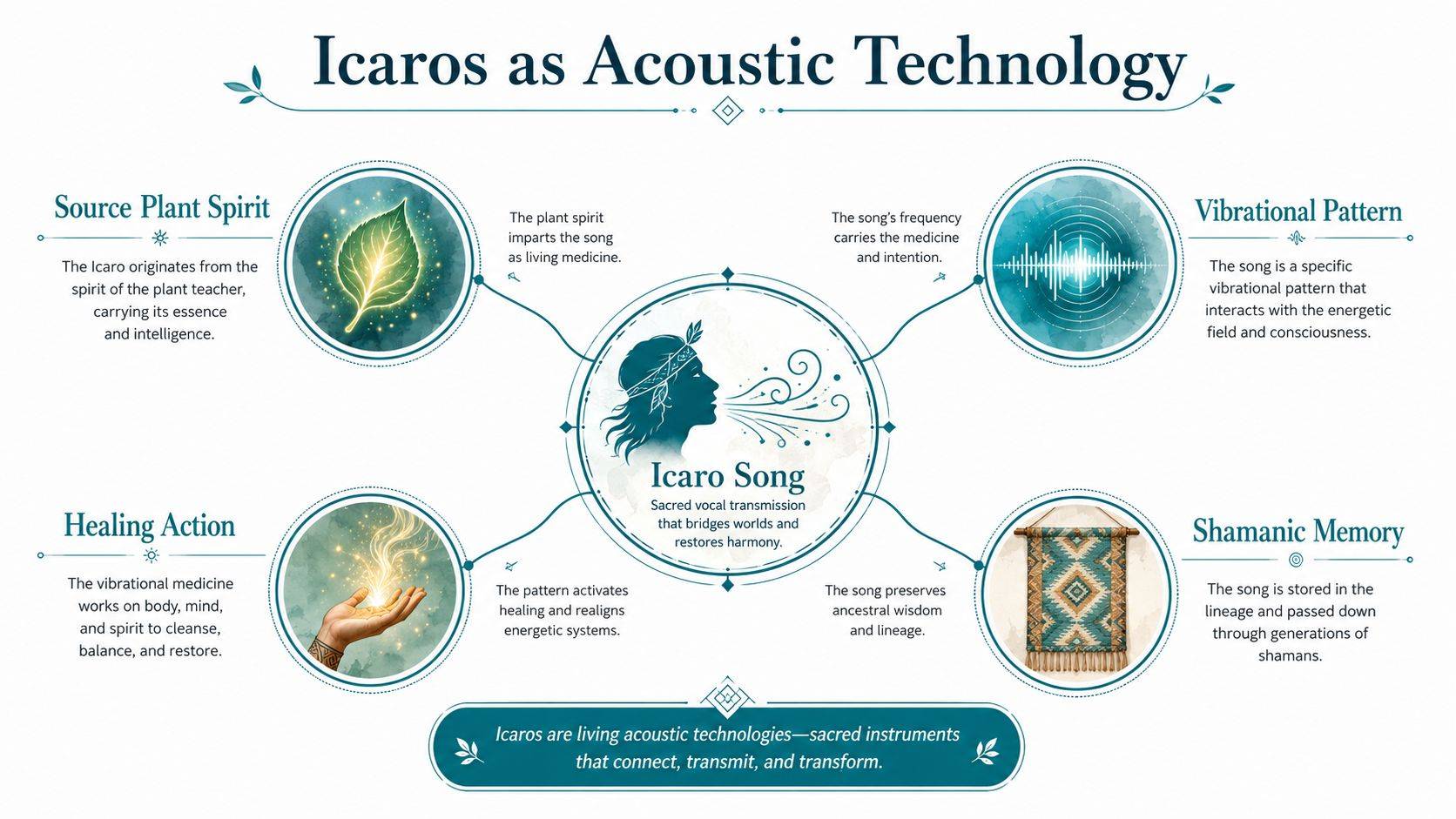
A short visual overview can clarify how plant learning, song, memory, and treatment fit together.
Icaros As The Acoustic Technology Of Healing
Icaros are often described as songs, but that translation can make them sound ornamental. In a Shipibo ceremony, the icaro functions as a deliberate acoustic intervention. Field reports describe ceremonies in which the healer drinks Ayahuasca, enters masked vocalizations, and then uses a sequence of songs to protect participants, guide visions, and regulate the direction of the altered state. The documented ceremonial description of icaro use presents sound as part of the treatment itself.
Sound, Attention, And Direction
A healer may use different song functions according to the perceived condition of the participant. Ruling icaros are associated with clearing and ordering. Calling icaros summon protective or assisting presences. Healing icaros direct Ayahuasca toward a bodily complaint, emotional wound, or perceived energetic disturbance.
Whistle patterns, maraca rhythms, breath, and chant phrasing create a changing sound field. Participants may notice that the voice seems to approach, recede, brighten, or settle. Within the Shipibo framework, those changes can help entrain attention, reduce disorientation, and signal when a participant should breathe, surrender, or release tension.
Research and practitioner documentation associated with Michael Harner, Luis Eduardo Luna, Jeremy Narby, and recordings held in the Strabo collection have helped make sound central to discussions of Amazonian healing. The careful point is that such work documents a ceremonial technology and an interpretive system. It doesn’t prove that every claimed physiological or spiritual effect occurs for every participant.
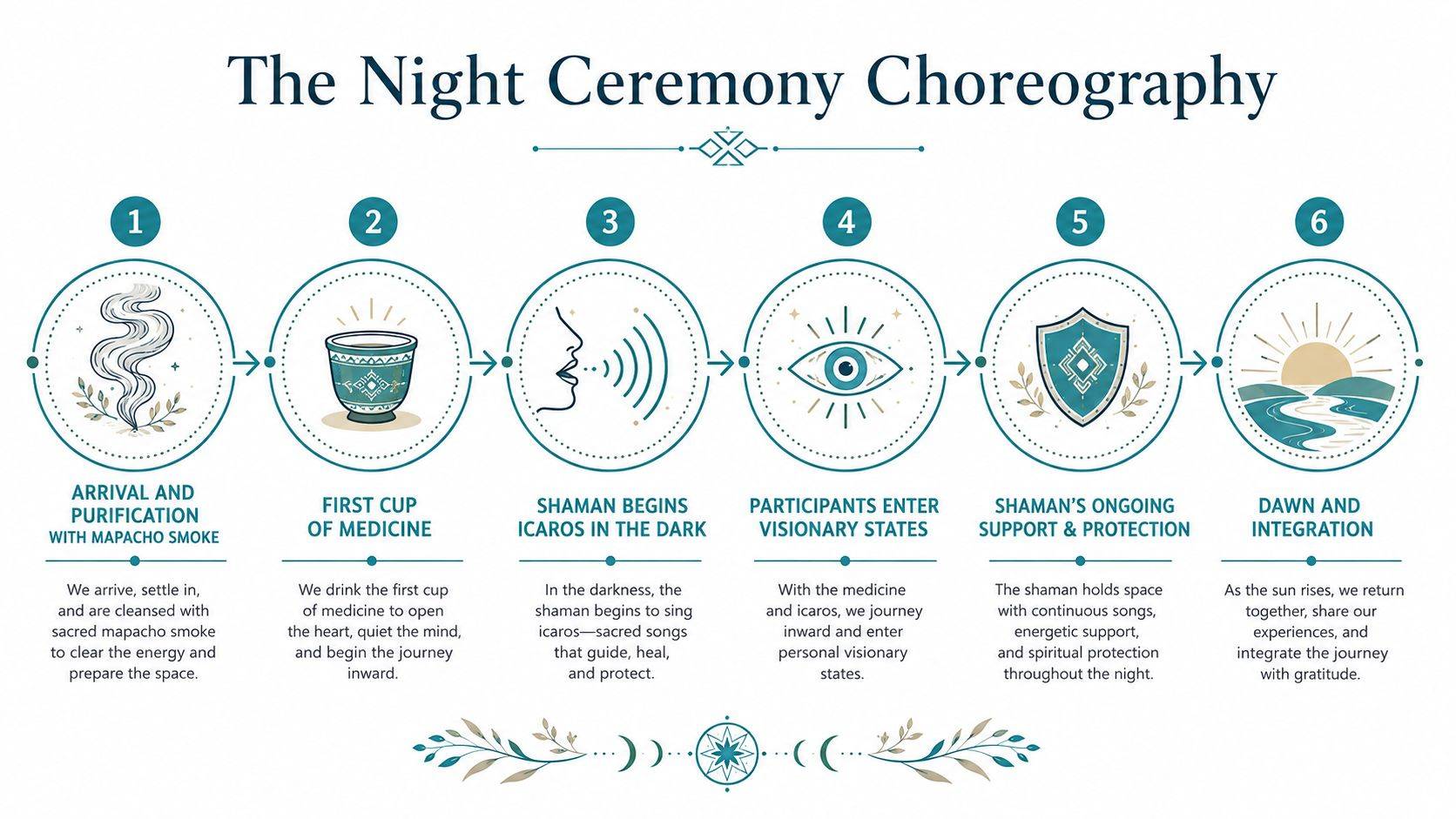
A Real-Time Diagnostic Soundscape
A fixed playlist would miss the central feature of the practice. The healer listens and observes while singing, then changes the song’s intensity, register, or function as the ceremony develops. One participant may receive sustained clearing, while another receives a more protective or grounding sequence.
That responsiveness explains why vocal control matters. The icaro carries plant learning, but it also carries the healer’s memory of how to work with a patient in a specific state. Readers seeking a fuller ceremonial explanation can consult this guide to the role of icaros, while keeping in mind that no written guide replaces competent supervision in a maloka.
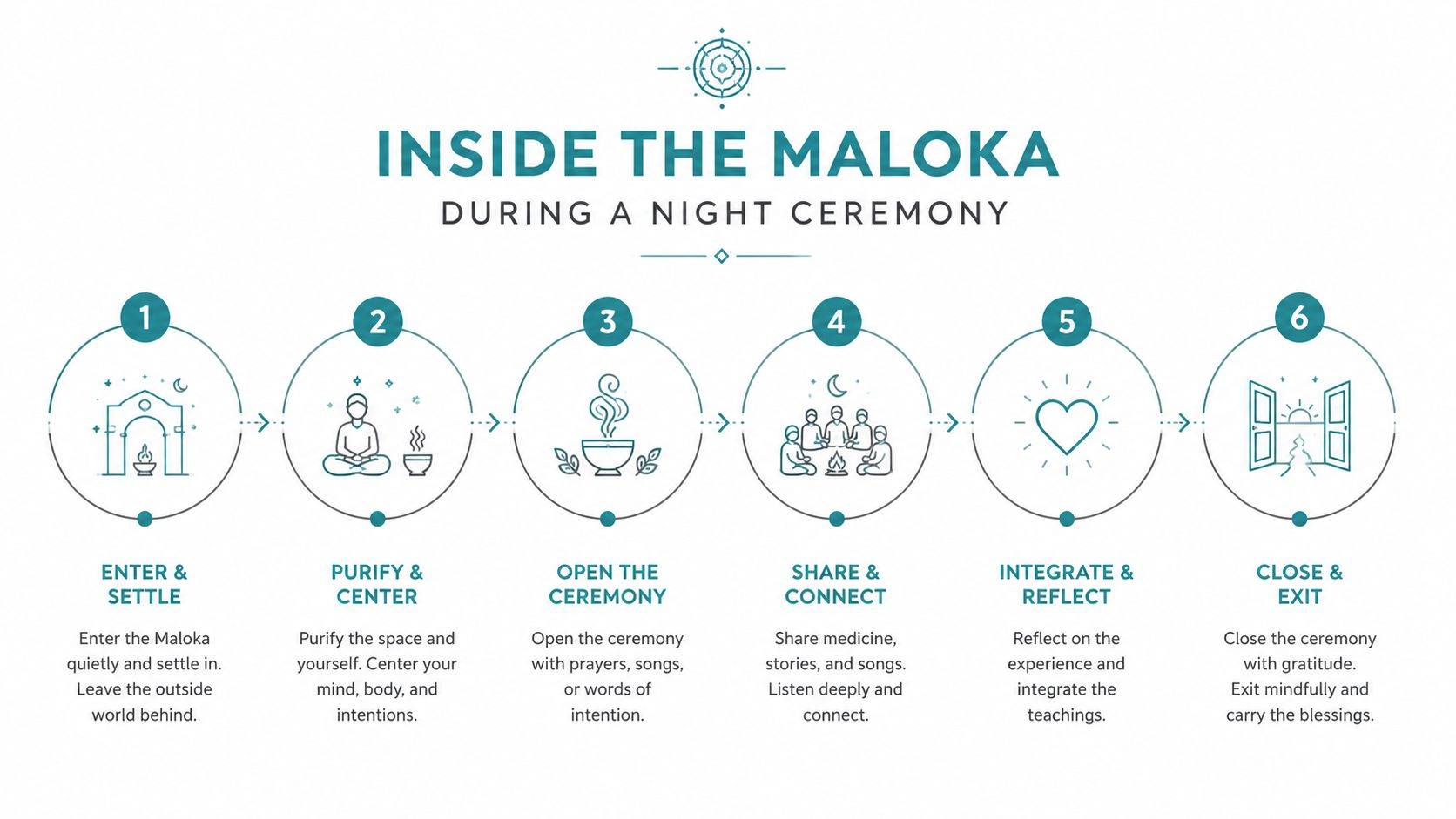
Inside The Maloka During A Night Ceremony
A Shipibo Ayahuasca ceremony takes place at night inside the maloka, the protected ceremonial space. Participants arrive before darkness, settle into assigned places, and may receive clearing with mapacho smoke. The healer or an assistant pours the medicine, while helpers monitor the room and respond to practical needs.
The healer traditionally drinks Ayahuasca as a diagnostic tool. In the Shipibo model, the healer enters the spirit world, identifies the roots of a condition, and works through icaros, plant prescriptions, and direct energetic intervention. The patient isn’t expected to diagnose the healer or direct the songs.
The Choreography Of The Night
The sequence varies by community and center, but a participant may encounter the following rhythm:
- Arrival and preparation: The team reviews rules, seating, health concerns, and emergency procedures.
- Clearing: Mapacho smoke may be blown over participants or around the space.
- Serving: Each person receives the prepared Ayahuasca, while the healer takes a diagnostic dose.
- Darkness and silence: The room becomes quiet as participants enter their individual process.
- Song and support: The healer sings, helpers watch, and practical assistance remains available.
- Closing: A final blessing or announcement marks the end, followed by gradual reorientation.
The healer sings. Helpers may pour, manage buckets, offer water when appropriate, blow tobacco smoke, watch for respiratory distress, and escort someone to the bathroom or outside. Clear staffing matters because a participant in an altered state may not be able to explain what is happening.
A ceremony guide describing traditional maloka rules notes restrictions on talking, singing, clapping, recording, and leaving the protected space before facilitators announce that the ceremony has ended. Many centers also discourage eye contact and touching. These rules support energetic containment within the Shipibo framework, while they also reduce distraction, confusion, and unwanted interaction during vulnerable moments.
Ceremony recordings can help listeners study musical texture outside a live ritual. For that purpose, participants may browse ceremony tracks rather than recording inside a maloka.
The night can last for several hours. Participants may emerge disoriented, tearful, physically tired, or changed in how they understand a personal question. None of those reactions proves that healing occurred. The quality of care is measured by how the team responds during uncertainty, not by the drama of the ending.
Ethics Pricing And The Question Of Authentic Practice
A visitor may enter a maloka expecting the fee to reveal the healer’s quality. In Shipibo practice, that assumption is unreliable. Ayahuasca tourism has created an economic situation in which spiritual authority, esoteric knowledge, and market exchange can become entangled. Academic writing calls this occult capitalism. The ethical question is how income supports healers and communities while sacred work is presented to international visitors as a purchasable experience.
The evidence does not show that a higher price produces a better outcome. A 2021 longitudinal observational study of 200 participants in a Shipibo healing program reported significant improvements in psychological, subjective, and spiritual well-being, along with quality of life, as described in the published study. Because the study was non-controlled and specific to one retreat, it cannot establish that identical benefits occur for every participant or setting.
What A Fee Can And Cannot Tell A Seeker
In Ucayali, exchanges may involve modest payment and reciprocal gifts within community relationships. Retreats serving international visitors can charge more than two thousand dollars for a week, reflecting the global retreat economy and the analysis of occult capitalism and Shipibo healing. Accommodation, food, translation, administration, transport, marketing, and international purchasing power can raise costs. They do not show how fairly the payment is distributed.
| Factor | Traditional Ucayali Setting | Commercial Iquitos Retreat |
|---|---|---|
| Exchange | Payment may sit within reciprocal community relationships | Price usually covers a packaged visitor experience |
| Authority | Reputation develops through local relationships and apprenticeship | Marketing may become the main public signal |
| Costs | Community context can keep arrangements modest | Lodging, translation, logistics, and promotion increase expenses |
| Ethical question | How does exchange support healer and community? | Who receives the visitor’s payment, and what does it fund? |
Authenticity also has degrees rather than a single pass-or-fail label. A healer may have local standing, formal apprenticeship, experience with international guests, or administrative support from a retreat. Those are different forms of authority, and a center should explain them plainly.
Lineage deserves the same scrutiny as price. References to elders such as Guillermo Arevalo or Pablo Amaringo provide context, but a name alone proves nothing. A responsible center can explain who trained the healer, where the training occurred, how the person learned to lead, and how compensation reaches the people doing the work.
“Ethical test: Paying more may buy logistics and comfort. It does not automatically buy deeper training, safer care, or a better ceremony.”
How To Choose A Reputable Shipibo Center Or Healer
Choosing a center should feel like an ethical inquiry, not a search for the most impressive brochure. The first conversation should include medical screening before any payment becomes binding. A responsible team asks about prescriptions, psychiatric history, cardiac history, pregnancy, and family history of psychosis. Particular care is needed with SSRIs, MAOIs, and other psychiatric medications because Ayahuasca can interact with health conditions and substances.
Safety Starts Before The Maloka
A center should explain its response plan in plain language. That includes trained first-aid presence, access to medical help, evacuation arrangements, and clear responsibility when a participant becomes physically or psychologically unwell.
Useful questions include:
- Screening: What information must participants disclose, and who reviews it?
- Staffing: Who leads the ceremony, who assists, and how many participants receive attention?
- Emergency care: Where does a participant go if urgent medical assessment is needed?
- Boundaries: Can a participant refuse touch, tobacco smoke, or additional serving?
- Integration: What support exists after the ceremony ends?
Small groups or one-on-one attention generally make it easier for helpers to notice distress than crowded malokas. The important issue isn’t a magic ratio. It is whether staff can observe each participant and intervene without delay.
Verify Training And Compensation
A prospective participant can research lineage, verify the oniki or maestro leading ceremonies, request references, and arrange a preliminary interview. The healer should answer questions without treating curiosity as disrespect. A center that welcomes scrutiny can explain how much pricing covers accommodation, translation, food, dietary support, administration, and healer compensation.
The financial question extends beyond the individual healer. Visitors can ask whether Shipibo workers receive fair pay and whether the center reinvests in the Shipibo community of Pano origin. A transparent answer won’t eliminate every ethical complication, but secrecy makes informed consent impossible.
Red flags include:
- Guaranteed cures: Promises of certain healing or permanent transformation.
- No screening: Serving Ayahuasca without reviewing medications and medical history.
- Untrained facilitation: Helpers with no clear preparation for emergencies or altered states.
- Exploitative tiers: Charging more for access to supposedly stronger spiritual attention.
- No follow-up: Ending responsibility when participants leave the maloka.
For broader context on the distinction between ceremonial authority and generic spiritual branding, readers can consult this guide to Ayahuasca shamanism. The practical standard remains simple: a reputable healer explains training, risks, boundaries, money, and aftercare before asking for trust.
Integration And Common Questions After The Ceremony
Integration begins when the ceremony ends. The body may feel tired, the mind may remain unusually open, and memories or emotions can continue moving through awareness. Some participants report emotional sensitivity, vivid dreams, resurfacing memories, temporary grief, or a strong desire to return immediately for another ceremony. Those experiences deserve attention, but none should be treated as automatic proof of spiritual progress.
A calmer approach gives insights time to settle. Journaling can preserve details without forcing an interpretation. Somatic practices such as walking, gentle movement, breathing, and rest help participants notice whether an insight produces steadier behavior or merely a compelling story.
Practical Post-Ceremony Support
A participant may choose to:
- Keep food simple: Continue a basic food regime for 30 days when that fits the healer’s guidance and the person’s health needs.
- Avoid destabilizers: Stay away from alcohol and stimulants during the early integration period.
- Use trusted support: Speak with a grounded friend, therapist, or integration group that respects both cultural context and mental-health care.
- Revisit sound carefully: Listen to recorded icaros for grounding rather than trying to reproduce a live ceremony at home.
- Delay repetition: Resist chasing another ceremony before the previous experience has been understood in ordinary life.
The exact duration of effects varies. A vision may remain vivid while its practical meaning changes, or a ceremony may produce little imagery but a useful bodily or emotional shift. A helpful question is whether the interpretation supports responsible action, stable relationships, and clearer self-understanding. Symbolic intensity alone isn’t a reliable measure.
When Extra Help Is Needed
Professional mental-health follow-up is appropriate when insomnia, panic, paranoia, mania, severe depression, persistent disorientation, or distressing memories continue or interfere with daily life. Anyone with a personal or family vulnerability to psychosis deserves especially careful assessment before ceremony, not only reassurance afterward.
Multiple ceremonies aren’t automatically necessary. Repetition can deepen learning for some people, while it can become avoidance for others. The relevant question is whether another ceremony serves a considered therapeutic or spiritual purpose, supported by safe screening and competent care.
Shipibo shamanism is best understood as a relationship built through discipline, not as a single life-changing night. The path begins with preparation and dieta, continues through song and responsible treatment, and develops through years of patient practice within a living Indigenous tradition.
Before booking a ceremony, ask the prospective center for its healer’s training history, medical screening process, emergency plan, staff responsibilities, compensation structure, and integration support in writing. Compare those answers with the standards above, and choose only a setting that treats Shipibo knowledge, participant safety, and community reciprocity as inseparable responsibilities.
Disclaimer: The information provided on Ayahuasca.com is for educational purposes only and is not intended as medical advice, diagnosis, or treatment. Ayahuasca is a powerful traditional Amazonian medicine and may not be suitable for everyone. Always consult with a qualified healthcare professional before making decisions related to health, mental well-being, medications, or the use of Ayahuasca.