
If you’re considering a journey with Ayahuasca – Brazil, you’re looking at the very heartland of this powerful plant medicine. Brazil is the global epicenter where ancient Amazonian shamanism, organized spiritual movements, and modern wellness practices all converge. This unique blend makes it one of the most sought-after destinations for people seeking this experience.
Beginning Your Ayahuasca Journey in Brazil
This guide is here to walk you through the complex and beautiful world of Ayahuasca in Brazil. We’ll trace its path from ancient Amazonian roots to its modern role as a global spiritual tool. Naturally, the idea of traveling to Brazil for something so profound brings up questions—about safety, legality, and finding a truly authentic experience.
We’re going to tackle those questions head-on. By breaking down the different lineages and what they offer, you’ll get a clear roadmap for making a responsible and well-informed decision.
Understanding Brazil’s Unique Ayahuasca Culture
First things first: there isn’t just one “Ayahuasca culture” in Brazil. It’s a vibrant tapestry woven from different spiritual and historical threads. Getting a feel for these different paths is the most critical step you can take.
Indigenous Traditions: These are the ancient roots of Ayahuasca, practiced by communities deep in the Amazon. Here, the brew is a sacred tool for healing, community connection, and understanding the cosmos.
Syncretic Religions: Groups like Santo Daime and União do Vegetal (UDV) emerged in the 20th century, blending indigenous plant medicine practices with Christian beliefs. They offer a structured, community-based religious framework for working with Ayahuasca.
Modern Retreats: Often designed for international visitors, these centers typically combine traditional ceremonies with familiar wellness practices like yoga, meditation, and post-ceremony integration support.
“Each of these paths offers a completely different lens for experiencing the medicine. By understanding their unique approaches, you can start to figure out which environment truly resonates with your own reasons for seeking this journey.”
Why Brazil is the Epicenter
So, why Brazil? Its central role is rooted in a long history and, crucially, a legal framework that has long protected its religious use. This legal standing has allowed well-established, experienced communities and centers to flourish in a way you won’t find anywhere else.
The numbers really tell the story. A government-funded study found that roughly 567,000 Brazilians have taken Ayahuasca at least once. The 3rd National Survey on Drug Use by the Brazilian Population, conducted back in 2015, showed that about 181,000 people had participated in a ceremony in the previous year. You can discover more insights from this Brazilian drug use survey.
This long-standing, widespread, and regulated practice has created a depth of experience and community that is simply unmatched. As we go deeper in this guide, you’ll learn how to spot authentic, reputable facilitators and steer clear of the risks, ensuring your journey is as safe as it is profound.
The Cultural Roots of Ayahuasca in Brazil
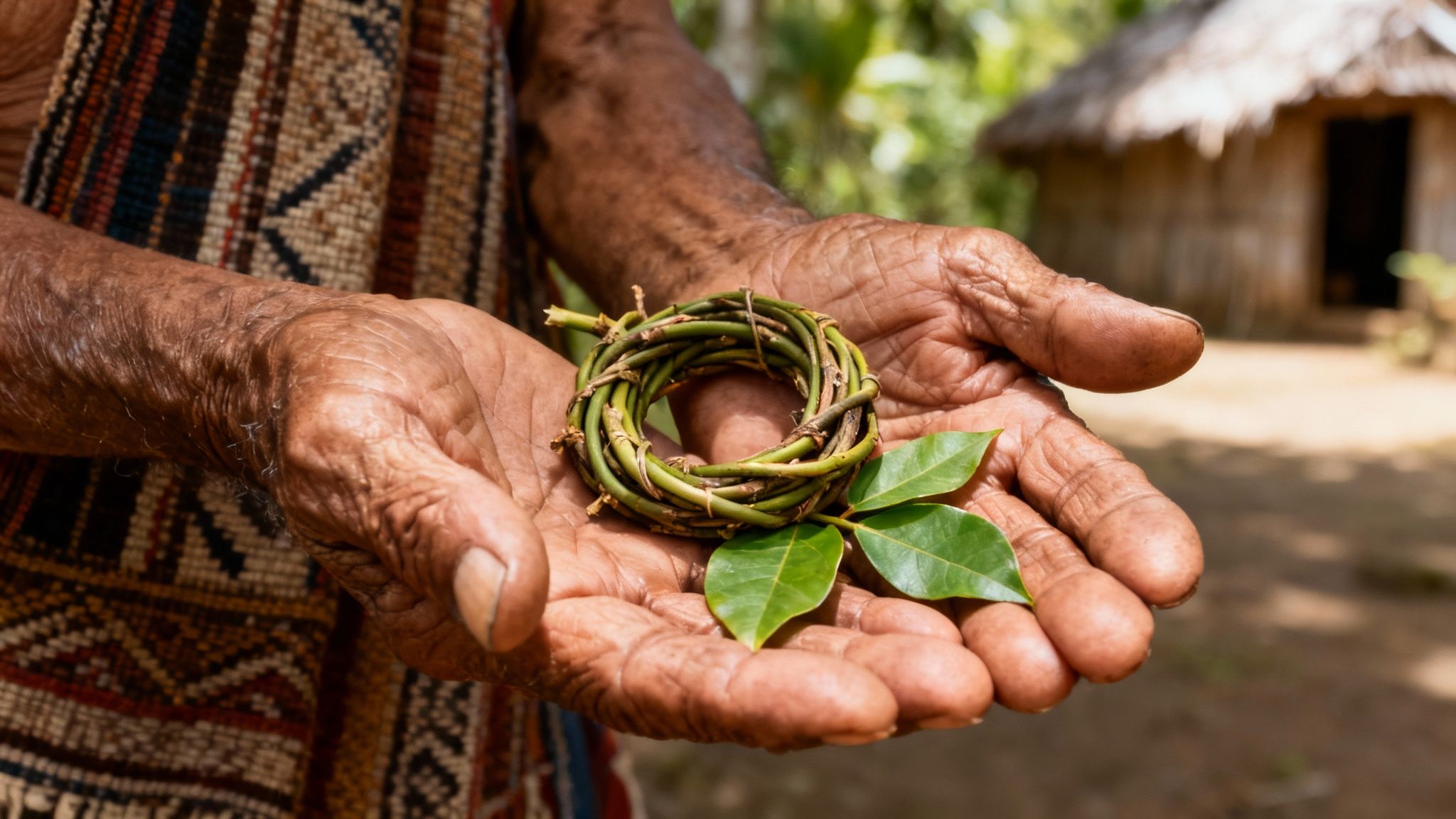
To really understand Ayahuasca in Brazil, you have to look far beyond its recent global popularity. The story of this sacred brew isn’t a new one; it’s ancient, born in the Amazon rainforest and deeply woven into the fabric of indigenous life for centuries, maybe even millennia. This isn’t just a substance—it’s a cornerstone of culture, medicine, and spirituality.
For generations, native communities have revered Ayahuasca as a sacrament. It was their window into the spirit world, a tool for diagnosing and healing illness, and a way to understand their place in the cosmos. These weren’t commercial retreats but intimate, communal ceremonies led by experienced spiritual guides, the pajés, who used the brew to find answers and bring healing to their people.
This deep, earth-based relationship with the medicine is the bedrock of every Ayahuasca tradition that exists today. It’s a world away from a wellness trend; it’s a profound spiritual technology that grew from the heart of the planet’s most vital ecosystem.
The Rise of Syncretic Religions
The 20th century brought a fascinating twist to Ayahuasca’s story. As Brazilian society evolved, new spiritual movements began to sprout, taking the indigenous sacrament out of the remote jungle and into new contexts. This created a uniquely Brazilian way of working with the medicine.
These movements are often called syncretic religions because they blend the indigenous use of Ayahuasca with elements of Christianity, spiritism, and Afro-Brazilian traditions. The two largest and most influential are the Santo Daime and the União do Vegetal (UDV).
Santo Daime: Founded in the 1930s by a rubber tapper named Raimundo Irineu Serra, this church fuses Ayahuasca consumption with Catholic prayers, hymns, and a highly structured ceremonial format. The brew itself is called “Daime” and is considered a divine sacrament.
União do Vegetal (UDV): Established in 1961 by another former rubber tapper, José Gabriel da Costa, the UDV is focused on spiritual evolution through the practice of peace, love, and virtue. Their ceremonies are organized sessions involving teachings and dialogues centered on moral development.
These religions built a cultural bridge, making the profound experience of Ayahuasca accessible to urban Brazilians who might never have found it otherwise. You can dive deeper into its doctrines and practices with this detailed Santo Daime overview.
“The emergence of these movements wasn’t just a religious shift; it was a cultural one. They created established, legally recognized communities where the sacred use of Ayahuasca could continue to thrive and evolve in a modern Brazilian context.”
From Urban Centers to a Global Stage
While Ayahuasca began its journey into Brazilian cities around the 1930s, its popularity didn’t truly explode until the last decade of the 20th century. The catalyst was the Santo Daime movement establishing its first church in Rio de Janeiro. When the church began attracting well-known public figures and gaining media attention, interest in Ayahuasca skyrocketed across Brazil’s urban hubs. You can read the full research about this cultural shift.
This newfound visibility and acceptance within mainstream Brazilian culture set the stage for its next evolution. As word of these powerful experiences spread, people from all over the world started traveling to Brazil, seeking not just religious ceremonies but also the deep healing and personal insight the medicine offered.
This influx of international interest helped fuel the rise of the modern retreat model we see today. These centers often blend traditional ceremonial practices with things a global audience is more familiar with, like yoga, meditation, and structured integration coaching. This evolution has made the experience of Ayahuasca in Brazil more accessible than ever, opening a new chapter in the long and sacred history of this plant medicine.
Navigating Brazil’s Ayahuasca Legal Landscape
If you’re planning a trip to Brazil for an Ayahuasca experience, the first thing you need to wrap your head around is the legal situation. It can feel a bit contradictory at first glance, but there’s a clear logic to it once you understand the core distinction Brazil makes between the brew and its isolated chemical components.
The whole legal framework hinges on one crucial point. DMT (dimethyltryptamine), a key psychoactive compound in Ayahuasca, is a controlled substance in Brazil, just like it is almost everywhere else. But—and this is the important part—the Ayahuasca brew itself is treated differently and is legally protected for specific uses.
This isn’t some new, flimsy loophole. It’s a legal position that has been thoughtfully developed by the Brazilian government over several decades, rooted in a deep respect for the country’s spiritual traditions.
The Foundation of Legal Protection
The journey to legal protection really got going back in the 1980s. A special working group, put together by the Federal Council on Narcotics (CONFEN), was tasked with studying Ayahuasca’s use in religious settings. Their conclusion was straightforward: the ritual consumption of the brew wasn’t a danger to society. This finding led to a landmark decision in 1987 that officially recognized its legitimate use within religious practices.
That moment was the cornerstone for all future regulations. It carved out the guiding principle that has defined Brazil’s policy ever since: Ayahuasca is protected when it’s part of a genuine religious or ritual tradition.
In the years that followed, this stance was consistently reinforced. The National Council on Drug Policy (CONAD), the successor to CONFEN, continued to defend the right to religious use.
“A major step came in 2010 when CONAD passed a resolution that cemented the legal framework. This resolution gave clear guidelines, ensuring that established religious and cultural groups could conduct their ceremonies without legal trouble, as long as they followed rules designed to prevent the brew from being misused.”
So, what does this all mean for you? It answers the most common question I get from travelers: Yes, it is legal for a foreigner to drink Ayahuasca in Brazil, but only if you are participating in a ceremony held by a legitimate, recognized spiritual organization.
The Critical Line Between Ritual and Commerce
While the religious use of Ayahuasca is well-protected, the Brazilian government draws a very sharp line when it comes to money. It’s vital to understand that the law protects ritual consumption, not commercial sales. You won’t find Ayahuasca for sale on a shelf, and that’s by design.
Brazil’s Health Regulatory Agency (Anvisa) has been explicit, banning any marketing, advertising, or sale of Ayahuasca products. This is a broad ban that covers:
Selling the brew itself outside of a proper ceremony.
Marketing any related products like tinctures, microdosing capsules, or “florals.”
Any advertising that presents Ayahuasca as some kind of commercial “natural remedy.”
The reasoning is simple: Ayahuasca is not classified as a medicine in Brazil, so it can’t be manufactured or sold like one. These regulations are in place to safeguard public health and, just as importantly, to preserve the sacred integrity of the brew. The goal is to keep its use confined to the ritual and research settings where it is properly understood and respected. This ensures that when you seek an experience with Ayahuasca in Brazil, you’re stepping into a protected spiritual tradition, not just buying a product.
Finding the Right Ayahuasca Retreat for You
Choosing where to experience Ayahuasca is the most critical decision you’ll make on this journey. This isn’t like booking a hotel on a whim; you’re selecting a safe, ethical container for what can be a deeply profound inner voyage. When it comes to an Ayahuasca Brazil experience, the options are incredibly diverse—from rustic jungle encampments led by indigenous pajés to modern centers that weave ceremonies into a full wellness curriculum.
That variety can feel overwhelming at first, but it’s actually a good thing. It means there’s almost certainly a setting that will align with your intentions and personal needs. The key is to do your homework, approaching the search with diligence and a clear head. Your mission is to find the genuine, well-run centers and steer clear of operations that lack the experience, integrity, or safety protocols this work demands.
Vetting Your Options: A Practical Checklist
Think of choosing a retreat facilitator like you would a surgeon. You’d want to vet their credentials, understand their specific methods, and feel a deep, intuitive sense of trust. Rushing this step is a common mistake. A structured approach can help you slice through the marketing fluff and focus on what truly matters for your safety and well-being.
Before you commit to any retreat, make sure you get clear answers on these critical points:
Facilitator Lineage and Experience: Who is actually leading the ceremony? Don’t be shy about asking about their training, how many years they’ve been serving the medicine, and who their teachers were. Authentic guides are always transparent and grounded about their lineage.
Medical Screening Process: This is a non-negotiable. A responsible center will have a thorough medical intake process, asking detailed questions about your physical and mental health history, along with any medications you’re taking. This is essential to screen for potentially dangerous contraindications.
Group Size and Support Staff: How many people are in each ceremony? Smaller groups, typically under 20 people, allow for far more individual attention. Crucially, ask about the ratio of facilitators and helpers to participants. You want to know there are enough experienced hands on deck to support everyone if things get difficult.
Integration Support: The ceremony itself is only the beginning; the real work often starts when you go home. Does the center offer any kind of integration support? Look for things like sharing circles, one-on-one sessions, or post-retreat follow-up. This is a huge indicator that a center is invested in your long-term well-being.
Transparency and Communication: Pay attention to how they respond to your questions. A trustworthy center will answer everything clearly and patiently. They should be completely open about their safety protocols, what a ceremony actually looks like, and exactly what’s included in the price.
This visual helps clarify the legal landscape for travelers interested in Ayahuasca, highlighting that its legality in Brazil is specifically tied to religious and ritualistic contexts.
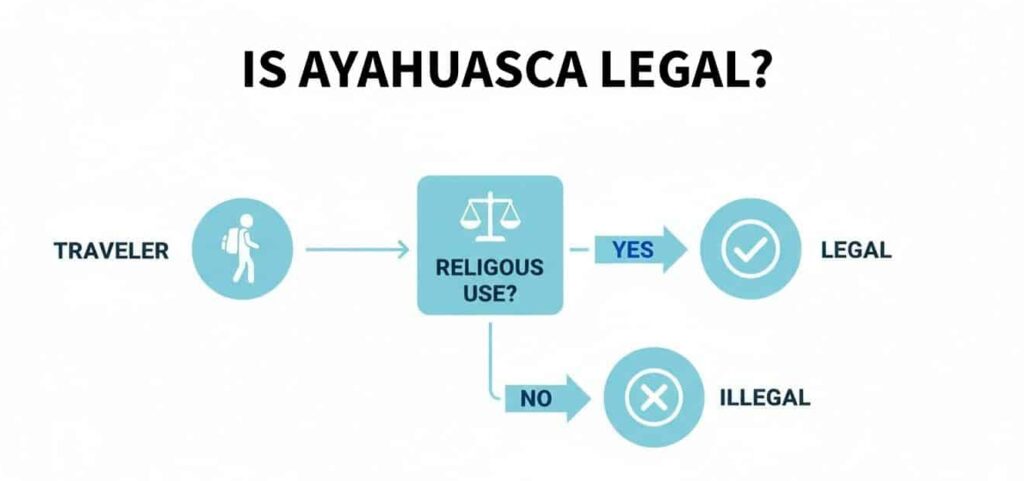
As the flowchart shows, while Ayahuasca isn’t outright illegal for visitors, its use is strictly confined to these legally protected spiritual settings.
Navigating Different Retreat Styles
The kind of retreat you choose will fundamentally shape your entire experience. To help you decide, here is a breakdown of the main archetypes you’ll find in Brazil.
Comparing Ayahuasca Experiences in Brazil
This table compares the key characteristics of the main types of Ayahuasca retreats and communities available in Brazil to help you choose the best fit.
| Characteristic | Traditional Indigenous | Santo Daime / UDV | Modern Retreat Center |
|---|---|---|---|
| Setting | Often rustic, deep in the Amazon jungle, basic amenities. | Organized church or community setting, can be rural or urban. | Purpose-built facilities, often comfortable with modern amenities. |
| Ceremony Style | Led by a pajé (shaman), focuses on traditional chants (icaros), and healing. | Structured religious service with hymns, prayers, and set rituals. | Often a blend of shamanic practices with psychotherapeutic elements. |
| Focus | Deep spiritual healing, connection to nature and plant spirits. | Devotional worship, community connection, spiritual doctrine. | Personal growth, psychological healing, and structured self-exploration. |
| Support | Relies on the shaman’s direct guidance and the community. | Support from church members and established doctrine. | Professional facilitators, therapists, and structured integration programs. |
| Best For | Those seeking a raw, authentic connection to the medicine’s roots and who are comfortable with rustic conditions. | Individuals looking for a structured, community-based religious or spiritual path. | First-timers or those wanting more comfort, psychological support, and a comprehensive wellness program. |
There really is no single “best” option—only what’s best for you. Spend some time reflecting on what kind of environment you truly need to feel safe, supported, and able to open up to the experience.
Red Flags to Watch Out For
Knowing what to look for is only half the battle; you also need to know what to avoid. The explosion of global interest in Ayahuasca has, unfortunately, attracted some unscrupulous operators who prioritize profit over people’s safety and integrity.
The scale of this boom is staggering. Globally, it’s estimated that four million people have now tried Ayahuasca, but this growth is overwhelmingly driven by non-indigenous seekers. Research has shown that a mere 10% of these global consumers belong to the indigenous groups where Ayahuasca is a sacred, ancestral practice. This means that today, about 90% of users are non-indigenous, creating a massive market that some are eager to exploit. You can learn more about these global consumption trends from the experts at ICEERS.
Keep a sharp eye out for these critical red flags:
“A lack of a thorough medical screening is the biggest warning sign. If a center doesn’t ask detailed questions about your health and medications, they are not prioritizing your safety. This is non-negotiable. Walk away.”
Other warning signs include high-pressure sales tactics, vague answers about their safety protocols, or facilitators who make grandiose claims about their own power or promise specific healing outcomes. Always, always trust your intuition. If something feels off, it probably is. Your due diligence is the best tool you have for ensuring a safe and genuinely beneficial journey with Ayahuasca in Brazil.
Essential Medical and Psychological Preparation
Stepping into the world of Ayahuasca is a serious commitment that goes far beyond just booking a flight to Brazil. It’s a deep dive that requires you to carefully prepare your body and mind, and this groundwork isn’t optional—it’s the very foundation of a safe and meaningful journey.
Ultimately, you are responsible for your own health. Being completely transparent with your facilitators isn’t just a good idea; it’s the single most important step you can take.
The Ayahuasca brew is powerful because it contains MAOIs (Monoamine Oxidase Inhibitors) from the Banisteriopsis caapi vine. These compounds are the key that unlocks the DMT in the Psychotria viridis leaf, making it active when you drink it. But that same chemical key can also unlock some very dangerous, even fatal, interactions with certain medications and health conditions.
This is exactly why any retreat center worth its salt will have a rigorous medical screening process. Think of it as a non-negotiable safety check. Hiding information here doesn’t just put you at risk—it puts everyone in the ceremony at risk.
Critical Medical Contraindications
Some medications and health conditions are absolute no-gos for an Ayahuasca ceremony. The most widely known and dangerous interaction involves antidepressants, especially SSRIs and MAOIs. Combining these with Ayahuasca can trigger a life-threatening condition called serotonin syndrome.
It’s absolutely crucial to talk to your doctor about how to safely taper off these medications long before you even think about packing your bags. Never, ever stop taking a prescribed medication on your own.
Beyond antidepressants, a few other conditions present serious risks:
Heart Conditions: If you have a history of heart problems, severe high blood pressure, or aneurysms, you should not drink Ayahuasca. The brew can temporarily spike your blood pressure and heart rate.
Psychiatric History: A personal or immediate family history of psychosis, schizophrenia, or bipolar disorder is a major red flag. Ayahuasca can potentially trigger latent conditions, making it an unsafe path for those with these predispositions.
Liver or Kidney Disease: Your liver and kidneys are responsible for processing everything you ingest. If these organs are severely impaired, they won’t be able to handle the brew safely.
Being honest about your medical history isn’t about judgment; it’s an act of profound self-care and respect for the sacredness of the medicine.
The Importance of the ‘Dieta’
The traditional way to prepare for Ayahuasca includes a specific food protocol called the dieta. This isn’t just about detoxing your body; it’s a spiritual practice in its own right. Following the dieta helps quiet the mental noise, sharpens your sensitivity to the plant’s wisdom, and shows respect for the ceremony itself.
At its heart, the dieta is all about simplicity. For at least one to two weeks before your first ceremony, you’ll need to cut out foods that can cause nasty interactions with the MAOIs in the brew.
“The traditional dieta is more than a list of rules; it’s an invitation to simplify your life and focus your energy inward. By clearing out physical and mental clutter, you create a cleaner vessel for the profound insights Ayahuasca may offer.”
Typically, you’ll need to eliminate:
Red meat (especially pork)
Aged cheeses and fermented foods (like soy sauce or sauerkraut)
Alcohol and all recreational drugs
Refined sugars and heavily processed foods
Spicy foods and excessive salt
Caffeine
Instead, fill your plate with a clean, simple diet of fresh vegetables, fruits, whole grains like rice and quinoa, and lean proteins like fish or chicken. For a truly exhaustive list and the science behind it, you can learn more about foods and meds to avoid with MAOIs from this excellent guide.
Cultivating the Right Mindset
How you prepare your mind is every bit as important as how you prepare your body. An Ayahuasca ceremony can surface intense emotions, long-lost memories, and visions that feel more real than reality. Building a mindset of surrender, trust, and resilience is your best tool for navigating whatever comes up.
Start by setting clear intentions. What are you hoping to heal, understand, or release? Get a journal and write them down, but then try to hold them lightly. An intention is a compass, not a map—it gives your journey a direction, but it doesn’t dictate the exact path you’ll take.
Practice letting go. Ayahuasca has a way of showing you what you need, not necessarily what you want. The most challenging experiences often arise when we try to fight or control what’s happening. A simple meditation or breathwork practice can be incredibly helpful here. It’s your training ground for staying present and open, allowing you to meet even the most difficult moments with curiosity instead of fear.
7. Planning Your Trip: Logistics, Preparation, and Integration
Deciding to experience Ayahuasca in Brazil is a significant moment. But the journey doesn’t start with the first cup; it begins with the practical steps you take to get there and, just as crucially, how you plan to bring the experience back home with you. This is all about bridging the profound, internal work of a ceremony with the tangible realities of travel and everyday life.
Getting these details right—from flights to packing lists—isn’t just about avoiding stress. It’s about creating the mental and emotional space you need to show up fully. When the logistics are handled, you can arrive at your retreat centered and ready, with your energy focused on your inner work, not on last-minute worries.
Getting to Your Retreat in Brazil
First things first, let’s talk about the travel nuts and bolts. Depending on where you’re from, you might need a visa, so it’s smart to check the latest requirements with your local Brazilian consulate months ahead of time.
For most international visitors, the journey starts at one of two major airports:
São Paulo-Guarulhos International Airport (GRU): This is Brazil’s biggest international gateway. From here, you can find a connecting flight to almost anywhere in the country.
Rio de Janeiro/Galeão International Airport (GIG): Another massive hub with great connections, especially if your retreat is in a coastal state like Bahia.
Once you land in São Paulo or Rio, you’ll almost certainly need to catch a domestic flight to a smaller city closer to your retreat. If you’re headed deep into the Amazon, that likely means flying into a regional hub like Rio Branco (RBR) in Acre or Manaus (MAO) in Amazonas.
What to Pack for Your Journey
Packing for an Ayahuasca retreat is a unique blend of practical and ceremonial. You’re dressing for a jungle climate but also for a sacred space.
Here’s a solid starting list:
Light, loose-fitting clothes: Think layers. Lightweight pants and long-sleeved shirts made from cotton or linen are perfect for staying comfortable and protecting yourself from insects.
White or light-colored ceremony clothes: In many lineages, wearing white is a sign of respect and purity. It’s always best to ask your retreat center about their specific dress code.
A journal and pen: Don’t skip this. It’s an indispensable tool for jotting down insights, dreams, and reflections during and after your ceremonies.
A reusable water bottle: You’ll need to stay hydrated, and this is the best way to do it sustainably.
Natural insect repellent: Look for a good, DEET-free option to avoid harsh chemicals.
A small flashlight or headlamp: Absolutely essential for finding your way around in the dark without disrupting the ceremony space.
Bringing the Work Home: The Integration Process
The Ayahuasca ceremony doesn’t end when the music stops. In many ways, that’s when the real work truly begins. Integration is the deliberate process of weaving the insights, lessons, and healing from your experience into the very fabric of your daily life. Without it, even the most earth-shattering revelations can fade away like a half-remembered dream.
“Integration is the bridge you build between the ceremonial world and your everyday reality. It’s the active, ongoing practice of turning mystical insights into meaningful, lasting change. This is where the true value of your journey is unlocked.”
How you integrate is deeply personal, but a few practices are almost universally helpful. Journaling is a fantastic way to continue exploring the complex emotions and visions that came up for you. Finding a community, whether it’s an online integration circle or a local group, provides incredible support as you navigate the shifts.
Above all, be gentle with yourself. Avoid the temptation to make huge, life-altering decisions the moment you get home. Give yourself the time and space to let the experience settle. To help guide you through this critical phase, it’s worth exploring the principles of psychological integration after a psychedelic experience. Real, lasting change doesn’t happen in a single night—it’s built through the small, consistent choices you make in the weeks and months that follow.
Common Questions About Your Ayahuasca Journey in Brazil
If you’re planning a trip to Brazil to experience Ayahuasca, you probably have a lot of questions. Let’s tackle some of the most common ones that come up.
How Much Should I Budget for a Retreat?
The cost of an Ayahuasca retreat in Brazil can swing wildly, all depending on the style of experience you’re after. On one end, you might find a traditional ceremony in an indigenous village that operates on a donation basis. On the other, a full-service, week-long retreat aimed at international guests can run anywhere from $1,500 to over $4,000 USD.
Typically, this price tag includes your lodging, all your dieta-friendly meals, several ceremonies, and whatever integration support the center provides. It’s always a good idea to get a crystal-clear breakdown of what’s covered before you commit so there are no unexpected costs later on.
Where Is the Best Place in Brazil to Experience Ayahuasca?
There’s no single “best” place for an Ayahuasca Brazil journey. It really boils down to what you hope to get out of the experience, as each region offers a completely different vibe and setting.
The Amazon: For a truly traditional experience, heading to states like Acre is your best bet. Here, you’ll find indigenous-led ceremonies held deep in the heart of the rainforest, as close to the source as you can get.
Bahia: Famous for its beautiful coastline, Bahia has become a hotspot for modern retreat centers. These places often mix Ayahuasca ceremonies with other wellness activities like yoga and meditation.
Major Cities: If you’re drawn to a more structured, religious setting, you’ll find established Santo Daime and UDV churches in cities like Rio de Janeiro and São Paulo.
“Think carefully about the environment that will best serve your intentions. The profound isolation of the Amazon offers a very different path than the communal spirit of a church or the guided support of a modern retreat center.”
Will I Be Okay if I Don’t Speak Portuguese?
For the most part, yes. Many retreat centers catering to an international crowd have facilitators and staff who are fluent in English, so you can communicate clearly about your experience.
However, if you’re venturing off the beaten path to a more traditional community or a local Santo Daime church, the language barrier can be very real. It’s crucial to check ahead of time what language will be spoken during the ceremony and by the support team. Even learning a few basic phrases in Portuguese is a simple sign of respect that goes a long way.
Disclaimer: The information provided on Ayahuasca.com is for educational purposes only and is not intended as medical advice, diagnosis, or treatment. Ayahuasca is a powerful traditional Amazonian medicine and may not be suitable for everyone. Always consult with a qualified healthcare professional before making decisions related to health, mental well-being, medications, or the use of Ayahuasca.