
The most popular advice about an ayahuasca church in Brazil is also the most misleading: “Ayahuasca is legal there, so visitors can drink it anywhere.” Brazilian law offers meaningful protection, but that protection follows a specific religious and ceremonial context. It doesn’t create a general license for commercial retreats, wellness businesses, recreational gatherings, or therapeutic providers to serve the brew.
That distinction matters for visitors, researchers, and communities alike. A legitimate church operates within a religious tradition, internal governance, sacramental controls, and rules designed to keep production and administration connected to worship. A business that sells an experience to tourists may look similar from the outside while carrying a very different legal and ethical profile.
Understanding The Ayahuasca Church Brazil Landscape
Brazil occupies a distinctive place in Ayahuasca history because Indigenous Amazonian knowledge became connected with organized syncretic religions, including Santo Daime and the União do Vegetal, commonly known as UDV. These churches helped establish durable forms of ceremonial life around the brew, with recognized leadership, shared doctrine, regular worship, and community responsibilities.
The legal question therefore isn’t just whether Ayahuasca exists in Brazil or whether a foreign visitor may attend a ceremony. The practical question is who is administering it, under what religious authority, for what purpose, and through which organizational controls. Brazilian protection centers on religious use by recognized entities and Indigenous communities, rather than on open access to a psychoactive product. Brazil’s legal overview describes the country as the clearest national model for legally durable Ayahuasca religion.
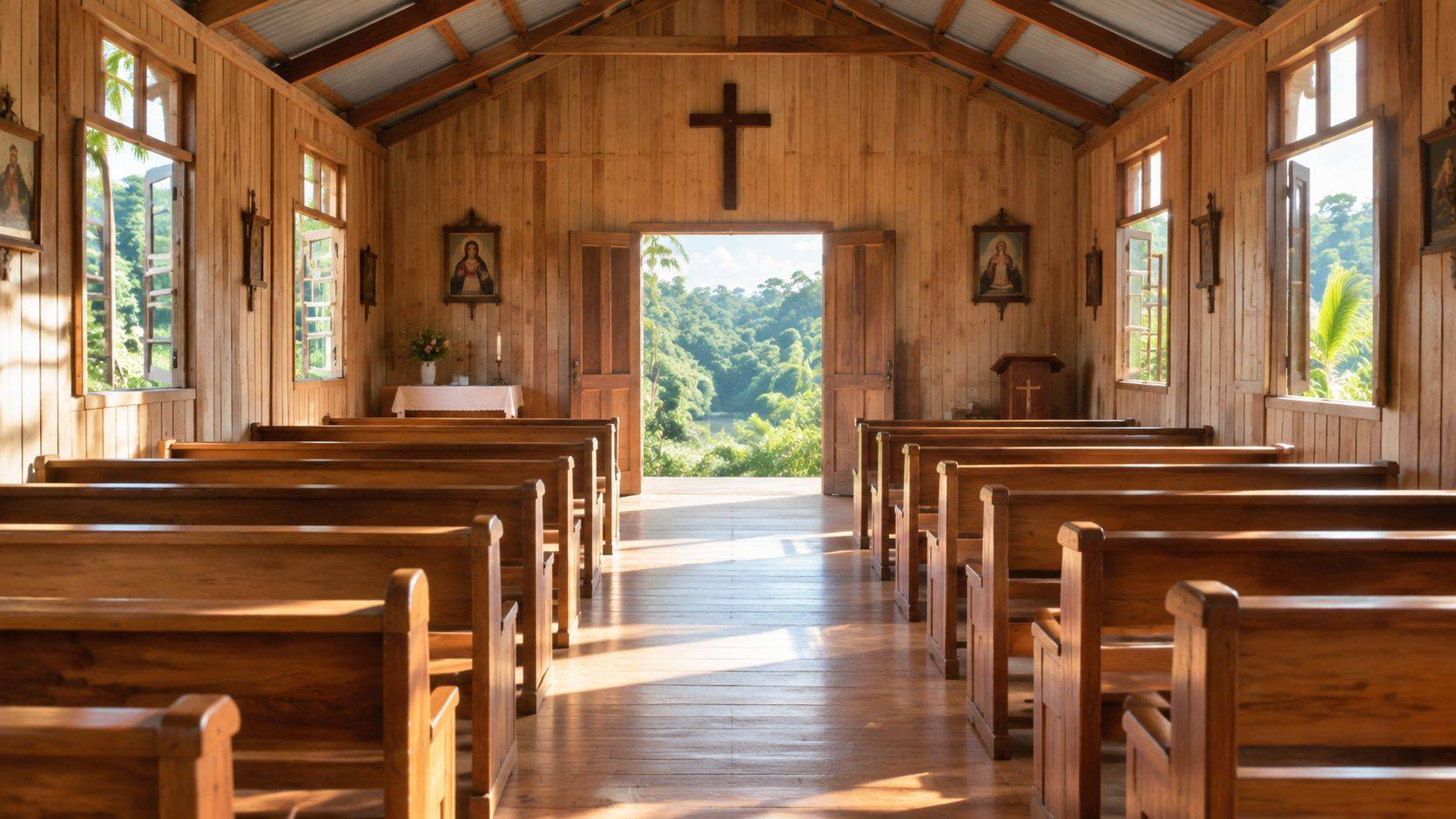
Church Or Commercial Retreat
A church normally presents itself as a religious community, not as a provider of a guaranteed psychological outcome. Members may contribute to maintenance, food, housing, or communal needs, but the sacrament remains embedded in worship rather than sold like a consumer product. Leaders should be able to explain the tradition’s teachings, the group’s governance, and the responsibilities expected of participants.
A commercial retreat may use spiritual language while emphasizing bookings, packages, transformational promises, or therapeutic claims. Those features don’t automatically prove misconduct, but they should prompt careful questions because Brazilian rules distinguish protected ritual use from non-religious tourism and commercialization. A visitor researching options can use this guide to safe and authentic Ayahuasca retreats in Brazil as one point of comparison while evaluating a center’s structure.
Why Context Changes The Answer
A ceremonial setting also creates responsibilities that go beyond possession. The brew is traditionally administered as a sacrament, and the church must maintain a coherent relationship between preparation, storage, distribution, membership, and religious practice. A visitor who sees only the ceremony may miss the systems that make the practice legally and ethically distinct.
Brazil’s model doesn’t mean every group using religious vocabulary qualifies for protection. It means seekers should approach the setting as a religious institution, with the same care applied to any unfamiliar spiritual community. Respectful participation begins with transparency, informed consent, health screening, and an understanding that no ceremony can guarantee healing or personal transformation.
The History And Legal Evolution Of Sacred Brews
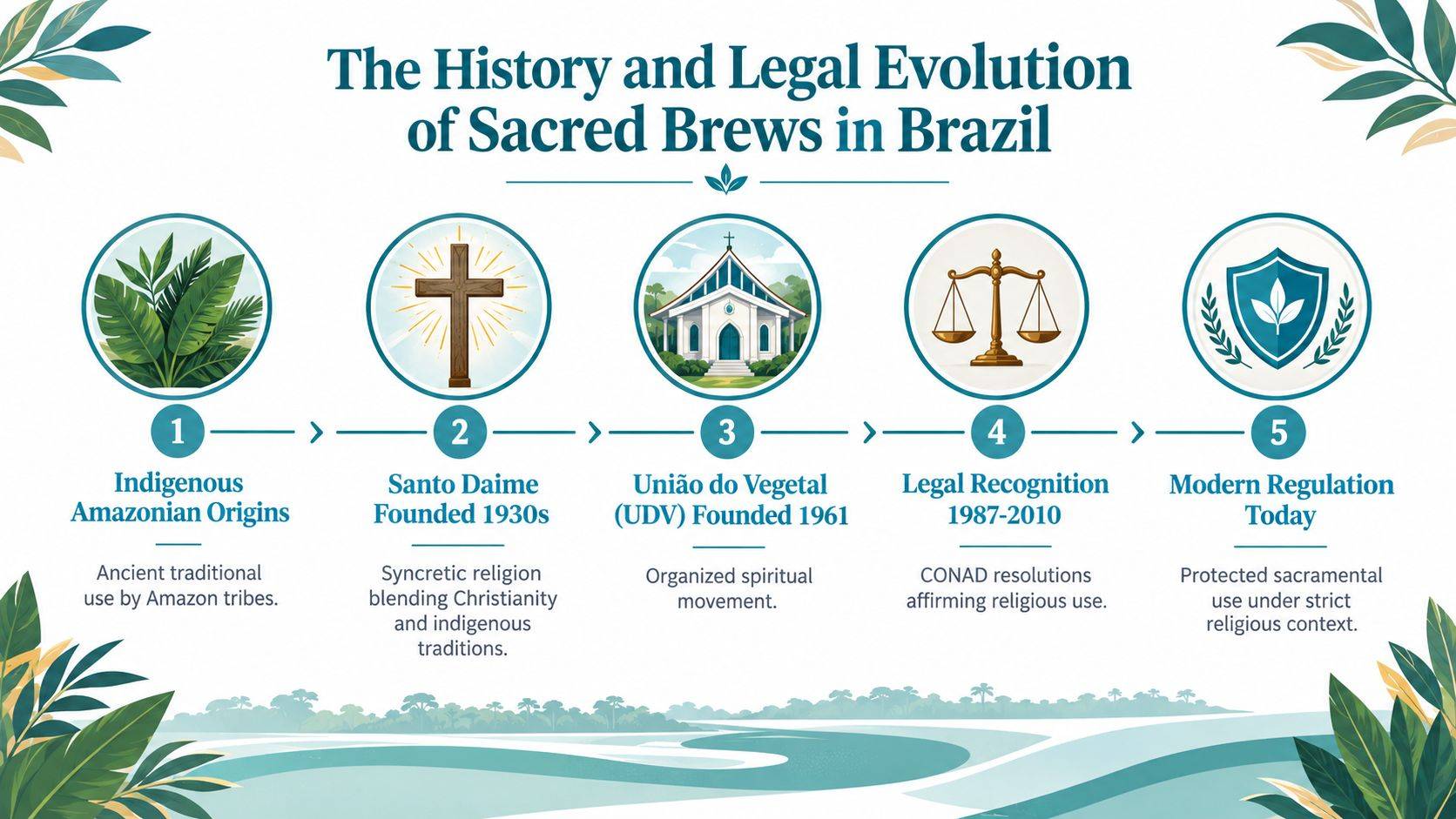
Ayahuasca traditions in Brazil developed from older Indigenous Amazonian relationships with plants, prayer, song, healing, and collective ceremony. Modern churches didn’t erase those foundations, but they interpreted the brew through new religious forms. The result was a family of traditions that combine Christian imagery, Indigenous botanical knowledge, Afro-Brazilian and local spiritual influences, disciplined ritual, and community life.
Santo Daime emerged as a syncretic religion in the early twentieth century, while the UDV developed as an organized spiritual movement later in the century. Their theologies and ceremonial styles differ, yet both helped make Ayahuasca central to a structured religious path rather than treating it as an isolated visionary technique.
From Local Practice To Organized Religion
The União do Vegetal was founded in 1961, according to the historical framing supplied for the tradition. It developed a formal structure around the sacrament, instruction, moral discipline, and a central religious community. Santo Daime is associated with a different ritual vocabulary, including hymns, uniforms in some settings, Christian symbolism, and ceremonial forms that can vary by lineage.
Barquinha represents another Brazilian current, with its own religious synthesis and ritual language. These traditions shouldn’t be treated as interchangeable versions of one universal ceremony. Each has its own account of revelation, leadership, correct conduct, music, preparation, and the role of the congregation.
The organizational dimension became especially important as authorities examined the legal status of the brew. Review work began in the 1980s, and Brazil’s Ayahuasca church scene became legally durable in 1992, when the federal drug council, identified in the supplied legal record as CONFEN, formally exempted Ayahuasca tea and its principal plants from the illicit-drugs list. The historical legal account places this decision within a longer process of institutional review.
The 2010 Regulatory Framework
Legal recognition didn’t end the need for boundaries. A later framework in 2010 formalized religious use and established rules against commercialization and unauthorized therapeutic use. This shifted the discussion from a simple possession question toward a broader deontology of use, meaning the ethical and operational duties that define how the sacrament should be prepared, administered, and governed.
That framework matters because religious freedom and commercial freedom are different things. A church may receive protection for ceremonial practice while a business model built around tourism, profit, or medical promises falls outside the protected context. The distinction also explains why Brazilian Ayahuasca law is often described as stable while still demanding careful institutional conduct.
A Global Influence With A Local Foundation
Brazil became the largest historical center of Ayahuasca churches, and its religious models later spread internationally. The 2010 census data used to map the traditional Ayahuasca religions recorded 7,875 Santo Daime adherents and 9,380 UDV affiliates, for 17,255 members in total across the traditions counted in that census, as reported in the Brazil population and church context.
Those figures describe formal religious affiliation, not everyone who has encountered the brew. The same source explains that Ayahuasca use in Brazil extends beyond church membership, showing why membership counts alone can’t define the full social picture. Still, formal affiliation provides an important clue: these religions are organized communities with histories, obligations, and identities, not temporary tourism products created for visitors.
Comparing Major Ayahuasca Traditions And Ceremonies
A seeker comparing Brazilian Ayahuasca churches should begin with a simple principle: shared sacrament doesn’t mean identical religion. Santo Daime, UDV, and Barquinha each developed distinct forms of worship and authority. Their ceremonies may share singing, collective attention, prayer, and disciplined participation, but the meaning assigned to those elements differs.
Santo Daime ceremonies often place strong emphasis on hymnody, Christian symbolism, collective singing, and, in some lineages, formal dress or uniforms. The hymns guide the congregation through a sequence of spiritual themes, and participants are generally expected to remain attentive to the ritual structure rather than treating the session as an individual psychedelic event. A detailed Santo Daime overview can help readers understand why the tradition’s ceremonial identity matters.
UDV ceremonies commonly emphasize instruction, moral reflection, religious study, and the authority of an organized hierarchy. The atmosphere may feel more focused on teaching and disciplined listening than on the extended hymn-centered structure familiar from some Santo Daime settings. Local congregations can differ in presentation, yet the central idea remains that the sacrament belongs within a religious path.
Barquinha is another syncretic tradition, associated with a rich spiritual universe and ritual forms that can include songs, devotional work, and relationships with multiple spiritual currents. Its practices may be less familiar to international visitors, which makes direct explanation from local leadership especially important. Outsiders shouldn’t assume that a ceremony described with generic language such as “shamanic night” represents Barquinha or any established church accurately.
Comparison Of Major Brazilian Ayahuasca Traditions
| Tradition | Core Theology | Ceremonial Elements | Organizational Structure |
|---|---|---|---|
| Santo Daime | Christian and Indigenous influences, with a sacramental understanding of Daime | Hymns, collective singing, prayer, ritual discipline, and uniforms in some lineages | Church communities led through established religious roles and local lineages |
| União do Vegetal | Organized spiritual teaching, moral formation, and sacramental communion | Instruction, attentive participation, devotional practice, and structured communal sessions | Formal hierarchy with recognized leadership and congregation-based organization |
| Barquinha | A syncretic spiritual system drawing on Christian, Amazonian, and other Brazilian religious currents | Devotional songs, spiritual work, prayer, and lineage-specific ceremonial forms | Community and leadership structures shaped by the tradition and its local houses |
What Visitors Should Observe
Ceremonial etiquette usually begins before the brew is served. Visitors should learn whether the congregation expects silence, particular clothing, participation in singing, specific seating, or restrictions on movement. A church that explains these expectations clearly gives newcomers a better chance of participating without disrupting worship.
Leadership also deserves attention. In a religious context, facilitators aren’t merely event staff. They interpret doctrine, manage the ritual space, decide who may participate, respond to distress, and carry responsibility for the community’s standards. A respectful seeker therefore evaluates the institution, not only the intensity or reputation of the ceremony.
The strongest sign of cultural respect is a willingness to accept the tradition on its own terms. A visitor seeking a private therapeutic session may be looking for a different service from what a Brazilian church exists to provide. Confusing those purposes can create legal exposure, cultural harm, and avoidable safety problems.
Navigating The Legal Framework And Religious Protections
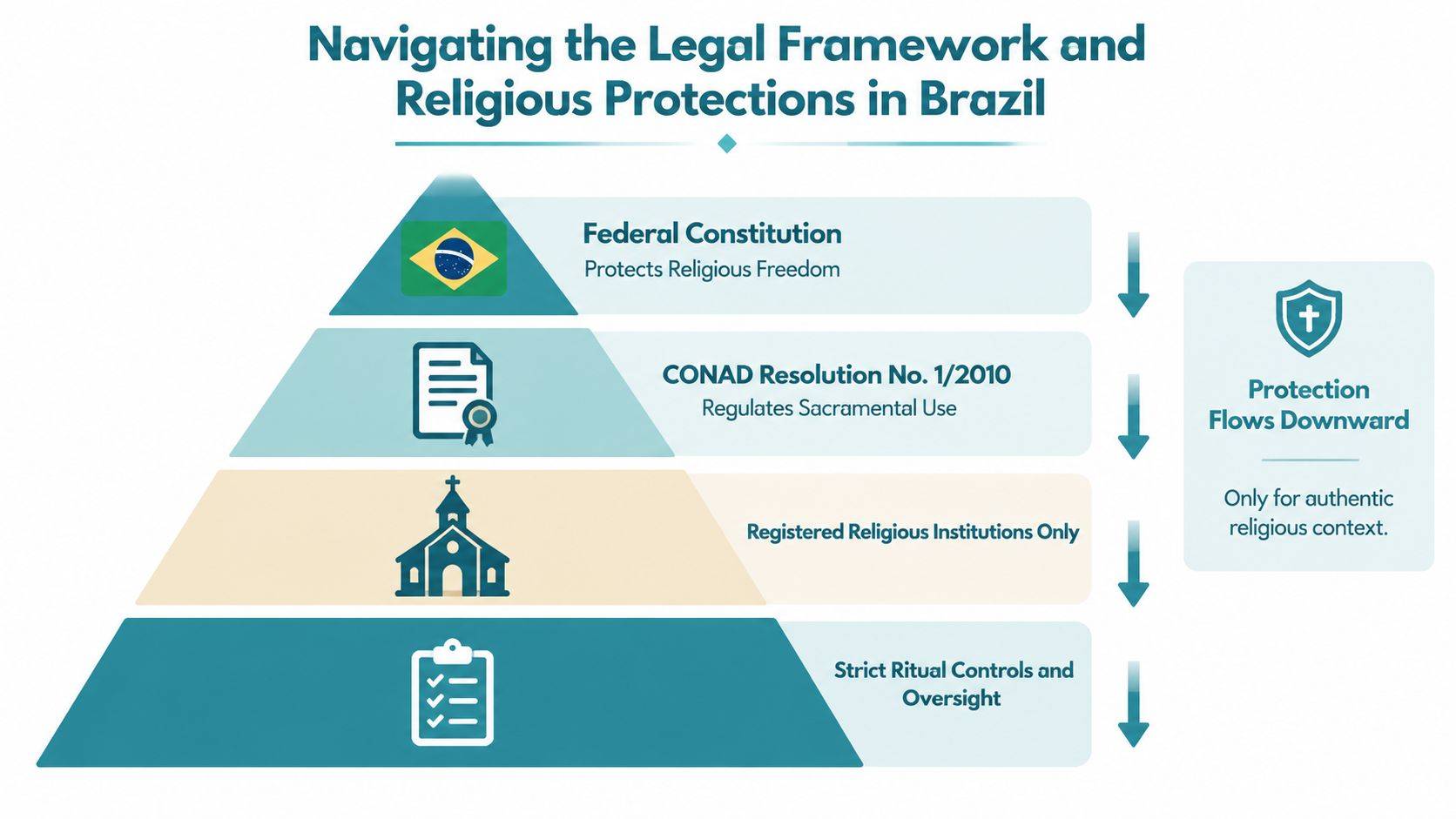
Brazilian Ayahuasca law protects a religious sacrament within a defined context, rather than recognizing Ayahuasca as a general-purpose product. CONAD Resolution No. 1/2010 authorizes production, distribution, and ceremonial use by registered religious entities and Indigenous communities, while prohibiting commercial sale, recreational use, and non-religious tourism contexts, as described in this legal analysis of Ayahuasca authorization.
That wording has practical consequences. A church needs more than a spiritual website or a ceremonial name. It needs an organizational identity, internal rules, accountable leadership, and practices that keep the brew connected to religious use. The protection doesn’t automatically transfer to any operator who charges visitors for a packaged experience.
The Deontology Of Use
Brazil’s framework is better understood as a system of use obligations than as a simple possession rule. The protected brew is tied to the decoction of Banisteriopsis caapi vine and Psychotria viridis leaves, the religious context in which it is administered, and controls maintained by the church.
Those controls can cover:
- Production: The church should know who prepares the brew, under what authority, and for which religious community.
- Storage: The group needs responsible custody and clear internal procedures.
- Distribution: Supply should remain connected to ceremonial use rather than open retail.
- Membership contributions: Contributions should support communal maintenance rather than operate as profit-making sales.
- Participant governance: Newcomers, minors, pregnant women, and vulnerable members require careful policies and responsible judgment.
This structure resembles the governance of a sacrament more closely than the operation of an uncontrolled entheogen marketplace. Independent legal analysis describes Brazil as having rules that address sustainability, religious tourism, advertising, therapeutic claims, newcomers, minors, and pregnant women, reinforcing the importance of institutional conduct. The Brazilian legal status resource offers a further orientation for readers examining the distinction.
“Practical rule: A ceremony’s religious label matters less than the organization’s actual conduct, governance, and relationship between the brew and worship.”
Why Commercial Language Creates Risk
A center that promises a medical outcome, markets a recreational adventure, or sells Ayahuasca as a standalone consumer product may be moving away from the protected context. Advertising can reveal this shift. Claims about guaranteed trauma resolution, physical cures, or predictable spiritual results should concern seekers because they turn a sacrament into a product and may encourage vulnerable people to ignore ordinary health safeguards.
The legal picture also includes local administrative realities. A São Paulo court decision in April 2025 reaffirmed the right of a religious organization using Ayahuasca to register as a religious entity, according to the recent legal discussion of Brazilian Ayahuasca governance. The decision illustrates that national protection doesn’t eliminate local disputes. Churches still need documentation, coherent registration, transparent administration, and conduct that fits the religious exemption.
Vetting A Church And Ensuring Personal Safety
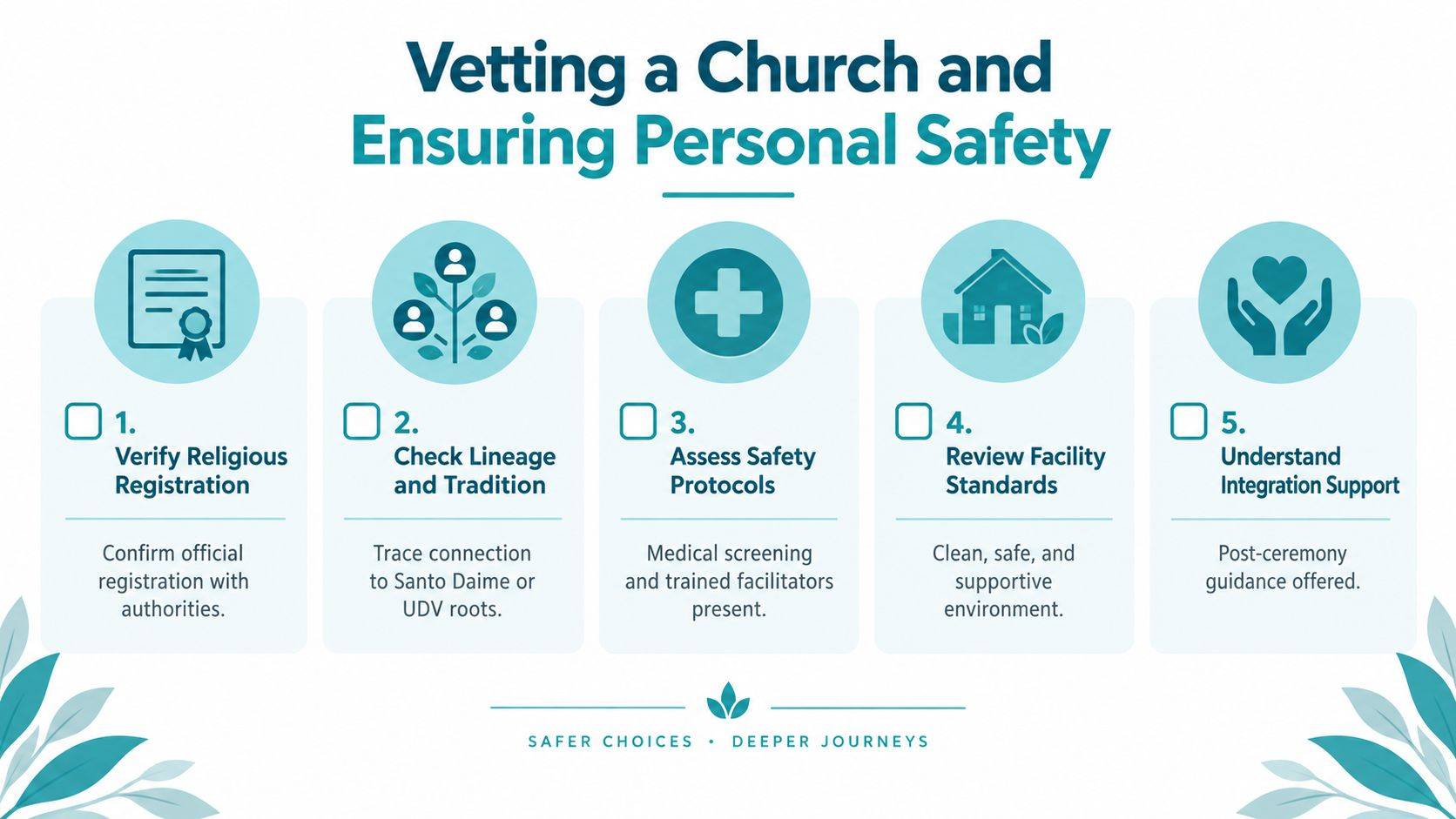
A seeker can reduce avoidable risk by treating church selection as an institutional assessment, not a holiday booking. The first question should be whether the group can explain its religious identity and operational rules without evasion. A serious organization won’t resent reasonable questions about leadership, screening, emergency procedures, accommodation, or what happens if a participant becomes distressed.
The gap between public assumptions and legal reality remains substantial. The strongest recent analysis indicates that Brazilian protection is specifically for ritual and religious use under CONAD, not for commercial retreats, even though general coverage often describes Ayahuasca as broadly legal in Brazil. This recent legal research is useful because it focuses attention on the difference between formal protection and practical operation.
Five Questions Before Participation
What religious tradition does the church follow? A group should identify its lineage, teachings, leaders, and relationship to a recognized tradition or local religious history. Vague references to “ancient wisdom” aren’t enough.
How does the group screen participants? Responsible screening asks about medications, psychiatric history, cardiovascular concerns, pregnancy, and other conditions that may affect safety. A center that admits everyone without questions places commercial convenience above duty of care.
Who supervises the ceremony? Participants should know whether leaders have experience managing physical distress, panic, confusion, or a participant who needs medical attention. The group should explain how emergency transport and outside medical support would work.
What does the contribution pay for? Maintenance-oriented communal contributions fit a religious setting more naturally than a menu of premium packages, guaranteed results, or escalating charges for access. Transparency doesn’t prove legality, but secrecy and aggressive sales language are strong warning signs.
What support follows the ceremony? Integration can involve conversation, rest, journaling, spiritual counseling, or referral to qualified mental health care. A church that ends its responsibility when the session ends may leave participants alone with difficult material.
Red Flags In The Physical And Social Setting
A clean, secure facility matters. Participants should have access to drinking water, toilets, ventilation, safe sleeping arrangements where relevant, and a quiet place away from the main ritual if someone becomes overwhelmed. Leaders should respect personal boundaries, explain touch policies, and avoid treating resistance or discomfort as proof that a participant must surrender control.
Background checks can also support responsible institutional practice, especially when organizations rely on volunteers who interact with vulnerable participants. A church administrator researching screening procedures may consult this resource on church volunteer background checks as part of a broader safeguarding policy.
Dietary preparation, often called dieta, should be presented carefully. Traditional restrictions may have spiritual meaning, but no dietary instruction replaces medical screening or professional advice. Participants should disclose relevant health information openly and should never stop prescribed medication without speaking with the prescribing clinician.
Integration And The Future Of Ayahuasca Research
A ceremony ends when the ritual ends, but the participant’s process often continues. Integration means translating an intense experience into ordinary decisions, relationships, habits, and values. Religious communities may support this through prayer, conversation, study, service, repeated participation, or guidance from trusted leaders.
The most useful integration avoids two extremes. One treats every vision as a literal instruction that must be obeyed immediately. The other dismisses the experience as meaningless once the ceremony is over. A careful approach records what happened, identifies emotional themes, waits before making major decisions, and tests new interpretations against daily life.
Religious Meaning And Clinical Language
Brazilian churches frame Ayahuasca as a sacrament, not as a medical intervention. The regulation treats the brew as a religious substance rather than a medicine or commercial product, and it requires brewing, storage, distribution, and consumption to remain integral to religious use, as summarized in this account of Brazilian Ayahuasca law.
That distinction should guide conversations about research. Scientists may study pharmacology, psychology, ethnobotany, or cultural meaning, while church members may understand the same experience through prayer, revelation, discipline, and community. Neither vocabulary should automatically replace the other. Researchers need cultural humility, and participants need clarity about whether a setting offers religious practice, clinical research, informal support, or a commercial service.
A Grounded Integration Practice
A practical post-ceremony process can include:
- Write without overinterpreting: Record sensations, emotions, memories, and recurring themes before assigning fixed meaning.
- Talk with a trusted person: Choose someone who can listen without glorifying every insight or dismissing the religious context.
- Keep ordinary routines: Sleep, hydration, food, work, and social connection help the participant regain perspective.
- Delay irreversible decisions: Intense conviction can feel final immediately after a ceremony. Time allows reflection.
- Seek qualified care when needed: Persistent fear, confusion, insomnia, mood instability, or difficulty functioning deserves professional attention.
A church’s integration role should have clear limits. Spiritual leaders can offer religious guidance, but they shouldn’t present themselves as medical professionals unless they hold the relevant qualifications. Participants deserve referrals when psychological or physical concerns exceed the community’s competence.
Research With Cultural Responsibility
Future Ayahuasca research can contribute valuable knowledge about the brew, its constituent plants, ceremonial settings, and reported experiences. That work should distinguish religious use from recreational consumption and avoid extracting knowledge from Indigenous and Brazilian communities without proper respect, consent, and recognition.
For seekers, the central lesson is practical. A meaningful experience doesn’t depend on chasing the strongest ceremony or the most dramatic promise. It depends on entering a transparent religious environment, understanding the legal boundaries, preparing responsibly, and allowing enough time for insight to become conduct.
A prospective participant should contact a church directly, ask for its registration and safeguarding policies, disclose relevant health information, and confirm that the ceremony is religious rather than a commercial experience presented under spiritual branding. Anyone researching Brazilian traditions can also review educational material from Ayahuasca.com, including its country-specific guidance, while comparing that information with the church’s own documentation and local legal advice.
Before booking travel or attending a ceremony, verify the organization’s religious identity, leadership, participant screening, emergency plan, contribution structure, and integration support in writing. Choose a community that treats Ayahuasca as a sacrament, respects Brazilian law, protects participant dignity, and answers careful questions without pressure.
Disclaimer: The information provided on Ayahuasca.com is for educational purposes only and is not intended as medical advice, diagnosis, or treatment. Ayahuasca is a powerful traditional Amazonian medicine and may not be suitable for everyone. Always consult with a qualified healthcare professional before making decisions related to health, mental well-being, medications, or the use of Ayahuasca.