
You may be reading this with a dozen browser tabs open, a mix of curiosity and caution, and a quiet question in the background. Could Ayahuasca help me heal something I haven’t been able to reach any other way?
That question deserves a careful answer. Ayahuasca healing sits at the meeting point of sacred tradition, altered states, emotional truth, and modern research. For some people, it becomes a meaningful chapter in recovery, spiritual growth, or personal change. For others, it can be overwhelming, poorly timed, or unsafe without the right support.
A grounded approach helps. Think of this path less like booking a wellness getaway and more like preparing for a demanding expedition. You need the right map, the right guides, honest self-assessment, and respect for the terrain.
An Introduction to Ayahuasca Healing
Many people arrive at Ayahuasca after a long season of trying to function while carrying something heavy. Sometimes it’s grief. Sometimes burnout. Sometimes a pattern that keeps repeating despite therapy, insight, or genuine effort.
Ayahuasca often enters that moment as a possibility for deeper work. Not casual work. Deep work.
Why so many people are paying attention
Ayahuasca comes from Indigenous knowledge systems of the Amazon, where it has been used in ceremonial and healing contexts for generations. In recent years, interest has spread far beyond those traditional settings.
A 2023 report estimating that more than 4 million people globally have consumed Ayahuasca, and that tourist retreats in Amazonian countries and Costa Rica served an extrapolated 62,000 individuals in 2019 across 232 centers shows how far this practice has expanded.
That growth tells two stories at once. One is openness. People are looking for help with depression, trauma, addiction, meaning, and disconnection. The other is responsibility. As Ayahuasca moves into global wellness culture, respect for Indigenous tradition and serious safety standards become more important, not less.
What healing usually means here
Ayahuasca healing doesn’t usually look like a neat, polished self-improvement experience. It can involve strong emotions, physical discomfort, vivid memories, spiritual insight, and moments of unusual clarity.
Some people describe it like cleaning out an old house. You open doors that have been stuck shut. Dust rises. Forgotten things appear. Then, if you stay with the process and integrate it well, there’s more space to live authentically.
“Ayahuasca can be sacred, therapeutic, and disruptive all at once. Those qualities are part of why discernment matters so much.”
A wise first question
Before asking where to go, ask whether this path is appropriate for you right now. Your health, medications, mental state, support system, and expectations all matter.
If you’re in that evaluation stage, this guide on whether Ayahuasca is right for you is a useful starting point.
How Ayahuasca Works for Mind and Body
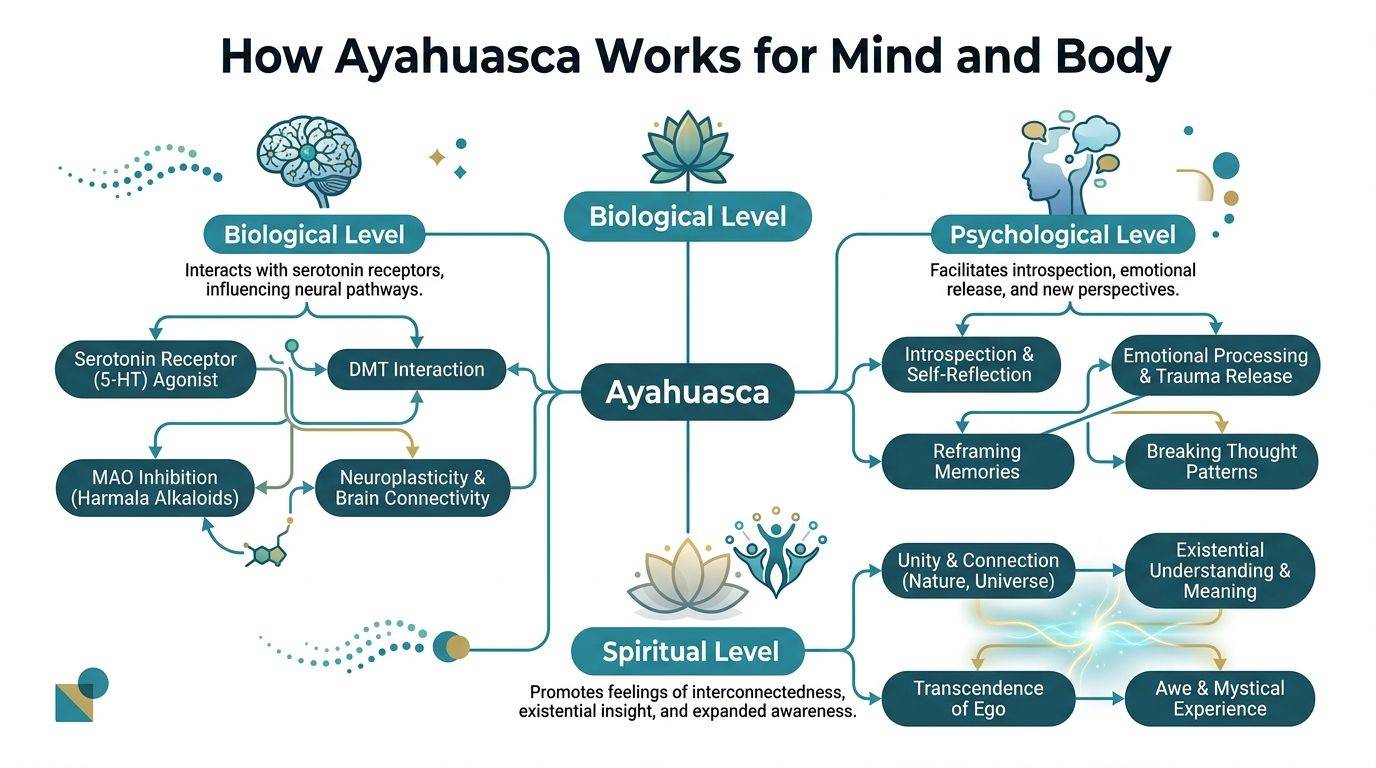
Ayahuasca can sound mysterious until you break it into simple parts. The brew is often made from Banisteriopsis caapi vine and Psychotria viridis leaf. Their interaction is a big part of why the experience is so distinct.
A simple analogy helps. Think of Ayahuasca as a symphony.
The orchestra analogy
One part of the brew acts like the conductor. The vine contains compounds such as harmine that inhibit monoamine oxidase, often shortened to MAO. That matters because MAO would normally break down the DMT in the leaf before it could take effect when taken orally.
The leaf carries DMT, which is more like the lead instrument. On its own, swallowed DMT wouldn’t be heard clearly by the body in the same way. With the conductor in place, the music can be played.
That synergy is why the brew works as a combined medicine rather than as a single isolated ingredient.
What happens in the brain
One of the more confusing ideas for first-time seekers is the Default Mode Network, or DMN. In plain language, the DMN is involved in the ongoing story of “me.” It helps maintain habitual thinking, self-referential loops, and familiar identity patterns.
When researchers say Ayahuasca affects that network, a practical translation is this. The usual mental traffic can loosen.
A Frontiers review describing Ayahuasca as fostering hyperconnectivity in the brain and dissolving the Default Mode Network, with EEG alpha suppression and gamma enhancement linked to reappraisal of traumatic patterns and rapid antidepressant effects through increased BDNF gives language to what many people report experientially.
That can feel like stepping off a well-worn mental path and suddenly seeing the whole situation from above.
Why that can feel healing
When ordinary defenses soften, people may encounter memories, grief, fear, or insight with less avoidance. This doesn’t mean the experience is easy. It means the mind may become more flexible.
Here’s a grounded way to picture it:
- Old pattern: “I always fail. I already know how this story ends.”
- Shifted perspective: “I learned that belief early. It shaped me, but it may not be the whole truth.”
That gap matters. In psychotherapy, healing often begins when a person can witness a pattern instead of being fully trapped inside it. Ayahuasca may open that witnessing space.
Mind, body, and spirit move together
People sometimes separate the biological from the spiritual, as if one cancels out the other. In practice, many Ayahuasca experiences involve both.
You might feel a surge of emotion and understand it psychologically. At the same time, you may experience it symbolically or spiritually. A person grieving a parent might cry, remember specific moments, feel tension release from the chest, and also sense forgiveness in a way that feels larger than language.
That overlap can confuse people who want a clean category. Ayahuasca rarely stays in one category.
“Practical rule: You don’t need to decide whether every part of an Ayahuasca experience is chemical or spiritual. You do need to notice whether it leads to clearer, kinder, more responsible living afterward.”
What the body may experience
The experience often lasts several hours. It can include nausea, vomiting, shifts in temperature, trembling, tears, intense visuals, and a strong inward focus.
Many traditions view purging as part of the healing process. Some people interpret it physically, others emotionally, others spiritually. You don’t have to force a single meaning onto it. What matters is understanding that the body is involved, not just the mind.
The Transformative Potential of Ayahuasca Healing
People are often drawn to Ayahuasca because conventional routes have helped, but not fully. The interest isn’t only spiritual. It’s also clinical, emotional, and practical.
When the conversation stays balanced, Ayahuasca healing becomes easier to understand. There is real promise. There are also limits, unanswered questions, and major differences between a meaningful ceremony and a chaotic one.

Depression and rapid change
One reason Ayahuasca entered scientific discussion so strongly is its potential in difficult depression cases.
That finding matters because treatment-resistant depression is exactly where many people feel out of options. The appeal of Ayahuasca isn’t just intensity. It’s the possibility of movement when someone has been stuck for a long time.
Why a single ceremony can feel so consequential
A single ceremony doesn’t magically solve a life. But it can create a concentrated encounter with material that has been buried, defended against, or intellectually understood without being emotionally metabolized.
Three things often happen together:
- Emotional access becomes stronger. Feelings that were muted or compartmentalized may come forward.
- Perspective widens. People can sometimes see their history with less self-punishment and more context.
- Meaning reorganizes. A painful event may stop feeling like random damage and start becoming part of a coherent story of survival, grief, or growth.
That combination can feel like years of inner material becoming visible in one night. The challenge is what comes next.
Trauma healing and the careful middle ground
Ayahuasca can help people revisit painful experiences in a way that allows reinterpretation, release, and new insight. That’s why trauma survivors are often interested in it.
But oversimplified storytelling becomes dangerous. Surfacing trauma is not automatically healing. A person needs enough support, timing, and nervous system capacity to process what arises.
For some, the medicine experience is like opening a pressure valve safely. For others, it can feel more like opening a floodgate. The difference often lies in preparation, facilitation, and integration.
Addiction and pattern interruption
Addiction work with Ayahuasca is especially interesting because it appears to involve more than chemistry alone. The medicine may help interrupt rigid behavioral loops, but the ritual container appears to matter as well.
People in recovery often describe seeing the emotional architecture of their substance use more clearly. They may recognize the loneliness beneath compulsive behavior, the grief beneath numbing, or the fear beneath control.
A useful image is a trail through the woods. Addiction can become a path so frequently traveled that it feels like the only route available. Ayahuasca may help a person notice the trail, step off it briefly, and imagine another route. The ongoing work is learning to walk that new route repeatedly in daily life.
Here’s a short conversation that captures the shift many people report:
“I thought the substance was my problem. Then I saw the pain I was using it to manage.”
That kind of insight doesn’t complete recovery, but it can deepen motivation and honesty in a way that talk alone sometimes doesn’t.
Healing includes spiritual dimensions for many people
Some of the most significant outcomes people report aren’t easy to reduce to symptom language. They may speak about forgiveness, connection, humility, reverence, grief turning into love, or a renewed sense of belonging in life.
For some readers, that sounds abstract. In practice, it can be concrete. A person who has lived in chronic self-rejection may leave with a felt experience of worth. A parent may return home and relate with more patience. Someone who has been emotionally numb may begin praying, journaling, or speaking openly for the first time in years.
Later in the process, hearing another perspective can help frame what that transformation can look like in lived experience.
The balanced view
Ayahuasca healing has legitimate therapeutic potential. It can catalyze insight, emotional release, behavioral change, and spiritual renewal.
It also has limits. One ceremony can open a door. It can’t build a life for you.
Navigating Your Journey With Safety and Awareness
Safety is where maturity shows up. Plenty of people are attracted to the breakthrough. Fewer are willing to respect the screening, restraint, and preparation that make a breakthrough safer.
Ayahuasca is not appropriate for everyone. Medical history, psychiatric history, medications, and the quality of facilitation all matter.
The risk many people underestimate
Ayahuasca can bring buried material to the surface quickly. For some trauma survivors, that can support healing. For others, especially without strong support, it can become destabilizing.
A review discussing retraumatization risk noted that some broader psychedelic research suggests 20-30% of participants experience intensified distress without proper support. That doesn’t mean Ayahuasca is harmful. It means support quality changes outcomes.
“Safety isn’t separate from healing. Safety is part of healing.”
Key Ayahuasca contraindications
| Category | Specific Contraindication | Reason for Concern |
|---|---|---|
| Medications | SSRIs and other medications with MAOI interaction risk | The brew involves MAO inhibition, so certain medication combinations can be dangerous and require medical review |
| Cardiovascular | Certain heart conditions | Ayahuasca can place stress on the body and may increase risk in vulnerable individuals |
| Psychiatric | Psychotic disorders or a history that suggests elevated psychosis risk | Altered states may intensify disorganization, fear, or loss of reality testing |
| Trauma history | Severe unresolved trauma without support | The experience can surface overwhelming material that needs skilled containment |
| General readiness | Lack of screening or pressure to participate | A retreat that doesn’t assess fit is showing poor judgment before ceremony even begins |
Set and setting as a safety system
People often hear “set and setting” and think of ambiance. It’s much more than that.
Set means your inner state. Your expectations, emotional readiness, current stress level, and intention all shape the experience.
Setting means the external environment. The people present, the skill of facilitators, the ceremonial structure, the response plan if something goes wrong, and the quality of post-ceremony care all matter.
A caring setting doesn’t guarantee an easy night. It does make it more likely that difficulty becomes workable rather than chaotic.
Questions worth asking before you commit
Use direct questions. If a retreat gives vague answers, take that seriously.
- Medication review: Ask how they screen for MAOI-related contraindications and what medical information they require in advance. This guide on foods and meds to avoid with MAOIs helps you understand why that screening matters.
- Psychological screening: Ask who evaluates trauma history, panic history, or psychosis risk.
- Emergency plan: Ask what happens if someone becomes medically or psychologically unstable during ceremony.
- Integration support: Ask what they offer after the ceremony, not just during it.
Red flags that should slow you down
A safe facilitator won’t promise enlightenment, a cure, or guaranteed transformation.
Be wary if a center minimizes medication risks, dismisses your history, or frames caution as lack of faith. Mature facilitators know that discernment is part of the work.
Preparing for and Integrating Your Experience
The ceremony is the visible part of the process. Preparation and integration are what give it shape.
A simple way to understand this is to think of Ayahuasca as rain on soil. If the ground is hard and cluttered, the water runs off. If the ground is prepared and tended afterward, something can grow.
Before ceremony matters more than most people expect
Preparation is partly physical and partly relational. You’re building a more stable inner environment before entering an unstable one.
Many people follow some form of dieta, simplify stimulation, reduce alcohol or other substances, journal, and spend more time in reflection. The practical purpose is focus. When you enter ceremony less scattered, you’re often better able to work with what appears.
Intention also matters, though not in a wish-list sense. A strong intention is more like a compass than a demand. “Show me how to heal my relationship with fear” is useful. “Give me a perfect mystical experience” usually isn’t.
Why ritual context changes outcomes
Research on addiction suggests that Ayahuasca’s effects are not just about the compounds in the brew. A review on Ayahuasca and addiction treatment describes efficacy as tied to ritual context, with structured set and setting enhancing the neuroplastic effects of its alkaloids and isolated pharmacology lacking the same efficacy without supportive ceremonial space and integration practices.
That fits what many facilitators observe on the ground. The songs, pacing, group field, preparation, and post-ceremony reflection aren’t decorative extras. They shape how the experience lands.
Integration is where insight becomes behavior
People sometimes return from ceremony with pages of insight and no plan to live any of it. That’s like receiving seeds and never planting them.
Integration asks practical questions:
- What did I see about my habits?
- What relationship needs honesty now?
- What did my body communicate?
- What support do I need so this doesn’t fade into a dramatic memory?
A helpful orientation is to review what the Ayahuasca experience can feel like and what to expect before you go, then revisit your notes afterward with fresh eyes.
“Integration note: Keep the first changes small and specific. One honest conversation, one daily journal practice, one therapy session, one firmer boundary.”
Practical ways to integrate well
Different people need different tools. Start with what helps you stay honest and regulated.
- Journaling: Write down images, emotions, bodily sensations, and any actions the experience seemed to ask of you.
- Therapy or counseling: A skilled therapist can help translate symbolic material into grounded change.
- Meditation and breathwork: These can help you revisit insights without needing another ceremony.
- Time in nature: Many people find that quiet outdoor time helps the experience settle into the body.
- Community: Trusted peers can help you distinguish between genuine insight and post-ceremony inflation.
What not to do right away
Try not to make sweeping life decisions in the emotional afterglow. If the ceremony reveals that a change is needed, let that realization breathe.
Big truths often become clearer when you’ve slept, eaten, talked, and reflected for a while.
How to Choose a Vetted Ayahuasca Retreat
Choosing a retreat is less about the jungle view, the room style, or how polished the website looks. It’s about whether the people running it show integrity before you ever arrive.
That may sound obvious, but many seekers still get pulled toward aesthetics, promises, or urgency. A safe decision usually comes from slower questions.
Start with the retreat’s behavior, not its branding
A credible retreat should be able to explain how it screens participants, who leads ceremony, what lineages or training inform the work, how medical concerns are handled, and what support exists after ceremony.
If answers are slippery, romanticized, or defensive, pay attention. The retreat experience will usually amplify the organizational culture that was already there.
What a solid center can explain clearly
Use these criteria as a practical filter:
- Screening process: They should ask about medications, psychiatric history, trauma history, and physical health in a serious way.
- Facilitator experience: They should explain who leads, what their background is, and how participants are supported during difficult moments.
- Ceremonial structure: They should describe how the space is held, how many participants attend, and how care is maintained through the night.
- Integration support: They should offer some form of follow-up, reflection guidance, or referral pathway after the retreat.
- Respect for tradition: They should speak about Ayahuasca as more than a product.
Red flags that deserve a hard no
Some warning signs are simple.
- Grand promises: Claims of guaranteed healing, instant awakening, or universal suitability.
- Pressure tactics: Urgency, emotional manipulation, or dismissal of your concerns.
- No clear screening: If anyone can book with almost no review, that’s a problem.
- Thin aftercare: If the center’s relationship with you ends the morning after ceremony, the container may be too weak.
“A retreat earns trust through its procedures, not through mystical language.”
One practical place to research options
If you want a starting point for comparing centers, Ayahuasca.com provides educational resources and a curated directory of vetted retreats, which can help you compare safety practices, retreat style, and preparation standards in one place.
The best fit is personal, not generic
A retreat can be ethical and still not be right for you. One person may want a more traditional setting. Another may need stronger structure, more preparation support, or a setting that feels less austere.
The right question is not “Which retreat looks most powerful?” It’s “Which retreat shows the maturity, clarity, and care that match my needs?”
Your Path Forward with Ayahuasca Healing
Ayahuasca healing asks for more than curiosity. It asks for honesty, preparation, respect for tradition, and a willingness to keep working after the ceremony ends.
The medicine may open insight. Your daily life is where that insight becomes real.
If you continue exploring, stay close to grounded resources. Read carefully. Ask direct questions. Talk with experienced practitioners, informed clinicians, or trusted peers who value both safety and humility. Books on psychedelic integration, documentaries that treat Indigenous traditions respectfully, and education from established Ayahuasca organizations can all help you refine your judgment.
A good next step is simple. Slow down enough to choose wisely. The strongest journeys usually begin that way.
Frequently Asked Questions About Ayahuasca
Is purging necessary for healing
Not always in a literal sense, but it’s common and often meaningful within Ayahuasca traditions. Some people vomit, cry, shake, or sweat. Others don’t. The important question is less “Did I purge?” and more “What moved through me, and how am I integrating it?”
How many ceremonies should a first-timer do
There isn’t one correct number for everyone. Some people prefer a single carefully supported ceremony. Others choose a short retreat with more than one ceremony so they have time to settle, reflect, and re-enter the work. What matters most is safety, fit, and integration capacity.
What’s the difference between a traditional shaman and a modern facilitator
A traditional shaman usually works within a living lineage, with ceremonial forms and cosmology rooted in Indigenous practice. A modern facilitator may come from therapeutic, spiritual, or hybrid training. Either way, you want humility, experience, ethical boundaries, and strong safety practices.
Can I use Ayahuasca as a substitute for therapy
For some people, Ayahuasca complements therapy well. It may bring forward material that therapy can help process over time. It isn’t a universal replacement for ongoing mental health care.
What if I’m scared but still feel called
Fear is common. Sometimes it’s healthy caution. Sometimes it reflects the depth of the work ahead. Don’t rush to silence it. Get more information, review your health situation carefully, and speak with credible providers. A grounded yes is much safer than an impulsive one.
Disclaimer: The information provided on Ayahuasca.com is for educational purposes only and is not intended as medical advice, diagnosis, or treatment. Ayahuasca is a powerful traditional Amazonian medicine and may not be suitable for everyone. Always consult with a qualified healthcare professional before making decisions related to health, mental well-being, medications, or the use of Ayahuasca.