
So, you’re curious about Ayahuasca and its potential for healing. You’re not alone. People are drawn to this sacred plant medicine for deeply personal reasons, often looking for a breakthrough that has eluded them elsewhere. Our goal here is to give you a clear, grounded look at what that healing can look like, blending ancient wisdom with what modern science is beginning to understand.
An Ayahuasca journey is a process, not just a single event. It often starts with what many describe as a powerful “purge” or cleansing, which can be both physical and emotional. Think of it as clearing out the clutter to make space for deeper self-exploration. It’s a chance to face the old patterns, limiting beliefs, and emotional baggage that you’ve been carrying for far too long.
What Are The Healing Benefits Of Ayahuasca?
When we talk about the healing benefits of Ayahuasca, we’re talking about changes that can ripple through every part of a person’s life. While everyone’s experience is unique, a few key themes consistently surface in both personal stories and scientific studies. These are often foundational shifts in how people see themselves and their place in the world, not just temporary mood boosts.
To give you a clearer picture, let’s look at the most commonly reported outcomes.
Key Ayahuasca Healing Benefits At A Glance
This table breaks down the main areas where people often find relief and growth through Ayahuasca, along with the mechanisms thought to be at play.
| Area of Benefit | Reported Outcome | Primary Mechanism |
|---|---|---|
| Mental Wellness | Significant reduction in symptoms of depression and anxiety; a renewed sense of peace and mental clarity. | Neurochemical reset (serotonin system); new perspectives on personal struggles; increased self-awareness. |
| Addiction Recovery | Insight into the root causes of addictive behaviors, leading to a break in compulsive cycles. | Autobiographical insight; emotional release; spiritual connection that provides a new source of meaning. |
| Trauma Processing | The ability to revisit traumatic memories without being overwhelmed, fostering self-compassion and resolution. | Reduced fear response (amygdala activity); reframing of traumatic narratives; deep emotional release. |
| Spiritual Connection | A profound sense of interconnectedness with oneself, others, and the universe; a clearer sense of life purpose. | Ego dissolution; mystical-type experiences; direct encounters with a perceived “higher intelligence” or consciousness. |
These benefits are not just abstract concepts. They represent real, tangible changes in people’s lives, from finally overcoming a lifelong phobia to finding the strength to leave a toxic relationship.
A Look at the Core Benefits
Let’s dig a little deeper into what these benefits feel like in practice.
Mental Wellness: Many people leave their Ayahuasca experience reporting a significant lifting of the fog of depression and anxiety. They often talk about feeling a newfound sense of clarity and an inner peace they haven’t felt in years.
Addiction Recovery: For those struggling with addiction, Ayahuasca can offer a unique window into the why behind the behavior. By illuminating the source of the pain that fuels addiction, it can create a powerful opportunity to finally break free.
Trauma Processing: The experience can allow you to look at past trauma from a new, more detached, and compassionate viewpoint. It helps reduce the emotional charge, allowing for the release of deep-seated grief and shame.
Spiritual Connection: Participants frequently describe a powerful sense of connection: to their true selves, to others, and to the natural world. This often translates into a much stronger sense of meaning and purpose in their daily lives.
“The heart of the experience is really a journey into your own consciousness. It provides a space where you can look at your life and its challenges from a completely different angle, and that’s often where the real healing starts.”
Ultimately, Ayahuasca acts as a powerful catalyst for a deep and honest conversation with yourself. It creates the conditions for profound introspection and emotional release. To dive deeper into this process, you can learn more about how Ayahuasca facilitates personal transformation in our detailed article. By providing a path for this kind of radical self-reflection, an Ayahuasca journey can help you reconnect with your authentic self and move forward with more awareness and inner peace.
The Science Behind Ayahuasca and Mental Wellness
While the personal stories of healing are moving, what does the science say? The world of research is finally catching up to what ceremonial participants have known for years, providing a solid, evidence-based look at why Ayahuasca is gaining so much attention for mental wellness.
This is more than just anecdotes now. We now have compelling data showing that this sacred Amazonian brew can trigger measurable, positive changes in the brain and mind. This is especially true for those wrestling with persistent conditions like depression and anxiety. What we’re seeing is a validation of traditional wisdom through the lens of rigorous scientific inquiry.
Unpacking the Research on Mental Health
Recent studies have gone far beyond small, isolated groups. The largest-ever international survey on Ayahuasca use, which gathered data from thousands of individuals, gave us an unprecedented look at its long-term effects. The results were striking.
The study found that people who regularly participated in Ayahuasca ceremonies reported significantly less psychological distress and higher overall well-being. What’s more, these benefits were not just for the psychologically healthy; individuals with pre-existing mental health diagnoses showed just as much improvement. This points to Ayahuasca’s potential not just for wellness, but for building genuine resilience. In fact, a remarkable 70-80% of frequent users reported lasting improvements six months after their last ceremony.
This kind of data is a game-changer. It suggests the positive shifts can lead to stable, long-term improvements in how people feel and function, not just a temporary high.
The infographic below breaks down some of the most well-documented benefits.
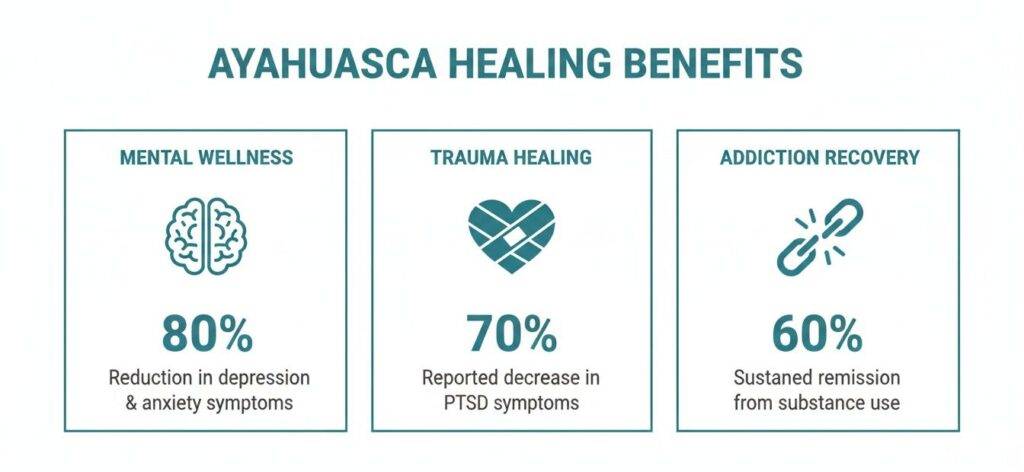
As you can see, the healing potential of Ayahuasca extends across mental health, addiction recovery, and trauma, pointing toward a more holistic path to personal well-being.
The Role of Mystical Experiences and Self-Insight
One of the biggest questions researchers have is how exactly Ayahuasca helps create these lasting changes. It seems the answer lies within the quality of the experience itself. The same large-scale survey discovered a powerful link: the more profound and mystical the experience, the greater the mental health benefits reported afterward.
“A mystical experience often involves a sense of profound interconnectedness, the dissolution of the ego, and direct encounters with deep personal truths. This fundamental shift in perspective appears to be what catalyzes the healing process.”
Think of it this way. For years, your mind has been running on the same well-worn tracks, reinforcing patterns of anxiety, self-criticism, or despair. An Ayahuasca journey can feel like lifting the train right off those old tracks and setting it down on a completely new line, one that offers a vantage point you never knew was possible.
This process is fueled by what researchers call profound self-insight. Many people report gaining stunning, deeply felt clarity on the root causes of their suffering. These are emotional, embodied realizations that can reduce distress by up to 20-30% in key areas, not just intellectual “a-ha” moments.
This connection between mystical states and psychological breakthroughs is a core element of Ayahuasca’s healing power. For a deeper dive into the studies, check out this excellent review of the scientific investigation of Ayahuasca.
How Ayahuasca Helps Heal Trauma and Addiction
Of all the healing benefits people report from Ayahuasca, its power to address trauma and addiction is often the most profound. These conditions can feel like a prison, trapping people in cycles of old wounds and compulsive behaviors that feel impossible to break. Ayahuasca seems to offer a way to get to the very heart of this suffering, not just manage the symptoms.
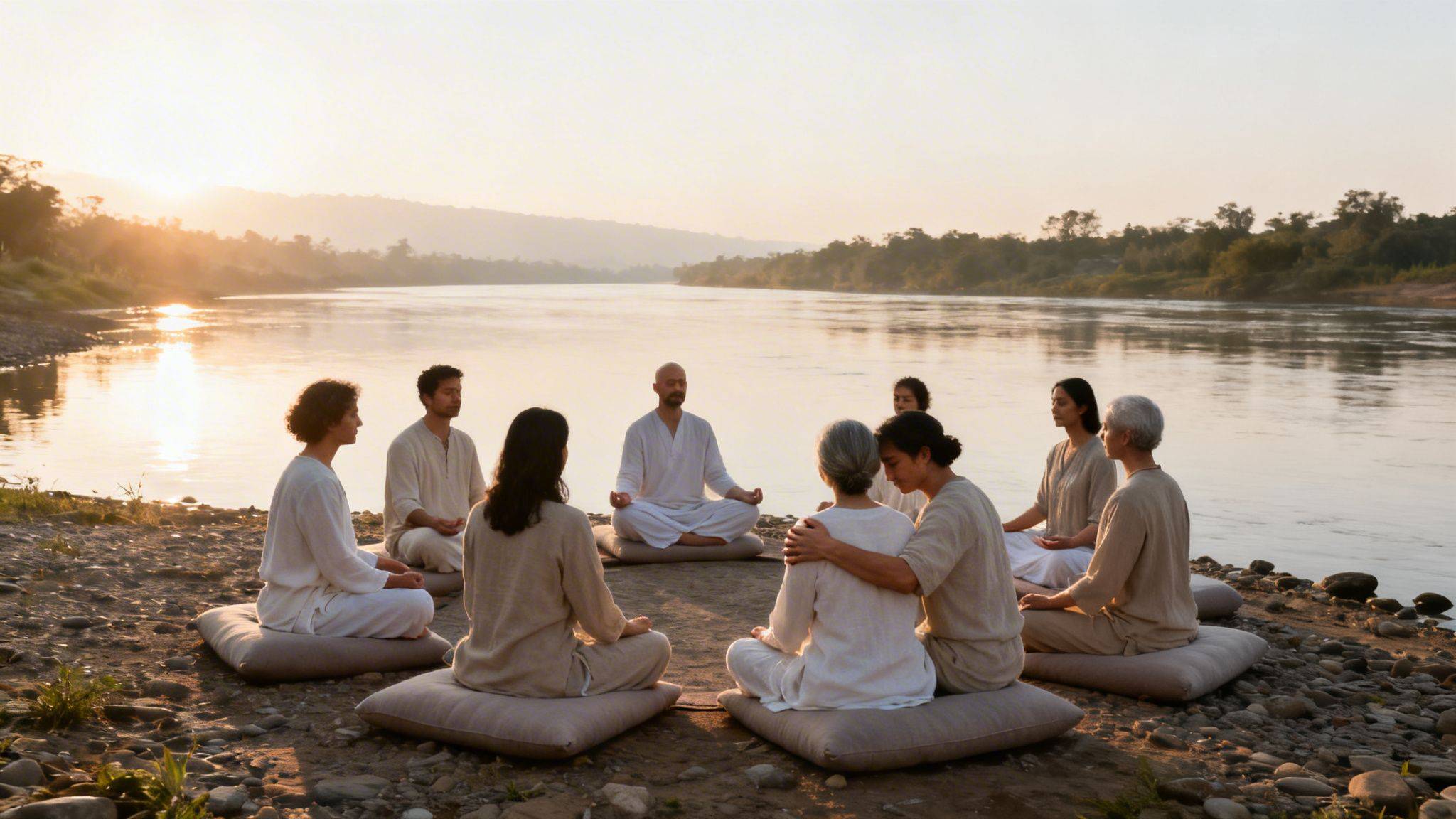
For someone carrying the weight of trauma, like post-traumatic stress disorder (PTSD), the Ayahuasca experience can feel like a profoundly deep and internally guided therapy session. It often allows a person to revisit painful memories, but from a completely different vantage point, one of safety and empowerment. This is about seeing the past without being swallowed by the original fear and pain, not just reliving it.
Fostering a New Perspective on the Past
Trauma has a way of locking people into rigid narratives of shame and self-blame. An Ayahuasca journey can dismantle these stories by flooding the system with self-compassion. Many people describe a sudden, overwhelming feeling of forgiveness for themselves, realizing their past actions were born from a need to survive, not from some inherent weakness.
This shift in perspective is the bedrock of real healing. When you reframe the story, the emotional charge tied to it starts to fade. The memory is still there, of course, but its power to hijack your daily life can be dramatically reduced.
“The experience often feels like accessing a wise, compassionate part of yourself that can look at your history with understanding rather than judgment. This allows for a deep emotional release that is difficult to achieve through conventional means alone.”
This is not just anecdotal. Longitudinal research following people who participate in ceremonial Ayahuasca use shows significant and lasting improvements. Months after their sessions, participants reported reductions in depression and anxiety scores by 15-25%. They also showed less shame and an increased ability to reframe negative thoughts, which are key for trauma recovery. A stunning 80-90% noted positive behavioral changes, like an increase in self-love. You can explore the full study about these lasting Ayahuasca healing benefits on Frontiers in Psychiatry.
Addressing the Root Causes of Addiction
When it comes to addiction, Ayahuasca gets to the “why” behind the substance use. The experience often cuts right through the surface-level behavior to illuminate the underlying pain, loneliness, or trauma that’s fueling the entire cycle. This is about gaining genuine insight, not just mustering more willpower.
For someone who feels stuck, this insight can be the catalyst for real change. The medicine can show you, in undeniable clarity, how the addiction is a misguided attempt to self-soothe or escape. This realization alone can break the spell of compulsion.
Here’s how this process often looks, both during and after a ceremony:
- Autobiographical Insight: The person finally understands the direct line connecting past events to their current addictive patterns.
- Emotional Catharsis: The ceremony provides a container to safely release the grief, anger, or fear that was being managed with the substance.
- A New Source of Meaning: The spiritual nature of the experience can offer a renewed sense of purpose, making old coping mechanisms far less appealing.
This approach fits perfectly with what we’re learning in addiction recovery: you have to heal the original wound. You can read more about blending traditional knowledge with modern approaches to treat drug addiction in our dedicated article. By providing a direct pathway to the source of the pain, Ayahuasca creates an opportunity to heal from the inside out, fostering a more sustainable and meaningful recovery.
One of the most profound things people discover through Ayahuasca is something ancient healing traditions have known for millennia: your mind and body are not two separate things. They’re in constant conversation. The connection between how you feel emotionally and how you feel physically is direct, powerful, and deeply intertwined.
An Ayahuasca experience often throws this link into sharp focus. You can literally feel how releasing a lifetime of stored-up emotional pain can lift a physical weight you didn’t even know you were carrying. It’s more like a full system reboot than just patching up symptoms, getting to the very roots of what makes you tick, or what makes you feel stuck.
The Science Behind Mind-Body Healing
The notion that our thoughts and feelings directly affect our physical health is a rapidly growing field of science, not “woo-woo” anymore. We know for a fact that chronic stress floods the body with hormones that fuel inflammation, mess with our immune system, and contribute to a long list of health issues. Ayahuasca seems to work right at this intersection, creating shifts you can feel in your soul and see in your bloodwork.
One systematic review that pulled together multiple studies gave us a fascinating look at this process. Researchers found that after using Ayahuasca, individuals struggling with depression had a significant drop in C-reactive protein, which is a primary marker doctors use to measure inflammation in the body. This is a huge deal, especially since we now believe inflammation is a major driver behind many cases of depression. It suggests that Ayahuasca can help calm the body’s inflammatory response, creating a much healthier internal environment for the mind to heal.
But it does not stop there. The same body of research found that these biological shifts go hand-in-hand with major lifestyle improvements. After their experiences, people just naturally started taking better care of themselves.
We’re talking about tangible changes like:
- Choosing healthier foods: A genuine, unforced desire for more nourishing meals.
- Drinking less: A significant drop in alcohol use, with many people self-reporting reductions between 30-50%.
- Feeling better: A more stable, positive mood day-to-day.
This is not about white-knuckling your way through a new diet or forcing yourself to skip a drink. The change comes from a much deeper place: a fundamental shift in how people see and feel about themselves.
“The experience can cultivate a sense of self-acceptance and compassion that just was not there before. When you genuinely start to like and respect yourself, treating your body with care becomes the most natural thing in the world.”
Learning to Watch the Storm, Not Stand in It
The psychological state that Ayahuasca can produce looks a lot like what dedicated, long-term mindfulness practitioners cultivate over years. Many participants report gaining an ability to step back from their own thoughts and judgments, a skill researchers call decentering. This is the capacity to observe your thoughts without getting swept away by them, and it’s been shown to reduce that frantic internal reactivity by as much as 25-40%.
Think of it like this: you can either be caught in a torrential downpour, soaked and struggling, or you can watch the same storm from inside a warm, dry house. The storm has not changed, but your relationship to it has. Ayahuasca can sometimes provide a powerful, accelerated lesson in how to build that inner shelter, leaving you with a lasting sense of calm and resilience.
The Physical Side of the Healing Coin
The physical benefits are not just a downstream effect of emotional healing, either. The plant compounds themselves seem to have direct healing properties. In one fascinating study, wound-healing assays showed that all nine of the plant extracts commonly used in Ayahuasca preparations helped skin fibroblasts, the cells responsible for repairing tissue, move to where they were needed. This points to a direct, biological healing capacity built right into the brew.
It all comes together in a powerful, positive feedback loop:
- The Ayahuasca experience helps you release emotional baggage and find self-acceptance.
- This new inner peace lowers stress and inflammation, directly improving your physical health.
- Feeling better in your body reinforces your positive state of mind and makes it easier to stick with healthy habits.
This virtuous cycle is really the core of Ayahuasca’s holistic healing potential. It’s about kickstarting a comprehensive shift that moves your entire being, mind, body, and spirit, toward a more integrated and balanced way of life, not just about a single change.
Of course. Here is the rewritten section with a more natural, human-expert tone.
Navigating Your Journey Safely and Responsibly
Learning about the incredible healing Ayahuasca can offer is one thing; preparing to experience it yourself is another entirely. This is not a casual undertaking. Approaching this powerful plant medicine requires deep respect, a clear mind, and a serious commitment to your own safety. It’s all about creating the right conditions for the medicine to do its work.
When you decide to sit with Ayahuasca, you’re making a profound commitment to yourself. The preparation is a mental and spiritual process, not just physical. By taking the right steps beforehand, you honor the ancient tradition, the medicine itself, and most importantly, you set the stage for a truly meaningful journey.
Understanding Medical Contraindications
First things first: your health. I cannot stress this enough: you must be completely transparent about your medical history. Ayahuasca contains compounds that can have dangerous, even life-threatening, interactions with certain medications and health conditions. This is where honesty with your retreat facilitator is non-negotiable.
The biggest red flag involves any medication that tinkers with your brain’s serotonin levels.
- Antidepressants (SSRIs, SNRIs, MAOIs): Combining these with Ayahuasca can trigger a condition called serotonin syndrome, which is a dangerous flood of serotonin in the brain. It’s a medical emergency.
- Antipsychotics: These can also cause unpredictable and seriously adverse reactions.
- Certain Heart Conditions: Ayahuasca gives your cardiovascular system a temporary workout, raising your heart rate and blood pressure. For someone with a pre-existing heart issue, this can be risky.
“Let me be crystal clear: you have to disclose every single medication and supplement you take to your facilitators. A reputable retreat will have a meticulous medical screening process and will not think twice about telling you it’s unsafe to participate. Your safety is, and always should be, the number one priority.”
The Importance of the Traditional ‘Dieta’
Once you’re medically cleared, the next phase of your preparation begins: the ‘dieta’. Think of this as more than just a diet. It’s a traditional practice of purifying your body and quieting your mind in the weeks leading up to a ceremony, making you more sensitive and receptive to the plant’s wisdom.
Physically, the dieta is about simplifying what you consume. You’ll typically need to avoid:
- Red meat and pork
- Spicy and heavily processed foods
- Excessive salt, sugar, and oil
- Fermented foods
- Caffeine and alcohol
By eating clean, you’re essentially reducing the physical “static” in your system. This allows the Ayahuasca to work more effectively and can also lessen the intensity of the physical purge, or “la purga.” On a behavioral level, the dieta usually means abstaining from sexual activity and tuning out distractions like news and social media. It’s a way to turn your attention inward and start the work before you even drink the medicine.
How to Vet a Retreat and Facilitator
This brings us to what might be the most critical decision you’ll make: choosing where you drink Ayahuasca and who serves it. The experience, integrity, and skill of your facilitators and the center they run will fundamentally shape your entire journey. A safe, well-held space is everything when you’re doing this kind of deep, vulnerable work.
When you’re researching potential retreats, do not be shy. Ask direct, specific questions. A trustworthy facilitator will welcome your due diligence and answer everything with transparency.
Key Questions to Ask a Potential Retreat Center:
| Category | Questions to Ask | Why It Matters |
|---|---|---|
| Facilitator Experience | How many years have you been serving medicine? Where did you train and for how long? | You want facilitators who have put in the time. Deep experience means they know how to hold a strong, safe space and can navigate the countless situations that can arise in a ceremony. |
| Group Size | What is the maximum number of participants per ceremony? What is your facilitator-to-participant ratio? | Smaller is almost always better. Look for groups of 10-15 people or fewer and a low participant-to-facilitator ratio. This ensures you’ll get individual attention if you need support. |
| Safety Protocols | What are your emergency procedures? Do you have medically trained staff on-site? How close is the nearest hospital? | This is non-negotiable. The center must have a clear, practiced plan for handling both psychological and medical emergencies. No excuses. |
| Screening Process | What does your medical and psychological screening process involve? | A robust screening process is a huge green flag. It shows the center prioritizes safety above profit and is willing to turn people away if the experience might be harmful for them. |
Taking the time to prepare properly and carefully vet your options is an act of self-love. It shows you’re ready to engage with this sacred medicine not as a tourist or a thrill-seeker, but as someone genuinely committed to their own healing and growth.
The Power of Integration: Weaving Insights into Daily Life
Many people think the Ayahuasca ceremony is the main event. It is not. The ceremony is the catalyst, but the real, lasting change happens in the days, weeks, and even months that follow.
We call this crucial period integration, and it’s where you learn to translate the profound, often overwhelming, insights from your journey into the actual fabric of your day-to-day life. Without it, the experience is just a powerful memory. With it, it becomes a blueprint for a new way of being.
An Ayahuasca journey can feel like a decade of therapy packed into a single night, delivering breathtaking clarity and deep emotional release. But here’s the thing: if you don’t consciously work with those breakthroughs, the vibrant feelings can fade, and old, familiar patterns have a way of creeping back in. Integration is the commitment to not letting that happen.
Grounding Your Insights in the Real World
Think of the insights from your ceremony as seeds of potential. Integration is the patient work of planting them, watering them, and making sure they get enough sun to grow. You have to become the gardener of your own inner world.
This is about taking the wisdom from that state and putting it into practice, not about desperately trying to cling to a mystical state. The overwhelming feeling of connection you experienced can become a daily commitment to being more compassionate. The stark realization about a draining relationship can become the strength to finally set a healthy boundary.
“Ayahuasca is a powerful catalyst for change, but you are the agent of that change. The medicine opens the door, but it’s up to you to walk through it and continue down the path.”
Practical Strategies for Effective Integration
Bringing such a huge experience back down to earth requires patience, self-compassion, and a good set of tools. The idea is to create a supportive container for your new awareness to settle in and take root. Here are some of the most effective strategies I’ve seen work time and again:
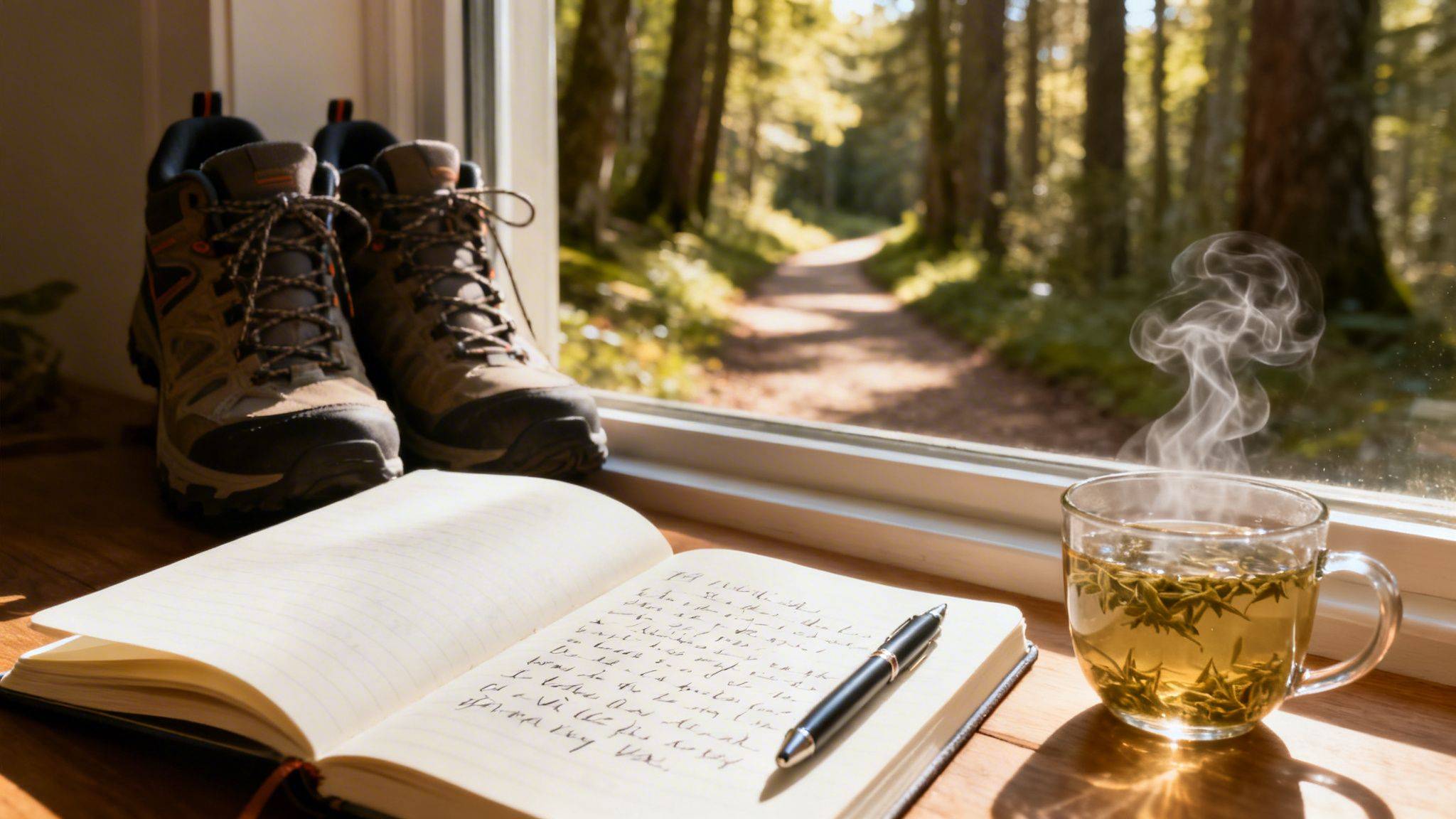
Journaling: Get it all down on paper while the experience is still vivid. Do not censor yourself; document the visions, the feelings, the confusing parts, and the core messages that came through. This journal becomes your personal map, a resource you can return to for months or even years.
Time in Nature: Ayahuasca has a way of reminding us that we’re part of the natural world. Simply spending quiet time walking in the woods, sitting by a lake, or feeling the sun on your skin helps keep you grounded and connected to that profound sense of belonging.
Embodiment Practices: Your body processes things your mind cannot. Practices like yoga, tai chi, dance, or simple, mindful breathing help move the lessons from your head into your very cells. This is how insights become instinct.
Professional Support: Do not go it alone. Talking with a therapist or a coach who specializes in psychedelic integration can be incredibly grounding. They can help you make sense of complex emotions and, most importantly, help you figure out how to turn “I should…” into “I am doing.”
Ultimately, integration is an act of deep respect for the journey you’ve undertaken and for yourself. It’s the promise you make to take what you’ve learned and use it to build a more authentic, connected, and meaningful life, long after the last echoes of the icaros have faded.
Frequently Asked Questions
As you explore the healing potential of Ayahuasca, it’s completely normal to have a lot of questions. This is a big decision, and being informed is the first step toward a responsible and meaningful journey. Let’s walk through some of the most common questions we hear.
How Long Do The Healing Benefits Of Ayahuasca Last?
This is the million-dollar question, and the honest answer is: it depends. Research shows us that measurable effects, like a drop in depression and anxiety scores, can stick around for months. But the deep, life-altering changes hinge almost entirely on one thing: integration.
Think of the Ayahuasca ceremony as the catalyst, not the cure. It can show you the door to a new way of being, but you’re the one who has to walk through it every day afterward. The real, lasting benefits come from taking the insights you gained and actively weaving them into your life: your habits, your relationships, and how you see the world. Without that commitment, the initial glow can fade.
Is One Ayahuasca Ceremony Enough For Healing?
For a small number of people, a single, profound ceremony can be the breakthrough they need to jump-start major change. That does happen. But for most, healing is more of a gradual unfolding that happens over several ceremonies, sometimes spread out over a few years. There’s no magic number.
“What’s far more important than the number of ceremonies is the quality of your intention, the safety of the container you’re in, and your dedication to the integration work that follows. Many indigenous traditions do not see Ayahuasca as a one-and-done fix, but as a lifelong relationship with a wise teacher.”
What Is The Difference Between A Therapeutic And A Spiritual Benefit?
In the world of Ayahuasca, the line between “therapeutic” and “spiritual” gets blurry very quickly; in fact, it often disappears altogether. A therapeutic benefit is something you can often measure, like a significant reduction in PTSD symptoms. A spiritual benefit might be something harder to quantify, like a sudden, deep sense of purpose or a feeling of being connected to everything.
But here’s what the experience so often reveals: they are two sides of the same coin.
For instance, the spiritual insight of feeling deeply interconnected with all people can directly produce the therapeutic outcome of reduced social anxiety. The Ayahuasca journey helps you see that your mental, emotional, and spiritual health are not separate boxes. They are all woven together, and healing in one area almost always sparks healing in another.
Disclaimer: The information provided on Ayahuasca.com is for educational purposes only and is not intended as medical advice, diagnosis, or treatment. Ayahuasca is a powerful traditional Amazonian medicine and may not be suitable for everyone. Always consult with a qualified healthcare professional before making decisions related to health, mental well-being, medications, or the use of Ayahuasca.