
A veteran may reach the same point after years of appointments, medication changes, group sessions, and coping strategies that keep life manageable without making it feel whole. The search then shifts online: ayahuasca retreat for veterans, PTSD, hypervigilance, moral injury, and the possibility of finding a different path in a ceremonial setting.
That curiosity deserves respect, but enthusiasm alone is a poor safety plan. Ayahuasca may produce meaningful symptom changes for some veterans, while the ceremony can also trigger intense traumatic re-experiencing. A responsible decision requires medical screening, honest psychiatric assessment, careful retreat selection, and an integration plan that begins before travel.
Why Veterans Are Looking at Ayahuasca Right Now
A former service member may have tried evidence-based care and still feel trapped in constant scanning, emotional shutdown, nightmares, anger, or guilt. Another may have left the military years ago but still feel disconnected from civilian life and from the unit-level identity that once provided structure. For some, the question isn’t whether conventional care has value. The question is whether conventional care has reached the parts of the injury that remain untouched.
That tension brings veterans to Ayahuasca. The brew has become part of a wider conversation about trauma, emotional processing, and approaches outside ordinary clinical routines. Veteran-focused organizations and retreat communities have also made the subject easier to find, particularly for people who feel that standard treatment has offered maintenance rather than a decisive shift.”
“Practical rule: Curiosity can justify research. It can’t replace screening.”
The evidence remains early and specific rather than definitive. A 2023 Johns Hopkins mixed-methods case series examined eight military veterans with PTSD symptoms after a three-day Ayahuasca intervention in Central America. The report found clinically meaningful improvement for many participants, but it was a small case series, not proof that every veteran will benefit. A later observational study also found encouraging changes among veterans who attended psychedelic retreats, while a separate observational study highlighted how often veterans relived difficult trauma during ceremony.
That combination should shape the decision. Ayahuasca isn’t a soft wellness weekend, a guaranteed cure, or a substitute for emergency psychiatric care. It can be spiritually meaningful and psychologically difficult in the same sitting. This guide focuses on what veterans should understand before booking, what a credible retreat should ask, which warning signs should end the conversation, and how to build support after returning home.
What Ayahuasca Actually Is and How Ceremony Works
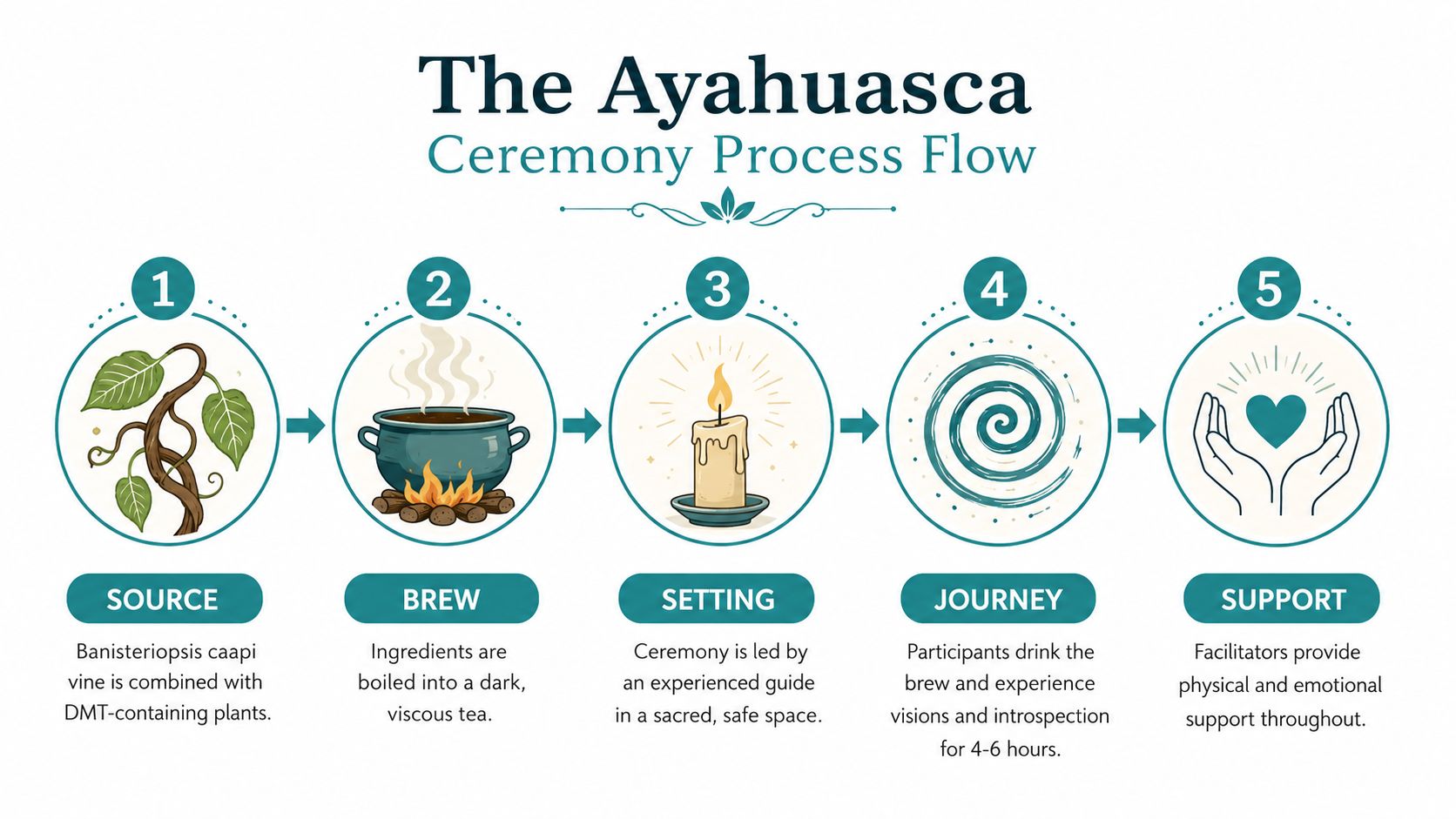
Ayahuasca is a psychoactive brew traditionally made by combining the Banisteriopsis caapi vine with plants that contain DMT. The vine supplies compounds that inhibit monoamine oxidase, allowing orally consumed DMT to become active. That interaction is why medication review matters, especially for veterans taking psychiatric drugs or other substances that affect serotonin, blood pressure, seizure risk, or mood stability.
A retreat ceremony usually follows a shared structure. Participants arrive in a prepared space, receive instructions, drink a measured serving, and remain in the ceremony area while facilitators monitor the group. The experience may involve visions, memories, strong emotions, nausea, vomiting, fear, bodily sensations, spiritual interpretations, or periods of quiet reflection. The ceremony generally continues through the night, with support available as the effects unfold.
A Guided Watch Rather Than A Party
A useful analogy for a veteran is a guided overnight watch. The participant remains alert to an unpredictable internal environment while trained people should maintain perimeter awareness, notice distress, and intervene when necessary. A retreat with strong safety practices will explain who watches each participant, how physical emergencies are handled, and when a facilitator will step in.
That analogy also shows why ceremony differs from recreational use. A ceremonial group may include ritual, music, silence, prayer, or traditional practices, while a clinical psychedelic protocol generally uses defined procedures, trained clinical personnel, and formal research oversight. Ayahuasca retreats vary widely, so the word “ceremony” says little about the actual standard of care.
Veterans researching unfamiliar terminology can review this plain-language beginner guide to what Ayahuasca is. The important questions are practical: what exactly is in the brew, who prepared it, how much is served, who remains sober, and what happens if a participant becomes disoriented, panicked, aggressive, medically unstable, or unable to consent to further contact.
What The Research Says About Veterans And PTSD
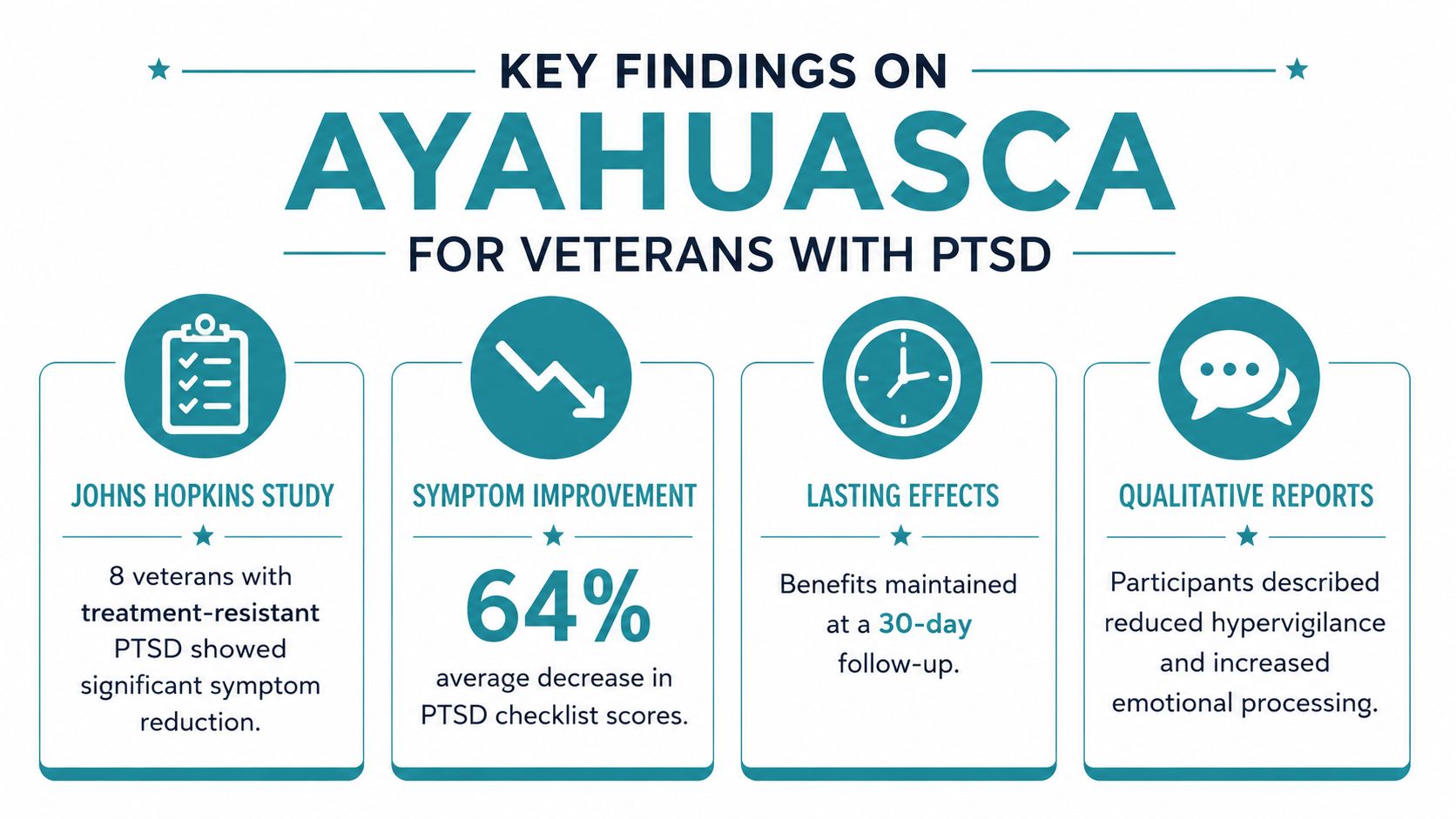
The most relevant evidence comes from veteran-specific work, and it points in two directions at once. The Johns Hopkins case series followed eight military veterans with PTSD symptoms after a three-day Ayahuasca intervention in Central America. Seven of eight participants, or 87.5%, showed reliable and/or clinically significant improvement immediately after treatment, and five of those seven responders, or 70%, retained the gains at three-month follow-up. The same report found that five of eight veterans, or 63%, reported moderate-to-large improvements in daily negative and positive affect. These figures come from the Johns Hopkins case series.
A related report on the same three-day intervention found that five of seven participants, or 71.4%, showed reliable clinical change on the PCL-5 immediately afterward, with five of seven, or 71.4%, maintaining that change at three months. The report also documented significant improvements in momentary PTSD symptoms and daily affect, alongside adverse acute experiences. That pairing matters. A participant can experience distress during the ceremony and still report later improvement.
A 2025 peer-reviewed observational study followed 58 U.S. and U.K. veterans who attended psychedelic retreats. Four weeks after retreat attendance, the largest average improvements appeared in depression, with a 29.1% reduction on the PHQ-9, and PTSD, with a 26.1% reduction on the PCL-5. Ayahuasca retreats showed a 26.4% PTSD score reduction, compared with 24.8% for psilocybin retreats, as reported in the peer-reviewed observational study.
Benefit And Distress Can Coexist
The risk picture becomes clearer in a larger observational study of 339 retreat participants, including 33 veterans. Nearly 60% of the veteran participants reported reliving at least one difficult event during ceremony, and the study identified veterans and people with PTSD as especially likely to experience adverse re-experiencing. The observational study on traumatic re-experiencing fills a gap that retreat marketing often leaves open.
The conclusion is straightforward. Meaningful symptom reduction is documented, but Ayahuasca can intensify traumatic material before a participant has the capacity to process it. Veterans should ask about trauma containment with the same seriousness used to ask about reported benefits. For people exploring overlapping substance use, trauma, and mental-health concerns, a resource on dual diagnosis trauma treatment may help clarify whether retreat travel fits within a broader care plan.
Screening Questions Veterans Should Answer First
A reputable retreat should screen a veteran before accepting payment. If the intake form asks only about food preferences, travel dates, and spiritual intentions, the process has already failed.
The veteran should prepare a complete medication and health history for a prescribing clinician and for the retreat medical team. The retreat may not be able to interpret every prescription, and a retreat facilitator mustn’t instruct anyone to stop medication without the prescriber’s involvement.
Medical And Psychiatric Questions
The following questions deserve direct, written answers:
- Current medications: Is the veteran taking an SSRI, SNRI, MAOI, lithium, stimulant, sleep medication, blood-pressure medication, or any drug that affects mood, serotonin, or seizure threshold?
- Recent medication changes: Has a dose recently changed, or has a medication been stopped? Abrupt discontinuation can create its own danger.
- Psychosis or bipolar history: Has the veteran experienced psychosis, mania, hypomania, or a strong family history of those conditions?
- Suicidality: Are there current suicidal thoughts, recent attempts, a plan, or difficulty staying safe without supervision?
- Neurological history: Has the veteran experienced TBI, seizures, unexplained loss of consciousness, or serious head injury?
- Physical health: Are there cardiac conditions, uncontrolled blood pressure concerns, or other conditions that could make an intense physiological experience unsafe?
- Pregnancy: Could the participant be pregnant, or is pregnancy being considered?
- Trauma exposure: What memories, body sensations, or situations reliably trigger panic, dissociation, aggression, or shutdown?
A current crisis, unstable mania, active psychosis, or inability to remain safe should end the retreat discussion for now. The appropriate next step is qualified clinical care, not an overseas ceremony.
Medication Interaction Table
| Medication Class | Example | Interaction Concern |
|---|---|---|
| Selective serotonin reuptake inhibitor | SSRI antidepressant | Possible interaction with the brew’s monoamine oxidase inhibition, plus uncertainty around stopping treatment |
| Monoamine oxidase inhibitor | MAOI antidepressant | High-concern interaction requiring direct prescriber review |
| Mood stabilizer | Lithium | Potential concern involving seizure risk, altered mental status, and medication changes |
| Stimulant | Prescription stimulant | Possible effects on heart rate, blood pressure, anxiety, and agitation |
| Blood-pressure medication | Antihypertensive drug | Possible additive blood-pressure effects or dizziness |
The table is a prompt for a prescriber, not clearance. The veteran should also ask about alcohol, cannabis, stimulants, supplements, and recreational drugs. Retreat dietary rules may restrict certain foods and substances, but a “dieta” doesn’t make an unsafe medication combination safe.
Veteran-Specific Programs And Pathways
A generic tourist retreat and a veteran-focused pathway can look similar on a website while functioning very differently. The meaningful distinction is whether the program understands service-related trauma, military culture, moral injury, TBI, suicide risk, reintegration, and the loss of unit identity.
Veteran-specific nonprofits, scholarship funds, peer-led cohorts, and clinical trials may offer a better first conversation than a commercial retreat found through an attractive testimonial. A peer cohort can reduce the burden of explaining military language, but shared identity doesn’t automatically equal clinical competence. Veterans still need independent medical screening and a plan for psychiatric support.
What A Stronger Pathway Adds
- Trauma-informed intake: Staff ask about dissociation, triggers, suicide risk, psychosis, mania, medication, and physical health.
- Peer accountability: Veterans can discuss expectations with participants who understand deployment and reintegration without treating military identity as a marketing device.
- Continuity after travel: The program maintains contact, offers integration support, and helps coordinate care after the participant returns home.
- Clear financial boundaries: Scholarship decisions and program costs are explained without emotional pressure or promises of transformation.
- Clinical separation: The program states what it can provide and what requires a licensed medical or mental-health professional.
A retreat that says every veteran should attend, discourages outside therapy, or frames doubt as a lack of spiritual readiness deserves caution. The same applies to programs that use military imagery to build trust but can’t explain their emergency procedures.
Veterans in Massachusetts who want a conventional clinical option alongside exploratory research can review information on PTSD treatment for MA veterans. That kind of parallel planning matters because an Ayahuasca retreat shouldn’t become the only available support.
The best pathway is usually the one that slows the decision down. A veteran should be able to speak with a clinician, a trusted peer, and the retreat’s actual safety lead before sending money or booking international travel.
How To Evaluate And Choose A Vetted Retreat
A retreat earns consideration through operational detail, not testimonials. The strongest programs answer difficult questions in writing, identify who holds responsibility during an emergency, and explain what happens when a participant becomes frightened or disorganized.
Green Flags
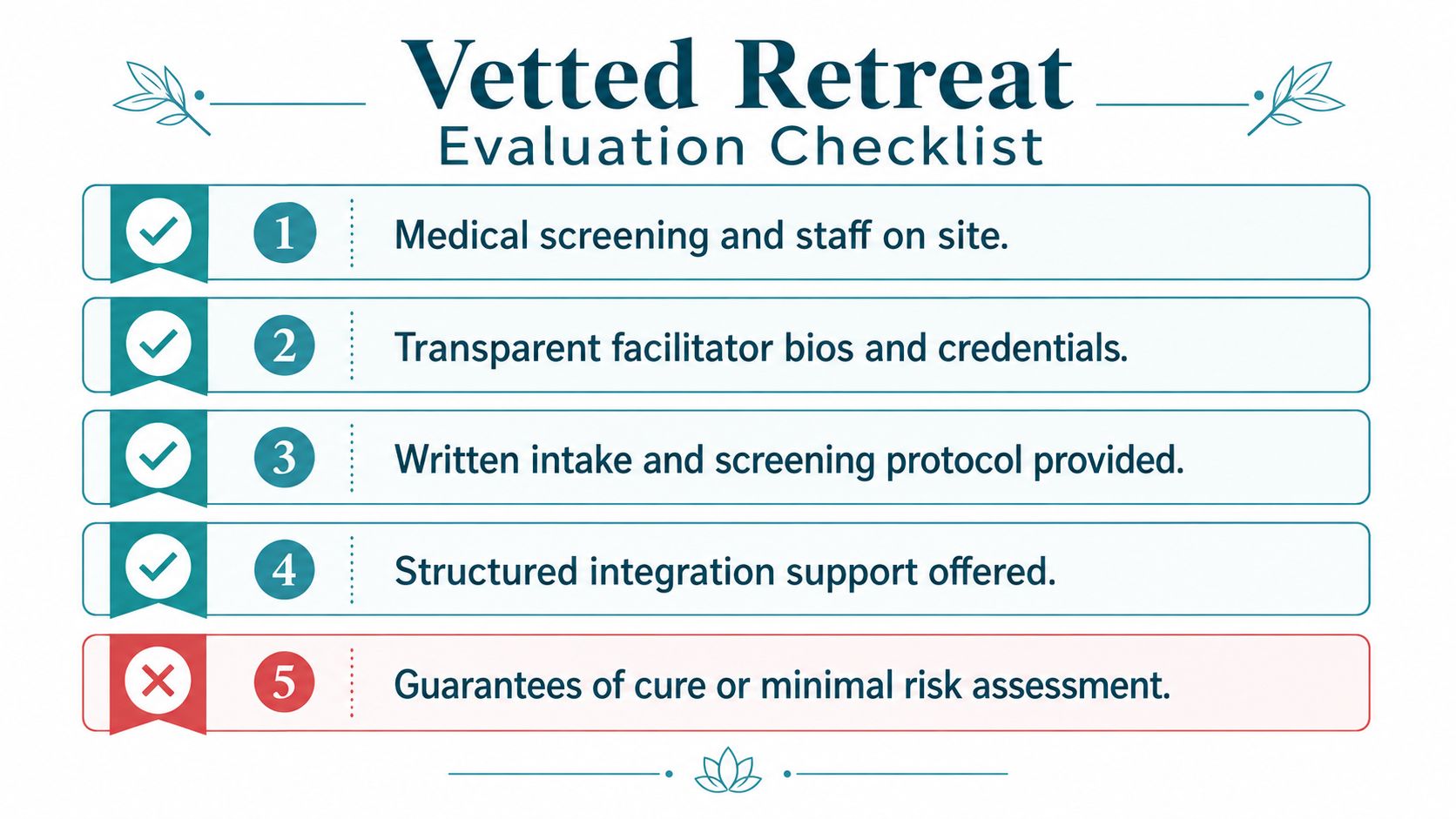
- Written medical screening: The retreat provides its intake questions before payment and explains contraindications.
- Qualified on-site support: The program identifies sober staff, medical personnel, and the limits of their roles.
- Transparent facilitator biographies: Names, training, responsibilities, and relevant experience are available for review.
- Defined emergency plan: Staff explain transportation, local medical care, communication, and evacuation procedures.
- Structured integration: The program offers facilitated processing after ceremony rather than ending support at checkout.
The retreat should explain ingredient sourcing and preparation without using secrecy as a substitute for safety. Participants should know what is in the brew, whether potency varies, how dosing decisions are made, and whether a participant can decline another serving without pressure.
Questions To Send Before Booking
- Who conducts psychiatric and medication screening?
- What conditions or medications lead to exclusion?
- How many sober facilitators remain present throughout ceremony?
- What happens if a veteran relives combat trauma and becomes unsafe?
- Is medical staff physically on site, and what emergency equipment is available?
- How does the retreat handle suicidal thoughts, psychosis, severe panic, or prolonged confusion?
- What integration contacts are provided after departure?
- Can the participant leave the ceremony space or stop participating?
- How are complaints, injuries, and boundary violations handled?
- What credentials can be independently verified?
A veteran can place two or three retreats in a simple comparison sheet and score only verifiable answers. Missing information should count against the program. The retreat structure and support guide offers another useful lens for examining how a retreat organizes care.
“A beautiful setting can’t compensate for weak screening, vague staffing, or no evacuation plan.”
Red flags include cure guarantees, pressure to book quickly, no contraindications conversation, secretive ingredient claims, facilitator worship, price-only urgency, and no aftercare. If staff treat questions as disrespect, the veteran should walk away.
Legal And Practical Logistics For U.S. Veterans
In the United States, DMT is classified as a Schedule I controlled substance. That legal status means Ayahuasca retreats generally operate outside the country, creating practical issues that a participant must resolve before departure.
Religious-use protections may exist in specific circumstances, but they aren’t a universal personal-use permission slip. A retreat’s religious identity doesn’t automatically protect every participant, every ceremony, or every cross-border transaction. Veterans should review the relevant religious freedom and exemption process and obtain qualified legal advice for circumstances that could affect employment, licensing, immigration, or family matters.
Travel And Care Coordination
A veteran should never carry Ayahuasca, DMT-containing plant material, or an unverified preparation across an international border. Import rules, customs enforcement, and local laws can differ sharply from the laws governing the ceremony location. The safest logistical assumption is that the brew stays where it was legally provided, if it was lawful there at all.
Medication planning requires equal care. Prescriptions may be legal in the United States but restricted in the destination country, and a veteran should confirm transport rules with the relevant authorities rather than relying on a retreat’s informal advice. Medication should never be stopped to satisfy a dieta without a prescribing clinician’s direction.
VA records and benefits require a practical conversation, not automatic fear. A veteran can ask a VA provider for help with medication safety, psychiatric stability, travel-related continuity, and post-retreat support without presenting the retreat as approved medical treatment. The provider may have limits on what can be endorsed, but clinical information about the veteran’s health remains relevant.
An other-than-honorable discharge can create separate eligibility questions for care, so the veteran should verify available services before traveling. International travel also needs a backup plan for missed flights, worsening symptoms, lost medication, and a trusted contact who knows the itinerary.
Preparation And Integration That Actually Stick
The ceremony ends before the work does. Veterans who treat the retreat as a single decisive event may return with powerful memories but no structure for translating those memories into sleep, relationships, work, treatment, or daily behavior.
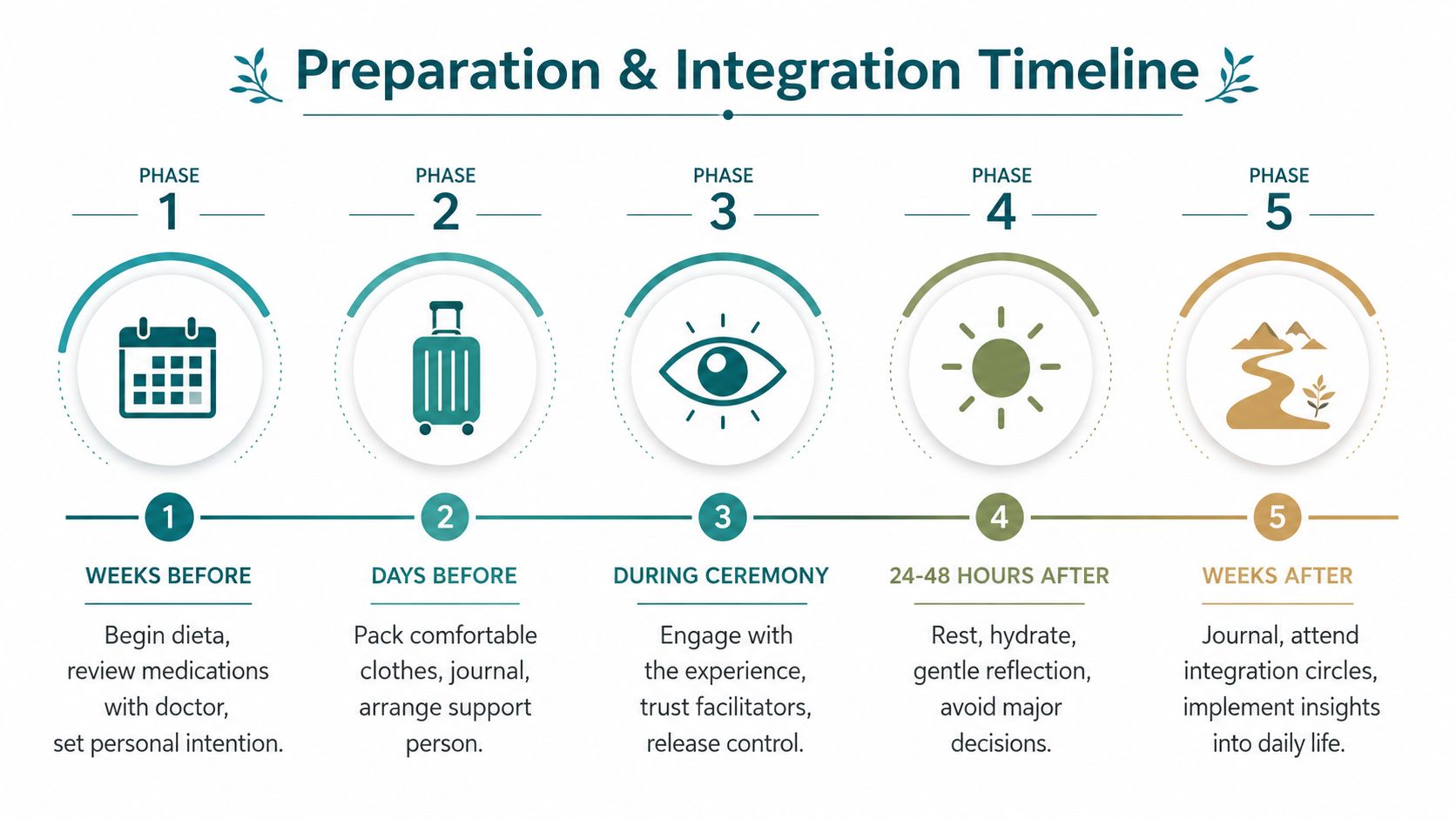
Preparation starts with medication review, honest intention setting, and practical support. The veteran should tell a trusted person where the retreat is located, who operates it, and how to make contact. A written list of medications, emergency contacts, diagnoses, allergies, and relevant medical history should travel separately from the phone.
Before And During Ceremony
The retreat’s dieta should be treated as a preparation protocol, not a medical guarantee. A veteran should ask which foods, supplements, substances, and medications are restricted, then take those questions to the prescribing clinician.
During ceremony, the participant needs a sober support structure and permission to communicate distress. Simple grounding tools can help: feeling both feet on the floor, naming objects in the room, slowing the exhale, orienting toward a trusted facilitator, and asking for space when touch or conversation feels overwhelming. No participant should be pressured to surrender control, accept physical contact, or consume more brew.
A Practical Integration Calendar
- First 24 to 48 hours: Rest, hydrate, eat gently, avoid major decisions, and record basic observations without forcing an interpretation.
- First weeks: Schedule a therapist or integration provider, attend a peer support group when appropriate, and write down recurring memories, dreams, emotions, and behavior changes.
- Around 30 days: Review sleep, substance use, relationships, work function, irritability, avoidance, and suicidal thoughts with a qualified professional.
- Around 60 days: Identify one or two concrete changes, such as repairing a relationship, improving a routine, or returning to a valued activity. Avoid turning every insight into a life overhaul.
- Around 90 days: Reassess symptoms with the treating clinician and decide whether further care, additional support, or no further psychedelic work is appropriate.
The Johns Hopkins case series found that gains persisted for 70% of the responders at three-month follow-up, while the related report documented adverse acute experiences. Those findings support structured follow-up rather than passive optimism. Integration should ask what changed, what remains painful, and whether the veteran is safer and more functional, not merely whether the ceremony felt profound.
A therapist should be told about the retreat, including difficult memories, dissociation, medication changes, sleep disruption, and any urge to repeat the experience quickly. Persistent panic, mania, psychosis, suicidal thinking, inability to sleep, or loss of daily functioning requires prompt professional care.
A veteran considering an Ayahuasca retreat should begin with a clinician-led medication and mental-health review, then send the retreat the screening questions above before paying anything. For further preparation, safety, retreat evaluation, and integration guidance, explore the vetted educational resources at Ayahuasca.com and choose only a program that can answer difficult questions without promises of a miracle.
Disclaimer: The information provided on Ayahuasca.com is for educational purposes only and is not intended as medical advice, diagnosis, or treatment. Ayahuasca is a powerful traditional Amazonian medicine and may not be suitable for everyone. Always consult with a qualified healthcare professional before making decisions related to health, mental well-being, medications, or the use of Ayahuasca.