
You’ve probably already felt the pull. A friend mentions a retreat, a podcast makes the brew sound life-changing, and then the practical questions hit all at once. Can someone take it safely while on prescription medication? What happens if nausea gets intense? How much of the internet advice is usable?
The honest answer is that how to take Ayahuasca safely starts long before ceremony night. The process has three parts, preparation, ceremony, and integration, and each one changes the next. That matters because this is an oral practice, not something inhaled or injected, and clinical descriptions note that effects usually begin about 40 minutes after ingestion, peak between 60 and 120 minutes, and fade by about 4 hours (clinical description and survey data).
For first-timers, that timeline is useful for another reason. It explains why ceremony is planned as a long session, not a brief experiment. It also shows why the work starts before the cup is ever poured and continues after the room goes quiet.
Understanding The Ayahuasca Journey
A useful way to think about the journey is simple. A person prepares, enters ceremony, then spends real time making sense of what came up. That middle chapter gets the most attention, but the first and third chapters shape whether the experience feels usable or confusing.
Three Phases That Shape The Experience
Preparation is where body, mind, and medication status get sorted out. Ceremony is where the brew is taken under supervision, with the full range of physical and emotional intensity that can come with it. Integration is where the person decides what the experience means in daily life, which is where many promising journeys either deepen or unravel.
A first-timer often wants a neat promise. The experience is usually messier. Some people arrive looking for clarity about relationships, work, grief, or direction, then leave with a mix of insight, discomfort, and a new sense of responsibility. That is not a side effect of the process. It is often the process itself.
“Practical rule: Enter with one clear intention, but do not expect the ceremony to obey it. Ayahuasca tends to surface what is ready, not what is convenient.”
The image many newcomers carry is a single transformative night. The reality is usually a longer arc. The preparation phase can begin weeks earlier, the ceremony itself may feel intense and physically demanding, and the integration work can keep unfolding long after the retreat ends. That is why reputable settings treat this as a multi-week process, not a one-off event.
For readers who want the broader framework behind altered states and why ceremony can feel so different from ordinary consciousness, the background overview on non-ordinary states of consciousness is worth pairing with this guide. It helps place the experience in context without romanticizing it.
Why Respect Matters More Than Curiosity
Curiosity is a weak foundation if it is not paired with restraint. Ayahuasca is often described as a medicine, but that does not make it casual. The same depth that draws people in also demands serious boundaries, especially around health screening, group setting, and aftercare.
That is also why the most trustworthy guidance sounds plain. Show up prepared. Stay supervised. Integrate afterward. Anything that skips one of those steps usually asks the participant to carry risks they did not agree to carry.
Preparing Your Body And Mind For Ceremony
Preparation is where many safety problems can be prevented. The biggest mistake is usually not eating the wrong meal. It is entering ceremony with a medication, condition, or interaction risk that no one reviewed carefully enough.
Start With Medical Screening, Not Internet Rules
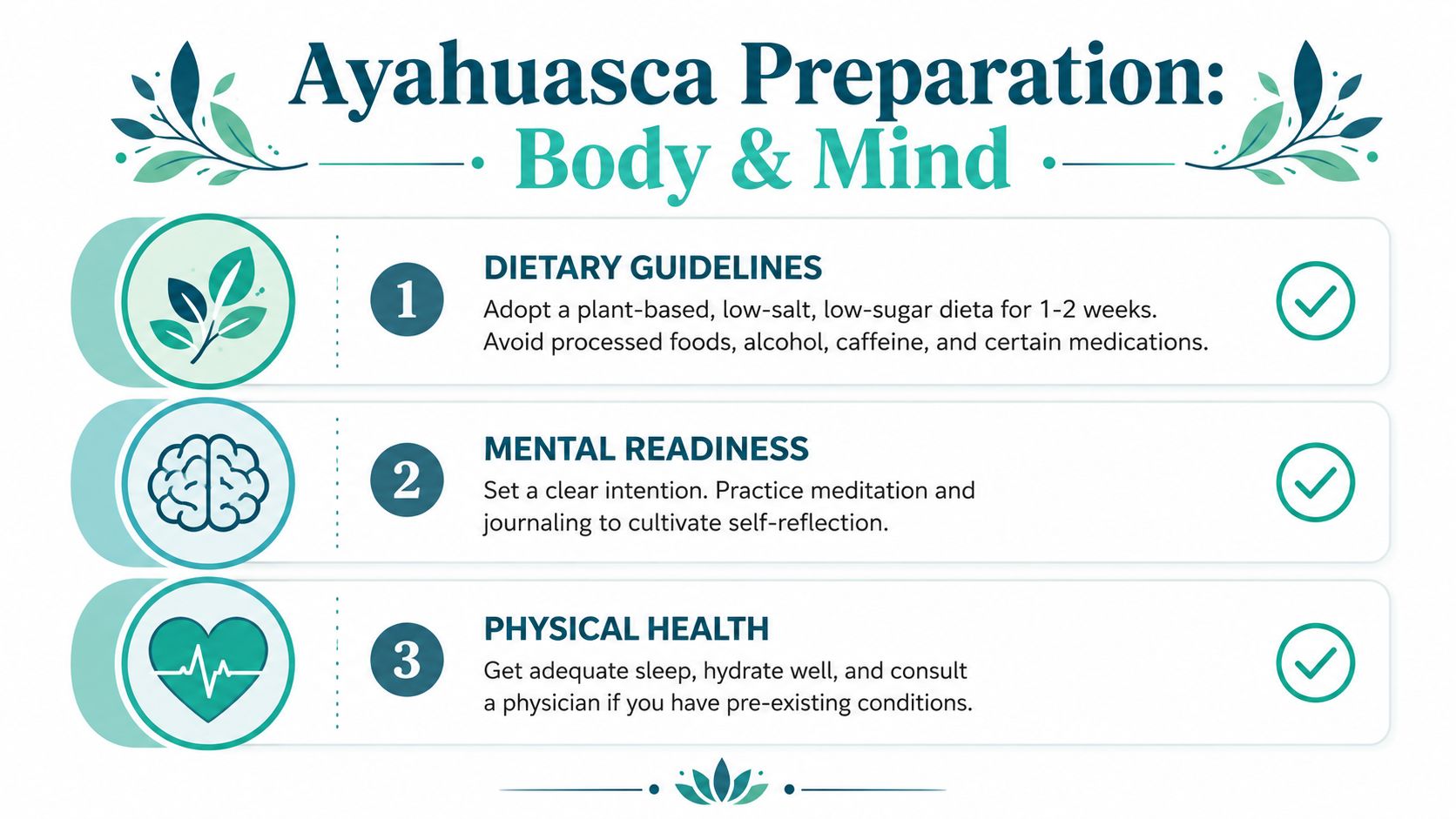
The first step should always be medical screening and medication reconciliation. A clinically defensible preparation period is a low-risk diet and medication screen for at least 1 to 2 weeks before ceremony, and stricter settings may extend dietary restrictions and substance abstinence to 2 weeks or more (retreat preparation guidance). The point is not purity. The point is lowering the chance of nausea and vomiting burden and avoiding dangerous interactions with the brew’s MAOI component.
Prescription drugs matter most here. People taking SSRIs, MAOIs, stimulants, antihypertensives, antipsychotics, antihistamines, heart medications, or decongestants should speak with a doctor before attending, because a blanket internet checklist will not tell them whether a specific taper or washout is safe. Medical literature also notes that some retreats advise avoiding antidepressants and other substances for several days before and after ceremony, while other guidance recommends multi-week washouts for serotonin-affecting drugs under medical supervision. For a practical overview of foods and medications that can interact with MAOIs, see foods and meds to avoid with MAOIs.
“A person already on psychiatric or blood-pressure medication should not improvise this part. The right next move is a prescriber-led plan, not a retreat handout.”
What The Dieta Usually Removes
The dieta commonly excludes alcohol, recreational drugs, red meat, dairy, fermented foods, spicy foods, caffeine, and other stimulants (preparation guidance). International safety organizations also advise avoiding alcohol, stimulants, opioids, and other drugs in the days or weeks before ceremony, and they recommend that the last meal be eaten about four to six hours before the session. That gives a realistic prep window, not vague wellness language.
A practical checklist looks like this:
- Review every medication early. Bring exact names and doses, including over-the-counter items and supplements.
- Tell the truth about what’s taken regularly. The biggest risk is not the diet itself, it is a hidden interaction.
- Begin the dieta on time. Stable habits make the ceremony easier to handle.
- Keep the final meal light. The last meal should be well before the session, not right before the first cup.
- Hydrate and avoid stimulants on ceremony day. That helps the body stay steadier under strain.
Mindset Still Matters, But Keep It Practical
Mental readiness matters, but it does not need to be theatrical. People do better when they know why they are coming, what they hope to understand, and who they will contact if anxiety rises before the retreat. Gentle reflection, journaling, and a few days of reduced stimulation can help settle the mind without turning prep into a performance.
The most useful attitude is plain. Be honest, be medically specific, and do not minimize anything just because it feels embarrassing to mention. A retreat can only screen what the participant actually discloses.
Choosing A Vetted Retreat And Facilitator
A safe retreat does more than pour a brew and ring a bell. It screens people, sets clear expectations, keeps participants supervised, and knows what to do if a session turns medically complicated. Anything less is a gamble, especially for first-timers.
The Questions That Matter Before Booking
A serious retreat should answer direct questions without getting defensive. Ask who does the medical screening, how medications are reviewed, what happens if someone has panic, fainting, vomiting, or a cardiovascular issue, and how close medical care is if needed. Drug education authorities recommend screening for pre-existing conditions, medications, emergency protocols, proximity to medical care, and supervision arrangements before using ayahuasca in a retreat setting (ADF guidance).
A legitimate setting also makes the dose decision explicit. International ayahuasca safety organizations say facilitators should estimate dose according to age, gender, experience, health condition, and individual needs, and if unsure, they should give a smaller dose. They also say participants should never be left alone and that safety requires removing hazards and preventing people from driving (ICEERS good practice guide).
Red flags are usually obvious once the questions get specific.
- Guaranteed outcomes: No one can promise healing, visions, or closure on schedule.
- No screening forms: That usually means medication risk is being handled casually.
- Pressure to attend anyway: A rushed booking process often skips the hardest safety conversations.
- Vague facilitator background: Training, lineage, and experience should be explainable.
- No aftercare plan: A retreat that ends at the ceremony floor is incomplete.
Traditional And Western Settings Are Not The Same
Traditional contexts and Western retreats can both be meaningful, but the safety assumptions differ. In traditional settings, the ceremony may be embedded in community knowledge and long-held ritual structure. In Western settings, the participant often needs more explicit orientation on diet, supervision, and emergency planning because the cultural scaffolding is thinner.
That is why many first-timers do better in places that are unusually transparent about logistics. One example within Ayahuasca.com’s ecosystem is a curated retreat listing approach that focuses on preparation and integration details rather than marketing language. The value there is not hype, it is structure.
The strongest centers are usually boring in the best way. They explain the dieta clearly, state who screens participants, say how many facilitators are present, and spell out what happens if somebody becomes disoriented. If those details are missing, the retreat is asking participants to trust a process they cannot inspect.
For readers trying to understand the role of ceremonial leadership and lineage, the overview on Ayahuasca shamanism can help separate cultural role from marketing language. That distinction matters when choosing who to trust.
What To Expect During The Ceremony
A ceremony usually starts in a quiet room, but the body often reacts before the mind has time to make sense of it. The setting, the pace, and the people watching over the group matter as much as the brew itself. Strong facilitators keep the room calm, remove trip hazards, and stay alert from the first sip until the experience has clearly settled.
The Timeline From Arrival To Come Down
The first stretch is usually practical. People arrive, get oriented, and hear the final safety reminders about where to sit or lie down, how to get attention, and what the team will do if someone reacts strongly. That structure matters because the experience can shift quickly even when the setup feels orderly.
The brew is taken orally, and the effects build over time. Clinical descriptions note onset around 40 minutes, peak effects between 60 and 120 minutes, and fading by about 4 hours (clinical description). That timing is why the night often feels like a long process rather than a short peak.
Physical intensity is common during that arc. In the Global Ayahuasca Survey, 69.9% of participants reported acute physical adverse effects, mainly vomiting, and 2.3% needed subsequent medical attention. The same research found 55.9% reported negative mental-health effects in the following weeks or months, while 88% of those people still considered those effects part of a positive growth or integration process (survey findings).
Purging, Surrender, And What Facilitators Are Doing
Purging can mean vomiting, and sometimes more ordinary bodily release than newcomers expect. That does not automatically mean something is wrong. In well-run ceremonies, the team expects it, prepares for it, and treats it as part of the body’s response rather than a sign that the night has failed.
A facilitator’s job is to keep participants from feeling alone in that intensity. They watch for signs that someone needs help, remind people to breathe, keep the room safe, and step in if the experience turns unsafe rather than simply difficult. The right response to a hard stretch is usually straightforward. Stay with the breath, keep the body supported, and ask for help when needed.
“Practical rule: If confusion becomes frightening, if physical symptoms feel beyond normal purging, or if a participant can’t orient themselves, call the facilitator immediately.”
The inner work varies widely. Some people encounter memories, grief, or bodily release. Others experience silence, visual content, or a strong sense that something is reorganizing underneath the surface. No single reaction proves the ceremony worked. The useful question is whether the participant stayed within a supervised setting and came out able to integrate what surfaced.
Medication screening is part of that same safety picture, and it is where many guides stay too vague. People already on prescriptions need a direct review of antidepressants, stimulants, migraine medicines, blood pressure drugs, and anything else that can change the body’s response. A careful facilitator should ask what you take, when you last took it, who reviewed the interaction risk, and what plan is in place if symptoms point toward a dangerous reaction. Without that screening, the room may look calm while a medication issue is building underneath it.
If a session includes more than one cup, dosing should still be conservative. Stronger is not better. Predictability, supervision, and clear screening are the real signs that the ceremony is being handled responsibly.
Integration And Ongoing Support Practices
The ceremony is not the finish line. The next few days often decide whether the experience becomes insight, confusion, or something in between. The right pace is usually simple, rest first, analysis later.
The First Few Days After Ceremony
Immediate aftercare tends to be plain and unglamorous. Continue the dieta, rest, avoid strenuous activity, and keep food light until the body settles. Gentle movement, hydration, and quiet time usually work better than jumping back into work, travel, or social overload.
That period can also bring anxiety or emotional sensitivity. Grounding helps when the nervous system feels overloaded after a powerful night, and a useful outside resource on grounding techniques for anxiety and PTSD can give participants simple ways to reorient.
The first few days are not the time to force a conclusion. They are better used for noticing what feels clear, what still feels raw, and what needs more time. A short list often helps.
- Rest first. Sleep and quiet reduce overstimulation.
- Journal briefly. Record images, emotions, and practical takeaways before memory blurs.
- Keep contact human. A short check-in with the facilitator or trusted support can prevent isolation.
- Avoid dramatic decisions. The mind can feel unusually certain right after ceremony.
Medication screening also continues to matter after the night itself. People on prescriptions should keep paying attention to changes in sleep, mood, blood pressure, agitation, or unusual physical symptoms, and they should know who to contact if something feels off. A careful retreat team makes that path clear before anyone goes home, because that is where overlooked interaction risk can become a real problem.
Building Meaning Over Weeks And Months
Integration circles, therapy, and reflective practice give the experience a place to land. Valerio Scaramucci’s discussion of psychedelic integration notes that Ayahuasca experiences can plant seeds that need time and nourishment to grow, and that integration means bringing those parts together into a whole. That framing keeps attention on lived change rather than a dramatic story.
The most stable integration habits are usually simple. Journaling, meditation, creative work, body-based practices, and regular conversations with grounded people can all help. A person who came home with sharper awareness about relationships, work, or health often needs time to translate that insight into behavior, not just reflection.
Some experiences include physical intensity, disrupted sleep, or a temporary sense of being emotionally raw. That does not automatically mean something has gone wrong, but it does mean the person should slow down and get support early if the effects linger or feel destabilizing. For people already managing prescriptions, the safest course is to keep their prescriber in the loop rather than guessing at what is spiritual, what is psychological, and what could still be medication-related.
The Global Ayahuasca Survey found that many people who reported difficult mental effects still experienced them as part of positive growth or integration. That does not minimize the rough edges, it does underline why post-ceremony support matters so much.
For difficult integration, the wisest move is usually straightforward. Get support early, keep the body regulated, and talk to someone who understands both trauma and altered states if the experience feels destabilizing. Silence can be useful in the room. Afterward, support is often what makes the difference.
Common Questions About Taking Ayahuasca
What should someone do if they take a necessary prescription?
They should not guess. A licensed prescriber needs to review the medication, the taper risk, and the washout window before any retreat date is set.
Can ayahuasca be taken safely with antidepressants?
No one should assume so. Some retreat guidance advises stopping serotonin-affecting drugs weeks in advance under medical supervision, because the interaction risk is serious.
What if stopping a medication isn’t medically realistic?
Then the correct answer may be to postpone ceremony. Safety comes first, and a retreat worth attending will respect that boundary.
How can someone tell if they’re ready?
They’re closer to ready when their medical screening is complete, their intentions are clear, and they can accept that the experience may be physically demanding and emotionally uneven.
What if the ceremony becomes too intense?
Call the facilitator immediately. Good supervision is there for exactly that moment, and participants should never try to muscle through alone.
Are multiple ceremonies necessary?
Not always. Some people integrate a single ceremony for months, while others return later with a new purpose. The useful measure is whether the first experience has been meaningfully worked through.
If someone is seriously considering a first ceremony, the next move should be practical, not romantic. Review every medication with a clinician, ask any retreat about its screening process before paying a deposit, and choose a setting that can explain its safety plan in plain language.
Disclaimer: The information provided on Ayahuasca.com is for educational purposes only and is not intended as medical advice, diagnosis, or treatment. Ayahuasca is a powerful traditional Amazonian medicine and may not be suitable for everyone. Always consult with a qualified healthcare professional before making decisions related to health, mental well-being, medications, or the use of Ayahuasca.