
Non-ordinary states of consciousness are simply shifts in our mental experience, where the way we perceive ourselves and the world changes in a big way. You’ve almost certainly been there before—in a vivid dream, a deep meditation, or even just a moment of intense focus where time seemed to melt away.
These states are not weird or fringe; they are a natural part of being human, and they hold incredible potential for growth and self-discovery.
Understanding What Lies Beyond Normal Awareness
Most of our waking life is spent in a default mode. We think, plan, and engage with the world through a familiar filter we call our ordinary consciousness. But what happens when that filter is temporarily lifted? That is when we enter the realm of non-ordinary states.
Imagine your normal mind is like a flashlight, casting a tight, focused beam on the tasks right in front of you. A non-ordinary state is like swapping that flashlight for a lantern, suddenly illuminating the entire room at once. You see details you never noticed before, and your whole perspective on the space—and yourself—shifts dramatically.
A Natural Part of Human Experience
These experiences are far from unusual. In fact, they are woven into the fabric of human history across every culture, representing a whole spectrum of awareness that is available to everyone.
Some of the most common ways we access these states include:
- Deep Meditation: The practice of quieting the mind to touch a sense of profound peace and interconnectedness.
- Vivid Dreaming: Exploring the inner landscapes of our psyche where the normal rules of reality do not apply.
- Creative Flow: Getting so lost in an activity—like painting, writing, or playing music—that the ego fades and intuition takes the lead.
- Breathwork: Using specific breathing patterns to gently alter brainwave activity and access deeper emotional layers.
- Plant Medicine: Partnering with sacred plants like Ayahuasca in a ceremonial setting to open doors to healing and insight. You can learn more about how these experiences unfold by exploring visionary states in our guide.
A Quick Look at Different States
To get a clearer picture, it helps to see how these states compare to our everyday awareness.
The Spectrum of Consciousness States
| State of Consciousness | Key Characteristic | Common Trigger |
|---|---|---|
| Ordinary Waking | Ego-driven, analytical, focused on external tasks. | Daily life, routine activities. |
| Meditative | Reduced ego, heightened present-moment awareness. | Mindfulness, focused attention. |
| Flow | Loss of self-consciousness, deep immersion in an activity. | Creative or athletic pursuits. |
| Dreaming (REM Sleep) | Illogical narratives, symbolic imagery, emotional processing. | The natural sleep cycle. |
| Psychedelic | Dissolution of ego, profound insights, altered sensory perception. | Plant medicines, psychedelics. |
This table is just a starting point. Each state has its own unique texture and depth, but they all share one thing in common: they take us beyond our normal, day-to-day mind.
The Connection to Healing and Growth
So, why would someone actively seek out these states? Because they offer a direct line to personal healing and a much deeper understanding of ourselves.
When we step outside our routine patterns of thought, we get a bird’s-eye view of our own lives. This shift in perspective can make it possible to process difficult emotions, release old traumas, and find new solutions to problems that have felt stuck for years.
The use of Ayahuasca in guided ceremonies, for instance, is gaining serious attention from wellness professionals and individuals looking for profound healing. A landmark study, the Global Ayahuasca Survey, collected data from over 10,000 people and found powerful links between these experiences and improved mental well-being.
Participants consistently reported significant reductions in symptoms of depression and anxiety, proving that these states are far more than just spiritual curiosities—they can be powerful tools for genuine change.
The Many Pathways to Altered Consciousness
While powerful plant medicines like Ayahuasca are a well-known gateway to non-ordinary states of consciousness, they are just one star in a vast constellation. For millennia, cultures across the globe have cultivated an incredible array of techniques to intentionally shift their awareness, each with its own character and purpose. Seeing this bigger picture helps us place the Ayahuasca journey within a much broader human story of exploration and self-discovery.
These are not esoteric practices reserved for monks in remote monasteries. The methods range from subtle, everyday shifts in focus to profound, life-altering departures from reality, and many are surprisingly within reach. What they all share is an ability to temporarily dial down the noise of our analytical, ego-driven mind, creating space for deeper insights and a more connected sense of self to come forward.
Exploring Without Psychedelics
Many of the most time-tested techniques tap into the body’s own ability to change its chemistry and brainwave patterns. These practices often offer a more gradual, controlled entry into altered states, helping to build a stable foundation of self-awareness and presence along the way.
Take meditation, for example. It is one of the oldest and most studied methods out there. By consistently bringing your attention to your breath or a mantra, you can begin to quiet the brain’s “default mode network”—the hub of our inner critic and constant self-commentary. With practice, this can open up into states of profound peace, timelessness, and a palpable feeling of connection to everything.
Then there is breathwork. Specific techniques, like Holotropic Breathwork, use deep, accelerated breathing in a safe, intentional setting to shift the body’s balance of oxygen and carbon dioxide. This simple physiological change can be surprisingly potent, often leading to intense emotional releases and unlocking vivid inner imagery from the subconscious for healing.
This diagram helps visualize how these states sit on a continuum, moving from our everyday focused mind toward a more open, expansive awareness.
Spectrum of Consciousness
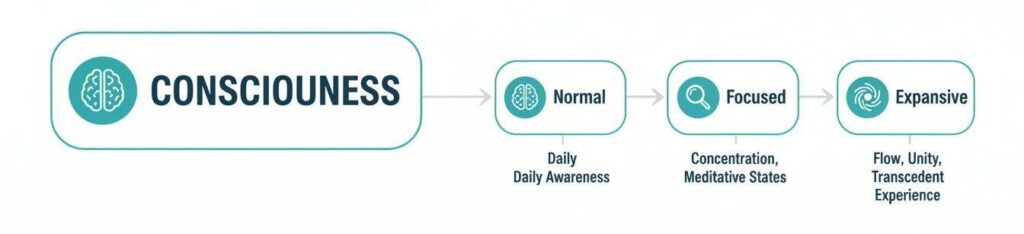
The image shows that stepping into a non-ordinary state is often about relaxing our tight, analytical grip on reality and allowing for a broader, more interconnected way of seeing.
Harnessing Sensory Input and Movement
Beyond stillness and breath, other fascinating pathways use sensory engagement—or its complete absence—to open the doors of perception. These methods highlight just how much our external world shapes our internal one.
Consider these approaches:
- Sensory Deprivation: Floating in a dark, silent tank removes all external distractions. With no light, sound, or even gravity to process, the mind naturally turns inward. This can lead to a deeply meditative state, often accompanied by vivid mental imagery or the feeling of leaving the physical body behind.
- Rhythmic Activities: For centuries, people have used drumming, chanting, and ecstatic dance to enter trance states. The repetitive, driving rhythms can literally sync up brainwaves, quieting the chattering ego and letting a more primal, embodied awareness take the lead.
- Lucid Dreaming: This is the skill of waking up inside your dream, becoming aware that you are dreaming without leaving the dream state. It turns your sleep into a conscious playground for exploring your own subconscious and interacting with your inner world with real intention.
“Each of these methods proves that the potential for profound experience is not out there somewhere—it is already wired into our own nervous system. The goal is to explore reality’s hidden depths by skillfully adjusting our own inputs.”
The table below offers a quick comparison of these different modalities, showing how they vary in intensity, duration, and what people typically seek from them.
Methods for Accessing Non Ordinary States
| Method | Typical Intensity | Primary Mechanism | Common Goal |
|---|---|---|---|
| Meditation | Low to Moderate | Focused Attention & DMN Deactivation | Stress reduction, insight, spiritual connection |
| Breathwork | Moderate to High | Physiological Shift (O2/CO2 balance) | Emotional release, trauma processing, catharsis |
| Sensory Deprivation | Moderate | Reduced External Sensory Input | Deep relaxation, introspection, creativity |
| Rhythmic Trance | Moderate to High | Brainwave Entrainment, Physical Exhaustion | Community bonding, spiritual ecstasy, release |
| Lucid Dreaming | Low to Moderate | Conscious Awareness During REM Sleep | Subconscious exploration, problem-solving |
As you can see, the path you choose depends entirely on your intention and comfort level. Some offer gentle introspection, while others provide a more intense, cathartic experience.
Ultimately, whether you find it in the deep quiet of meditation or the vibrant visions of an Ayahuasca ceremony, the underlying purpose is often the same. These non-ordinary states give us a precious opportunity to step outside our ingrained habits of thinking and feeling. It is this shift in perspective that allows us to see our lives—and ourselves—in a new light, clearing the way for genuine healing and growth.
A Brief History of Consciousness Exploration
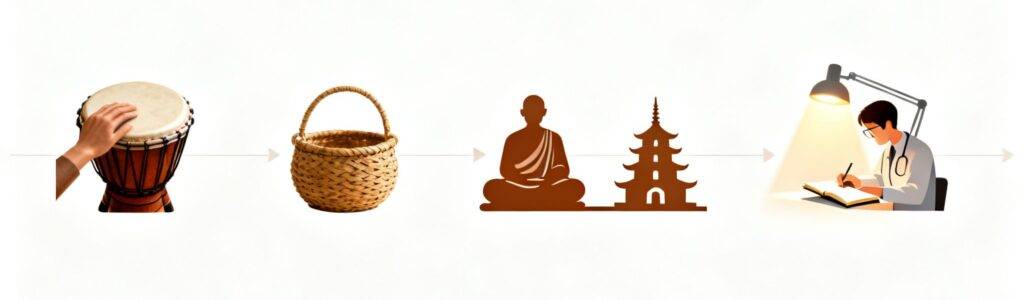
The drive to see beyond our normal, everyday awareness is not some new-age fad. It is one of the oldest and most human stories we have. The pursuit of non ordinary states of consciousness is a thread running from the very beginnings of civilization right up to today’s neuroscience labs.
From the Siberian tundra to the Amazon rainforest, our ancestors were not just idly experimenting. They developed incredibly sophisticated ways to shift perception for a reason. These altered states were vital community tools—gateways for healing, seeking guidance, and gaining spiritual insight. Early explorers used everything from rhythmic drumming and chanting to psychoactive plants to intentionally step outside the ordinary.
Ancient Roots and Sacred Traditions
Shamanic practices are some of the oldest spiritual technologies on the planet. In these cultures, the shaman or medicine person would enter a trance to talk with spirits, figure out what was making someone sick, or even retrieve a lost soul. Their journeys into these other realities were seen as absolutely essential for the tribe’s balance and well-being.
You can see this same theme of inner exploration popping up all over the world in different wisdom traditions. The methods change, but the goal is often the same.
- Mystical Experiences: Think of the saints and mystics in Christian, Sufi, or Kabbalistic traditions who described profound moments of divine union and ecstasy. Often achieved through intense prayer, their accounts sound remarkably similar to the ego dissolution people report in other contexts.
- Deep Meditative States: For thousands of years, Buddhist monks and yogis have been meticulously mapping the mind’s inner landscape. Through rigorous meditation, they cultivate states of deep concentration (samadhi) and insight (vipassana) that completely reshape how they see themselves and the world.
What connects all these diverse practices is a fundamental human drive to connect with something bigger than our own small self.
The Ayahuasca Lineage
One of the most potent and enduring examples of this ancient practice comes from the Amazon basin. Imagine entering a space where the usual rules of reality bend, revealing deep truths about yourself and the universe. This is the world opened up by Ayahuasca, a sacred brew used in Amazonian traditions for thousands of years.
“The use of Ayahuasca is not just a recent phenomenon. Archaeological evidence, like artwork from Peru’s Chavin people, suggests its ritual use dates back to at least 900 B.C., making it one of the earliest documented shamanic plant medicine practices.”
By the 1930s, Ayahuasca found its way into urban Brazil through syncretic religions like Santo Daime and União do Vegetal, which blend indigenous traditions with Christian beliefs. To get a better sense of this rich history and how it spread globally, you can read this overview from ICEERS.
From Ancient Ritual to Modern Science
This long, deep history is the bedrock for today’s psychedelic renaissance. The renewed scientific interest in substances like psilocybin or the compounds in Ayahuasca is not about discovering something new. It is about rediscovering something ancient.
Today, researchers use tools like fMRI scanners to see what is happening in the brain during these states, and much of what they are finding validates the wisdom these traditional cultures have held for centuries.
By understanding this lineage, we can approach the topic with the respect and depth it deserves. It reminds us that we are simply the latest participants in a timeless human quest for meaning, connection, and understanding.
What Happens Inside the Brain
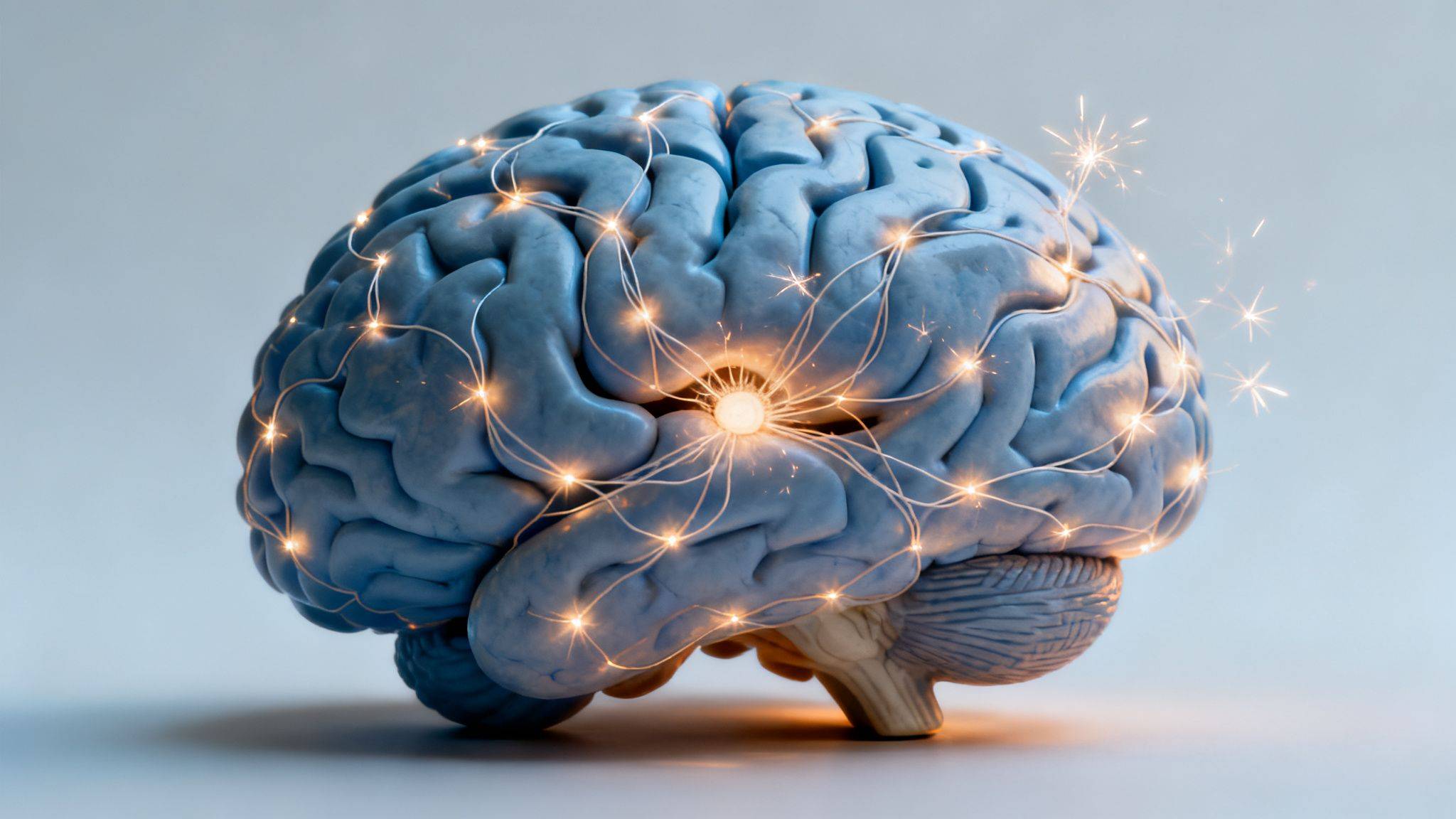
While these experiences can feel otherworldly, what is happening inside our skulls during non-ordinary states of consciousness is entirely grounded in science. Neuroscience is finally starting to map the incredible changes that take place when our reality shifts, building a bridge between ancient spiritual wisdom and modern, measurable data.
Think of your normal, everyday brain function as a highly efficient corporation. Departments have their set roles, information flows through predictable channels, and a “CEO”—your ego—keeps everything in order and on task. This structure is great for survival, but it can also be incredibly rigid.
Entering a non-ordinary state is a bit like the CEO taking a long lunch. The usual top-down management disappears, and departments that rarely interact suddenly start collaborating in new and creative ways. This neurological shake-up is where the magic really begins.
Quieting the Brain’s CEO
One of the most profound discoveries in this field centers on a brain circuit called the Default Mode Network (DMN). The DMN is essentially the brain’s autopilot. It is what kicks in when you are mind-wandering, worrying about the future, or replaying the past. It is the source of that constant inner monologue—the story of “me.”
During deep meditation, a psychedelic journey with Ayahuasca, or even a creative flow state, activity in the DMN quiets down dramatically. Scientists have found this drop in activity is often directly correlated with the experience of ego dissolution, that powerful feeling where the hard line between “you” and “the universe” starts to blur.
“When the DMN goes offline, that persistent inner narrator finally takes a break. This opens the door to a profound sense of connection to the present moment, to other people, and to the world itself. This is the feeling of oneness that so many people report.”
This is not just a fleeting sensation. Quieting the DMN allows the brain to climb out of its usual cognitive ruts, creating a rare opportunity to see old problems from a completely new angle.
Rewiring the Neural Landscape
So, what happens when the DMN’s grip loosens? Other parts of the brain start talking to each other in ways they normally would not. Brain imaging studies reveal a stunning increase in connectivity between regions that are usually siloed.
Picture your brain as a city with major highways that everyone uses. During a non-ordinary state, it is as if thousands of back alleys, bridges, and footpaths suddenly open up, connecting neighborhoods that were once isolated. This hyper-connected state is a big reason why these experiences can feel so flooded with insight, emotion, and creativity.
The active compounds in Ayahuasca are a key catalyst here. They primarily engage with serotonin receptors, most notably the 5-HT2A receptor. When these receptors are activated, two critical things happen:
- Rigid patterns are disrupted: This action helps dismantle the brain’s normal filtering systems, letting a richer stream of sensory and emotional data reach your conscious awareness.
- Neuroplasticity is enhanced: This is the brain’s amazing ability to form new connections. It is the physical basis for learning and is crucial for creating lasting change in our habits and thought patterns.
If you want to go deeper into the research, you can explore the scientific investigation of Ayahuasca in this review.
From Mysticism to Measurable Change
This combination of increased brain connectivity and heightened plasticity helps explain why experiences with Ayahuasca can lead to such lasting, positive changes. By temporarily scrambling and then rewiring the brain, these states create a powerful window of opportunity for genuine healing.
Deep-seated patterns—like those linked to trauma or depression—are often wired into rigid neural circuits. The hyper-flexible, fluid brain state induced by Ayahuasca allows us to revisit these patterns and, in many cases, start to rewrite them. This is not just a psychological shift; it is a biological one, creating fertile ground where new perspectives and healthier habits can finally take root.
The Ayahuasca Journey Within
Of all the ways to explore consciousness, the path offered by Ayahuasca is in a class of its own. This sacred Amazonian brew does not just tweak your perception; it feels more like plunging into a deep, vivid conversation with your own soul. While meditation might gently pull back the curtain on your awareness, an Ayahuasca journey often feels like being thrust onto the center stage of your own psyche.
The experience is intensely personal and no two are ever alike, but a few common threads tend to weave through most accounts. People often report a journey that is not just seen or heard, but felt in every cell of their being. This creates an incredibly powerful container for profound emotional and spiritual work.
The Landscape of an Ayahuasca Experience
The state Ayahuasca induces is often defined by a few key elements that seem to work in concert, paving the way for deep insight and emotional release. This is anything but a passive experience; you are an active participant in a process of raw discovery.
Most journeys include some combination of the following:
- Vivid, Meaningful Visions: This is not just seeing pretty colors. Participants often describe incredibly detailed, symbolic visions—everything from complex geometric patterns and encounters with archetypal beings to reliving scenes from their past. These visions are not random; they act as a kind of symbolic language, offering entirely new ways of looking at old problems.
- Profound Emotional Release: Ayahuasca has a way of bringing long-buried emotions to the surface with stunning force and clarity. This process is often called “the purge” (which can be physical as well as emotional) and is widely considered a necessary cleansing. It is a way of finally releasing grief, fear, or anger that has been trapped in the body for years.
- Deep Personal Insights: By temporarily dialing down the ego’s usual chatter, the experience can give you a bird’s-eye view of your own life patterns. Suddenly, the “why” behind certain behaviors or relationship struggles becomes startlingly clear, providing a level of understanding that might otherwise take years of therapy to uncover.
“Many describe the Ayahuasca state as a form of accelerated psychotherapy, guided by the spirit of the plant itself. It meets you exactly where you are and shows you precisely what you need to see for your own healing and growth.”
This potent mix of vision, emotion, and insight is what makes the experience such a powerful tool for working with deep-rooted issues. It allows you to stop just thinking about your trauma, depression, or addictions and instead re-experience and re-frame them in a supported space. For many, this direct encounter is the key to finally letting go. For others, it is the source of a powerful new sense of spiritual connection and purpose.
The Critical Role of Set and Setting
An experience this deep simply cannot be approached casually. The outcome of an Ayahuasca journey is profoundly shaped by two factors known as set and setting. This framework is the bedrock of any serious inner work, providing the container that helps ensure the experience is safe, supportive, and ultimately, beneficial.
Set is all about your internal landscape—your mindset, your intentions, your emotional state, and what you expect to happen. Preparing your “set” means doing the inner work before you ever sit in a ceremony. What questions are you bringing? What are you hoping to understand or heal? A clear, humble intention can act like a rudder, helping you navigate the sometimes-stormy waters of the journey.
Setting is the external environment: the physical space, the other people present, and the entire cultural and energetic container of the ceremony. For this kind of work, a safe and sacred setting is completely non-negotiable. It has to feel secure, comfortable, and free from outside distractions so you can fully surrender to the process without fear.
The Guide in the Inner World
Of all the elements of the setting, none is more important than the facilitator or shaman guiding the ceremony. A skilled guide does far more than just pour the medicine—they are the anchor for the entire group, the person holding the space for everyone’s journey.
An experienced facilitator is responsible for:
- Holding a Safe Space: They create and fiercely protect the energetic and physical safety of the ceremony, making sure every participant feels secure enough to let go.
- Guiding the Journey: Using traditional songs (icaros), music, and other sacred tools, they help steer the energy of the room and support people through the peaks and valleys of their experience.
- Providing Support: They know how to spot someone who is struggling and can offer a gentle hand, a reassuring word, or an energetic clearing to help them move through a difficult patch.
Choosing a ceremony with a reputable, experienced facilitator is the single most important decision you can make. It is this combination—a prepared mind, a sacred space, and skilled guidance—that unlocks the true healing potential of Ayahuasca, turning a powerful inner journey into lasting, meaningful change.
Navigating Your Journey Safely and Meaningfully
Venturing into non-ordinary states of consciousness, especially with a potent plant medicine like Ayahuasca, is not something to be taken lightly. It demands respect, a deep sense of responsibility, and thoughtful planning.
The ceremony itself is just one piece of the puzzle. The real, enduring value comes from the work you put in before you ever sit with the medicine and how you carry the experience forward afterward. Think of meaningful preparation and dedicated integration as the bookends to a safe and genuinely profound journey.
The Foundation: Why Preparation is Everything
Proper preparation is so much more than just following a special diet for a few weeks. It is about getting your mind, body, and spirit ready for the intense, often challenging work that lies ahead.
By consciously building a stable and intentional foundation, you are creating the conditions for the experience to unfold from a place of clarity and trust, rather than fear or confusion. This is your chance to quiet the noise of daily life and listen for the deeper questions you are bringing to the medicine.
Here are the key areas to focus on:
- Mental and Emotional Readiness: Carve out time for some honest self-reflection. What is your real intention? What hopes are you carrying? What fears are bubbling under the surface? Journaling and meditation can be incredibly helpful for unearthing these truths.
- Physical Preparation: Many traditions advocate for a specific “dieta” to cleanse the body. This usually means avoiding things like salt, sugar, caffeine, and red meat to purify your system and heighten your sensitivity to the medicine’s effects.
- Choosing a Reputable Guide: This is non-negotiable. An experienced facilitator and a safe, well-held container are what allow you to fully let go and surrender to the process, knowing you are protected.
We dive much deeper into this critical phase in our guide on preparing for your Ayahuasca journey.
“Preparation is an act of self-respect. It signals to yourself and to the medicine that you are taking this work seriously and are ready to receive whatever insights are offered.”
The Art of Integration: Bringing the Lessons Home
An Ayahuasca ceremony can feel like receiving a lifetime of wisdom in a single night. But without a conscious effort to integrate what you have learned, those powerful insights can fade away just like a dream.
Integration is the ongoing process of weaving those revelations into the fabric of your daily life. This is where the real change happens. It is the patient, sometimes messy work of turning abstract feelings of interconnectedness or newfound self-love into concrete actions, new habits, and different ways of showing up in the world.
To help anchor your experience and make it last, try weaving these simple practices into your life:
- Journal Your Experience: As soon as you can, write down everything you remember—the visions, the feelings, the confusing parts, the breakthroughs. Do not censor or judge it. This journal will become a priceless map for you to revisit.
- Spend Time in Nature: Nature has a powerful way of grounding us. A simple walk in the woods or sitting by a river can help you process everything and reconnect with the quiet beauty of the world.
- Find a Supportive Community: Talk about your journey with trusted friends, a therapist who gets it, or an integration circle. Voicing your experience to people who can listen without judgment is incredibly validating and can help you make sense of it all.
- Practice Mindfulness and Meditation: These practices are your tools for staying connected to that open, aware state you touched during the ceremony. They help you build the muscle of presence, which is the key to lasting change.
Frequently Asked Questions
It is completely normal to have questions as you start exploring non-ordinary states of consciousness, especially if you are thinking about something as significant as an Ayahuasca ceremony. Let’s walk through some of the most common ones to give you a clearer picture.
How Do I Know If I Am Ready for an Experience Like Ayahuasca?
This is a deeply personal question, and there is no simple checklist. Often, people describe a feeling of being “called” to the medicine—a persistent inner nudge that will not go away.
Beyond that, readiness is about being in a relatively stable place in your life. Do you have a good support system? Are you genuinely willing to face uncomfortable truths and do the hard emotional work that follows? If the answer is yes, those are strong signs. A conversation with an experienced facilitator can also help you figure out if the timing is right.
“Key takeaway: Readiness is not about being fearless. It is about having the courage and the support structure to navigate whatever the experience brings up, both during the ceremony and in the weeks that follow.”
Are Non-Ordinary States of Consciousness Safe?
When you approach them with care and respect, absolutely. For practices like meditation or breathwork, the risks are very low.
With more powerful experiences like an Ayahuasca ceremony, safety comes down to two critical factors: set and setting. “Set” is your mindset—your intentions and mental state. “Setting” is the environment—a secure space with a trustworthy, experienced guide. Being completely honest about your physical and mental health history is also a crucial piece of the safety puzzle.
What Is the Difference Between a Psychedelic Experience and Simple Relaxation?
They might both feel good, but they are worlds apart. A gentle meditation or a relaxing activity calms your mind and body within the familiar territory of your normal awareness. It is like turning down the volume on your daily stress.
A psychedelic experience, on the other hand, fundamentally changes the channel. It can temporarily dissolve your sense of self (the ego), bring up powerful visions, and rewire your brain’s typical patterns. This allows you to see your life, your problems, and your place in the world from a completely new and often profound vantage point.
Will One Ayahuasca Ceremony Fix All My Problems?
Think of Ayahuasca as a powerful diagnostic tool, not a magic pill. A ceremony can shine a brilliant light on the root causes of your patterns and struggles, offering incredible clarity and a path forward. But it will not walk that path for you.
The real transformation happens after the ceremony. This is the work of integration—taking the profound insights you gained and weaving them into your everyday life through new habits, choices, and perspectives. One ceremony can be life-changing, but healing is a journey, not a destination.
Disclaimer: The information provided on Ayahuasca.com is for educational purposes only and is not intended as medical advice, diagnosis, or treatment. Ayahuasca is a powerful traditional Amazonian medicine and may not be suitable for everyone. Always consult with a qualified healthcare professional before making decisions related to health, mental well-being, medications, or the use of Ayahuasca.