
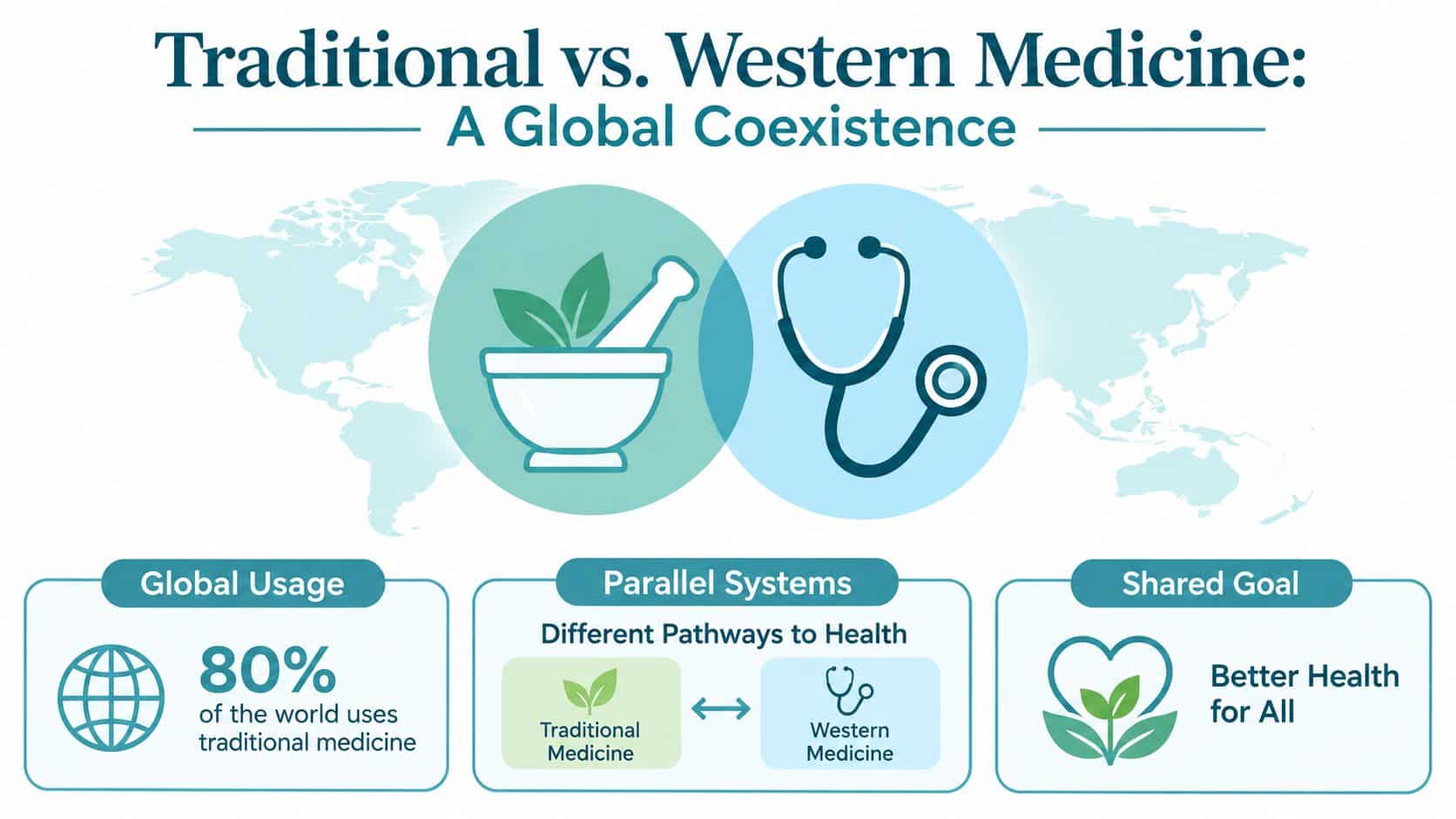
Traditional medicine vs western medicine is usually framed as a culture war, but the numbers point to something else. The WHO says traditional, complementary and integrative medicine is used in 170 countries, and in its 2019 survey 67% of responding countries reported that 40 to 99% of their populations use it. In other words, people are already living in a mixed system, whether their local hospital label reflects that or not. That makes the core question less about allegiance and more about coordination, safety, access, and fit.
| Dimension | Traditional Medicine | Western Medicine |
|---|---|---|
| Core Logic | Individualized, lineage-based, often holistic | Standardized, evidence-based, protocol driven |
| Diagnosis | Subjective, practitioner-dependent | Validity, reliability, ruggedness, objective endpoints |
| Evidence Style | Variable by system and tradition | Clinical trials, regulated testing |
| Safety Profile | Can vary by preparation and oversight | More standardized, but side effects are documented |
| Best Use | Chronic support, cultural continuity, access in some regions | Acute care, surgery, emergencies, diagnostics |
Why This Comparison Matters Now
The most useful way to read traditional medicine vs western medicine is as a map of how people get care. The WHO notes use across 170 countries and reports that 67% of responding countries said 40 to 99% of their populations use it (WHO). That scale matters because it shows traditional and complementary care isn’t sitting outside mainstream health behavior. It is already inside it.
The overlap is also visible in everyday care choices. In the United States, survey data show 40% of adults used at least one form of alternative medicine, 20% tried it instead of conventional care, and 29% used it alongside conventional treatment (WHO). Those figures suggest a practical reality, many patients move between systems depending on cost, trust, symptom type, and access.
The Real Question Is Coordination
Western medicine is usually treated as the default standard in many countries, and it relies on scientific evidence to diagnose and treat disease. Cleveland Clinic’s overview makes that concrete with examples like blood tests, medications, and surgery (Cleveland Clinic). Traditional medicine often comes from a different logic, where healing can be tied to balance, community, and long-standing practice.
That difference creates a decision problem readers can use. A person with a broken bone, an infection, or chest pain needs a different pathway than someone seeking long-term support for stress, chronic symptoms, or culturally rooted care. The debate becomes clearer when the focus shifts from ideology to what happens when care has to work in the real world.
“Practical rule: the right comparison isn’t which system exists, it’s which system is better matched to the problem, the setting, and the level of risk.”
Core Philosophies and Worldviews
Traditional medicine and western medicine often start from different assumptions about what illness is. Traditional systems commonly treat health as a matter of balance, relationship, and context. Western medicine, by contrast, tends to isolate a mechanism, test it, and standardize the response. That split shapes everything downstream, from diagnosis to treatment goals.
Holistic Meaning Versus Standardized Mechanism
A peer-reviewed review in NIH literature says conventional medicine is well standardized, and its medicines go through rigorous safety testing in multiple stages, from animal trials to final human trials after approval. The same review says many traditional systems remain unstandardized, and that preparations often vary by lineage, region, and practitioner (NIH review). That does not make traditional medicine simple or primitive, it makes it different in how knowledge is preserved and applied.
Western medicine also has a clear diagnostic language built around validity, reliability, and ruggedness, especially where measurement and interrater variability matter (PubMed). Traditional systems often use more individualized assessment, which can be useful in context but harder to compare directly across practitioners. The philosophical gap matters because two systems can both aim at healing while defining evidence in very different ways.
A practical example is the way patients search for culturally fluent care when conventional pathways feel too narrow. For readers exploring the traditional side of reproductive health, a focused resource like endometriosis and fertility with Chinese medicine sits inside that broader conversation about how traditional frameworks interpret symptoms, patterns, and treatment fit.
Different Definitions of Success
Western medicine often treats success as measurable change in symptoms, labs, imaging, or function. Traditional medicine may define success more broadly, including tolerance, energy, sleep, daily rhythm, or perceived balance. Those goals can overlap, but they aren’t identical.
“Healing becomes harder to compare when one system asks, “Did the marker change?” and another asks, “Did the person return to balance?””
That difference is why head-to-head arguments often miss the point. The more productive comparison starts with what each system thinks a body is, what each system thinks illness is, and what each system counts as improvement.
Diagnostic Methods and Standardization
The most visible difference between the systems shows up in diagnosis. Western medicine uses standardized tools, from bloodwork and imaging to validated performance metrics, while traditional medicine often uses individualized methods that depend heavily on the practitioner’s training and interpretive style. That makes direct comparison tricky unless there’s some calibration to objective endpoints.
How Diagnosis Is Built
Western medicine works best when the problem can be measured, compared, and repeated. The literature on diagnosis emphasizes validity, reliability, and ruggedness, which means the same finding should be accurate, consistent, and not overly dependent on who is reading it (PubMed). That is why a CBC, BMP, or CMP can be used as a shared clinical language across teams and settings (Cleveland Clinic).
Traditional diagnosis is often more interpretive. A practitioner may look at pulse quality, tongue features, symptom patterns, and overall constitution, then form a treatment picture that’s individualized rather than standardized. That can capture nuance, but it also means two practitioners can reach different conclusions from similar observations.
Calibration Changes The Conversation
A 2024 calibration study found that mapping traditional Chinese medicine diagnostic cutoffs to Western clinical categories produced a mean misclassification rate of 11.68%, with a standard deviation of 1.83% and a 95% confidence interval of 8% to 15.67% (PMC study). That result matters because it suggests the gap between systems is not always absolute. With statistical calibration, traditional assessments can line up closely with Western-style classification.
That doesn’t erase the methodological difference. It does show that some of the friction comes from translation, not only from disagreement. When a diagnostic language can be partially mapped onto another, practitioners gain a way to compare outcomes more reliably.
“Useful benchmark: if a diagnosis can’t be explained, repeated, or checked against a clearer endpoint, the risk of inconsistency rises fast.”
Evidence, Safety, and Regulation Compared
Safety debates usually get flattened into slogans, but the core issue is how each system creates and controls risk. Western medicine is more standardized, more regulated, and usually easier to audit. Traditional medicine may be more accessible or familiar in certain settings, but it can also vary widely in preparation, dosing, and oversight.
What The Data Says About Trade-Offs
A comparative study summarized in the International Journal of Food and Nutritional Sciences reported that traditional medicine had higher accessibility for rural populations at 75% versus 55% for modern medicine (IJFANS). The same table reported higher effectiveness for acute disease with modern medicine at 88% versus 40% for traditional medicine, while traditional medicine showed lower average side effects at 18% compared with 46% for modern medicine and was described as lower cost overall (IJFANS). Those numbers don’t settle the debate, but they do clarify where each system tends to fit better.
| Access, Effectiveness, and Safety at a Glance | Traditional Medicine | Western Medicine |
|---|---|---|
| Rural Access | 75% | 55% |
| Acute Disease Effectiveness | 40% | 88% |
| Average Side Effects | 18% | 46% |
| Cost Profile | Lower cost overall | Higher resource intensity |
Western medicine’s strength is that it usually passes through layers of testing before wide use. The NIH review notes medicines undergo rigorous safety testing through multiple stages, which is one reason dosing, interactions, and adverse effects are tracked more systematically (NIH review). That reduces some forms of risk, but it doesn’t eliminate side effects.
Traditional medicine’s risk profile often comes from variability. The same NIH review says many preparations are still not scrutinized with rigor and remain dependent on how they’re made and who makes them (NIH review). That becomes especially important when herbs are combined with prescriptions, or when the source material isn’t standardized.
For a practical safety lens on interaction risk, a focused guide on foods and meds to avoid with MAOIs is relevant because many traditional preparations, especially plant-based ones, can collide with conventional drugs in ways patients don’t expect.
“Safety takeaway: the biggest danger is often not choosing one system, it’s mixing them without someone tracking interactions, timing, and dosage.”
Where The Two Systems Meet In Practice
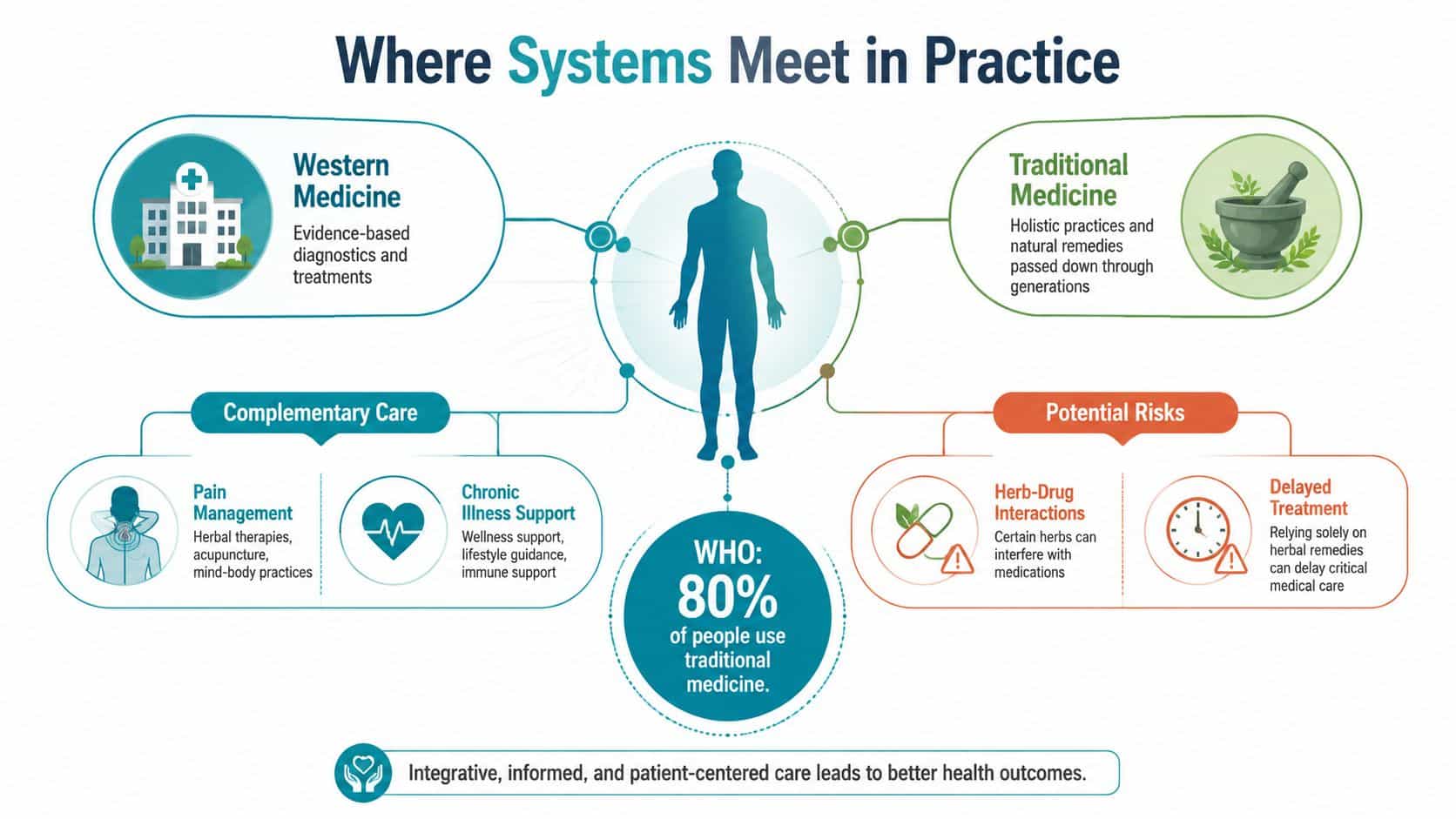
Integration already happens in everyday care, but the biggest problems show up in the handoff. WHO-related literature says around 80% of people use some form of traditional or complementary medicine, usually alongside biomedicine, and recent WHO-review evidence points to implementation barriers like weak referral systems, lack of standardized training, inconsistent herbal supply, and gaps in efficacy, quality, and safety oversight (PMC review). That makes integration look less like a philosophy and more like an operations problem.
When Combination Care Helps
Combination care can make sense when the goal is symptom support, stress reduction, rehabilitation, or long-term coping, especially if the conventional team stays informed. The literature on integrative care in chronic conditions points to a broader pattern, patients often want whole-person support, not only disease suppression. That’s where the overlap can be useful, provided the care plan is coordinated.
A short guide on blending traditions using indigenous medicinal knowledge to treat drug addiction fits this theme because addiction care often sits at the junction of biomedical treatment, cultural practice, and long-term support.
Where Coordination Breaks Down
The same system that adds support can also add risk. Weak referrals mean one provider may not know what the other prescribed. Inconsistent herbal supply means the patient may not get the same product twice. Gaps in safety oversight mean side effects can be missed or attributed to the wrong treatment.
The patient side of the story matters too. Research on care preferences shows that in rural and mountainous areas of India, traditional healing is more prevalent where Western medicine is less accessible, while patients who felt more ill or more worried during pregnancy were more likely to choose Western medicine (PMC study). That is a useful reminder that choice is often shaped by geography, trust, and perceived severity, not only identity.
“Integration works best when one clinician knows what the other one is doing, and when the patient can describe every herb, supplement, and prescription in the room.”
Ayahuasca As A Case Study In Modern Plant Medicine
Ayahuasca is a useful case study because it sits inside all the tensions at once, tradition, research, legality, and safety. It is a ceremonial plant medicine with Indigenous roots, but modern discussion also centers on its pharmacology, clinical research, and the conditions under which people choose retreats. That makes it a strong example of traditional medicine meeting western medical risk management.
Tradition, Chemistry, And Clinical Interest
Ayahuasca’s traditional use belongs in a ceremonial setting, not a casual wellness shortcut. The brew is commonly discussed in relation to DMT and MAO inhibitors, which is why interaction screening matters so much before any session. Clinical interest has also grown around possible applications for depression and trauma, though those conversations belong in research and supervised settings, not in self-experimentation.
For a plain-language overview of the substance itself, what is Iowaska is a relevant starting point for readers who want the traditional and pharmacological context together. In parallel, anyone evaluating retreat options should pay attention to screening, medical disclosure, and the degree to which a host respects Indigenous lineage rather than treating the medicine like a commodity.
Safety Comes Before Ceremony
That safety lens becomes essential when medications and medical conditions enter the picture. Antidepressants, especially SSRIs, can matter in plant-medicine settings because of interaction risk. So can cardiovascular issues, psychiatric instability, and incomplete disclosure of medications or supplements.
A practical way to evaluate any retreat is to ask whether organizers screen participants, explain contraindications, and encourage medical consultation before participation. For readers comparing retreat options in a specific region, a resource focused on finding reputable ayahuasca ceremonies can help frame the search around due diligence rather than marketing.
The video below is useful only if the viewer treats it as context, not instruction.
A curated directory like Ayahuasca.com can function as one starting point for retreat research, especially for readers trying to compare safety language, preparation guidance, and post-ceremony integration. The key is to treat any plant medicine as part of a broader care plan, not a standalone cure.
Choosing The Right Path For Your Health
The cleanest decision framework starts with the condition itself. Acute, life-threatening, or surgical problems belong in western medicine first, because that is where standardized diagnostics, emergency response, and procedural care are strongest. Chronic, functional, or psychospiritual concerns may leave more room for traditional or complementary care, especially when the goal is support, comfort, or cultural continuity.
A Simple Screening Checklist
Before starting any treatment, traditional or conventional, the same questions help:
- Licensing and Training: Is the practitioner qualified in the system they’re using, and can they explain their scope clearly?
- Risk Disclosure: Are side effects, interactions, and limitations stated plainly?
- Medication Review: Does the practitioner ask about prescriptions, supplements, and recent changes?
- Referral Pathway: Can they coordinate with a clinician if symptoms worsen?
- Product Transparency: If herbs or preparations are involved, is the source, preparation, and dosing understandable?
That checklist matters because coordination is where many failures begin. A good practitioner doesn’t just recommend a treatment, they make room for safe follow-through.
When Integration Makes Sense
Integration is most reasonable when the western team can monitor risk and the traditional practitioner can contribute something concrete, such as symptom relief, comfort, or culturally grounded care. It becomes less reasonable when either side discourages disclosure or acts as if the other side never matters.
The strongest decisions tend to be situational. A person facing an emergency should move fast into standardized care. A person managing an ongoing condition may benefit from layered support, if the plan stays transparent and medically coherent.
“Best practice: ask every provider the same question, “How does this treatment fit with everything else already being used?””
Next Steps, Resources, And Common Questions
The most useful next step is to match the resource to the decision. Readers looking at conventional care should review evidence-based diagnosis and treatment pathways. Readers interested in traditional systems should look for sources that explain lineage, preparation, contraindications, and coordination with existing care. Readers considering ceremonial plant medicine should prioritize medical screening and retreat vetting before anything else.
A few common questions come up repeatedly:
- Can traditional medicine replace psychiatric medication? Sometimes people hope for that, but any change to psychiatric medication should be handled with medical supervision because stopping or switching care can carry real risk.
- How can retreat safety be verified? Ask about screening, emergency plans, medication rules, and whether facilitators explain both ceremony expectations and contraindications.
- What should a practitioner be able to answer? They should explain what the treatment is for, what it might interact with, and what signs mean the plan needs adjustment.
The broader conclusion is simple. Traditional medicine vs western medicine is a practical coordination problem disguised as a philosophical one. The best choices come from matching the system to the situation, then making sure every other part of care knows what is happening. If that balance matters to the current decision, use this article as a checklist, then speak with a qualified clinician or practitioner before starting, stopping, or combining any treatment.
Disclaimer: The information provided on Ayahuasca.com is for educational purposes only and is not intended as medical advice, diagnosis, or treatment. Ayahuasca is a powerful traditional Amazonian medicine and may not be suitable for everyone. Always consult with a qualified healthcare professional before making decisions related to health, mental well-being, medications, or the use of Ayahuasca.