
A friend is considering an MDMA-assisted therapy session and wants to know how to reduce risk without being judged. Someone else is deciding whether carrying naloxone at a festival is sensible, even though they don’t use opioids. A participant preparing for an Ayahuasca ceremony may have a different concern, such as medication interactions, facilitator training, or what happens if the experience becomes medically or psychologically difficult.
These situations share a practical question: What is harm reduction, and how does it work? In public health, harm reduction offers tools and decisions that lower the negative consequences associated with drug use while respecting the fact that people make different choices, live in different environments, and may not be ready or able to stop using. The framework applies to overdose prevention and syringe services, but it can also guide safer festival planning, drug checking, and Ayahuasca ceremony preparation.
What Harm Reduction Actually Means
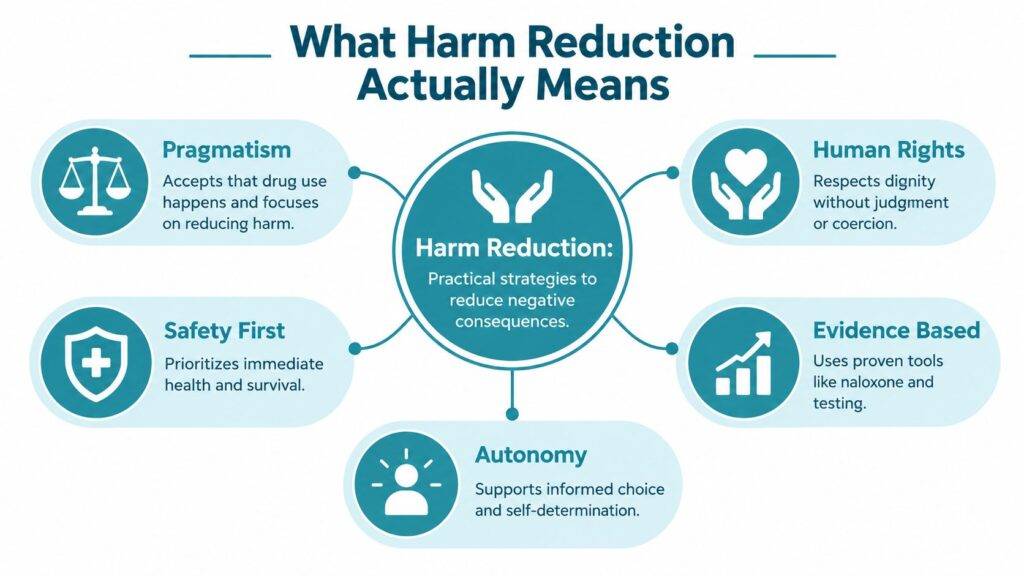
A person may still use a substance while taking steps to reduce danger. They might carry naloxone, use sterile supplies, check what they have, or ask about medication interactions before an Ayahuasca ceremony. These choices reflect the central idea of harm reduction, a public-health framework that lowers health, social, legal, and economic harms associated with drug use without making abstinence a condition for receiving help.
The practical test is straightforward: does the person have better information, face fewer preventable risks, and have a stronger chance of surviving an emergency or reaching care?
A seatbelt does not require someone to stop driving. Sunscreen does not require someone to avoid sunlight, and condoms do not require someone to avoid sex. Each tool accepts that an activity may occur, then adds protection where protection can make a meaningful difference. Harm reduction applies that same logic to drug-related risks.
The risks differ across people and settings. Someone injecting opioids regularly may need naloxone, sterile equipment, or opioid agonist therapy. Someone at a festival may need information about unexpected substances and emergency signs. An Ayahuasca participant may need transparent ingredient information, screening for medication interactions, trained support, and a clear response plan if the experience becomes medically or psychologically difficult. One framework can address this range without pretending the situations are identical.
What Harm Reduction Is Not
Harm reduction is not encouragement to use drugs. Sterile equipment can reduce infection risk. Overdose education can help someone recognize an emergency. Naloxone can give a person more time to receive medical care. Providing these tools addresses foreseeable danger; it does not create a demand for drug use.
The framework also does not settle questions about legal status. Public-health safety and drug law are related, but they are separate issues. A safety service may reduce harm whether a substance is legal, restricted, decriminalized, or prohibited.
Treatment and recovery remain part of the picture. A person may receive naloxone, use a syringe service, begin opioid agonist therapy, seek counseling, reduce use, pursue abstinence, or move between these goals. The Integrity Together LLC addiction models can help explain why addiction and recovery do not follow one pathway.
“Practical rule: A person does not have to meet an ideal standard before receiving safety information or respectful care.”
The Harm Reduction International global overview describes services that address overdose, HIV, and hepatitis C risk without requiring abstinence first. The World Health Organization also includes needle and syringe programmes among public-health responses for people who inject drugs, as described in its operational guidance for needle and syringe programmes.
In practice, harm reduction can include sterile syringes, take-home naloxone, drug checking, supervised consumption services, medication treatment, nonjudgmental clinical care, and peer support. In an Ayahuasca ceremony, it may mean medical screening, honest ingredient disclosure, trained facilitators, careful pacing, emergency preparation, and post-ceremony integration.
A Short History of Harm Reduction
Harm reduction grew from urgent community responses rather than from a single policy announcement. In the Netherlands during the 1980s, people who injected drugs and their allies developed needle and syringe programmes in response to hepatitis B outbreaks. The Junkiebond in Amsterdam helped show how people with lived experience could shape practical health services instead of waiting for institutions to design them from a distance.
The HIV/AIDS crisis accelerated this approach. Activists in the United Kingdom, Australia, and elsewhere argued that public-health workers had to reach people who used drugs with sterile equipment, accurate information, and respectful care. Their work challenged the idea that punitive messaging alone could prevent infection.
From Local Action To International Policy
Harm Reduction International was founded in 1994, giving the movement a stronger international advocacy and monitoring role. In 1996, Frankfurt established the first supervised consumption site, creating a setting where people could use pre-obtained drugs under supervision and receive rapid help during an overdose.
Vancouver’s Insite became another major turning point. In 2001, the site opened, and a later legal challenge reached the Canadian Supreme Court. The ruling upheld continued operation, helping establish that supervised services could be evaluated through public-health and constitutional considerations rather than dismissed as automatically permissive.
The opioid crisis then pushed take-home naloxone into wider public use. Communities trained people who use opioids, their friends, families, and other bystanders to recognize overdose and administer a medication that can reverse opioid respiratory depression. This shift placed emergency response in the hands of people who were often present before an ambulance could arrive.
Recognition And Continuing Pressure
New York City opened its first sanctioned overdose prevention centers in 2021. In March 2024, the UN Commission on Narcotic Drugs explicitly recognised harm reduction in Resolution 67/4, an important change in international drug-policy language. Harm Reduction International reports that explicit supportive references in national policy rose from 105 countries in 2023 to 112 in 2025, while the number of countries with opioid agonist therapy programmes increased from 84 in 2020 to 95 in 2025 in its global 2024 update.
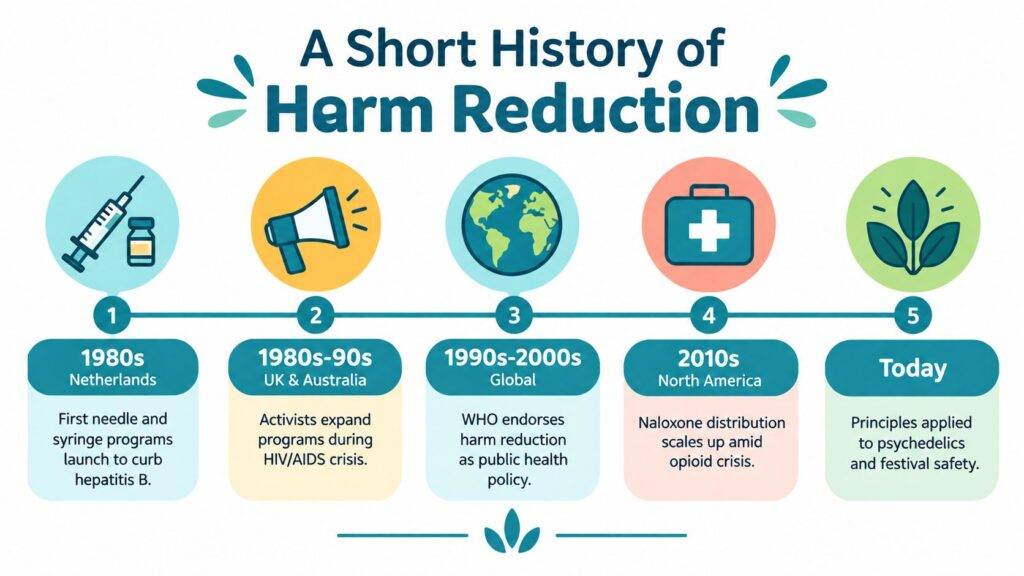
The history also explains why psychedelic communities increasingly use peer-led screening, sober support, integration circles, and incident reporting. These practices carry forward the original movement’s emphasis on practical care, lived experience, and trust. The substance and setting may change, but the question remains familiar: what can people do before, during, and after use to reduce the worst plausible outcome?
Core Principles And The Evidence Behind Them
A person may arrive at a syringe service seeking supplies, or enter an Ayahuasca ceremony unsure whether a medication could interact with the experience. Harm reduction starts from the same question in both settings: what practical change can lower risk now?
Pragmatism accepts that drug use occurs. A smoke detector does not ban fire. It identifies danger early and gives people a chance to respond. Overdose education, drug checking, and ceremony screening follow that logic by addressing real conditions rather than waiting for an ideal behavior change.
Human dignity means providing care regardless of how a situation began. A hospital does not refuse treatment because an injury followed a poor decision. Respect also improves communication. People are more likely to share what they used, how much they used, and which health factors could affect their safety.
Evidence-based practice favors interventions with a plausible mechanism and outcomes that can be assessed. That standard applies to established public-health measures and to newer practices in psychedelic settings. A screening form, medication review, or emergency plan should have a clear purpose, defined limits, and a way to learn from what happens.
Meeting people where they are means lowering practical barriers. A diner can serve coffee without requiring a full meal order. Likewise, a low-barrier service may offer information, supplies, testing, or referral without first requiring abstinence. In a ceremony context, it may mean offering private screening, clear preparation guidance, and a plan for support after the event.
Comparing Principles With Practice
| Principle | Practical Example | What the Principle Requires |
|---|---|---|
| Pragmatism | Offer overdose education where opioid use occurs | Address the setting and risk that are actually present |
| Human dignity | Provide nonjudgmental care and invite honest disclosure | Protect privacy, listen carefully, and avoid treating shame as a safety tool |
| Evidence-based practice | Use sterile equipment, validated testing methods, and structured screening | Explain what an intervention can detect, what it cannot, and how it will be reviewed |
| Meeting people where they are | Offer services without abstinence as an entry requirement | Reduce access barriers while keeping safety information clear |
These principles do not promise a risk-free outcome. A programme may miss people, a test may have limits, and a screening form cannot replace clinical judgment. Good practice therefore includes monitoring and adjustment as the drug supply, venue, participant health, and available support change.
The same discipline helps a ceremony organizer ask whether a participant takes an interacting medication or has uncontrolled hypertension. A guide to psilocybin drug interactions can support that conversation, while medication changes should be discussed with a qualified prescriber instead of managed through self-directed stopping. Good harm reduction keeps the person involved in decisions and makes the next safer choice easier to identify.
Real-World Examples Across Substances
Harm reduction becomes clearest at the moment a risk appears. A person using opioids, someone sharing injection equipment, and a participant entering an Ayahuasca ceremony face different hazards, yet each situation benefits from practical information, preparation, and a response plan.
Take-home naloxone addresses opioid-related breathing emergencies. Opioids can slow or stop breathing. A bystander who recognizes the signs can contact emergency services, provide rescue support, and give naloxone according to local guidance. Families, peers, and event staff can review opioid overdose signs and naloxone before an emergency occurs, when there is time to learn without pressure.
Needle and syringe programmes address blood-borne infection and equipment access. Sterile supplies reduce the chance that blood left from one injection enters another person’s bloodstream. Evidence has linked these programmes with fewer HIV and hepatitis C infections, while return systems can also encourage safe disposal. The needle exchange evidence brief presents this evidence and helps distinguish programme goals from assumptions about the people who use them.
Four Interventions, Four Risk Pathways
| Intervention | Substance Context | Measured Outcome |
|---|---|---|
| Take-home naloxone | Opioids | Community programmes report reductions in overdose mortality, including 25% to 46% lower mortality in several studies (systematic review) |
| Needle and syringe programmes | Injected drugs | Evidence includes reduced transmission of blood-borne infections and safer disposal practices (evidence brief) |
| Fentanyl test strips | Drugs that may contain fentanyl | Direct testing sensitivity of about 96.3% to 98% and specificity of 89.2% to 89.4% in a scoping review (review) |
| Supervised consumption services | Injected or otherwise consumed drugs in supervised settings | A review associated services with 88 fewer overdose deaths per 100,000 person-years and 67% fewer ambulance calls for overdose treatment (peer-reviewed review) |
Drug checking adds information before consumption. A sample may be tested for particular substances, including fentanyl, but a result reflects only the portion tested and the method used. Direct testing commonly involves dilution with at least 50 mL of water, and handling can affect performance. NIDA describes drug checking as a harm reduction practice and reports that some people changed behavior after a positive fentanyl result, such as using less, going slowly, or avoiding solitary use in its drug-checking resource.
The same framework applies in psychedelic settings, including Ayahuasca ceremonies. Confidential intake, informed consent, sober support, clear boundaries, emergency procedures, and follow-up care address risks that may involve distress, confusion, injury, or medical symptoms. These measures do not promise a particular experience. They give participants and facilitators more opportunities to notice danger early and choose a safer response.
Applying Harm Reduction To Ayahuasca Ceremony Safety
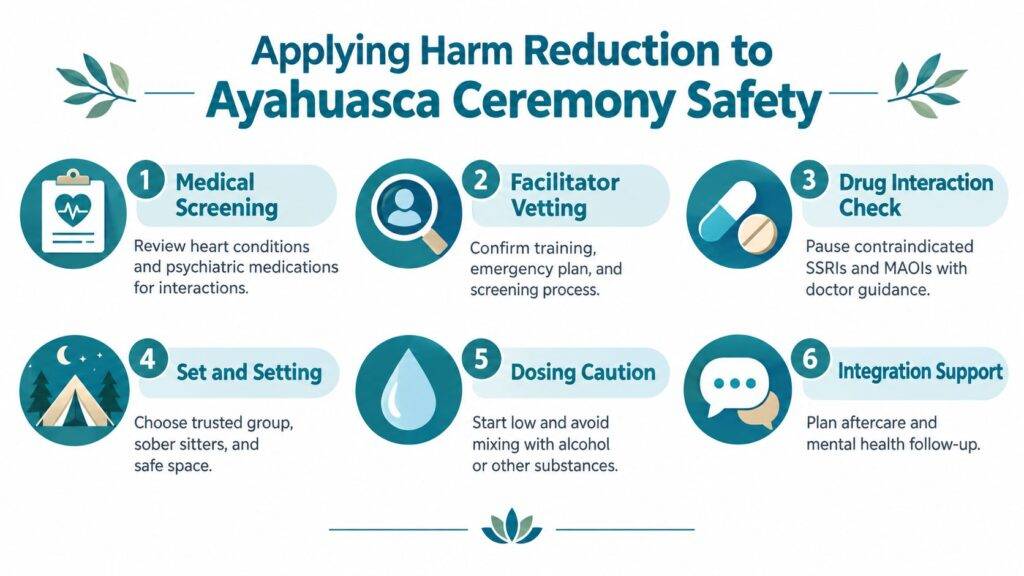
Ayahuasca ceremony safety starts before anyone drinks. A responsible screening process asks about cardiovascular conditions, psychiatric history, pregnancy, prescribed medications, supplements, and personal or family history of psychotic disorders. The purpose isn’t to exclude people casually. It is to identify risks that require medical advice, a different setting, or a decision not to participate.
Medication questions deserve particular care. Ayahuasca contains DMT and harmala compounds, and some combinations may create serious risks. Participants shouldn’t stop SSRIs, MAOIs, or other prescribed medicines without guidance from the prescribing clinician. The Ayahuasca safety guide can help organize questions for a qualified medical professional and a prospective facilitator.
Screen The Setting And The People
A venue should be able to explain who supervises participants, how many trained sitters are present, and what happens if someone experiences a medical emergency. A safe plan includes communication access, first-aid capability, clear transport arrangements, and a route for an emergency vehicle.
Facilitator transparency matters as much as atmosphere. Before attending, a participant can ask:
- Request Individual Intake: The facilitator should make space for a private health and medication conversation.
- Verify Emergency Procedures: Staff should explain who calls for medical help and how the group responds.
- Ask About Ingredients: The source and preparation of the brew should be disclosed in understandable terms.
- Confirm Exit Rights: Participants shouldn’t be prevented from leaving the ceremonial space when they need help or feel unsafe.
- Review Integration Support: The organization should describe available follow-up, referrals, or community support.
Red flags include pressure to drink multiple cups quickly, vague answers about ingredients, no individual screening, no plan for medical transport, or claims that distress is always spiritually necessary. A participant should also confirm the retreat’s legal location and understand which protections do or don’t apply there.
Prepare For Before And After
Fasting instructions should be clear, proportionate, and consistent with a person’s health needs. Participants should disclose supplements, alcohol use, recreational substances, and relevant medical conditions in advance. They should arrange transport, avoid making important decisions immediately afterward, and identify a trusted person or clinician for follow-up if difficult symptoms persist.
A ceremony can be spiritually meaningful and still require practical safeguards. Spiritual framing should never replace informed consent, medical screening, or the ability to ask for help.
Legal, Ethical, And Cultural Considerations
Harm reduction operates inside laws that vary by jurisdiction. Naloxone access, Good Samaritan protections, syringe distribution, supervised consumption, and drug checking may all be regulated differently from one place to another. A person should check local rules rather than assume that a service permitted in one city has the same status elsewhere.
Ayahuasca creates additional legal complexity because its components may be controlled under United States federal law outside approved religious use. Retreat organizers and participants need to understand the law where a ceremony takes place, including rules affecting preparation, possession, travel, and medical assistance. The Ayahuasca legal status guide provides a starting point for that review, but it doesn’t replace local legal advice.
Consent, Access, And Funding
Abstinence-only messaging can alienate people who aren’t ready to stop using or who use substances occasionally. When people fear punishment or humiliation, they may hide critical information about dose, timing, medications, or symptoms. Harm reduction treats honest disclosure as a safety resource.
Funding creates another tension. Harm Reduction International’s 2025 update described the sudden withdrawal of United States funding in January 2025 as the most severe threat to global harm reduction services in decades, even as formal policy support expanded. That contrast shows why policy recognition doesn’t automatically produce reliable access to naloxone, opioid agonist therapy, syringe services, or supervised settings.
Ethical practice also requires cultural accountability. Ayahuasca traditions are connected to Indigenous communities, including Shipibo and Cofán peoples and other Amazonian communities whose knowledge has shaped contemporary ceremony. Western retreat businesses and participants should ask how they acknowledge that lineage, compensate communities, protect ecological resources, and support community-led stewardship.
“Ethical standard: Personal safety and cultural reciprocity belong in the same conversation. A ceremony can’t claim integrity while treating Indigenous knowledge as a decorative background.”
Bringing Harm Reduction Into Your Own Decisions
Harm reduction can function as a general decision-making skill. The framework applies to a psychedelic experience, alcohol at a wedding, a long hike, or any activity where preparation can reduce the consequences of a bad turn.
A simple loop has four parts:
- Clarify the intended outcome. Is the person seeking connection, therapeutic support, spiritual exploration, celebration, or something else?
- Inventory realistic risks. Consider health history, medications, setting, unknown potency, transportation, emotional state, and who can respond to trouble.
- Choose one or two strong mitigations. Select measures that reduce the most serious plausible harm, such as a sober support person, verified information, naloxone, sterile equipment, or a clear stop plan.
- Build an exit or rescue plan. Decide who can call for help, where the person can go, how transportation works, and what follow-up looks like.
Trip planning offers a useful analogy. Weather forecasts don’t guarantee a smooth journey, but they help a traveler choose clothing, timing, supplies, and an alternate route. Harm reduction works similarly by replacing assumption with preparation.
For deeper learning, readers can consult peer-led festival safety education, psychedelic peer-support resources, drug-information archives, local syringe service programmes, and local drug-checking services. Ayahuasca.com also publishes health, safety, preparation, and integration resources for people evaluating ceremony settings.
Three prompts can turn the framework into an immediate exercise:
- What outcome matters most, and what risk could interfere with it?
- Which single preparation would make the worst plausible outcome less likely?
- Who knows the plan, and what will happen if the experience becomes medically or psychologically unsafe?
Before attending a ceremony, festival, or other substance-related setting, write down the answers, verify local laws, disclose relevant health information, and confirm that a real person can respond in an emergency. Choose environments that respect consent, provide transparent safety information, and support help-seeking without judgment.
Disclaimer:
The information provided on Ayahuasca.com is for educational purposes only and is not intended as medical advice, diagnosis, or treatment. Ayahuasca is a powerful traditional Amazonian medicine and may not be suitable for everyone. Always consult with a qualified healthcare professional before making decisions related to health, mental well-being, medications, or the use of Ayahuasca.