
When we talk about entheogens, we’re talking about something far more specific than just a psychoactive substance. These are plants, fungi, and sometimes synthetic compounds that are approached with a very particular intention: to connect with the spiritual, to explore the self, or to have a religious experience.
It’s all about purpose. The experience isn’t about escapism; it’s about a deep, intentional dive inward. This is the crucial element that separates entheogens from substances used for purely recreational reasons.
What Are Entheogens? A Journey Within
The very word “entheogen” gives us a clue. It comes from the Greek for “generating the divine within.” This term was deliberately coined to move the conversation away from the loaded, often recreational baggage of words like “hallucinogen” or even the clinical “psychedelic.” It puts the spotlight right where it belongs: on the potential for profound personal insight.
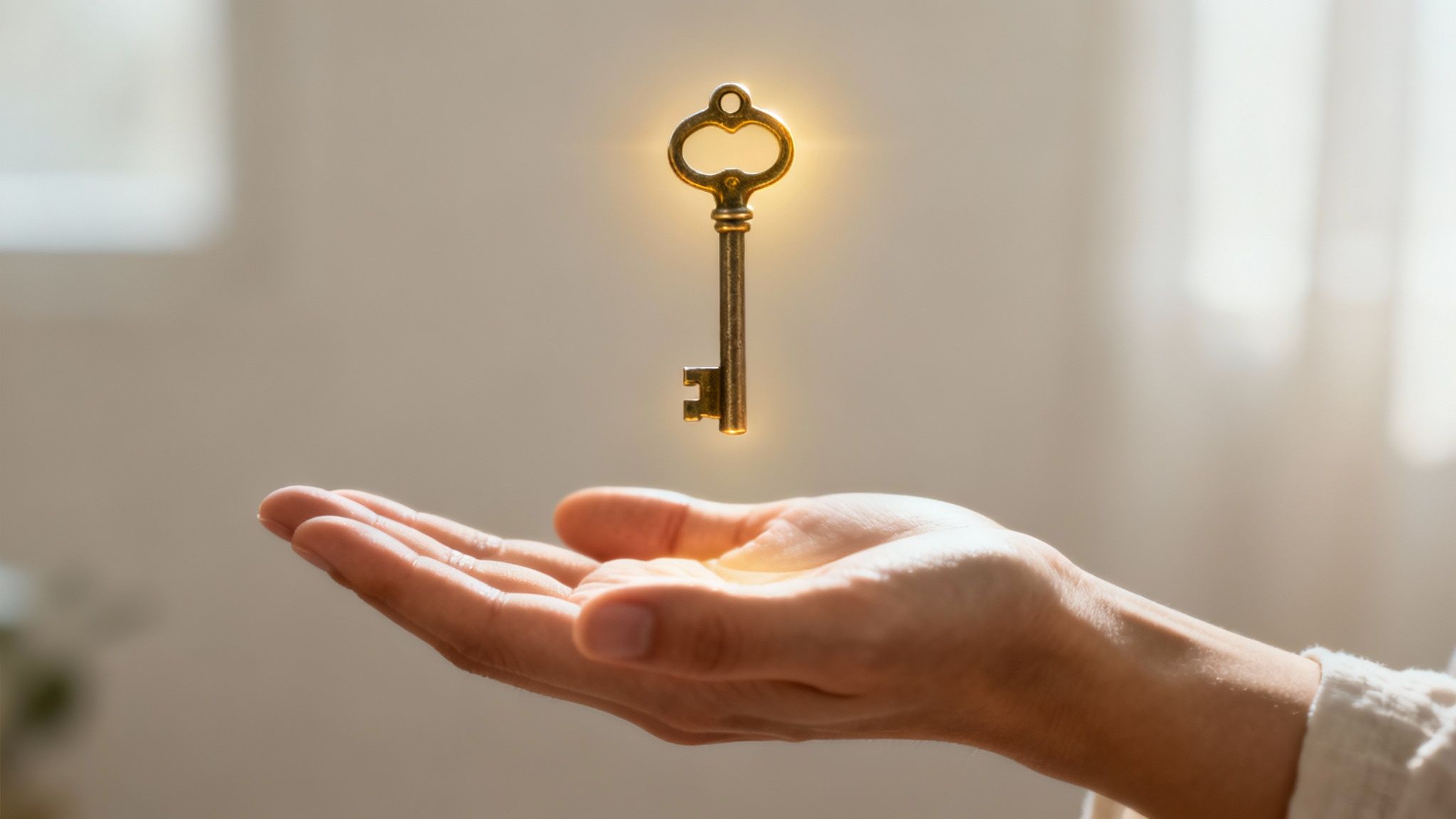
Instead of thinking of an entheogen as some wild ride for your senses, picture it as a key. This key doesn’t unlock a gate to a fantasy land. It opens doors inside your own mind—doors to deeper self-awareness, to old emotions you thought were long gone, and to entirely new ways of seeing your life and your place in the world.
Intent is Everything
The real difference between using a substance at a party and engaging with an entheogen is intention. One is for kicks; the other is for growth.
This purpose-driven mindset completely changes the experience. It usually involves a framework that includes:
- Ceremony: A structured, respectful ritual that creates a safe and sacred container for the journey.
- Guidance: The presence of an experienced facilitator or guide who knows the territory.
- Preparation: Getting your mind and body ready for the experience in the days or weeks leading up to it.
- Integration: The crucial work of making sense of the experience and weaving its lessons into your daily life afterward.
This structure is what makes the work powerful. For instance, a traditional Amazonian Ayahuasca ceremony isn’t just a casual gathering. It’s a meticulously planned ritual designed to guide participants toward healing and clarity. This sacred context is the very heart of the entheogenic path.
“An entheogenic experience is fundamentally about the journey inward. It’s a conscious choice to explore the depths of one’s own mind and spirit for the purpose of growth, healing, or connection.”
Beyond the Dictionary Definition
Ultimately, you can’t define entheogens just by their chemical makeup. While they are certainly psychoactive, their true nature is revealed in how they’re used.
When people approach these powerful plant medicines and compounds with respect, a clear purpose, and in a supportive setting, they are tapping into a practice that has been part of human spiritual life for millennia. This intentional framework is vital for anyone looking to understand how entheogens can be catalysts for personal growth and what many describe as a deeper existential intelligence. The journey they offer isn’t an escape from reality, but a profound plunge into it.
The Ancient Roots of Entheogenic Practices
The use of entheogens isn’t some new-age fad. It’s a practice woven deep into the fabric of human history, stretching back thousands of years. Long before modern labs and clinical trials, these powerful plants and fungi were spiritual cornerstones for cultures all across the globe.
Their roots connect ancient civilizations to profound states of consciousness, healing, and the divine. This history isn’t just a list of dates; it’s a rich tapestry of human spirituality, medicine, and our relationship with the natural world.
A Glimpse into Ancient Worlds
For nearly 2,000 years in ancient Greece, the celebrated Eleusinian Mysteries were secretive initiation rites that profoundly shaped the culture. Historians are pretty convinced that participants drank a psychoactive brew called kykeon, which triggered the powerful visionary states central to the ceremony’s purpose.
These weren’t parties. They were highly structured rituals designed to help people confront their own mortality and experience a kind of spiritual rebirth. The influence of these experiences rippled through Greek philosophy for centuries.
The story is just as old and compelling in the Americas. Archeologists have unearthed “mushroom stones” in Mesoamerica, pointing to sacred psilocybin rituals that date back to at least 1000 BCE. And for over 5,000 years, the peyote cactus has been a central sacrament for indigenous peoples in Mexico and the American Southwest, used for healing, guidance, and spiritual connection.
What these ancient practices show us is a deep, enduring partnership between humans and these sacred plants, built on wisdom passed down through generations.
The Heart of Amazonian Shamanism
When you think of entheogens with deep indigenous roots, it’s hard not to think of Ayahuasca. This potent botanical brew has been at the very heart of shamanic practice in the Amazon basin for centuries, maybe even millennia. For many tribes there, Ayahuasca isn’t just a substance; it’s a revered teacher, a diagnostic tool, and a direct line to the spirit world.
Unlike the often individualistic journeys people seek today, traditional Ayahuasca ceremonies are deeply communal. A trained shaman, or curandero, guides the experience, using the brew to diagnose illnesses, communicate with plant spirits, and bring healing to the entire group.
“The traditional use of Ayahuasca embodies a worldview where physical, emotional, and spiritual health are inseparable. It is a system of medicine where the entire community’s well-being is addressed through a connection to the wisdom held within nature.”
Understanding this sacred context is crucial. The intricate knowledge of preparing the brew and safely guiding a ceremony is passed down carefully from one generation to the next. You can dive deeper into this rich history by exploring detailed accounts on the origins of Ayahuasca.
Honoring a Legacy of Wisdom
If there’s one common thread running through the historical use of entheogens, it’s deep respect and intentionality. These substances were never treated casually. They were woven into the fabric of society with clear guidelines, sacred rituals, and a profound understanding of their power to both heal and harm.
This ancient wisdom offers a vital lesson for the modern world’s renewed interest. It’s a powerful reminder that we’re not just dealing with chemical compounds, but with sacred tools that have been carefully stewarded by indigenous peoples for countless generations. Acknowledging this history is the first step toward approaching them with the reverence they truly command.
Exploring Different Types of Entheogens
The world of entheogens is incredibly vast. It’s less like a single category and more like a massive botanical library, with each plant, fungus, or compound offering a completely different story. To make sense of it all, we can group them into “families” based on their chemical makeup. This helps us draw a map of the entheogenic landscape and understand how they relate to one another.
Think of it like music. Tryptamines might be the deep, soulful classical symphonies that take you on an inward journey. Phenethylamines, on the other hand, could be the vibrant, sensory-rich electronic music that lights up your perception of the world outside. Each has its own rhythm and feel, but they’re all fundamentally ways of shifting consciousness.
The Tryptamine Family
Tryptamines are probably the most well-known group, and for good reason. They bear a striking resemblance to serotonin, one of our brain’s most important neurotransmitters for regulating mood, perception, and how we think. Because they fit so neatly into our serotonin system, they can produce some truly profound shifts in awareness.
This family includes some of the most classic entheogens:
- Psilocybin: This is the magic in “magic mushrooms” (from Psilocybe species). Experiences often bring feelings of deep connection, euphoria, and powerful emotional release. A typical journey lasts about 4-6 hours.
- DMT (N,N-Dimethyltryptamine): Famously dubbed the “spirit molecule,” DMT is found in countless plants and is one of the main ingredients in the Amazonian ceremonial brew, Ayahuasca. When vaporized, it triggers an incredibly intense but brief experience, lasting only 5-20 minutes. In Ayahuasca, however, the journey is much longer, usually around 4-6 hours.
- 5-MeO-DMT: Sourced from the venom of the Bufo alvarius toad as well as certain plants, this compound is known for inducing an overwhelming sense of ego dissolution and cosmic unity. It’s exceptionally potent, and the experience is very short, typically 15-30 minutes.
The history of these substances is as diverse as their effects, spanning cultures and continents for millennia.
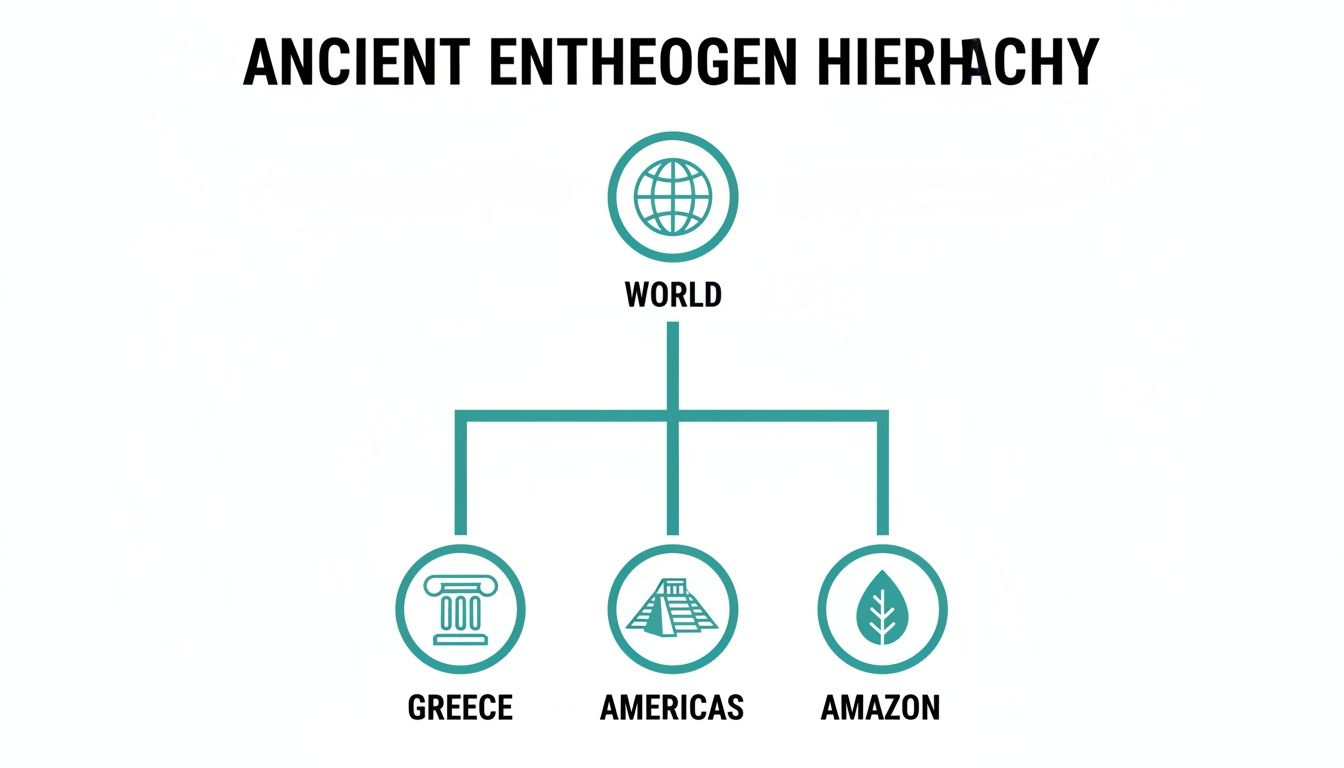
As this shows, whether it was in ancient Greece, across the Americas, or deep in the Amazon, people have long turned to these powerful plants for spiritual and healing purposes.
The Phenethylamine Family
While tryptamines often guide us inward, phenethylamines tend to expand our senses outward, fostering emotional connection and a new appreciation for the world around us. This class of compounds is more closely related to our brain’s “get up and go” neurotransmitters, like dopamine and norepinephrine, which influence energy, mood, and how we process sensory information.
The most famous member of this family is mescaline. Found in the peyote (Lophophora williamsii) and San Pedro (Echinopsis pachanoi) cacti, mescaline has been a cornerstone of indigenous ceremonies for thousands of years. A mescaline journey is often filled with rich visual tapestries, profound empathy, and a warm, embodied feeling. It’s a marathon, not a sprint, with experiences typically lasting a full 8-12 hours.
“Entheogens are not one-size-fits-all. The differences between a psilocybin journey and a mescaline experience are as significant as the differences between a dream and a vivid memory—both are internal experiences, but their textures, themes, and lessons are entirely unique.”
A Quick Guide to Common Entheogens
To pull this all together, here is a simple table comparing some of the key entheogens we’ve discussed. Think of it as a quick reference for their source, primary active compound, and the general timeframe of their effects.
| Entheogen | Primary Compound | Common Source | Typical Duration |
|---|---|---|---|
| Magic Mushrooms | Psilocybin | Psilocybe fungi | 4-6 hours |
| Ayahuasca | DMT & MAOIs | Psychotria viridis & Banisteriopsis caapi | 4-6 hours |
| Peyote Cactus | Mescaline | Lophophora williamsii cactus | 8-12 hours |
| San Pedro Cactus | Mescaline | Echinopsis pachanoi cactus | 8-12 hours |
This chart is just a starting point. It’s crucial to remember that the duration, intensity, and nature of any experience depend heavily on dosage, your own biology, and most importantly, the “set and setting”—your mindset and environment. Understanding these different types of entheogens is the first step in appreciating the rich spectrum of tools humanity has used for centuries to explore the inner workings of the mind and spirit.
The Modern Renaissance: Therapeutic and Scientific Interest
After being pushed to the fringes of science for decades, entheogens are making a powerful comeback. Top-tier universities and research centers are now taking a serious look at what indigenous cultures have understood for millennia: these substances hold incredible potential for healing the human mind.
This isn’t just a fleeting academic trend. It’s a focused effort to find new solutions for some of our toughest mental health crises. The research happening today is careful and precise, conducted in controlled clinical environments where scientists are mapping out exactly how compounds like psilocybin and MDMA can spark lasting, positive change in the brain.
Rebooting the Brain’s Rigid Circuits
One of the most promising frontiers is in treating treatment-resistant depression. For people who have tried everything else without success, the findings from recent studies are nothing short of game-changing.
Institutions like Johns Hopkins and Imperial College London are at the forefront, with research showing that psilocybin can trigger dramatic and lasting relief from depressive symptoms, sometimes after only one or two guided sessions.
Think of a depressed brain as being stuck on a looping track of negative thoughts. A guided entheogenic experience can act like a hard reset. It quiets the brain’s Default Mode Network (DMN)—the hub of our ego and self-critical inner monologue—which allows fresh neural pathways to form.
This “neural reset” helps people break out of those rigid, self-defeating patterns. It creates a temporary window of profound mental flexibility, giving them a chance to see their life, their past, and their relationships with a renewed sense of clarity and compassion.
“The real magic isn’t in the substance alone. It’s the combination of the psychedelic experience within a safe, therapeutic setting. The journey opens the door to change, and the therapy that follows helps you walk through it and integrate those lessons into your daily life.”
This same approach is showing incredible promise for addiction. We’re seeing studies where psilocybin-assisted therapy is proving far more effective for quitting smoking than conventional methods. By helping people tap into a deeper sense of self and purpose, these experiences get at the root causes of addictive behavior. The goal shifts from just stopping a bad habit to building a life so meaningful that the old crutch is no longer needed.
Calming the Echoes of Trauma
Beyond depression and addiction, scientists are also exploring how entheogens can help people with post-traumatic stress disorder (PTSD) and the deep anxiety that can accompany a terminal illness.
Early studies using MDMA-assisted therapy for PTSD have been remarkable. The substance seems to dial down the brain’s fear center (the amygdala) while boosting the prefrontal cortex, which handles emotional regulation. This creates a unique mental space where traumatic memories can be revisited and processed without the usual overwhelming terror. It allows for healing in a way that talk therapy alone often can’t.
Similarly, for those facing end-of-life anxiety, psilocybin has been shown to significantly reduce fear and depression, helping patients find a sense of peace and acceptance. This compassionate work underscores the profound humanistic potential of these medicines. There’s still so much to learn, but many of us are optimistic about what future studies, including the scientific investigation of Ayahuasca, will uncover.
Safety and Responsibility: Navigating Your Journey
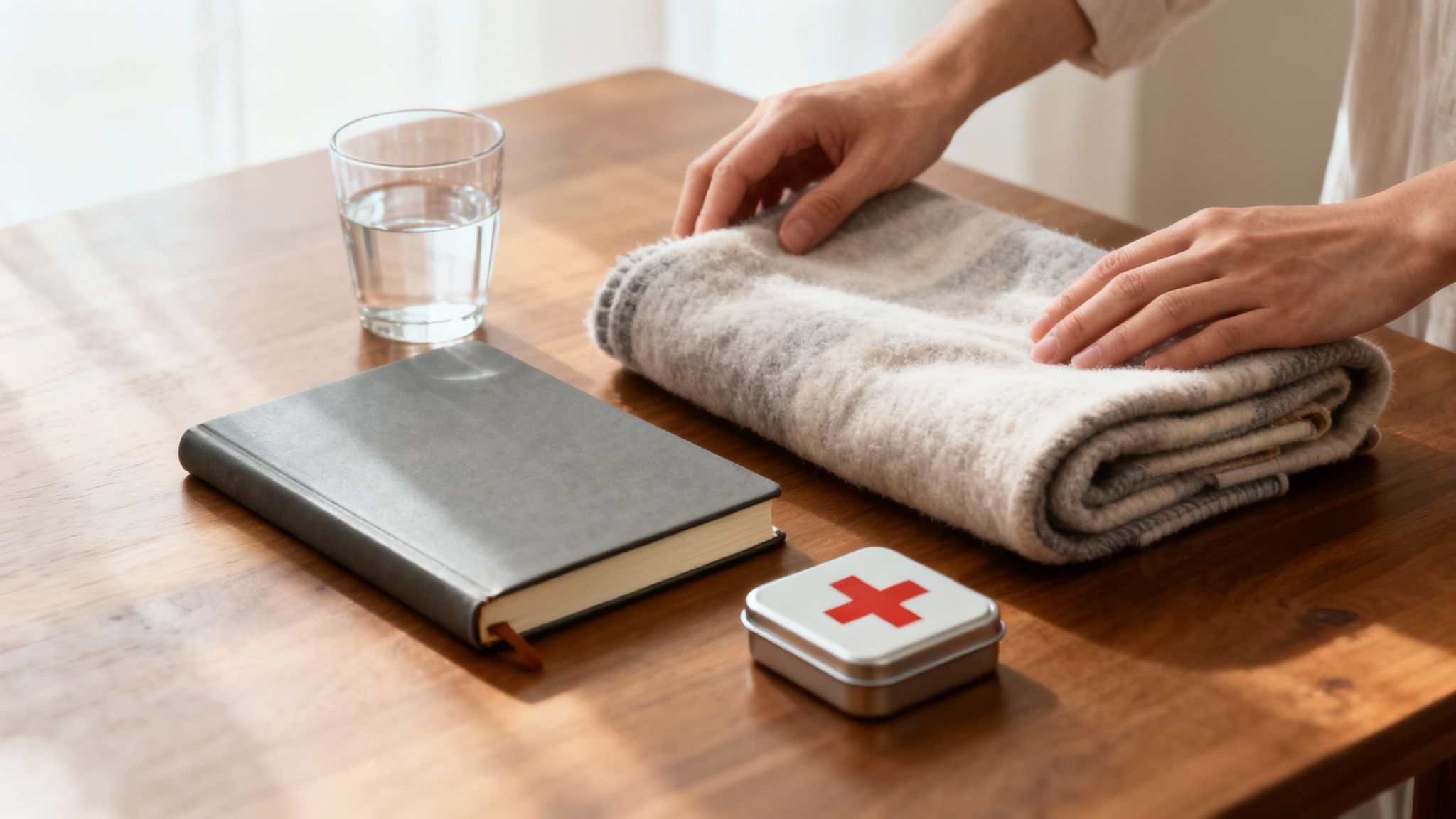
Engaging with entheogens isn’t something to be taken lightly. It’s a profound undertaking that demands immense respect, sharp awareness, and careful, deliberate planning. The key to a truly beneficial journey lies in minimizing risks while maximizing the potential for positive growth, and that takes a real commitment to safety.
Think of it like preparing for a deep-sea dive. You wouldn’t just jump off the side of a boat and hope for the best. You’d need the right equipment (preparation), a knowledgeable guide (facilitation), and a solid plan for resurfacing safely (integration). This exact level of preparedness is crucial when you’re exploring the depths of your own consciousness.
The Foundation of Set and Setting
The absolute bedrock of any responsible entheogenic journey is the principle of set and setting. It’s a simple concept that’s been around for decades, yet it’s arguably the single most critical factor influencing the outcome of an experience.
Set is all about your mindset. This covers your intentions, expectations, current emotional state, and your overall psychological readiness for the journey ahead. Entering an experience with a clear, positive intention can act as a powerful anchor when things get intense.
Setting is your physical environment. This means everything from the room you’re in and the people around you to the music playing and the quality of the light. A safe, comfortable, and supportive setting is simply non-negotiable.
When both your inner world and your outer world are properly prepared, you create a container that can hold whatever arises. A turbulent mind or a chaotic environment, on the other hand, can easily send an experience into difficult or distressing territory.
Understanding the Contraindications
Let’s be clear: not everyone is a suitable candidate for an entheogenic experience. Certain conditions pose significant risks, and it’s vital to be brutally honest about your physical and mental health history before ever considering this path.
Pharmacological interactions are a huge concern. Common medications like SSRIs and other antidepressants can have dangerous, even life-threatening, interactions with certain entheogens—especially those containing MAOIs, like Ayahuasca.
Similarly, a personal or family history of psychosis, schizophrenia, or bipolar disorder is a major contraindication. These powerful experiences have the potential to trigger latent psychological issues in individuals who are vulnerable.
“Responsible use begins with radical self-honesty and thorough screening. Acknowledging these risks isn’t about fear; it’s about honoring the power of these substances and ensuring the safety of your own mind and body.”
Acknowledging the Risks and Realities
While many entheogens have a remarkably favorable safety profile when used correctly, they are not without risk. For instance, a Global Ayahuasca Survey of over 10,000 people found that while physical discomfort is common, only 2.3% of participants actually required medical attention.
What’s fascinating is that 88% of those who reported adverse psychological effects still viewed them as part of a positive growth process. You can dig into the full study on the safety profile of Ayahuasca on PubMed for more detail.
This really highlights a key point: a challenging experience is not necessarily a bad one. These journeys can bring up difficult emotions and repressed memories, which can feel overwhelming in the moment. But often, that’s the very material that needs to be processed for deep healing to occur.
The Vital Role of Integration
The journey doesn’t end when the substance wears off. In fact, some of the most important work begins in the days, weeks, and months that follow. This is the integration phase—the ongoing process of making sense of your experience and weaving its lessons into the fabric of your daily life.
Without proper integration, even the most profound insights can fade away like a half-remembered dream. It’s like returning from that deep-sea dive and immediately forgetting everything you saw. Integration can take many forms:
- Journaling to capture raw insights and fading memories.
- Speaking with a therapist or a trained integration coach.
- Spending quiet time in nature to reflect.
- Making tangible, concrete life changes based on what you learned.
This post-journey work is what turns a powerful experience into lasting, meaningful change. It is the final, essential step in a truly responsible and complete entheogenic journey.
The Ayahuasca Movement’s Global Reach and Its Responsibilities
Ayahuasca’s journey from a sacred Amazonian brew to a global phenomenon is a complicated one, packed with stories of healing, burgeoning interest, and some very real ethical dilemmas. A practice that was once confined to specific indigenous groups has now spread across continents, drawing people from every imaginable background who are looking for deep personal healing and growth. This incredible expansion, however, brings a wave of important questions about how we can engage with it responsibly and respectfully.
As more and more people seek out this powerful medicine, the demand sends ripples all the way back to the Amazon. The conversation is no longer just about one person’s experience; it’s about our collective impact on the cultures and the very ecosystems that have cared for this medicine for generations. We all have a role to play in approaching this movement with awareness.
The Scale of Global Expansion
It’s hard to overstate just how massive this movement has become. Recent research throws a spotlight on how widespread interest in Ayahuasca is, reaching far beyond its traditional roots.
The data reveals a dramatic change. A study from ICEERS covering 2020 to 2023 estimates that over four million people around the world have now tried Ayahuasca. In 2019 alone, about 820,000 people took part in ceremonies. Here’s the most telling statistic: 90% of these lifetime consumers—that’s roughly 3.6 million people—are non-indigenous. This single fact highlights the immense global reach of this ancestral medicine. You can dive deeper into these findings on global Ayahuasca consumption from ICEERS.
Navigating the Ethical Terrain
This explosion in popularity forces us to look squarely at several critical ethical issues. As someone interested in this path, simply being aware of these challenges is the first step toward making choices that truly honor the tradition.
Here are the key areas that need our attention:
- Cultural Appropriation: There’s a delicate balance between genuine appreciation and harmful appropriation. It’s crucial to seek out practices that respect the lineage of the medicine instead of stripping the ceremony of its deep cultural and spiritual context.
- Sustainability: The two essential ingredients, the Banisteriopsis caapi vine and the Psychotria viridis leaf, are being harvested like never before. This is putting incredible strain on local ecosystems and sparking real concern about their availability for future generations.
- Reciprocity: How do we give back in a meaningful way? True reciprocity isn’t just a transaction; it’s about ensuring the indigenous communities who are the original keepers of this knowledge benefit, both economically and culturally, from its worldwide spread.
“Taking part in the global Ayahuasca movement means being an informed and ethical participant. It’s about finding centers and facilitators who are dedicated to sustainability, who honor the medicine’s roots, and who actively support the communities it comes from.”
In the end, choosing a retreat or facilitator is about so much more than your personal journey. It’s a choice that affects the entire ecosystem of this global movement. By asking the right questions and putting our support behind ethical centers, we can all help protect Ayahuasca’s healing potential for generations to come in a way that’s respectful and sustainable for everyone involved.
Common Questions About Entheogens
It’s natural to have a lot of questions when you first start learning about entheogens. As more people become curious about these powerful plants and compounds, it’s more important than ever to have clear, reliable answers. Let’s tackle some of the most common ones.
What’s the Real Difference Between “Entheogen” and “Psychedelic”?
You’ll hear these terms used interchangeably, but there’s a subtle and important difference in what they imply.
The word “psychedelic” was coined in the 1950s and literally means “mind-manifesting.” It’s a broad, clinical term that can describe any substance that radically alters consciousness, from LSD to psilocybin, regardless of how it’s used.
“Entheogen,” on the other hand, means “generating the divine within.” This term was introduced to move away from the recreational or purely scientific connotations of “psychedelic.” It specifically points to the intention behind the experience—using a substance for spiritual insight, personal healing, or as part of a sacred ceremony. The key difference isn’t the substance itself, but the purpose for taking it.
Are Entheogens Safe?
This is a big question, and the answer isn’t a simple yes or no. The safety of an entheogenic experience has less to do with the substance itself and far more to do with the context, your preparation, and your personal health.
When used responsibly—with thorough medical and psychological screening, in a safe and supportive setting, and with a trained facilitator—many of these substances have a remarkably good safety profile.
But the risks are very real and should never be underestimated. These substances can trigger intense psychological distress, especially for those with a personal or family history of certain mental health conditions. They can also have dangerous, even fatal, interactions with common medications like antidepressants (SSRIs). Being completely honest about your health history with a facilitator isn’t just a good idea; it’s a critical safety measure.
“The right question to ask isn’t “Is this substance safe?” but rather, “Is it safe for me, right now, in this specific environment?” Responsible exploration demands a serious commitment to understanding your own risks and building a strong container for the experience.”
How Is an Ayahuasca Journey Different From a Psilocybin Mushroom Experience?
While both can lead to incredibly profound and healing experiences, they are worlds apart in how they’re typically approached and what the journey feels like. Both are powerful tryptamines, but that’s where the similarities often end.
Psilocybin mushrooms are fungi that are usually eaten directly. The experience can be shaped in countless ways and happen in all sorts of settings, from a quiet room with a guide to a hike in nature. It’s often more personal and internally directed.
Ayahuasca is a complex brew, a combination of at least two different Amazonian plants. It’s almost always consumed within a highly structured ceremonial container, led by an experienced guide (curandero or shaman), often in a group setting. The journey is typically longer and known for its purgative effects, which are seen as a core part of the physical and spiritual cleansing process.
The biggest distinction is that tightly held, ritualistic framework of a traditional Ayahuasca ceremony. That container, built on generations of indigenous wisdom, profoundly shapes the experience. It’s designed to be a guided, communal path toward healing, which feels very different from the more solitary or less structured nature of many mushroom journeys.
Disclaimer: The information provided on Ayahuasca.com is for educational purposes only and is not intended as medical advice, diagnosis, or treatment. Ayahuasca is a powerful traditional Amazonian medicine and may not be suitable for everyone. Always consult with a qualified healthcare professional before making decisions related to health, mental well-being, medications, or the use of Ayahuasca.