
A traveler folds loose clothing into a bag, checks passport requirements, and rereads a retreat questionnaire before flying toward the Peruvian Amazon. The practical questions arrive first: What happens during the ceremony? Which medicines create danger? How can a visitor participate without treating another community’s spiritual life as a wellness product?
Those questions lead into a larger subject. Sacred plants aren’t one universal category, and their meaning can’t be separated from the people, places, rules, and relationships surrounding them. Some traditions describe plants as teachers or messengers. Others treat them as offerings, medicines, ancestors, or participants in community life. A responsible guide therefore needs to hold several ideas together: historical depth, biological effects, indigenous authority, legal uncertainty, and careful preparation.
What Sacred Plants Really Mean Across Cultures
A visitor arriving for an Ayahuasca ceremony may think in terms of personal healing, emotional clarity, or spiritual exploration. A Shipibo healer may approach the same ceremony through lineage, songs, diagnosis, discipline, and obligations to a living tradition. Neither perspective can be understood properly by reducing the plant to a chemical effect or a retreat itinerary.
A sacred plant is generally recognized within a community as more than a useful species. Its role emerges through ceremonial framing, including rules for harvesting, preparation, prayer, diet, timing, conduct, and interpretation. Communities may treat the plant as a teacher, messenger, ancestor, or embodiment of divine presence. That relationship distinguishes sacred use from casual consumption, even when the same species also has medicinal, nutritional, or recreational applications.
One Category, Many Cultural Systems
The category crosses regions, but the systems remain distinct:
- Amazonian traditions: Shipibo, Asháninka, and Kichwa communities maintain different ceremonial languages, plant knowledge, and forms of stewardship around Ayahuasca and other medicines.
- Himalayan traditions: Sacred plants may appear within ritual, healing, pilgrimage, and mountain ecology, where community rules shape access and use.
- African traditions: Sacred groves and initiation systems connect plants with ancestors, authority, healing, and collective identity.
- Mesoamerican traditions: Mushroom ceremonies and other plant relationships are embedded in local histories, religious practice, and community responsibilities.
References to Yoruba, Navajo, and Vedic contexts also show why “sacred plant” shouldn’t be treated as a synonym for “psychedelic.” A plant can be sacred because of its role in offering, purification, protection, healing, or social ceremony, whether or not it produces dramatic altered states.
“Practical rule: The plant alone doesn’t define the tradition. The community’s relationship with the plant does.”
Western seekers often arrive with individualized goals. Source cultures may emphasize reciprocity, humility, service, and accountability to elders or community members. That difference creates the central ethical tension: access can support genuine learning, while careless tourism can extract ceremony from the relationships that give it meaning.
Ancient Roots and Living Traditions of Plant Reverence
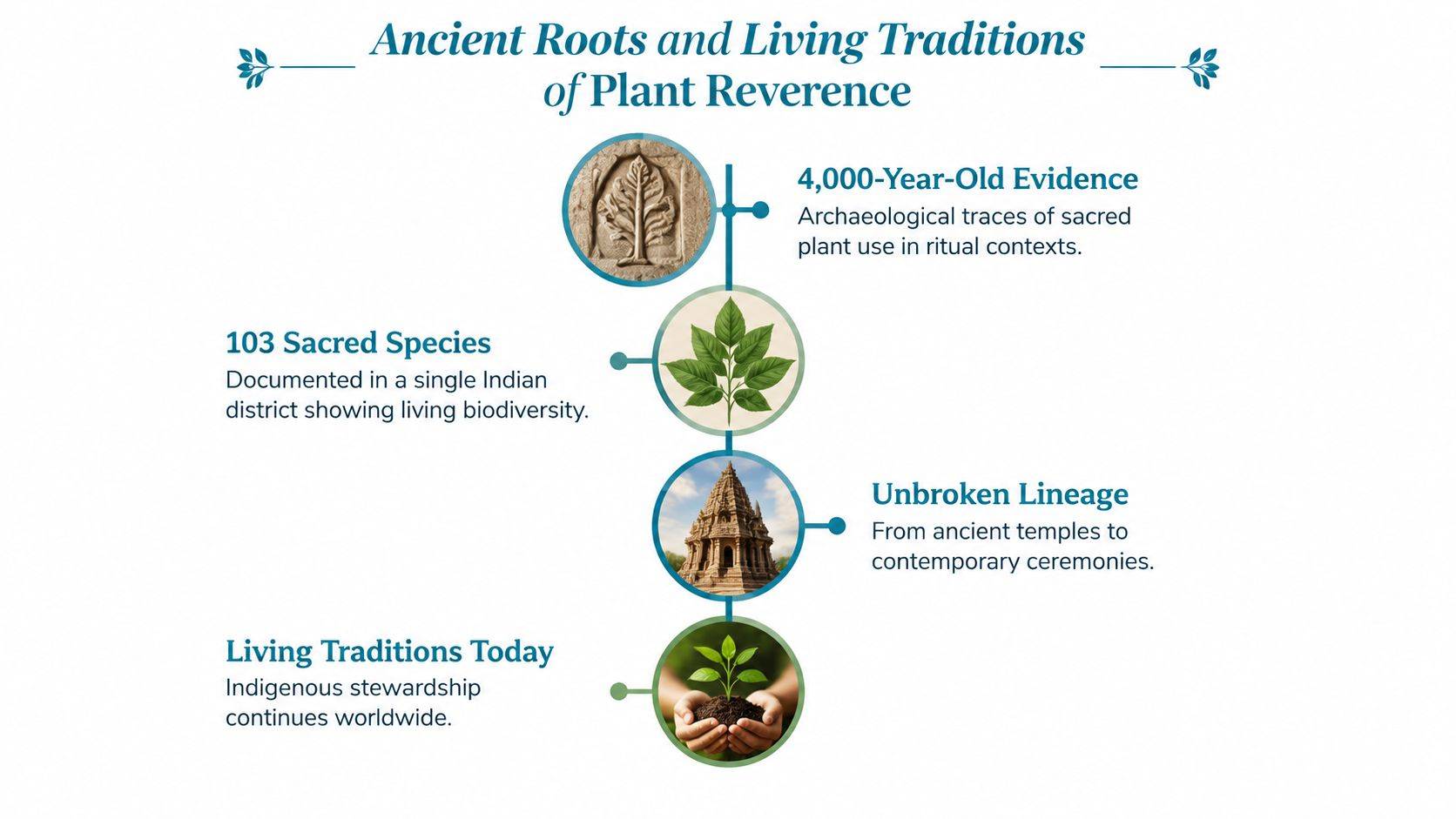
Plant reverence reaches far beyond modern psychedelic culture. Historical research places plant worship in ancient India at least as far back as the third or fourth millennium B.C., connecting sacred species with healing, ritual, and self-empowerment. Vedic traditions associated plants such as soma with ritual knowledge, while later Indian communities continued to maintain elaborate relationships with trees, herbs, and other species.
The breadth is visible in contemporary ethnobotanical records. In one Indian district, a survey documented 103 sacred plant species spanning 95 genera and 54 families in its published ethnobotanical record.pdf). That finding matters because it challenges the idea that plant reverence centers on a small collection of globally famous medicines. A single district can hold a botanically diverse sacred assortment shaped by local history and ecological knowledge.
From Archaeological Traces to Present Ceremony
Amazonian traditions offer another anchor. Archaeological evidence discussed in the historical literature suggests that Amazonian communities used Ayahuasca around 4,000 years ago as described in this cultural history source_2.pdf). The precise details of early practice can’t be reconstructed completely, but the evidence supports a long human relationship with psychoactive plant preparations in the region.
Across the Americas, pre-Columbian communities developed their own ceremonial systems around plants and fungi. Mesoamerican mushroom stones, Andean coca traditions, and other ritual practices formed part of broader religious and social worlds. Colonial encounters disrupted transmission through persecution, forced conversion, land dispossession, and restrictions on Indigenous ceremony. At the same time, written accounts and global trade carried fragments of botanical knowledge beyond their original settings, often without the consent or protection of the communities that held it.
Syncretic movements helped preserve some lineages under pressure. The União do Vegetal and the Native American Church, for example, maintained sacramental traditions through collective organization and religious continuity. These traditions aren’t museum artifacts. Elders, healers, ceremonial leaders, and knowledge keepers continue to teach them, adapt them, and defend their authority.
For readers interested in how plant compounds and human cultures have intersected across history, the ancient terpene archive from Gold Coast Terpenes provides useful historical context. Chemical history can enrich cultural understanding, but it can’t replace it.
How Sacred Plants Work in the Body and Brain
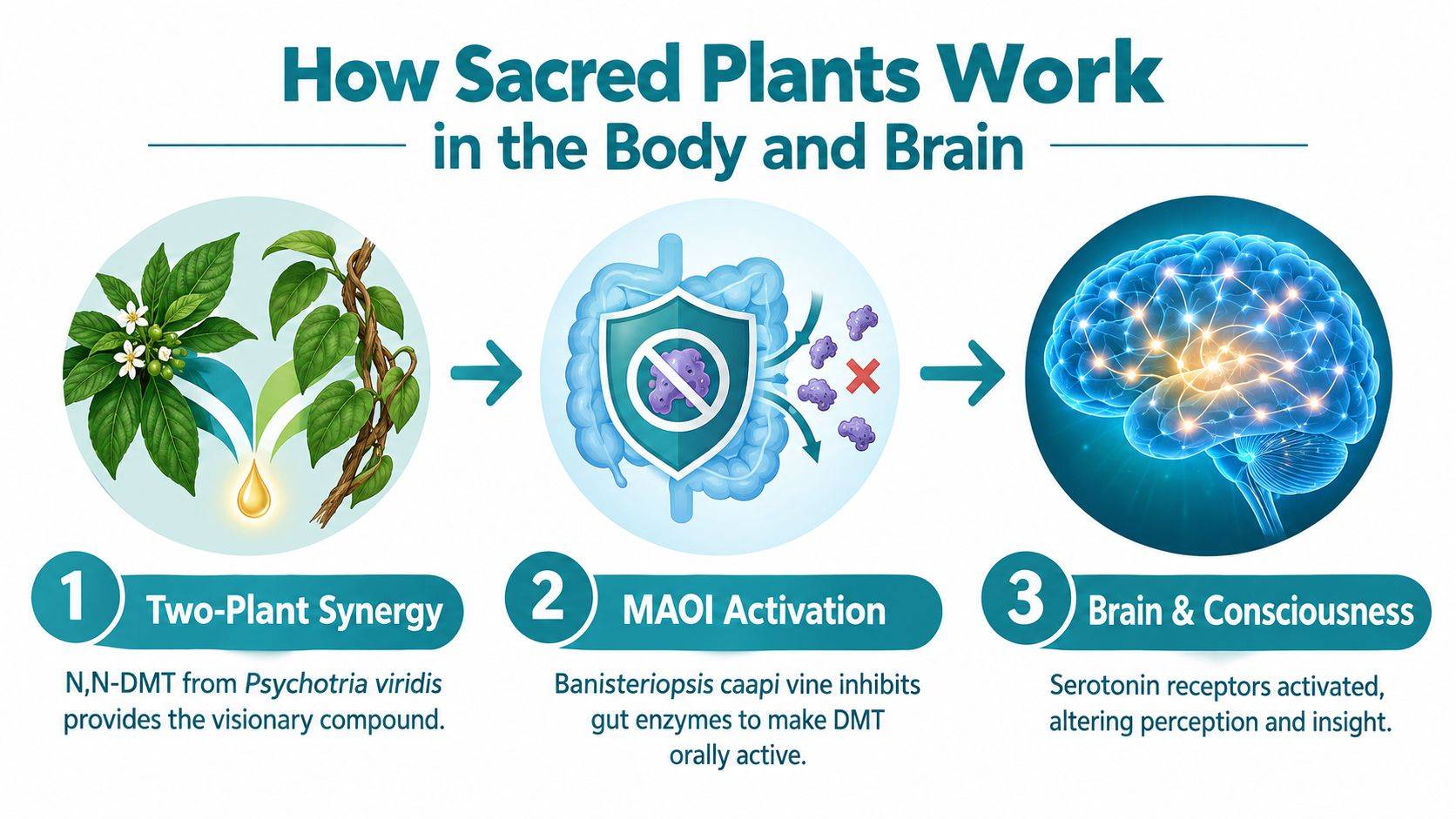
Ayahuasca offers the clearest example of why plant composition matters. The traditional brew combines leaves of Psychotria viridis, which supply DMT, with Banisteriopsis caapi, whose β-carbolines include harmine, harmaline, and tetrahydroharmine. These β-carbolines act as reversible, competitive MAO-A inhibitors, reducing the first-pass metabolism that would otherwise make oral DMT inactive according to the pharmacological review indexed by PubMed.
DMT then acts primarily at 5-HT2A receptors, with documented interaction at 5-HT2C and 5-HT1A receptors. In plain language, the vine changes the conditions under which the leaf compound can act. That two-part interaction explains why changing plant parts, preparation methods, or proportions can alter onset, intensity, duration, and risk.
Reported human time-course data place peak effects at about 60 to 120 minutes, with effects resolving by roughly 240 minutes after ingestion in the same human pharmacology source. These figures are useful for planning observation and emergency procedures, but they shouldn’t be treated as a promise for every individual.
Composition Shapes Experience
Other sacred medicines illustrate the same principle. Peyote contains mescaline. Psilocybin mushrooms contain psilocybin, which the body converts into psilocin. Iboga contains ibogaine, a compound with activity across several systems, including opioid-related pathways. These aren’t interchangeable “plant medicines,” and their subjective effects, contraindications, and therapeutic research profiles differ.
The phrase default mode network disruption often appears in popular explanations of psychedelics. It can help describe changes in self-referential processing, but it doesn’t explain the whole ceremony or prove a healing outcome. Neurochemistry supplies one layer of understanding. Preparation, expectations, social setting, cultural meaning, and post-ceremony support supply others.
A concise overview of the brew’s ingredients and mechanisms appears in this Ayahuasca.com guide to how Ayahuasca works. It’s most useful when read alongside cultural and safety information rather than as a substitute for either.
Major Sacred Plants and the Wisdom They Carry
Sacred plants form an interconnected family, but they shouldn’t be placed on a single ladder of intensity or importance. Each plant carries a different history, preparation system, and set of responsibilities. A chemical profile can describe what a compound does in the nervous system. It can’t explain why a community considers a plant a relative, sacrament, offering, or master teacher.
Ayahuasca appears in Amazonian healing and divination practices, including ceremonies associated with Shipibo, Asháninka, and Kichwa communities. Peyote holds sacramental importance in Huichol traditions and within the Native American Church, where its use is shaped by religious governance rather than retreat-style consumption.
Cannabis has sacred threads in Hindu, Rastafarian, and Scythian histories. Kava supports social and ceremonial diplomacy across Pacific Island communities. Coca leaf chewing and religious offering in the Andes represent a cultural practice distinct from cocaine, whose production and effects belong to a very different context.
Iboga is connected with Bwiti initiation in Gabon. Psilocybin mushrooms appear in Mazatec veladas and in historical accounts of Aztec ritual. Tobacco, including Amazonian rapé traditions and Mapuche relationships, can function as a master plant within ceremonial systems. These examples resist the wellness habit of treating every sacred plant as a personal optimization tool.
| Plant | Cultural Origin | Traditional Role | Modern Context |
|---|---|---|---|
| Ayahuasca | Amazonian communities | Healing, divination, and ceremony | Globalized retreats and clinical research |
| Peyote | Huichol traditions and Native American Church | Sacrament and communal prayer | Protected religious use alongside legal pressure |
| Cannabis | Hindu, Rastafarian, and Scythian traditions | Devotion, meditation, and ritual | Medical, recreational, and renewed spiritual interest |
| Kava | Pacific Island communities | Social welcome and ceremonial diplomacy | Community gatherings and international consumption |
| Coca Leaf | Andean communities | Chewing, offering, and religious practice | Often confused with cocaine despite distinct traditional use |
| Iboga | Bwiti communities in Gabon | Initiation and spiritual instruction | International interest with serious safety questions |
| Psilocybin Mushrooms | Mazatec and Mesoamerican traditions | Veladas, healing, and divination | Modern research and psychedelic facilitation |
| Tobacco | Mapuche and Amazonian traditions | Offering, protection, and master-plant work | Commercial tobacco markets and ceremonial revival |
The Ayahuasca.com resource on psychotropic plants offers a broader botanical frame. The central lesson remains consistent: pharmacology follows relationship, not the reverse. A plant becomes meaningful through practice, stewardship, language, and accountability.
Preparing for Ceremony With Respect and Care
Preparation should be treated as a continuum. A person’s responsibility begins before arrival and continues after the ceremony, because a safe container depends on screening, communication, supervision, and integration rather than a single checklist.
Start With Health Screening
A qualified medical conversation should cover current medicines, psychiatric history, cardiovascular history, pregnancy, and family history of psychosis. Particular caution is necessary around SSRIs and MAOIs, because Ayahuasca’s β-carbolines inhibit MAO-A and medication interactions can create serious risks. Participants shouldn’t stop prescribed medication without the clinician responsible for that treatment.
A facilitator should ask direct questions rather than relying on a vague waiver. The retreat team also needs a clear process for declining participation when a person’s health history makes the setting unsuitable.
Examine the Retreat Container
Amazonian and Shipibo traditions may include a dieta, with restrictions involving foods such as tyramine-rich items and salt, along with sexual abstinence and social quietude. These practices can carry spiritual meaning, but participants should ask what each rule means, who supervises it, and whether the retreat presents tradition accurately rather than turning it into a marketing formula.
Before booking, a seeker can request:
- Lineage information: Who trained the facilitator, and which community relationships are active?
- Emergency procedures: Who handles medical distress, and how can outside care be reached?
- Group boundaries: How are consent, touch, privacy, and vulnerable disclosures managed?
- Financial transparency: Are prices, exclusions, cancellations, and optional fees explained clearly?
- Integration support: Does assistance continue after the final ceremony?
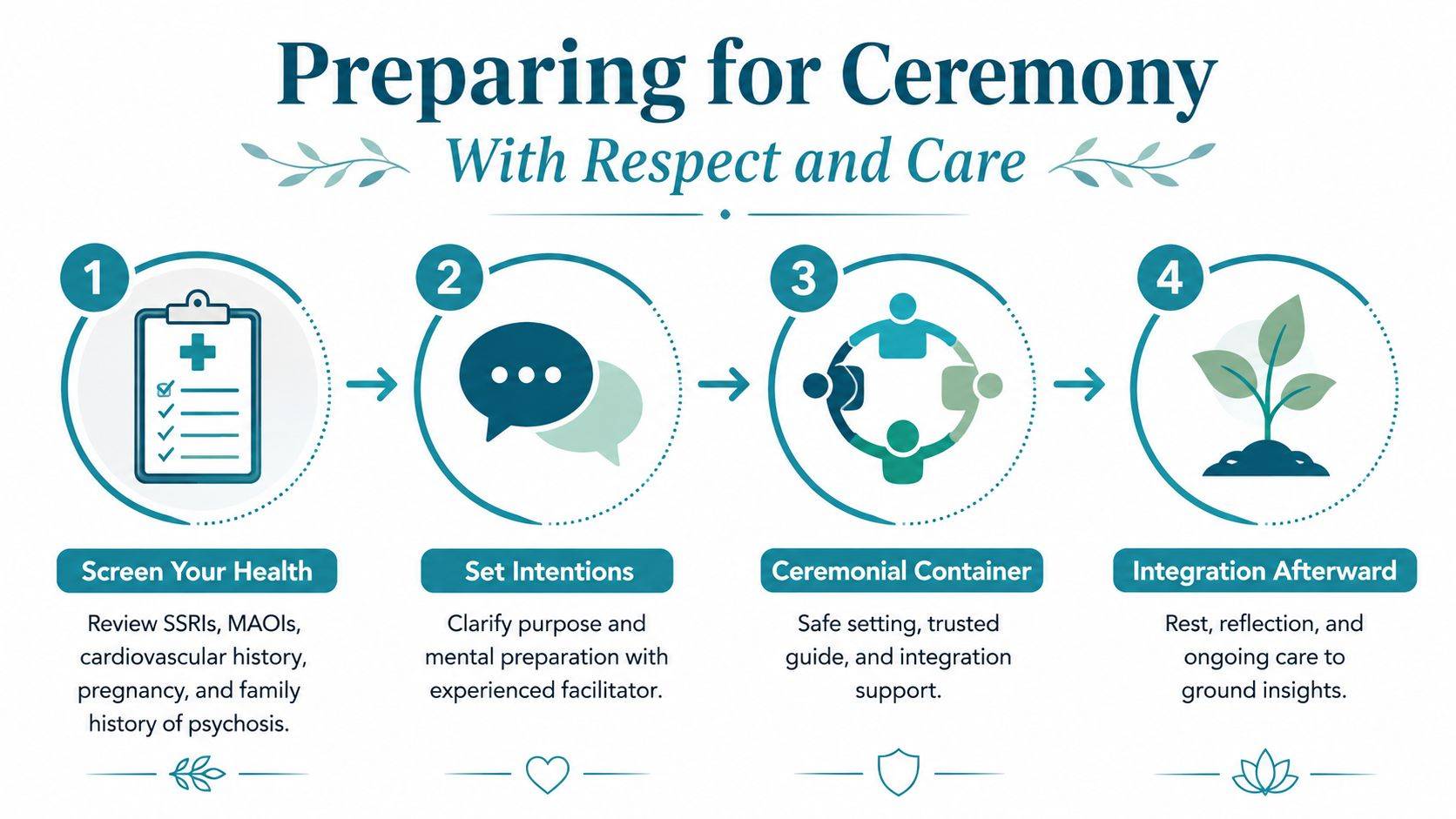
During ceremony, intention can provide direction without turning the experience into a performance. Difficult material may arise, and a responsible guide should support grounding, physical safety, and consent rather than promising a predetermined breakthrough. Rest afterward, journaling, therapist follow-up, somatic practices, and trusted community support help translate an intense experience into durable choices.
“Safety principle: A retreat can’t screen too carefully, explain too clearly, or provide too much integration support.”
Ethics, Law, and the Line Between Tradition and Appropriation
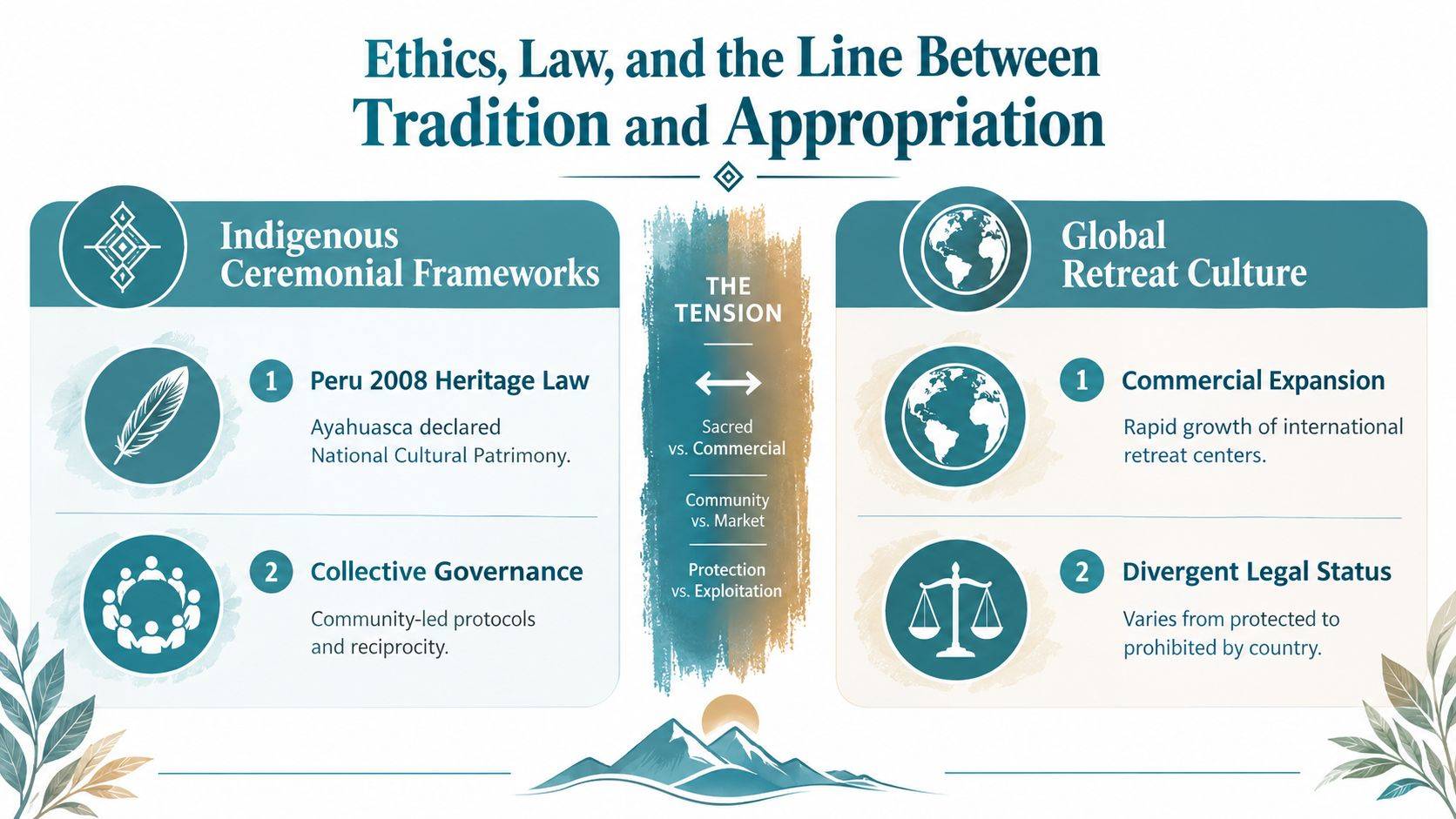
Indigenous ceremonial frameworks and global retreat culture often operate under different forms of governance. A community may regulate who serves, how plants are harvested, which songs are shared, and what obligations participants carry afterward. A commercial retreat may instead organize access around schedules, marketing language, visitor demand, and individualized outcomes.
Peru declared the knowledge and traditional uses of Ayahuasca practiced by native Amazonian communities National Cultural Heritage on June 24, 2008 in the documented government milestone_2.pdf). That designation recognizes cultural continuity, but it doesn’t create a universal international permission structure.
Legal Protection Is Narrow and Uneven
In the United States, Ayahuasca generally falls under federal controlled-substance restrictions because it contains DMT, a Schedule I substance as summarized in this legal overview. Courts and agencies have created narrow religious exemptions for specific groups, but those exemptions don’t amount to broad legalization.
The federal Religious Freedom Restoration Act process also isn’t automatic. A claimant must demonstrate a sincere religious belief and a substantial burden imposed by law. The government must then satisfy strict scrutiny by showing a compelling interest and using the least restrictive means as described in this RFRA process guide.
“Ethical test: If a practice removes a plant from its community obligations while keeping the revenue, symbolism, and prestige, it deserves serious scrutiny.”
Appropriation can involve copying songs, titles, clothing, or rituals without permission. It can also appear through extractive supply chains, inflated claims, unpaid cultural labor, or retreat branding that implies indigenous legitimacy without an accountable relationship. Appreciation requires more than respectful language.
Practical ethics include:
- Pay fairly: Compensate local workers and knowledge holders without disguising payment as charity.
- Trace the source: Ask how plants are harvested, cultivated, transported, and replenished.
- Support reciprocity: Direct resources toward originating communities through transparent, accountable arrangements.
- Reject commodification: Avoid operators who guarantee healing, pressure participation, or trivialize lineage knowledge.
The Ayahuasca.com resource on sacred reciprocity provides a useful framework for thinking about responsibility beyond the ceremony itself.
What Science Actually Says About Healing Potential
Research does support therapeutic potential, but the evidence needs careful language. Reviews describe improvements in depressive and anxious symptoms across naturalistic and experimental Ayahuasca studies, while also emphasizing that controlled trials remain limited by small samples, single-dose designs, and short follow-up in the recent clinical review.
Psilocybin-assisted therapy and MDMA-assisted therapy have also received substantial clinical attention, including studies of depression, trauma-related symptoms, and psychotherapy-supported treatment models. However, the supplied evidence base doesn’t establish a single universal protocol, long-term outcome pattern, or safety profile for every participant. Expectancy effects, limited blinding, narrow participant populations, and uncertain durability remain important methodological concerns.
| Substance | Primary Studied Indication | Evidence Stage | Key Limitation |
|---|---|---|---|
| Ayahuasca | Depressive and anxious symptoms | Promising early clinical and translational evidence | Small samples, limited controlled trials, and short follow-up |
| Psilocybin | Depression and psychotherapy-supported care | Active clinical research | Blinding challenges, expectancy effects, and uncertain long-term durability |
| MDMA | Trauma-related treatment models | Advanced clinical research | Access, screening, implementation, and long-term monitoring questions |
The Practical Bottleneck
The strongest reasonable conclusion is promising signal, not mature clinical consensus. Mechanistic discussions involve serotonergic signaling, MAO-A inhibition, and possible downstream effects across glutamatergic, dopaminergic, and endocannabinoid systems. Preclinical literature also points toward possible neuroplastic, immunomodulatory, and anxiolytic effects, but biological plausibility doesn’t guarantee a safe or effective personal outcome.
Ayahuasca use expanded globally while remaining niche. In the 2015 and 2016 Global Drug Survey, 527 of 96,901 respondents reported having used Ayahuasca, roughly 0.54% as reported in the technical literature_2.pdf). The contrast matters. Cultural importance can be extensive even when mainstream prevalence remains limited.
Fragmented regulation and inconsistent screening may therefore create a larger practical barrier than the absence of efficacy data. Wider access requires medication review, psychiatric risk assessment, trained facilitators, emergency planning, informed consent, and structured integration. Therapeutic legitimacy depends on building that infrastructure, not repeating hopeful claims.
Bringing the Lessons Home and Continuing the Path
A ceremony rarely serves as the destination. The useful question afterward is whether the experience changes behavior, relationships, health decisions, or community responsibility in grounded ways.
A Practical Preparation Checklist
Before participating, a seeker should confirm:
- Medical screening: Current medications, cardiovascular history, pregnancy considerations, and psychiatric risk have been reviewed with an appropriate clinician.
- Interaction planning: Prescribed medicines aren’t stopped or changed without medical guidance.
- Dietary clarity: Any dieta is explained in cultural and practical terms, including what happens if a participant can’t follow it.
- Emergency readiness: The team can describe supervision, evacuation, medical support, and consent procedures.
- Intentions: The participant has a flexible purpose rather than an expectation of guaranteed healing.
Ethical sourcing requires equal care. A responsible operator should explain facilitator lineage, plant sourcing, community relationships, compensation, and post-ceremony support. Seekers can favor transparent arrangements that return value to originating communities and avoid retreats that imitate indigenous authority without accountability.
Integration can remain simple and concrete:
- Journal about what changed in perception, relationships, and daily priorities.
- Use gentle somatic practices to notice stress, sleep, and emotional regulation.
- Discuss difficult material with a suitably trained therapist.
- Join a support circle that respects confidentiality and avoids grandiose interpretations.
- Turn insights into small, observable lifestyle changes.
For further education, readers can explore the Chacruna Institute for psychedelic studies, ICEERS for policy and indigenous advocacy, MAPS for clinical research, harm-reduction guides from established educational organizations, and peer-reviewed journals such as the Journal of Psychedelic Studies. Ayahuasca.com also publishes educational material on preparation, integration, sacred medicines, and indigenous traditions.
Curiosity matters, but humility and reciprocity matter more. Anyone considering sacred plants should begin with medical screening, verify the legal situation in the relevant location, ask difficult questions about cultural authority, and choose a setting with clear emergency and integration practices. Use those standards before paying a retreat deposit or drinking a ceremonial brew.
Start with the Ayahuasca.com resources on sacred medicines and ceremony preparation, then make a written checklist covering health screening, legal status, facilitator accountability, ethical sourcing, emergency plans, and integration support. Share that checklist with a qualified clinician and a trusted support person before making any commitment.
Disclaimer: The information provided on Ayahuasca.com is for educational purposes only and is not intended as medical advice, diagnosis, or treatment. Ayahuasca is a powerful traditional Amazonian medicine and may not be suitable for everyone. Always consult with a qualified healthcare professional before making decisions related to health, mental well-being, medications, or the use of Ayahuasca.