
You return home after ceremony carrying something hard to name.
Maybe you saw a pattern in your family that suddenly made sense. Maybe you felt grief move through you like a storm. Maybe you touched a kind of love that felt more real than ordinary life, and now you’re standing in your kitchen answering emails, folding laundry, and wondering why the world looks the same when you do not.
That moment can feel tender and disorienting. The visions have faded. The songs are gone. Your body is back in daily time, but part of you is still listening for what the experience was trying to teach.
Many people often get confused. They assume the ceremony was the whole journey. In reality, ceremony often opens the door, and the days and weeks after determine what changes.
After the Ayahuasca Vision Fades What Now
A common scene looks like this. Someone leaves an Ayahuasca retreat feeling clear, raw, and emotionally transformed. For a few days, everything feels meaningful. Food tastes different. Old habits seem obvious. A difficult conversation with a parent or partner suddenly feels possible.
Then regular life returns.
By the second week, that same person may feel scattered instead of clear. The insights are still there, but they don’t fit neatly into work deadlines, family roles, or the pace of modern life. They might ask themselves whether they were supposed to quit a job, end a relationship, forgive someone, start meditating, or rest. All of those questions can rush in at once.
If that sounds familiar, you’re not failing. You’re meeting the work itself.
Many readers arrive here after trying to make sense of a powerful ceremony like the ones described in this overview of what the Ayahuasca experience can feel like. The challenge isn’t only understanding what happened during the experience. It’s learning how to carry it home without dropping it or forcing it into a shape that doesn’t fit.
The art of returning
Psychedelic integration therapy is the art of returning with care. It helps you translate a non-ordinary experience into ordinary actions, relationships, choices, and rhythms.
A useful image is a traveler coming back from unknown land with a notebook full of symbols. The trip matters. But the map only becomes useful when the traveler sits down, studies it, and asks, “How does this change the way I live?”
Without that step, even beautiful insight can fade into memory.
“Some experiences arrive like lightning. Integration is the steady work of wiring that energy into daily life safely.”
Why this phase can feel so confusing
People often expect clarity after a profound ceremony. Sometimes clarity comes. Sometimes what comes first is sensitivity, fatigue, vulnerability, or a flood of unresolved material. A meaningful Ayahuasca experience can loosen old stories, habits, and defenses. That can be healing, but it can also leave you feeling unusually open.
You may notice:
- Emotional intensity: tears, irritability, gratitude, grief, or tenderness that seem to rise without warning
- A gap between insight and action: you know something important, but you don’t yet know how to live it
- Relationship strain: people around you may not understand what changed
- A need for structure: sleep, food, movement, and routine suddenly matter much more
Psychedelic integration therapy gives this phase a container. It doesn’t tell you what your experience meant in some absolute sense. It helps you listen more carefully, act more wisely, and stay grounded while the meaning unfolds.
What Exactly Is Psychedelic Integration Therapy
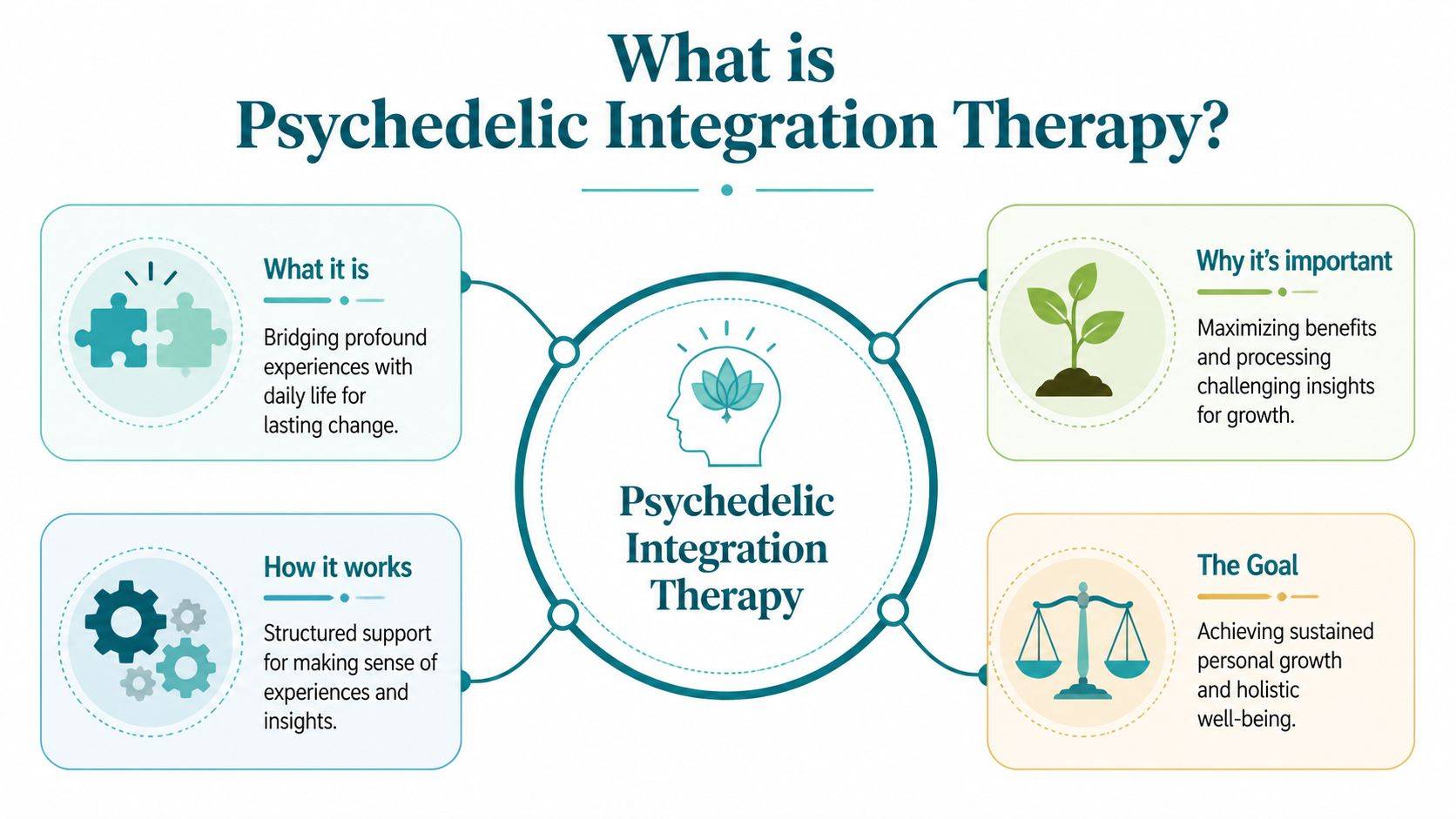
At its simplest, psychedelic integration therapy is support for making sense of a psychedelic experience and turning its lessons into lived change.
That sounds straightforward, but many people mix up the ceremony and the integration. They are related, but they are not the same thing. The ceremony may reveal. Integration helps you respond.
A good analogy is a bridge. Ayahuasca may show you a different realm of your mind, your history, your pain, your values, or your spirit. Integration therapy helps you build the bridge back to daily life so those discoveries don’t remain stranded on the other side.
What it includes
Integration can happen with a therapist, in a group, with a skilled guide, or through grounded self-practice. In all forms, the core tasks are similar:
- Meaning-making: putting words, images, or felt sense around what happened
- Emotional processing: staying with grief, fear, awe, or confusion instead of pushing it away
- Embodiment: noticing what the experience stirred in the body, not only in thoughts
- Action: deciding what small, real changes belong in your life now
This is why integration isn’t the same as retelling your ceremony story over and over. Retelling can help, but integration goes further. It asks what your experience is asking of you.
What it isn’t
Integration therapy isn’t someone interpreting your visions for you. It isn’t a sales funnel for more ceremonies. It isn’t a race to “maximize” your breakthrough. And it isn’t always traditional talk therapy in the usual sense.
Sometimes the most important work sounds simple. You cry while describing a memory that surfaced. You realize your body tightens every time you say yes when you mean no. You admit that the message you received was less about cosmic mystery and more about finally getting enough sleep, telling the truth, and leaving a harmful situation.
“Practical rule: If support makes you more dependent on the provider, less trusting of your own discernment, or pressured toward big life decisions too quickly, step back.”
Why the field takes integration seriously
Modern interest in this work has deep roots. Research into psychedelic therapy began as early as the 1950s, and the foundational clinical work from that era helped shape modern psychedelic-assisted therapy protocols, even though the understanding of integration as key to lasting benefit developed more fully over time, as described in Frontiers in Psychology on the history and evolution of psychedelic integration.
That historical thread matters. Early psychedelic work paid close attention to the experience itself. Contemporary thinking has become much clearer that what happens afterward matters greatly too.
A simple way to think about the process
You can picture psychedelic integration therapy as tending a garden after heavy rain.
The rain may soften hard ground. It may reveal what was buried. It may bring life. But if you never tend the soil, clear debris, protect new shoots, and water what you want to grow, the garden won’t organize itself.
Integration is that tending.
Exploring Different Therapeutic Models for Integration
Not every integration approach feels the same. Some therapists focus on values and behavior. Some focus on the body. Some hold space for spiritual and symbolic material without trying to reduce it to diagnosis. A thoughtful provider may borrow from several models rather than follow one rigid script.
That flexibility matters because Ayahuasca experiences rarely arrive in one neat category. A person might return with childhood grief, intense body sensations, a mystical sense of interconnectedness, and a very practical realization about work or partnership. One method alone may not hold all of that well.

ACT for values and flexibility
Acceptance and Commitment Therapy, often shortened to ACT, is useful when someone has clear insight but struggles to live it. ACT pays attention to values, psychological flexibility, and the gap between what you know and what you do.
If your ceremony helped you see that you’ve been abandoning yourself to please others, an ACT-informed therapist may ask practical questions. What value do you want to live by now. Where does fear pull you off course. What small act of honesty would move your life in the right direction this week.
ACT tends to work well for people who want a grounded, structured style. It doesn’t flatten spiritual experience. It asks how insight becomes action.
Somatic work for what words can’t reach
Some Ayahuasca material lives in the body before it can be explained in language. A person may say, “I don’t know what happened, but my chest tightens every time I remember the ceremony,” or “I keep feeling a wave in my stomach when I think about my father.”
Somatic approaches pay attention to breath, posture, tension, movement, and nervous system regulation. That can be helpful when the experience was overwhelming, physically intense, or tied to trauma.
Here is a simple comparison:
| Approach | Best suited for | What sessions may focus on |
|---|---|---|
| ACT | Insight that needs action | values, habits, choices, committed change |
| Somatic therapy | Strong body sensations or trauma activation | breath, grounding, tracking sensation, movement |
| Transpersonal work | Spiritual or mystical material | meaning, symbolism, worldview, existential questions |
Transpersonal and spiritually sensitive approaches
Some experiences don’t fit neatly into symptom language. They may involve archetypal imagery, encounters with death, experiences of unity, or a felt sense that life has become sacred in a new way. A transpersonal approach creates room for that material without forcing a narrow interpretation.
This can be especially important for Ayahuasca, because many people come away with questions that are spiritual as much as psychological. A skilled practitioner doesn’t have to share your beliefs. They do need the maturity to stay curious and respectful.
The PHRI model as a flexible container
The Psychedelic Harm Reduction and Integration Model offers a broad framework for this kind of work. It draws from mindfulness, somatic techniques, and other therapies to address post-experience challenges, and it emphasizes that structured integration can reduce potential harms by supporting a more unified relationship among mind, body, and spirit, as outlined in this explanation of the Psychedelic Harm Reduction and Integration Model.
That broad approach can be a relief. It means a provider doesn’t have to force every experience into one theory.
For readers who want a deeper conceptual background, this psychointegration overview offers a useful companion perspective.
“A good integration model should feel like a well-built container, not a cage.”
Questions that help you choose
When you’re speaking with a practitioner, ask how they work. Listen for specifics.
- If you need structure: ask how they help clients translate insight into concrete changes
- If your body feels stirred up: ask whether they use somatic tools, grounding, or nervous system support
- If your experience was spiritual: ask how they hold mystical material without imposing beliefs
- If the ceremony was difficult: ask how they approach fear, confusion, and destabilization
You don’t need a provider with perfect answers. You do need someone whose framework matches the territory you’re walking through.
The Evidence Behind Successful Integration
Integration is often described in soft language, but there is hard evidence behind the reason people take it seriously.
Modern clinical research on psychedelic therapies shows that these treatments can have substantial effects when delivered in structured settings. In a review published by the Cleveland Clinic Journal of Medicine, psilocybin-assisted therapy for major depressive disorder showed a standardized mean difference of –0.78 between experimental and control groups, with a 57% pooled response rate compared with 22% for controls. In the same review, MDMA-assisted therapy for PTSD produced a 22-point greater reduction in baseline CAPS scores than controls, and participants receiving MDMA in phase 2 trials had a 6.8% dropout rate, compared with 56% and 47% in conventional trauma-focused therapies such as prolonged exposure and cognitive processing therapy. The review also found that group treatment models reduced clinician costs by 50.9% for MDMA-PTSD, or $3,467 per patient, and by 34.7% for psilocybin-MDD, or $981 per patient. Over a 10-year projection in the United States, group models were associated with 6,711 fewer full-time equivalent clinicians for MDMA-PTSD and 1,159 fewer for psilocybin-MDD, with savings of up to $10.3 billion and $2.0 billion respectively, according to the Cleveland Clinic Journal of Medicine review on psychedelic therapies and group treatment cost-effectiveness.
Those numbers come from MDMA and psilocybin research rather than Ayahuasca specifically, but they point to something important. Psychedelic treatment works best in well-supported systems, not in isolation.
Why support after the experience matters
A psychedelic session can open a window. Integration determines what gets built while that window is open.
People often assume healing comes from the peak experience alone. Clinical practice suggests something more grounded. Lasting benefit usually depends on what happens after insight appears. Do people process it. Do they apply it. Do they have support when difficult material surfaces.
That same broader scientific context is part of why researchers continue investigating Ayahuasca and related psychedelic therapies. The field is learning that altered states may create opportunity, while integration shapes outcome.
The case for group support
One practical finding stands out from the review above. Group models can sharply reduce clinician costs while also lowering the staffing burden required to reach people who need care.
That matters because access is one of the biggest issues in this field. If integration only exists as a premium one-on-one service, many people who most need support won’t receive it. Group integration won’t fit every person or every story, but the evidence suggests it can be a meaningful part of the solution.
“Strong integration support doesn’t only improve care. It can also make care more reachable.”
Practical Integration Practices You Can Start Today
Formal support can help, but many integration practices begin at home. You don’t need to turn your life upside down. Small, repeated actions usually do more than dramatic promises.
A helpful model comes from the structure of a typical integration session. One common format lasts 60 minutes and includes a 5 to 10 minute check-in, a 30 to 40 minute core processing phase, 10 to 15 minutes of grounding and action planning, and a 5-minute closing. This structure, often rooted in ACT, helps translate insight into behavioral change and can be adapted for self-practice through journaling and body-based work, as described in this overview of integration therapy structure and ACT-based practice.
That template is useful because it gives shape to an experience that can otherwise feel slippery.

Journaling that goes beyond storytelling
Journaling helps catch insights before everyday life washes over them. But many people get stuck because they only try to write a full ceremony report. That can become overwhelming.
Try shorter prompts instead:
- What is staying with me most strongly today
- What felt true during the ceremony that I don’t want to forget
- What part of me feels afraid of change
- What is one small action that would honor this experience
You can also divide a page into three columns: image, feeling, action. In the first column, write a symbol or memory from the ceremony. In the second, name what emotion comes with it now. In the third, write one grounded response such as resting, apologizing, setting a boundary, or making an appointment.
Body awareness for grounding
Ayahuasca often works through the body as much as the mind. Integration gets stronger when you pay attention to that.
A simple body practice might look like this:
- Sit somewhere quiet.
- Notice your breathing without trying to change it.
- Scan your body from feet to head.
- Name what you notice. Heat, pressure, trembling, openness, numbness.
- Ask, “What helps this part of me feel supported right now?”
Sometimes the answer is movement. Sometimes it’s stillness. Sometimes it’s food, sleep, or stepping outside.
If your body feels overloaded, keep it plain. Gentle stretching, walking, longer exhales, and basic routines are often more supportive than intense practices.
Nature time as nervous system support
Many people feel more regulated outdoors after ceremony. Nature gives the psyche something spacious to lean against.
You don’t need a mountain retreat. A park bench, a slow walk under trees, or time beside water can help you settle enough to listen inwardly. Leave your phone in your pocket for part of that time if you can.
Try one question while walking: “What am I being asked to cultivate, and what am I being asked to release?”
Creative expression for material beyond words
Some parts of an Ayahuasca journey don’t want analysis first. They want expression.
You might:
- paint shapes or colors from the ceremony
- make a playlist that matches the emotional arc of the experience
- work with clay, collage, or simple sketching
- write a letter to the version of you that entered ceremony
The point isn’t artistic quality. The point is contact.
“When words feel too small, let color, sound, and movement carry some of the meaning.”
Build a simple weekly rhythm
Integration becomes more stable when it has rhythm. You can borrow the shape of a therapy session and create your own shorter home version.
Here is one practical example:
| Day | Practice | Aim |
|---|---|---|
| Monday | 10 minutes journaling | name what is active now |
| Wednesday | quiet walk or gentle movement | regulate and listen |
| Friday | review one insight and one action | keep change concrete |
| Weekend | creative practice or trusted conversation | give the experience form and witness |
Keep it small enough that you can continue. A garden grows through tending, not through one heroic afternoon.
How to Choose Vetted Practitioners and Retreats
The integration marketplace can be confusing. Some providers are thoughtful, trauma-aware, and ethically grounded. Others use spiritual language to cover poor boundaries, weak training, or expensive services that don’t fit real life.
You deserve support that is both safe and realistic.
One of the biggest blind spots in mainstream discussion is access. Socioeconomic barriers to integration are often ignored. Many resources speak as if everyone can afford ongoing private sessions and already has stable housing, food security, flexible work, and community support. That gap is described clearly in this discussion of psychedelic therapy and underserved populations. For many people, the question isn’t only “What kind of integration do I need?” but also “What support can I sustain?”

Green flags worth looking for
A good practitioner or retreat doesn’t need to be flashy. They need to be clear.
Look for these signs:
- Trauma-informed language: they understand that powerful experiences can surface fear, grief, dissociation, or confusion
- Clear boundaries: they explain scope, confidentiality, communication limits, and fees plainly
- Respect for complexity: they don’t force one interpretation onto your experience
- Integration specifics: they can describe what support looks like after ceremony, not just promise “ongoing care”
- Cultural humility: they speak respectfully about Indigenous traditions and don’t market themselves as ultimate authorities
- Room for your real life: they ask about your home environment, work pressures, support system, and practical constraints
Red flags that deserve caution
Some problems are easier to spot once you know the pattern.
Be careful if a provider or retreat:
- Promises certainty: claiming they know exactly what your visions mean
- Pushes urgency: pressuring you to book quickly, attend more ceremonies, or make major life changes right away
- Avoids screening: failing to ask about mental health history, medications, support, or readiness
- Centers charisma over ethics: making the guide seem special while leaving boundaries vague
- Sells expensive integration as the only valid path: dismissing peer support, community options, or low-cost alternatives
Ask practical questions before you commit
These questions often reveal more than polished marketing copy:
| Question | What a strong answer sounds like |
|---|---|
| What happens after the ceremony ends | specific follow-up structure, referrals, group or individual options |
| How do you handle difficult experiences | calm, concrete process rather than vague reassurance |
| What if I can’t afford ongoing sessions | openness to lower-cost paths, pacing, or community support |
| How do you screen for fit | thoughtful assessment, not instant acceptance |
Finding support that fits your life
If private integration therapy is beyond your budget, you still have options. They may require more initiative, but they are real.
Consider a layered approach:
- Peer integration circles: helpful when well-facilitated and grounded in consent and confidentiality
- Sliding-scale therapists: some clinicians offer reduced rates or shorter check-in formats
- Trusted community support: one wise, steady person can be invaluable
- Self-guided routines: journaling, movement, nature, creative practice, and regular reflection
- Retreat aftercare you can verify: ask exactly how many follow-up contacts are included and what form they take, without assuming more expensive means better
The best support isn’t always the most prestigious or the most expensive. It’s the support you can access, trust, and continue long enough for it to matter.
“A grounded choice beats an idealized one. Sustainable support is more healing than a beautiful plan you can’t maintain.”
Weaving the Threads of Your Journey Together
Ayahuasca can open a door, soften defenses, and reveal truth with unusual force. What follows is quieter. It asks for patience, honesty, and care.
Psychedelic integration therapy gives shape to that quieter work. It helps you sort insight from impulse, symbolism from literal instruction, and real growth from spiritual overwhelm. It can happen with a skilled practitioner, in a group, or through steady personal practices that keep you in relationship with what you learned.
The most useful mindset is simple. Treat the period after ceremony like tending a living garden. Some things need water. Some need pruning. Some need time underground before they show any visible growth at all.
If you’re feeling moved and uncertain at the same time, that’s a human place to be. You don’t need to decode everything at once. You do need enough structure, support, and self-kindness to stay in the conversation.
Choose one practice. One honest reflection. One practical next step.
Then keep going.
If you’re looking for trusted educational resources and vetted pathways for preparation and aftercare, explore Ayahuasca.com for guidance grounded in safety, integrity, and respect for the wider journey.
Disclaimer: The information provided on Ayahuasca.com is for educational purposes only and is not intended as medical advice, diagnosis, or treatment. Ayahuasca is a powerful traditional Amazonian medicine and may not be suitable for everyone. Always consult with a qualified healthcare professional before making decisions related to health, mental well-being, medications, or the use of Ayahuasca.