
You can feel the pull before you feel prepared. One ceremony opens the door, a few more sessions deepen the question, and then the practical side arrives, what does it take to become someone others trust in the room? Shamanic practitioner training has moved far beyond casual workshops. Today, the path can involve long apprenticeships, structured curricula, practicum hours, and the kind of ethical scrutiny that asks whether a certificate means anything outside the school that issued it.
That shift matters because the field now contains very different ideas of what “trained” means. Some paths grow from lineage and community recognition, some from modern course design, and some from hybrid models that try to hold spiritual work and client safety at the same time. The smart first question is not whether a program sounds inspiring, it’s whether it leads to real competence, clear boundaries, and a reputation that can survive contact with actual people, not just marketing copy.
Stepping From The Circle Into The Role Of Practitioner
The move from participant to practitioner usually begins in a deceptively ordinary way. Someone has had meaningful work in ceremony, started helping friends process experiences, and then wondered whether the next step is to study seriously. That question is healthy. It usually marks the difference between personal exploration and the start of a public-facing responsibility.
Historically, shamanic training has been documented as apprenticeship work that can last from a few days to months or years, with learners expected to master theory and practice under a master shaman, including myths, cosmology, rituals, and techniques source. That range explains a lot about the modern field. Some students want a doorway. Others need years of supervised formation before they can hold space without confusion.
Why The Path Feels More Serious Now
The work has become more formal, more expensive, and more legally sensitive than many beginners expect. In a modern training market, the language of initiation still matters, but so do practicum hours, scope of practice, trauma awareness, and whether the teacher can supervise real-world cases. Those are not side issues. They shape whether a person becomes a grounded practitioner or just a person with spiritual vocabulary.
A useful way to think about the decision is this. Personal healing is one lane. Public service is another. The second lane asks for more than insight, because clients bring complexity, history, and expectations that can’t be handled by inspiration alone.
“Practical rule: If a program can’t explain how its students are supervised after the first burst of enthusiasm fades, the program is treating formation like a product, not a responsibility.”
For readers coming from Ayahuasca preparation or integration, the transition can feel especially sharp. Intuition may have opened the door, but training is where intuition gets tested, shaped, and sometimes corrected. For a useful companion lens on how inner knowing shows up in practice, how Tarot Chats explores intuition offers a helpful contrast between raw sensitivity and a trained interpretive skill.
The Three Main Lineages Of Shamanic Practitioner Training
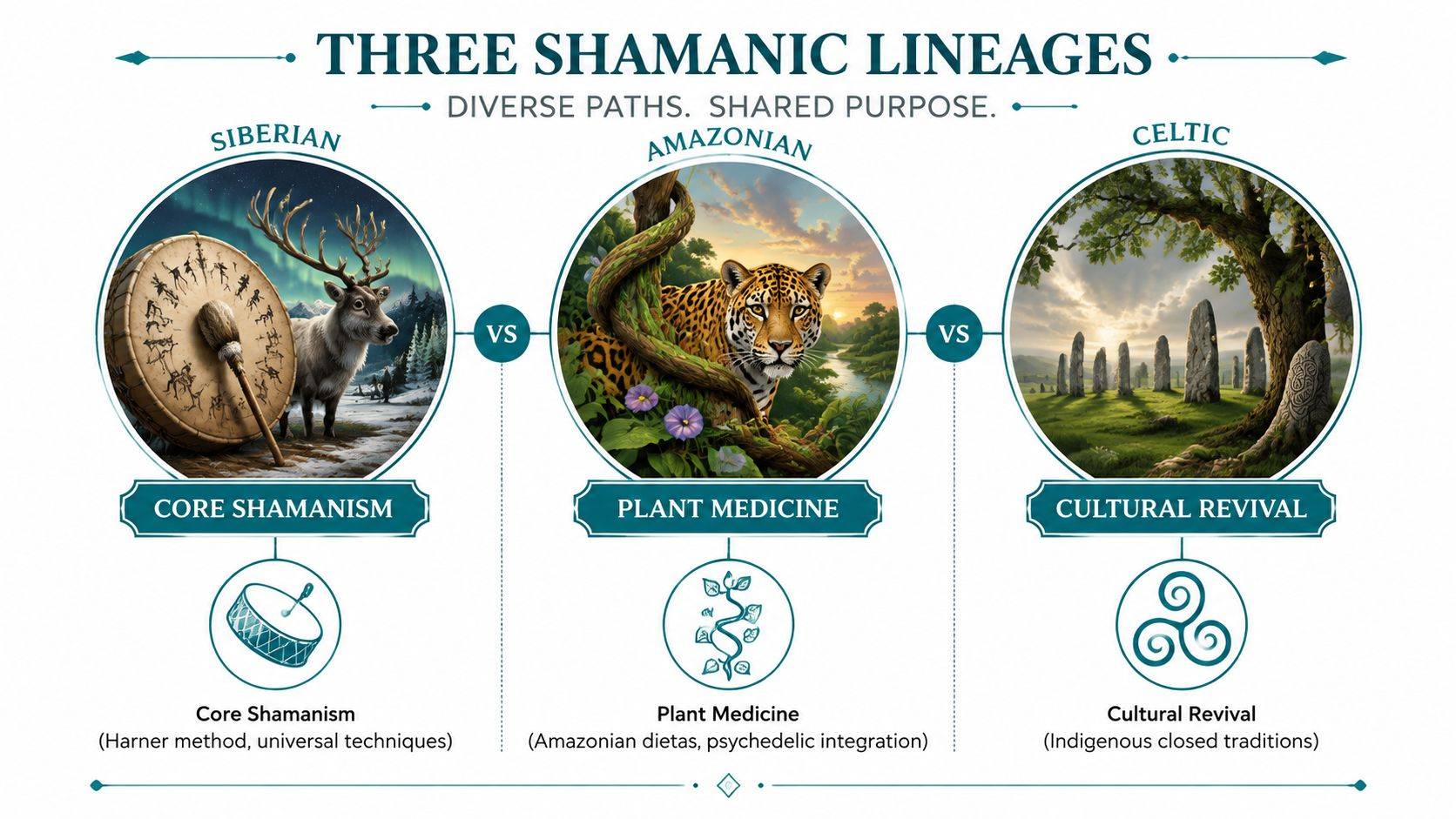
A student may enter shamanic practitioner training looking for one thing and discover three very different paths underneath the same label. One path is tied to indigenous lineage-based traditions, another to neo-shamanic or core-shamanic approaches, and a third to clinical or hybrid integrations. The label sounds similar on a brochure, but the training, authority, and expectations can be very different once real people are involved.
How The Three Paths Feel Different In Practice
An indigenous lineage functions more like a living obligation than a personal brand. The teacher, the community, and the protocols matter because the work belongs to a specific tradition with its own responsibilities, permissions, and limits. A student in that setting is not just collecting techniques, they are being taught how to carry something that already exists before they arrive.
A neo-shamanic or core-shamanic path works more like a method-based apprenticeship. Practices are separated from a single cultural home and taught in a way that can be repeated in classes, retreats, and private study. That makes the material easier to standardize, but it also means the student has to ask a harder question, whether learning a repeatable method is the same as being formed to serve people responsibly.
Clinical or hybrid training sits in a different place again. It often includes spiritual methods alongside trauma awareness, referral boundaries, and language for client safety, because the work is expected to touch people who bring history, grief, confusion, or risk into the room. That shift changes the tone of the training, from spiritual experience alone to spiritual experience held inside a duty of care.
The older apprenticeship model still helps explain why these differences matter. Training has long meant learning under a master, with the student absorbing technique and worldview together source. Modern schools keep some of that shape, but they often translate it into syllabi, certificates, and scheduled modules that look more like continuing education. The structure may look formal, yet a certificate still does not prove the person can sit with a distressed client, recognize limits, or act safely in public.
Why Lineage Choice Shapes Everything Downstream
The lineage someone chooses at the start affects the curriculum, the community they enter, and the way they describe their own authority later. A culturally rooted path may emphasize restriction, consent, and relationship to elders. A universalized path often emphasizes repeatable techniques, personal experience, and practice with peers. A hybrid path usually pays more attention to screening, integration, and referral because it expects students to work near mental-health or plant-medicine contexts.
That is why two students can both say they are studying shamanic work and still be preparing for very different roles. One may be entering a closed tradition with clear boundaries around who may teach and who may speak. Another may be building a facilitation toolkit for broad use. A third may be training for client-facing support, where safety language matters as much as spiritual fluency and where public trust depends on more than time spent in class.
For readers who have seen intuition sharpen during preparation or integration, the difference can feel familiar. Raw sensitivity is one thing, disciplined interpretation is another, and training has to separate the two. For a useful companion lens on how inner knowing shows up in practice, how Tarot Chats explores intuition offers a helpful contrast between raw sensitivity and a trained interpretive skill.
What A Real Curriculum Covers
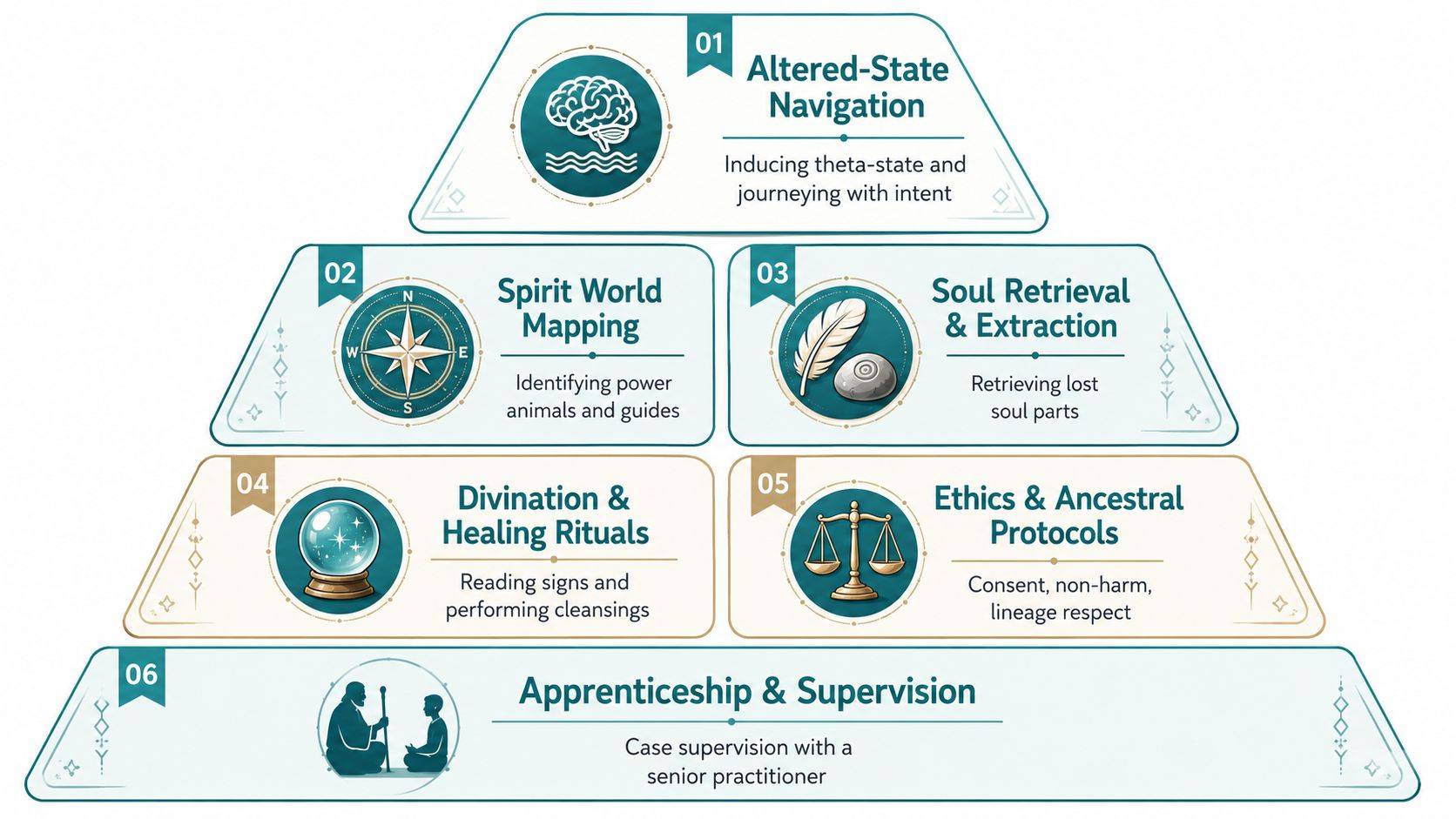
A short marketing page can make shamanic practitioner training sound light and intuitive. Real formation is usually denser. A credible curriculum tends to cover altered-state journeying, ritual and ceremony facilitation, healing modalities, ethics and scope of practice, integration methodology, and supervised practicum. If several of those pieces are missing, the program may still be interesting, but it is hard to treat it as full preparation for client-facing work.
What The Hours Usually Signal
Hours are not the same as competence, but they do reveal how seriously a program treats formation. A 2024 survey of Oregon’s psilocybin facilitator ecosystem found 16 active training programs with tuition ranging from $4,500 to $12,000 and a mean tuition of $9,359. The typical curriculum included 120 hours of coursework plus 40 hours of practicum source. That is not a direct map of every shamanic path, but it shows what formal practitioner preparation looks like when a field expects students to do more than absorb ideas.
Older shamanic training benchmarks point in the same direction. The Foundation for Shamanic Studies’ former Certified Shamanic Counselor track required 125 additional hours of core shamanic training beyond the Basic workshop and the Shamanic Counseling Training Course source. A number like that does not prove mastery by itself. It does show that serious programs rarely rely on a single weekend and a printed certificate.
The Modules That Matter Most
A careful curriculum teaches handling, not just experience. Journeying without ethics can turn into performance. Ritual without supervision can turn into improvisation that goes badly. Practicum matters because students need a place to make mistakes while someone qualified is still present, or at least reviewing the work afterward.
The strongest programs also train the parts that are easy to overlook. They explain how to screen for fit, when to slow a session down, and how to distinguish a meaningful spiritual experience from a client who needs referral or more support. They build in integration, because altered-state work can open things that need structure afterward.
A useful benchmark is simple. If the program teaches altered-state entry but never addresses integration, the training is incomplete. If it teaches ceremony but not screening, the risk rises. If it hands out a certificate without observed practice, the credential may look polished while readiness remains untested.
That gap between a certificate and real competency is where public trust is won or lost. Oregon’s training data shows how much formal programs lean on coursework and practicum together, while the Foundation for Shamanic Studies benchmarks show that lineage-based education has also treated hours as a floor, not a finish line. For readers who have seen intuition sharpen during preparation or integration, the difference can feel familiar, and how Tarot Chats explores intuition gives a useful contrast between raw sensitivity and a trained interpretive skill.
“Strong training always leaves room for correction. The best teachers do not just confirm what a student can already do. They notice where the student is overreaching and slow the pace before confidence outruns competence.”
Comparing Retreats, Apprenticeships, Certification, And Online Modules
A student may leave a weekend retreat feeling clear and committed, then discover that the actual work starts at home. Another student may spend years in an apprenticeship, getting corrected slowly, only to realize that closeness to a teacher does not automatically create readiness for independent practice. Certification and online modules sit somewhere else on that spectrum. They can organize learning and widen access, but they do not, by themselves, prove that someone can hold public trust or keep a session safe.
A Simple Comparison Of The Main Formats
| Training Format Comparison At A Glance | Typical Duration | Cost Range | Supervision Level | Best For |
|---|---|---|---|---|
| Retreats | Short and immersive | Usually bundled into a single program fee | Light to moderate | Students wanting concentrated exposure and a first taste of practice |
| Apprenticeships | Long-term and relationship-based | Varies widely with teacher and format | High | Students seeking depth, correction, and lineage continuity |
| Certification Programs | Structured and milestone-based | Often significant, especially when practicum is included | Moderate to high | Students who want a clearer curriculum and accountability |
| Online Modules | Self-paced or scheduled | Often lower entry cost, though not always lower total cost | Low unless supplemented live | Students who need flexibility and are already self-disciplined |
A retreat works like a strong current. It can move a person quickly, stir up insight, and create the feeling that a door has opened. The weakness is that momentum can fade once the group setting ends. An apprenticeship works more like farm training, where the student repeats the same tasks, gets watched closely, and learns that timing matters as much as intention. Certification programs try to add structure, so the student knows what has been studied and what still needs review. Online modules give access to people who cannot travel or commit to a fixed schedule, but that convenience often comes at the cost of real-time correction.
The Foundation for Shamanic Studies reports that it currently offers 203 courses to approximately 5,000 people annually source. That scale shows how formal teaching can reach a large audience while still preserving a practitioner-development model. It also shows the difference between reach and readiness. A broad course catalog can expand access, but access alone does not tell you whether a student has been observed, corrected, and tested under conditions that resemble actual practice.
What A Student Should Notice Before Enrolling
The format matters because it shapes accountability. Retreats are strongest for immersion. Apprenticeships are strongest for correction. Certification programs are strongest when they include practicum and review. Online modules are strongest when they sit inside a larger supervised path, not when they replace it.
A useful question is simple. Who sees the student work, and how often? If the answer is no one, the training may still be inspiring, but it is hard to call it preparation for public-facing work. If the answer includes only a final quiz or a certificate of attendance, the student may have completed a path without proving competence. That distinction matters because trust in this field usually grows from repeated observation, guided correction, and practice that can be evaluated, not from the title on a document alone.
Does Certification Mean Anything Outside The School
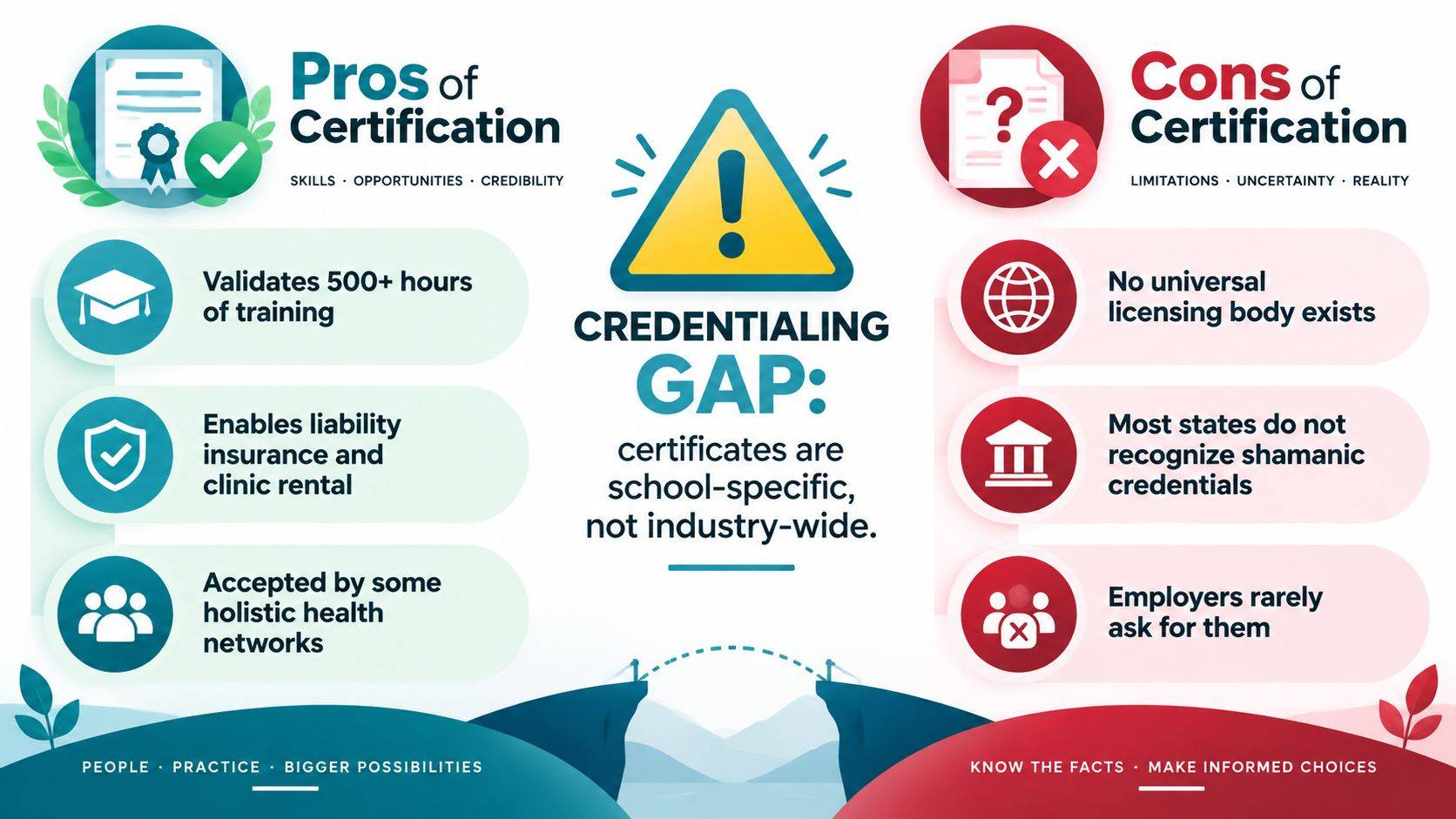
A certificate can help inside a school’s own system. It can mark progress, show attendance, and record that a student completed a defined path. Outside that school, the meaning becomes less clear. Many programs highlight the paper, but fewer explain what it signals once a student meets real clients, employers, or community members.
The Gap Between Completion And Recognition
The gap shows up in the questions people ask after training is finished. They ask how a practitioner was trained, whether there is a lineage behind the work, and whether the practitioner can support integration after a session. That tells you a great deal. The public keeps looking for signs of judgment and care, not just a document with a school’s seal.
A useful comparison comes from the globalization of ayahuasca harm reduction and benefit maximization. Once a practice moves beyond its original teaching circle, the standard for trust shifts. People no longer rely only on the school’s internal language, they look for whether the practitioner can hold boundaries, explain limits, and protect the person sitting across from them.
A certificate can still matter. It can show that a student met a school’s requirements and finished a stated path. It can also help a graduate explain where their training came from. But it is not the same as broad recognition, and it is not the same as public trust. Those are earned through consistent conduct, clear scope, and work that other people can see in practice.
Why More Training Doesn’t Automatically Build Public Trust
A school can make its program longer, more selective, and harder to finish, and the wider public can still remain unsure what that means. That is because a certificate is only one signal among several. Reputation, lineage, referrals, and observed conduct often carry more weight than the paper itself. A practitioner who can name their training but cannot explain boundaries, safety, or integration still leaves a major part of the role unaddressed.
The clearest distinction is simple. A certificate of completion says the student finished a course. A school-issued certification says the school recognizes the student under its own criteria. A license would carry legal recognition, and shamanic practice generally does not operate through a unified licensing body. That is the credentialing gap in plain language.
Public confidence works the same way as a sturdy bridge. One plank is not enough. Training hours matter, but they do not replace visible competence, careful supervision, or the kind of judgment that keeps a session from going sideways.
Safety, Legal, And Ethical Considerations You Cannot Skip
A person holding space for altered states needs more than spiritual confidence. They need judgment. They need a process for screening, an understanding of when to stop, and a clean sense of where their role ends. Training that skips those layers leaves both student and client exposed.
A recent practitioner discussion notes a live tension in the field, some modern trainings lean hard into psychology and trauma awareness, while others worry that spiritual depth gets undertaught. That tension is real. It shows up whenever practitioners try to balance nonmedical support with the symbolic and ceremonial core of the work.
Screening Before Ceremony Or Session
The first question is always whether the person is suitable for the work being offered. That means asking about mental-health history, current medications, recent instability, and whether a referral is more appropriate than a session. If someone discloses a recent prescription or a fragile psychological state, a trained practitioner should slow down and think about boundaries first.
That same concern appears in guidance on shamanic healing and integration. One critical question is whether the practitioner is available for integration support or can refer out after the session, which means the work isn’t finished when the ceremony ends. A responsible practitioner plans for the aftercare conversation before the first session begins.
Cultural Respect And Legal Reality
Plant-medicine contexts raise their own risks. The legal and ethical considerations around Ayahuasca are complicated, and a practitioner who ignores that reality is not protecting clients. For a focused discussion of those trade-offs, see this overview of Ayahuasca globalization and harm reduction. The point is not fear. The point is informed restraint.
“If a teacher can’t explain their screening process clearly, that’s a safety issue, not a style difference.”
Cultural appropriation is another place where training gets tested. Borrowing ceremony language without understanding lineage or permission is a serious problem. Good training should teach students how to ask better questions, credit sources of practice, and avoid presenting borrowed ritual as personal invention.
How To Evaluate And Choose The Right Training Program
The cleanest way to evaluate a program is to stop asking whether it sounds profound and start asking whether it is transparent. Four signals matter most. Lineage transparency, curriculum depth, post-training support, and ethical clarity. If a school is strong in all four, it usually has done the slow work.
The Questions That Separate Real Training From Marketing
Ask who supervises practicum hours. Ask how integration is taught. Ask what happens when a student struggles with journeying, protocol, or emotional overload. Ask whether alumni can describe their first year of practice without sounding rehearsed. Those answers reveal more than the brochure ever will.
The school should also be able to name its ethical stance without hiding behind vague language. Vague policies often mean the hard questions were never really addressed. If a program guarantees quick transformation, that’s a red flag. If it sells certainty instead of formation, that’s another one.
What A Strong Program Usually Makes Visible
A strong school usually makes its teaching structure legible. It shows who teaches, what gets supervised, and how learning continues after the main container ends. It also treats the student as someone becoming responsible, not just someone collecting techniques. That difference matters because shamanic work often gets trusted in moments where people are vulnerable and don’t have much room for ambiguity.
For a closer look at how shamanic identity and practitioner language are often framed, this Ayahuasca.com guide on the shamanic path adds useful context. It helps readers see why titles can be emotionally powerful while still falling short of real-world verification.
Preparing For Training And Integrating It After You Graduate
The best time to prepare for training is before paying tuition. Clarify the reason for studying, because motive shapes the kind of teacher needed. Build support around the process, because serious formation can bring up old material. Budget realistically, because tuition, travel, and follow-up work can stretch a commitment far beyond the first payment.
Integration continues after the last class ends. The strongest graduates keep practicing under supervision, stay in mentorship, and keep learning from cases rather than treating a certificate as the finish line. A reputation in this field is built slowly, through consistency, care, and a willingness to refer when a case goes beyond one’s skill set.
For readers preparing for ceremony or deeper study, Ayahuasca.com’s preparation guide is a practical place to continue. It pairs well with peer-reviewed practitioner research and with the training benchmarks above, because the goal isn’t just to enter the work. The goal is to enter it responsibly, with enough structure that service and safety can grow together.
If the next step is real training, not just more browsing, start by comparing lineage, supervision, and post-training support before sending a deposit. Then read the Foundation for Shamanic Studies material, review the practitioner research linked above, and use Ayahuasca.com’s preparation and integration resources to build a path that fits both your calling and your limits.
Disclaimer: The information provided on Ayahuasca.com is for educational purposes only and is not intended as medical advice, diagnosis, or treatment. Ayahuasca is a powerful traditional Amazonian medicine and may not be suitable for everyone. Always consult with a qualified healthcare professional before making decisions related to health, mental well-being, medications, or the use of Ayahuasca.