
Ayahuasca integration: a psychological perspective at Rythmia begins with one simple truth: the real work starts when the ceremony ends.
Many people think an Ayahuasca ceremony is the final destination, but it is actually the starting point. The journey does not conclude when the final sacred song, or icaro, fades; it simply enters its most crucial phase: integration.
This is the deliberate, conscious process of weaving the profound insights from your ceremony into the very fabric of your daily life. In other words, ayahuasca integration: a psychological perspective at Rythmia is about turning insight into lived change, so the wisdom you gained becomes real and lasting, instead of fading into a beautiful but distant memory.

In the following video, the importance of what happens after a ceremony is explored.
As the video highlights, what you do after the ceremony is just as important as what happens during it. Here, we will explore the psychological framework behind Ayahuasca integration and how a center like Rythmia approaches this vital work.
Why Integration Is Not an Afterthought
A common misconception is to approach Ayahuasca as a single, powerful event that will magically fix everything. Think of the medicine more like a master architect who reveals the complete blueprint of your inner world. It shows you the faulty foundations and misaligned walls, but you are the one who must pick up the tools and do the reconstruction.
This reconstruction is the very heart of integration. From a psychological standpoint, the brain enters a state of heightened neuroplasticity following an Ayahuasca experience. This is a window of opportunity where your mind is literally more malleable, open, and receptive to forming new neural pathways.
“Integration is the deliberate process of translating visionary experiences and emotional releases into new ways of thinking, feeling, and behaving. It is the practice of weaving the lessons from the ceremony into the fabric of your identity.”
Without this conscious effort, even the most profound insights risk remaining abstract concepts. Integration is what makes them real.
The Psychological Landscape After Ayahuasca
In the days and weeks after a ceremony, your inner world can feel both vast and incredibly delicate. You might experience a newfound clarity and a deep sense of purpose, but you could also feel emotionally raw, disoriented, or even confused.
This is completely normal. Old psychological structures have been deconstructed, but the new, healthier ones have yet to be fully built.
This is why a supportive environment is so critical during this phase. A retreat that provides a structured container, like the program at Rythmia Life Advancement Center, helps you navigate this sensitive period safely. This structure grounds the experience, preventing the insights from becoming overwhelming. Without it, the opportunity for deep, lasting change can be missed as old, familiar patterns reassert themselves.
A Psychological Blueprint for Post-Ceremony Life
An Ayahuasca journey can feel like being handed a detailed, intricate map of your own inner world. But a map is only useful if you know how to read it. To navigate this new landscape, you need a blueprint, a set of guiding principles to help you rebuild your life with the insights you have gained. This blueprint is grounded in well-established psychological concepts that make the integration process both understandable and actionable.
Think of the ceremony as a deep psychological excavation. The medicine often brings buried memories, suppressed emotions, and forgotten parts of yourself to the surface. This is where having a psychological framework becomes invaluable, giving you the tools to sort through, understand, and heal what has been unearthed.
Core Pillars of Psychological Integration
Effective integration involves actively and courageously engaging with the material that came up. This work stands on several key psychological pillars that help you process your experience in a constructive way.
- Cognitive Reframing: Ayahuasca can shatter rigid, negative thought patterns. Integration is the conscious work of replacing them with new, more empowering beliefs. For example, a lifelong feeling of being unworthy might be reframed not as a fundamental truth, but as a learned belief from your childhood.
- Emotional Processing: Instead of pushing away difficult feelings like grief or anger that may arise, integration invites you to meet them with curiosity and compassion. This allows you to understand their roots and release their stored energy, freeing you from their unconscious grip.
- Somatic Experiencing: Your body keeps the score. It holds onto trauma and emotional history in ways the mind cannot always access. Somatic, or body-based, practices help you connect with these physical sensations, allowing for a release that goes much deeper than just talking about it. This is about healing your nervous system, not just your thoughts.
Uncovering the Shadow Self
Much of this work aligns with Jungian psychology, particularly when an Ayahuasca journey shines a light on what Carl Jung called the “shadow”: the parts of ourselves we have disowned or pushed into the unconscious. This can be “negative” traits we do not like, such as anger or jealousy, but it can also be positive qualities like creativity or assertiveness that we were taught to suppress.
The medicine does not create these aspects; it just turns on the lights so you can see what has been operating in the dark. A central part of Ayahuasca integration from a psychological perspective is courageously looking at this shadow material. By acknowledging and integrating these hidden parts, you reclaim lost energy and become a more whole, authentic person. This overview of the psychointegration process offers a deeper look at these foundational concepts.
“Until you make the unconscious conscious, it will direct your life and you will call it fate.”
— Carl Jung
This quote perfectly captures the heart of integration. It is about shifting from being a passenger in your own life to becoming the conscious driver. Practices like mindfulness and radical self-awareness become your anchors, allowing you to observe your inner world without getting swept away by it.
The following table illustrates the powerful mindset shift that this dedicated work can facilitate.
Mindset Shift Before and After Integration
This table shows the psychological evolution that can happen with dedicated integration, contrasting common pre-ceremony mindsets with the transformed perspectives that emerge afterward.
| Psychological Aspect | Pre-Integration Mindset (Before Ceremony) | Post-Integration Mindset (With Dedicated Work) |
|---|---|---|
| Emotional Regulation | Reacting unconsciously to emotional triggers. | Responding to emotions with awareness and choice. |
| Self-Concept | Identified with limiting beliefs and past traumas. | Understanding that you are not your thoughts or your past. |
| Relationship to Past | Haunted or defined by past events. | Viewing the past as a source of wisdom and lessons. |
| Sense of Purpose | Feeling lost, confused, or lacking direction. | Living with a clearer sense of personal values and meaning. |
| Connection | Feeling isolated or disconnected from others and self. | Experiencing a deeper sense of interconnectedness. |
As you can see, integration is essential work that turns a powerful experience into lasting, positive change.
How Rythmia Structures the Integration Journey
A powerful Ayahuasca experience is just the beginning. The real question is, what happens after the ceremony ends? Profound insights can feel like a beautiful but fleeting dream if they are not anchored into your daily life. Without a solid structure, they can even feel fragmented or overwhelming.
This is why a well-designed program is so essential. It is about creating a supportive container that guides you from preparation, through the ceremony itself, and into the vital work that follows. This is the heart of the ‘Rythmia Way’ program.
The entire program is built around three core intentions: healing, transformation, and miracles. It provides a comprehensive framework where deep psychological work can unfold safely, ensuring the clarity you gain is not just a momentary glimpse but a catalyst for genuine, lasting change.
By pairing four weekly Ayahuasca ceremonies with a full schedule of classes, therapeutic workshops, and mindfulness practices, the program helps you process what you are experiencing in real-time. It is an approach designed to ground visionary states into practical wisdom. You can learn more about this integration support and see how a psychologically informed process is prioritized.
The ‘Rythmia Way’ a Structured Approach
This is a structured, holistic healing journey. Since opening its doors in 2016, Rythmia has guided over 15,000 guests through this method. The results speak for themselves.
An incredible 97% of participants report profound healing and lasting shifts in their lives, from their perspectives and relationships to their overall well-being. This remarkable success rate, which you can read more about on AyaAdvisors.org, highlights just how effective a structured approach can be.
The program creates a complete ecosystem of support that goes far beyond the ceremony itself. It includes:
- Daily Educational Classes: Workshops led by spiritual teachers and thought leaders give you the mental frameworks to understand your own patterns, heal trauma, and consciously create a new path forward.
- Therapeutic Modalities: You have access to practices like breathwork, yoga, meditation, and life coaching. These are not just add-ons; they are vital tools for regulating your nervous system and processing emotions as they surface.
- Medical and Therapeutic Staff: With on-site medical doctors and licensed therapists, both your physical and psychological safety are held as the highest priority throughout your stay.
This combination creates a powerful dynamic. The classes offer the cognitive tools to make sense of your journey, while the somatic practices help your body release stored energy and truly integrate the healing on a cellular level. It is a balanced and deeply supportive approach.
From Awareness to Lasting Healing
You can think of the entire process as a journey through three core psychological stages, moving from initial awareness to deep, embodied healing.
This diagram shows how the process flows, starting with the spark of awareness, moving through active processing, and leading to sustainable healing.
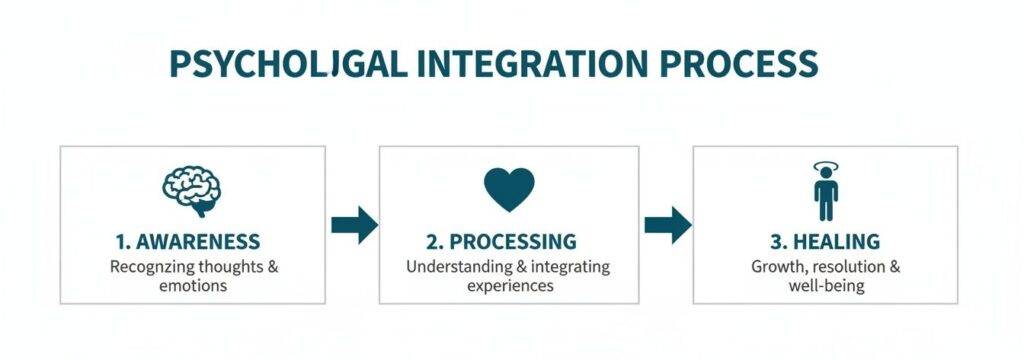
The structure at Rythmia is intentionally designed to guide you through this natural flow.
The ceremonies act as the catalyst for awareness, bringing unconscious patterns, old wounds, and suppressed emotions into the light. From there, the daily classes and workshops give you the tools for processing these powerful insights, helping you make sense of what you have just experienced.
“The ultimate goal is to become a profoundly different person because of a profound experience. Structure and support are the bridge that makes this transformation possible.”
Finally, the combination of community, ongoing practice, and a serene environment creates the space for true healing. This is where new perspectives land, emotional releases settle, and a new way of being starts to feel natural. This model ensures that Ayahuasca integration from a psychological perspective at Rythmia is a guided, intentional, and deeply held process.
Navigating Your Post-Ceremony Emotional World
After the intensity of an Ayahuasca ceremony, your inner world can feel like a vast, unfamiliar ocean. The experience often opens the floodgates, leaving you far more sensitive and emotionally fluid than usual. One day you might be riding waves of profound joy, and the next, you could find yourself navigating surprising currents of grief or anxiety. This is completely normal; in fact, it is a necessary part of the journey.

The goal is to learn how to surf these feelings with grace and self-compassion. Instead of being pulled under by their intensity, you can learn to use them as a compass, pointing you toward deeper self-knowledge. This part of the process is about turning what feels overwhelming into a powerful source of strength.
Building Your Emotional Toolkit
Navigating this new terrain requires a practical toolkit. These are not complex, abstract theories but simple, evidence-informed practices that ground you in your body and help regulate your nervous system. By turning to these tools consistently, you build resilience and create a safe inner space to process everything that came up.
Here are a few practices you can start with right away:
- Journaling for Insight: Writing is a powerful way to make sense of the symbolic and emotional material from your ceremonies. The aim is giving your thoughts and feelings a place to land without judgment.
- Breathwork for Regulation: Your breath is a direct line to your nervous system. When you feel overwhelmed, simple, conscious breathing can bring you back to the present moment, calming anxiety and creating a sense of inner stability.
- Somatic (Body-Based) Practices: Emotions are not just in your head; they are felt experiences in your body. Practices like yoga, stretching, or even just dancing can help release stored trauma and emotional energy that words alone cannot touch.
The Spiral Path of Healing
One of the most important things to understand about integration is that healing is a spiral, not a straight line. You will revisit old patterns and emotions, but each time you will do so from a higher level of awareness. This is where self-compassion becomes your most vital tool. There will be days when you feel like you are moving backward, but this is often just part of the process of truly integrating deep-seated material.
“Remember that you are unlearning a lifetime of conditioning. The key is to meet yourself with kindness and patience, celebrating small steps forward and offering yourself grace during challenging moments.”
This nonlinear journey is a sign that deep and authentic change is happening. For many, this process has a profound impact on mental well-being, especially for conditions that have been notoriously hard to treat. Ayahuasca integration has shown remarkable potential in addressing treatment-resistant depression, with guest testimonials often equating a single ceremony to thousands of therapy hours.
Emerging science is starting to back this up. Studies are showing that Ayahuasca can significantly lower C-reactive protein (CRP) levels, a key inflammation marker often elevated in depression. This reduction correlates directly with drops in depression scores for both patients and healthy controls. You can read more about these findings and see how this ancient medicine is being understood through a modern scientific lens.
As you explore this emotional world, it is helpful to understand the bigger picture. You might be interested in exploring the connection between Ayahuasca and mental health to see how these experiences foster lasting psychological balance. Ultimately, this entire journey is about equipping you to become your own healer, armed with the tools and self-awareness to navigate life with greater authenticity and purpose.
Cultivating Lasting Change After You Leave
The insights that surface during an Ayahuasca ceremony can feel earth-shattering, but they are not the final destination. Think of them as the starting line. The real journey begins when you get home, the patient, dedicated work of weaving those moments of clarity into the fabric of your everyday life. This is integration, and it is how the medicine truly changes you, long after you have left the retreat.
Lasting change does not just happen to you; it is something you actively create, day by day. It is the art of translating that newfound self-awareness into new behaviors, healthier habits, and more honest ways of connecting with others. This is the heart of the work.
The Power of Continued Practice
For a period after an Ayahuasca experience, your brain is in a state of heightened neuroplasticity. The simplest way to understand this is that the soil of your mind is incredibly fertile, ready for new seeds. When you consistently practice new ways of thinking and being, you are literally rewiring your brain, carving out new pathways that support the person you want to become.
- Mindfulness and Meditation: A daily practice helps you stay tuned in to your inner world. You learn to observe your thoughts and feelings without getting swept away by them, creating just enough space to choose a conscious response instead of an old, knee-jerk reaction.
- Journaling for Clarity: Keep writing. Documenting your experiences, your struggles, and your wins helps to solidify what you have learned. It is a powerful way to track your own evolution and make sense of the subtle shifts happening over time.
- Embodied Practices: Things like yoga, dance, or even just walking barefoot in the grass keep you grounded in your body. This helps you process emotions on a physical level, reinforcing the mind-body connection that is so central to this healing work.
Building Your Support System
You do not have to do this alone. In fact, you should not. Community is one of the most powerful tools you have for keeping the momentum going. When you return to a world that might not understand what you have been through, connecting with people who do is vital for staying centered and inspired.
“The ultimate purpose of integration is to empower you to become your own healer, equipped with the awareness and tools to live a life aligned with your truest values. This involves building an internal compass rather than seeking constant external validation.”
This is exactly why integration circles and therapists familiar with psychedelics are so invaluable. They offer a container where you can share your journey, get help navigating the inevitable challenges, and celebrate your growth. These support systems act like a mirror, reflecting your progress and helping you see your own blind spots with compassion.
Becoming Your Own Healer
Ultimately, the goal is to become your own healer. It is about learning to trust the wisdom you gained and having the courage to apply it, day in and day out. From a psychological perspective, this is where Ayahuasca integration at Rythmia truly shines, by focusing on enhancing mindfulness and helping you rebuild your sense of self. Studies have shown that first-time participants dealing with recurrent depression often see huge reductions in their symptoms after their ceremonies, along with significant increases in spirituality and neuroplasticity. With over 15,000 guests since 2016 reporting 97% healing rates, many say their lasting well-being comes from the center’s intense focus on turning those profound perspective shifts into daily, lived realities.
The medicine shows you the door, but you are the one who has to walk through it, again and again, every single day. This is the beautiful, ongoing practice of Ayahuasca and personal transformation, a continuous unfolding, a lifetime of becoming more fully and authentically yourself.
Your Ongoing Journey of Psychological Growth
The Ayahuasca ceremony is not the finish line. In fact, it is the starting line. Think of it as the moment a map of your inner world is suddenly illuminated, revealing the terrain, the obstacles, and the hidden treasures. But the real, lasting transformation happens when you take that map and begin the dedicated, courageous work of the journey itself.
This journey is what we call integration. It is the art of closing the gap between the profound clarity you touched in ceremony and the person you are in your daily life. It is about translating those incredible moments of insight into small, consistent choices that reflect who you now know you can be.
This path is about persistent, compassionate effort, not achieving perfection. There will be days of deep connection and clarity, and there will be days when old, familiar patterns resurface, asking for your attention once more. Each time, you simply meet yourself with a little more wisdom and a little more grace than before.
“The core message of Ayahuasca integration from a psychological perspective at Rythmia is one of empowerment. It is a reminder that you hold the capacity to heal, to grow, and to create a life that is truly aligned with your soul.”
The experience gives you the blueprint, but you are the architect of your new reality. The most powerful work you can do is to take what you have learned and use it, brick by brick, to build a more authentic, conscious, and connected life.
So, approach this ongoing path with curiosity, courage, and a deep commitment to your own evolution. The journey is about bravely and unapologetically becoming more of who you have always been, not about becoming someone new. The work continues, and so does your growth.
Common Questions About Ayahuasca Integration
Once the ceremony ends and you step back into your everyday life, a whole new set of questions can surface. This is completely normal. The experience is profound and personal, and the process of weaving those lessons back into your life, what we call integration, is just as unique. Here are a few answers to the most common questions people ask.
How Long Does the Integration Process Last?
There is no set timeline for Ayahuasca integration; the journey is yours alone. The most intense and sensitive period is often in the first few weeks to six months after a ceremony. This is when your nervous system is recalibrating and the big insights are starting to land.
Over time, many people find that integration becomes a lifelong practice. It is less about reaching a finish line and more about continuously applying what you have learned to the everyday joys and challenges of being human. A structured program, like the one offered at a retreat environment, gives you that critical initial support, but the real goal is to give you the tools for your own ongoing growth.
Do I Need a Therapist for Integration?
While not a requirement for everyone, working with a psychedelic-informed therapist can be a game-changer. A good therapist provides a safe, professional, and confidential space to unpack complex emotions, make sense of symbolic visions, and figure out how to turn those abstract insights into real-life changes. This is especially true if the medicine brought deep-seated trauma to the surface.
“A skilled therapist acts as a guide for the psychological terrain that Ayahuasca opens. They can help you navigate challenging emotions and ensure that the powerful lessons from your experience lead to sustainable healing rather than confusion.”
What Are the Biggest Challenges in Integration?
Some of the most common hurdles people face are feeling overwhelmed by intense emotions, struggling to connect visionary insights to their 9-to-5 reality, and feeling a sense of disconnect from old friends or habits that no longer feel right. It is also common to feel a bit of anxiety as old parts of your identity start to fall away to make room for a more authentic you.
This is exactly why having a solid support system and grounding practices is so important. Things like journaling, spending quiet time in nature, and connecting with a community of people who “get it” are not just nice-to-haves; they are vital for staying stable during this period of deep change.
Can I Integrate a Difficult Ayahuasca Experience?
Absolutely. From a psychological standpoint, there are no “bad” trips, only challenging ones. In fact, these difficult experiences are often where the most valuable healing happens. They bring suppressed fears, old wounds, and hard truths to the surface so you can finally look at them, understand them, and let them go.
Integration is even more critical after a tough ceremony. A skilled facilitator, integration coach, or therapist can help you unpack what happened, understand its symbolic messages, and reframe what felt like a difficult ordeal into a powerful catalyst for profound growth.
Disclaimer: The information provided on Ayahuasca.com is for educational purposes only and is not intended as medical advice, diagnosis, or treatment. Ayahuasca is a powerful traditional Amazonian medicine and may not be suitable for everyone. Always consult with a qualified healthcare professional before making decisions related to health, mental well-being, medications, or the use of Ayahuasca.