
A person often arrives at this question in a very recognizable place. There is genuine curiosity, a sense that Ayahuasca may hold something meaningful, and at the same time a sober concern about safety. That combination is healthy.
The most grounded seekers usually ask difficult questions early. They want to know what can go wrong, who should stay away, how often things become serious, and whether a powerful ceremony is the same thing as a safe one. Those questions don’t signal resistance. They signal respect.
Ayahuasca deserves that respect. It can be profound, destabilizing, clarifying, physically unpleasant, emotionally intense, and in some cases medically risky. The quality of a person’s preparation matters. The quality of screening matters. The quality of the container matters. So does the honesty to recognize when the right answer is “not now” or “not for this person.”
Answering The Call With Awareness
Many people first consider Ayahuasca after months or years of carrying something heavy. Sometimes it is grief. Sometimes burnout. Sometimes a spiritual hunger that ordinary routines no longer touch. Alongside that pull, another voice appears and asks a simpler question: “Is this safe?”
That question is worth listening to.
A responsible approach to ayahuasca risks starts there, not in fear and not in fantasy. A person may be reading retreat pages, hearing powerful stories from friends, and feeling drawn in. At the same time, that same person may be taking prescription medication, managing anxiety, recovering from trauma, or living with a family history that complicates the decision.
Those details are not minor. They shape risk.
“The safest starting point is neither blind trust nor blanket alarm. It is careful discernment.”
Ayahuasca is often spoken about in extremes. One side treats it as a near-miraculous answer. The other reduces it to danger and dysfunction. Neither view helps someone make a wise personal decision. Real safety work sits in the middle. It asks practical questions about body, mind, setting, supervision, and aftercare.
What Responsible Curiosity Looks Like
A well-prepared seeker usually slows down enough to examine a few areas before committing:
- Medical reality: Existing conditions, prescriptions, supplements, and recent substance use all matter.
- Psychological readiness: Current stability matters more than enthusiasm.
- Setting quality: A ceremony is only as safe as the people holding it.
- Integration support: The days after can be as important as the ceremony itself.
The most useful frame is simple. Ayahuasca may be meaningful for some people, but meaningful does not automatically mean appropriate. Mature preparation turns vague concern into informed choice, and that is the foundation of any respectful path with this medicine.
Medical Risks And Critical Contraindications
The most important medical fact about Ayahuasca is not the purge. It is the brew’s monoamine oxidase inhibitor activity, or MAOI activity. That is the central risk mechanism, and it is the reason medication screening must be taken seriously.
A peer-reviewed review notes that Ayahuasca should be avoided with serotonergic drugs including SSRIs, warns that combining it with other monoaminergic agents can raise the risk of serotonin syndrome, and also reports that no deaths have been observed during clinical studies, while serious outcomes remain a concern outside screened settings. The same review is also the basis for the warning that the U.S. Embassy in Peru has issued alerts noting Ayahuasca can cause increased heart rate and has been associated with severe outcomes, including death, in less controlled settings, as summarized in this peer-reviewed review of Ayahuasca safety and interactions.
Why The MAOI Mechanism Changes Everything
MAOIs affect how the body processes certain neurotransmitters and compounds. That means Ayahuasca can interact dangerously with medications and substances that many people assume are routine or harmless. These interactions often lead to many preventable problems.
A person can look physically healthy, meditate regularly, and still be a poor candidate for ceremony because of a prescription, an over-the-counter product, or a recent medication change. Good screening isn’t ceremonial gatekeeping. It is basic risk control.
“Practical rule: If a facilitator minimizes medication disclosure or treats contraindications casually, that alone is reason to walk away.”
Critical Drug And Substance Interactions With Ayahuasca
| Substance Category | Examples | Potential Risk |
|---|---|---|
| Serotonergic Antidepressants | SSRIs, SNRIs, other serotonergic antidepressants | Increased risk of serotonin syndrome |
| Other Monoaminergic Agents | Other drugs that affect monoamine systems | Dangerous interaction risk, including toxic overstimulation |
| Stimulants | Prescription or non-prescription stimulants | Higher strain on the cardiovascular and nervous systems |
| Other Psychoactives | MDMA and other psychoactive substances | Unpredictable psychological and physiological reactions |
| Unreviewed Supplements And Botanicals | Supplements not cleared in advance | Unknown interaction risk, especially if they affect serotonin or stimulation |
People preparing seriously should review a detailed list of foods and meds to avoid with MAOIs well before travel, not the night before ceremony.
What Works And What Does Not
A safe process usually includes written medical intake, follow-up questions, and enough lead time for independent medical review when needed. If prescription changes are involved, those decisions belong with a qualified prescribing clinician, not a retreat message thread.
What doesn’t work is guesswork. It doesn’t work to assume that “natural” means compatible. It doesn’t work to hide medications out of fear of being excluded. And it doesn’t work to rely on a center that asks only a few broad health questions and calls that screening.
The strongest physical harm reduction often looks uneventful. A person discloses everything, gets cleared carefully, or is told to postpone. That may not feel dramatic, but it is often the moment real safety begins.
Psychological And Spiritual Risks To Consider
The deepest ayahuasca risks are not always medical. Some of the most lasting difficulties begin in the psyche, especially when a person enters ceremony with unresolved trauma, fragile mood stability, poor sleep, or a history that hasn’t been carefully examined.
Mainstream advice often stops at a short warning about bipolar disorder or schizophrenia. That matters, but it doesn’t go far enough. The more useful question is whether the nervous system can tolerate an intense altered state without becoming overwhelmed during the ceremony or destabilized afterward.

Beyond The Obvious Red Flags
Research suggests that a history of anxiety or depression is associated with a higher likelihood of experiencing adverse mental states after Ayahuasca use, which supports individualized psychiatric screening rather than relying only on a few diagnostic exclusions, as outlined in this clinical overview of who may face higher psychological risk.
That point is more important than it first appears. Many people who feel called to Ayahuasca are not asking whether they have a severe psychiatric diagnosis. They are asking whether ceremony could intensify lingering anxiety, trigger derealization, worsen insomnia, or open traumatic material faster than they can process it.
Those are real concerns.
Where Spiritual Language Can Confuse Risk
A difficult ceremony can include terror, grief, paranoia, disorientation, or a sense of ego dissolution that feels meaningful in one moment and frightening in the next. In a well-held setting, some of that may move through safely. In a weak container, the same material can become psychologically destabilizing.
Spiritual framing needs maturity. Not every overwhelming state is a breakthrough. Not every disturbing vision is a message to act on. Not every emotional collapse is healing just because it happened in ceremony.
A careful screening conversation should explore:
- Mood history: Prior anxiety, depression, panic, or periods of emotional instability.
- Trauma load: Unprocessed trauma can surface with force and speed.
- Family history: Vulnerability sometimes appears through lineage, not just personal diagnosis.
- Current functioning: Sleep, stress level, recent loss, and substance use all affect resilience.
For people trying to separate meaningful inner work from spiraling self-confrontation, this piece on shadow work and anxiety explained can help clarify why intense introspection sometimes heals and sometimes overwhelms.
“A strong ceremony can open the heart. It can also open material a person isn’t ready to metabolize without real support.”
What Healthy Spiritual Care Looks Like
Psychological safety is strengthened when facilitators know how to distinguish catharsis from decompensation, when participants are encouraged to stay grounded in the body, and when post-ceremony support extends beyond inspirational language.
What tends to fail people is vague reassurance. Telling someone that fear is “just the medicine working” may bypass a genuine risk signal. Strong facilitation respects the sacred dimension of Ayahuasca while staying clinically sober about psychiatric vulnerability.
How Common Are Adverse Effects?
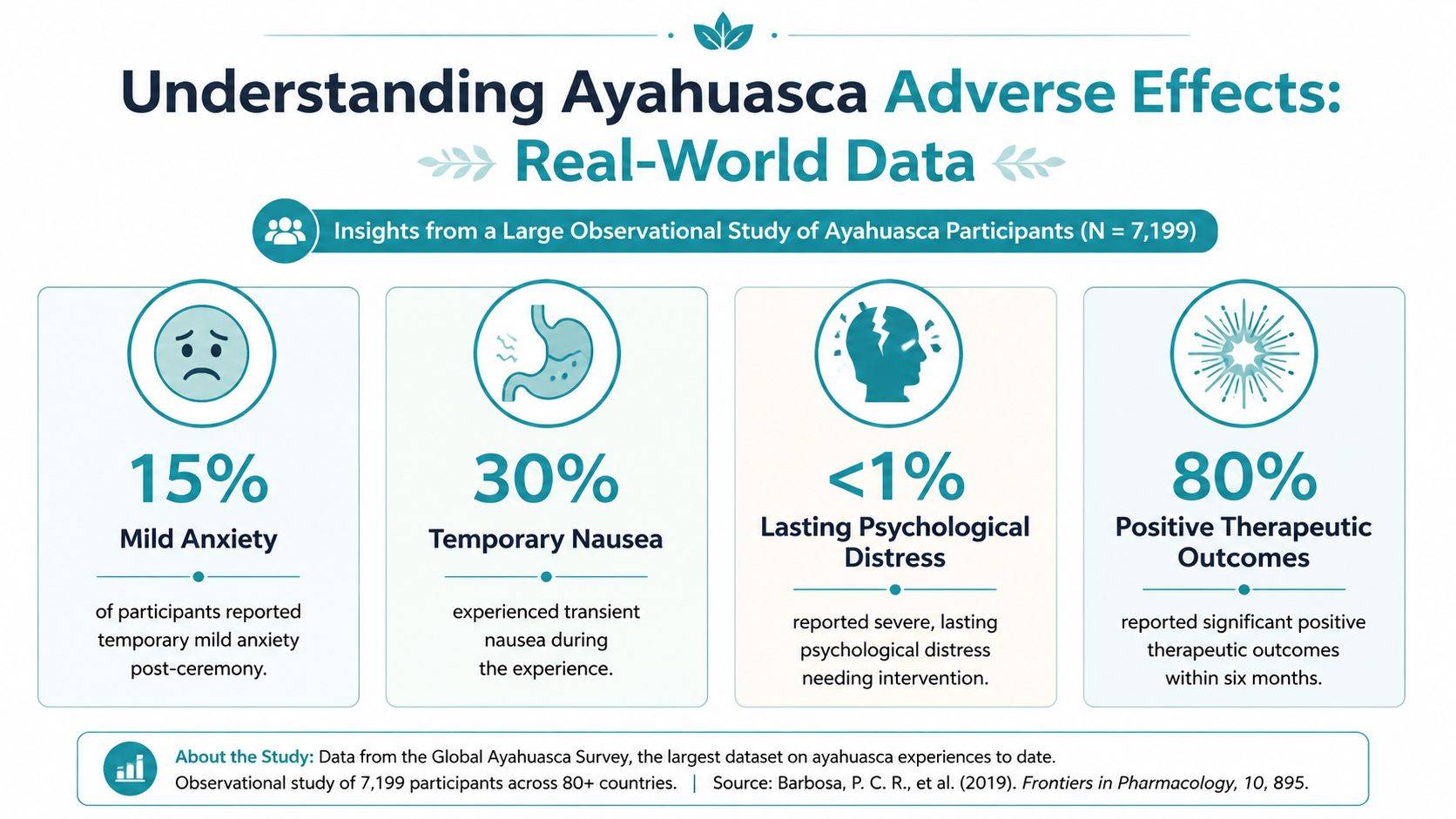
The conversation about ayahuasca risks becomes more useful when it moves from rumor to incidence data. The largest widely cited observational dataset is the Global Ayahuasca Survey, which included more than 10,000 respondents.
According to this overview of the survey’s findings, about 69.9 percent to 70 percent reported acute physical adverse effects, 68.2 percent reported vomiting or nausea, 17.8 percent reported headache, 12.8 percent reported abdominal pain, and 55 percent reported adverse mental health effects. At the same time, only 2.3 percent reported a physical adverse event that required medical attention, based on this summary of the Global Ayahuasca Survey results.
What Those Numbers Actually Mean
These figures cut through two common myths. The first myth is that unpleasant effects are rare. They aren’t. Physical discomfort and challenging mental states are common enough that they should be treated as part of the actual risk picture, not brushed aside as a footnote.
The second myth is that every adverse effect signals a medical emergency. The survey suggests something more nuanced. Difficult effects appear frequently, but events that escalate to medical attention are much less common in these surveyed populations.
That distinction matters for first-time seekers. It helps separate expected hardship from signs that call for tighter screening, stronger support, or medical caution.
A Better Way To Read Ceremony Risk
A realistic expectation is not “nothing bad will happen.” A realistic expectation is that discomfort is common, intensity is common, and quality support can make a major difference in how those experiences unfold.
A person considering ceremony should expect to encounter some version of the challenging experience described in detailed preparation resources such as what to expect from the Ayahuasca experience.
“Numbers like these don’t make Ayahuasca safe by default. They make the conversation more honest.”
The survey also has limits. It is observational and based on self-report. It does not answer every question about dose, setting quality, repeated use, or follow-up care. Still, it offers a far more grounded starting point than anecdote alone. The clearest takeaway is that many people experience difficult effects, while only a smaller share report events serious enough to require medical attention.
Long Term Effects And Unanswered Questions
Many people can find plenty of information about the night of ceremony itself. Far fewer find clear guidance about what happens after repeated use, after multiple retreats, or after months of integrating experiences that may continue to unfold psychologically.
That gap matters. A single controlled session and repeated exposure are not the same question.
A major current limitation in the evidence base is that Ayahuasca’s long-term impacts are not well studied, and safety in a single controlled session does not establish safety for repeated use. That concern is highlighted in this clinical discussion of long-term Ayahuasca safety gaps.
The Questions Many People Actually Want Answered
The most common long-term concerns are practical. Could repeated ceremonies create cumulative psychiatric strain? Could they add cardiovascular burden in some people? Could a person feel stable in ceremony but become progressively ungrounded afterward over time?
Current research does not fully answer those questions. That does not prove long-term harm, but it does require humility.
This is where discernment matters more than ideology. People sometimes assume that because one ceremony felt beneficial, a steady increase in frequency is automatically wise. That leap is not supported by a mature risk framework. More is not always deeper. More is sometimes just more.
A Sustainable Mindset Matters
Safer long-term engagement usually looks slower than retreat marketing suggests. It includes reflection after ceremony, attention to sleep and nervous system regulation, and a willingness to postpone future work if life begins to feel less stable rather than more grounded.
A few warning signs deserve serious attention after any ceremony cycle:
- Lingering activation: Ongoing insomnia, agitation, or inability to settle.
- Psychological spillover: Persistent derealization, paranoia, or emotional volatility.
- Compulsive seeking: Using ceremony after ceremony to chase resolution without integrating daily life.
- Physical strain: Recurring symptoms that suggest the body isn’t recovering well.
“Responsible work with consciousness includes watching what happens weeks later, not only what happens at the peak of the experience.”
The most mature stance is neither dismissive nor overly dramatic. Long-term safety questions remain open. That means repeat use should be approached with care, pauses, and honest self-observation rather than automatic repetition.
Practical Harm Reduction For Your Journey
Harm reduction is where good intentions become real safety. A person does not reduce ayahuasca risks through optimism, spiritual language, or a polished retreat website. Risk drops when preparation becomes concrete, documented, and honest.
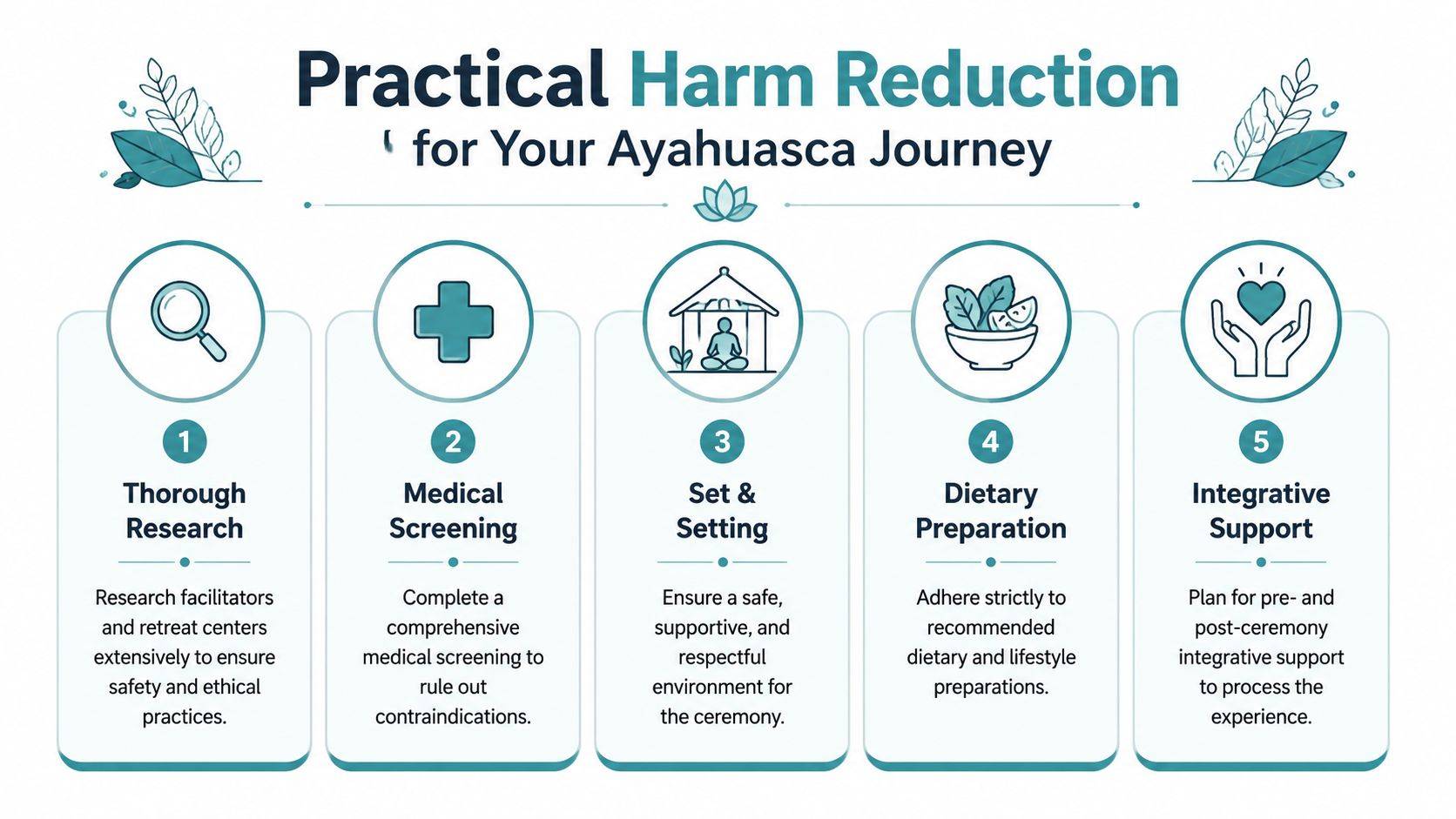
The first safeguard is thorough screening. That means full disclosure of prescriptions, supplements, psychiatric history, current stress load, and recent substance use. It also means accepting that screening may lead to a pause or a no.
The Pre-Ceremony Checklist That Actually Matters
A strong preparation process usually includes the following:
- Medical Review: Every medication and supplement should be disclosed early. If tapering or medication changes are involved, they should be managed by the prescribing clinician.
- Psychological Screening: A retreat should ask more than whether a person has psychosis or bipolar disorder. It should explore anxiety history, depression, trauma exposure, sleep, and current life stress.
- Facilitator Vetting: Participants should know who is leading, who is assisting, and what happens if someone becomes medically or psychologically unstable.
- Emergency Planning: There should be a clear response plan for distress, evacuation, and medical escalation.
- Integration Planning: Support after ceremony should be arranged before ceremony, not improvised afterward.
This preparation guide offers a useful framework for preparing for your Ayahuasca journey with practical safety steps.
How To Evaluate A Retreat Without Guessing
A reputable center should be able to answer direct questions clearly. Evasive answers are information.
Useful questions include:
Who reviews medical and psychiatric intake forms?
A serious program has a real screening process, not just an online form that disappears into silence.What conditions or medications lead to exclusion or postponement?
A center that never turns anyone away is not demonstrating openness. It may be demonstrating poor boundaries.How many trained staff are present during ceremony?
The issue is not luxury. The issue is whether participants can be observed and supported adequately.What happens if someone panics, dissociates, or needs medical care?
The answer should be specific.
A short educational video can help frame these safety questions before deeper preparation begins.
What Helps After The Ceremony
Good harm reduction continues after the music stops. The period after ceremony is when insights can become grounded change, confusion, or both. Gentle routines, journaling, therapy, body-based practices, and reduced stimulation often help the nervous system settle.
For readers trying to understand how altered-state experiences can have lingering effects when they are poorly integrated or used recklessly, this discussion of lasting impacts of hallucinogen abuse offers helpful context.
What tends not to work is rushing back into ordinary intensity. Big decisions, relationship ultimatums, and grand spiritual conclusions are better delayed until the system has fully settled. A powerful ceremony can reveal something true. It can also temporarily magnify certainty. Mature integration knows the difference.
Frequently Asked Questions About Ayahuasca Safety
Can Ayahuasca Trigger Lasting Psychosis
It can be especially risky for people with psychiatric vulnerability. The concern is not limited to people with a formal diagnosis. Family history, trauma burden, prior anxiety or depression, and poor sleep can all matter. Anyone with significant psychiatric uncertainty should seek independent clinical guidance before considering ceremony.
Is It Safe To Drink Ayahuasca Alone
Unsupervised use carries far more risk. Without proper screening, support, and emergency planning, a person may not recognize a dangerous physical or psychological reaction in time. Solo use also removes one of the most important safety factors, which is competent observation by experienced, sober support.
Is Purging A Sign That Everything Is Fine
No. Purging can occur in ceremony and may be expected in some settings, but it does not prove safety and it does not rule out medical problems. Chest pain, severe confusion, inability to regulate, or signs of a serious drug interaction should never be spiritualized away.
How Should A Person Think About Legal Risk
Legal status varies by country and context. A ceremony’s spiritual framing does not automatically make participation legal, and international travel can add additional risk. Anyone considering attendance should verify local law directly before making plans.
What Is The Safest Mindset To Bring
A grounded one. Respect the medicine, disclose everything, screen thoroughly, choose experienced support, and stay willing to postpone if the fit isn’t right. The best decisions around ayahuasca risks usually come from patience, not urgency.
For readers seeking carefully vetted education, preparation support, and retreat guidance, Ayahuasca.com offers resources grounded in safety, respect, and informed discernment.
Disclaimer: The information provided on Ayahuasca.com is for educational purposes only and is not intended as medical advice, diagnosis, or treatment. Ayahuasca is a powerful traditional Amazonian medicine and may not be suitable for everyone. Always consult with a qualified healthcare professional before making decisions related to health, mental well-being, medications, or the use of Ayahuasca.