
You may be reading this because something in you feels curious, cautious, hopeful, or tired of going in circles.
For some people, the interest in healing Ayahuasca begins after years of therapy, burnout, grief, addiction recovery, or a lingering sense that old patterns keep repeating. For others, the call is quieter. A desire to feel more connected, more honest, more alive.
That pull deserves respect.
Ayahuasca has moved far beyond a niche practice. An estimated four million people worldwide drink ayahuasca, and in 2019, 232 retreat centers in the Amazon and Costa Rica facilitated about 210,000 Ayahuasca experiences for around 62,000 individuals, according to a report covered by Psychedelic Health. That growing interest says something important. Many people are searching for forms of healing that reach deeper than symptom management alone.
Still, popularity doesn’t make something simple.
Ayahuasca is better understood as a process than an event. The ceremony matters, but so do the weeks before it and the months after it. A useful analogy is a deep sea dive. You don’t jump into unfamiliar water because you feel ready in the moment. You check your gear, learn the conditions, go with skilled guides, and prepare for what happens when you come back to the surface.
That same mindset helps with Ayahuasca.
A grounded approach asks practical questions. Am I medically and psychologically prepared? Who is serving the medicine? What support exists if difficult material comes up? What will I do with the insight afterward?
Those questions aren’t signs of fear. They’re signs of maturity.
The Call to a Deeper Healing with Ayahuasca
People often describe a feeling of being “called” to Ayahuasca. That word can sound mystical, but it’s often very human. It may mean you’re recognizing that your usual coping tools aren’t reaching the root of what hurts.
Sometimes the call arrives during a life transition. Divorce. Sobriety. Loss. A health crisis. A spiritual dry spell. Sometimes it comes when life looks functional from the outside, yet something inside feels numb or fragmented.
Why the interest keeps growing
Ayahuasca sits at an unusual crossroads. It comes from longstanding indigenous traditions, yet it’s also being studied through modern therapeutic frameworks. That combination has drawn people who want both spiritual depth and psychological healing.
What many seekers don’t realize at first is that Ayahuasca rarely behaves like a single-purpose intervention. It can affect memory, emotion, worldview, body awareness, and relationships at the same time. That can be powerful, but it can also be disorienting.
“Healing with Ayahuasca tends to ask for participation, not passive consumption.”
That’s why approaching it like a wellness trend often leads to confusion. If you expect one dramatic night to solve years of pain, you may miss the slower, steadier work that makes change durable.
A better frame for healing Ayahuasca
A more useful frame is full-lifecycle healing.
That means seeing the journey in three connected phases:
- Preparation: Clarifying your health status, motives, fears, and support needs.
- Ceremony: Entering a well-held environment with trained facilitators and ethical structure.
- Integration: Translating insight into changed behavior, boundaries, habits, and relationships.
Many first-time seekers focus almost entirely on the middle part. That’s understandable. The ceremony carries the mystery, the intensity, and the stories people tell.
Yet real transformation often depends on what happens outside the ceremony room.
The mindset that helps most
Come with openness, but keep your discernment.
Come with hope, but release the fantasy of instant perfection.
Come with respect, especially for the indigenous roots of this medicine and the seriousness of the states it can evoke.
If you hold Ayahuasca this way, the journey begins to make more sense. You’re not shopping for a miracle. You’re considering a demanding, potentially meaningful healing process that asks for honesty, structure, and care.
Understanding the Dimensions of Ayahuasca Healing
A person can leave ceremony saying, “I saw something life-changing,” and still feel confused two weeks later when old fears, habits, or relationship patterns return.
That does not mean the experience failed. It often means the healing touched more than one layer at once.
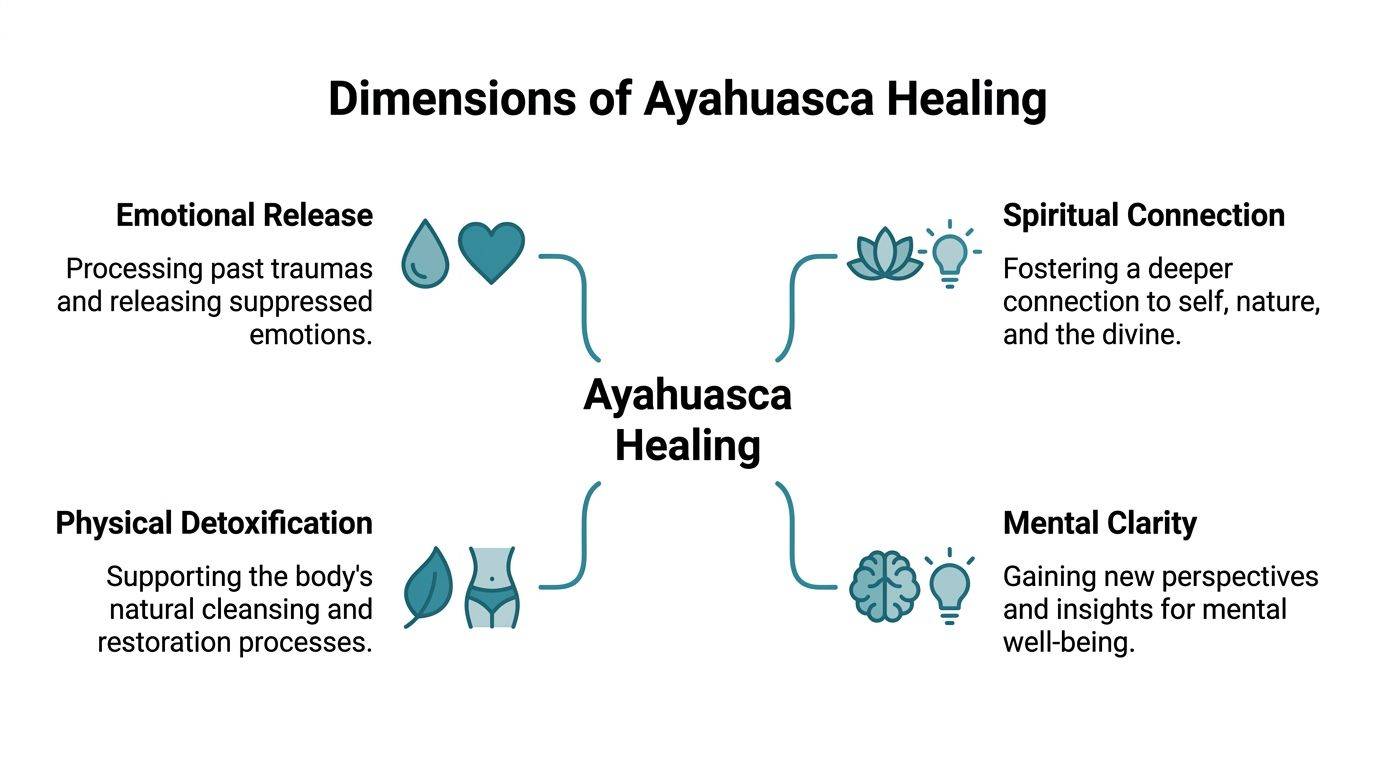
Ayahuasca healing is easier to understand if you see it as a house with several rooms. One room holds emotion. Another holds belief and memory. Another holds your sense of meaning. Another holds the ways you bond, protect yourself, and respond to stress. During ceremony, several doors may open in the same night. The work afterward is learning what you found in each room, and what needs care over time.
Psychological healing
This is often the clearest layer for beginners.
People may come carrying depression, trauma, addiction history, compulsive behavior, or a painful self-image that has hardened over years. During or after ceremony, some begin to see the structure of that suffering more clearly. Instead of feeling swallowed by a pattern, they can recognize it. That shift matters because you can work with what you can see.
Research reviewed by the National Center for Biotechnology Information describes ayahuasca as a subject of interest in mental health because of its reported effects on mood, cognition, and self-perception. Research interest, however, is not the same as a guaranteed outcome for any individual.
A common psychological shift sounds simple, but it can be profound: “I am broken” becomes “I learned ways to survive pain, and those ways now have a cost.” That is less like receiving a magic answer and more like finally getting the right map.
Emotional healing
Ayahuasca often brings feeling to the surface faster than ordinary conversation can.
Grief may rise. Fear may rise. Shame, anger, relief, tenderness, and love may all appear in quick succession. For some people, this feels like pressure releasing from a container that has been sealed for years. For others, it feels like ice softening after a long winter.
Emotional healing is not measured by intensity alone. Crying hard in ceremony does not automatically create change. What matters is contact with the emotion, enough honesty to feel it, enough safety to stay present, and enough support afterward to make sense of it.
An attic works as a useful comparison here. Old boxes sit untouched for years, collecting dust. Ceremony may bring those boxes into the light. Integration is the part where you sort through what is inside, decide what still belongs in your life, and stop stuffing everything back into the dark.
Spiritual healing
Some people meet Ayahuasca as a psychological tool. Others meet it as a spiritual encounter. Many experience both.
Spiritual healing can involve a felt connection to nature, ancestry, forgiveness, humility, or a sense that life has meaning beyond constant self-protection. Some return feeling less isolated inside their thoughts. Some feel grief and gratitude side by side. Some discover that what they called emptiness was a loss of relationship to the sacred, however they define that word.
This dimension needs maturity. A moving vision or mystical insight can soften despair, but it can also be misread. If an experience leaves someone more inflated, more certain of their special status, or less accountable in daily life, the insight has not yet been digested.
A grounded spiritual opening usually shows itself in ordinary behavior. More honesty. More patience. Better boundaries. More care with speech.
Relational healing
Ayahuasca healing does not stop with the self.
Many wounds are relational at their core. A person may fear abandonment, choose unavailable partners, overextend to keep peace, or shut down when closeness feels risky. Ceremony can reveal these patterns with painful precision. It may show where trust became fused with anxiety, where love became fused with performance, or where conflict began to feel like danger.
This is one reason post-ceremony life matters so much. Relational healing rarely becomes real because of one insight alone. It becomes real when someone pauses before repeating the old script, speaks more directly, tolerates healthy closeness, or leaves a dynamic that keeps injuring them.
If you want a fuller view of how insight becomes lived change, this article on Ayahuasca and transformation adds helpful context.
How the brain may support change
Ayahuasca can feel psychologically significant in part because it may affect how rigid patterns loosen.
A simple comparison is a hiking trail. The paths you walk most often become the easiest to follow, even when they lead somewhere painful. In daily life, the mind does something similar. It repeats familiar interpretations, reactions, and defenses because those routes are well worn.
Researchers have examined whether ayahuasca temporarily changes communication across brain networks and may support a period of increased flexibility. What matters for healing is the practical implication. If the mind becomes less locked into its usual loops, a person may glimpse new ways of relating to memory, emotion, identity, or possibility.
But openness is not the same as lasting change.
People often ask a fair question. If ceremony can create such powerful insight, why doesn’t everyone come home transformed for life?
Because insight is a beginning. Healing becomes durable when the nervous system learns safety in new ways, when beliefs are tested in real relationships, and when daily choices reinforce what ceremony revealed. The ceremony may open the gate. Integration determines whether you build a path through it.
What healing Ayahuasca often includes
| Dimension | What it may feel like | What supports it afterward |
|---|---|---|
| Psychological | New insight into trauma, depression, or habit loops | Therapy, journaling, honest reflection |
| Emotional | Crying, release, tenderness, fear, relief | Rest, self-compassion, safe support |
| Spiritual | Connection, awe, meaning, humility | Meditation, nature, grounded practice |
| Relational | Clearer patterns in love, trust, and boundaries | Communication work, relational repair |
When people talk about healing Ayahuasca, they are often trying to describe all of these layers at once.
That is why the experience can be powerful and hard to explain. It is also why the full healing lifecycle matters. Ceremony may reveal the material, but the life you return to is where that material becomes wisdom, behavior, and sustained well-being.
How to Prepare for Your Ayahuasca Journey
The work often begins before you ever enter the ceremony space.
A person may spend weeks researching retreats, reading accounts, and wondering what the night itself will be like. Then the date gets closer, and a different question appears. Am I ready for what this could bring up in me? That question matters because preparation is part of the healing lifecycle, not a waiting room before the “real” event. It lays the ground that both ceremony and integration will later stand on.
Physical preparation
Physical preparation starts with honesty.
Ayahuasca affects the body as well as perception, mood, and memory. The ceremony can last for hours, so your current health, sleep, medications, and substance use all shape how stable and safe that window will feel. A useful comparison is preparing for surgery or a long mountain hike. You do not do it to perform well. You do it to reduce avoidable risk and give your system the best chance to respond well.
A careful review with qualified medical professionals matters, especially if you take prescription medications or have a history of cardiovascular, neurological, or psychiatric conditions. The Johns Hopkins Center for Psychedelic and Consciousness Research notes that psychedelic use requires screening and professional oversight because certain health conditions and medications can create serious safety concerns.
Common areas to address before ceremony include:
- Medication review: Be fully transparent about prescriptions, supplements, and over the counter substances.
- Food simplification: Many retreats suggest lighter, simpler meals for a period before ceremony.
- Sleep protection: Rest helps your nervous system handle intensity with more stability.
- Substance honesty: Alcohol and other drugs can complicate both safety and emotional clarity.
Many centers also recommend some version of dieta. The details vary by tradition and facilitator, which can confuse first-time participants. At its simplest, dieta works like reducing background noise before trying to hear a quiet voice. Less stimulation, less heavy food, and fewer substances can make it easier to notice what is happening in your body and mind.
If you want a practical overview of readiness questions and common preparation steps, this guide to preparation for the Ayahuasca experience is useful.
Mental and emotional preparation
Intention helps most when it stays flexible.
People sometimes approach Ayahuasca with a hidden contract. I will do this, and in return my grief, fear, or confusion should disappear. That mindset usually creates strain. A healthier approach is to enter with a clear question and a willingness to learn, even if the answer arrives in an unexpected form.
An intention works like setting a compass bearing. It gives direction without pretending you control the terrain. “Help me understand why I keep returning to this pattern” is grounded. “Fix everything in one night” puts pressure on an experience that may instead reveal what needs patient care afterward.
These journal prompts can help you prepare with more depth:
- What pain, belief, or behavior keeps repeating in my life?
- What am I afraid I may feel, remember, or admit?
- Who can support me if difficult material surfaces after ceremony?
- What changes would need to happen at home for healing to continue?
That last question is easy to overlook.
It shifts preparation away from the ceremony as a single dramatic event and toward the full process. If you already know your life is overloaded, your relationships are unstable, or you have no support for integration, those realities deserve attention before you go.
Spiritual preparation
Spiritual preparation does not require adopting someone else’s beliefs.
For some people, this phase includes prayer, meditation, or time in nature. For others, it means practicing humility and listening more carefully to their own inner life. The common thread is receptivity. You are making room to notice what is true, instead of arriving full of noise, urgency, and performance.
Simple practices are often enough. Sit in stillness for a few minutes each day. Put the phone away during a walk. Write down what you are asking to understand. Notice where your life feels out of alignment with your values. These habits may sound small, but they train the kind of attention that helps both during ceremony and in the weeks after it.
Some people also benefit from reducing stimulation before a retreat. Less social media, less conflict, less multitasking. That quieter baseline can make strong emotions easier to recognize without immediately reacting to them.
A short visual primer can help you think about mindset and ceremony context before you travel.
What preparation is really doing
Preparation builds capacity.
It helps you arrive with a steadier body, a more honest mind, and a clearer sense of what support you may need afterward. That matters because a powerful ceremony is not the finish line. If difficult memories surface, preparation gives you more grounding. If beauty, clarity, or relief arise, preparation helps you receive them without clinging or confusion.
Good preparation also creates a bridge to integration. You begin noticing your patterns before the ceremony, not only after it. You identify support before you need it. You start practicing the attention, restraint, and self-honesty that sustainable healing asks for later.
“The person who prepares well is usually not controlling the journey more. They are bringing more steadiness to it.”
That steadiness can shape what you remember, how you respond, and whether the experience becomes a meaningful chapter in healing rather than an intense night that fades without lasting change.
Choosing a Safe and Ethical Ayahuasca Retreat
You arrive at a retreat center after a long trip. The website looked beautiful. The testimonials sounded profound. Then, during the intake, no one asks about your medications, your mental health history, or what support you have at home after the retreat.
That is not a small oversight. It is a warning.
Ayahuasca can open intense emotional, physical, and spiritual states. The retreat is the container that holds all of that. If the container is careless, the experience can become confusing, unsafe, or much harder to integrate later. A good retreat does more than serve ceremony. It screens carefully, sets clear boundaries, responds well under stress, and prepares people for the days and weeks after they leave.

What to look for first
Start with the systems that protect people.
A trustworthy retreat should be able to explain, in plain language, how they screen participants, who leads ceremonies, what happens in a medical or psychological emergency, and what support continues after the retreat ends. If the answers are vague, evasive, or hidden behind mystical language, take that seriously.
Retreat quality often shows up in ordinary details. Clear forms. Thoughtful questions. Staff who answer directly. Written policies. These may sound less romantic than stories about transformation, but they matter more when someone is frightened, dissociated, physically ill, or overwhelmed.
Here is a practical checklist.
- Medical screening: The center should ask detailed questions about medications, diagnoses, cardiovascular issues, substance use, trauma history, and previous reactions to altered states.
- Facilitator clarity: You should know who is leading, who is assisting, and what training or experience each person brings.
- Ethical boundaries: The retreat should have explicit standards around consent, touch, privacy, sexual boundaries, and power dynamics.
- Integration support: The staff should treat post-ceremony care as part of the retreat itself, not as an optional extra.
- Transparent communication: You should understand the schedule, accommodations, group size, costs, expectations, and safety procedures before you arrive.
Green flags and red flags
A good retreat often feels grounded. It may be simple, but it is rarely chaotic.
Choosing a retreat works a lot like choosing a surgeon or therapist. Warmth matters. So does trust. But kindness without competence is not enough, and spiritual language does not replace screening, ethics, or crisis response.
| Green flags | Red flags |
|---|---|
| Thorough intake process | Little or no screening |
| Clear facilitator roles | Vague claims about “mastery” |
| Humble language about healing | Grand promises of guaranteed cure |
| Respect for tradition and consent | Pressure, secrecy, or manipulation |
| Real integration planning | Focus only on the ceremony high |
One common mistake is choosing mainly from scenery, branding, or social proof. A beautiful location does not tell you how the team handles panic, trauma activation, interpersonal conflict, or a participant who should not be drinking in the first place.
Questions worth asking
Direct questions protect you.
You do not need to be confrontational. You do need clear answers that help you judge the retreat’s maturity, ethics, and follow-through.
Consider asking:
- How do you screen for mental health concerns and medication risks?
- Who is present during ceremony besides the lead facilitator?
- Is there medical support nearby, and what is your emergency plan?
- What is your policy on physical touch and consent during altered states?
- What kind of integration support do you offer after guests return home?
The answers should be specific and calm. A safe retreat usually welcomes informed questions because careful guests are easier to support well. You can also look for signs that the center understands post-ceremony psychospiritual integration support as part of healing, not as an afterthought once people have already gone home.
The issue many seekers miss
People often focus on whether a retreat is “authentic.” Authenticity matters, but it is only one part of the picture.
A center can use traditional language and still have poor boundaries. Another may have a more clinical or structured format and still act with deep respect for lineage, participants, and the seriousness of the work. The better question is whether the retreat protects vulnerability with skill, humility, and accountability.
Cultural respect matters here too. Ayahuasca comes from living traditions. A center that treats indigenous knowledge as branding, costume, or decoration deserves close scrutiny.
A final standard
Choose the place that would still feel trustworthy if your ceremony becomes difficult.
If you cry, purge, shake, remember trauma, feel terrified, or become disoriented, would the people there know how to respond? Would they stay calm, protect your dignity, and avoid turning your vulnerability into a spectacle?
That standard helps cut through marketing.
Healing with ayahuasca is a process, not a single dramatic night. The retreat you choose shapes not only the ceremony itself, but also how well you can make sense of what follows after you return home.
The Critical Art of Post-Ceremony Integration
Many people treat the ceremony as the main event and integration as the optional follow-up.
That’s backward.
The ceremony may open the material, but integration is where you learn to live differently because of what you saw. Without that phase, even a profound experience can fade into confusion, inflation, or emotional whiplash.
Research and retreat-based observations summarized by Temple of the Way of Light note that integration is a common challenge, especially after multiple ceremonies that surface intense emotional content requiring months of processing. The same discussion highlights that people can feel isolated after returning home, and that symptoms may rebound without structured, long-term support.

Why the return home can feel so strange
Ceremony space is unusually concentrated.
You may spend days in silence, vulnerability, altered states, nature, and emotional openness. Then you return to emails, traffic, family roles, deadlines, and people who have no context for what you experienced.
That shift can feel jarring.
Some people come home tender and inspired. Others feel raw, lonely, or disoriented. A few feel tempted to make huge life decisions immediately. All of these responses deserve patience.
What integration actually means
Integration is the process of turning insight into lived structure.
If Ayahuasca showed you that you abandon your own needs, integration means practicing boundaries. If it revealed grief, integration may mean creating time to mourn instead of jumping back into productivity. If it exposed addiction dynamics, integration could involve therapy, recovery support, and serious accountability.
This is why integration is not just reflection. It is application.
For a deeper look at this process, the psychointegration resources at Ayahuasca.com offer a useful starting point.
A simple toolkit for the first weeks
You don’t need a perfect system. You do need rhythm.
Try building around these anchors:
- Journaling: Write what happened, what you felt, and what patterns are now clearer.
- Therapeutic support: A grounded therapist can help you sort insight from overwhelm.
- Peer connection: Integration circles or trusted peers can reduce isolation.
- Embodiment: Gentle yoga, walking, breathwork, and rest help the body catch up.
- Delayed decisions: Give major life choices time unless immediate safety is involved.
A few journaling prompts work especially well:
- What truth became harder to avoid after ceremony?
- What part of my life now feels out of alignment?
- What one change can I practice this week rather than fantasize about someday?
Common post-retreat traps
Not all post-ceremony difficulty means something is wrong. Sometimes it means the process is still active.
Still, there are patterns worth watching.
- Over-interpreting every symbol: Not every image is a command.
- Spiritual inflation: Feeling specially chosen can block real growth.
- Isolation: Keeping everything private can make the experience feel unreal or unmanageable.
- Rushing to reinvent your life: Insight needs grounding before it becomes action.
- Chasing the next ceremony too fast: More medicine isn’t always the next right step.
“Healing stabilizes when insight becomes routine behavior.”
That sentence sounds simple, but it’s the whole game.
What sustainable change can look like
Integration often looks much less dramatic than ceremony. That’s a good sign.
It may look like apologizing without defensiveness. Going to bed earlier. Leaving a harmful relationship. Eating in a simpler way. Crying when you need to. Telling the truth in therapy. Saying no where you used to people-please.
Those changes can seem ordinary. They are not ordinary if they represent a new pattern.
When to get more support
If you’re struggling to function, feeling persistently overwhelmed, or unable to make sense of what surfaced, seek qualified support. The point isn’t to prove you can handle everything alone.
Ayahuasca can uncover meaningful material. It can also uncover destabilizing material. Mature integration includes knowing when community, therapy, or additional care is needed.
A ceremony may give you a glimpse of another way to live. Integration is where that glimpse either becomes a path or becomes a memory.
Your Path Forward on the Healing Journey
Healing Ayahuasca work asks for more than courage. It asks for pacing, discernment, and follow-through.
If you’re considering this path, keep the whole lifecycle in view. Prepare carefully. Choose your retreat with high standards. Treat integration as part of the medicine rather than what happens after the medicine.
That orientation changes everything.
It protects you from the most common misunderstanding, which is believing the ceremony alone carries the full burden of healing. In reality, the ceremony may open a door, but your preparation helps you walk through it safely, and your integration helps you keep walking when everyday life resumes.
A steady next step might be simple:
- Read more about medical, emotional, and spiritual readiness.
- Vet retreats with real questions about ethics and support.
- Build an integration plan before you book anything.
- Talk with a qualified professional if you have mental health or medication concerns.
If you want trusted guidance, Ayahuasca.com offers educational resources, science-informed articles, and access to vetted retreat information that can help you move forward with more clarity and care.
The best reason to move slowly is not fear. It’s respect.
Respect for your nervous system. Respect for the traditions that carry this medicine. Respect for the fact that deep healing rarely arrives as a shortcut, but it can unfold through honest preparation, safe support, and the willingness to live what you learn.
If you’re ready to continue thoughtfully, explore Ayahuasca.com for retreat guidance, preparation resources, and integration support built around safety, integrity, and informed decision-making.
Disclaimer: The information provided on Ayahuasca.com is for educational purposes only and is not intended as medical advice, diagnosis, or treatment. Ayahuasca is a powerful traditional Amazonian medicine and may not be suitable for everyone. Always consult with a qualified healthcare professional before making decisions related to health, mental well-being, medications, or the use of Ayahuasca.