
The most popular advice about Amazonian plant medicine often starts with a ceremony, a preparation ritual, or a search for the “right” Ayahuasca retreat. That order skips the foundation. Before choosing a brew, a facilitator, or an intended outcome, curious adults need to understand that Amazonian plant medicine is a broad knowledge system, not a synonym for one psychoactive drink.
Ayahuasca matters, but it represents only one part of a much larger botanical, cultural, and therapeutic repertoire. The evidence also demands restraint. Traditional knowledge can be extensive and internally structured while modern clinical research remains limited, especially beyond Ayahuasca. A responsible approach therefore holds two ideas together: Indigenous Amazonian healing traditions contain detailed observations about plants, preparation, ritual, and human experience, while many modern wellness claims still lack strong human testing.
Why Amazonian Plant Medicine Is Bigger Than Ayahuasca
Western audiences often compress Amazonian plant medicine into a single story about Ayahuasca. That shortcut makes the subject easier to market, but it distorts the work of Indigenous healers, who may draw on numerous plants, dietary restrictions, songs, diagnostic practices, cleansing methods, and long periods of apprenticeship.
Ethnobotanical research shows the scale of this knowledge. A review of the Achuar of Ecuador recorded 134 medicinal species and 733 use-reports, while research among Amazonian coastal residents documented knowledge of 229 medicinal plants across 81 botanical families. Peruvian research on plant diets found that 106 of 318 medicinal plants, about 33%, were used under diet conditions, with 29 of those 106 used exclusively in diets. These findings describe a structured healing system rather than a loose collection of folk remedies. (ethnobotanical research on Amazonian plant diets)
A System, Not A Single Brew
A healer may assign a plant for a physical complaint, another for a period of isolation, and another within a ritual sequence intended to alter attention, dreams, appetite, or emotional orientation. Preparation can matter as much as species identity. The plant may be infused, boiled, smoked, powdered, applied externally, or used within a restricted diet.
This also explains why the phrase “plant medicine” can create confusion. Phytotherapy usually refers to therapeutic use of plant materials and their constituents. Amazonian shamanic practice may include phytotherapy, but it can also involve relationships with plant teachers, songs, dreams, ritual cleansing, social responsibilities, and spiritual interpretations that clinical pharmacology doesn’t measure easily.
The strongest evidence-supported conclusion is modest but important: Amazonian plant medicine is extensive, specialized, and culturally embedded. The weaker conclusion is that every traditional use has been clinically validated. Recent independent reviews emphasize that research on traditional Amazonian healing remains limited, with many studies focused on isolated compounds rather than whole-practice systems and with human trials still scarce. (review of the evidence base for Amazonian health practices)
“Practical rule: A plant’s traditional importance deserves respect, but tradition, laboratory activity, and proven clinical treatment are different kinds of evidence.”
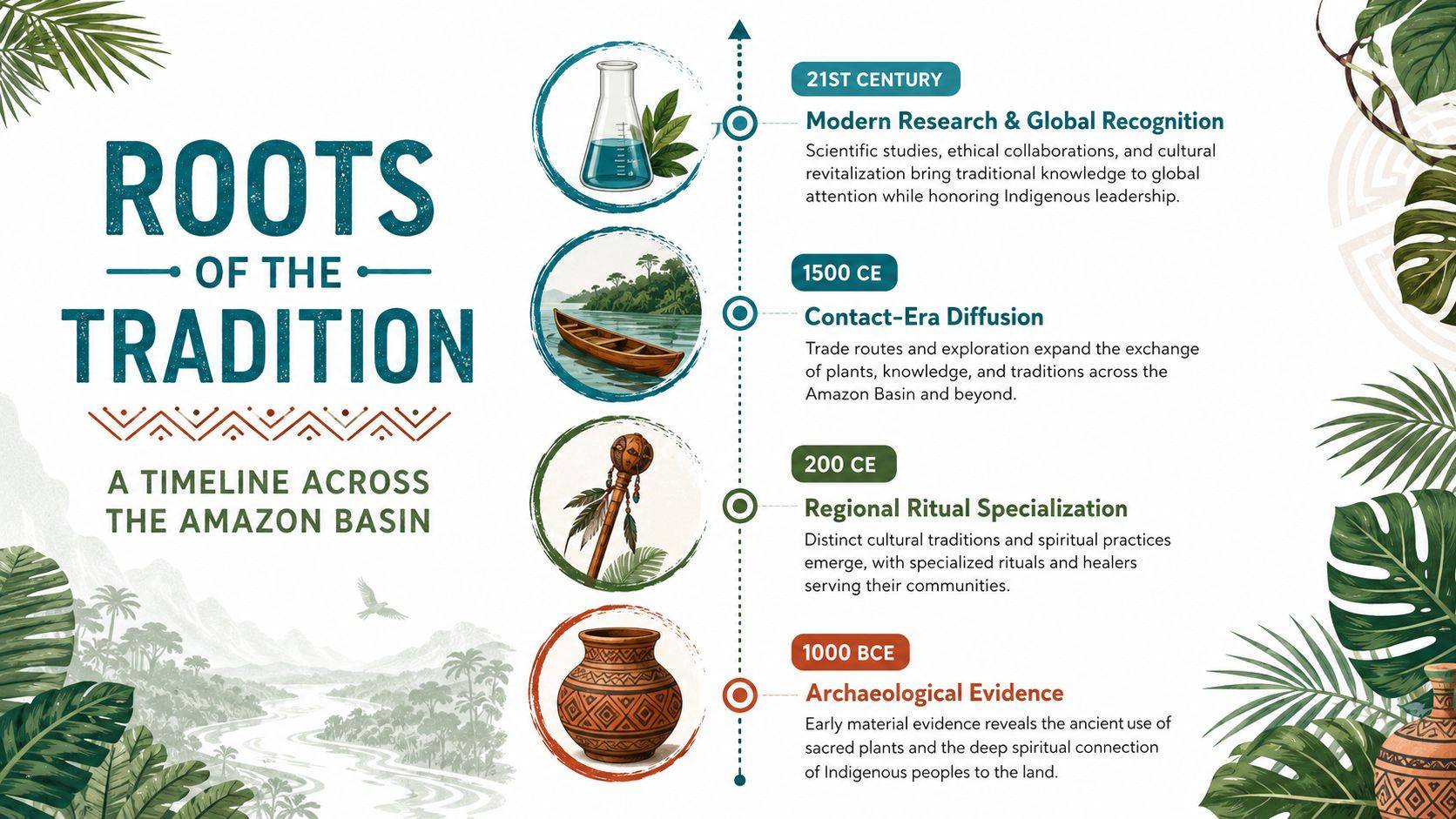
Roots Of The Tradition Across The Amazon Basin
The written record gives Ayahuasca a relatively recent documentary history, often tracing it to about 150 years ago, but archaeology points deeper. Small ceramic vessels associated with Ayahuasca rituals have been dated to around 2400 BC, and snuff materials containing bufotenine, DMT, and harmine have been found from about 1000 years ago in present-day Bolivia. Researchers therefore treat Ayahuasca as both a historically documented tradition and part of a much older Amazonian and Andean context of psychoactive plant use. (archaeological and historical review of Ayahuasca)
Knowledge Travels Through Practice
Archaeology can show that people handled particular materials, but it can’t fully reconstruct what those ceremonies meant. That continuity comes through Indigenous communities whose botanical knowledge has been transmitted through oral teaching, observation, apprenticeship, and repeated practical use.
Traditions associated with peoples including the Tupí, Guaraní, Kichwa, Asháninka, Shipibo, Cofán, and Tukano demonstrate that there isn’t one uniform Amazonian system. Each community has its own languages, plants, songs, social roles, and interpretations. A vegetalista, a term used in some regional traditions, may understand plants as beings with agency while also preparing physical medicines. That approach differs from a narrow biomedical model, but it doesn’t mean the botanical work is random.
Dietas, Icaros, And Apprenticeship
A master plant diet generally involves a deliberate period of reduced stimulation, dietary restrictions, and focused relationship with a selected plant. Icaros, or healing songs in some traditions, can guide attention and ritual atmosphere. These practices preserve knowledge through embodied learning, not just through written formulas.
Western interest later carried localized traditions into international retreat economies and research institutions. Global visibility has created opportunities for cultural exchange and scientific investigation, but it has also increased the risk of treating Indigenous knowledge as a menu of extractable experiences. Historical depth should lead to humility, not romantic certainty.
How Ayahuasca Actually Works In The Body
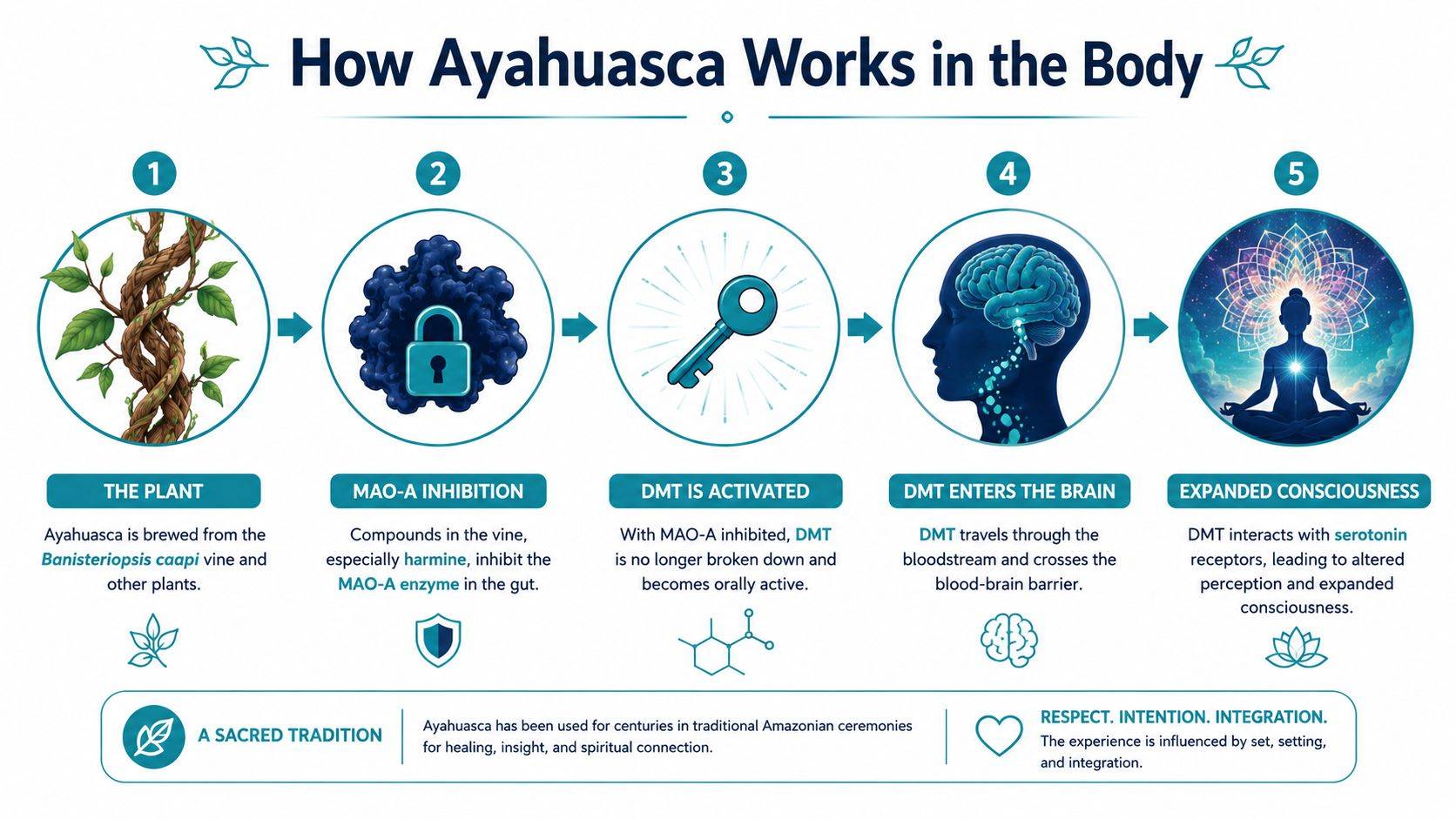
Ayahuasca becomes pharmacologically distinctive through cooperation between its ingredients. The vine Banisteriopsis caapi supplies beta-carbolines, especially harmine, harmaline, and tetrahydroharmine, while admixture plants may supply N,N-dimethyltryptamine, or DMT. The chemistry works like a temporary access system. The beta-carbolines reduce the body’s ability to deactivate swallowed DMT before it reaches circulation.
Normally, oral DMT is rapidly broken down through first-pass metabolism in the gut and liver. The beta-carbolines in Banisteriopsis caapi reversibly inhibit monoamine oxidase-A, or MAO-A, preventing that early deamination. Harmine is described in pharmacological reviews as a potent MAO-A inhibitor, while tetrahydroharmine also acts as a serotonin reuptake inhibitor. The result is synergy, not an additive mixture. (Ayahuasca pharmacology and MAO-A interaction)
Why The Same Recipe Can Feel Different
Ayahuasca isn’t chemically standardized across all ceremonies. One published analysis measured harmine concentrations from 0.109 to 7.11 mg/mL, harmaline from 0.012 to 0.945 mg/mL, tetrahydroharmine from 0.09 to 3.05 mg/mL, and DMT from 0.10 to 3.12 mg/mL. (measured chemical variability in Ayahuasca)
Those ranges mean different brews can vary substantially in both MAO-A inhibition and psychoactive payload. A participant therefore shouldn’t assume that a previous dose predicts a later experience. Batch testing, clear ingredient information, careful screening, and conservative dose titration can reduce uncertainty, though they can’t eliminate it.
At the brain level, DMT’s psychedelic effects involve serotonin signaling, including activity at 5-HT2A receptors. Research discussions also examine changes in large-scale brain-network organization and possible neuroplasticity signals. Those mechanisms may help explain why some people describe emotional material, unusual imagery, or shifts in self-processing, but a compelling subjective experience doesn’t by itself establish lasting therapeutic benefit.
The acute experience and later integration are also different processes. A ceremony can end while its emotional or autobiographical meaning continues to develop. Set, setting, expectations, physical condition, support, and cultural framing all shape how a person interprets the experience.
The Wider Plant Toolkit Used By Amazonian Healers
Ayahuasca is best understood as one instrument in a larger toolkit. The categories below are analytical aids for modern readers, not a universal Indigenous classification system. A single plant can occupy different roles across communities, and names can refer to different species in different regions.
Functional Categories
Cleansing and purgative practices may include tobacco varieties and other preparations used within ritual or therapeutic sequences. Their purpose can involve physical purging, altered attention, or symbolic removal of unwanted influences. Kambo, which is a secretion rather than a plant, is sometimes grouped into the same broad ceremonial conversation, but it shouldn’t be confused with botanical medicine.
Visionary and dream-oriented materials include DMT-containing admixtures and plants from genera such as Brugmansia and Brunfelsia. Their traditional significance can involve dreams, diagnosis, initiation, or communication with nonordinary realms. Modern readers should avoid treating “visionary” as a synonym for harmless. Potency, preparation, and context vary widely.
Botanicals associated with immune, antimicrobial, or restorative use include guayusa, sangre de grado, and cat’s claw. Traditional preparations may involve infusions, decoctions, topical applications, or resin collection. Laboratory interest in a plant’s constituents doesn’t establish that a traditional preparation treats a particular disease.
Master-plant diet materials can include chiric sanango, bobinsana, and nucño pichana. Their role may be tied to isolation, restricted food, dreams, instruction, and long-term apprenticeship rather than a single symptom.
A practical overview of names and traditional roles appears in this guide to psychotropic plants in sacred medicine traditions. Readers should use such resources to build questions, not to self-prescribe unfamiliar preparations.
| Category | Example Plants | Traditional Preparation | Primary Use |
|---|---|---|---|
| Cleansing and purgative | Tobacco varieties and regional purgatives | Infusion, smoke, or ritual application | Cleansing, focus, and ceremonial preparation |
| Visionary and dream-oriented | DMT-containing admixtures, Brugmansia relatives, Brunfelsia | Brew, infusion, or carefully controlled traditional preparation | Dreams, diagnosis, initiation, or altered perception |
| Restorative and topical | Guayusa, sangre de grado, cat’s claw | Tea, decoction, resin, or topical preparation | Traditional support for physical complaints |
| Master-plant diets | Chiric sanango, bobinsana, nucño pichana | Isolated diet, restricted food, and ritual supervision | Apprenticeship, dreams, and plant relationship |
The working principle is combinatorial medicine. A healer may select a plant, preparation, song, restriction, and timing as parts of one sequence. Removing one item from that sequence and selling it as a universal wellness product can erase the reasoning that gave the treatment its traditional meaning.
What The Clinical Evidence Really Shows
The clearest modern human signal concerns Ayahuasca and depression, especially treatment-resistant depression. A peer-reviewed clinical trial reported statistically significant reductions in depressive scores of up to 82% between baseline and follow-up points at 1, 7, and 21 days after a single dose, using HAM-D, MADRS, and BPRS psychiatric scales. (clinical trial of Ayahuasca for treatment-resistant depression)
That result is meaningful, but it isn’t the same as proof that Ayahuasca is a broadly validated treatment. Early studies often involve small samples, limited blinding, and settings where participants and facilitators can recognize the psychoactive intervention. Retreat environments add further confounders, including group support, expectation, travel, ritual, and time away from ordinary stressors.
A 2026 PubMed-indexed review identified 26 eligible interventional trial registers for DMT, Ayahuasca, and DMT combined with harmine on ClinicalTrials.gov. (review of registered DMT and Ayahuasca clinical trials) The field is active, but that remains a relatively small research base compared with mature psychiatric drug-development programs. A registered protocol, including first-in-human work involving novel administration routes for DMT and harmine under NCT04716335, marks mechanistic progress without proving clinical efficacy. (Frontiers review of traditional Ayahuasca pharmacology)
For readers assessing claims, a systematic investigation for AI teams offers a useful reminder to separate study design, endpoints, and replication from persuasive anecdotes.
| Preparation | Strongest Evidence | Study Type | Confidence Level |
|---|---|---|---|
| Ayahuasca | Short-term changes in depressive scores in an early clinical trial | Human clinical research | Promising, not conclusive |
| DMT and harmine combinations | Pharmacokinetic and mechanistic investigation | Registered and early-stage clinical research | Preliminary |
| Broader Amazonian plant diets | Ethnobotanical documentation and traditional use | Field studies and reviews | Strong cultural evidence, limited clinical validation |
| Kambo and rapé | Claims involving mood, pain, or EEG effects | Early or limited human research | Insufficient for broad treatment claims |
| Isolated plant compounds | Biological activity in laboratory or animal models | Preclinical research | Hypothesis-generating |
The most defensible conclusion is narrow. Ayahuasca has a promising but developing human evidence base for some psychiatric questions, while much of the wider Amazonian system remains supported primarily by ethnomedical knowledge, observational work, or preclinical findings.
Risks, Adverse Events, And Honest Safety Signals
Safety discussions often fail in opposite directions. Some accounts portray Ayahuasca as dangerous, while others treat traditional framing as a guarantee of safety. Neither position helps a participant identify the practical risks that can be screened, reduced, or managed.
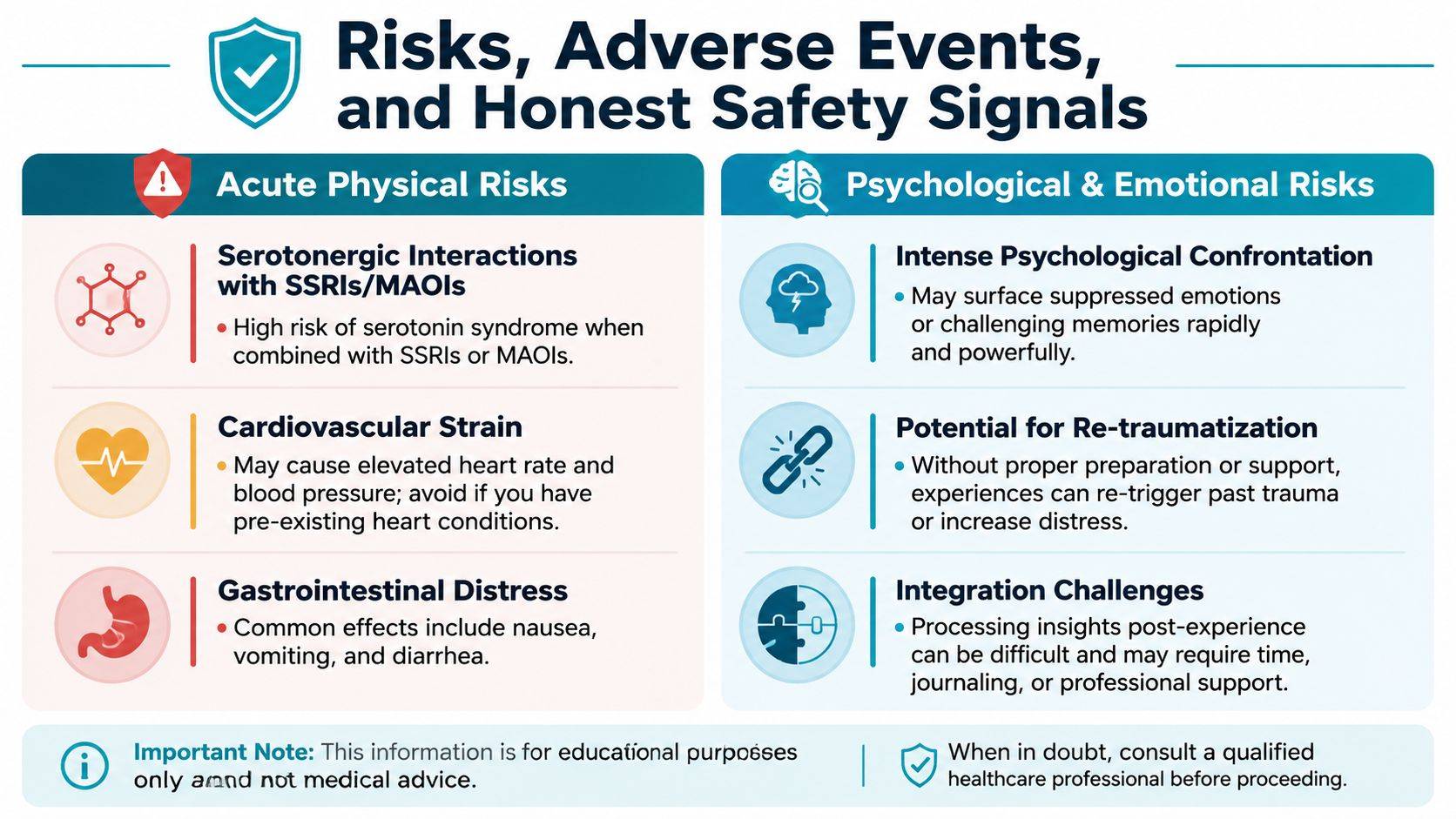
The central pharmacological concern is interaction. Because beta-carbolines inhibit MAO-A and increase monoamine exposure, serotonergic medicines and other psychoactive drugs require careful review. Antidepressants, stimulants, opioids, and other substances can create clinically important uncertainty. Anyone taking prescribed medication should seek guidance from a qualified clinician who understands the medication, the planned preparation, and the relevant legal and medical context.
Physical Signals And Psychological Vulnerability
A 2024 systematic review found that adverse events were usually transient and gastrointestinal, while a small minority of participants required medical aid. That pattern doesn’t make every ceremony safe, and it doesn’t support sensational claims that every difficult physical reaction signals lasting injury. (systematic review of Ayahuasca adverse events)
Vomiting, diarrhea, dizziness, panic, and intense emotional distress can become more dangerous when facilitators lack medical plans or when participants have undisclosed health conditions. Cardiovascular strain deserves particular attention for people with relevant heart conditions or medication risks. Psychological vulnerability also matters. A powerful experience can intensify unresolved trauma, destabilize someone with a history of psychosis or mania, or leave a person struggling after the ceremony if integration support is absent.
“Safety boundary: A retreat’s spiritual language doesn’t replace medication review, emergency planning, informed consent, or qualified supervision.”
Before participation, readers should ask whether a provider:
- Screens medications: The intake process should ask about antidepressants, stimulants, opioids, psychiatric history, cardiovascular conditions, and other relevant risks.
- Plans emergencies: Staff should explain how medical help is reached, who makes decisions, and what happens if a participant becomes physically or psychologically unstable.
- Protects consent: Touch, sexual contact, private sessions, and facilitator access should follow explicit consent standards with clear reporting routes.
- Supports integration: Participants should receive practical follow-up options rather than being left to interpret a destabilizing experience alone.
Food and medication questions are often oversimplified online. A focused guide to foods and medicines that may interact with MAOIs can help organize questions, but it shouldn’t replace individualized medical advice.
Legality, Ceremony Ethics, And Choosing A Retreat
Legality comes before logistics. Ayahuasca is generally illegal in the United States because DMT is classified as a Schedule I controlled substance under federal law, although narrow religious protections exist. The União do Vegetal has a federal exemption, while Santo Daime has received exemptions or settlements in certain jurisdictions. (U.S. legal status and religious exemptions for Ayahuasca)
Internationally, the position is patchwork. Ayahuasca isn’t explicitly scheduled internationally, but national laws can treat DMT, plant materials, prepared brews, religious practice, and commercial ceremonies differently. Tolerance in a country doesn’t automatically mean that every retreat is licensed, screened, medically supervised, or ethically operated.
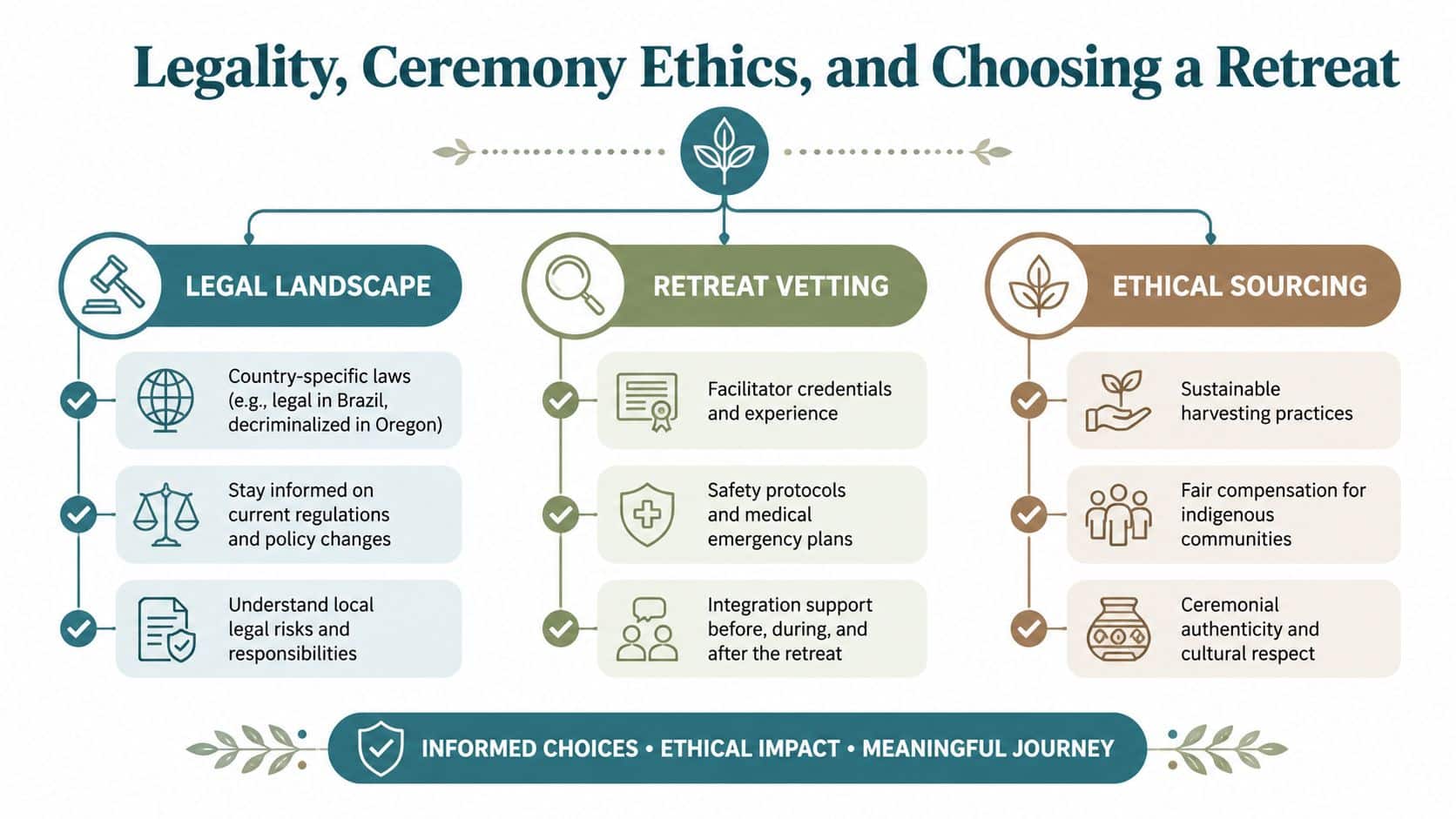
A Three-Part Decision Sequence
First, verify the legal situation. A provider should explain the relevant law in plain language rather than relying on phrases such as “legal everywhere” or “the authorities know about us.” Participants should understand what happens at the retreat location, during travel, and when carrying medicines across borders.
Next, evaluate the operation. A credible intake process asks about health history and medications before payment or arrival. The staff should explain who leads ceremonies, what training or community authorization they hold, how many participants each facilitator supports, and how emergencies are handled. A provider that refuses to answer basic safety questions creates unnecessary risk.
Then, examine the ethical relationship. Claims of Indigenous connection need specifics. Which community or practitioner is involved? How is compensation decided? Does the operation describe land stewardship, sourcing pressure, and community benefit? Ethical participation requires more than decorative language, symbolic clothing, or the use of Indigenous names.
A retreat booking resource such as retreat booking with Samba may help organize travel and wellness logistics, but booking support doesn’t substitute for legal verification or medical due diligence. Ayahuasca.com also publishes educational material on cultural appropriation versus cultural appreciation, which can help readers examine how their participation affects the communities whose traditions they encounter.
Questions To Ask Before Departure
- What happens during screening? Ask which medications, psychiatric histories, cardiovascular conditions, and other contraindications are reviewed.
- Who is responsible for emergencies? Request a clear answer about transport, clinical assistance, communication, and staff roles.
- How is consent protected? Ask about touch, sexual boundaries, private interactions, complaint procedures, and independent reporting.
- What support follows the ceremony? Confirm whether integration conversations or referrals are available.
- How are practitioners compensated? Look for transparent information about Indigenous leadership, wages, community payments, and sourcing.
- What should participants bring? Keep copies of identification, medication information, emergency contacts, insurance details, and relevant medical records.
Red flags include no medical screening, isolation from outside communication, untrained facilitators, pressure to take more, vague ingredients, unclear pricing, and promises of guaranteed healing. A responsible participant can postpone a ceremony without losing anything. A responsible retreat can answer difficult questions without using spiritual authority to silence them.
Amazonian plant medicine deserves curiosity with boundaries. The traditions are historically deep and botanically complex, Ayahuasca has a developing clinical research profile, and the wider healing system contains far more than one brew. The safest next step is education before participation: verify the law, review health risks with a qualified clinician, ask precise questions about consent and emergency care, and choose providers that demonstrate respect for Indigenous knowledge through transparent relationships rather than marketing language.
Disclaimer: The information provided on Ayahuasca.com is for educational purposes only and is not intended as medical advice, diagnosis, or treatment. Ayahuasca is a powerful traditional Amazonian medicine and may not be suitable for everyone. Always consult with a qualified healthcare professional before making decisions related to health, mental well-being, medications, or the use of Ayahuasca.