
The calendar is full, the work is technically going well, and yet a quiet question keeps returning: Who is making these choices, and what do they want? A career change, a relationship ending, burnout, or a growing distance from familiar routines can create the need for more than a relaxing holiday. A self discovery retreat offers protected time to examine those questions with structure, guidance, and enough distance from daily roles to hear what has been difficult to notice at home.
The right retreat won’t be the one with the most dramatic setting or the most impressive promises. It will be the one whose demands match a participant’s time, budget, emotional bandwidth, physical capacity, and openness to unfamiliar practices.
What a Self Discovery Retreat Is
A person at a career crossroads may leave home expecting clarity to appear during a forest walk. The more demanding work often starts when the schedule calls for silence, journaling, meditation, and honest attention to the fear beneath the career question. The setting creates distance; the structure gives that distance a purpose.
A self discovery retreat is a planned period away from ordinary responsibilities, built around practices that support self-inquiry. These may include silence, meditation, breathwork, yoga, somatic exercises, creative work, therapeutic reflection, or guided psychedelic experiences. Rest may have a place, while the central aim remains examining patterns, values, emotions, relationships, or direction.
The Three-Part Structure
A credible retreat usually rests on three elements:
- Time: Participants leave normal demands long enough to observe themselves without immediately performing familiar roles.
- Container: The program sets boundaries through a schedule, group agreements, facilitator access, dietary guidance, silence periods, or ceremony protocols.
- Practice: The retreat offers a method for inquiry. Without one, time away can become an attractive holiday.
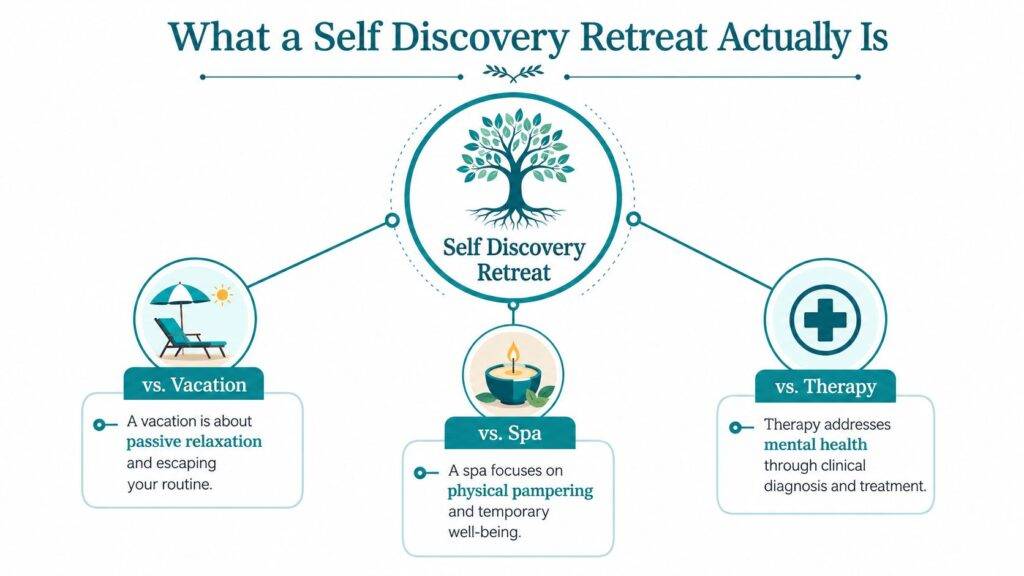
A vacation centers enjoyment, exploration, or passive relaxation. A spa gives priority to physical care and comfort. A clinical therapy program follows assessment and treatment by qualified professionals. A retreat can share features with each, yet its defining feature is intentional self-examination inside a designed environment.
A Simple Qualification Test
Before paying a deposit, ask:
- What practice will occupy the day?
- What support is available when difficult emotions arise?
- What happens after returning home?
Answers focused only on scenery, luxury, or guaranteed transformation signal a program that may be a holiday using wellness language. Clearer programs describe the daily rhythm, facilitator role, participant responsibilities, and integration process.
The participant’s demands also matter. Silence requires tolerance for reduced conversation. Movement asks for physical capacity. Emotional reflection uses attention and emotional bandwidth. A supervised altered-state practice asks for openness, preparation, and trust in the stated safety boundaries. These demands are part of the retreat’s design, not minor details hidden behind its setting.
“Practical rule: Choose a retreat that asks something specific of you, whether that is silence, movement, emotional honesty, disciplined attention, or openness to a carefully supervised altered state. Its structure should make the request visible before you book.”
Why Self Discovery Retreats Are Growing Now
Self discovery retreats now sit inside a large wellness economy rather than a narrow travel niche. The global wellness retreat market, which includes yoga retreats, meditation intensives, personal development programs, and nature-based reset trips, was valued at $180.5 billion in 2022 and is projected to reach $363.9 billion by 2032, roughly doubling across that decade, according to global wellness retreat market coverage. The same source connects demand with burnout and identifies personal development and meditation as core retreat formats.
That scale creates both opportunity and confusion. A quiet nature weekend, a structured mindfulness program, and a plant-medicine immersion may all use words such as clarity, healing, and transformation, while asking participants to tolerate very different levels of physical effort, emotional exposure, and uncertainty.
Who Is Choosing These Experiences
The booking patterns show that retreats appeal to adults with varied life circumstances. Solo travelers represented 35% of bookings in 2023, equivalent to about 15.6 million independent trips, while women represented 68% of global retreat attendees. Adults aged 25 to 65 accounted for 72.4% of the market, according to retreat wellness industry data.
Yoga and meditation retreats held 45% market share and hosted 19.2 million guests globally in 2023, from the same industry report. These figures place mindfulness-based self-inquiry near the center of the retreat economy, rather than at its margins.
The practical insight is that the category has fragmented into different tools for different needs. A person with limited leave may need a short, highly focused format. Someone processing a major identity shift may need sustained reflection and follow-up. Another participant may want creative expression because direct verbal disclosure feels too exposed.
The four broad paths below help separate those choices. Each one has a different participant contract. The question isn’t which modality looks most appealing. The question is what the participant can realistically give, and what kind of inquiry the format can support.
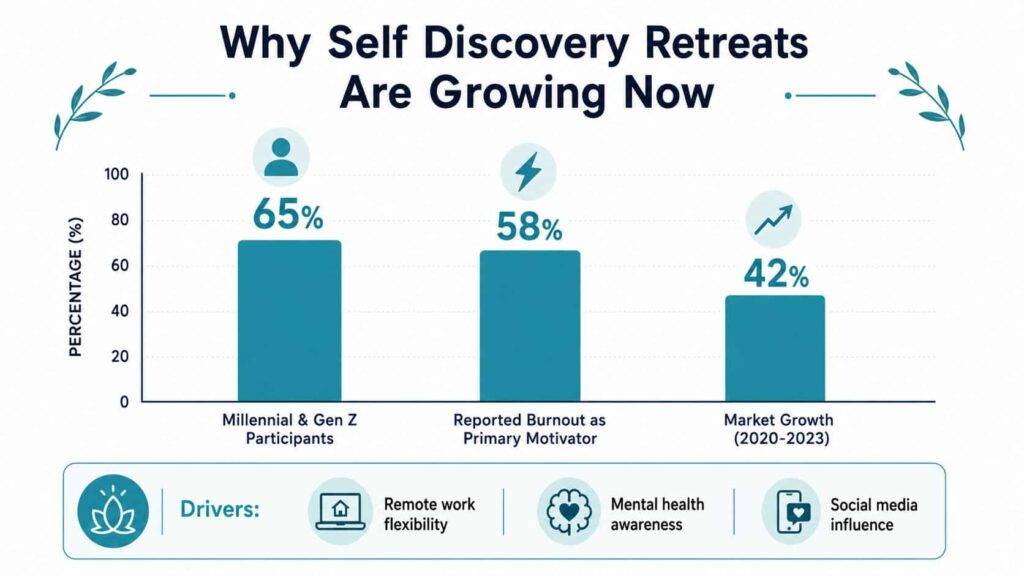
The wider cultural context also includes changing work patterns and a growing willingness to treat personal development as an intentional use of travel time.
The Four Main Retreat Modalities Compared
A retreat format is a tool, not a personality test. Silent practice suits someone willing to meet internal noise without immediate distraction. Yoga and mindfulness suit participants who learn through attention and the body. Spiritual or plant-medicine work asks for careful screening and openness to altered states. Creative or therapeutic formats provide more expressive and relational routes into difficult material.
| Modality | Typical Length | Intensity | Best For |
|---|---|---|---|
| Silent retreat | Weekend to multi-day immersion | High mental discipline | Attention training, observation of thought, and simplicity |
| Yoga and mindfulness retreat | Short break to extended program | Moderate to physically demanding | Body awareness, emotional regulation, and steady routine |
| Spiritual or plant-medicine retreat | Multi-day immersion | Emotionally and psychologically intense | Meaning, spiritual inquiry, and profound perspective shifts |
| Creative or therapeutic retreat | Short program to extended workshop | Variable, depending on therapeutic depth | Expression, life transitions, grief, identity, and relational patterns |
Silent Retreats
Silence removes many ordinary ways of regulating discomfort. Participants may have limited conversation, reduced digital access, and a schedule built around sitting, walking, eating, and observing. This can reveal compulsive thinking with unusual directness.
The format suits people who can accept repetition and uncertainty. It may be a poor match for someone seeking constant interpersonal processing, immediate answers, or a highly social itinerary. Beginners can participate, but a gradual introduction to meditation and a clear explanation of the schedule can make the experience more workable.
Yoga and Mindfulness Retreats
Yoga and mindfulness programs usually combine movement, breath awareness, meditation, and guided reflection. The body becomes an entry point, which can help participants who find abstract journaling or extended sitting difficult.
The main demand is consistency. A participant may need to attend early practices, adjust to unfamiliar physical effort, and notice sensations without forcing them into a dramatic story. These retreats work well for people seeking a grounded reset, improved self-observation, or a repeatable routine that can continue after travel.
Spiritual and Plant-Medicine Retreats
Spiritual retreats may use ritual, prayer, ancestral teachings, ceremony, or contemplative practice. Plant-medicine retreats, including Ayahuasca ceremonies, add an altered-state component that can intensify emotional and symbolic material.
This path requires the greatest care with medical screening, legality, facilitator competence, cultural respect, and integration. Openness alone isn’t enough. Participants need informed consent, clear contraindication guidance, emergency planning, and a support structure for experiences that may remain difficult to interpret.
Creative and Therapeutic Retreats
Creative retreats use writing, music, visual art, movement, or storytelling to approach questions indirectly. Therapeutic retreats may add professionally guided group or individual work.
These formats suit participants who need relational safety or a concrete medium for expression. The trade-off is that emotional depth can depend heavily on facilitator skill and group culture. A beautiful setting can’t compensate for weak boundaries or unclear therapeutic responsibility.
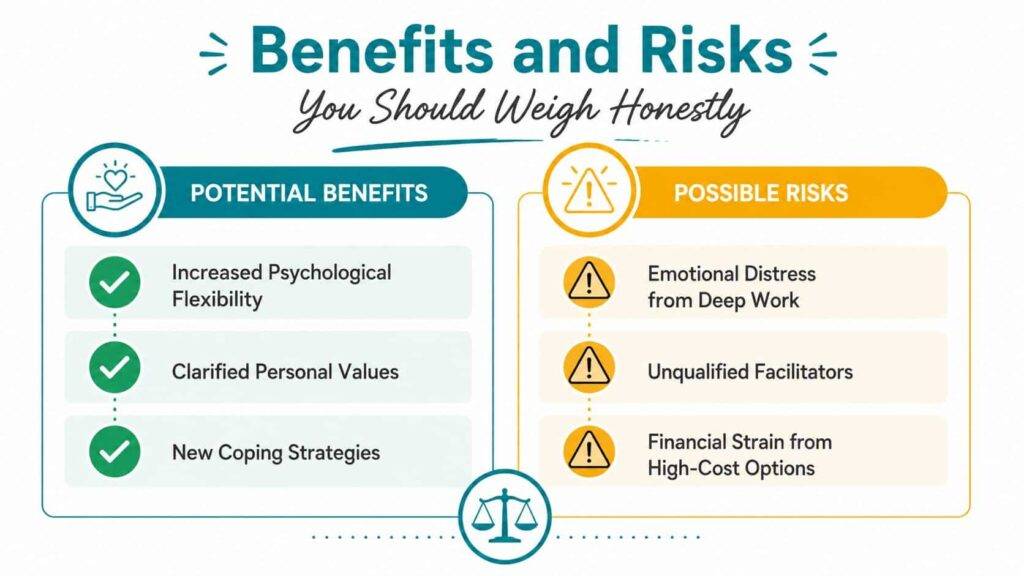
Benefits and Risks You Should Weigh
You arrive at a retreat after months of running on habit. The schedule removes familiar distractions, leaving more room to notice reactions, examine values, and test different ways of responding. That concentration can support meaningful change, provided the format matches your time, budget, and emotional capacity.
Research from a published retreat pilot examined a 7-day group psilocybin retreat pilot. Participants showed medium-to-large improvements in psychological flexibility processes during follow-up, including cognitive defusion, valued living, and self-compassion. The general inflexibility score showed a larger effect by 6 months, g = 0.86. Values obstruction remained significantly lower at 2 weeks, g = 1.32, and 6 months, g = 0.99.
What the Evidence Can and Can’t Say
The study points toward process change, such as relating differently to thoughts and values, which goes beyond a temporary mood lift. A separate review of mindfulness neuroscience describes research in which intensive contemplative programs, including a 7-day retreat, were associated with changes in large-scale brain networks. The review identifies attention control, emotion regulation, and self-awareness as central self-regulation mechanisms, with research examining the default mode, salience, and frontoparietal networks.
These findings describe possible mechanisms, not a guarantee for every retreat. Repeated attention practice, silence, and guided reflection may carry more weight than scenery. They also require time and willingness to stay with ordinary, sometimes uncomfortable experiences after the retreat ends.
A Frank Self-Screen
Pause before choosing an altered-state retreat and seek qualified clinical guidance if medical conditions, medication concerns, significant psychiatric symptoms, or uncertainty about psychological stability apply. Staff should explain screening requirements clearly. Share relevant information fully so the program can assess whether its format suits you.
Other risks deserve equal attention:
- Emotional flooding: Deep work can bring grief, fear, shame, or traumatic memories into awareness.
- Weak containment: Unclear boundaries or untrained facilitators can leave participants without appropriate support.
- Retraumatization: Intense practices can cause harm when consent, pacing, and choice receive inadequate respect.
- False finality: A retreat may open useful questions without resolving them. Expecting one experience to settle everything can lead to disappointment or impulsive decisions.
- Financial pressure: A costly retreat can create stress if money worries follow you home.
Match the retreat to your available resources. A local, lower-intensity practice may offer steadier preparation than an immediate commitment to a highly demanding format.
How to Vet a Retreat Before You Book
Marketing language becomes useful only when it leads to specific answers. A reputable operator should explain who facilitates the program, how participants are screened, what happens during an emergency, and how support continues after departure.
Five Checks That Matter
Medical screening protocol: Ask what health information the program collects, who reviews it, and how medication questions are handled. Plant-medicine programs should provide clear guidance about contraindications and explain when participation isn’t appropriate.
Facilitator training and lineage: Request names, relevant training, supervision arrangements, and the boundaries of each facilitator’s role. Spiritual lineage can provide cultural context, but it doesn’t replace practical safety competence.
Safety and emergency procedures: Ask where participants go if urgent medical care is needed, who remains sober and responsible during ceremonies, and how consent is protected when someone becomes distressed.
Post-retreat integration support: Find out whether follow-up calls, peer groups, referrals, or structured reflection are available. Integration shouldn’t be an afterthought, especially after intense emotional or altered-state work.
Transparent pricing and testimonials: Get a written list of inclusions, exclusions, cancellation terms, accommodation details, and travel responsibilities. Testimonials can provide context, but they don’t prove that the same outcome will occur for another participant.
Questions to Send Before Paying
A written response is more useful than a polished sales call. Participants can ask:
- Who supervises medical screening?
- What happens if a participant wants to stop?
- How are touch, privacy, sexual boundaries, and confidentiality handled?
- What support is available during the night or outside scheduled sessions?
- What does the fee exclude?
- What preparation and integration materials are provided?
For readers evaluating plant-medicine settings, this guide to a safe and transformative plant medicine retreat offers another set of questions to bring into the screening process. A center that avoids reasonable scrutiny, guarantees outcomes, skips medical screening, or offers no follow-up support has given a meaningful answer already.
Preparing For and Integrating the Experience
A retreat works best as a three-phase arc: preparation, participation, and integration. The most common planning error is treating the retreat as the whole journey. Travel ends on the departure date, but the meaning of the experience often develops through ordinary decisions made afterward.
Before Departure
Preparation should begin early enough for practical questions to surface. Participants can:
- Review health information: List medications, supplements, relevant diagnoses, allergies, sleep concerns, and previous reactions to intense practices. Share the information with the retreat team and a qualified clinician when appropriate.
- Clarify an intention: Choose an inquiry rather than a demand. “What am I avoiding in this decision?” is more workable than “Make the correct decision appear.”
- Confirm logistics: Arrange transport, work coverage, childcare, emergency contacts, communication expectations, and a gentle return schedule.
- Reduce avoidable strain: Arrive rested and understand dietary, movement, silence, or technology requirements. Preparation guidance should come from the specific program because needs differ by modality.
Resources on preparing for an Ayahuasca journey can help participants identify questions about disclosure, intention, and ceremony readiness. For broader daily habits, these mind and body wellness tips provide a useful foundation for sleep, movement, and basic self-care before travel.
During the Retreat
Participants don’t need to force a breakthrough. They need to follow the container while retaining the right to ask questions, set boundaries, and decline an activity that feels unsafe or outside informed consent.
A journal can record sensations, recurring themes, dreams, values, and specific behavioral intentions. The strongest observations are often concrete, such as noticing a tendency to apologize before expressing a need, rather than grand conclusions about an entire identity.
After Returning
Integration turns insight into practice. A participant might schedule therapy, maintain a short meditation routine, discuss the experience with a trusted support person, revisit journal notes, and choose one observable change at home or work.
Difficult reactions deserve prompt attention. Persistent fear, sleep disruption, confusion, impulsive decisions, or a loss of functioning calls for qualified professional support, not more retreat content. Integration may continue for months, especially after emotionally intense work, and the retreat provider should explain how participants can access appropriate help.
Logistics, Cost, and Choosing the Right Length
The best length is the one a participant can complete without creating a larger crisis at home. A weekend may fit work and family obligations while still providing a defined break from routine. A longer immersion offers more time for practice and reflection, but it also demands more leave, preparation, money, and recovery space.
Recent market reporting says the global wellness retreat market reached $248.09 billion in 2025 and is projected to reach $398.99 billion by 2030, with personalized and AI-driven health optimization identified as a key trend, according to wellness retreat market reporting. Another industry report says weekend retreats account for more than three-fifths of global wellness retreat revenue, suggesting that shorter formats have become central to the category.
What the Price Should Clarify
A retreat fee may cover accommodation, food, instruction, ceremonies, transfers, preparation materials, or integration sessions. It may exclude flights, insurance, medication review, private therapy, additional nights, or emergency travel.
Participants should request an itemized total before booking. Paying more may be reasonable for qualified staff, smaller groups, strong screening, safe facilities, transparent logistics, and meaningful follow-up. A higher price alone doesn’t establish quality.
Location matters, too. Participants should verify the legal status of the practices offered, local emergency access, travel requirements, climate, and cultural protocols. Group programs may provide community at a lower cost, while private work can offer more personal attention but may reduce the stabilizing effect of shared experience.
A practical choice can be made by scoring four constraints: available time, realistic budget, emotional capacity, and desired intensity. If any score is low, a shorter or less immersive format may be wiser than postponing self-inquiry indefinitely. For readers specifically assessing Ayahuasca costs, this guide to how much an Ayahuasca retreat costs can help organize the questions before comparing programs.
Common Questions and Your Next Step
How Long Do the Effects Last?
The retreat schedule ends quickly, but changes in perspective or behavior may develop through continued practice. Research on psychological flexibility followed participants beyond the retreat, yet individual experiences vary and no format guarantees lasting change.
Are Silent Retreats Suitable for Beginners?
They can be, provided the program explains the schedule, offers suitable instruction, and allows participants to ask for help. A shorter local format may be a better first test than an intense immersion.
How Should a Participant Evaluate a Plant-Medicine Center?
The center should provide medical screening, informed consent, facilitator credentials, emergency procedures, cultural context, clear boundaries, and integration support. Any promise of guaranteed healing should be treated as a serious warning sign.
When Is Integration Support Needed?
Support is appropriate whenever an experience creates persistent distress, confusion, sleep problems, relationship disruption, or difficulty functioning. Someone facing grief, trauma, or a major identity change may also benefit from therapy for life transitions before or after a retreat.
A simple decision framework can guide the next move:
- Limited time and moderate capacity: Choose a structured weekend of mindfulness, yoga, or nature-based practice.
- Strong interest in attention training: Consider a silent retreat with clear beginner support.
- Desire for altered-state work: Complete medical and psychological screening first, then investigate the center’s safety and integration systems.
- Active instability or acute distress: Work with a qualified clinician before booking an immersive retreat.
The next step should be concrete. Write one question the retreat is expected to help clarify, set a realistic limit on time and money, and contact only programs willing to answer safety questions in writing. If no retreat meets those conditions, begin with a local practice or professional support rather than forcing a decision.
Disclaimer: The information provided on Ayahuasca.com is for educational purposes only and is not intended as medical advice, diagnosis, or treatment. Ayahuasca is a powerful traditional Amazonian medicine and may not be suitable for everyone. Always consult with a qualified healthcare professional before making decisions related to health, mental well-being, medications, or the use of Ayahuasca.