
You’re sorting through a medication list, a journal article, and a group chat full of confident advice, then trying to decide whether a psilocybin experience is still a good idea. That’s the moment people realize the hard part isn’t finding information, it’s knowing which interactions matter.
Psilocybin drug interactions sit at the center of that decision. Some combinations mainly dull the experience, some make side effects more likely, and a few raise real safety concerns that deserve respect. A responsible plan starts with screening, not guessing.
Why Psilocybin Drug Interactions Matter More Than You Think
A lot of people assume psilocybin is simple because it is usually taken as a single dose. That assumption breaks down fast once prescription meds, supplements, alcohol, cannabis, or stimulants enter the picture. Real-world use rarely looks like a clean clinical setting.
The clearest warning sign is the rise in poison-center encounters. A 10-year study found 6,933 psilocybin-related poison-center encounters from 2013 to 2022, with annual cases rising from 477 in 2013 to 1,441 in 2022, a 202% increase. The same study found the trend was flat through 2019, then increased by 308 encounters per year, which means nearly all of the growth happened after 2019, and the cases were most common among adults ages 18 to 24 and 25 to 44 (study on U.S. poison-center encounters).
Why That Trend Matters
That rise doesn’t prove every case was caused by a drug-drug interaction, but it does show something practical. People are using psilocybin more often, and the safety questions are now showing up in poison-center data rather than only in theory. That matters because interactions often involve the exact medications people forget to mention, like antidepressants, stimulants, and other common prescriptions.
“Practical rule: If a medication feels unrelated to psychedelic use, that’s exactly the one worth checking twice.”
The stakes are not just about a stronger or weaker trip. Interaction problems can mean nausea, high anxiety, blood pressure changes, or in the wrong combination, a seizure risk that doesn’t belong in casual planning. The safest approach is to treat every medication as relevant until proven otherwise.
How Psilocybin Interacts With Your Body and Medications
Psilocybin is a prodrug, which means the body has to convert it into the active compound psilocin before the main psychedelic effect appears. Psilocin then acts like a key trying to fit into the brain’s serotonin locks, especially the 5-HT2A receptor. That receptor is one of the main reasons the experience feels psychedelic instead of ordinary.
The key-and-lock analogy helps, but only up to a point. If another drug is already sitting in the same lock, psilocin may not fit the same way, or it may fit more strongly than expected. That’s where pharmacodynamic interactions happen, meaning two substances affect the same signaling system, and the result can be blunting, intensification, or side effects.
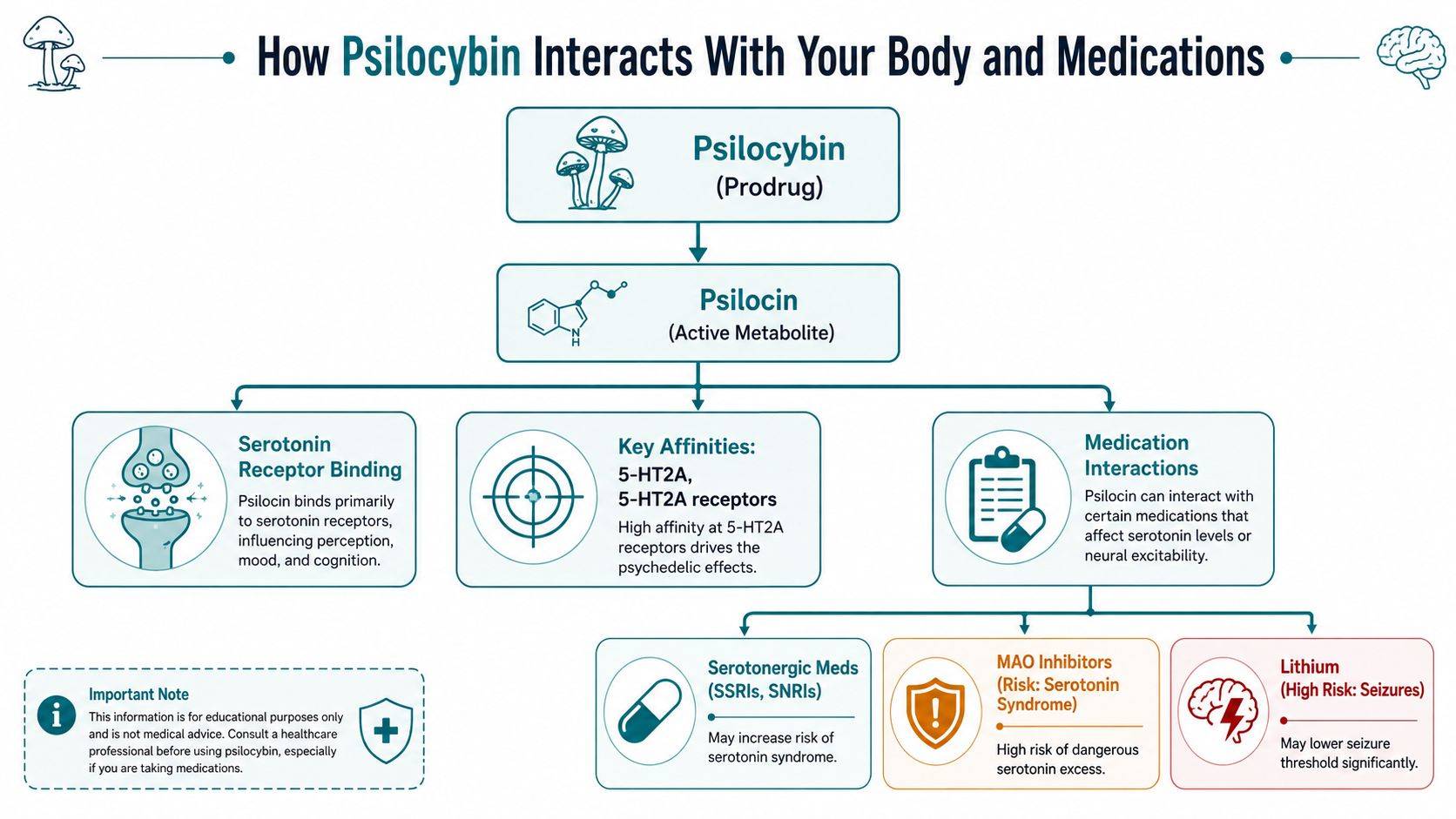
Two Ways Interactions Happen
The other route is pharmacokinetic interaction, which means one substance changes how the body processes another. Psilocin is primarily metabolized by UGT1A10 and UGT1A9, so drugs that inhibit or induce UGT enzymes can alter handling of psilocybin in clinical contexts (psilocin metabolism and UGT pathways). That’s a different kind of problem from receptor competition, because the issue is speed of breakdown, not receptor signaling.
A helpful way to think about this is traffic. Pharmacodynamic interactions are two cars trying to use the same lane. Pharmacokinetic interactions are the road itself changing, so traffic moves faster or slower than expected. Both can make the ride feel very different.
For a broader view of enzyme-driven interaction patterns, key isoenzymes and substrates explained is a useful reference point for understanding how metabolism can shape medication behavior. The point is not to memorize enzyme names, it’s to notice that metabolism is part of the safety picture.
Why Receptor Sensitivity Matters
Long-term serotonergic medication use can change receptor behavior. That’s why people on some antidepressants may feel less from psilocybin, even if they stopped the medication earlier. The body doesn’t always reset on command, and that delay is one of the biggest sources of confusion in real-world planning.
“The same dose can feel muted, normal, or unusually intense depending on what else is on board and how recently it was changed.”
That’s why interaction screening isn’t just about “is this drug bad with psilocybin.” It’s about whether the combination changes the experience, changes the risk profile, or both.
High-Risk Medications And Interaction Severity Rankings
A person planning a psilocybin session may be looking at a long medication list and wondering which items are a mild nuisance and which ones change the risk picture in a serious way. The most useful way to sort psilocybin drug interactions is by severity, not by alphabet. Some combinations mainly reduce the expected effect. Others deserve strong caution because they have been tied to seizures, serotonin toxicity concerns, or responses that are hard to predict. A few common medications sit in the middle, where the main issue is not acute danger but planning around a duller or rougher experience.
Antidepressants And Mood Stabilizers
SSRIs and SNRIs are the most common pharmacodynamic concern. A Johns Hopkins self-report analysis found weaker-than-expected psilocybin mushroom effects in people using these medications, and the reduced effect could persist for a period after discontinuation (Johns Hopkins self-report analysis). That matters even when the medication has already been stopped, because the body does not always reset as soon as the prescription ends.
The practical takeaway is simple. If an SSRI or SNRI is still active in the system, the experience may feel muted rather than broken. That is one reason washout guidance varies so much across sources and why people sometimes stop a medication expecting a full return to baseline that does not arrive on their preferred timeline.
Lithium is different. Reports summarized in the literature have linked lithium plus psychedelics with seizures and with strongly adverse experiences, which is why lithium is treated as a high-risk combination in many harm-reduction discussions. That is the combination that should trigger the most caution.
Lamotrigine has a different signal. A naturalistic review of co-administration suggested lithium, but not lamotrigine, may increase seizure risk when used with psilocybin (naturalistic review of co-administration). That does not make lamotrigine a free pass, but it places it in a very different category from lithium.
Other Common Medications
MAO inhibitors are high-risk because they can amplify serotonergic effects and raise concern for serotonin toxicity. That concern applies to classic antidepressant MAOIs and to other MAOI-like combinations, especially when another serotonergic agent is added. Bupropion can also blunt effects in some people, so a session may feel different from what the dose alone would suggest.
Stimulants and caffeine can make the experience feel more tense, especially when the body is already activated. Tramadol matters because it can lower seizure threshold and has serotonergic properties. Cannabis is unpredictable, sometimes relaxing and sometimes sharply anxiety-provoking, which is why its interaction with psilocybin is so hard to predict in practice.
The broader MAOI issue also includes food and medication conflicts beyond the psychedelic itself, so a careful review of foods and meds to avoid with MAOIs can be useful when someone is sorting out a medication list.
Severity Table
| Medication Class | Interaction Type | Primary Risk | Severity Rating |
|---|---|---|---|
| SSRIs | Pharmacodynamic blunting | Reduced psychedelic intensity | Moderate |
| SNRIs | Pharmacodynamic blunting | Reduced psychedelic intensity | Moderate |
| Bupropion | Mixed effect change | Blunted or altered response | Moderate |
| Lithium | Safety interaction | Seizures, severe adverse outcomes | High |
| Lamotrigine | Unclear, likely lower risk than lithium | Possible interaction concern | Lower to moderate |
| MAO inhibitors | Strong serotonergic amplification | Serotonin toxicity concern | High |
| Stimulants | Sympathetic activation | Blood pressure, anxiety, thought loops | Moderate to high |
| Caffeine | Sympathetic activation | Jitteriness, increased anxiety | Low to moderate |
| Tramadol | Seizure threshold, serotonergic effect | Seizure and toxicity concern | High |
| Cannabis | Variable CNS effect | Unpredictable anxiety or sedation | Moderate |
For people checking many medications at once, the safest reading is straightforward. Lithium and MAOI combinations deserve the most concern, serotonergic antidepressants often blunt the experience, and polypharmacy can turn a routine dose into something much less predictable.
The Evidence Gap Between Clinical Trials And Real-World Use
A person with depression, anxiety, chronic pain, sleep problems, or cardiovascular issues is often the exact person who gets left out of psilocybin studies. Clinical trials usually exclude people taking multiple medications, which makes the safety picture cleaner for researchers, but much less complete for everyone else. That gap matters because real-world use rarely happens in a medication-free vacuum.
A 2022 Oregon Health & Science University review found only one study on psilocybin interactions with antidepressants, and later reviews noted that many psilocybin studies ask participants to stop other medications before dosing (OHSU review). So a lot of public guidance still rests on indirect evidence, careful inference, and clinician judgment instead of direct head-to-head trials.
Why Washout Advice Varies
People often want one fixed number of days, but the literature does not give that kind of certainty for every drug. Some summaries describe SSRIs and SNRIs as often possible to continue with psilocybin, while still warning that the effect may be reduced, and lithium keeps showing up as the higher-concern medication. The practical gap lies in the lack of evidence-based tapering and washout guidance for everyday patients.
The unresolved question is how long blunting or risk may linger after stopping an SSRI or SNRI. The Johns Hopkins self-report analysis found diminished effects could last up to 3 months after discontinuation (Johns Hopkins self-report analysis). That does not create a universal rule, but it does show why a short pause may still leave someone with a muted or altered response.
Polypharmacy Is The Real Blind Spot
Clinical trials also miss the messy combinations people use outside study settings. Psilocybin may overlap with sleep aids, pain meds, nicotine, caffeine, alcohol, cannabis, or emergency medications, and those combinations can change both the experience and the risk profile. A naturalistic review noted that combinations involving lithium may be especially risky, while other interactions remain less clearly mapped (naturalistic review).
“Practical reading: trial eligibility shows what researchers were willing to study, not the full range of what a real-world body and medication list may encounter.”
That is why a therapy-style overview such as psychedelic therapy and mental wellness can help with context, but it cannot replace an individualized medication review. The safest real-world standard is to treat trial protocols as a starting point, then adapt them with a clinician who knows the full medication list, and a guide to medication management visits can help frame the questions to bring into that conversation.
Practical Screening And Harm Reduction Framework
A safer psilocybin plan starts with a complete medication picture. That includes prescription drugs, over-the-counter medicines, supplements, and recreational substances, because interaction risk often comes from combinations people would not normally think of as a single list. A medication review visit can make the process easier to sort through, especially when the list is long or the advice is inconsistent, and a guide to medication management visits can help frame the right questions for that conversation.
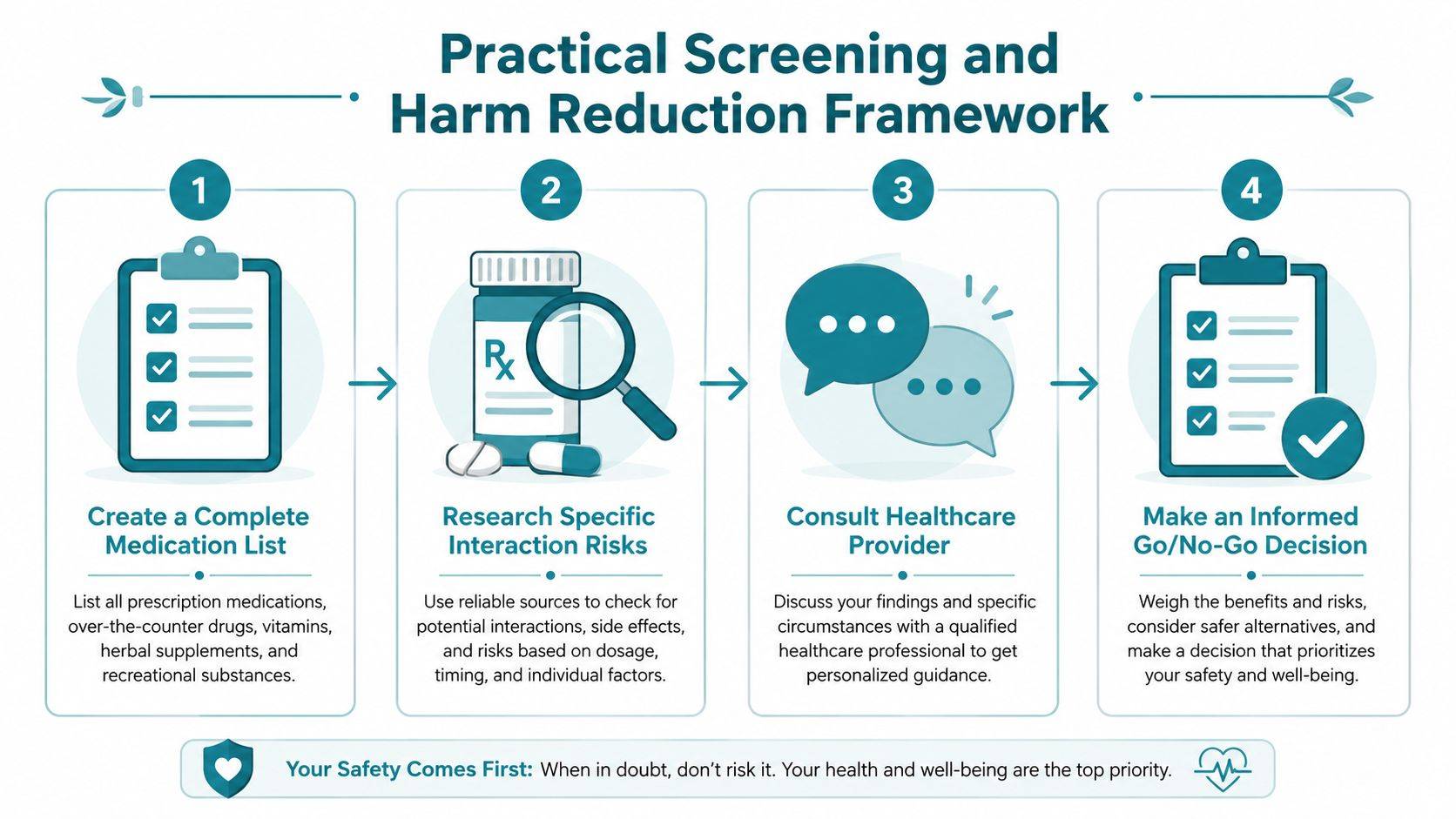
A Clear Screening Sequence
- Create a complete list. Include daily prescriptions, as-needed medications, sleep aids, pain relievers, cannabis, alcohol, nicotine, and supplements. Missing even one item can change the risk picture.
- Check the highest-risk classes first. Lithium, MAO inhibitors, stimulants, tramadol, and serotonergic antidepressants deserve the first pass because they carry the clearest concern.
- Ask about timing, not just names. A drug that was stopped recently may still matter, especially when antidepressant blunting can linger after discontinuation.
- Make a go or no-go decision with the full context. If the combination is uncertain, the cautious choice is to slow down rather than improvise.
For people considering lower-intensity use instead of a full session, a practical guide to microdose mushrooms for personal growth helps separate the same safety questions from a different use pattern. The dosing context changes, but interaction screening still matters.
What Deserves Medical Review
A clinician should be consulted if lithium is involved, if an MAOI is involved, if there are multiple serotonergic drugs on board, or if there is a history of seizures, bipolar disorder, or blood pressure instability. Conflicting advice is another reason to get a second look, especially when one source says “generally safe” and another says “avoid.” The disagreement usually means the medication combination sits in a gray zone where risk remains uncertain.
“If stopping a medication would risk relapse, withdrawal, or destabilization, the interaction plan needs medical input, not a guess.”
There is no universal washout timeline that fits every medication in every body. Some drugs clear quickly, while others can keep affecting serotonin signaling, mood stability, or blood pressure after the last dose. When the evidence is thin, treat the medication list as part of the setting, not an annoyance to work around.
Key Takeaways For Safe Psilocybin Use
The biggest safety lesson is simple. Lithium is the combination that stands out most clearly as high risk, MAO inhibitors deserve serious caution, and SSRIs/SNRIs often blunt the experience rather than create a dramatic toxic reaction. The poison-center trend, the self-report data, and the review literature all point to the same conclusion, real-world use needs medication screening.
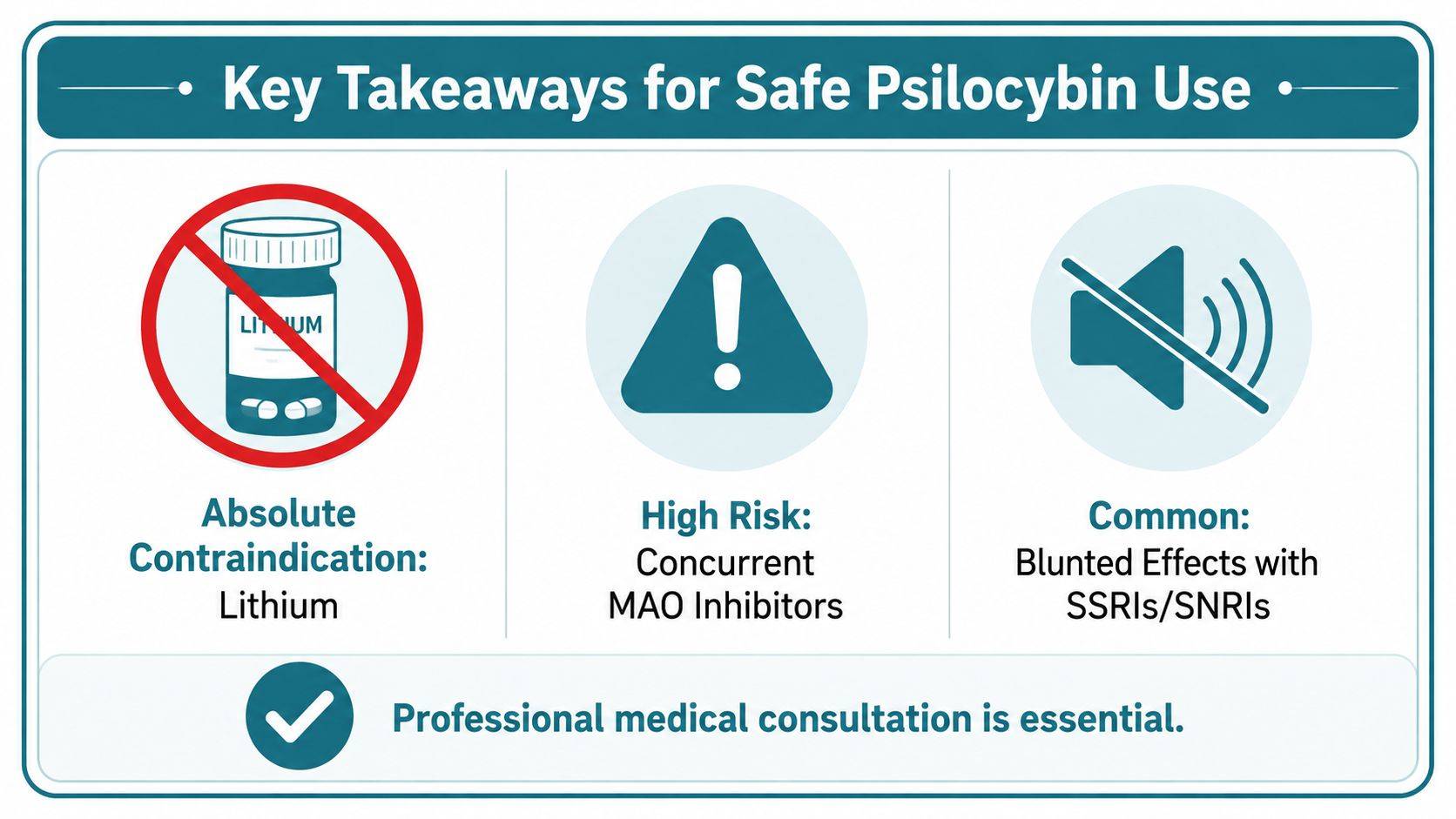
If a medication list includes anything serotonergic, blood-pressure active, seizure-related, or mood-stabilizing, the safest next step is a real review with a clinician who can weigh timing, tapering, and mental health stability. A “natural” label doesn’t remove interaction risk.
Responsible preparation makes the experience safer and usually more predictable. For readers balancing psilocybin with ongoing treatment, Ayahuasca.com can be a useful place to continue learning, but the final go or no-go decision should come from a complete medication review and a sober look at the actual risk profile.
Disclaimer: The information provided on Ayahuasca.com is for educational purposes only and is not intended as medical advice, diagnosis, or treatment. Ayahuasca is a powerful traditional Amazonian medicine and may not be suitable for everyone. Always consult with a qualified healthcare professional before making decisions related to health, mental well-being, medications, or the use of Ayahuasca.