
You’re sitting in a dim room, the meal has been served, the cups have gone around, and the first sound is still very soft. It might be a voice, a whistle, or a simple melodic line that repeats just enough to hold the room together. For many readers, that moment is where icaro stops being an abstract “shamanic song” and starts looking like what it is, a working part of the ceremony.
In Ayahuasca contexts, an icaro is usually described as a healing song, but that phrase can hide more than it reveals. A well-trained healer is not singing for decoration. The song can mark space, steady attention, soften fear, and help organize what participants are feeling. That practical function is why the topic matters, because once the icaro is understood as a ceremonial instrument, the rest of the tradition becomes easier to read.
A Song That Opens The Ceremony Room
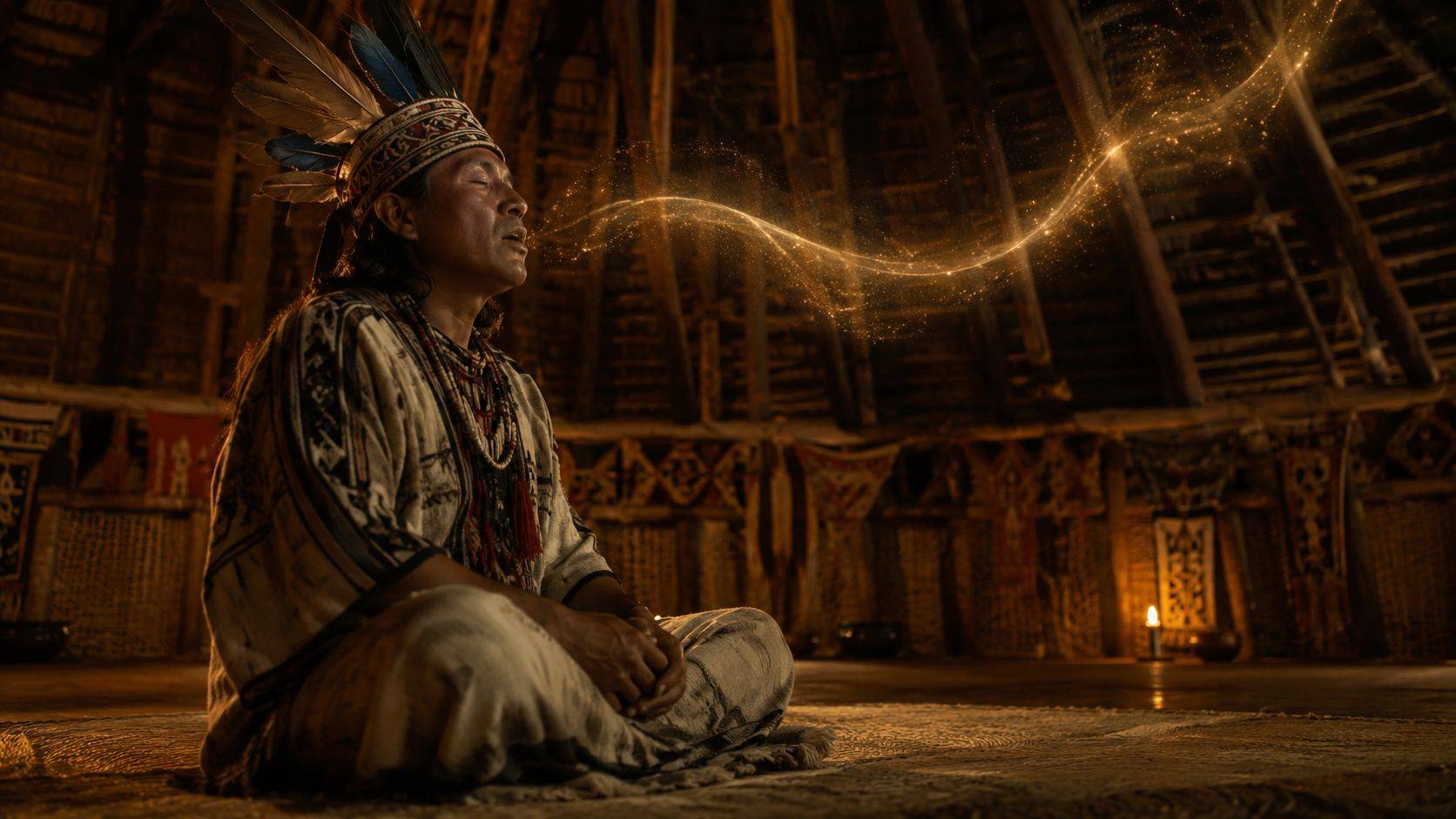
The room is quiet enough that small sounds matter. A candle flickers, a cup is set down, and the healer begins with a line that may sound almost plain at first, then develops shape through repetition. In many ceremonies, that opening sound does more than fill silence, it gives the room a shared rhythm to follow.
An icaro is often heard before anyone knows how to name it. The healer may sing, whistle, or use a narrow melodic phrase that feels focused rather than expansive. Ethnomusicological descriptions from the Peruvian Amazon treat these songs as a core ritual technology and as the healer’s primary instrument of intervention, not as background music healing songs used by mestizo curanderos.
A Working Sound, Not Decorative Sound
That distinction matters because the song is relational. It responds to what the healer is reading in the room, and it can change with the phase of ceremony, the people present, or the kind of work underway. In that sense, an icaro is closer to a clinical gesture than to a performance number.
The voice itself often carries the structure. A steady tone can feel containing, while a more insistent line can sharpen attention or mark a difficult passage. Field reports from Takiwasi describe icaros as active ceremonial elements that help participants feel safer, process hard material, and stay with the experience rather than drift away from it participant experiences of icaros at Takiwasi.
“Practical rule: if the song seems to be doing nothing, that often means the reader is treating it like music alone. In the ceremonial setting, it is part of the healer’s method.”
That is why the best place to start is with function. The icaro is structured, purposeful, and learnable, and the rest of this guide follows that reality rather than the more casual idea that it is only mystical atmosphere.
Defining The Icaro And Why It Matters
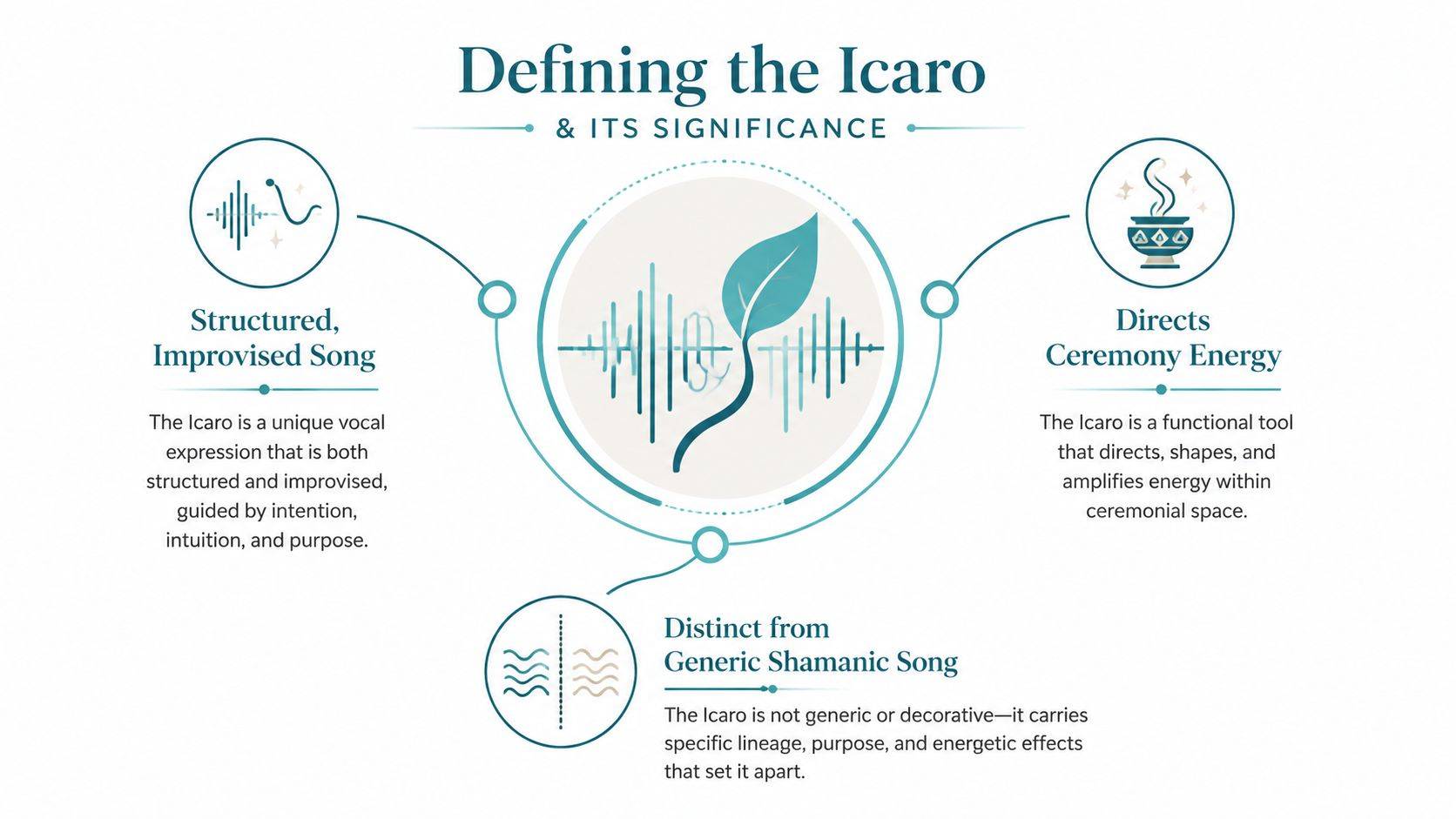
A useful working definition is simple. An icaro is a structured, often improvised song or chant used to direct an Ayahuasca ceremony, especially in vegetalismo and related Amazonian healing traditions. It is not just any indigenous song, and it is not a generic label for spiritual chanting. Precision matters because the word points to a specific ceremonial role.
The Vocabulary That Keeps The Category Clear
Several related terms help readers avoid confusion:
- Maestro: the trained healer or teacher who leads the ceremony and knows how to use song as part of intervention.
- Icarar: to sing or activate an icaro in ceremony, with the force of intention and technique.
- Soplar: to blow, often used in healing contexts connected to breath, smoke, or energetic cleansing.
- Mesa: the ceremonial setting or working arrangement in which ritual action is organized.
These terms matter because the icaro does different work depending on how the healer uses it. It may diagnose, protect, invite, soothe, or push the ceremony in a particular direction. A song used this way functions as a sonic technology, not as ornament.
The phrase also sits inside a broader tradition of healing or magical songs used in Ayahuasca ceremonies. Linguistic and ethnographic sources connect the word to Quechua and related Amazonian usage, with one common explanation tracing it to ikaray, meaning “to blow smoke over in order to heal,” while other scholarship links it to Kukama ikara meaning “song” Icaro overview and linguistic notes. The exact route is debated, but the practical meaning is stable, this is a healing song whose authority comes from training, lineage, and function.
One more point matters for safety. Using the word loosely can flatten major differences in intent and preparation. A casual chant borrowed from a ceremony is not automatically an icaro in the traditional sense, because the tradition includes apprenticeship, relation to plants, and a specific way of entering ceremonial work. That distinction protects both the reader and the tradition.
For a broader frame on mestizo healer traditions, see this guide to Amazonian vegetalismo and related lineages. For travelers trying to locate the cultural context, a see in Peru guide can help place the tradition in a wider regional context without replacing the tradition itself.
Origins Of Icaros In Amazonian Mestizo Shamanism
The history of the icaro is best read as living transmission, not as a single point of origin. The term appears across Amazonian mestizo shamanism, and linguistic scholarship connects it to Quechua and neighboring Amazonian usage, with some researchers emphasizing the verb ikaray and others the Kukama word for song Icaro overview and linguistic notes. That spread already says something useful, the tradition moved through contact zones, not sealed compartments.
Vegetalismo And The Academic Record
A key academic reference is Luis Eduardo Luna’s 1986 dissertation, Vegetalismo. It is widely treated as one of the first systematic records of this healing-song complex. That matters because it places icaro study in fieldwork and documented practice, not in folklore alone.
Traditionally, healers say their songs are received through dietas, extended periods of discipline, isolation, and apprenticeship with plant teachers. Different lineages describe that training in different ways, including mestizo vegetalista currents and families linked to Shipibo-Conibo ceremonial life. The point is not simple memorization. The healer learns how to carry a melody, when to use it, and what work it is meant to do. A song can pass from teacher to student and then change shape in a new healing relationship, which is why family lines and cross-river borrowing make any neat origin story too tidy.
Why Regional Context Matters
The repertoire is often associated with places such as Pucallpa, Iquitos, and the Upper Amazon, where healer traditions have moved between communities and lineages. That circulation helped shape the wider current of Amazonian mestizo practice, even when a song later becomes strongly linked with Shipibo-Conibo ceremonial life. The result is local, relational, and porous at the same time.
For readers who want the broader social frame, the guide to Amazonian vegetalismo and related mestizo lineages helps place these songs inside healer training, plant work, and ceremonial authority. A see in Peru guide can also situate the tradition regionally without replacing the tradition itself.
That complexity is why the term should not be reduced to “an Amazonian chant.” The song carries the imprint of the healer’s training, the plants involved, and the ceremonial setting in which it was learned. Outside that setting, the melody may still be beautiful, but beauty alone does not define the tradition.
How Icaros Function Across Four Ceremonial Stages
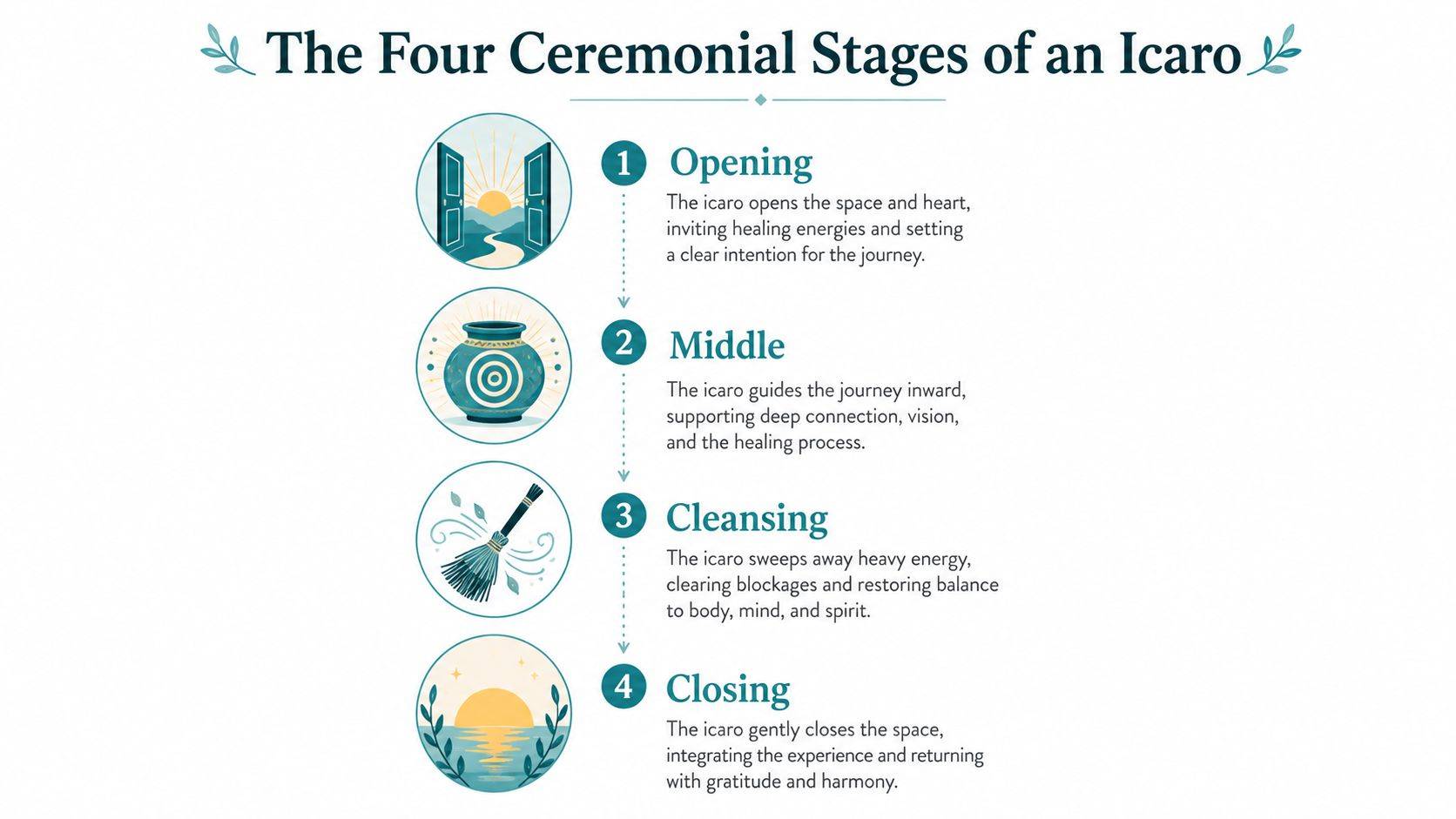
A useful way to listen is to hear the ceremony as a sequence of functions rather than a single long event. In one widely used model, the icaro operates across Opening, Middle, Cleansing, and Closing phases, each with a different purpose and sonic feel. That structure is a teaching scaffold, not a universal rule, but it helps the reader hear what is happening.
Opening And Middle
At the Opening stage, an Arcana Icaro is used to create a protective field and formally open sacred space. The melody tends to feel measured and contained, because the healer is setting the container before the work deepens. In the Middle, Navigational and Healing Icaros guide the group through visions, release, and difficult material. The contour often becomes more responsive, and the singer may move between Spanish, Shipibo, and plant names depending on lineage and context.
Cleansing And Closing
The Cleansing phase often uses a Limpieza Icaro, sometimes paired with a soplada, to remove blockages and clear what has surfaced. The sound can become more forceful or directive, because the ceremonial task has shifted from guidance to purification. By the Closing stage, a designated closing song grounds the energy and formally ends the container. The melody often feels steadier, with less exploratory movement and more return.
A compact way to hear the difference is this:
“Opening makes space. Middle guides. Cleansing clears. Closing brings the room back.”
Not every tradition arranges songs this way. Some mestizo vegetalista lineages organize the repertoire by plant teacher rather than ceremony phase, and some performers shift between functions fluidly. Still, the four-stage model gives readers a practical map for noticing how melody, pace, and intent change across the night.
What The Research Shows About Icaros And Altered States
A singer begins an icaro, and the room changes before anyone can explain why. The research base is still small, but it is no longer purely anecdotal. Clinical and phenomenological work from the Takiwasi context describes icaros as affecting participants’ emotional state during Ayahuasca sessions, helping them feel safer, process difficult memories, and experience a sense of unblocking or cleansing participant experiences of icaros at Takiwasi. The main point is careful, not inflated. Researchers are treating the song as an active ceremonial variable, not decorative sound.
What Has Been Observed
A study from Takiwasi reported intense healing with an icaro among 5.4% of 239 attendees, and among individuals the phenomenon was reported by about 23.9%, or roughly 1 in 4 participants Takiwasi study and 2024 academic source. That finding matters because it points to a repeatable ceremonial pattern, even if it does not yet explain the mechanism.
A 2024 academic source on participant experiences at the Takiwasi Center in Peru also keeps the discussion grounded in contemporary observation, not only oral tradition. The clinical picture is modest but consistent. People report stronger emotional regulation, a greater sense of safety, and moments that feel like cleansing or unblocking during the song.
| Observed Effect | Evidence Source | Status / Open Question |
|---|---|---|
| Emotional regulation and increased safety | Takiwasi qualitative work | Reported by participants, still based on small-scale observation |
| Unblocking or cleansing feelings | Takiwasi phenomenological reports | Suggestive, but not isolated from the broader ceremony |
| Intense healing with an icaro | Takiwasi study with 239 attendees | Documented, though not a randomized test |
| Presence during difficult visions | Clinical-phenomenological reporting | Promising, mechanism still unclear |
What Remains Unclear
The research does not isolate the icaro from Ayahuasca itself, and that limitation matters. These accounts rely heavily on self-report and retrospective description, so the central question remains open, whether the effect comes from the singer, the melody, the intent, the lineage, or the song working together with the altered state itself.
For readers who want the broader frame, this overview of non-ordinary states of consciousness helps place the reports in context. The honest conclusion is simple. The evidence points to meaningful ceremonial effects, but it does not yet explain them cleanly.
Learning, Recordings, And Working With Icaros Respectfully
A first encounter with an icaro often comes through a recording, a ceremony, or a teacher’s demonstration. That can help a student hear the shape of the song, but it can also create the wrong idea that the song can be moved into any setting without loss. In ceremonial practice, singing belongs to long training, usually through years of dieta and direct apprenticeship with a recognized healer Icaro overview and learning context.
What Can Be Learned From Recordings
Recordings are useful for study, reflection, and integration. They can help a participant remember the emotional contour of a ceremony, or notice how an opening song differs from a closing one.
They do not, by themselves, prepare someone to sing with ceremonial function. A recorded voice can preserve melody, but it cannot carry the full relationship between singer, lineage, intent, and setting.
How Authenticity Is Usually Signaled
A trustworthy learning context tends to show a few markers:
- Named teachers: the lineage is disclosed, not hidden behind vague spiritual branding.
- Dietas and apprenticeship: training is described as embodied and prolonged, not instant.
- Ceremonial purpose: the song is tied to healing practice, not sold as a generic ambient product.
- Lineage respect: the source community is acknowledged, especially when songs are shared outside the Amazon.
These markers matter because the value of an icaro does not sit in melody alone. A tune lifted from its setting can become decorative, while the same song in its proper frame functions as part of a real healing relationship.
The question of appropriation needs direct language. Sacred melodies used for personal branding, commercial packages, or detached performance can strip the song of the relational context that gives it meaning. Respectful engagement means giving credit, showing restraint, and recognizing that the icaro is a living tool, not a downloadable aesthetic.
“Keep the song inside its ethical frame. If the source line is unclear, the context is unclear, and the function is usually unclear too.”
For readers sorting reverence from misuse, this guide on cultural appropriation versus cultural appreciation offers a practical lens. A careful path usually includes listening without claiming, studying without extracting, and learning only in contexts where the lineage itself consents to the work.
Integrating Icaros And Continuing Your Learning
The question many carry home is simple. Now what? After the ceremony, the song often remains more vivid than the visuals, because sound can hold memory in a way that language doesn’t immediately capture. Passive listening can be comforting, but active integration asks for attention, context, and patience.
A Simple Integration Practice
A useful journal prompt is to sort remembered songs by function. Which one felt like opening, which one felt like healing, which one felt like cleansing, and which one felt like closing? That kind of note-taking helps the participant remember the structure of the night without turning the memory into mythology.
A serious study path often includes structured, culturally grounded learning. Some readers benefit from Takiwasi-style programs that place songs inside a treatment and apprenticeship framework. Others use culturally focused reading lists from the Chacruna Institute or learn through Shipibo-led pathways such as the Inkani Project. For a publication-based starting point, Ayahuasca.com also offers educational material on ceremony, preparation, and integration, which can be useful when read alongside indigenous and academic sources.
A Short Reading Path
- Luis Eduardo Luna, Vegetalismo: foundational academic framing of the healing-song complex.
- Furst’s evidence review: useful for readers who want a broader scholarly overview of ayahuasca research.
- Recent Takiwasi work: helpful for understanding how icaros appear in contemporary clinical-ethnographic observation.
- Indigenous-led learning resources: essential for keeping practice tied to lineage and context.
One honest boundary remains. The field still lacks broad, comparative evidence on how music functions in Ayahuasca healing, especially when researchers try to separate melody, singer, intent, and altered-state chemistry. That uncertainty is not a weakness to hide. It is the shape of the topic, and it is exactly why careful students keep listening.
If this guide helped clarify what an icaro is, the next step is to keep studying it in context. Read a lineage-based source, revisit the ceremony notes you already have, and choose one respected learning resource before treating any recording as practice.
Disclaimer: The information provided on Ayahuasca.com is for educational purposes only and is not intended as medical advice, diagnosis, or treatment. Ayahuasca is a powerful traditional Amazonian medicine and may not be suitable for everyone. Always consult with a qualified healthcare professional before making decisions related to health, mental well-being, medications, or the use of Ayahuasca.