
Three days after drinking Ayahuasca, a person may sit on a balcony with a notebook open, remembering a vivid image, a difficult emotion, or a sense of certainty that hasn’t yet found a place in ordinary life. The ceremony has ended, but the experience keeps unfolding through dreams, conversations, body sensations, and changing priorities. A person in that position may need witnessing and structure, not another interpretation.
An integration circle offers a small, facilitated setting for that work. It can help someone reflect on what happened, hear how others have dealt with similar questions, and identify grounded next steps. It also has clear limits. A circle can support reflection and connection, but it can’t replace medical assessment, crisis care, or appropriately trained individual therapy when symptoms become severe or prolonged.
What an Integration Circle Is
In a typical circle, four to fifteen people sit together, often in a ring. Each person speaks without interruption while the others listen. This arrangement, witnessing before interpreting, gives the group its particular purpose. An ICEERS’ analysis of psychedelic integration experiences describes integration as work that can include reflection, support, and making sense of what follows an altered-state experience.
The practical task is to narrate, witness, and contextualize what happened. A participant might describe a recurring image, connect a ceremony insight with a strained relationship, or notice that a new intention is difficult to carry into daily routines. Others can ask careful questions, reflect what they heard, and leave room for uncertainty. The facilitator keeps the discussion from becoming a contest over spiritual authority or a search for one official meaning.
What The Circle Does And Doesn’t Do
A circle has more structure than casual conversation. Friends may offer warmth, but they may not have shared agreements about turn-taking, disclosure, distress, or referrals. A sitter debrief usually concentrates on events during or shortly after a session. Integration circles give more attention to what continues afterward, including effects on choices, emotions, bodily experience, relationships, and meaning.
Individual therapy has a different frame. A therapist-led circle can bring clinical training and awareness of referral needs, while the group still centers on participants’ own meaning-making rather than a private treatment plan. Clinical-program descriptions place circles alongside, rather than inside, individual therapy, as described in this overview of integration circles.
That distinction creates a useful triage question. Ordinary reflection, shared uncertainty, and manageable emotional material may fit a circle. Persistent distress, trauma responses, or problems that interfere with daily life call for a therapist’s closer assessment. Severe confusion, dangerous behavior, major sleep disruption, or urgent safety concerns require clinical or crisis care. Recent integration research has made this sorting function increasingly important: a circle can offer witnessing and community, but it is not a diagnostic service.
When People Attend
Some participants come soon after a ceremony; others arrive weeks or months later. Timing depends on stability, the intensity of the experience, and its effect on ordinary functioning. Someone may bring a fresh emotional response to one meeting, then return later to examine whether a new practice is taking hold.
Group reflection works best alongside personal practices such as journaling, breathwork, walking, creative work, or somatic attention. An Ayahuasca integration guide can help a person build a steady rhythm between meetings. The circle provides a container and a place to be witnessed, not a guaranteed outcome.
Comparing The Main Integration Circle Formats
A peer-led online circle in Australia runs for 90 minutes with up to 12 people per session. A therapist-led in-person group may be smaller and can respond directly when someone becomes destabilized. These examples show why format choice belongs alongside a simple triage question: what can a circle hold, what needs a therapist, and what requires clinical care?
| Integration Circle Format | Facilitator | Avg Group Size | Best For | Main Limitation |
|---|---|---|---|---|
| Therapist-led in-person | Licensed or clinically trained professional | 4 to 10 | Emotionally charged material and clearer triage | Higher cost and less geographic flexibility |
| Peer-led in-person | Trained peer or integration specialist | 4 to 15 | Community connection and shared experience | Quality depends heavily on training and group maturity |
| Therapist-led online | Licensed or clinically trained professional | Up to 12 in some online models | Early integration, access across locations, and clinical oversight | Screen-based contact can limit nonverbal attunement |
| Peer-led online | Peer facilitator or grassroots group | Small-group format | Stable reflection and low-friction participation | Limited capacity for assessment and crisis response |
A therapist-led circle offers clearer boundaries around disclosure, can recognize signs that individual care is needed, and may make a more informed referral. Participants should still ask about the facilitator’s training, confidentiality practices, emergency procedures, and experience with psychedelic material. A professional title alone does not explain how the group handles risk.
Peer-led circles often reduce hierarchy and make shared experience easier to access. The Psychedelic Society describes groups governed by integration specialists or organized in a grassroots way by members, with participants taking turns listening and sharing through its description of psychedelic integration. That openness demands stronger group norms around consent, advice-giving, and crisis referral. The group must enforce those norms itself rather than relying on clinical oversight.
In-person meetings give facilitators more access to posture, breathing, silence, and visible emotional shifts. Online meetings reach people across locations and may be easier to attend when travel or leaving home feels difficult. One Australian service describes online circles lasting 90 minutes and accommodating up to 12 people per session (online integration circle details).
A useful matching rule is straightforward. Stable reflection can suit peer-led online work. Emotionally charged material generally calls for stronger facilitation and easier access to individual support. Severe confusion, dangerous behavior, major sleep disruption, or urgent safety concerns belong with clinical or crisis services rather than a circle. The circle is a place for shared reflection, not diagnosis or emergency treatment.
Anatomy Of A Safe And Effective Integration Circle
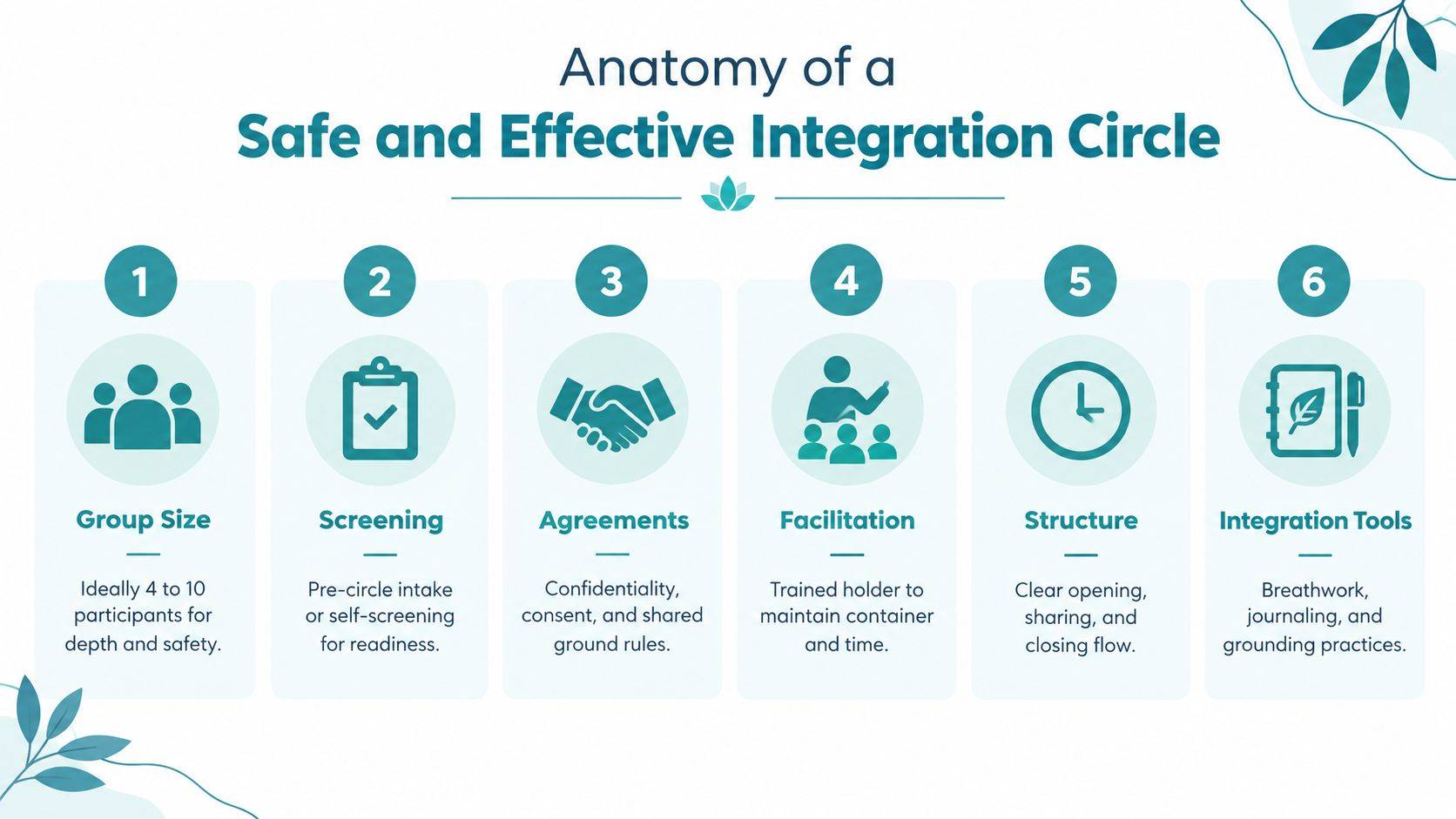
A safe circle has more structure than a group chat. Before attending, each participant should know who facilitates, who can join, what confidentiality means, how speaking time works, and what happens if someone becomes unsafe.
Start With Fit And Screening
A pre-circle intake or self-screening checklist helps participants assess readiness. It might ask whether the person can remain present during emotional material, follow group agreements, avoid intoxication during the meeting, and seek additional help if symptoms escalate. Screening isn’t a judgment about whether someone deserves support. It protects the group and directs people toward care that matches their needs.
A group of four to ten participants often allows enough variety without making each person’s turn too brief. Other groups may use a larger range, but capacity should be clear before registration. A Maryland peer circle, for example, explicitly limits participation to people who’ve already had psychedelic experiences, requires registration, and charges no fee (its participation details).
Make Agreements Visible
Written agreements should cover confidentiality, consent, speaking time, and the right to pass. Participants shouldn’t record meetings, post identifiable stories online, or contact another member privately without permission. A no-advice rule keeps one person from turning another’s vulnerable disclosure into a prescription.
Facilitators should also explain that participants can pause before sharing retraumatizing detail. The group can acknowledge a difficult experience without demanding a graphic account. Resources on faith-based discussion methods from HolyJot can offer useful ideas for respectful listening, structured participation, and values-aware dialogue, even when the circle itself isn’t faith-based.
Give The Facilitator A Real Job
The facilitator acts as timekeeper, witness, emotional barometer, and referrals holder. That means tracking speaking turns, noticing when the group is becoming agitated, protecting silence, and knowing how to direct someone toward individual or emergency support. Co-facilitation adds resilience because one person can stay with the group while the other responds to a participant who needs immediate attention.
Physical details matter. Chairs arranged in a circle, comfortable lighting, water, tissues, and an easy exit help participants regulate. Online groups need equivalent care, including a private room, stable connection, clear camera expectations, a chat protocol, and a backup contact method. Strong circles publish their format, agreements, and emergency plan so people can assess fit before joining.
Documented Benefits And Known Risks
Recent research presents integration groups as useful but conditional forms of support. A published cross-sectional online study included 65 psychedelic integration-group participants, while a separate longitudinal psilocybin trial reported that 86 participants, or 68% of the sample, attended an integration group at least once by 12 months (PubMed record for the integration-group research). Those findings show that group integration has entered formal research settings and has been used by a majority of participants in one modern care pathway. They don’t prove that every circle produces the same result.
A 2024 qualitative study identified three recurring domains, reasons for attending, utility, and adverse factors. Participants described community support and shared coping strategies as benefits, while poor group dynamics and inadequate facilitator training appeared as hazards (qualitative guide and study discussion).
| Outcome | Finding From Recent Evidence | Linked Design Element |
|---|---|---|
| Community connection | Participants report support and shared coping | Skilled listening and turn-taking |
| Meaning-making | Groups can help participants process experience and connection | Participant-led prompts without imposed interpretations |
| Greater distress | Poor dynamics can intensify discomfort | Screening, trained moderation, and permission to pass |
| Uneven effectiveness | Research still needs stronger evidence on outcomes | Clear scope, referral pathways, and follow-up |
The design determines whether a benefit remains supportive or becomes risky. A person who feels isolated may find relief in hearing others describe uncertainty without forcing a conclusion. The same person may feel pressured if members compete over spiritual insight, insist on one interpretation, or treat disclosure as proof of commitment.
Known risks include retraumatization, pressure to overshare, spiritual bypassing, and premature closure around material that needs individual therapy. Vulnerable participants may also experience serious destabilization, which is why facilitators must screen rather than assume that group belonging is sufficient. Safety guidance for Ayahuasca contexts, including health and safety considerations for Ayahuasca, should sit alongside the circle’s own emergency plan.
The central lesson is straightforward. Good intentions don’t create safety by themselves. Format, training, screening, and boundaries shape the outcome.
A Sample Agenda With Prompts You Can Use
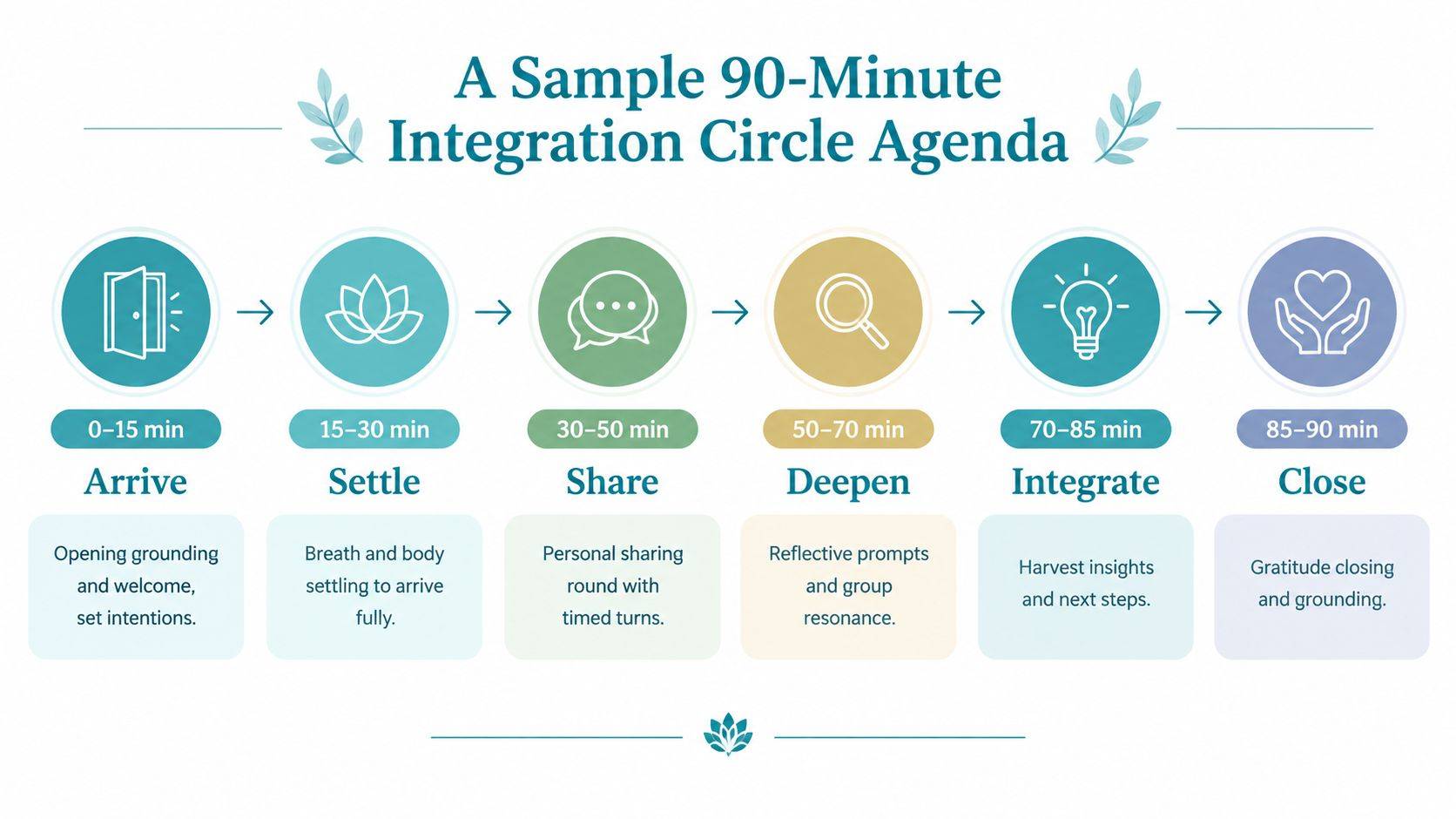
A 90-minute circle in Portland runs from 6:30 to 8:00 pm. The facilitator arrives 30 minutes early to arrange chairs, test the Zoom link, and post the emergency contact card. At 6:45, five participants join, two returning and three new. That practical preparation gives the gathering a clear container before anyone begins sharing.
The Opening Half
0 to 15 minutes, arrive and check in. The facilitator welcomes everyone, reviews confidentiality and the right to pass, then invites one sentence from each person: “What’s the main quality of the experience today, such as calm, confusion, grief, or curiosity?” Keep this round brief. If someone raises an immediate safety concern, speak with them privately rather than turning the group into an assessment room.
15 to 30 minutes, settle. A short breath or body-awareness practice helps participants arrive. The facilitator might say, “Notice the support beneath the body. Let the breath find its own pace. No interpretation is needed right now.” Online, participants can place water nearby and silence notifications. These small details reduce interruptions and give people a physical reference point.
30 to 50 minutes, share. Give each person a timed turn. The prompts should invite observation rather than prescribe meaning:
- Vivid detail: “What image or feeling from ceremony is still vivid?”
- Attention: “What part of yourself is asking for attention?”
- Daily life: “Where does this experience meet an ordinary decision or relationship?”
Offer a gentle time cue, then leave a few seconds of silence before moving on. Silence does not need to be solved.
The Deepening And Close
50 to 70 minutes, deepen. Use pairs or small groups only if the setting supports privacy and clear boundaries. One person speaks while the listener reflects a phrase without analysis. The listener can ask, “What would feeling understood sound like right now?” For groups discussing recovery-related concerns, substance abuse group therapy topics can suggest prompts about boundaries, triggers, accountability, and support. Adapt those topics to psychedelic integration rather than treating them as a clinical treatment plan.
70 to 85 minutes, integrate. Return to the full circle and ask, “What’s one small action this week?” Suitable actions include writing for ten minutes, planning a conversation, taking a walk, or scheduling professional support. Keep the choice modest and voluntary. A circle can help someone name a next action, while a therapist or clinician may be needed when the concern exceeds peer support.
85 to 90 minutes, close. Each participant names one thing they are taking forward and completes a grounding action. Do not cut the closing to make room for late discussion. In-person groups can stand, stretch, or share water. Online groups can keep cameras on for the final grounding, confirm a safe transition, and provide the follow-up contact or emergency information listed in the agreements.
When A Circle Is Not Enough
A circle suits meaning-making, relational insight, integration practices, and emotional processing that stays within a participant’s window of tolerance. That window describes the range in which a person can feel emotion while remaining oriented to the present, able to choose whether to speak, and capable of returning to basic steadiness.
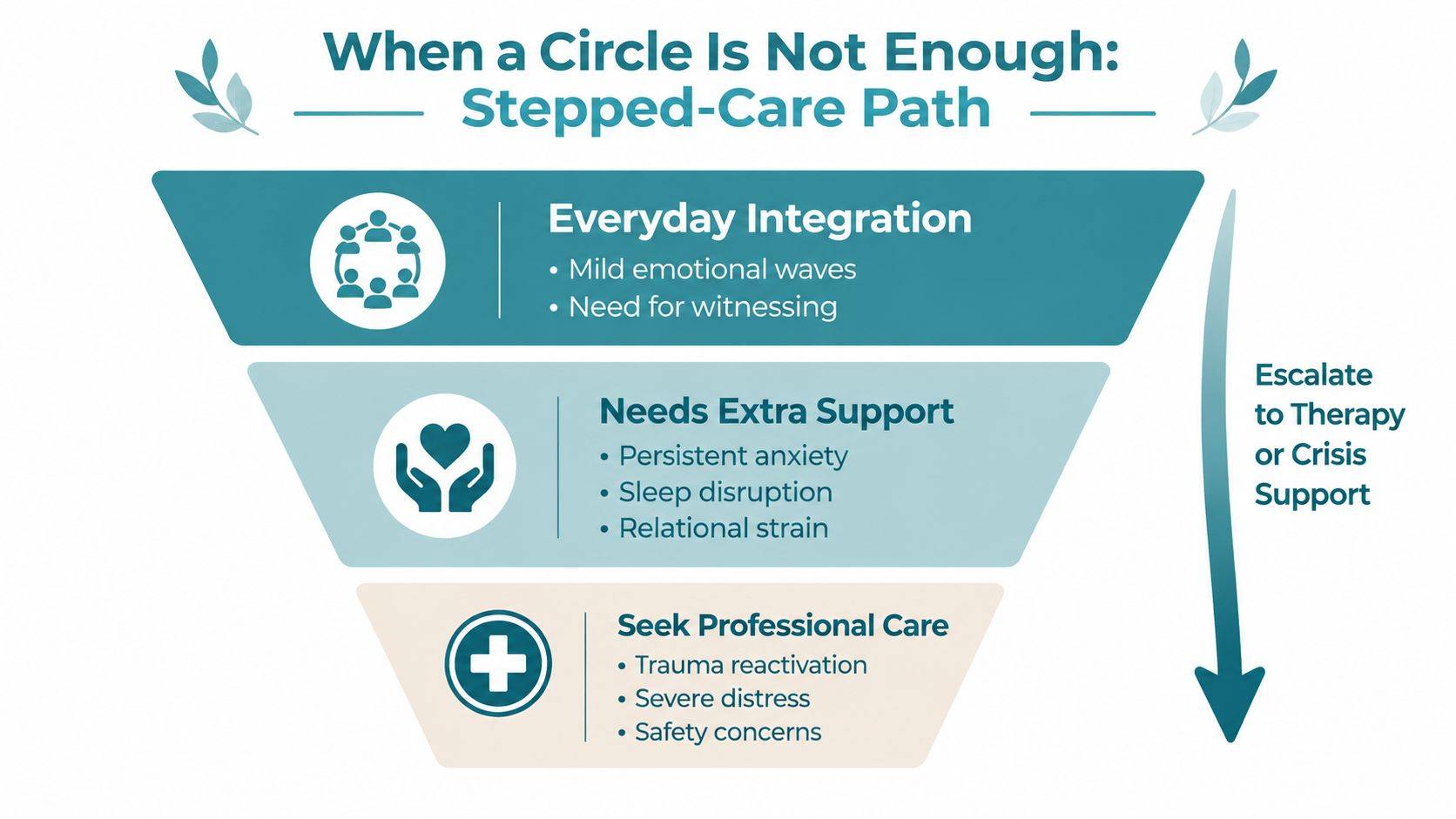
A circle needs another level of support when distress persists, intensifies, or interferes with safety and daily functioning. A 2025 practitioner-perspectives study on extended difficulties identified individual psychotherapy, grounding and mindfulness, peer or community support, meaning-making, and sometimes short-term psychiatric medication among the most frequently recommended supports (research on extended psychedelic difficulties). That range makes clear that integration may require stepped care, not group sharing alone.
A Practical Triage Ladder
- Peer circle: Appropriate for stable reflection, mild emotional waves, ordinary uncertainty, and a desire for witnessing.
- Individual integration therapist: Appropriate when anxiety, sleep disruption, recurring fear, or relationship strain continues and needs private attention.
- Trauma-trained clinician: Appropriate when old trauma floods the person, dissociation makes the present hard to track, or emotional activation repeatedly exceeds the person’s coping capacity.
- Psychiatric or medical assessment: Appropriate for psychotic features, severe confusion, persistent suicidal thoughts, ongoing substance withdrawal, serious inability to care for basic needs, or other urgent safety concerns.
A facilitator shouldn’t diagnose or promise that a person will stabilize through attendance. The role is to identify concern, pause participation when necessary, contact the agreed support person or emergency resource, and make a warm referral within the facilitator’s competence.
“A useful hand-off sounds specific: “The group can’t provide the level of support this situation needs. The next step is an individual appointment with a qualified clinician today. The facilitator can help identify an appropriate service and stay connected while the appointment is arranged.””
For immediate danger, a person should contact local emergency services or a crisis service in their country rather than wait for the next circle. A facilitator can say, “Safety takes priority over finishing this conversation. The participant won’t be left to manage this alone, and urgent support is being contacted now.”
Confidentiality, Cultural Care, And Legal Realities
Responsible integration rests on three protections: confidentiality, cultural humility, and legal awareness. None can be added casually after a difficult event. Each should shape the group before participants enter.
Confidentiality With Clear Limits
A written agreement should state that personal stories stay inside the group, names and identifying details aren’t shared on social media, and no one records or takes notes about another participant without explicit consent. Participants should also know what happens if someone expresses an intention to harm themselves or another person. Confidentiality has limits when immediate safety is at risk, and the facilitator should explain those limits in plain language before the first disclosure.
Online groups need extra care. Participants should join from a private space, use headphones when appropriate, and avoid inviting an unseen listener into the room. The organizer should explain how chat messages, attendance information, and follow-up communication are handled.
Cultural Respect Beyond Vocabulary
Ayahuasca carries living Indigenous histories and traditions. A responsible circle acknowledges those origins, avoids treating sacred practices as interchangeable wellness products, and makes room for Native or mestizo perspectives when the context calls for them. Language such as “shamanic healing” can flatten distinct traditions when used as a generic label.
Facilitators can consult guidance on cultural appropriation and cultural appreciation before designing rituals, promotional language, or educational material. Reciprocity should mean more than symbolic acknowledgment. It should influence whose knowledge is credited, how traditions are represented, and whether the group avoids claims of authority it hasn’t earned.
Law, Scope, And Responsible Vetting
Legal rules vary by country and can change. Ayahuasca’s legal status in the United States differs across contexts, including religious-use arrangements associated with specific traditions, while other jurisdictions apply their own rules to possession, ceremony, facilitation, and travel. Retreat travel also carries legal and practical risks that participants should investigate before departure. A facilitator shouldn’t present legal information as universal or encourage participants to ignore local law.
Vetting should include questions about training, supervision, screening, emergency procedures, confidentiality, cultural grounding, and referral relationships. Participants can also look for qualified mental-health professionals familiar with psychedelic experiences, while remembering that a directory listing alone doesn’t establish competence.
Ayahuasca.com may serve as one educational resource for preparation, integration, safety, and cultural context. When a person needs urgent help, peer support should give way to local crisis services, emergency care, or a qualified clinician who can assess the situation directly.
Choose an integration circle with the same care used to choose any support relationship. Before registering, ask how participants are screened, what happens during a crisis, who facilitates, how confidentiality works, and when the group refers people elsewhere. If the experience feels stable, a well-structured circle can provide meaningful witnessing. If distress is persistent or safety is uncertain, contact a qualified therapist, clinician, crisis service, or emergency provider before attending the next meeting.
Disclaimer: The information provided on Ayahuasca.com is for educational purposes only and is not intended as medical advice, diagnosis, or treatment. Ayahuasca is a powerful traditional Amazonian medicine and may not be suitable for everyone. Always consult with a qualified healthcare professional before making decisions related to health, mental well-being, medications, or the use of Ayahuasca.