
A reader may arrive at San Pedro plant medicine after hearing two very different stories. One account describes Huachuma, a revered Andean cactus associated with clarity, connection, and an open-air ceremony. Another reduces it to “natural mescaline,” as if a plant’s appearance could reveal its strength or its legal status. Both views leave important questions unanswered.
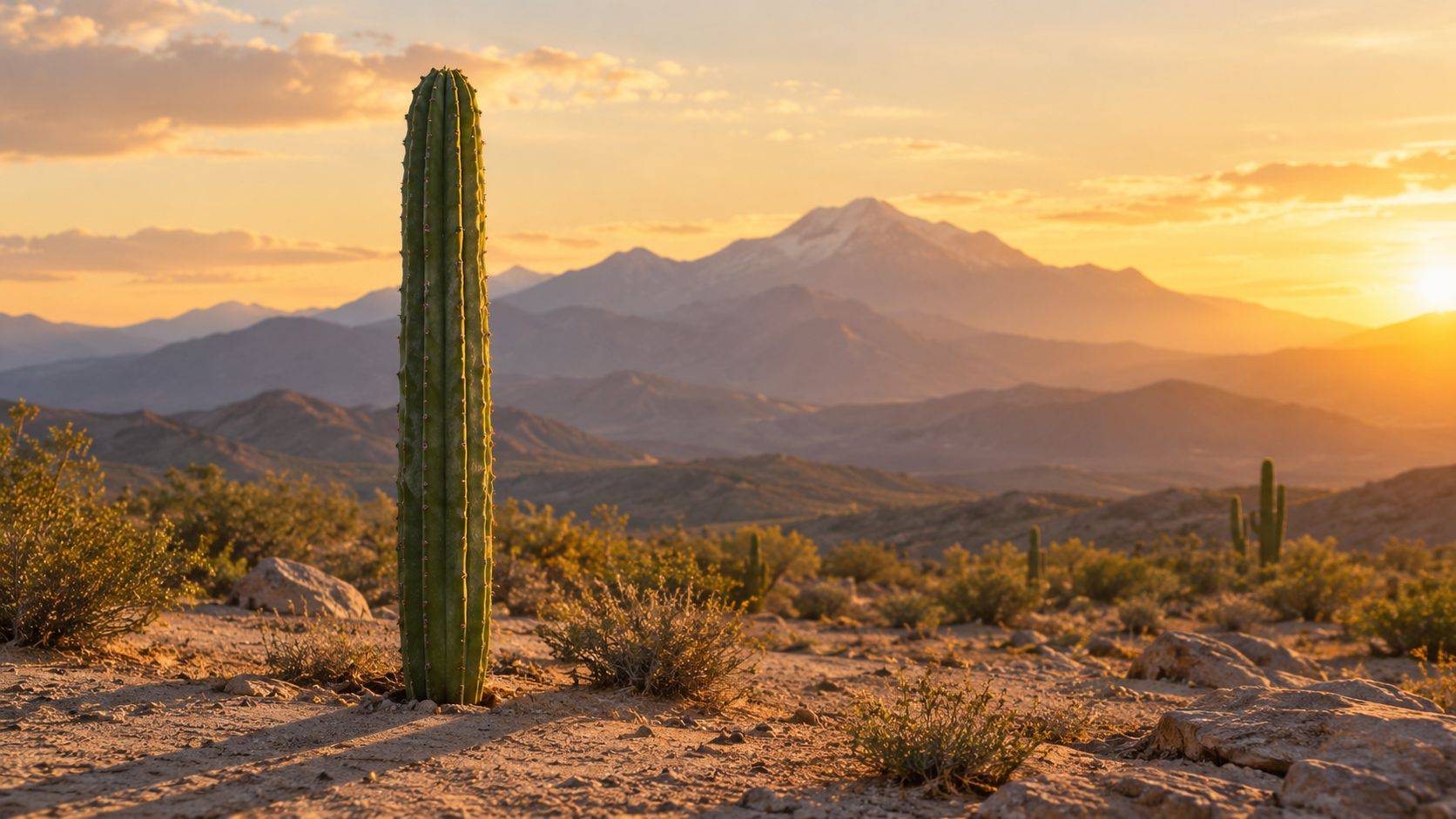
San Pedro, also called Huachuma or Wachuma, is Echinopsis pachanoi, a columnar cactus whose principal psychoactive alkaloid is mescaline. Its story reaches from ancient Andean religious systems into modern retreat culture, but the modern conversation needs more than romantic language. It needs historical respect, scientific accuracy, careful preparation, medical screening, and a clear distinction between a living cactus and a prepared substance intended for human consumption.
A responsible journey begins before a ceremony and continues after it. Preparation includes clarifying motivation, reviewing health considerations, checking the facilitator’s practices, and understanding local law. The ceremony itself depends on setting, support, and the person’s physical and emotional condition. Integration gives the experience a place in ordinary life through reflection, community, professional support, and grounded daily choices.
Introduction to San Pedro Plant Medicine
A Sacred Cactus With A Modern Audience
People often compare San Pedro with Ayahuasca because both are described as sacred plant medicines and both appear in contemporary healing and spiritual communities. Their traditions, chemistry, settings, and subjective effects differ, however. San Pedro contains mescaline, while Ayahuasca is generally associated with a different group of plant compounds and ceremonial practices.
The name matters. Huachuma and Wachuma connect the cactus to Andean cultural contexts, while “San Pedro” reflects a name used through later historical and colonial settings. Treating every ceremony as interchangeable strips away the relationships, songs, places, lineages, and responsibilities that give plant medicine traditions their meaning.
A curious reader may be seeking emotional clarity, a deeper relationship with nature, spiritual insight, or a way to examine a difficult life transition. Those motivations can be sincere without guaranteeing a particular outcome. San Pedro may become meaningful for one person and confusing, physically demanding, or emotionally challenging for another.
“A grounded intention: Curiosity can open the door, but preparation determines whether the person has a safe way to walk through it.”
The Three Phases Of A Responsible Journey
Preparation starts with honest questions. What is drawing the person toward Huachuma? Does the person have a history of serious mental or physical health concerns? Are prescription medicines involved? Has a qualified medical professional reviewed the relevant risks? A facilitator who avoids these questions creates a serious warning sign.
Ceremony involves more than consuming a cactus preparation. The setting, supervision, group boundaries, emergency planning, cultural respect, and freedom to pause or ask for help all matter. A responsible container doesn’t promise a beautiful experience. It provides practical support if the experience becomes physically or psychologically difficult.
Integration turns an unusual experience into considered action. Journaling, time in nature, therapy with a qualified practitioner, peer support, and changes to daily routines can help a person examine what belongs in ordinary life. Dramatic interpretations made immediately after a ceremony deserve time and scrutiny rather than instant commitment.
The central lesson is simple: San Pedro should be approached as a powerful traditional medicine with variable chemistry, not as a predictable wellness product. Its ancient lineage deserves respect, and modern science adds a reason for caution. The plant can be sacred within its cultural context and pharmacologically active in ways that require careful attention.
Ancient History And Indigenous Roots Of Huachuma
A Timeline Measured In Millennia
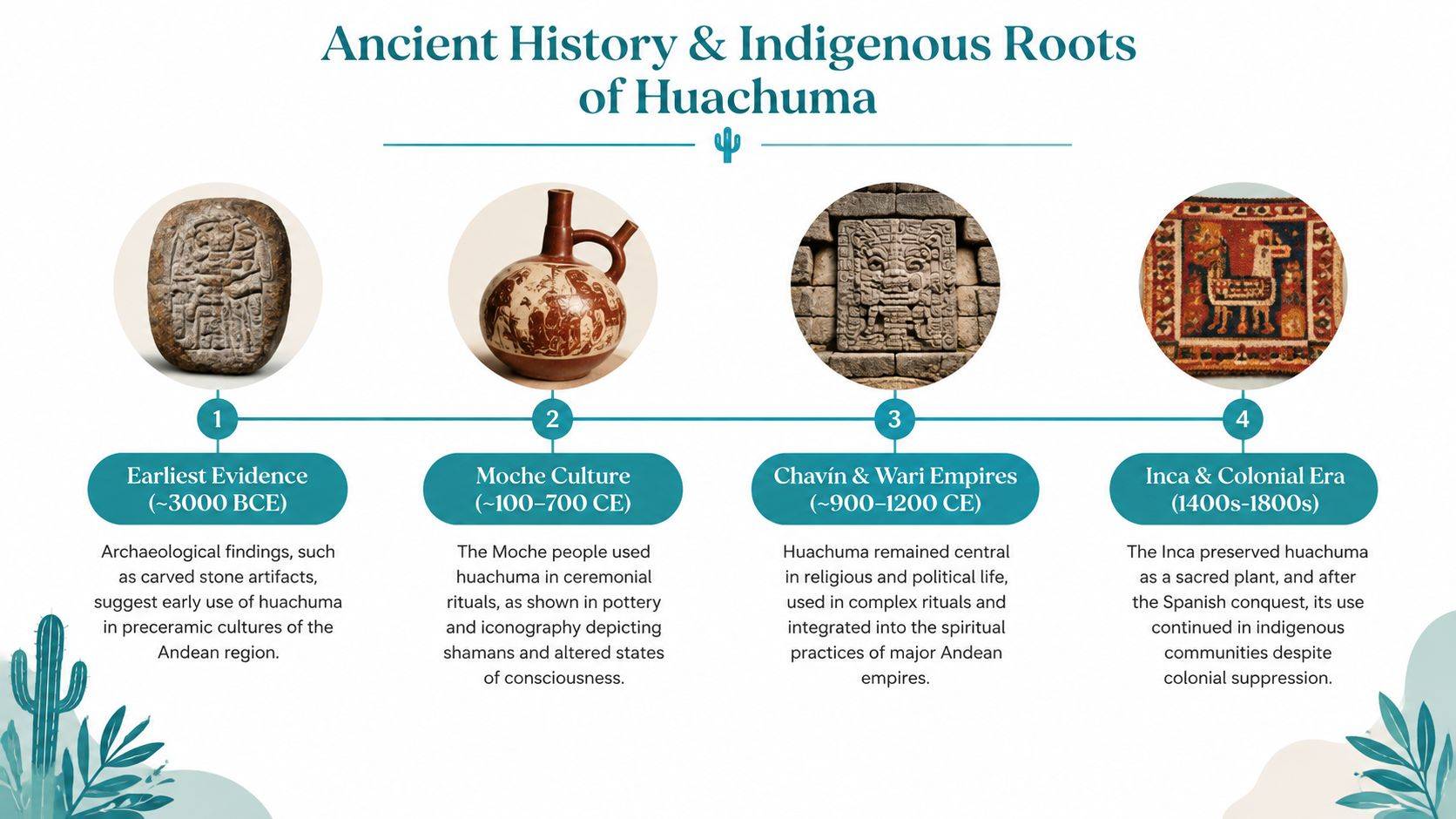
San Pedro has one of the longest documented ceremonial histories among Andean entheogens. Archaeological evidence places its use in northern Peru across several pre-Columbian cultures, including Cupisnique around 1500 BCE, Chavín around 1000 BCE, Moche from about 100 to 750 CE, and Lambayeque from about 750 to 1350 CE. These dates are summarized in a historical synthesis indexed by PubMed’s record on San Pedro cactus use.
A separate synthesis reports even earlier material evidence from Peru. Cactus remains from Guitarrero cave have been dated to roughly 6800 to 6200 BCE, while other archaeological contexts suggest ritual use extending beyond 3,000 years. The evidence doesn’t prove that every ancient cactus fragment served the same purpose, but it does establish a long relationship between Andean communities and this plant.
From Archaeological Object To Living Tradition
The Cupisnique, Chavín, Moche, and Lambayeque cultures weren’t isolated groups using a plant casually. San Pedro appears within a wider Andean religious context that included monumental architecture, ritual objects, animal symbolism, and specialist roles. Its presence in that setting suggests a sacramental relationship, where the cactus participated in systems of healing, divination, social meaning, and communication with the sacred.
That context changes how modern readers should interpret the word “medicine.” In contemporary English, medicine often means a standardized product administered according to a clinical protocol. In Andean ceremonial settings, plant medicine can refer to a relationship involving land, community, ritual authority, prayer, song, ethics, and inherited knowledge. The words overlap, but they don’t describe identical systems.
The cactus also belongs to a broader botanical world shaped by South American climates and terrains. Readers who want a general orientation to regional plant diversity can explore this overview of cacti native to South America, while keeping in mind that botanical identification alone doesn’t explain ceremonial meaning or pharmacological strength.
Why Lineage Matters Today
Historical continuity doesn’t automatically validate every modern retreat or every claim made about San Pedro. A contemporary facilitator can’t borrow legitimacy from ancient cultures by using the word Huachuma. Responsible practice requires transparency about training, cultural relationships, consent, money, participant welfare, and the limits of personal expertise.
The long record does establish something important. San Pedro wasn’t a marginal folk remedy that suddenly became fashionable. It was embedded in major Andean religious systems for millennia, and that history deserves more than a decorative reference in a retreat brochure.
Modern participants can honor that lineage by learning the names and contexts connected with the plant, avoiding exaggerated claims, and asking how a ceremony relates to the traditions it invokes. Respect also means recognizing that indigenous knowledge isn’t an unlimited resource for commercial adaptation. A ceremony can be personally meaningful while still requiring humility about cultural ownership and historical complexity.
How San Pedro Works Chemistry Effects And Duration
Mescaline And The Serotonin System
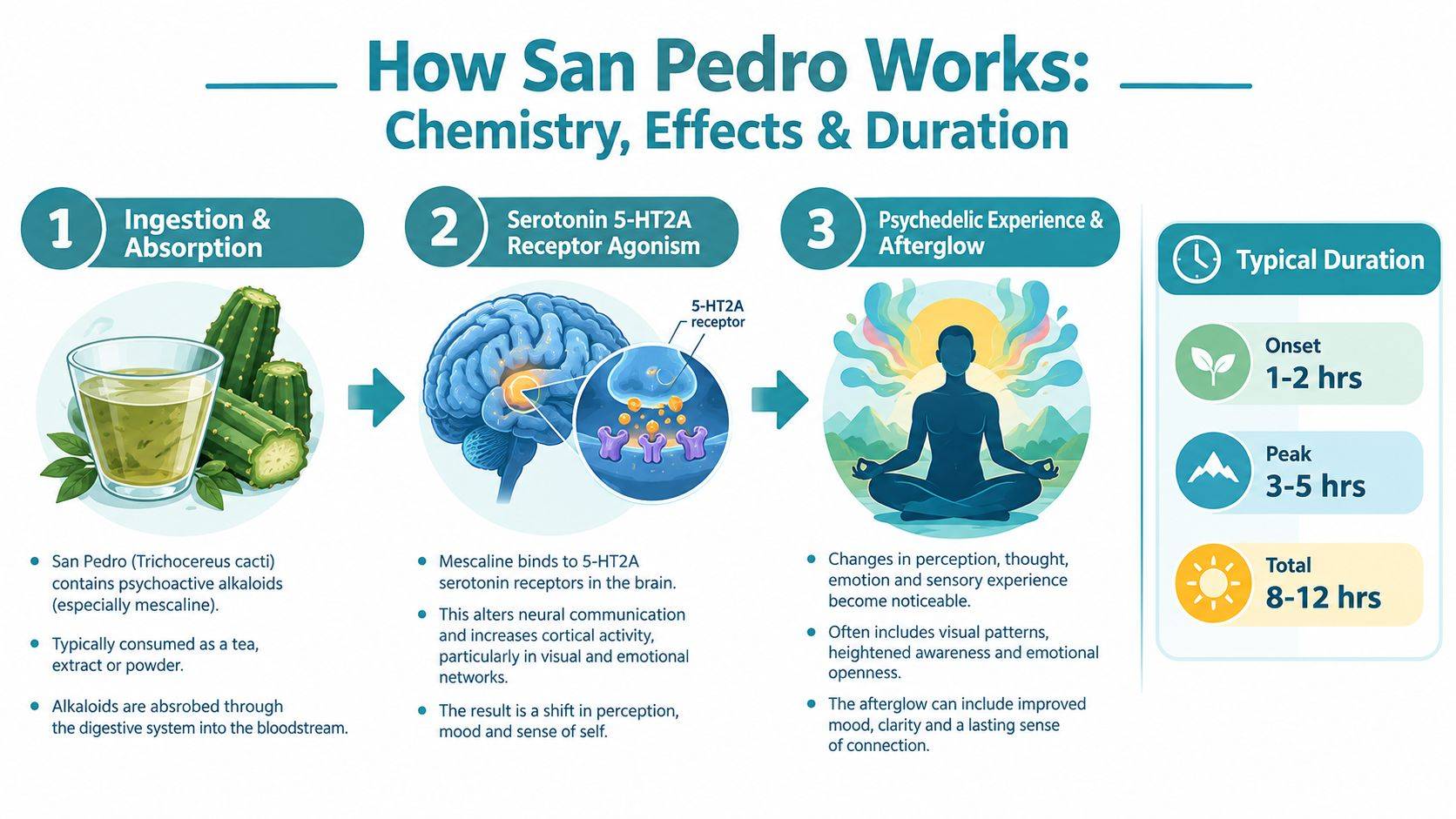
San Pedro’s principal psychoactive alkaloid is mescaline. It acts mainly as an agonist at serotonin 5-HT2A receptors, helping explain changes in perception, cognition, emotion, and sensory meaning. The interaction resembles a key meeting a lock, although the biology is more complicated. These receptor sites help regulate how the brain handles incoming information and internal signals.
The effects are not limited to visual changes. A person may notice shifts in emotional salience, attention, body awareness, and the perceived meaning of thoughts or surroundings. Ceremony and setting influence how these sensations are interpreted, while the underlying pharmacology remains active.
For a focused explanation of mescaline in relation to sacred medicines, this mescaline resource provides useful context. It complements careful screening and medical advice rather than replacing either one.
Why The Timeline Feels Slow
References describe oral mescaline as having a delayed onset of roughly 0.5 to 1.5 hours, peak effects around 2 to 4 hours, and a total duration of about 6 to 14 hours (mescaline pharmacology overview). Someone who feels little shortly after drinking may assume the preparation is weak and take more. Slow absorption can then produce an unexpectedly intense or prolonged experience.
This timing shapes ceremony planning. A facilitator needs to remain available after the first signs of altered perception. Participants also need a setting where nobody pressures them to leave, drive, make major decisions, or manage responsibilities while still affected.
Clinical references summarized in the same overview often cite an active oral dose range of 150 to 700 milligrams, threshold effects near 100 milligrams, and customary dosing around 3.75 milligrams per kilogram. These figures describe oral mescaline, not a dependable conversion for homemade San Pedro. A cactus brew is not a standardized pharmaceutical. Its plant material, preparation, and final concentration may be unknown, so exact dosing cannot be inferred safely from a recipe or visual estimate.
Potency Can Change Dramatically
Chemical analyses found mescaline concentrations from roughly 0.053% to 4.7% of dry weight across 14 taxa and cultivars, a range of roughly two orders of magnitude (comparative San Pedro chemical analysis). Echinopsis pachanoi from Peru is repeatedly associated with documented shamanic use, suggesting that traditional selection may have considered psychoactive strength as well as appearance.
A 2023 Frontiers in Plant Science study reported mescaline values from 0.14 ± 0.01 micrograms per milligram to 102.6 ± 3.49 micrograms per milligram. Crown tissue contained significantly more mescaline than subterranean stem tissue, with P<0.05 (Frontiers study on mescaline distribution).
Plant height, thickness, age, and visual similarity therefore cannot provide a dependable potency estimate. San Pedro’s long Andean lineage does not make every preparation predictable. Preparation method, cautious dosing, health screening, and experienced facilitation matter because the plant and the resulting medicine are not the same legal or pharmacological category.
San Pedro Compared To Ayahuasca And Peyote
A participant choosing among San Pedro, Ayahuasca, and peyote is comparing more than three psychedelic experiences. Each medicine carries distinct active compounds, Andean or Indigenous histories, ecological concerns, and ceremonial forms. San Pedro’s millennia-long Andean lineage deserves respect, while its highly variable mescaline content makes preparation and dose caution especially important. The table provides orientation, not a forecast for any individual.
| Medicine | Active Compound | Typical Duration | Experience Character | Sustainability Note |
|---|---|---|---|---|
| San Pedro | Mescaline | Oral mescaline effects may begin after roughly 0.5 to 1.5 hours, peak around 2 to 4 hours, and last about 6 to 14 hours | Ceremonial accounts often describe a grounded, embodied, emotionally open experience connected with the daytime environment, though responses vary | Cultivation and responsible sourcing matter when demand separates the plant from Andean cultural stewardship |
| Ayahuasca | DMT combined with other plant constituents in traditional preparations | Duration varies by preparation and person | Often associated with inward attention, symbolic imagery, emotional confrontation, and songs or ritual guidance | Ethical sourcing, cultural respect, and responsible retreat practices matter |
| Peyote | Mescaline | Oral mescaline references offer a broad guide, but duration varies by preparation and person | May involve altered perception, spiritual focus, bodily sensations, and strong cultural meaning | Conservation concerns are significant, and Indigenous relationships with peyote should guide ethical decisions |
Duration is only one part of the comparison. San Pedro’s plant material can differ greatly in mescaline concentration, so a general mescaline timeline cannot turn an unknown preparation into a predictable one. The plant, the extracted or cooked preparation, and the final dose should be considered separately. Their legal treatment may also differ by jurisdiction.
Choosing By Intention And Context
Someone seeking a grounded, nature-oriented setting may feel drawn to San Pedro. Someone looking for a more inward ceremony may investigate Ayahuasca. These are tendencies, not guarantees. Setting, facilitation, health, expectations, and preparation can change how any medicine feels.
Peyote calls for particular care because it is connected to Indigenous ceremonial life and conservation concerns. Ask where the preparation comes from, whether the provider recognizes Indigenous stewardship, and whether the ceremony supports conservation. A threatened tradition should not be treated as a lifestyle accessory.
Interest in one psychedelic should not replace appropriate mental health care. Readers exploring psychedelic approaches in a broader recovery context may find psilocybin therapy for addiction recovery useful as general education. Psilocybin and mescaline are different compounds, and their settings, risks, and legal conditions require separate consideration.
For a focused discussion of peyote’s cultural and ceremonial context, this guide to peyote offers a useful comparison point. The practical question is not which medicine sounds strongest. It is which tradition, preparation, legal environment, support system, and personal health context can be approached with integrity and care.
Ceremony Preparation And Integration Practices
Before The Ceremony
Preparation begins with motivation rather than a menu of dietary rules. A participant can write a short intention such as “understand a recurring pattern” or “make space for grief,” while holding that intention lightly. The purpose is to create orientation, not to demand a specific revelation.
A qualified facilitator should discuss health history, current medicines, mental health history, emergency procedures, physical location, group boundaries, and aftercare. The participant should know who remains sober and available, how support is requested, and what happens if someone wants to stop participating.
A traditional dieta may carry cultural meaning, but modern participants shouldn’t copy restrictive practices without understanding their purpose or medical implications. Sensible preparation generally favors rest, ordinary hydration, light and familiar food when appropriate, avoidance of intoxicants, and enough time to arrive without rushing.
“Preparation checkpoint: A facilitator who treats screening as an obstacle rather than a duty shouldn’t receive a participant’s trust.”
During The Ceremony
San Pedro ceremonies vary widely. Some take place outdoors during daylight, while others use a more enclosed setting. Music, prayer, chanting, fire, silence, movement, and personal attention may all appear, depending on the lineage and the facilitator.
A safe ceremony gives participants room to experience the medicine without coercion. No one should be pressured to disclose private material, accept unwanted touch, continue an activity, or interpret an experience in a particular spiritual way. Clear consent applies throughout the event, including moments when a participant may be emotionally open or physically impaired.
Facilitators should also recognize the delayed timeline described earlier. Early calm doesn’t prove that the experience has reached its strongest point, and early discomfort doesn’t necessarily predict the full course. Participants need supervision, access to water and basic physical care, and a plan for contacting emergency services if serious symptoms occur.
After The Ceremony
Integration is where reflection becomes practical. A participant may record sensations, emotions, memories, questions, and decisions, then revisit those notes after the immediate intensity has settled. A therapist or integration practitioner can help distinguish a useful insight from an impulsive conclusion.
Helpful practices can be simple:
- Journal with specificity: Record what happened, what meaning was assigned to it, and what evidence supports that interpretation.
- Return gradually to routine: Sleep, nourishing meals, gentle movement, and ordinary responsibilities can reestablish stability.
- Use creative expression: Drawing, music, or poetry may communicate feelings that are difficult to summarize.
- Seek trusted company: A respectful support group or grounded friend can reduce isolation without turning every detail into a spiritual explanation.
- Watch for persistent distress: Ongoing panic, severe sleep disruption, confusion, or thoughts of self-harm require prompt professional support.
Integration shouldn’t become a demand to preserve a peak experience forever. The more durable measure is whether the person develops clearer boundaries, kinder self-understanding, healthier choices, or a more honest relationship with everyday life.
Safety Contraindications And Legal Considerations
Why Standardization Is Difficult
A San Pedro cactus may look like one familiar product, yet its chemistry can vary considerably. Earlier comparisons found a wide range of mescaline concentrations, while plant-tissue research also identified differences between the crown and subterranean stem. Plant size, appearance, or a vendor’s description therefore cannot reliably predict intensity.
The preparation adds another layer of uncertainty. Cutting, drying, cooking, and combining different parts can produce a brew whose strength is difficult to judge by sight. Oral mescaline may also take time to appear and remain active for many hours. Adding more because the first effects seem mild can turn a cautious beginning into an unexpectedly strong experience.
Medical screening belongs before participation, not after symptoms appear. Anyone with cardiovascular concerns, a history of psychosis or mania, severe anxiety, uncontrolled medical conditions, pregnancy, or possible medication interactions should seek individualized advice from a qualified clinician. Eligibility depends on the person, the preparation, and the local legal setting. A general online checklist cannot make that decision safely.
Medicines And Emergency Planning
A participant should disclose every prescription medicine, over-the-counter product, supplement, and recreational substance to both a clinician and the facilitator. Prescribed treatment should not be stopped independently for a ceremony. A clinician can assess possible interactions and advise on any change.
Facilitators should state which physical and psychological symptoms require urgent medical help. Severe chest pain, difficulty breathing, loss of consciousness, dangerous agitation, extreme confusion, or thoughts of self-harm require emergency services, not spiritual interpretation. The retreat should have a clear method for contacting help, identifying the participant, and handing over relevant information.
“Medical rule: No ceremonial promise outweighs a qualified review of a participant’s health and medicines.”
Plant Versus Preparation In Law
Legal questions become more difficult across borders because the cactus, mescaline, and a prepared drink may be treated differently. In some places, the plant itself may be unscheduled or tolerated in traditional or cultural use, while mescaline and preparations made for human consumption remain controlled. Peru illustrates the distinction described in ICEERS’ San Pedro legal information. The legal status of traditional use does not automatically establish permission to brew, sell, transport, or consume a preparation.
Ask these questions separately:
- Can a person buy the cactus?
- Can the person transport it domestically?
- Can the person cross a border with it?
- Can the person brew it?
- Can the person possess a preparation intended for ingestion?
- Can the person legally consume it at a retreat?
- What laws apply in the person’s home country after return?
Customs rules, controlled-substance laws, religious exemptions, and enforcement practices can differ. Travelers should obtain current guidance from qualified legal professionals and official authorities. A retreat advertisement or an informal statement that “the plant is legal” cannot settle the status of a particular preparation. The safest approach is to verify each step, from the living cactus to the drink and its intended use.
Finding A Safe Retreat And Continuing Your Journey
Before booking, ask how a retreat protects participants before, during, and after ceremony. A credible center should explain its medical screening, facilitator training, emergency response, consent policies, group boundaries, accommodation, sober support, cultural relationships, and integration process before accepting payment.
The practical details matter more than mystical promises. Facilitators should answer difficult questions directly, describe what the ceremony includes, identify what the preparation contains, and respect a participant’s choice to decline. Pressure, guaranteed healing claims, or dismissal of medical and legal concerns are clear reasons to leave.
Use this guide to a safe and transformative plant medicine retreat as one planning resource, then check its suggestions against independent medical and legal advice. Ayahuasca.com also offers educational material on sacred medicines and retreat preparation, which can help organize questions before contacting a center.
Integration can continue outside a retreat community. Quiet observation, time outdoors, and other non-drug practices may support reflection. Refresh Psychiatry & Therapy on forest bathing describes one low-pressure, nature-based practice that may fit into a broader routine.
San Pedro calls for several ideas to be held together. The cactus has a long Andean lineage, while mescaline can produce extended pharmacological effects. Potency may differ sharply between specimens and tissues, so preparation and dosing require more caution than generic psychedelic advice suggests. Legal rules may also distinguish the living plant from a prepared drink.
Start with questions, not a purchase. Discuss health and medicines with a qualified clinician, verify destination and home-country laws, ask facilitators about safety and lineage, and arrange integration support before the ceremony. Choose a setting that protects dignity, informed consent, and physical safety, without promising a particular outcome.
Write a checklist covering medical clearance, preparation contents, facilitator credentials, consent standards, emergency procedures, legal status, transportation, and post-ceremony support. Share it with the retreat. Vague, coercive, or dismissive answers are reasons to walk away.
Disclaimer: The information provided on Ayahuasca.com is for educational purposes only and is not intended as medical advice, diagnosis, or treatment. Ayahuasca is a powerful traditional Amazonian medicine and may not be suitable for everyone. Always consult with a qualified healthcare professional before making decisions related to health, mental well-being, medications, or the use of Ayahuasca.