
So, what exactly is an ayahuasca retreat? At its heart, it’s a structured program, usually lasting several days, where you take part in a series of guided ceremonies involving the sacred psychedelic brew, ayahuasca. But it’s so much more than that. Think of it as a dedicated space—a supportive, safe, and intentional environment—built specifically for deep psychological and spiritual work with the guidance of seasoned facilitators or shamans.
Unpacking the Ayahuasca Retreat Experience
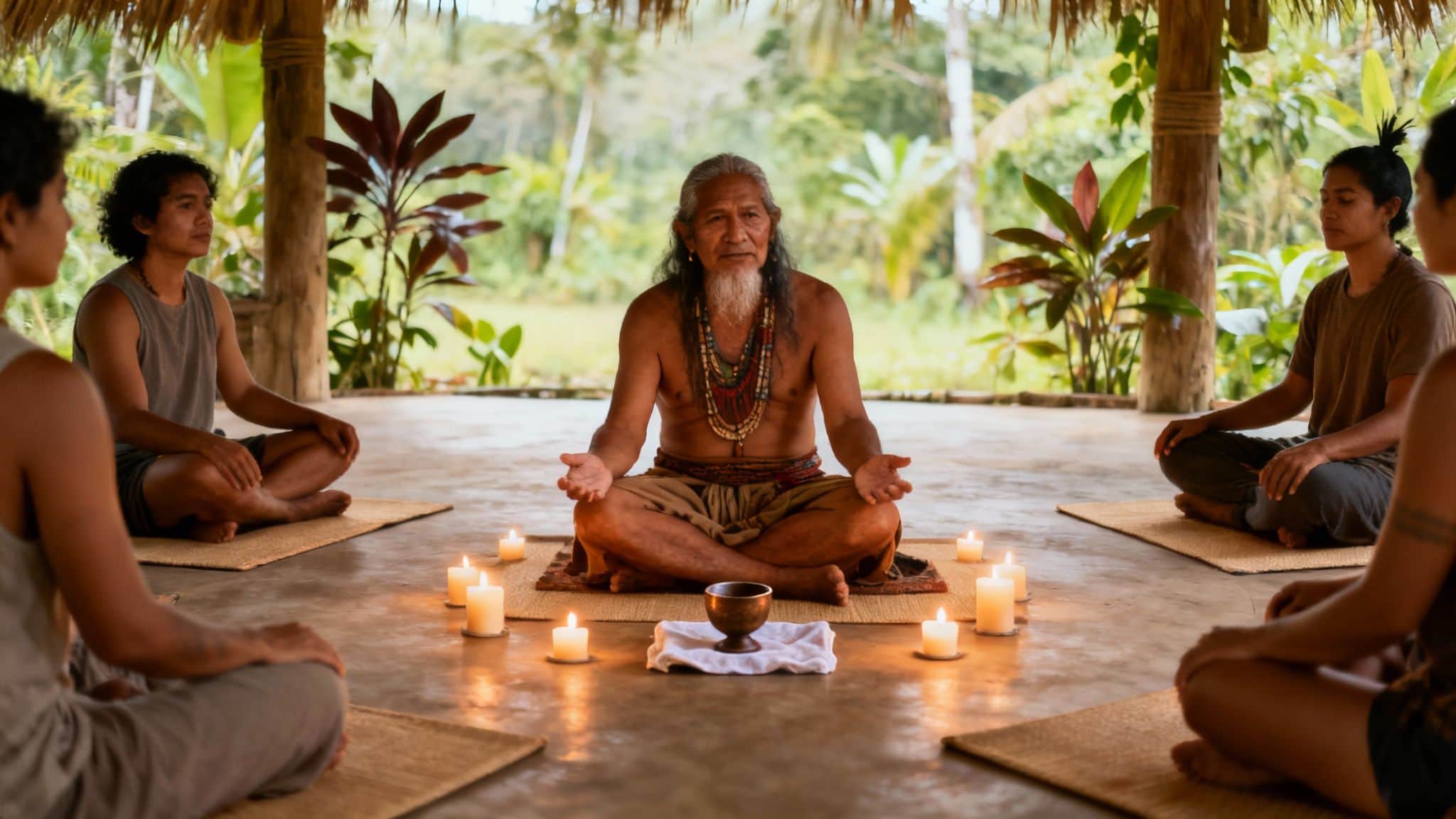
It’s best not to think of an ayahuasca retreat as a vacation. It’s more like a guided expedition deep into your own mind. Just like a mountain climber needs an experienced guide and the right gear to safely navigate a treacherous peak, a retreat gives you the framework to explore the profound inner landscapes ayahuasca can open up. It’s a space intentionally set apart from the noise of everyday life, designed purely for healing and self-discovery.
The ceremony is the centerpiece of the entire retreat. This isn’t just a casual get-together; it’s a sacred ritual, often steeped in centuries of tradition and led by an indigenous shaman or a highly trained facilitator. The setting is always meticulously prepared to ensure everyone feels physically safe and the energy of the space is clear.
Typically, everyone gathers in a ceremonial space (often called a maloca) to drink the brew. The shaman then guides the group through the night with traditional songs, or icaros, which are essential for navigating the journey.
The Three Pillars of a Retreat
Most reputable ayahuasca retreats are built on three core elements that work in concert. Understanding these pillars will give you a much clearer picture of why this model is so effective for such deep inner work.
- A Structured Environment: Good retreats create a sanctuary where every detail is handled. This means your lodging, meals (which follow a specific diet called the dieta), and a daily schedule are all taken care of. This structure removes all the usual stressors so you can turn your full attention inward.
- Expert Guidance: The shaman or facilitator is the absolute anchor of the experience. They aren’t just serving a drink; they are holding the energetic space for the entire group and offering support when things get challenging. Their deep training, often spanning decades, is crucial for a safe and productive journey.
- Community and Connection: You’re not going through this alone. You’re sharing the journey with a group, and this creates a powerful bond of shared vulnerability and mutual support. For many people, this sense of community becomes one of the most meaningful parts of the whole process.
“An ayahuasca retreat is a purpose-built container for profound personal work. It combines a safe and structured setting with ancient ceremonial practices and the invaluable support of both experienced guides and a community of peers.”
Ultimately, the retreat model is designed to respect the power of this medicine by creating the best possible conditions for you to heal and grow. To get a better sense of what the journey itself can feel like, you can learn more about the ayahuasca experience and what it involves. This framework ensures the focus stays exactly where it should be: on introspection, safety, and bringing the insights you gain back into your life.
2. Benefits vs. Risks: What to Expect on an Ayahuasca Journey
Deciding to sit with ayahuasca is a massive step. It’s a path that can lead to incredible healing, but it’s also filled with very real challenges. You have to go into it with eyes wide open, ready to look at both sides of the coin—the light and the shadow.
People who go through these ceremonies often talk about life-changing moments that stay with them long after they’ve left the retreat. The experience can be a powerful catalyst for working through deep-seated issues in a way that just isn’t possible in our day-to-day lives.
This isn’t some quick fix. We’re talking about fundamental shifts in how you see yourself and your place in the world, leading to real, lasting change.
The Potential for Deep Healing
Ayahuasca is getting a lot of attention for its ability to help with conditions that don’t always respond to traditional therapy. People come to these retreats for all sorts of reasons, and for many, the medicine delivers.
- Emotional and Psychological Breakthroughs: Ayahuasca is well-known for helping people confront trauma, depression, anxiety, and addiction. It has a way of bringing buried emotions and memories to the surface so you can finally process and release them in a safe space.
- A Deeper Spiritual Connection: For many, the experience is profoundly spiritual. It’s common to feel an overwhelming sense of oneness, a connection to everything and everyone, or a direct line to something much bigger than yourself.
- Radical Self-Discovery: The journey can feel like looking into a very honest mirror. It shows you the hidden parts of yourself—the limiting beliefs, the unconscious habits—giving you a new sense of clarity and purpose.
Modern science is starting to catch up with what indigenous cultures have known for centuries. Studies are showing that ayahuasca has real therapeutic potential. For instance, one study on depression found a 64% clinical response rate among participants, compared to just 27% in the placebo group. That’s a huge difference and points to its power as a tool for mental wellness.
Navigating the Inherent Risks
As profound as the benefits can be, the risks are just as real. An ayahuasca journey isn’t a walk in the park. It’s intense, unpredictable, and requires you to completely surrender.
The biggest challenge for most people is the sheer psychological intensity. You might come face-to-face with terrifying visions, old wounds, or uncomfortable truths. Interestingly, one study found that while the experiences were tough, 88% of participants later saw these challenges as vital for their growth. Still, in the moment, it can be incredibly difficult.
“The purge is another central part of the experience. This physical release—usually vomiting, crying, or diarrhea—is seen as a necessary part of the cleansing, but it can leave you feeling drained, both physically and emotionally.”
Finally, there are serious medical and psychological risks to consider. Ayahuasca is not for everyone. If you have a personal or family history of psychosis, schizophrenia, bipolar disorder, or serious heart issues, this path is likely not for you.
And this part is critical: ayahuasca contains Monoamine Oxidase Inhibitors (MAOIs). These compounds can have dangerous, even deadly, interactions with specific foods and medications, especially antidepressants like SSRIs. This is why being 100% honest during your medical screening is absolutely non-negotiable. It’s a matter of safety. For a complete breakdown, check this guide on foods and meds to avoid with MAOIs.
To help you weigh these factors, here’s a side-by-side look at what you might gain versus the challenges you could face.
Potential Benefits vs. Potential Risks of Ayahuasca
| Potential Benefit | Associated Risk or Challenge |
|---|---|
| Deep Emotional Healing | Facing intense and difficult emotions or past traumas. |
| Spiritual Awakening & Connection | Spiritual confusion or disorientation if not properly integrated. |
| Relief from Depression & Anxiety | Psychological distress during the ceremony (“bad trip”). |
| Breaking Addictive Patterns | Physical discomfort, including nausea, vomiting, and diarrhea. |
| Profound Self-Insight | Pre-existing mental health conditions could be worsened. |
| Renewed Sense of Purpose | Dangerous interactions with certain medications (SSRIs) and foods. |
Looking at the benefits and risks isn’t meant to scare you off—it’s meant to prepare you. A safe and meaningful ayahuasca journey depends on being fully informed, mentally ready, and choosing a retreat that puts your well-being and safety above all else.
How to Choose a Reputable Ayahuasca Retreat
Choosing an ayahuasca retreat is easily the most important decision you’ll make. The right center can be a sanctuary for life-changing healing, but the wrong one can be ineffective or, worse, flat-out dangerous.
Think of it like choosing a surgeon. You wouldn’t just pick the first name you see online; you’d dig into their credentials, their track record, and their safety protocols. You need to bring that same level of diligence here. This isn’t a decision to be rushed. It’s about carefully vetting a place to ensure they put your physical, psychological, and spiritual well-being first.
This image really frames the core question: are the potential benefits worth the inherent risks for you, right now?
Finding a retreat that minimizes those risks while creating the best possible environment for healing is the only responsible way forward.
Your Vetting Checklist
To help you sort the good from the bad, here’s a checklist of what truly matters. Use these points to compare centers and find one that feels safe and aligned with what you’re hoping to achieve.
Thorough Medical and Psychological Screening: This is an absolute non-negotiable. A responsible center will make you fill out a detailed application covering your complete health history. They must screen for things like heart conditions, a history of psychosis, and especially the use of SSRI antidepressants, which can create a fatal reaction when mixed with ayahuasca.
Experienced Facilitators and Shamanic Lineage: Who is actually pouring the medicine? Look for shamans, facilitators, or guides with years of dedicated training and experience, ideally from a recognized lineage. They should be completely transparent about their background and their approach to the work.
Appropriate Group Size: The ratio of facilitators to participants is crucial. Smaller groups, typically under 15 people, mean you get more individual attention and support when things get intense. Huge, overcrowded ceremonies can feel chaotic and unsafe, leaving people to fend for themselves at their most vulnerable.
Integration Support: The real work starts after the ceremony is over. A quality retreat will have structured support for integration, whether that’s group sharing circles, one-on-one sessions, or follow-up calls after you go home. This is essential for helping you make sense of your experience and bring its lessons back into your life.
Clear Safety Protocols: What’s the plan if something goes wrong? The center needs clear, established protocols for handling both medical and psychological emergencies. This includes having access to medical professionals and knowing where the nearest hospital is. They should also have sober, trained staff on hand to help participants at all times.
“The quality of an ayahuasca retreat isn’t measured by fancy accommodations, but by its unwavering commitment to safety, ethics, and genuine support for every single person’s healing journey.”
Red Flags to Watch Out For
Knowing what to look for is only half the battle; you also have to know what to run from. As ayahuasca has become more popular, some shady operators have popped up. Keep your eyes peeled for these warning signs.
- Promises of a “Miracle Cure”: Ayahuasca can be a profound tool for healing, but it’s not a magic pill. Any retreat guaranteeing specific outcomes or claiming it will cure serious diseases is being dishonest and just trying to take your money.
- Lack of a Screening Process: If a center is willing to take anyone who can pay without doing a deep dive into their medical and mental health history, that’s a massive red flag. It shows they couldn’t care less about participant safety.
- Vague or Hidden Facilitator Credentials: If you can’t find clear, straightforward information about who is leading the ceremonies and what their training involves, be very cautious. Authentic guides are generally open and proud of their lineage and experience.
- High-Pressure Sales Tactics: You should never feel rushed or pressured to book a spot. This is a deeply personal decision that requires time and reflection, not a last-minute impulse buy.
- Poor Communication: A professional, trustworthy center will be responsive and happy to answer all of your questions patiently and clearly. If their answers are evasive or they take forever to get back to you, it could be a sign of disorganization or worse.
By arming yourself with this knowledge, you can approach your search with confidence. The goal is to find a place that not only serves the medicine but does so with the utmost integrity, respect, and care. Your safety is everything, and a truly reputable retreat will always make it their top priority.
Preparing for and Integrating Your Experience

The ayahuasca ceremony is the peak of the mountain, but it’s not the whole journey. The real, lasting change happens on the trail leading up to it and the long road back home.
Think of it this way: the retreat is like finding a treasure map. Preparation is packing the right gear for the expedition, and integration is the lifelong adventure of actually following that map in your day-to-day life. Without both, the map is just a piece of paper.
The Foundation: Preparing for an Ayahuasca Retreat
Proper preparation is an act of respect—for the medicine, the tradition, and most importantly, for yourself. It’s about purifying your body and clearing your mind to be as open and receptive as possible. This process really boils down to two key practices: the traditional ‘dieta’ and setting a clear, powerful intention.
The ayahuasca dieta is a special diet you’ll follow for several weeks before your retreat. It’s so much more than a physical cleanse; it’s a spiritual discipline. Typically, the dieta involves cutting out:
- Pork, red meat, and aged foods (like certain cheeses or cured meats), which are considered energetically heavy.
- Spicy foods, excessive salt, sugar, and processed junk to purify your system and reduce stimulation.
- Alcohol, recreational drugs, and often caffeine to clear your mind and nervous system.
- Sexual activity for a set period to conserve your personal energy for the inner work ahead.
This isn’t just about making the body more sensitive to the medicine. It’s a way of showing your commitment. You’re signaling to yourself, and to the spirit of the plants, that you’re serious about this work.
Alongside the dieta, setting a clear intention is probably the single most important piece of mental prep you can do. Your intention is your North Star—it’s the “why” that’s bringing you to the medicine. It might be a question you need answered, a pattern you want to break, or a deep wound you hope to heal.
“An intention isn’t a demand; it’s a humble request for guidance. There’s a world of difference between saying “Fix my relationship with my mother” and “Please show me how I can heal my relationship with my mother.”
Spend some quiet time reflecting on what you truly need. Write your intention down. Say it out loud. Meditating on it will anchor your purpose, giving your journey a clear direction, especially if the experience becomes intense or confusing.
The Real Work: Integration After the Ceremony
Once the last ceremony ends, the real work is just beginning. Integration is the conscious process of weaving the lessons, insights, and emotional breakthroughs from your retreat into the fabric of your everyday life. Without it, the experience can fade like a beautiful dream, never taking root in reality.
The first few days and weeks after a retreat are a uniquely sensitive time. You might feel raw, open, and incredibly reflective. Jumping straight back into a high-stress job or old, unhealthy habits can feel like a shock to the system. You have to give yourself a soft landing—plan for at least a few quiet days to rest and process.
Here are a few practical ways to support your integration:
- Journal Everything: Write it all down—the visions, the feelings, the confusing bits, the beautiful moments. Don’t try to make sense of it all at once. Just get it out. This practice helps solidify the experience and reveals patterns as time goes on.
- Connect with Nature: Spend time outside. Take a walk in the woods, sit by a lake, or just feel the sun on your skin. Nature is grounding and can help you reconnect with the profound sense of unity you may have felt during the ceremony.
- Find Your People: Share what you went through with trusted friends, a therapist, or an integration circle. Working with a professional integration coach who understands psychedelic experiences can be invaluable for translating abstract insights into concrete, actionable steps.
- Practice Mindfulness: Bring practices like meditation, yoga, or simple breathwork into your daily routine. These tools help you stay centered, maintain the clarity you’ve gained, and continue doing the inner work on your own.
Integration isn’t a task you check off a list; it’s an ongoing commitment to living in line with your newfound truths. It’s about making different choices, setting better boundaries, and nurturing the seeds of change that were planted during your ayahuasca retreat. This dedicated effort is what turns a profound weekend into a whole new way of being.
Understanding the Rise of Ayahuasca Tourism
What was once a sacred spiritual practice, quietly held within the Amazon rainforest, has stepped onto the world stage. Ayahuasca’s journey from a deeply regional tradition to a global wellness industry is a fascinating one, fueled by a collective hunger for spiritual connection, a wave of media attention, and a growing search for healing beyond the conventional.
This global demand has sparked a booming ecosystem of ayahuasca retreats, especially in hubs like Peru, Costa Rica, and Brazil. This trend, often called “ayahuasca tourism,” has grown at a staggering pace.
The numbers alone tell a powerful story. In 2019, the industry was already valued at an estimated $62 million globally. The momentum kept building; between 2020 and 2023, the number of psychedelic retreat centers worldwide—many of which feature ayahuasca—shot up from just 64 to 362. This explosion has sent complex ripples through the indigenous communities who have stewarded this medicine for generations.
The Economic and Cultural Impact
For many local communities in the Amazon, the influx of spiritual seekers has created new economic pathways. It provides jobs for facilitators, cooks, and support staff, bringing a new source of income to regions where opportunities can be scarce. In the best cases, this interest from the outside world can even help empower communities to preserve and share their cultural practices.
But this rapid commercialization isn’t a simple success story. It brings with it a host of serious ethical questions that anyone thinking about this path needs to confront.
- Cultural Appropriation: Is the sacred tradition being honored, or is it being watered down into a packaged product for a Western audience? The best centers work tirelessly to respect the lineage and give back to the source communities.
- Sustainability: One of the core ingredients in ayahuasca, the Banisteriopsis caapi vine, is being harvested like never before. This raises real concerns about over-harvesting, which could threaten the future of the medicine for the very cultures that rely on it.
- Authenticity and Safety: High demand inevitably attracts opportunists. The market has seen a troubling rise in “sham shamans”—individuals who lack the deep training and integrity required, putting participants at real physical and psychological risk.
“The growth of ayahuasca tourism is a double-edged sword. It offers a profound path to healing for many and economic stability for some, but it also casts a shadow over the tradition’s integrity and the sustainability of the plants themselves.”
Navigating the Modern Landscape
Grasping this context is absolutely essential. It shifts your role from being a simple consumer to becoming a conscious, responsible participant. The retreat you choose has a real, tangible impact on the people and ecosystems at the heart of this practice.
When you select a center that operates ethically, honors its indigenous roots, and prioritizes sustainability, you’re casting a vote for the right way forward. This industry has already changed the face of this ancient practice. To dig deeper into these shifts, you might want to read about the four transformations ayahuasca tourism is producing in its traditional Amazonian context.
Making an informed, mindful choice is the best way to help ensure this powerful medicine can continue to offer its healing gifts for generations to come.
Who Is Seeking Out Ayahuasca Today?
The old stereotype of an ayahuasca drinker just doesn’t hold up anymore. If you picture a shaman deep in the Amazon, you’re only seeing a sliver of the story. Today, the person sitting next to you in a ceremony is just as likely to be a software engineer from Silicon Valley, a therapist from Berlin, or a military veteran from Texas.
This ancient medicine has officially gone global. It’s drawing people from all walks of life, from every corner of the developed world, who are all searching for something deeper. For some, it’s a spiritual path. For many others, it’s a last resort.
Why People Are Answering the Call
The reasons someone travels thousands of miles for an ayahuasca retreat are incredibly personal, but a few common threads run through most stories. It really boils down to a handful of core motivations.
- Healing from the Inside Out: A huge number of people are looking for real relief from PTSD, deep-seated depression, anxiety, and addiction. Many have tried conventional therapy and medication for years without finding a breakthrough. They come to ayahuasca hoping to get to the root of their pain, not just manage the symptoms.
- A Deeper Spiritual Connection: For another large group, the pull is purely spiritual. They’re seeking a direct experience of something bigger than themselves—a tangible feeling of connection to the universe or profound answers to life’s biggest questions.
- Breaking Through Personal Barriers: Many seekers feel stuck. They want to finally break free from self-sabotaging habits, unlock their creativity, or find genuine clarity about what they’re supposed to be doing with their lives.
“People don’t come to ayahuasca to escape their problems. They come to face them head-on. The medicine holds up an unflinchingly honest mirror, revealing insights that could otherwise take years of traditional therapy to uncover.”
A Look at the Numbers
This isn’t a niche trend anymore; it’s a full-blown global movement. One landmark study estimated that over four million people across the Americas, Europe, and Australia have sat in an ayahuasca ceremony.
Just in 2019, an estimated 820,000 individuals drank the brew. What’s truly telling is that only about 10% of these participants were from the Indigenous communities where the practice began. If you want to dive deeper into the data, you can read the full research from ICEERS on this global phenomenon.
These numbers paint a clear picture: a sacred Amazonian tradition has found a new, predominantly Western audience. Understanding who is seeking this medicine—and why—helps you see where your own journey fits into this modern, worldwide quest for healing and truth.
Common Questions About Ayahuasca Retreats
It’s completely normal to have a ton of questions when you start looking into ayahuasca retreats. As you move from initial curiosity to actually considering a trip, the practical side of things starts to pop up. Let’s walk through some of the most common queries to help you feel more grounded and prepared for what’s ahead.
Think of this as sorting out the essential logistics. Getting these answers will help you move forward with confidence, ensuring there are no major surprises when you finally get there.
What Does a Typical Ayahuasca Ceremony Feel Like?
First off, a ceremony is a highly structured ritual, not just a free-for-all. They almost always happen at night in a dedicated communal space, often a round building called a maloca. After everyone drinks the earthy, bitter brew, you’ll usually lie down on a mat. Then, the shaman or facilitator begins to sing.
These traditional songs, called icaros, are much more than just music; they’re considered the primary tool for guiding the ceremony’s energy and each person’s individual journey. The experience that follows is deeply personal and can last for several hours. You might have vivid visions, experience a powerful emotional release, or revisit long-forgotten memories.
It’s also important to know that physical purging—like vomiting or crying—is a very common and expected part of the process. In the Amazonian tradition, this is seen as a necessary cleansing of emotional and energetic baggage. You’re not alone, though. Trained assistants are always on hand to offer support, whether it’s a glass of water, a hand to hold, or help getting to the bathroom. Their job is to make sure everyone feels safe and cared for all night long.
Is Ayahuasca Legal Where I Live?
This is a tricky one because the legality of ayahuasca is all over the map. In countries where it’s a core part of the culture, like Peru and Brazil, it’s legal and even considered a protected piece of their national heritage. That’s a big reason why so many of the most established ayahuasca retreats are located there.
The situation in the United States, however, is very different. Ayahuasca’s main psychoactive component, DMT, is classified as a Schedule I controlled substance. This makes the brew illegal for general use, with the only exceptions being for a few specific religious groups that have secured legal exemptions from the government.
“Europe is a gray area, with a patchwork of different and often ambiguous laws. It’s entirely up to you to research the specific laws of any country you plan to visit for a retreat. A legitimate center will only ever operate where their work is legally permitted.”
Are There Health Conditions That Disqualify Me?
Yes, absolutely. Any responsible retreat puts safety first, and a thorough medical screening is a non-negotiable part of their process. Certain pre-existing conditions are simply not compatible with this work.
For instance, anyone with a personal or family history of psychosis, schizophrenia, or bipolar disorder should not drink ayahuasca, as the experience could potentially trigger a dangerous psychiatric episode.
Certain medications also pose a serious risk. Combining ayahuasca with SSRI antidepressants is particularly dangerous and can lead to a life-threatening condition called serotonin syndrome. People with serious heart conditions are also at significant risk. Being 100% transparent on your medical intake forms isn’t just a guideline—it’s absolutely critical for your own safety and well-being.
Disclaimer: The information provided on Ayahuasca.com is for educational purposes only and is not intended as medical advice, diagnosis, or treatment. Ayahuasca is a powerful traditional Amazonian medicine and may not be suitable for everyone. Always consult with a qualified healthcare professional before making decisions related to health, mental well-being, medications, or the use of Ayahuasca.