
A reader often arrives here after a long stretch of trying to feel better in ways that were supposed to work. Therapy may have helped, then plateaued. Medication may have taken the edge off, or created trade-offs that felt hard to carry. Meditation, breathwork, retreats, books, and podcasts may have opened a door without fully changing the room.
That’s usually the moment when Ayahuasca starts to appear differently. Less like a curiosity, more like a serious possibility.
For some people, the interest comes from despair. For others, it comes from a quiet but persistent intuition that a deeper layer of healing is available. Both are understandable. So are the fears. Fear of losing control. Fear of making a vulnerable decision in the wrong setting. Fear of being sold a miracle when what’s needed is discernment.
Ayahuasca for mental health deserves more than hype and more than dismissal. It deserves a careful look at what the brew is, what the science says, where risks live, and how a person can decide with clarity rather than urgency.
Answering The Call to Ayahuasca for Healing
A common pattern looks like this. Someone has carried depression, anxiety, unresolved grief, or emotional numbness for years. They’ve functioned. They’ve worked. They’ve shown up for family. But internally, something still feels unfinished, buried, or out of reach. Then Ayahuasca enters the conversation through a friend, a therapist, a retreat story, or a late-night search that keeps pulling their attention back.
That pull matters. It often signals a readiness to look beneath symptom management and into meaning, memory, and self-relationship. But a sincere calling isn’t the same thing as readiness.
Ayahuasca has a long ceremonial history rooted in Indigenous traditions of the Amazon. Approaching it well means treating it as more than a wellness trend or a dramatic shortcut. People who get the most from this path usually bring two qualities together. Openness and caution. One without the other can create problems.
“Entering an Ayahuasca process with hope is healthy. Entering without screening, preparation, or support isn’t.”
Many first-time seekers want a simple answer to a difficult question. Will this help? The honest answer is more textured. Ayahuasca can be profoundly therapeutic for some people. It can also be destabilizing, badly timed, or poorly matched to a person’s mental health history if the setting and support aren’t right.
What The Call Often Really Means
The call to Ayahuasca isn’t always a call to drink the medicine immediately. Sometimes it’s a call to start learning, to slow down, to investigate motives, and to get more honest about what healing would require.
That process usually includes questions like these:
- Why now: Is this coming from grounded intention, or from desperation after a crisis?
- What is being sought: Relief from symptoms, spiritual connection, trauma processing, grief support, or all of the above?
- What support exists: Is there access to medical guidance, psychological support, and post-ceremony integration?
- What history matters: Are there past episodes of panic, depression, dissociation, or instability that need careful review?
People often want certainty before making a decision. What helps more is maturity. A mature approach doesn’t romanticize Ayahuasca, and it doesn’t fear it reflexively either. It treats the medicine as powerful, meaningful, and worthy of respect.
What Is Ayahuasca and How Does It Affect The Brain
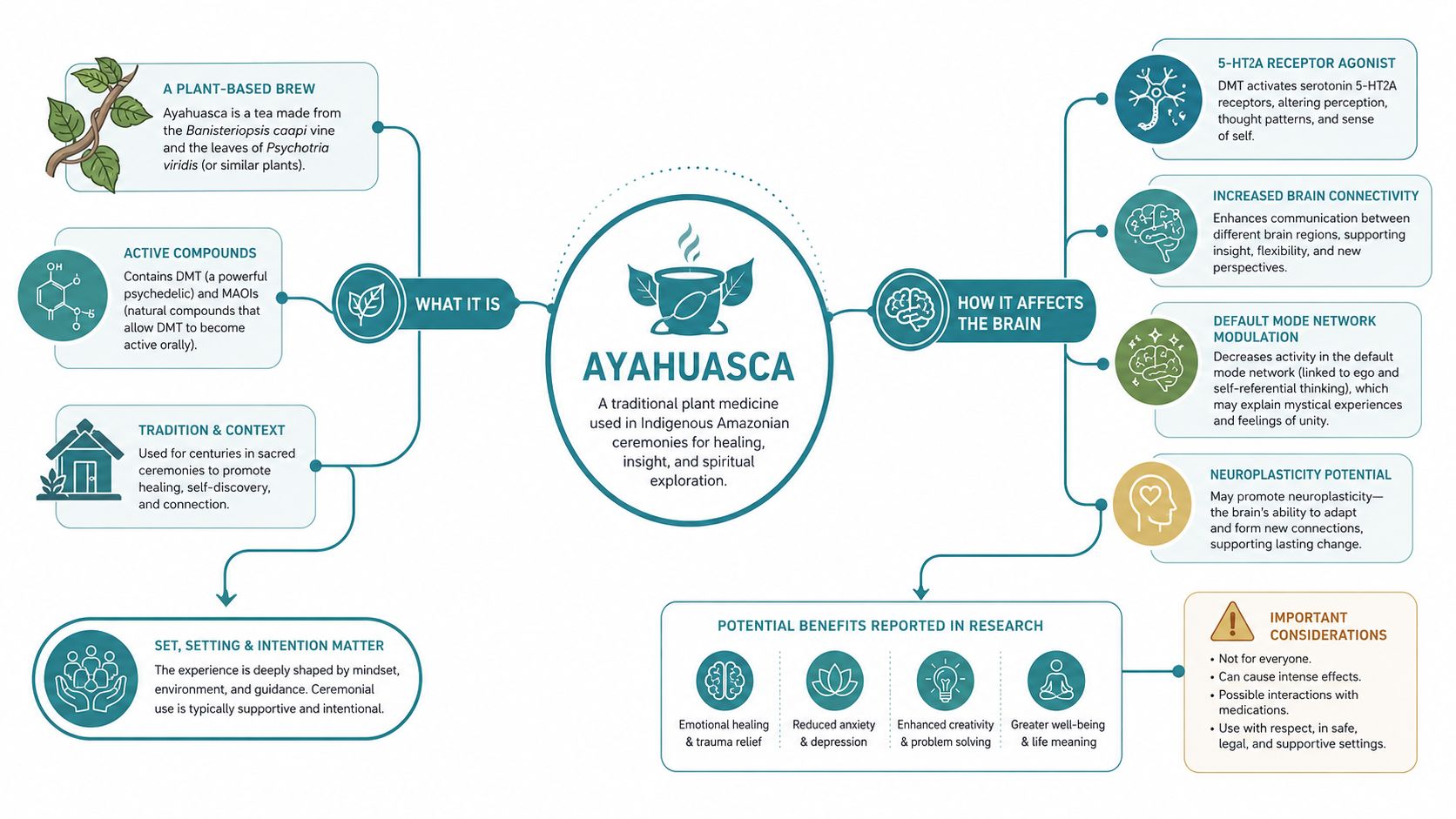
Ayahuasca is traditionally prepared from Psychotria viridis and Banisteriopsis caapi. One contributes DMT, the primary psychedelic compound associated with visionary effects. The other contributes compounds that allow that DMT to become orally active in the body. Without that partnership, the experience wouldn’t unfold in the same way.
A simple way to understand it is this. One plant carries the signal. The other opens the gate.
How The Brew Becomes Active
DMT on its own is rapidly broken down in the digestive system. The vine contains compounds that temporarily change that process, allowing the psychoactive effects to emerge when the brew is taken orally. Once active, DMT interacts with brain systems involved in perception, emotion, and meaning-making.
That’s part of why people report intense imagery, autobiographical insight, emotional release, altered body awareness, and a different sense of self. For some, the experience feels psychological. For others, spiritual. Often it’s both at once.
Research summarized in this review of Ayahuasca’s acute effects and antidepressant findings notes that Ayahuasca’s acute psychedelic effects generally last 4 to 6 hours and can include changes in perception, cognition, emotional experience, and spiritual awareness.
Why The Experience Can Feel So Deep
The brew doesn’t work like a conventional daily psychiatric medication. It doesn’t gradually blunt symptoms through routine dosing. It tends to create a concentrated window of altered consciousness in which thoughts, memories, emotions, and symbolic material can move in unusual ways.
That can be healing. It can also be overwhelming.
A person may revisit grief they’ve avoided for years. Another may see family patterns with startling clarity. Someone else may encounter fear, shame, or existential material that feels bigger than expected. The same basic pharmacology can lead to very different outcomes depending on mindset, environment, preparation, and the skill of the people holding the ceremony.
What The Brain Explanation Doesn’t Capture
A purely neurochemical explanation is useful, but it’s incomplete. In practice, Ayahuasca experiences are shaped by more than receptor activity. Ceremony structure, music, interpersonal safety, cultural framing, and post-experience integration all influence what a person does with what arises.
That’s why reducing Ayahuasca to “a psychedelic that affects serotonin pathways” misses part of the point. It tells part of the story, but not the whole one.
“Practical Rule: The brain effects explain why Ayahuasca can open powerful states. They don’t guarantee that those states will be healing. The container matters.”
The Science Behind Ayahuasca for Mental Health
A person with long-term depression reads a few glowing stories online and starts to wonder whether one ceremony could do what years of treatment have not. That hope is understandable. It also needs grounding in the actual research, especially if the person also lives with bipolar symptoms, panic, dissociation, or a history of psychosis in the family.
The current evidence is promising, but narrow. The strongest human data is in depression, particularly in structured settings with screening and follow-up. In the first randomized placebo-controlled trial investigating Ayahuasca for treatment-resistant depression, participants who received ayahuasca showed a significant reduction in depression severity on the HAM-D scale seven days after dosing. That is one reason clinicians and researchers take this area seriously.
A second signal comes from naturalistic research, which reflects real-world use more than a tightly controlled lab does. In the Scientific Reports study on mental health outcomes after Ayahuasca use, many first-time users reported clinical improvement after their initial experience, with depression showing the most consistent change through six months of follow-up. Studies like this are useful, but they have limits. They can suggest patterns. They cannot prove that ayahuasca alone caused the change.
That distinction matters in practice.
People often hear “rapid antidepressant effect” and fill in the rest of the story themselves. The research does not support that leap. The studies are small, the settings are highly selected, and the participants are usually screened to rule out some of the very risk factors that are common in the broader public. If you have unrecognized bipolar disorder, a trauma history with poor grounding, active substance instability, or a personal or family history of psychosis, your risk profile is different from the average participant in a promising study.
That is where the universal safety narrative breaks down.
Ayahuasca may help some people with depression. It may destabilize others. Both statements can be true at the same time. In my work, this is one of the most important realities to state clearly. The question is not only whether ayahuasca can produce meaningful relief. The question is who is a reasonable candidate, under what conditions, and what level of support is in place if the experience opens more than the person can integrate.
The findings look most encouraging when several factors are present:
- Careful screening: Existing diagnoses, medications, sleep history, mania risk, trauma severity, and family psychiatric history are reviewed in detail.
- Structured support: The experience happens in a setting with skilled facilitation, medical awareness, and clear crisis protocols.
- Clear therapeutic framing: The person is not chasing a miracle or using ceremony as an escape from treatment planning.
- Post-ceremony integration: Insights are worked through with therapy, reflection, and behavior change rather than treated as self-explanatory.
For readers comparing psychedelic paths, some people also explore psilocybin-assisted recovery options when addiction or compulsive behavior is part of the clinical picture. The better choice depends on diagnosis, contraindications, and the quality of support around the experience.
If you want a broader look at how this field has developed, this review of past and current ayahuasca research covers the literature in more detail.
The evidence is strongest for depressive symptoms. Research interest also extends to anxiety, trauma-related distress, and substance use, but those areas are still less settled. For someone with pre-existing mental health conditions, that uncertainty is not a minor footnote. It should shape the decision.
Hope is justified. So is caution.
The Spectrum of Healing Potential Benefits Explored
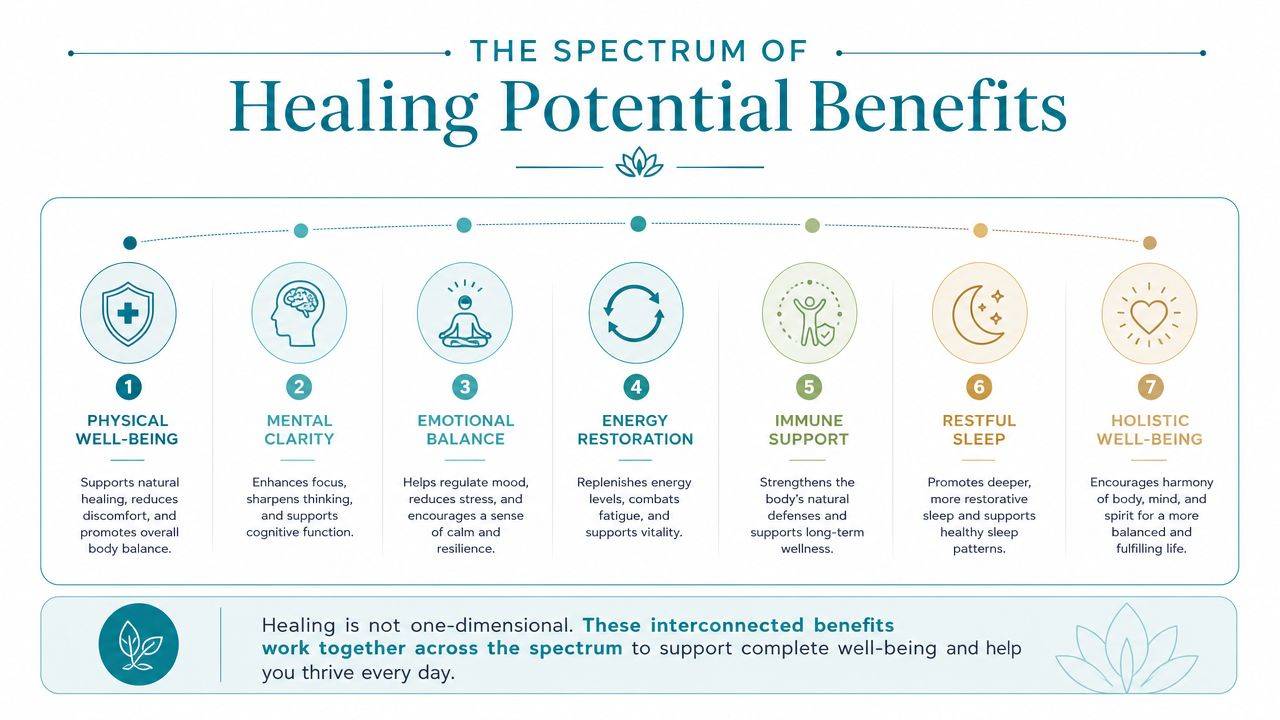
People often come to Ayahuasca focused on one diagnosis. Depression. Anxiety. Trauma. That’s understandable, but the healing process rarely stays confined to a label. What unfolds is often broader and more human than a symptom checklist can capture.
Relief may begin with mood, but the deeper shift often involves relationship. Relationship to the body, to grief, to memory, to shame, to purpose, and to other people.
Beyond Symptom Reduction
Some participants describe the experience less as “feeling better” and more as “finally feeling what was there.” That distinction matters. Emotional suppression can look calm from the outside while feeding depression, disconnection, compulsive behavior, or exhaustion.
Ayahuasca may help surface material that has stayed frozen or fragmented. In a supportive setting, that can allow a person to process old pain with unusual honesty. The benefit isn’t only catharsis. It can also be renewed coherence. The person starts making sense again to themselves.
Commonly reported areas of benefit include:
- Emotional access: Buried sadness, anger, fear, or tenderness becomes reachable.
- Perspective on trauma: Old experiences may be seen with more compassion and less identification.
- Relational clarity: People sometimes recognize patterns in family, attachment, or self-worth that were hard to name before.
- Spiritual reconnection: A person who has felt cut off from meaning may regain a sense of belonging, reverence, or direction.
Grief And Existential Distress Deserve More Attention
One of the most important emerging areas is grief. The conversation around Ayahuasca for mental health often becomes too narrow. Not everyone seeking healing is dealing with a standard psychiatric category. Many are carrying bereavement, existential rupture, or the aftermath of losing a loved one, a relationship, a role, or a former identity.
Recent data indicates that Ayahuasca has therapeutic potential for grief, with an analysis showing sustained reduction in grief severity over one year, along with enhanced quality of life and social relationships. That’s an important development because grief is often medicalized too quickly or left unsupported altogether.
“A person doesn’t need a psychiatric label to need deep healing. Grief and existential distress can reorganize a life just as powerfully as depression.”
What Healing Usually Looks Like In Real Life
The useful changes are often ordinary after they are profound. Someone starts sleeping more steadily. Another speaks openly with a parent for the first time in years. Someone else stops organizing life around emotional avoidance. A grieving person finds that memories no longer feel only crushing, but also connective.
Those outcomes don’t make Ayahuasca a cure-all. They do suggest that the medicine may support shifts across multiple layers of human experience when approached with structure, respect, and follow-through.
Navigating The Risks and Important Safety Protocols
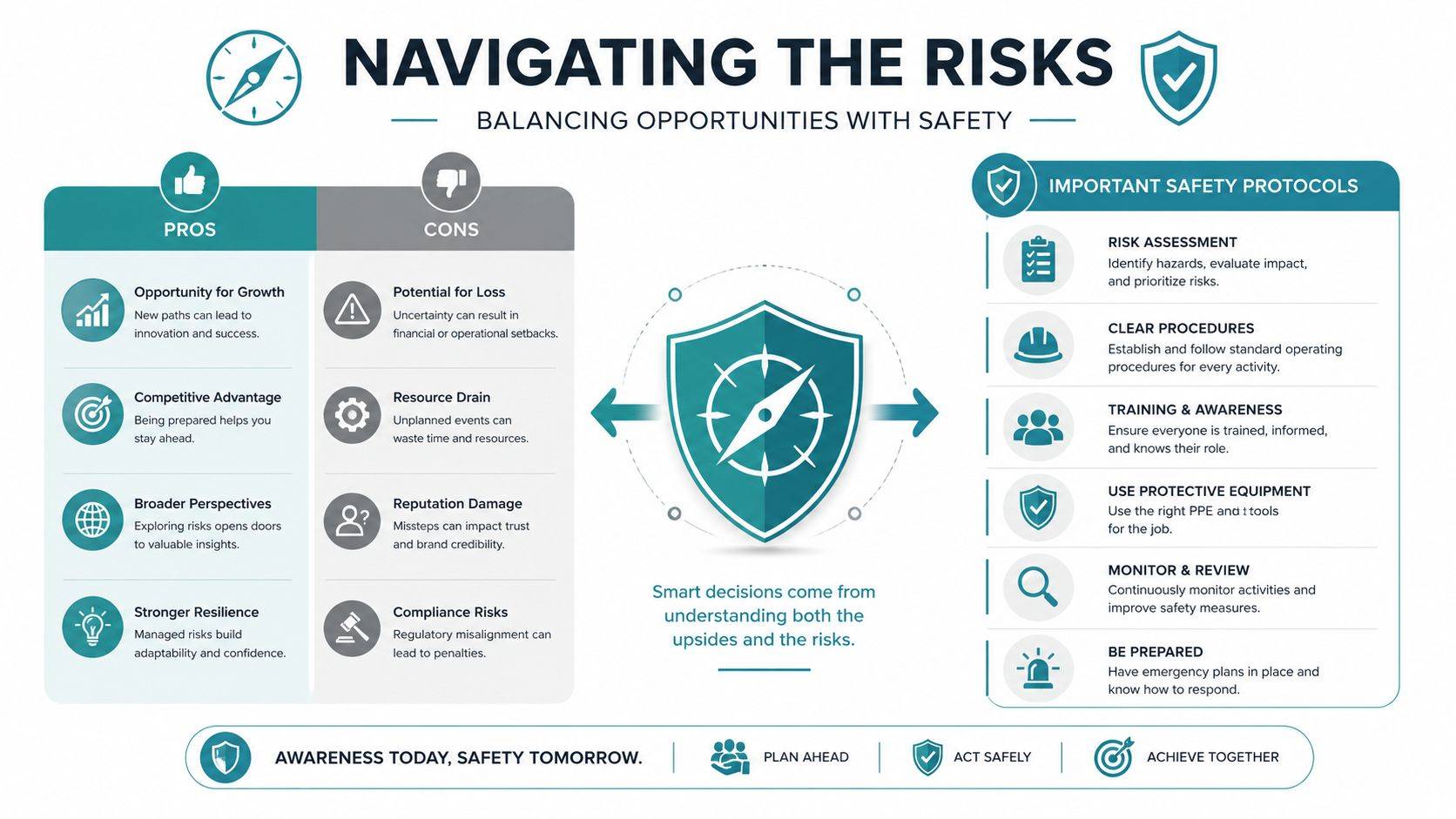
Ayahuasca is often discussed in two distorted ways. One version treats it as dangerously chaotic. The other treats it as universally safe if the intention is pure enough. Neither is useful.
The more responsible view is simpler. Ayahuasca can be helpful, but it can also be risky, especially for people with certain medical and psychological histories. Good decisions come from seeing both sides clearly.
The Most Overlooked Psychological Risk
A major nuance is often left out of overly positive conversations. A study on adverse mental states after Ayahuasca use clarified that individuals with a history of anxiety or depression experience significantly more adverse mental states after use. That doesn’t mean these individuals should automatically avoid Ayahuasca. It does mean they need more careful screening, stronger support, and a setting equipped for complexity.
A common misunderstanding arises for many first-time seekers. They assume that because they’re pursuing healing for anxiety or depression, Ayahuasca must therefore be straightforwardly suitable for those conditions. In reality, the very history that draws someone toward the medicine may also increase the likelihood of a difficult mental state during or after the experience.
“Safety Insight: A challenging ceremony isn’t automatically harmful. A challenging ceremony without skilled support can become harmful fast.”
Medical Interactions And Contraindications
One of the clearest physical concerns involves medication interactions. Ayahuasca can interact dangerously with certain substances, including some antidepressants. That’s why any reputable facilitator should require full medical disclosure and, where appropriate, coordination with a qualified clinician.
The table below covers broad categories that should trigger extra caution and formal screening.
| Category | Specific Contraindications |
|---|---|
| Medication Related | Certain antidepressants including SSRIs, other medications that may increase serotonin-related risk, and any medication changes made without medical supervision |
| Psychiatric History | Personal history of severe instability, prior episodes of overwhelming adverse mental states, or conditions that may be worsened by intense altered states |
| Current Mental Health Status | Acute crisis, recent destabilization, severe anxiety or depression without adequate support, or lack of post-ceremony care |
| Ceremony Readiness | Inability to disclose history honestly, pressure from others to participate, or no plan for integration afterward |
What Reduces Risk In Practice
Safety isn’t created by a beautiful website, spiritual language, or a charismatic facilitator. It’s created by process.
Look for these signs of a responsible approach:
- Full screening: The center asks detailed questions about mental health history, medications, and recent destabilization.
- Clear exclusion standards: They’re willing to say no when someone isn’t a fit.
- Experienced support: Facilitators know how to respond when trauma, panic, confusion, or dissociation arise.
- Integration planning: Support exists after the ceremony, not only during it.
A person who already lives with anxiety or depression doesn’t need false reassurance. They need accurate information and a high-quality container. That’s what makes informed consent real.
How To Choose a Safe and Reputable Ayahuasca Retreat
You may be staring at two retreat websites that look equally sincere. Both use careful language. Both show beautiful jungle photos. One has a disciplined screening process, clear medical limits, and staff who can explain what happens when someone becomes panicked, dissociated, or destabilized. The other mainly knows how to market. That difference can shape whether the experience is supportive, overwhelming, or the wrong level of care for you.
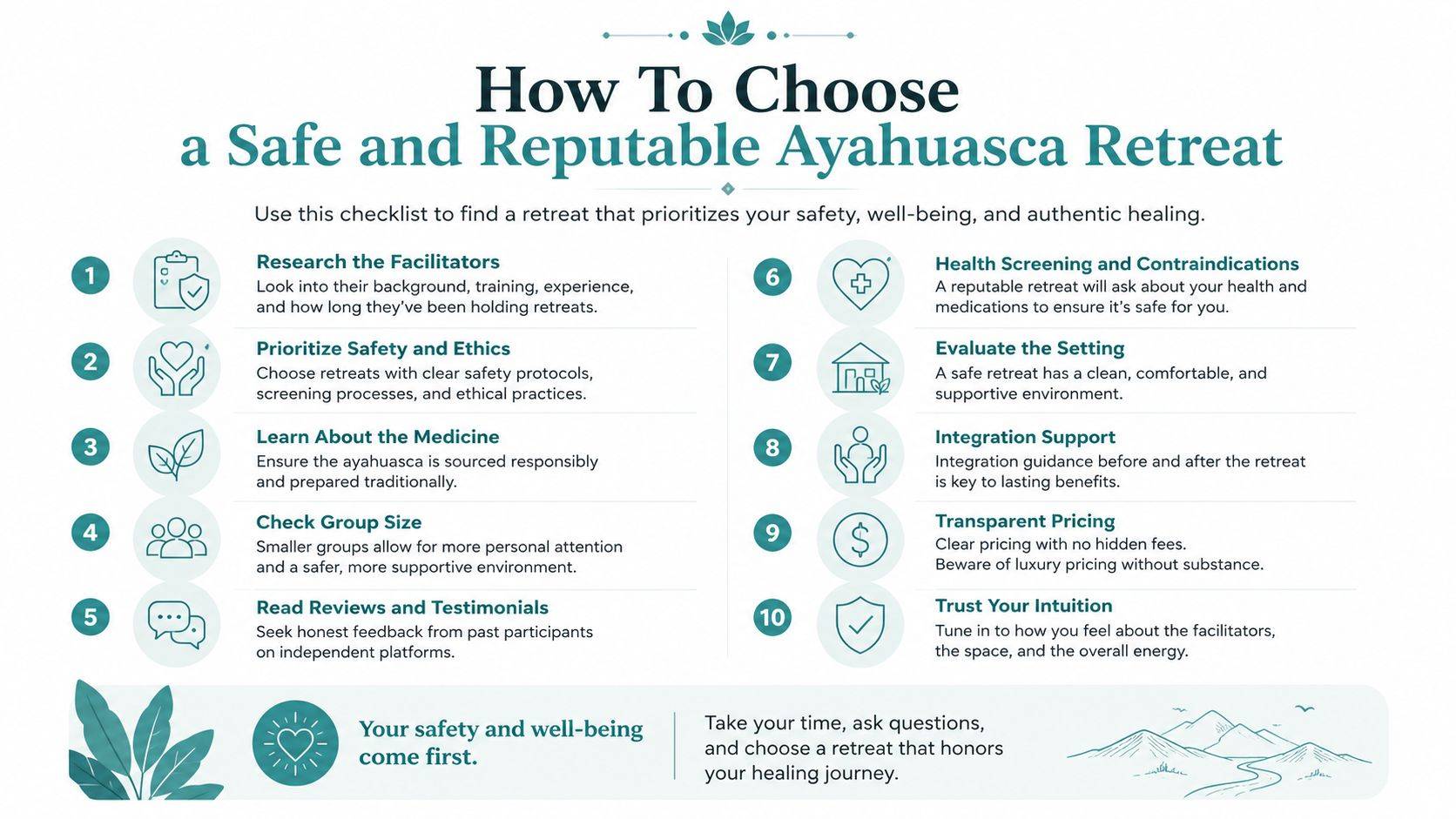
For people with depression, anxiety, trauma histories, or past periods of serious psychological instability, choosing a retreat is not a branding decision. It is a risk decision. A responsible center should respect the healing potential of ayahuasca without pretending it is broadly appropriate for everyone who is suffering.
Questions That Separate A Real Container From A Sales Pitch
As noted earlier, outcomes with ayahuasca are shaped by more than the brew itself. The setting, the screening process, the skill of the facilitators, and the quality of follow-up all affect whether a difficult ceremony becomes useful, destabilizing, or unfinished.
Ask direct questions, then listen for direct answers.
- Who reviews applications: A serious intake usually includes medical and psychiatric history, current medications, recent destabilization, and reasons for seeking ceremony now.
- Who leads the ceremonies: Facilitators should be able to explain their training, lineage, years of practice, and how they respond to panic, trauma activation, confusion, or prolonged dysregulation.
- How many participants are in each ceremony: Group size affects how much attention each person can receive when things get intense.
- What is the plan for acute distress: Ask what happens if someone becomes disoriented, suicidal, aggressive, or unable to reorient after the ceremony.
- What follow-up is included: Integration support should be structured, not improvised after the fact.
I pay close attention to how a center handles exclusion. A retreat that can clearly say, “This may not be appropriate for you right now,” is often safer than one that finds a spiritual justification for every booking inquiry.
For people managing overlapping concerns such as substance use, trauma, depression, or anxiety, broader support for co-occurring mental health may help clarify whether a retreat setting is suitable, or whether a higher-support environment should come first.
Practical Signs To Look For
Good retreats are concrete.
They explain contraindications in plain language. They describe who is on site during ceremonies. They can tell you how participants are monitored, how many helpers are present, whether private support is available, and what they do if someone needs medical attention or a pause from the process.
Watch for the trade-offs too. A remote center may offer quiet and strong ceremonial focus, but access to emergency care can be slower. A larger retreat may have more infrastructure, but less individual attention. A highly traditional setting may carry depth and integrity, but some readers will need to ask more questions about medical screening and mental health crisis response. Neither tradition nor clinical language guarantees safety by itself. You want both honesty and competence.
Other green flags are straightforward:
- They ask hard follow-up questions: Careful screening usually means they are trying to assess fit, not maximize attendance.
- They discuss limitations openly: Responsible centers do not promise healing, cure trauma, or imply that one ceremony resolves complex psychiatric suffering.
- They explain integration in specific terms: You should hear what support is offered, when it happens, and who provides it.
- They do not create urgency: Pressure is a warning sign, especially if you are in grief, burnout, or acute emotional pain.
Cost matters too, but price alone tells you very little about quality. A grounded review of what an Ayahuasca retreat costs and what is usually included can help you compare options without losing sight of safety.
A short video can also help first-time seekers think through the selection process with more realism.
Preparation and Integration The Keys To Lasting Change
A ceremony may last a handful of hours. The meaningful work often spans months. People who treat Ayahuasca as a single dramatic event usually miss much of its value. People who treat it as a process tend to carry more of the benefit into daily life.
Preparation matters because the medicine amplifies what a person brings in. Integration matters because insight alone doesn’t change behavior.
Preparation Builds Stability Before Intensity
Good preparation isn’t ceremonial perfectionism. It’s psychological and physical hygiene.
That usually means slowing down enough to clarify intention, review medical factors carefully, reduce unnecessary chaos in daily life, and enter the experience with less internal fragmentation. It also means being honest. If someone is secretly hoping the ceremony will erase all pain, rescue a failing relationship, or provide a final identity, that expectation needs attention before the first cup is poured.
A detailed guide to preparing for an Ayahuasca journey can help translate that intention into practical steps.
Integration Decides Whether Insight Stays Abstract
Many people have a powerful ceremony and then lose the thread when ordinary life resumes. Work emails return. Family dynamics return. Old habits return. Without a structure for integration, even a meaningful breakthrough can flatten into memory.
Strong integration often includes a mix of the following:
- Journaling soon after ceremony: Specific images, emotions, and realizations fade faster than people expect.
- Therapeutic support: A skilled therapist can help translate symbolic material into grounded psychological understanding.
- Body-based practices: Walking, breathwork, rest, and nervous system regulation help the experience settle.
- Relational honesty: Sometimes the integration task is a concrete conversation, boundary, apology, or change in how a person lives.
“The ceremony can reveal a truth. Integration is where a person starts living it.”
What Doesn’t Work
A few common mistakes show up again and again.
- Chasing peak experiences: More ceremony doesn’t automatically mean more healing.
- Ignoring destabilization: If someone feels flooded, dissociated, or psychologically unsteady afterward, they need support, not spiritualized minimization.
- Keeping everything private: Some experiences need careful containment, but total isolation after ceremony often slows recovery and meaning-making.
- Expecting immediate closure: Deep material may unfold gradually, especially grief, trauma, and long-standing depression.
Ayahuasca for mental health works best when a person respects the full arc of the process. Preparation creates readiness. Ceremony opens the material. Integration turns that opening into change.
Ayahuasca can be a powerful ally for mental health. It can also be the wrong choice, the wrong timing, or the wrong setting for a particular person. The wisest approach is neither fear nor idealization. It’s informed discernment.
For readers who want trusted education, preparation resources, and guidance toward vetted retreat options, Ayahuasca.com offers a strong place to continue the process carefully.
Disclaimer: The information provided on Ayahuasca.com is for educational purposes only and is not intended as medical advice, diagnosis, or treatment. Ayahuasca is a powerful traditional Amazonian medicine and may not be suitable for everyone. Always consult with a qualified healthcare professional before making decisions related to health, mental well-being, medications, or the use of Ayahuasca.