You’re probably here because your search got messy fast.
You typed something like “Ayahuasca retreats USA” or “ayahuasca legal in us,” and within minutes you found a strange mix of church websites, retreat listings, legal warnings, Reddit threads, and bold promises about healing. Some places sound official. Some sound spiritual. Some sound careful. Some feel improvised. It’s hard to tell which is which.
That confusion is normal.
Ayahuasca sits in a difficult place in the United States. People seek it for healing, spiritual growth, grief, addiction recovery, or a sense that conventional paths haven’t fully helped. At the same time, the law treats it seriously, and its practical risks go beyond a simple yes-or-no answer.
A person considering a ceremony usually wants a practical answer, not abstract legal language. Can you attend one? Could you get arrested? Are the “churches” real? Is the bigger danger legal trouble, or unsafe facilitation?
Those are the right questions.
This guide is written as education, not legal advice. The goal is to help you understand the actual situation in plain language so you can make a grounded decision. That means separating three things people often blur together:
- Federal law
- Religious exemptions
- Local decriminalization policies
It also means looking closely at something many articles skip: what the risks look like for attendees, not just organizers.
Your Search for Ayahuasca in the US
The first thing often noticed is how inconsistent everything sounds.
One site says Ayahuasca is illegal. Another says it’s protected as a sacrament. Another says it’s decriminalized in certain places. A retreat may present itself as a church, a wellness center, a private community, or a spiritual circle. If you’re new, all of that can feel like evidence that there must be some legal pathway hiding in the details.
Sometimes there is. Often there isn’t.
A key issue is that people use the word “legal” too loosely. In everyday conversation, “legal” can mean fully authorized, tolerated, rarely enforced, locally deprioritized, or protected under a specific religious ruling. Those are very different categories. If you don’t separate them, you can walk into a ceremony with the wrong expectations.
“Practical rule: If a retreat describes itself as legal, ask what that means in concrete terms. Federal exemption, local deprioritization, or simply low visibility are not the same thing.”
People also get tripped up by appearances. A website can look polished. A facilitator can sound wise. A group can use sacred language, mention lineage, and still operate in a legal gray zone with weak safety practices. Good branding doesn’t tell you much about legal standing or participant protection.
Here’s a simple way to hold the whole topic in your mind:
| Layer | What it affects | What it does not guarantee |
|---|---|---|
| Federal law | The baseline legal status nationwide | Safety, local enforcement choices |
| Religious exemption | Protection for specific qualifying groups | Automatic protection for all ceremonies |
| City or state decriminalization | Lower local enforcement priority in some places | Full legality or immunity from federal law |
That distinction matters because many seekers are not choosing between “illegal” and “legal.” They’re choosing between different kinds of uncertainty.
The Federal View Ayahuasca and Schedule I
A person can attend what feels like a sincere, carefully held ceremony in the US and still be stepping into conduct that federal law treats as prohibited. That tension starts with one fact. Ayahuasca is tied to DMT, and DMT is listed as a Schedule I controlled substance under the federal Controlled Substances Act.
What Schedule I means in plain English
“Schedule I” is legal shorthand, but its real-world meaning is easier to grasp than it sounds. Under federal law, DMT sits in the same category as substances the government treats as having no accepted medical use and a high potential for abuse.
For seekers, that classification sets the baseline. Federal authorities do not start from the view that Ayahuasca is a generally permitted wellness practice, even if a facilitator presents it as healing, ancestral, or sacramental.
A useful comparison is a nationwide rulebook that stays in force even when local officials choose not to prioritize certain cases. A city can reduce police attention. A state can lower penalties or shift enforcement priorities. Federal law still remains in place above those decisions.
Why this matters for ceremonies
This federal baseline shapes what ceremony providers can safely do, what they tend to hide, and what risks fall on the people who attend.
Activities such as importing the brew, possessing it, preparing it, serving it, advertising ceremonies, or collecting payment can all create legal exposure. In practice, enforcement often centers on organizers and distribution-related conduct, but that does not turn attendees into bystanders with no risk. If a ceremony is raided or investigated, everyone present can be drawn into a stressful legal situation, even if charges never follow.
That is why labels like “private,” “spiritual,” “church-based,” or “members only” should not reassure you on their own. Those words describe how a group presents itself. They do not change the federal starting point.
Natural origin does not change that starting point either. A plant-based brew can still contain a federally controlled substance. For legal purposes, “traditional” and “natural” are not the same as authorized.
Why seekers should care even if they are not organizing
Federal illegality affects the environment around a ceremony in ways that are easy to miss from the outside.
A group operating under legal pressure may avoid written screening, keep weak records, downplay medical risks, or communicate in vague terms to reduce visibility. Some providers become more careful under that pressure. Others become less transparent. For an attendee, that difference matters because secrecy can hide poor preparation just as easily as it can reflect legal caution.
One practical takeaway is this. The legal status of the brew influences the safety culture of the room.
If you are evaluating a ceremony, ask concrete questions. Who is responsible for sourcing the medicine? What legal basis does the group rely on? What happens if law enforcement shows up? Clear answers do not guarantee safety, but evasive ones tell you a lot.
If you want to examine how federal law and religious claims intersect, this guide to the RFRA and DEA religious exemption process is a strong place to start.
Religious Freedom The Supreme Court’s Narrow Exemption
The most important exception in the United States came from religion, not from a general change in drug law.
In Gonzales v. O Centro Espirita Beneficente União do Vegetal, decided on February 21, 2006, the U.S. Supreme Court unanimously ruled that the Religious Freedom Restoration Act protected sacramental Ayahuasca use for a specific religious group, the União do Vegetal, under strict federal oversight. That legal history is described in this summary of the O Centro decision and its impact.
That ruling matters a lot. It also gets misunderstood a lot.
Many seekers hear about the case and assume it opened the door for any sincere spiritual group to use Ayahuasca in the US. It didn’t. The decision recognized a narrow religious exemption for specific circumstances. It did not make Ayahuasca broadly legal for everyone who frames a ceremony as sacred.
What the Court recognized
The Court did not create a blanket right to serve Ayahuasca.
It recognized that under RFRA, the federal government had to justify burdening the sacramental practice of a particular religious organization. That distinction sounds subtle, but it changes everything. A ruling that protects one church’s practice is not the same as a ruling that legalizes a substance nationwide.
Groups such as UDV and branches of Santo Daime are the names most often discussed because they’re tied to the small number of recognized religious pathways. For a person browsing retreat options, that means a website calling itself a church isn’t enough on its own.
Why new groups struggle
The path for new groups is difficult. The DEA-licensed exemption process requires proving sincere religious belief, essential ceremonial use, robust safety protocols, and a guarantee of no diversion. The process often takes years in federal court, and only a handful of churches have received approval, according to this discussion of RFRA exemptions and recent FOIA efforts.
That same source notes that a 2024-2025 FOIA request highlighted government resistance to granting new exemptions.
For seekers, the practical takeaway is simple. Many newer groups may use religious language sincerely. Some may also believe they should qualify under RFRA. But belief that you should qualify is not the same as having an actual protected status recognized by federal authorities.
“If a group says it is protected, ask whether that protection is established and specific, or whether it is only the group’s interpretation of the law.”
A short video can help make the legal history easier to grasp:
Questions that cut through the confusion
If you’re evaluating a US ceremony that claims religious legitimacy, ask direct questions:
- What is your legal basis? Ask whether the group has a recognized exemption or is relying on a general RFRA argument.
- How long has the organization existed? Longevity doesn’t prove legality, but it helps you understand whether this is an established church or a recent rebrand.
- What safety procedures are documented? Serious religious protection cases tend to involve careful controls, not casual improvisation.
- How is the sacrament stored, served, and safeguarded? That goes to the “no diversion” issue federal authorities care about.
- What happens if someone has a medical or psychiatric contraindication? A credible group should answer clearly and calmly.
Here’s the deeper issue. A real church may still not be the right fit for you, and a beautiful spiritual community may still not have legal protection. Law, sincerity, and safety overlap sometimes, but not always.
A Patchwork of Policies State and City Changes
You find a ceremony in one city, read that entheogenic plants have been deprioritized there, and assume the legal risk must be low. Then you find the same kind of ceremony in another state, with a very different local climate, and the picture changes again. That is why location matters, but not in the simple way many people hope.
Across the US, some cities and states have changed how they treat entheogenic plants and natural psychedelics. Those changes affect local enforcement choices. They do not rewrite federal drug law.
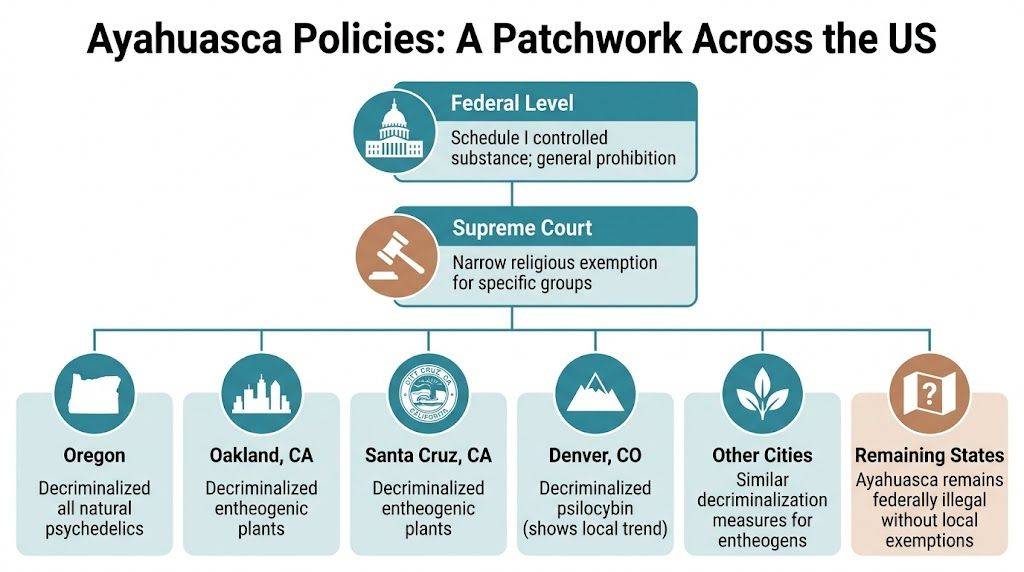
A practical way to understand this is to picture three layers of authority stacked on top of each other. A city can tell local police to treat entheogens as a low priority. A state can reduce penalties for certain conduct. Federal law still remains above both, especially where importation, distribution, or interstate activity is involved. For broader context on how these tensions developed, see this discussion of ayahuasca’s globalization, harm reduction, and legal pressure points.
Decriminalized does not mean permitted
Many seekers often get tripped up.
Decriminalization usually means reduced penalties or reduced enforcement priority. Legalization means the activity is affirmatively allowed inside a defined legal system, with rules that say who can do what, where, and under what conditions.
So if a city says entheogens are a low law-enforcement priority, that does not mean a retreat can openly advertise, charge money, serve a DMT-containing brew, and assume everything is approved. Local tolerance and legal permission are different things.
That difference matters most for attendees who are paying, traveling, signing up online, or joining a group that looks organized and public.
What changed in some jurisdictions
Some local governments have adopted policies that deprioritize enforcement against entheogenic plants and fungi. Washington, D.C., Oakland, Santa Cruz, Berkeley, Seattle, and other municipalities are often cited as examples. These measures usually focus on local policing priorities, not on creating a full legal framework for ayahuasca ceremonies.
At the state level, Oregon and Colorado are often part of the conversation because each has shifted parts of its drug policy in ways that make the map look more permissive. But those changes can be misleading if read too broadly. A reform aimed at possession, supervised services, or natural psychedelics in general does not automatically create a clear lawful lane for ayahuasca ceremony operators.
For someone considering a ceremony, that distinction is not academic. It affects what kind of risk you may be stepping into.
What local reform does, and does not, do for attendees
Local reform can lower the chance of attention from local police in some settings. It cannot promise protection if a ceremony becomes visible in the wrong way.
Here are the situations that tend to matter in real life:
- Public advertising. A retreat promoted openly on social media or through paid listings is easier for authorities to notice.
- Commercial structure. Charging set fees can make an event look less like private spiritual practice and more like an organized service.
- Interstate travel or transport. Crossing state lines adds a different layer of exposure.
- Imports and supply chains. The brew itself raises separate issues from simple possession of a plant in a local decriminalized setting.
This is why a city can be relatively tolerant while an ayahuasca ceremony there still carries meaningful legal risk.
“Local policy can reduce pressure from local authorities. It cannot erase federal exposure or guarantee that a specific ceremony is safe to attend.”
A simple way to read the map
If you are evaluating a US retreat, sort the location into one of these buckets first, then ask what that means for you as an attendee.
| Location type | What it may suggest | What you should still verify |
|---|---|---|
| No local reform | Standard local enforcement risk | Whether the group is making legal claims it cannot support |
| Deprioritized city | Lower local attention in some situations | Whether the event is commercial, public-facing, or tied to transport across jurisdictions |
| State with broader reform | A more permissive policy climate | Whether ayahuasca itself is clearly covered, rather than loosely associated with wider psychedelic reform |
| Recognized religious context | A possible narrow lawful pathway | Whether the protection is real, current, and specific to that organization |
The phrase ayahuasca legal in us remains misleading if it ignores this patchwork. In some places, local enforcement may be lighter. In a very small number of religious settings, use may be protected. For attendees, the key question is more practical: does this specific ceremony sit in a low-visibility gray area, or in a setting that creates obvious legal exposure for everyone involved?
The Real-World Risks for Ceremony Attendees
Most seekers eventually ask the most practical question of all.
What could happen to me if I attend?
The answer is more nuanced than many people expect. Public records indicate minimal direct prosecution of attendees, while operators of gray-zone retreats face the greater legal exposure, according to this review of risks at US Ayahuasca retreats. For most attendees, the larger danger is often not prosecution. It’s entering an unregulated ceremony with weak screening, unclear emergency procedures, and facilitators who may not be adequately trained.
The same source highlights the $15 million wrongful death verdict in 2024 related to Soul Quest in Florida. It also states that an estimated 83.9% of US operators lack traditional Shipibo training. That doesn’t mean training from one lineage is the only valid path. It does mean many seekers are entering spaces where experience, structure, and accountability may be thinner than the website suggests.
Legal risk versus practical risk
It helps to separate two different kinds of exposure.
An organizer may worry about importation, distribution, and federal scrutiny. An attendee may worry more about showing up, signing a waiver, drinking a powerful brew, and discovering too late that the group had no serious medical intake process.
That distinction is important because some people focus so hard on legality that they miss the more immediate danger. A retreat can avoid direct law enforcement attention and still be unsafe.
Where attendees get blindsided
Problems usually show up in ordinary details, not dramatic ones.
A center may have no real screening for medications. A facilitator may minimize psychiatric history. The group may lack a plan for participants who panic, dissociate, or need medical help. Integration may be treated as an afterthought. Transportation after ceremony may be poorly managed.
Here are warning signs worth taking seriously:
- Vague legal claims such as “fully protected” without specifics.
- No screening depth beyond a basic online form.
- Pressure to commit quickly before you’ve had your questions answered.
- Heroic language around the facilitator instead of clear operating procedures.
- Dismissive responses when you ask about safety, contraindications, or emergencies.
“A retreat that avoids your practical questions is telling you something important.”
Why the US setting changes the risk profile
Underground settings create their own pressures. Some groups try to stay discreet. Sometimes that means less paperwork, less transparency, fewer written policies, and more reliance on trust. For experienced community members, that may feel normal. For a first-time participant, it can make informed consent much harder.
The challenge isn’t merely whether a ceremony happens in the US. It’s that legal ambiguity can shape behavior behind the scenes. A group that fears scrutiny may be less open about sourcing, staffing, or incident response. Those are exactly the areas attendees most need clarity on.
A careful seeker should judge a ceremony by what the group can explain calmly, concretely, and without defensiveness.
How to Navigate Your Path Safely
You find a US ceremony that looks sincere. The photos feel calming. The facilitator says the space is protected. The intake form takes five minutes. At that point, the real question is not whether the website sounds spiritual. It is whether the group can explain, in plain language, how they protect people when something goes wrong.

A careful approach starts with patience. Ayahuasca decisions in the US carry two kinds of risk at once. One is legal uncertainty. The other is practical safety in the room. A group can sound confident about one and still be weak on the other.
Treat your screening process like checking a bridge before you drive across it. You are not looking for perfect language or polished branding. You are checking whether the structure underneath can bear weight.
Questions to ask any US-based group
Start with legal clarity, but keep it concrete.
- How do you describe your legal status in writing to participants?
- If you claim religious protection, what does that protection cover?
- Is the ceremony part of an organized church practice, or is it being offered more like a wellness retreat or private event?
- If law enforcement asked questions, what records or explanation would support the group’s position?
Those questions help you separate a real operating model from vague reassurance. A trustworthy group should be able to answer without getting slippery, defensive, or grandiose.
Then ask about safety procedures.
- What health screening happens before acceptance?
- How do you review medications, heart conditions, psychiatric history, and trauma history?
- Who is physically present during the ceremony besides the lead facilitator?
- What happens if someone has chest pain, severe panic, suicidal thoughts, or becomes disoriented?
- Who calls for medical help, and how quickly?
Specific answers matter. “We hold safe space” is not a safety plan. “We have two trained sitters, participant ratios, a medication review process, and a written emergency procedure” is the kind of answer that shows a group has thought beyond the ideal version of ceremony.
Then ask about the people leading the room.
- Who leads the ceremony, and who trained them?
- How long has this team worked together in real ceremonies, not just in theory?
- How are difficult situations documented and reviewed afterward?
- What support is offered in the days after the ceremony?
A strong group usually welcomes these questions. Careful participants are easier to support than people who arrive unprepared.
Comparing a US ceremony with going abroad
Some people stay in the US because travel is simpler, privacy feels easier, or time away from work is limited. Others look abroad because the legal and ceremonial context may be easier to understand.
Here is a practical comparison:
| Option | Possible advantage | Possible concern |
|---|---|---|
| US-based ceremony | Shorter travel, easier logistics, more control over your schedule | Legal uncertainty, less transparency, and uneven operational standards |
| Established international retreat | More visible ceremonial traditions and clearer expectations around structure | More travel complexity, higher cost, and the same need for careful vetting |
That comparison is less about geography than visibility. In a more established setting, it may be easier to verify lineage, staffing, and ceremony norms. In the US, legal pressure can push groups to share less, and that can leave attendees guessing about the things that matter most.
A simple decision filter
Before you commit, ask yourself:
- Do I understand this group’s actual legal position, not just comforting language?
- Can I describe their emergency process clearly to another person?
- Would this team still seem trustworthy if I ignored the spiritual branding and looked only at how they screen, supervise, and respond to risk?
If you hesitate on any one of those, pause.
Waiting is safer than forcing clarity where none exists. A serious ceremony should be able to withstand calm, practical questions.
The Evolving Future of Ayahuasca in the US
The US environment is changing, but it’s changing unevenly.
Federal law still treats Ayahuasca through the lens of DMT’s Schedule I status. A narrow religious pathway exists for a small number of groups. Some cities and states have moved toward decriminalization or deprioritized enforcement. Those developments point toward cultural and political change, but they haven’t created a simple national answer.
That’s why the phrase ayahuasca legal in us still needs context every time it’s used.
One person may be talking about a recognized church. Another may mean a city where entheogens are a low enforcement priority. Another may only mean “people do it there.” Those are different realities with different risks.
What seems likely is continued pressure for more nuanced policy. Interest in psychedelic healing has grown, public conversation has widened, and more people now understand the gap between punitive law and lived practice. At the same time, safety failures in unregulated settings have made it clear that looser enforcement alone doesn’t protect participants.
“The future people want isn’t just broader access. It’s safer access, clearer standards, and more honest language.”
If you’re considering a journey, you don’t need to solve the whole legal debate before making a wise choice. You do need to stay realistic. Look past labels. Ask direct questions. Respect the seriousness of the medicine and the law. Keep safety at the center of the decision.
Frequently Asked Questions
| Question | Answer |
|---|---|
| Are the raw plants treated differently from the brewed tea? | People often assume the plants are one issue and the brew is another. In practice, the main legal concern in the US is the presence of DMT in Ayahuasca. That’s why trying to rely on a technical distinction without legal guidance is risky. |
| Can I just join a church to make my ceremony legal? | Joining a group that calls itself a church doesn’t automatically protect you. The important question is whether the organization has a real, recognized legal basis for sacramental use, not simply religious language on its website. |
| Can I travel with Ayahuasca between states or bring it into the US? | That’s one of the clearest areas to avoid. Interstate transport and importation can increase legal exposure, especially because federal law remains in force. If you’re considering a ceremony, don’t assume travel makes anything safer or more protected. |
If you want help finding a vetted retreat path with stronger screening, preparation, and integration standards, explore the educational resources and retreat guidance at Ayahuasca.com.
Disclaimer: This article is for informational purposes only and does not constitute legal advice. Laws regarding Ayahuasca vary by jurisdiction and may change. Responsibility for compliance with all applicable local, national, and international laws rests with the individual.