The question of Ayahuasca’s legality isn’t a simple yes or no. It’s an intricate system of international treaties, national drug laws, and deeply rooted cultural traditions.
The real heart of the issue is a legal paradox: the Ayahuasca brew itself is rarely mentioned in any law, but its primary psychoactive component, DMT, is one of the most strictly controlled substances on the planet. This contradiction creates a vast legal gray area that changes dramatically the moment you cross a border.
Unpacking The Legal Status Of Ayahuasca
So, is Ayahuasca legal? The most straightforward answer is: it depends entirely on where you are.
In its Amazonian heartland—countries like Peru, Brazil, and Colombia—Ayahuasca is not just legal; it’s a protected part of their cultural and religious heritage. It’s medicine. But travel to the United States, Canada, or most of Europe, and the legal perspective changes completely. In these countries, the presence of DMT technically classifies the brew as an illegal drug.
The only exceptions are a few specific, court-recognized religious groups who fought for years to win the right to practice their faith.
This creates a situation involving legal risk. A ceremony that is considered a sacred tradition in one country might be interpreted differently in another, potentially leading to legal issues. Understanding this complex legal landscape is the first step for anyone contemplating working with this medicine.
The Central Legal Conflict: A Plant vs. A Molecule
The legal ambiguity comes down to a clash between ancient plant traditions and modern drug policy. Most international drug laws, like the 1971 UN Convention on Psychotropic Substances, were written to target specific, isolated chemicals. DMT was included in the list of controlled substances, but the plants that have contained it for thousands of years were not specified.
This oversight left it up to each country to interpret how to handle the brew. Over the years, this has evolved into three main legal scenarios:
Legal and Protected: Nations, primarily in South America, that officially recognize Ayahuasca as a cultural sacrament or medicine.
Decriminalized or Ambiguous: An increasing number of locations find themselves in a legal grey area. While possession may not be a primary concern for law enforcement, it has not been officially legalized.
Strictly Illegal: Countries that prosecute Ayahuasca as equivalent to pure DMT, carrying legal penalties for possession, transport, or distribution.
To provide you a better sense of how this works, refer to the quick-reference table below.
Global Ayahuasca Legality At a Glance
This table offers a simplified snapshot of Ayahuasca’s legal standing around the world. It’s a starting point, but remember, laws can be nuanced and are always subject to change.
| Legal Category | Example Countries/Regions | Key Considerations |
|---|---|---|
| Legal & Protected | Peru, Brazil, Colombia, Ecuador | Considered a cultural heritage or medicine. Ceremonies are open and regulated. |
| Ambiguous / Decriminalized | Spain, Portugal, Netherlands, Costa Rica | Often exists in a legal gray area. Personal use is typically not prosecuted, but distribution and large quantities are risky. |
| Medical/Religious Exemption | United States, Canada | Federally illegal, but specific religious groups (like the UDV and Santo Daime) have won legal exemptions through the courts. |
| Strictly Illegal | United Kingdom, France, Australia, Most of Asia | The presence of DMT makes the brew a high-level controlled substance with legal penalties for possession or sale. |
As you can see, there is no single global standard. The risk level and legal implications are entirely dependent on local interpretation and enforcement.
This following illustration clarifies how the legal status of the plant brew is connected to the scheduling of the chemical it contains.
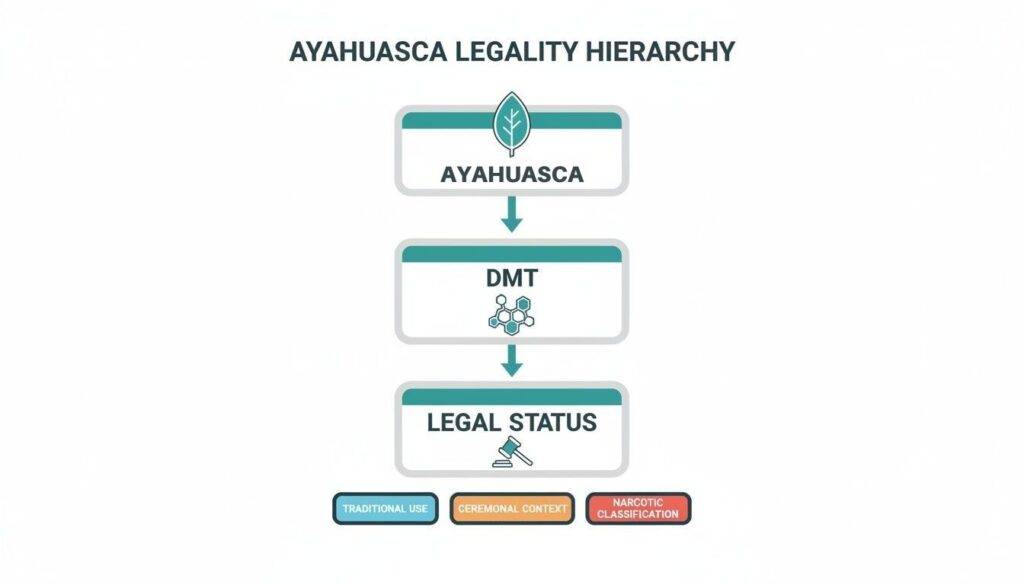
Ultimately, how a country treats DMT dictates how it treats Ayahuasca. This central issue is the main source of confusion and represents the most important information for anyone navigating the legality of Ayahuasca.
Why DMT Complicates Ayahuasca’s Legal Status
To comprehend the complex legal status of Ayahuasca, it is essential to focus on the small yet potent molecule known as DMT. This compound is central to Ayahuasca’s significant effects and is a primary factor contributing to its ambiguous legal standing globally.
The narrative begins with the 1971 UN Convention on Psychotropic Substances, a global treaty established to control mind-altering drugs. In this agreement, N,N-Dimethyltryptamine—DMT—was classified under Schedule I. This is the most restrictive category, reserved for substances with a high potential for abuse and no accepted medical use, putting it in the same category as heroin and LSD.
However, an important distinction was made by the treaty’s authors. They addressed the regulation of the isolated chemical—pure DMT—but did not include guidance regarding the numerous plants, fungi, and even animals that naturally contain it. This omission has led to many years of legal uncertainty concerning Ayahuasca.
The Plant Versus The Chemical Paradox
Think of it this way: you can buy poppy seeds at any grocery store for your morning bagel. Yet, the opium and heroin derived from that very same poppy plant are some of the most tightly controlled drugs in the world. The law draws a line between the natural plant source and the refined drug extracted from it.
Ayahuasca sits squarely in this same gray area. The brew is a natural preparation made from plants containing DMT, but it isn’t pure DMT. This distinction changes everything. Because the UN treaty is silent on plant-based preparations, it leaves a huge gap for individual nations to fill with their own laws and interpretations.
The result is a global patchwork of regulations where one country might see Ayahuasca as a sacred plant medicine while its neighbor sees an illegal Schedule I drug.
How Different Countries Interpret The Law
This legal vacuum has essentially compelled countries to take a stance, resulting in vastly different outcomes for people who use Ayahuasca. The entire legal debate centers on one question: is a brew containing DMT considered to be DMT itself?
The International Narcotics Control Board has pointed out that while Ayahuasca itself is not explicitly banned by international treaties, the presence of DMT means national authorities often treat the brew as if it were. This creates a confusing and inconsistent legal landscape from one country to the next.
This fundamental disagreement leads to a few common scenarios around the world:
Treating the Brew as the Chemical: Some nations, like France and Italy, take a hardline approach. Their logic is simple: if the brew contains DMT, the brew is illegal. In these places, getting caught with Ayahuasca can carry the same penalty as possessing pure, crystalline DMT.
Recognizing the Distinction: Other countries, especially in South America, view things differently. They protect Ayahuasca through laws recognizing it as a cultural heritage, a form of traditional medicine, or a sacrament for religious freedom. This effectively separates the sacred brew from the controlled molecule.
Carving Out Specific Exemptions: In places like the United States and Canada, the starting point is that Ayahuasca is illegal because it contains DMT. However, their legal systems have allowed for specific, hard-won exemptions for religious groups who can prove the brew is a central and sincere part of their spiritual practice.
This global legal issue has real-world consequences. Researchers estimate that over four million people across the Americas, Europe, and Oceania have participated in Ayahuasca ceremonies. This explosion of interest highlights a major disconnect between decades-old international drug treaties and the reality of modern cultural and spiritual practices. You can learn more about the complexities of these national differences and how they developed over time.
A Global Tour of Ayahuasca Laws
Where you are on the map is the single biggest factor in deciding whether Ayahuasca is a protected sacrament or a Schedule I drug. This isn’t just about cultural preference; it’s a direct consequence of how each country grapples with the presence of DMT in a natural plant brew. The result is a sharp global divide, with some nations celebrating Ayahuasca while others outright criminalize it.
To thoroughly understand the question “is Ayahuasca legal?”, it’s essential to consider the global perspective. A spiritual journey that’s government-protected in one country could result in legal prosecution just one border crossing away. Let’s explore this complex legal landscape, starting in the Amazonian heartland where it all began.
The Heartland of Legal Protection: South America
For anyone seeking a legally compliant Ayahuasca experience, South America offers ideal opportunities. In several Amazon basin countries, the brew is not only accepted but officially acknowledged as a vital part of their cultural and spiritual heritage. This official protection has turned the region into the global hub for Ayahuasca retreats.
Countries that lead the way with clear legal frameworks include:
Peru: In 2008, Peru made a significant decision by declaring the traditional use of Ayahuasca by Indigenous communities as part of the nation’s Cultural Patrimony. This provides ceremonies with a solid legal foundation and has established Peru as a prominent destination for Ayahuasca tourism.
Brazil: Brazil has a long, complicated relationship with Ayahuasca, but its religious use has been officially recognized for decades. Syncretic churches like the Santo Daime and União do Vegetal (UDV) can legally use the brew as a sacrament under specific government rules—a right they’ve held since the late 1980s.
Colombia: Much like its neighbors, Colombia recognizes the use of Ayahuasca (known there as Yagé) in its Indigenous contexts. It’s seen as an essential part of the traditional medicine and spiritual worldview of many Amazonian communities.
This legal protection allows ceremonies to take place openly, with a sense of predictability and safety. However, it is important to understand that these laws apply only within their borders. Attempting to export Ayahuasca is still considered international drug trafficking.
The United States: A Federal Ban with Tiny Exceptions
The United States presents a starkly different picture. Under federal law, the DMT in Ayahuasca makes it a Schedule I controlled substance. That classification lumps it in with heroin and carries heavy penalties for possession, distribution, or manufacturing.
There’s no gray area at the federal level: Ayahuasca is illegal.
However, the U.S. Constitution’s protection of religious freedom has opened the door for a few hard-won exceptions. Landmark legal fights, especially the 2006 Supreme Court case Gonzales v. O Centro Espírita Beneficente União do Vegetal, gave specific religious groups the right to import and use Ayahuasca as a sacrament.
These religious exemptions are extremely narrow. They only apply to federally recognized, legitimate religious organizations that have gone through years of expensive legal battles to prove their sincerity. This is not a loophole for individuals or casual spiritual groups.
This has created a strange dual reality in the U.S. A few hundred people can legally participate in Ayahuasca ceremonies within their church, but anyone else caught with the brew is breaking federal law and risks prosecution.
The Patchwork Laws of Europe and Beyond
The legal situation in Europe is quite complex. There isn’t a unified, continent-wide policy, so the legal status of Ayahuasca can vary significantly from one country to the next. This fragmentation makes it particularly challenging to engage with the medicine in Europe.
Western Europe: Countries such as France, Italy, and the United Kingdom enforce strict laws. They categorize the Ayahuasca brew similarly to pure DMT, which can result in serious criminal charges.
Legal Gray Areas: In places like Spain and Portugal, which have decriminalized personal drug use, the situation is more ambiguous. While selling or importing it is illegal, you might not be prosecuted for possessing a small personal amount. This is no guarantee of safety, though, and arrests still happen.
The Netherlands: Once considered a more tolerant haven, Dutch courts have recently cracked down, ruling that Ayahuasca is illegal because of its DMT content. As a result, authorities have increased their scrutiny of ceremonies.
The contrast between major producer and consumer markets is sharp. Brazil allows regulated ritual use, while Peru and Bolivia offer some of the clearest protections for traditional ceremonies. But in large consumer markets like the United States and many EU nations, the laws are a confusing patchwork. This creates predictable patterns of risk for travelers. People flock to Peru and Brazil for legal retreats, while those same visitors could face legal trouble if they try to bring plant materials back home. You can find out more about the legal status of Ayahuasca in different jurisdictions.
The worldwide exploration of Ayahuasca highlights a key point: your risk is closely linked to your location. As Ayahuasca gains international popularity, legal frameworks are having difficulty adapting, resulting in a complex mix of cultural traditions and legal issues. You can learn more about the challenges and considerations surrounding the global spread of Ayahuasca here.
How Religious Freedom Creates Legal Pathways
In countries where DMT’s legal status automatically makes Ayahuasca illegal, the strongest argument for its use hasn’t come from science or cultural heritage—it’s come from faith. The principle of religious freedom has managed to carve out some narrow but incredibly important legal pathways for Ayahuasca, establishing the powerful idea that the brew can be a protected sacrament.
This entire legal strategy depends on a single factor: demonstrating that Ayahuasca is an essential, non-negotiable part of a sincere religious practice. It’s a difficult path, marked by lengthy, costly, and thoroughly examined court battles.
The Landmark UDV Supreme Court Case
In 2006, a legal precedent in the United States was set when the U.S. Supreme Court ruled unanimously in favor of a Brazilian-based church, the União do Vegetal (UDV). The UDV successfully argued that the government’s ban on their sacrament, which they call Hoasca, was a direct violation of their religious freedom.
The court agreed. This decision granted them a specific exemption to import and use Ayahuasca in their ceremonies. It was a monumental victory, establishing that under the Religious Freedom Restoration Act (RFRA), the government can’t substantially interfere with a genuine religious practice unless it has a very compelling reason to do so.
This Supreme Court ruling set a powerful precedent, but it’s crucial to understand its limitations. The exemption applies only to the UDV and, by extension, other specific religious groups that have successfully navigated the same arduous legal process. It is not a blanket protection for individual spiritual use.
This victory opened the door for other syncretic churches, like Santo Daime, to fight for—and win—similar legal protections in the U.S. and elsewhere. It solidified the argument that for some, Ayahuasca is a constitutionally protected element of their faith.
What This Means for The Average Person
While these legal victories are historic, they offer almost no direct protection to anyone outside of these specific, recognized religious groups. The question “is Ayahuasca legal for me?” isn’t really answered by these cases unless you are a member of an approved church.
Here’s what the religious exemption path means in the real world:
It’s Highly Specific: These exemptions are granted to organizations, not individuals. You cannot declare your personal spiritual practice a “religion” and expect legal protection.
The Legal Bar is High: A group has to prove it’s a legitimate religion with a sincere, long-standing tradition where Ayahuasca is truly a central sacrament.
The Vetting is Rigorous: Any organization seeking legal protection undergoes thorough scrutiny from government agencies like the Drug Enforcement Administration (DEA).
In a significant move in May 2024, the DEA granted its first-ever formal religious exemption to the Church of Gaia, marking a new chapter in this ongoing story. However, the path remains incredibly challenging and far from transparent. To get a better understanding of this intricate legal process, you can explore the details of the religious exemption process under the RFRA and the DEA.
Ultimately, these hard-won freedoms demonstrate that a legal space for Ayahuasca can exist. However, it remains a tightly controlled and exclusive area, resulting from decades of dedicated legal advocacy. For most people, Ayahuasca is still not legally permissible.
The Decriminalization Movement and Its Impact
While the big picture of federal law and international treaties hasn’t changed much, an intriguing new narrative is unfolding at the local level. A strong, grassroots decriminalization movement is emerging, particularly in the United States, and it is beginning to reshape the legal landscape from the ground up.
This isn’t just a minor change in policy; it’s a sign that public opinion is shifting. People are becoming more curious about the therapeutic potential of plants like Ayahuasca and are advocating for the right to explore their own consciousness. Instead of waiting for slow-moving federal agencies, city councils and local voters are taking the reins themselves.
Decriminalization vs. Legalization: A Critical Distinction
This is where many people make mistakes, and the difference is crucial. Confusing decriminalization with legalization can lead to serious legal issues.
Decriminalization refers to the reclassification of possessing or using a substance so that it is no longer a primary concern for law enforcement. Penalties are typically minimized to minor consequences, such as a civil fine (comparable to a parking ticket), or eliminated entirely for personal use. It does not establish a legal, regulated market for the buying or selling of Ayahuasca.
Legalization applies to substances like cannabis in certain states. It means the substance is fully legal to produce, sell, and possess under a government-regulated system with rules for commerce, taxes, and quality control. To be clear: Ayahuasca is not legalized anywhere in the United States.
The heart of the decriminalization movement is harm reduction. The goal is to stop punishing people for personal use, which frees up police to focus on serious crime and prevents individuals from getting a criminal record for exploring their spirituality or mental health.
Cities Leading the Change
The movement prioritizing local initiatives has gained traction quickly. A growing number of U.S. cities have enacted measures to decriminalize entheogenic plants, including those used to make Ayahuasca. Although federal law remains a concern, these local efforts provide areas where the risk for individuals is considerably reduced.
Here are several of the early leaders:
Oakland, California: In 2019, Oakland’s city council unanimously voted to make investigating and arresting adults for using entheogenic plants one of the lowest priorities for law enforcement.
Washington, D.C.: The nation’s capital saw a landslide victory for Initiative 81 in November 2020. With an overwhelming 76% support, voters directed police to treat the non-commercial use and cultivation of these plants as their lowest priority.
Ann Arbor, Michigan and Seattle, Washington: Both cities have passed similar resolutions, joining a trend of municipalities pushing back against the federal status quo.
What’s driving this? It’s a combination of compelling personal stories, recent scientific research, and a deeply ingrained American value for personal freedom. As more cities join the movement, the pressure increases on state and federal governments to reconsider longstanding drug policies.
The increase in participation in Ayahuasca ceremonies is notable. Estimates indicate that approximately 1.5 million people in the U.S. have experienced it. This rising interest presents both opportunities and challenges; it supports the loosening of local policies and also leads to some cautionary policy responses around the world.
Practical Steps for Navigating Ayahuasca’s Legal Landscape
Determining the legality of Ayahuasca requires careful planning and a thorough understanding of legal regulations. The distinction between a sacred experience and a legal offense can often depend on jurisdictional boundaries. Ensuring safety and compliance is crucial.
The foremost rule is straightforward: never attempt to transport Ayahuasca across international borders. Regardless of attending a legal ceremony in Peru, carrying the brew home may result in serious legal issues. Local legal protections do not apply at the border, where customs officials will regard it as a Schedule I substance and the risk is substantial.
Vetting Retreats and Facilitators
Attending an Ayahuasca retreat safely and legally relies significantly on the quality and reputation of the chosen retreat center. With the rise of Ayahuasca tourism, many unreliable operators have emerged. Conducting thorough research is crucial before making any bookings, especially if it involves travel.
Choose Ayahuasca retreats with established positive reputations. Selecting one in a country where Ayahuasca is legal and culturally integrated, such as Peru or Brazil, ensures legal protection.
A reputable retreat will be transparent and prepared to address all inquiries.
A few key things you should always ask: What’s your medical screening process? What do you do in an emergency? How experienced are your facilitators? Where do you get your medicine? If they can’t give you straight answers, that’s a huge red flag.
A Traveler’s Pre-Flight Checklist
Prior to booking a flight for an Ayahuasca retreat, it is essential to review a legal checklist for the entire journey, not just the destination.
Research Destination Laws: Check the legal status in the country you’re traveling to. Is Ayahuasca a protected cultural heritage? Is it just decriminalized? Or is it in a legal gray area? Refer to official government and embassy websites for this information.
Check Transit Country Laws: It’s important to consider layovers locations. Connecting flights through countries with strict drug laws, such as France or the UK, can pose legal risks, even if you remain within the airport.
Consult Travel Advisories: Check updates from your government. For instance, the U.S. Embassy in Peru has issued warnings about health and safety concerns related to unregulated Ayahuasca ceremonies.
Recognize Regional VariationsLocal Nuances: Despite legal protection, complexities may arise due to regional rules or enforcement priorities that differ from national legislation.
Taking these steps can dramatically reduce your legal risk. For those facing legal issues, organizations such as the Ayahuasca Defence Fund offer essential support and serve as an important resource. Ultimately, responsible participation begins with a thorough understanding of the relevant laws surrounding this powerful medicine.
Frequently Asked Questions About Ayahuasca’s Legal Status
Let’s conclude by addressing frequently asked questions regarding Ayahuasca laws. This section distills the essential information into practical insights.
Can I Legally Bring Ayahuasca from Peru to My Home Country?
The simple answer is no. While participating in a ceremony in Peru is perfectly legal, transporting Ayahuasca across international borders is considered drug trafficking by customs and law enforcement in most countries. The cultural and religious protections in Peru do not apply outside its borders, and attempting to bring Ayahuasca home could result in serious legal consequences.
Does Decriminalization in My City Mean Ayahuasca Is Legal to Buy and Sell?
No, decriminalization should not be confused with legalization. Decriminalization typically means that law enforcement prioritizes personal use and possession less, aiming to reduce penalties for individuals. However, commercial activities such as selling, producing, or possessing large quantities usually remain serious offenses.This is a huge point of confusion for many people, and it’s critical to understand the difference. Decriminalization is not the same as legalization.
Think of it this way: decriminalization is a local policy that says, “We’re not going to arrest you for having a small amount for yourself.” It doesn’t give a green light to a legal market and certainly doesn’t override federal laws that still classify DMT as a Schedule I substance.
Is It Possible to Establish an Ayahuasca Church for Legal Protection?
Attempting to establish such a church is complex and fraught with challenges. Organizations like União do Vegetal (UDV) achieved legal protection through extensive and costly legal processes over many years. To qualify for similar protection, an organization must demonstrate it is a bona fide, established religion with Ayahuasca as a core sacrament. Simply forming a group for spiritual purposes does not meet the stringent legal criteria.
Disclaimer: The information provided on Ayahuasca.com is for educational purposes only and is not intended as medical advice, diagnosis, or treatment. Ayahuasca is a powerful traditional Amazonian medicine and may not be suitable for everyone. Always consult with a qualified healthcare professional before making decisions related to health, mental well-being, medications, or the use of Ayahuasca.
This article is for informational purposes only and does not constitute legal advice. Laws regarding Ayahuasca vary by jurisdiction and may change. Responsibility for compliance with all applicable local, national, and international laws rests with the individual.