
Ayahuasca plants are best understood as a partnership between several plants, preparation methods, and knowledge systems, not as a single species. That framing corrects a common misunderstanding. Ayahuasca is usually a traditional decoction, not a single botanical species, and its effects depend on how its ingredients work together.
The core pairing is the vine Banisteriopsis caapi and the leaves of Psychotria viridis, although Indigenous traditions also use other plants and regional recipes. Understanding the vine, the leaf, the chemistry, and the cultural setting helps replace vague ideas about a mystical substance with a more accurate view of a living ethnobotanical practice.
Why Ayahuasca Is a Brew, Not a Plant
Ayahuasca is best understood as a botanical partnership. The finished preparation is generally made from at least two Amazonian species, the vine Banisteriopsis caapi and the leaves of Psychotria viridis. Scholarly and United Nations materials describe this combination as the standard foundation of the brew. A peer-reviewed overview of ayahuasca’s botanical and historical background also distinguishes the plants from the decoction produced after they’re prepared together.
The distinction matters because the vine and leaf contribute different chemical roles. The vine supplies harmala alkaloids that affect the breakdown of other compounds in the digestive system. The leaf supplies DMT, a psychoactive alkaloid that would ordinarily be broken down rapidly when taken orally. The resulting brew therefore depends on interaction, not merely on the presence of one “active plant.”
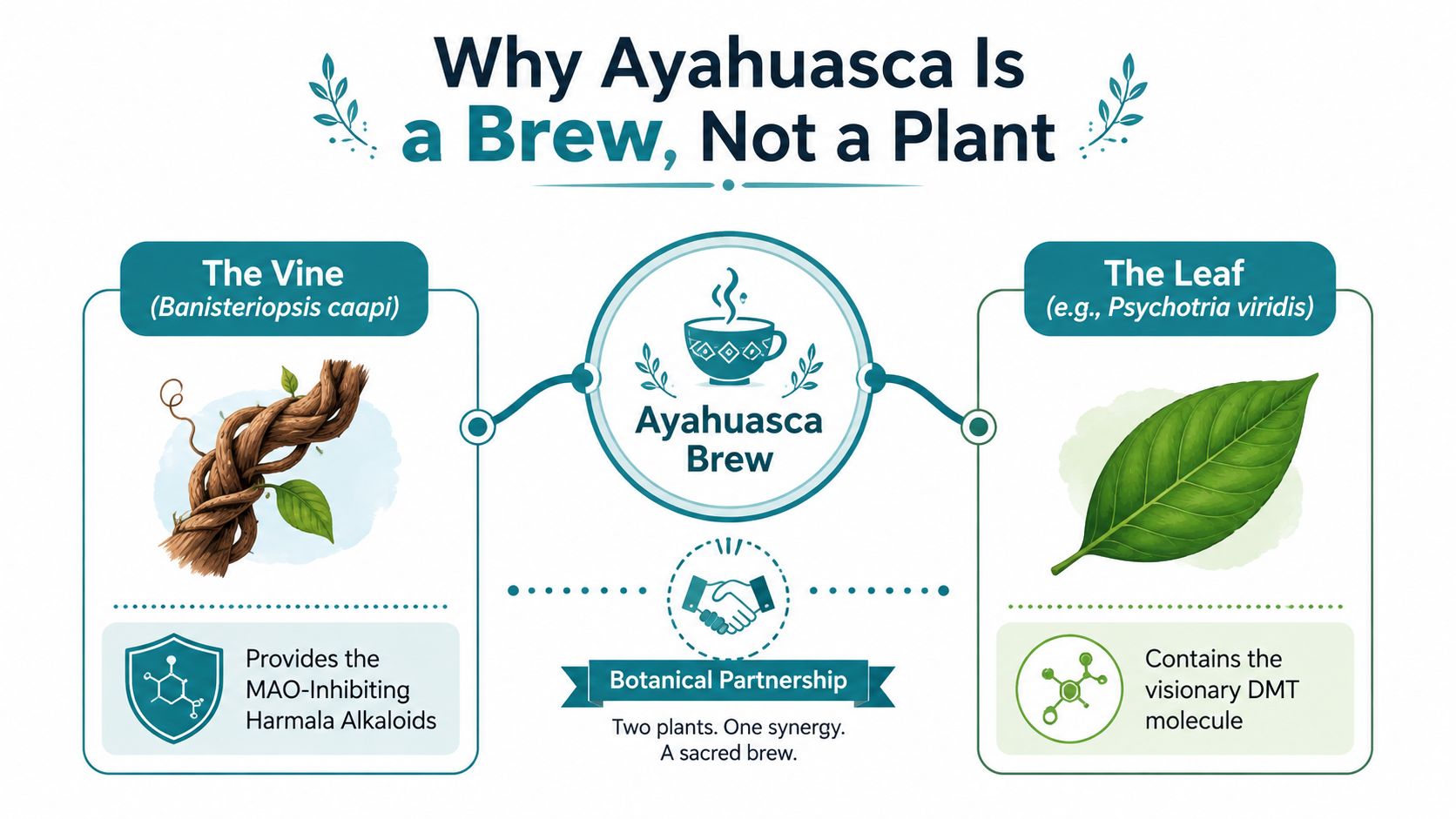
Vine, Leaf, And Brew
A useful mental model separates three things:
- The vine: B. caapi, the structural and pharmacological foundation in many preparations.
- The leaf: Often P. viridis, commonly called chacruna, though other DMT-containing plants can appear in regional recipes.
- The brew: The concentrated decoction created through preparation, in which the plants’ compounds become available together.
This combination reflects Indigenous knowledge developed through oral traditions and practical relationships with Amazonian ecosystems. The vine was formally identified by botanist Richard Spruce in 1851, after earlier European documentation of ayahuasca-related practices in the 16th century. Some sources describe Indigenous use as extending to at least 2000 B.C., while the documented modern history in the Amazon reaches back roughly 150 years. Those records describe different kinds of evidence, so they shouldn’t be treated as interchangeable timelines.
Regional variation follows naturally from this model. Communities may choose different leaves, vines, preparation techniques, or accompanying plants according to local ecology, lineage, and ceremonial purpose. The name ayahuasca therefore covers a family of related brews rather than one chemically identical formula.
The Two Foundational Species Explained
The two foundational ayahuasca plants look and behave very differently in the forest. Banisteriopsis caapi is a woody climbing vine that can wind through surrounding vegetation, while Psychotria viridis is a leafy shrub. Their contrasting forms mirror their contrasting roles in the preparation.
Banisteriopsis Caapi
B. caapi is often described in traditional contexts as the vine of the soul. Its stems and bark contain the principal harmala alkaloids associated with ayahuasca, especially harmine, harmaline, and tetrahydroharmine, commonly abbreviated as THH. These compounds provide the pharmacological scaffold that allows orally consumed DMT to remain active.
The vine’s appearance can vary with age and growing conditions, but healthy material generally shows vigorous climbing growth and firm, intact stems. Traditional preparation may involve cleaning, pounding, shredding, or otherwise processing the vine before prolonged decoction. The plant’s role is more than a technical contribution. In many lineages, the vine is treated as a central teacher and organizing presence within the brew.
Readers seeking a focused botanical introduction can consult this guide to Banisteriopsis caapi and the vine of the soul.
Psychotria Viridis
P. viridis, widely known as chacruna, is a tropical shrub with broad green leaves. The leaves contain DMT, the compound responsible for much of ayahuasca’s visionary activity. Chemical reviews report DMT concentrations in P. viridis of about 0.1% to 0.66% of dry weight, while beta-carbolines are reported at about 0.05% to 1.95% of dry weight across relevant plant materials. A pharmacological review of ayahuasca’s alkaloid profile provides that botanical chemistry context.
The leaves are commonly harvested fresh or dried, depending on local practice, then combined with the processed vine. Their green color and familiar leaf shape can make them appear ordinary, but visual identification alone is unreliable. Closely related plants, stressed material, and incorrectly labeled specimens can create confusion.
The most useful comparison is simple:
| Plant | Common Role | Main Contribution |
|---|---|---|
| Banisteriopsis caapi | Vine and brew foundation | Harmine, harmaline, and THH |
| Psychotria viridis | Leaf admixture | DMT |
| Finished decoction | Combined preparation | Active compounds available together |
Traditional specialists don’t select these plants only by appearance. Knowledge includes habitat, season, lineage, preparation, and relationships with the plants. That broader context explains why a dried sample purchased without provenance can’t reproduce the meaning or predictability of a traditionally prepared brew.
The Chemistry That Makes the Combination Work
Why does this botanical partnership work when the leaf and vine are prepared together? The answer begins with oral digestion. DMT from Psychotria viridis is normally broken down by monoamine oxidase A, or MAO-A, in the gut and liver. Without protection from rapid deamination, swallowed DMT does not produce the same psychoactive effect.
The vine supplies that protection. Harmine, harmaline, and THH from B. caapi inhibit MAO-A, allowing more DMT to survive digestion, enter circulation, and reach the brain. A clinical review of ayahuasca pharmacology, safety, and therapeutic effects explains this pharmacological relationship.
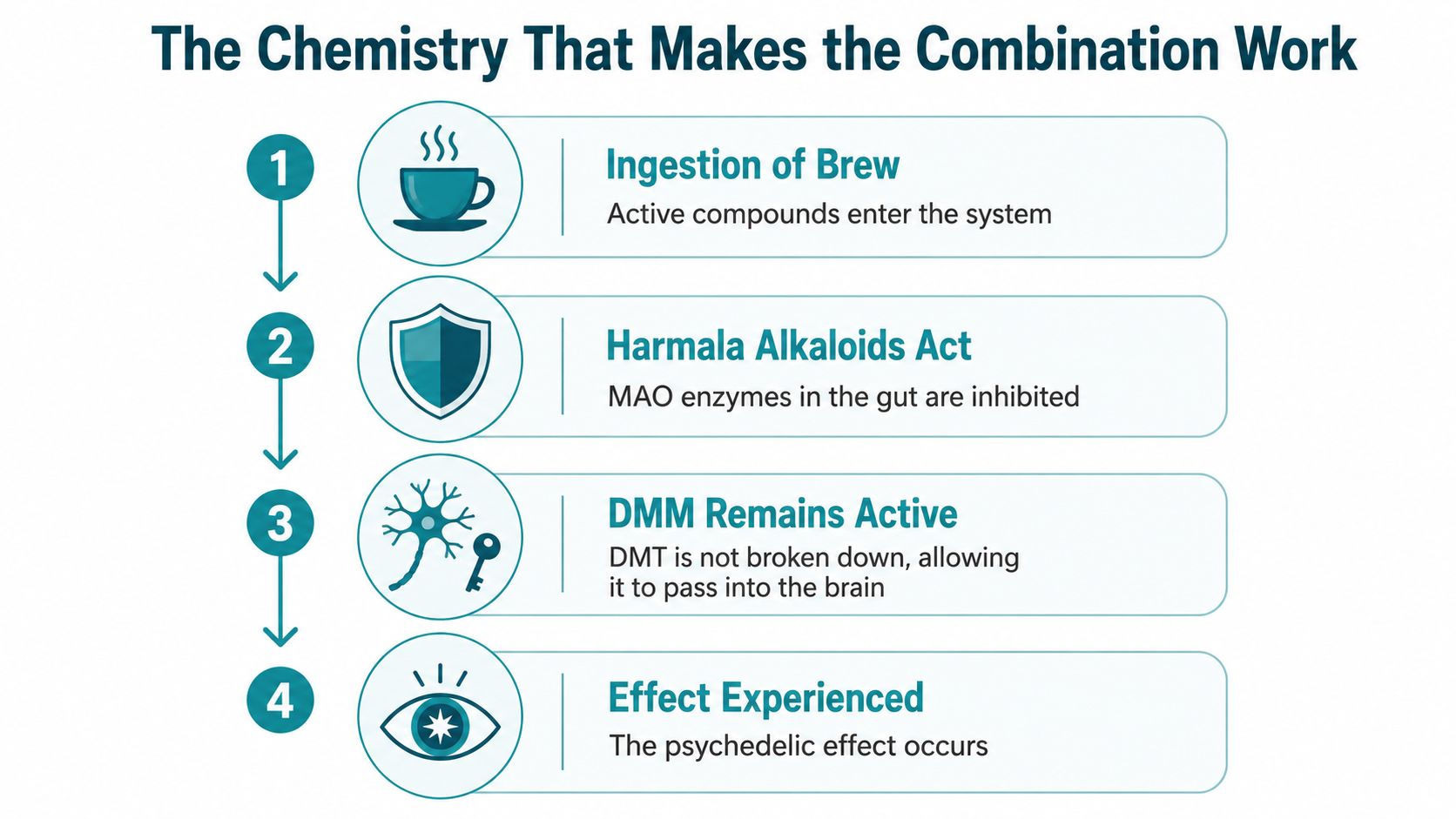
The Pharmacological Handshake
The sequence is easier to follow in four stages:
- The brew is consumed. DMT and beta-carbolines enter the digestive system together.
- The harmala alkaloids inhibit MAO-A. Enzyme activity that would break down oral DMT is reduced.
- More DMT remains available. Protected DMT can enter the bloodstream and reach the brain.
- Subjective effects emerge. Their intensity depends on the preparation’s chemistry and the individual.
A resource on ayahuasca beta-carbolines provides further background on the vine-derived compounds. The plants therefore perform different chemical tasks, and their interaction produces the oral pharmacology associated with ayahuasca.
The amounts vary between plant materials. One LC-MS/MS study reported B. caapi concentrations of 0.3 to 8.4 mg/g dry weight for harmine and 0.03 to 8.3 mg/g dry weight for harmaline. The analytical study of B. caapi alkaloids connects this variation with vine source, harvest conditions, and preparation.
Finished brews also lack a uniform chemical profile. Reported samples contained 0.109 to 7.11 mg/mL harmine, 0.012 to 0.945 mg/mL harmaline, 0.09 to 3.05 mg/mL THH, and 0.10 to 3.12 mg/mL DMT. Quantitative profiling of ayahuasca samples shows why appearance and recipe names cannot reliably predict potency.
Clinical pharmacology research links subjective effects closely with DMT blood concentrations and examines how those effects develop and resolve over time. The relationship reinforces a central point: the brew’s experience depends on a changing interaction between DMT, beta-carbolines, preparation, and individual physiology.
Admixture Plants And Regional Brew Variants
The familiar vine and leaf pairing is a foundation, not a universal recipe. Across Amazonian traditions, practitioners may add or substitute plants according to local availability, inherited knowledge, ceremonial intention, and the properties attributed to each species. That’s why the label ayahuasca can refer to preparations with noticeably different chemistry and sensory character.
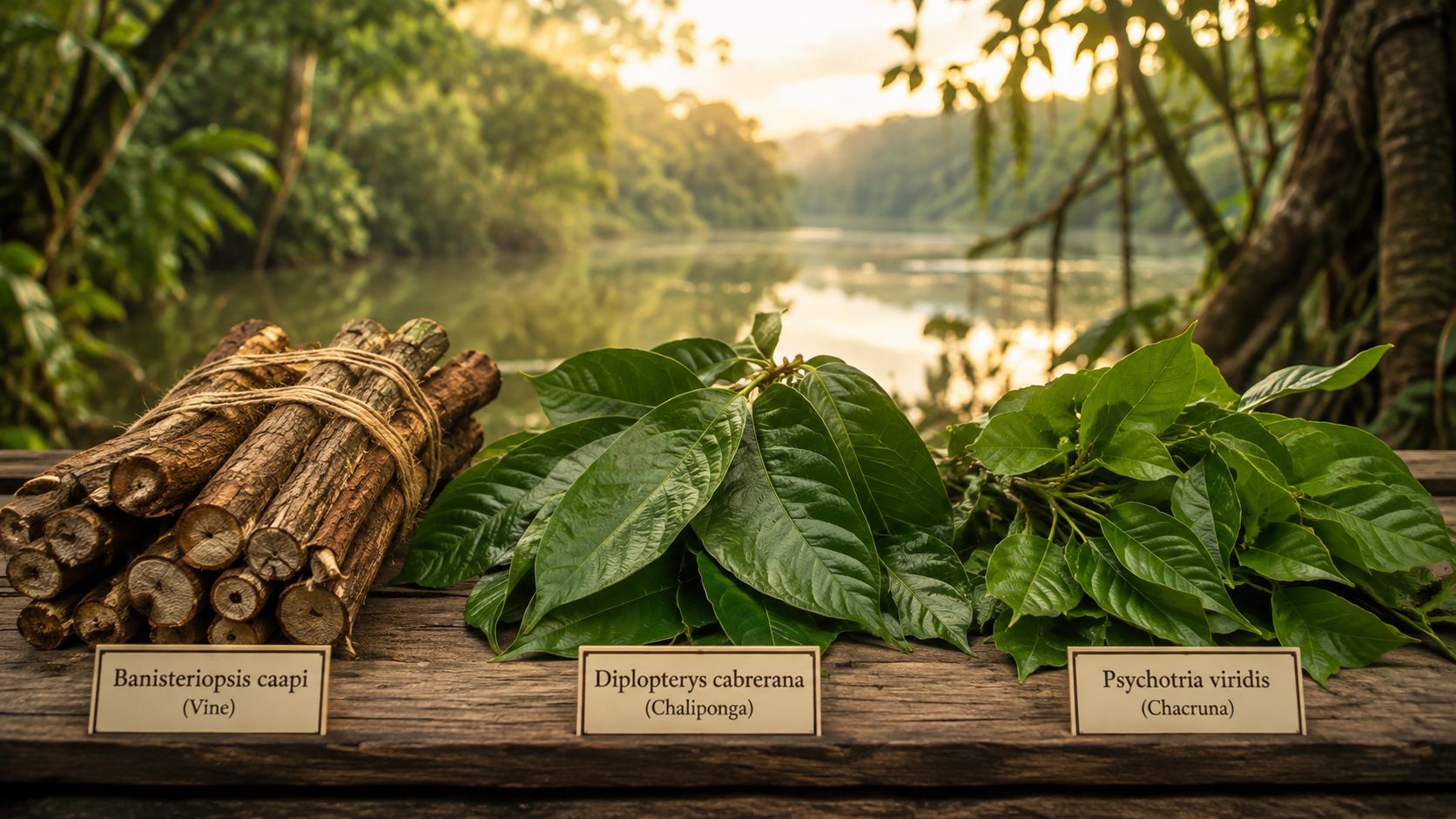
Common Comparisons
Diplopterys cabrerana, often called chaliponga, is a notable alternative or companion to P. viridis in some regional recipes. Like chacruna, it can serve as a DMT-containing leaf, but the plant’s chemistry and the resulting brew profile can differ. The precise outcome still depends on plant material, preparation, and the relative contribution of the vine.
Brugmansia belongs to a different category of concern. Its traditional presence in some plant repertoires doesn’t make it a routine or interchangeable ayahuasca ingredient. Its chemistry can create serious toxicity risks, and an ingredient list that includes it requires particular caution rather than casual experimentation.
Other admixtures may appear in Indigenous pharmacopeias, but names alone don’t reveal their pharmacology. A plant can be included for scent, ritual meaning, purgative action, perceived protection, or a desired alteration of the brew’s character. Those roles aren’t equivalent to supplying DMT or inhibiting MAO-A.
“Practical rule: An informed participant asks for the complete ingredient list, not merely the name ayahuasca.”
Regional Indigenous recipes should also be distinguished from modified blends prepared for commercial or neo-shamanic settings. Substitutions may reflect local ecology in one setting and convenience in another. For readers studying related botanical traditions, an Aroma Warehouse aromatherapy rue incense selection can provide context about rue as a culturally significant aromatic plant, but aromatic use shouldn’t be confused with ayahuasca preparation or medical safety.
Cultural Roles And Ceremonial Context
Ayahuasca plants carry meanings that chemistry alone can’t capture. Among Indigenous peoples in areas including Peru, Colombia, Ecuador, and Brazil, the vine and its companion plants may be treated as sacred teachers, relatives, medicines, or beings with whom practitioners maintain reciprocal relationships. Those understandings shape harvesting, preparation, ceremony, and the transmission of knowledge.
A curandero or ayahuasquero traditionally holds responsibilities that extend beyond serving a drink. The practitioner may prepare the brew, guide the ceremonial space, monitor participants, and use icaros, ceremonial songs associated with healing and direction. The songs aren’t decorative background. Within the traditions that use them, they can organize attention, communicate teachings, and express a lineage’s relationship with the plants.
Dieta And Lineage
A dieta may involve a period of food, behavior, and social restrictions connected to working with particular plants. Its details vary by tradition and practitioner. Treating dieta as a universal checklist strips it from the relationships and teachings that give it meaning.
Knowledge often moves through apprenticeship, repeated practice, observation, and oral transmission. That process differs from merely reading a species description or memorizing an alkaloid profile. A person can identify B. caapi in a nursery and still lack the training required to prepare or hold a ceremony responsibly.
Ethical engagement therefore requires more than appreciation. Visitors and researchers should acknowledge Indigenous stewardship, avoid presenting inherited knowledge as a personal discovery, and consider whether money, attention, and recognition reach traditional communities. Consent, fair compensation, cultural humility, and clear boundaries matter when knowledge or plant material crosses regions.
The plants’ sacred status also challenges the idea that ayahuasca is merely a raw material. A reductionist account can explain why the combination works orally, but it can’t explain why communities sing particular songs, follow particular diets, or maintain particular lineages. Both the ecological and cultural relationships belong in an accurate account.
Cultivation, Sourcing, And Identification Basics
Cultivation begins with habitat rather than hype. Banisteriopsis caapi is a tropical climbing vine that needs warmth, moisture, support, and enough room for sustained growth. Psychotria viridis is a tropical shrub that generally requires comparable warmth and humidity, along with suitable soil, drainage, and protection from harsh exposure.
Healthy plant material should show active growth, firm stems, intact leaves, and no obvious mold, rot, or unexplained discoloration. Those signs can support basic horticultural assessment, but they don’t prove species identity or chemical content. A photograph, common name, or seller description isn’t enough for confident identification.
Questions For Responsible Sourcing
- What is the scientific name? Sellers should identify the plant clearly and distinguish it from a common-name substitute.
- Where did the material come from? Provenance helps reveal whether a nursery propagates plants or relies on wild collection.
- How was it handled? Dried leaves and cuttings can be contaminated, degraded, or mislabeled.
- Who benefits? Ethical purchasing supports transparent cultivation and avoids treating Indigenous plants as anonymous commodities.
Overharvesting pressure can affect wild populations, particularly when demand grows faster than cultivation. Responsible nurseries should explain propagation practices and avoid vague claims about rare or “secret” varieties. Buyers should also check local laws before acquiring, cultivating, transporting, or possessing any ayahuasca plant.
A botanical explanation of chacruna can help readers distinguish the leaf’s cultural and botanical identity from simplified commercial descriptions. Cultivation remains a horticultural activity, however. Growing a vine or shrub doesn’t provide ceremonial training, lineage knowledge, or permission to prepare a psychoactive brew.
Legal Status Around The World
Ayahuasca law is a patchwork. Rules may differ for the finished decoction, isolated DMT, the vine, the leaf, religious practice, personal possession, cultivation, and transport. A plant’s legal status in one country doesn’t establish the legality of the same plant or preparation elsewhere.
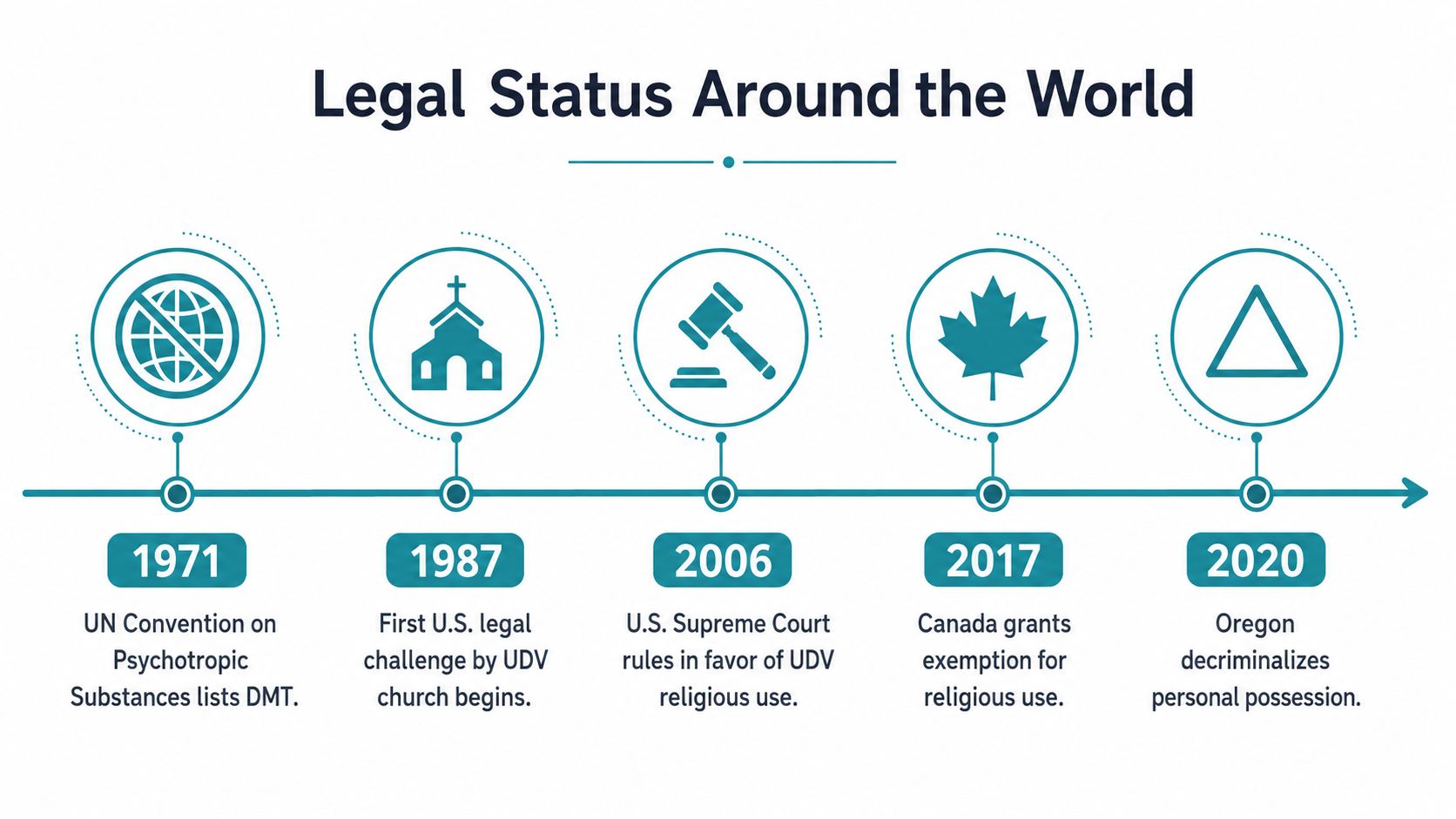
Milestones That Shaped Access
Brazil placed ayahuasca on a list of proscribed substances in 1985, then moved toward formal recognition of religious use. Brazil liberalized religious use in 2010, while Peru recognized traditional Indigenous use as part of national cultural heritage in 2008. These developments concern particular legal and cultural contexts, not a universal permission to possess or serve ayahuasca.
In the United States, a 2006 Supreme Court decision allowed a religious exemption for the Brazilian-based União do Vegetal church. That ruling addressed a specific religious organization and legal framework. It shouldn’t be read as blanket legalization for all ceremonies, facilitators, or plant materials.
Intellectual-property disputes also shaped the history. A patent on the ayahuasca vine was filed in 1986, challenged in 1999, and expired on June 17, 2003. The episode illustrates how Indigenous plants became part of debates about ownership, scientific claims, and the limits of patent protection.
“Legal protection usually depends on jurisdiction, purpose, organization, and the exact substance involved.”
Claims about broader decriminalization or religious freedom should be checked against current local law. Participants should verify rules with qualified legal counsel or official authorities before traveling with plant material, joining a ceremony, importing seeds, or cultivating a species. Retreat marketing isn’t a substitute for a jurisdiction-specific legal assessment.
Safety, Contraindications, And Next Steps For Learning
Ayahuasca’s pharmacology demands medical screening. The vine’s MAO-A inhibition can interact with medicines and health conditions, including some antidepressants, other MAOIs, and substances that affect serotonin, blood pressure, or cardiac function. Tyramine-rich foods can also be relevant to MAOI safety, so participants should obtain individualized guidance from a qualified clinician rather than rely on a generic retreat checklist.
A responsible facilitator should ask about prescriptions, psychiatric history, cardiovascular conditions, seizure risk, pregnancy, and current substance use. Screening should include every ingredient in the brew because admixture plants can introduce risks that aren’t present in the foundational pairing. Participants should never stop prescribed medication without the prescribing clinician’s supervision.
A Safer Learning Path
The clinical timing described earlier helps set expectations. Effects may begin around 20 minutes, peak around 60 to 120 minutes, and resolve around 240 to 300 minutes, according to clinical pharmacology research on ayahuasca. Those timings describe observed pharmacology, not a promise about any individual’s experience.
Before attending a ceremony, readers should:
- Verify ingredients: Request the complete recipe and ask whether Brugmansia or other high-risk plants are present.
- Assess supervision: Confirm that trained staff remain available throughout the ceremony and afterward.
- Plan integration: Arrange support from a qualified mental-health professional if difficult material persists.
- Check legal conditions: Review the law of the exact location, including transport and possession rules.
People experiencing distress related to hallucinogen use, withdrawal, or difficult after-effects can also consult withdrawal help for hallucinogen-related concerns from a treatment resource. Urgent symptoms such as chest pain, severe agitation, loss of consciousness, dangerous confusion, or suicidal thoughts require immediate emergency care.
Ayahuasca.com offers educational material on plant traditions, science, preparation, and integration, while peer-reviewed pharmacology papers provide a stronger basis for understanding mechanisms and variability. The most responsible next step is slow learning: verify the plants, respect the communities that steward them, consult qualified medical professionals, and treat the brew as a powerful cultural and pharmacological preparation rather than a casual botanical product.
Before booking a ceremony or purchasing ayahuasca plants, write down every ingredient, verify the local law, review medication and health risks with a qualified clinician, and choose a transparent practitioner who can explain training, sourcing, supervision, and post-ceremony support.
Disclaimer: The information provided on Ayahuasca.com is for educational purposes only and is not intended as medical advice, diagnosis, or treatment. Ayahuasca is a powerful traditional Amazonian medicine and may not be suitable for everyone. Always consult with a qualified healthcare professional before making decisions related to health, mental well-being, medications, or the use of Ayahuasca.